ANKUR PATHAK PGM07060476
INTRODUCTION STATEMENT OF OBJECTS AND REASONS ACT 20 OF 1946 LIST OF AMENDING ACT AND ADAPTATION ORDERS THE INDUSTRIAL EMPLOYMENT (STANDING ORDER) ACT 1946- RULES AND REGULATION FOR IMPLEMENTATIONS MODEL STANDING ORDERS FOR INDUSTRIAL ESTABLISHMENTS OTHER THAN COAL MINES MODEL STANDING ORDERS FOR INDUSTRIAL ESTABLISHMENT IN COAL MINES MODEL STANDING ORDERS ON ADDITIONAL ITEMS APPLICABLE TO ALL INDUSTRIES
Earlier demand and supply in the labor market settled mutually beneficial bargain between the employer and the workman. Later workmen found that they did not possess adequate bargaining strength, they organized themselves in trade unions and insisted on collective bargaining with the employer.  Trade unions and collective bargaining created new problems for maintaining industrial peace and production for the society. Recognizing the rough deal that was being given to the workers by employers who would not define their conditions of service and the inevitability of industrial strife in such a situation, the legislature made an attempt to intervene by introducing the  INDUSTRIAL EMPLOYMENT (STANDING ORDERS) ACT 1946 .
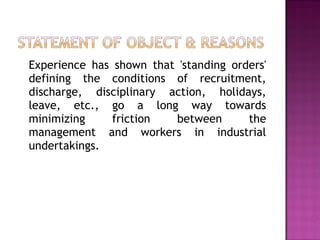
Experience has shown that 'standing orders' defining the conditions of recruitment, discharge, disciplinary action, holidays, leave, etc., go a long way towards minimizing friction between the management and workers in industrial undertakings.
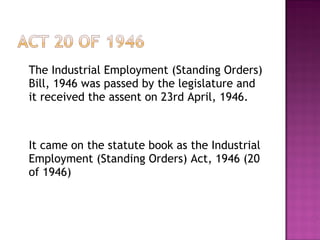
The Industrial Employment (Standing Orders) Bill, 1946 was passed by the legislature and it received the assent on 23rd April, 1946. It came on the statute book as the Industrial Employment (Standing Orders) Act, 1946 (20 of 1946)
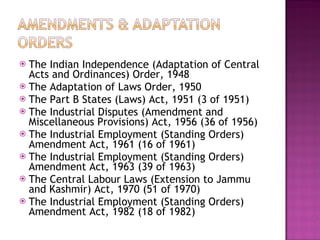
The Indian Independence (Adaptation of Central Acts and Ordinances) Order, 1948 The Adaptation of Laws Order, 1950 The Part B States (Laws) Act, 1951 (3 of 1951) The Industrial Disputes (Amendment and Miscellaneous Provisions) Act, 1956 (36 of 1956) The Industrial Employment (Standing Orders) Amendment Act, 1961 (16 of 1961)  The Industrial Employment (Standing Orders) Amendment Act, 1963 (39 of 1963) The Central Labour Laws (Extension to Jammu and Kashmir) Act, 1970 (51 of 1970) The Industrial Employment (Standing Orders) Amendment Act, 1982 (18 of 1982)
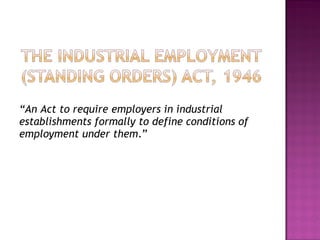
“ An Act to require employers in industrial establishments formally to define conditions of employment under them .”
Short title, extent and application Interpretation Submission of draft standing orders Conditions for certification of standing orders Certification of standing orders Appeals Date of operation of standing orders
Register of standing orders Posting of standing orders Duration and modification of standing orders Certifying Officers and appellate authorities to have powers of civil court Oral evidence in contradiction of standing orders not admissible Penalties and procedure Power to exempt Power to make rules
Classification of workmen, e.g., whether permanent, temporary, apprentices, probationers, or badlis.  Manner of intimating to workmen periods and hours of work, holidays, pay-days and wage rates.  Shift working.  Attendance and late coming.  Conditions of, procedure in applying for, and the authority which may grant, leave and holidays.  Requirement to enter premises by certain gates, and liability to search. 
Closing and re-opening of sections of the industrial establishment, and temporary stoppages of work and the rights and liabilities of the employer and workmen arising therefrom.  Termination of employment, and the notice thereof to be given by employer and workmen. Suspension or dismissal for misconduct, and acts or omissions which constitute misconduct.  Means of redress for workmen against unfair treatment or wrongful exactions by the employer or his agents or servants.  Any other matter which may be prescribed.
 
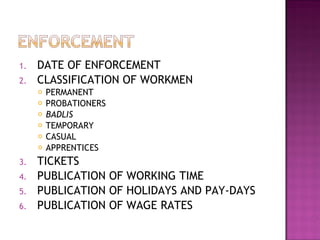
DATE OF ENFORCEMENT CLASSIFICATION OF WORKMEN PERMANENT PROBATIONERS BADLIS TEMPORARY CASUAL APPRENTICES TICKETS PUBLICATION OF WORKING TIME PUBLICATION OF HOLIDAYS AND PAY-DAYS PUBLICATION OF WAGE RATES
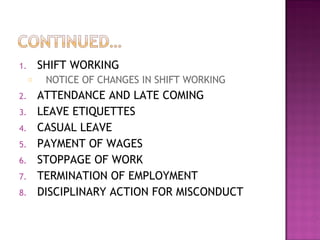
SHIFT WORKING NOTICE OF CHANGES IN SHIFT WORKING ATTENDANCE AND LATE COMING LEAVE ETIQUETTES CASUAL LEAVE PAYMENT OF WAGES STOPPAGE OF WORK TERMINATION OF EMPLOYMENT DISCIPLINARY ACTION FOR MISCONDUCT
CERTIFICATION ON TERMINATION OF SERVICES LIABILITY OF [EMPLOYER] EXHIBITION OF STANDING ORDERS
 
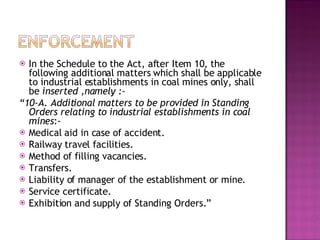
In the Schedule to the Act, after Item 10, the following additional matters which shall be applicable to industrial establishments in coal mines only, shall be  inserted ,namely :- “ 10-A. Additional matters to be provided in Standing Orders relating to industrial establishments in coal mines :- Medical aid in case of accident. Railway travel facilities. Method of filling vacancies. Transfers. Liability of manager of the establishment or mine. Service certificate. Exhibition and supply of Standing Orders.”
 
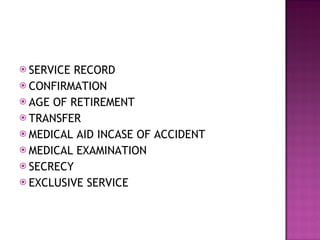
SERVICE RECORD CONFIRMATION AGE OF RETIREMENT TRANSFER MEDICAL AID INCASE OF ACCIDENT MEDICAL EXAMINATION SECRECY EXCLUSIVE SERVICE
 

Industrial Employment (Standing Orders) A

  • 1.
  • 2.
    INTRODUCTION STATEMENT OFOBJECTS AND REASONS ACT 20 OF 1946 LIST OF AMENDING ACT AND ADAPTATION ORDERS THE INDUSTRIAL EMPLOYMENT (STANDING ORDER) ACT 1946- RULES AND REGULATION FOR IMPLEMENTATIONS MODEL STANDING ORDERS FOR INDUSTRIAL ESTABLISHMENTS OTHER THAN COAL MINES MODEL STANDING ORDERS FOR INDUSTRIAL ESTABLISHMENT IN COAL MINES MODEL STANDING ORDERS ON ADDITIONAL ITEMS APPLICABLE TO ALL INDUSTRIES
  • 3.
    Earlier demand andsupply in the labor market settled mutually beneficial bargain between the employer and the workman. Later workmen found that they did not possess adequate bargaining strength, they organized themselves in trade unions and insisted on collective bargaining with the employer. Trade unions and collective bargaining created new problems for maintaining industrial peace and production for the society. Recognizing the rough deal that was being given to the workers by employers who would not define their conditions of service and the inevitability of industrial strife in such a situation, the legislature made an attempt to intervene by introducing the INDUSTRIAL EMPLOYMENT (STANDING ORDERS) ACT 1946 .
  • 4.
    Experience has shownthat 'standing orders' defining the conditions of recruitment, discharge, disciplinary action, holidays, leave, etc., go a long way towards minimizing friction between the management and workers in industrial undertakings.
  • 5.
    The Industrial Employment(Standing Orders) Bill, 1946 was passed by the legislature and it received the assent on 23rd April, 1946. It came on the statute book as the Industrial Employment (Standing Orders) Act, 1946 (20 of 1946)
  • 6.
    The Indian Independence(Adaptation of Central Acts and Ordinances) Order, 1948 The Adaptation of Laws Order, 1950 The Part B States (Laws) Act, 1951 (3 of 1951) The Industrial Disputes (Amendment and Miscellaneous Provisions) Act, 1956 (36 of 1956) The Industrial Employment (Standing Orders) Amendment Act, 1961 (16 of 1961) The Industrial Employment (Standing Orders) Amendment Act, 1963 (39 of 1963) The Central Labour Laws (Extension to Jammu and Kashmir) Act, 1970 (51 of 1970) The Industrial Employment (Standing Orders) Amendment Act, 1982 (18 of 1982)
  • 7.
    “ An Actto require employers in industrial establishments formally to define conditions of employment under them .”
  • 8.
    Short title, extentand application Interpretation Submission of draft standing orders Conditions for certification of standing orders Certification of standing orders Appeals Date of operation of standing orders
  • 9.
    Register of standingorders Posting of standing orders Duration and modification of standing orders Certifying Officers and appellate authorities to have powers of civil court Oral evidence in contradiction of standing orders not admissible Penalties and procedure Power to exempt Power to make rules
  • 10.
    Classification of workmen,e.g., whether permanent, temporary, apprentices, probationers, or badlis.  Manner of intimating to workmen periods and hours of work, holidays, pay-days and wage rates.  Shift working.  Attendance and late coming.  Conditions of, procedure in applying for, and the authority which may grant, leave and holidays.  Requirement to enter premises by certain gates, and liability to search. 
  • 11.
    Closing and re-openingof sections of the industrial establishment, and temporary stoppages of work and the rights and liabilities of the employer and workmen arising therefrom.  Termination of employment, and the notice thereof to be given by employer and workmen. Suspension or dismissal for misconduct, and acts or omissions which constitute misconduct.  Means of redress for workmen against unfair treatment or wrongful exactions by the employer or his agents or servants.  Any other matter which may be prescribed.
  • 12.
  • 13.
    DATE OF ENFORCEMENTCLASSIFICATION OF WORKMEN PERMANENT PROBATIONERS BADLIS TEMPORARY CASUAL APPRENTICES TICKETS PUBLICATION OF WORKING TIME PUBLICATION OF HOLIDAYS AND PAY-DAYS PUBLICATION OF WAGE RATES
  • 14.
    SHIFT WORKING NOTICEOF CHANGES IN SHIFT WORKING ATTENDANCE AND LATE COMING LEAVE ETIQUETTES CASUAL LEAVE PAYMENT OF WAGES STOPPAGE OF WORK TERMINATION OF EMPLOYMENT DISCIPLINARY ACTION FOR MISCONDUCT
  • 15.
    CERTIFICATION ON TERMINATIONOF SERVICES LIABILITY OF [EMPLOYER] EXHIBITION OF STANDING ORDERS
  • 16.
  • 17.
    In the Scheduleto the Act, after Item 10, the following additional matters which shall be applicable to industrial establishments in coal mines only, shall be inserted ,namely :- “ 10-A. Additional matters to be provided in Standing Orders relating to industrial establishments in coal mines :- Medical aid in case of accident. Railway travel facilities. Method of filling vacancies. Transfers. Liability of manager of the establishment or mine. Service certificate. Exhibition and supply of Standing Orders.”
  • 18.
  • 19.
    SERVICE RECORD CONFIRMATIONAGE OF RETIREMENT TRANSFER MEDICAL AID INCASE OF ACCIDENT MEDICAL EXAMINATION SECRECY EXCLUSIVE SERVICE
  • 20.