RESEARCH METHODOLOGY &
INTELLECTUAL PROPERTY RIGHTS (IPR)
Course Code: BRMK557
MODULE - 5
Industrial Designs (ID),
Geographical Indications (GI) and
Case Studies on Patents
A Simplified Notes for the 5th Semester As per
VTU Syllabus - 2022 Scheme
Dr. SURESHA V
Professor, Department of E&CE
K.V.G. College of Engineering, Sullia, D.K-574 327
RM & IPR (21RMI56) - Module 5: Industrial Designs (ID), Geographical Indications(GI) And Case Studies On Patents
Dr. Suresha V, Professor, Dept. of E&C. K V G C E, Sullia, D.K-57432 Page 1
MODULE 5
INDUSTRIAL DESIGNS (ID), GEOGRAPHICAL INDICATIONS(GI)
AND
CASE STUDIES ON PATENTS
Learning Module Outcomes
After reading this Module, the student will be able to:
o To Learn the knowledge of the legal framework governing industrial designs
and their protection mechanisms.
o To identify and evaluate products eligible for geographical indication
protection.
o Familiarise with landmark patent cases and their implications on intellectual
property law.
Chapter 2.4: Industrial Designs (Textbook 2: Page 80-89)
Eligibility Criteria. Acts and Laws to Govern Industrial Designs. Design Rights.
Enforcement of Design Rights. Non-Protectable Industrial Designs India.
Protection Term. Procedure for Registration of Industrial Designs. Prior Art
Search. Application for Registration. Duration of Registration of a Design.
Importance of Design Registration. Cancellation of the Registered Design.
Application Forms. Classification of Industrial Designs. Designs Registration
Trend in India. International Treaties. Famous Case Law: Apple Inc. vs.
Samsung Electronics Co.
Chapter 2.5: Geographical Indications (Textbook 2: Page 90 - 98)
Acts, Laws, and Rules About GI. Ownership of GI. Rights Granted to the
Holders. Registered GI in India. Identification of Registered GI. Classes of GI.
Non-Registerable GI. Protection of GI. Collective or Certification Marks.
Enforcement of GI Rights. Procedure for GI Registration. Documents Required
for GI Registration. GI Ecosystem in India.
Chapter: Case Studies on Patents.
Case study of Curcuma (Turmeric) Patent, a Case study of Neem Patenta ,
Case study of Basmati patent. IP Organizations In India. Schemes and
Programmes
Text Book: “Intellectual Property: A Primer for Academia” by Prof. Rupinder Tewari
Ms Mamta Bhardwaj, Publication Bureau Panjab University Chandigarh.
RM & IPR (21RMI56) - Module 5: Industrial Designs (ID), Geographical Indications(GI) And Case Studies On Patents
Dr. Suresha V, Professor, Dept. of E&C. K V G C E, Sullia, D.K-57432 Page 2
Chapter 2.4: Industrial Designs (ID)
2.4.0. Overview and definition
o The word “design” is defined as the features of shape, configuration, pattern,
ornament, or composition of lines or colors applied to any article.
o The Design may be of any dimension i.e. one or two or three dimensional or a
combination of these.
o An industrial design right protects only the appearance or aesthetic features of a
product, it does not protect the technical or functional features of a product.
o In addition, it may be created by any industrial process or any means, that
appeals to and is judged solely by the eye in the finished article.
o The main object of the registration of industrial Designs is to protect and
incentivize the original creativity of the originator and encourage others to work
towards the art of creativity.
2.4.1 Eligibility Criteria for Industrial Designs
o It must be novel or original i.e., should not be disclosed to the public by prior
publication or by prior use or in any other way.
o The Design should be significantly distinguishable from the already registered
Designs existing in the public domain.
2.4.2. Acts and Laws to Govern Industrial Designs
o In India, Industrial Designs are governed under 'The Designs Act' 2000 and
Design Rules 2001. which have been amended from time to time in 2008, 2013,
2014, and 2019.
o The Design should include the following characteristics:
- It should be novel and original.
- It should apply to a functional article.
- It should be visible on a finished article.
- There should be no prior publication or disclosure of the Design.
o Some of the famous Industrial Designs are mentioned below:
1. Coca-Cola Bottle
2. Piaggio Vespa
3. iPhone
4. Mini Cooper
RM & IPR (21RMI56) - Module 5: Industrial Designs (ID), Geographical Indications(GI) And Case Studies On Patents
Dr. Suresha V, Professor, Dept. of E&C. K V G C E, Sullia, D.K-57432 Page 3
2.4.3. Design Rights
o Right to prevent unauthorized copying or imitation of the design.
o Right to all others from making, reproducing, offering, importing, exporting, or
selling any product in which the design is incorporated or to which it is applied.
o The Design registration is particularly useful for entities where the shape of the
product has aesthetic and commercial value.
2.4.4. Enforcement of Design Rights
o The design owner has the right to sue the person if the pirated products of his
registered design are being used.
o He can file the infringement case in the court (not lower than the District Court)
to stop such exploitation and claim any damage to which the registered
proprietor is legally entitled.
o The court will ensure first that the Design of the said product is registered under
the Designs Act, 2000.
o If the Design is found not registered under the Act, there will not be legal action
against the infringer.
o If the infringer is found guilty of piracy or infringement, the court can ask him to
pay the damage (₹ 50,000/-) in respect of infringement of one registered Design.
2.4.5. Non-Protectable Industrial Designs in India
o Any Industrial Design that is against public moral values.
o Industrial Designs including flags, emblems, or signs of any country.
o Industrial Designs of integrated circuits.
o Any Design describing the process of making an article.
o Industrial Designs of books, calendars, certificates, forms and other documents,
dressmaking patterns, greeting cards, leaflets, maps and plan cards, postcards,
stamps, and medals.
o The artistic work defined under the Copyright Act, of 1957 is not a subject matter
for registration for Industrial Designs, such as:
o Paintings, sculptures & drawings including a diagram, map, chart, or plan.
o Photographs and work of architecture.
o Any other work related to artistic craftsmanship.
o Industrial Designs does not include any Trademark.
RM & IPR (21RMI56) - Module 5: Industrial Designs (ID), Geographical Indications(GI) And Case Studies On Patents
Dr. Suresha V, Professor, Dept. of E&C. K V G C E, Sullia, D.K-57432 Page 4
2.4.6. Protection Term
o The registered Designs are protected for 10 years in India and can be extended
by 5 years after making a renewal application.
2.4.7. Procedure for Registration of Industrial Designs *****
 Prior Art Search
o Before applying for registration of Industrial Designs, it is advisable to ensure
that the same or similar Design has not been registered earlier.
o This search can be carried out using various search engines, such as Design
Search Utility (CGPDTM), Global Design Database (WIPO), etc.
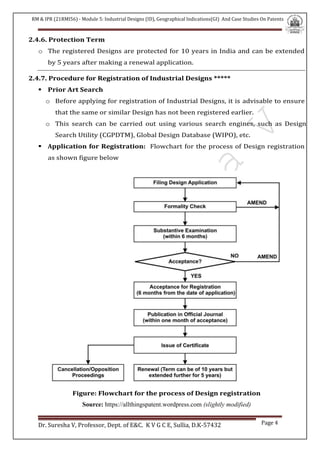
 Application for Registration: Flowchart for the process of Design registration
as shown figure below
Figure: Flowchart for the process of Design registration
Source: https://allthingspatent.wordpress.com (slightly modified)
RM & IPR (21RMI56) - Module 5: Industrial Designs (ID), Geographical Indications(GI) And Case Studies On Patents
Dr. Suresha V, Professor, Dept. of E&C. K V G C E, Sullia, D.K-57432 Page 5
 Design registration procedure as follows
o The application for registration of Design can be filed by an individual, small
entity, institution, organization or industry.
o The application may be filed through a professional patent agent or legal
practitioner.
o If the applicant is not a resident of India, an agent residing in India has to be
employed for this purpose.
o The applicant submits the registration application to the Design Office Deputy
Controller of Patents & Designs at Kolkata.
o After the application has been filed, an officer (examiner) analyses the
application for qualifying the minimum standards laid down for eligibility
criteria for registration.
o In case of any query, the same is sent to the applicant and he is supposed to
respond within 6 months from the objection raised.
o Once the objections are removed, the application is accepted for registration.
2.4.8. Duration of the Registration of a Design
o Initially, the Design registration is valid for TEN years from the date of
registration.
o The period of registration may be extended further for FIVE years. An
application has to be made in Form-3 accompanied by prescribed fees to the
Controller General before the expiry of the said initial period of ten years.
2.4.9. Importance of Design Registration
o Registration of Design ensures the exclusive rights of the applicant on the Design.
o The owner can prevent the registered Design products from piracy and imitation.
o This helps the owner boost the sale of the products and establish goodwill in the
market.
2.4.10. Cancellation of the Registered Design
o The registration of a Design may be canceled at any time. The petition has to be
filed in Form-8 with the prescribed fee to the Controller of Designs. The
application can be made on the following grounds:
o Design has already been registered.
o Design has been published in India or elsewhere before the date of
registration.
o Design is not novel and original.
RM & IPR (21RMI56) - Module 5: Industrial Designs (ID), Geographical Indications(GI) And Case Studies On Patents
Dr. Suresha V, Professor, Dept. of E&C. K V G C E, Sullia, D.K-57432 Page 6
2.4.12. Classification of Industrial Designs
o Designs are registered in different classes as per the Locarno Agreement, 1968.
o The classification comprises a list of classes and subclasses with a list of goods
that constitute Industrial Designs.
o There are 32 classes and 237 subclasses that can be searched in two languages
i.e. English and French.
o For example, Class 1 includes foodstuffs for human beings, foodstuffs for animals,
and dietetic foods excluding packages because they are classified under Class 9
(Bottles, Flasks, Pots, Carboys, Demijohns, and Pressurized Containers).
o Class 32 classifies the Design of graphic symbols and logos, surface patterns, and
ornamentation.
2.4.13. Designs Registration Trend in India
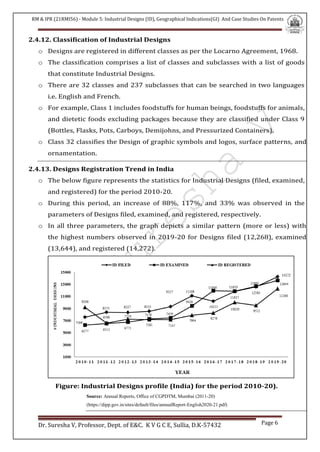
o The below figure represents the statistics for Industrial Designs (filed, examined,
and registered) for the period 2010-20.
o During this period, an increase of 88%, 117%, and 33% was observed in the
parameters of Designs filed, examined, and registered, respectively.
o In all three parameters, the graph depicts a similar pattern (more or less) with
the highest numbers observed in 2019-20 for Designs filed (12,268), examined
(13,644), and registered (14,272).
Figure: Industrial Designs profile (India) for the period 2010-20).
Source: Annual Reports, Office of CGPDTM, Mumbai (2011-20)
(https://dipp.gov.in/sites/default/files/annualReport-English2020-21.pdf)
RM & IPR (21RMI56) - Module 5: Industrial Designs (ID), Geographical Indications(GI) And Case Studies On Patents
Dr. Suresha V, Professor, Dept. of E&C. K V G C E, Sullia, D.K-57432 Page 7
2.4.14. International Treaties: The WIPO has put in place two important treaties
(international) dealing with the smooth functioning of various aspects of Industrial
Designs:
1. Hague Agreement for International Registration (1925)
2. Locarno Agreement (1968) for international classification
2.4.15. Famous Case Law:
 Apple Inc. vs. Samsung Electronics Co.
o In 2011, Apple Inc. filed a case against Samsung Electronics Co. in the United
States District Court for the Northern District of California for infringing their
Designs and Utility Patents of the user interface like screen app grid and tap
to zoom.
o As evidence, Apple Inc. submitted a side-by-side image comparison of the
iPhone 3GS and the i9000 Galaxy S to demonstrate the alleged similarities in
both models.
o However, later it was found that the images were tempered by the Apple
Company to match the dimensions and features of the controversial Designs.
o So the counsel for Samsung Electronics blamed Apple for submitting false and
misleading evidence to the court and the company countersued Apple
Company in
- Seoul, South Korea;
- Tokyo, Japan; and
- Mannheim, Germany,
- United States District Court for the District of Delaware, and with the
United States International Trade Commission (ITC) in Washington D.C.
o The proceedings continued for 7 years in various courts. In June 2018 both
companies reached a settlement and Samsung was ordered to pay $539
million to Apple Inc. for infringing on its patents.
RM & IPR (21RMI56) - Module 5: Industrial Designs (ID), Geographical Indications(GI) And Case Studies On Patents
Dr. Suresha V, Professor, Dept. of E&C. K V G C E, Sullia, D.K-57432 Page 8
2.5 Geographical Indications (GI)
2.5.0. Overview and definition
o A Geographical Indication (GI) is defined as a sign that can be used on products
belonging to a particular geographical location/region and possesses qualities or
a reputation associated with that region.
o In GI, there is a strong link between the product and its original place of
production.
o Example: Tirupati Laddu from AP. Rasgulla from Oddisha, Kashmir Saffron from
J and K, Champagne from France, Kanchipuram silk saree from TN.
2.5.1. Acts, Laws, and Rules About GI
o In India, GI was introduced in 2003 and is governed under the Geographical
Indications of Goods (Registration & Protection) Act, of 1999.
o Geographical Indications of Goods (Registration & Protection) Rules, 2002.
2.5.2. Ownership of GI
o The ownership/holders of GI (registered) can be of the producers, as a group of
association/ cooperative society or associate, on or in certain cases, government.
2.5.3 Rights Granted to the Holders: The following rights are associated with GI
1. Right to grant the license to others: The holder has the right to gift, sell,
transfer/grant a license, mortgage, or enter into any other arrangement for
consideration regarding their product. A license or assignment must be given in
writing and registered with the Registrar of GI, for it to be valid and legitimate.
2. Right to sue: The holder of GI has the right to use and take legal action against a
person who uses the product without his consent.
3. Right to exploit: The holder of GI can authorize users with exclusive rights to
use goods for which the GI is registered.
4. Right to get reliefs: Registered proprietors and authorized users have the right
to obtain relief concerning the violation of such GI products
2.5.4. Registered GI in India
o GI products registered in India belong to the domains of handicrafts, agriculture,
foodstuffs, alcoholic beverages, etc.
RM & IPR (21RMI56) - Module 5: Industrial Designs (ID), Geographical Indications(GI) And Case Studies On Patents
Dr. Suresha V, Professor, Dept. of E&C. K V G C E, Sullia, D.K-57432 Page 9
o The first GI tag was granted in 2004 to Darjeeling Tea, the latest being Kashmir
Saffron and Manipur Black rice (Chakhao) in May 2020.
o A total of 370 GI have been registered in India till May 2020.
o Nearly 58% of these belong to handicrafts, followed by agriculture (30%).
o Other categories belong to foodstuff, manufacturing, and natural goods.
o In the Handicraft category, Tamilnadu holds the maximum number (21) of GI
followed by Uttar Pradesh (20) and Karnataka (19).
o A few standards are mentioned in the table below
GI Type State
Darjeeling Tea Agriculture West Bengal
Mysore Silk Handicraft Karnataka
Kashmir Pashmina Handicraft Jammu & Kashmir
Banaras Brocades and Sarees Handicraft Uttar Pradesh
Naga Mircha Agriculture Nagal
Tirupathi Laddu Foodstuff Andhra Pradesh
Basmathi Agriculture India
2.5.5. Identification of Registered GI
o Registered GI products are granted a tag, which is printed on the registered
products.
o The tag confirms the genuineness of the product in terms of its production (by
set standards) and location of production.
o Non-registered GI products cannot use/exploit this tag.
o GI tags represent the place of origin (of the product) along with cultural and/or
historical identity e.g. Darjeeling Tea, Mysore Silk, Tirupathi Laddu, etc.
o In India GI tags are issued by the Geographical Indication Registry under the
Department DPIIT Ministry of Commerce and Industry.
o The head of the GI registry is at the G I Registry IPO Building in Chennai.
o GI-registered products can be grown/produced in any part of the world using
standards laid down by the GI Registry.
o However, these products cannot be labeled as GI as they are not produced/
manufactured in a specific geographical location
o For example, plants of Darjeeling Tea can be grown in any part of India. However,
the tea leaves of these plants cannot be sold under the brand name Darjeeling
Tea, as the concerned plants were not grown in the soil and climate of the
Darjeeling area.
RM & IPR (21RMI56) - Module 5: Industrial Designs (ID), Geographical Indications(GI) And Case Studies On Patents
Dr. Suresha V, Professor, Dept. of E&C. K V G C E, Sullia, D.K-57432 Page 10
2.5.6. Classes of GI: GI-certified goods are classified under 34 different classes.
o Class 1: chemicals used in industry, science, photography, agriculture,
horticulture, and forestry; unprocessed artificial resins, unprocessed plastics,
manures; fire extinguishing compositions; tempering and soldering
preparations; chemical substances for preserving foodstuffs; tanning substances;
adhesives used in industry.
o Class 33 is for alcoholic beverages (except beers).
o Class 34 is related to tobacco, smoker‘s articles, and matches.
2.5.7. Non-Registerable GI: As per GI Act, 1999, which prohibits registration of a GI
mentioned below:
o The use of which would be likely to deceive or cause confusion.
o The use of which would be contrary to any law.
o Which comprises or contains scandalous or obscene matter.
o Which comprises or contains any matter likely to hurt the sentiments of society,
Religious susceptibilities of any class or section of the citizens of India
o Which are determined to be generic names or indications of goods and are,
therefore, not or ceased to be protected in their country of origin or which have
fallen into disuse in that country.
2.5.8. Protection of GI
o The IP rights to GI are enforced by the court of law of the concerned country.
o The GI registration of a product has certain advantages.
o It enables to identification of pirated/non-genuine stuff, provides more
commercial value to the product, and also strengthens the case if it reaches the
judicial courts.
o The two common methods of protecting a GI are:
- Many countries, including India protect GI by using the sui generis system.
- This decision was taken after the TRIPS agreement (1995) and an option
was given to the countries to choose either TRIPS standards or the sui
generis system.
- This was decided because every country has different legislation and
geographical structures & resources. Therefore, this system is not uniform
in all countries and varies according to the jurisdiction and legislation of
the particular country.
RM & IPR (21RMI56) - Module 5: Industrial Designs (ID), Geographical Indications(GI) And Case Studies On Patents
Dr. Suresha V, Professor, Dept. of E&C. K V G C E, Sullia, D.K-57432 Page 11
2.5.9. Collective or Certification Marks
o Certification marks aim to certify the products comply with specific quality
standards irrespective of their origin.
o The purpose of certification marks is to distinguish certified goods from non-
certified ones.
o Collective marks are owned by associations ensuring compliance with the agreed
standards.
o Collective marks signify that a good or service originates from a member of a
particular association.
o The Collective mark is used by cooperating enterprises that have agreed to
comply with defined quality standards for goods or services that share common
characteristics.
2.5.10. Enforcement of GI Rights
o The rights to GI protection are typically enforced by the court of law.
o The sanctions provided could be civil (injunctions restraining or prohibiting
unlawful acts, actions for damages, etc.), criminal, or administrative.
2.5.11. Procedure for GI Registration
o Before applying for registering GI, it is prudent to search whether the concerned
GI is already protected or not. This can be done by using search engines created
by WIPO.
o The list of registered GI in India can be accessed from the official website of
CGPDTM.
o Once the prior search for registered GI is done, the applicant has to apply.
o The application for GI can be forwarded by an individual or an organization or
authority of people established under Indian law.
o The application in a prescribed format is submitted to the Registrar,
Geographical Indications along with the prescribed fee.
o IIn the application, the applicant needs to mention the interest of the producers
of the concerned product.
o The application should be duly signed by the applicant or his agent with all the
details about the GI and how its standard will be maintained.
o The submission of three certified copies of the map of the region where the GI
belongs is mandatory.
RM & IPR (21RMI56) - Module 5: Industrial Designs (ID), Geographical Indications(GI) And Case Studies On Patents
Dr. Suresha V, Professor, Dept. of E&C. K V G C E, Sullia, D.K-57432 Page 12
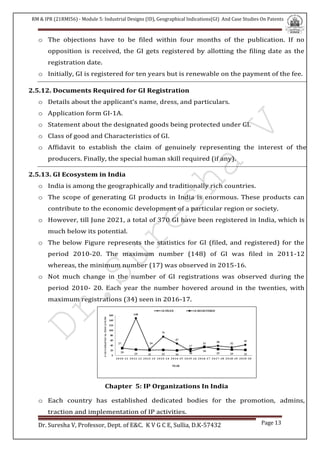
o Once the application is filed at the GI Registry, the Examiner will scrutinize the
application for any deficiencies or similarities.
o If the examiner finds any discrepancy, he will communicate the same to the
applicant, which is to be replied to within one month of the communication of
the discrepancy.
o Once the examiner is satisfied with the response/s, he files an examination
report and hands over the same to the Registrar. Once again, the application is
scrutinized.
o If need be, the applicant is asked to clear any doubts/objections within two
months of the communication otherwise, the application will be rejected.
Figure: Flow chart for the process of GI registration
o After getting a green signal from the Registrar, the application is published in the
official Geographical Indication Journal for seeking any objections to the claims
mentioned in the application.
RM & IPR (21RMI56) - Module 5: Industrial Designs (ID), Geographical Indications(GI) And Case Studies On Patents
Dr. Suresha V, Professor, Dept. of E&C. K V G C E, Sullia, D.K-57432 Page 13
o The objections have to be filed within four months of the publication. If no
opposition is received, the GI gets registered by allotting the filing date as the
registration date.
o Initially, GI is registered for ten years but is renewable on the payment of the fee.
2.5.12. Documents Required for GI Registration
o Details about the applicant‘s name, dress, and particulars.
o Application form GI-1A.
o Statement about the designated goods being protected under GI.
o Class of good and Characteristics of GI.
o Affidavit to establish the claim of genuinely representing the interest of the
producers. Finally, the special human skill required (if any).
2.5.13. GI Ecosystem in India
o India is among the geographically and traditionally rich countries.
o The scope of generating GI products in India is enormous. These products can
contribute to the economic development of a particular region or society.
o However, till June 2021, a total of 370 GI have been registered in India, which is
much below its potential.
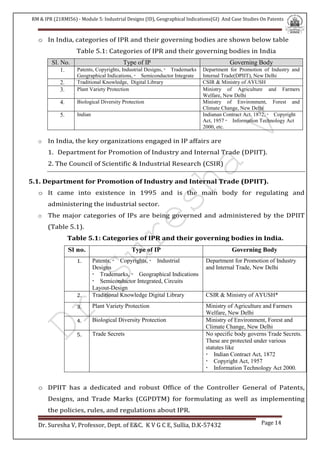
o The below Figure represents the statistics for GI (filed, and registered) for the
period 2010-20. The maximum number (148) of GI was filed in 2011-12
whereas, the minimum number (17) was observed in 2015-16.
o Not much change in the number of GI registrations was observed during the
period 2010- 20. Each year the number hovered around in the twenties, with
maximum registrations (34) seen in 2016-17.
Chapter 5: IP Organizations In India
o Each country has established dedicated bodies for the promotion, admins,
traction and implementation of IP activities.
RM & IPR (21RMI56) - Module 5: Industrial Designs (ID), Geographical Indications(GI) And Case Studies On Patents
Dr. Suresha V, Professor, Dept. of E&C. K V G C E, Sullia, D.K-57432 Page 14
o In India, categories of IPR and their governing bodies are shown below table
Table 5.1: Categories of IPR and their governing bodies in India
Sl. No. Type of IP Governing Body
1. Patents, Copyrights, Industrial Designs, Trademarks
Geographical Indications, Semiconductor Integrate
Department for Promotion of Industry and
Internal Trade(DPIIT), New Delhi
2. Traditional Knowledge, Digital Library CSIR & Ministry of AYUSH
3. Plant Variety Protection Ministry of Agriculture and Farmers
Welfare, New Delhi
4. Biological Diversity Protection Ministry of Environment, Forest and
Climate Change, New Delhi
5. Indian Indianan Contract Act, 1872, Copyright
Act, 1957 Information Technology Act
2000, etc.
o In India, the key organizations engaged in IP affairs are
1. Department for Promotion of Industry and Internal Trade (DPIIT).
2. The Council of Scientific & Industrial Research (CSIR)
5.1. Department for Promotion of Industry and Internal Trade (DPIIT).
o It came into existence in 1995 and is the main body for regulating and
administering the industrial sector.
o The major categories of IPs are being governed and administered by the DPIIT
(Table 5.1).
Table 5.1: Categories of IPR and their governing bodies in India.
Sl no. Type of IP Governing Body
1. Patents, Copyrights, Industrial
Designs
Trademarks, Geographical Indications
Semiconductor Integrated, Circuits
Layout-Design
Department for Promotion of Industry
and Internal Trade, New Delhi
2. Traditional Knowledge Digital Library CSIR & Ministry of AYUSH*
3. Plant Variety Protection Ministry of Agriculture and Farmers
Welfare, New Delhi
4. Biological Diversity Protection Ministry of Environment, Forest and
Climate Change, New Delhi
5. Trade Secrets No specific body governs Trade Secrets.
These are protected under various
statutes like
Indian Contract Act, 1872
Copyright Act, 1957
Information Technology Act 2000.
o DPIIT has a dedicated and robust Office of the Controller General of Patents,
Designs, and Trade Marks (CGPDTM) for formulating as well as implementing
the policies, rules, and regulations about IPR.
RM & IPR (21RMI56) - Module 5: Industrial Designs (ID), Geographical Indications(GI) And Case Studies On Patents
Dr. Suresha V, Professor, Dept. of E&C. K V G C E, Sullia, D.K-57432 Page 15
o In addition, DPIIT also undertakes the following IPR-related activities:
a. Modernization and strengthening of Intellectual Property Office.
b. Strengthening of physical infrastructure.
c. Enhancement of human resources.
d. Expansion of physical infrastructure at Delhi, Mumbai, Kolkata and
Chennai.
e. IT up-gradation.
f. Development of software required for ISA/IPEA and Madrid Protocol.
g. Subscription to non-patent literature required for PCT minimum
documentation.
h. Digitization of records and Sensitization and awareness programs.
i. Establishment of the electronic library.
j. Furniture and office equipment for the modernized environment in IP
offices.
k. DPIIT also collaborates with WIPO and other apex industry organizations
to promote and strengthen the IP ecosystem.
l. It also provides inputs on various issues related to the TRIPS agreement.
5.1.1. Intellectual Property Appellate Board and its Amendment
o With an increase in the IPR regime all over the world, a higher number of
disputes has also been observed. Because of the overoccupancy of the judicial
courts in India, there was a significant delay in the judgments related to IPR
cases.
o To overcome this issue, in 2003 Government of India established the Intellectual
Property Appellate Board (IPAB), a statutory body under DPIIT.
5.1.2. Draft Model Guidelines on Implementation of IPR Policy for Academic
Institutions
o To implement the policy for enhancing the IP ecosystem, IP commercialization,
Entrepreneurship, and start-up ecosystem in academic institutions, DPIIT has
prepared a draft of guidelines for the implementation of IPR policy for academic
institutions.
5.1.3. Scheme for Facilitating Start-ups Intellectual Property Protection (SIPP)
o This scheme is to facilitate the protection of Patents, Trademarks, and Designs
generated by start-ups.
RM & IPR (21RMI56) - Module 5: Industrial Designs (ID), Geographical Indications(GI) And Case Studies On Patents
Dr. Suresha V, Professor, Dept. of E&C. K V G C E, Sullia, D.K-57432 Page 16
o The scheme is inclined to nurture and mentor innovative and emerging
technologies among the start-ups and assist them in protection and
commercialization by providing them access to high-quality IP services and
resources.
5.1.4. Office of the Controller General of Patents, Designs, and Trademarks
(CGPDTM): It supervises the functioning of the following IP offices:
o The Patent Offices (including the Design Wing) at Chennai, Delhi, Kolkata &
Mumbai.
o The Patent Information System (PIS) and Rajiv Gandhi National Institute of
Intellectual Property Management (RGNIIPM) at Nagpur.
o The Trademarks Registry at Ahmadabad, Chennai, Delhi, Kolkata & Mumbai.
o The Geographical Indications Registry (GIR) at Chennai.
o The Copyright Office in Delhi.
o The Semiconductor Integrated Circuits Layout-Design Registry at Delhi.
 Salient features of CGPDTM are:
- It administers all the Acts and laws related to Patents, Trademarks, Industrial
Designs, Geographical Indications, Copyrights, and Semiconductor Integrated
Circuits Layout-Design Registry.
- Applicants can file their applications related to Patents, Designs, Trademarks, and
GI througa‗E gateway‘
- The office has designed a dedicated public search engine to search the
detailthroughregistered IP and the status of the applications filed. These search
engines are available free of cost for the public at large.
- The office publishes official journals of Patents, Trademarks, and GI every week,
which contain the details of applications published, abandoned, First Examination
Report (FER), and Patents granted by the controller general.
- The details and amendments in the Rules and Acts are administered by the office
and the same is notified by the Office regularly.
- The Office publishes an annual report every year containing statistics about all IPs.
The report also contains information regarding the international applications filed
and granted in India through PCT and Conventions.
- The details of the revenue incurred and generated in the respective financial year
are also depicted in the report.
RM & IPR (21RMI56) - Module 5: Industrial Designs (ID), Geographical Indications(GI) And Case Studies On Patents
Dr. Suresha V, Professor, Dept. of E&C. K V G C E, Sullia, D.K-57432 Page 17
- The Office notifies the vacancies for Patent Examiners‘ and holds the exams of
Patent Agents from time to time.
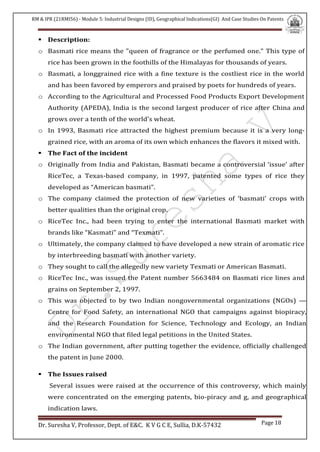
Figure 5.1: Organizational structure of IPR regime in India.
 Case Studies on Patents.
1. Case study of Basmati patent.
2. Case study of Curcuma (Turmeric) Patent
3. Case study of Neem Patent
1. Case study of Basmati patent:
 Introduction:
o Dr. Vandana Shiva, an Indian environmental activist once quoted that, “Bio-
piracy (is) biological theft; an illegal collection of indigenous plants by
corporations who patent them or their use and benefit”.
o Shiva has challenged the bio-piracy of Neem, Basmati, and wheat by developed
countries.
o The importance of analyzing the issue of Basmati Rice is that India has a bundle of
traditional knowledge and rich heritage which if patented by other nations can
put restrictions on the use of such resources by the indigenous communities.
o India is a signatory country that complies with the provisions stated in the
(TRIPs) for IP, wherein, most countries have been committed to providing
minimum standards of protection to intellectual property.
RM & IPR (21RMI56) - Module 5: Industrial Designs (ID), Geographical Indications(GI) And Case Studies On Patents
Dr. Suresha V, Professor, Dept. of E&C. K V G C E, Sullia, D.K-57432 Page 18
 Description:
o Basmati rice means the "queen of fragrance or the perfumed one." This type of
rice has been grown in the foothills of the Himalayas for thousands of years.
o Basmati, a longgrained rice with a fine texture is the costliest rice in the world
and has been favored by emperors and praised by poets for hundreds of years.
o According to the Agricultural and Processed Food Products Export Development
Authority (APEDA), India is the second largest producer of rice after China and
grows over a tenth of the world's wheat.
o In 1993, Basmati rice attracted the highest premium because it is a very long-
grained rice, with an aroma of its own which enhances the flavors it mixed with.
 The Fact of the incident
o Originally from India and Pakistan, Basmati became a controversial ‘issue’ after
RiceTec, a Texas-based company, in 1997, patented some types of rice they
developed as “American basmati”.
o The company claimed the protection of new varieties of ‘basmati’ crops with
better qualities than the original crop.
o RiceTec Inc., had been trying to enter the international Basmati market with
brands like “Kasmati” and “Texmati”.
o Ultimately, the company claimed to have developed a new strain of aromatic rice
by interbreeding basmati with another variety.
o They sought to call the allegedly new variety Texmati or American Basmati.
o RiceTec Inc., was issued the Patent number 5663484 on Basmati rice lines and
grains on September 2, 1997.
o This was objected to by two Indian nongovernmental organizations (NGOs) —
Centre for Food Safety, an international NGO that campaigns against biopiracy,
and the Research Foundation for Science, Technology and Ecology, an Indian
environmental NGO that filed legal petitions in the United States.
o The Indian government, after putting together the evidence, officially challenged
the patent in June 2000.
 The Issues raised
Several issues were raised at the occurrence of this controversy, which mainly
were concentrated on the emerging patents, bio-piracy and g, and geographical
indication laws.
RM & IPR (21RMI56) - Module 5: Industrial Designs (ID), Geographical Indications(GI) And Case Studies On Patents
Dr. Suresha V, Professor, Dept. of E&C. K V G C E, Sullia, D.K-57432 Page 19
o The major issues raised included:
- Whether the name ‘basmati’ is a ‘generic’ term or specifically originates from
the aromatic rice grown in India and various South-Asian countries?
- Whether the grain developed by Ricetec Inc. a novel variety and strain?
- Is Ricetec Inc. guilty of bio-piracy and violation of traditional knowledge
belonging to indigenous communities of Southern-Asian countries?
- Whether the patent granted to Ricetec must be revoked due to protests by
various NGOs and Indigenous Communities?
 Case Analysis:
o RiceTec has a patent for three things: growing rice plants with certain
characteristics identical to Basmati, the grain produced by such plants, and the
method of selecting rice based on a starch index (SI) test devised by RiceTec, Inc.
o The patent was challenged on the fact that the plant varieties and grains already
exist as a staple in India.
o 75 percent of U.S. rice imports are from Thailand and the remainder is from India
and Pakistan and both varieties are rice that cannot be grown in the US.
o The legal theory is that the patent is not novel and for an obvious invention, being
based on rice that is already being imported into the United States, therefore it
should not have been granted in the first place.
o India’s attorneys also seek to challenge the use of the term ‘basmati’ in
conjunction with the patent and the king of the rice. Such use of the term creates
confusion as to geographic origin and usurps the goodwill and recognition
established with basmati rice grown and sold from India.
o On January 29, 2002, the United States Patent and Trademark Office issued a
Reexamination Certificate canceling claims.
o As a result of the re-examination application filed by the Indian government,
RiceTec agreed to withdraw several of the claims.
 Conclusion
o The companies like Ricetec are violating our traditional knowledge by committing
the crime of bio-piracy.
o This utter spread of bio-piracy not only hurts the sentiments of local communities
but results in economic losses.
o To restrict the further conduct of bio-piracy by other developed nations, India
prepared a database called ‘Traditional Knowledge Digital Library’.
RM & IPR (21RMI56) - Module 5: Industrial Designs (ID), Geographical Indications(GI) And Case Studies On Patents
Dr. Suresha V, Professor, Dept. of E&C. K V G C E, Sullia, D.K-57432 Page 20
2. Case study of Curcuma (Turmeric) Patent
o Turmeric is widely used in India as a medicine, a food ingredient, and a dye to
name a few of its uses.
o In the ancient Indian medical system, Ayurveda, a poultice of turmeric paste is
used to treat common eye infections dress wounds, treat bites, burns, acne, and
various skin diseases
o In 1995, the United States awarded patent no 5,401,504 on turmeric to the
University of Mississippi Medical Center for wound healing properties.
o The claimed subject matter was the use of "turmeric powder and its
administration", both oral as well as topical, for wound healing. It was specially
awarded for the ‘use of turmeric in wound healing
o In1996, the Indian Council for Scientific and Industrial Research (CSIR) objected
to the patent granted. Due to extensive research, 32 references were located in
different languages namely Sanskrit, Urdu, and Hindi on the traditional use of
turmeric.
o After a legal battle the patent was revoked, stating that the claims made in the
patent were obvious and anticipated, and agreeing that the use of turmeric was
an old art of healing wounds.
o A re-examination claim with USPTO was filed for the invalidation of patent
application no. 5401540 by CSIR on October 1996 as the patent lacked the
element of novelty on the ground of the healing power of turmeric powder which
was already found and put into practice in India for ages.
o In 1997, the six claims were rejected by the USPTO anhe, and the patent was
declared invalid.
o The Traditional Knowledge that belonged to India was safeguarded ithe n the
Turmeric case.
3. Case study of Neem Patent
 Introduction:
o The NEEM tree is a tropical evergreen tree native to India and is also found in
other southeast countries.
o In India, neem is known as “the village pharmacy” because of its healing
versatility, and it has been used in Ayurvedic medicine for more than 4,000
years due to its medicinal properties.
RM & IPR (21RMI56) - Module 5: Industrial Designs (ID), Geographical Indications(GI) And Case Studies On Patents
Dr. Suresha V, Professor, Dept. of E&C. K V G C E, Sullia, D.K-57432 Page 21
o Neem is also called ‘arista’ in SansSanskritd which means ‘perfect, complete
and imperishable’.
o The seeds, bark, and leaves contain compounds with proven antiseptic,
antiviral, antipyretic, anti-inflammatory, anti-ulcer, and antifungal uses.
 Patentingoff Neem: A Case Of Biopiracy:
o Biopiracy is the theft of genetic materials especially plants and other biological
materials by the patent process.
o Corporations of the Western world have for the past two decades or so, been
reaping immense profits by patenting the knowledge and genetic resources of
Third World communities, which also form biodiversity hotspots.
o Once patented, the patent owner can effectively prevent competitors from
producing the product, occasionally even interfering with the lifestyles of the
community which is the origin of the patented information.
o In such cases, farmer and community livelihoods are threatened
 The Problem:
o For centuries the Western world ignored the neem tree and its properties: the
practices of Indian peasants and doctors were not deemed worthy of
attention by the majority of British, French, and Portuguese colonialists.
o In 1971, US timber importer Robert Larson observed the tree's usefulness in
India and began importing neem seed to his company.
o Over the next decade he conducted safety and performance tests on a
pesticidal neem extract called Margosan-O and in 1985 received clearance for
the product from the US Environmental Protection Agency (EPA).
o Three years later he sold the patent for the product to the multinational
chemical corporation, W R Grace and Co.
o Since 1985, over a dozen US patents have been taken out by US and Japanese
firms on formulae for stable neem-based solutions and emulsions and even
for a neem-based toothpaste.
o In 1992, W.R. Grace secured its rights to the formula that used the emulsion
from the Neem tree's seeds to make a powerful pesticide.
o It also began suing Indian companies for making the emulsion.
RM & IPR (21RMI56) - Module 5: Industrial Designs (ID), Geographical Indications(GI) And Case Studies On Patents
Dr. Suresha V, Professor, Dept. of E&C. K V G C E, Sullia, D.K-57432 Page 22
 Dispute:
o The controversy over who has the rights to the Neem tree raised many
questions. India claims that what the US Companies are calling discoveries are
the actual stealing and pirating of the indigenous practices and knowledge of its
people
o The Indians and members of the Green Party in the European Union oppose big
businesses owning the rights to living organisms because they believe that the
rights of poor farmers in developing countries will be harmed.
o The United States, on the other hand, states that what they are doing will help
the Indian economy.
o Another issue is whether the neem tree is patentable since it is a product of
nature.
o The problem is that W.R. Grace does not have a patent on the tree itself, but
rather on the process of making the emulsion.
 The Neem Campaign
o The Neem Campaign consisting of a group of NGOs and individuals, was initiated
in 1993 in India.
o This was done to mobilize worldwide support to protect indigenous knowledge
systems and resources of the Third World from piracy by the West, particularly
in light of emerging threats from intellectual property rights regimes under WTO
and TRIPS.
o The Neem patent became the first case to challenge European and US patents on
grounds of biopiracy.
 Case Judgement
o On the 30th of September 1997, the European Patent Office (EPO) delivered a
favorable interim judgment on the challenge of a European patent on the
fungicidal effects of neem oil (Patent No. 436 257 B1) owned by W. R. Grace & Co.
o The European Patents Office accepted the arguments offered by Indian scientists
and rejected the order of the US patents office to award the patent to W R Grace,
a US-based company, at the last hearing of the case.
o The Indian scientists argued that the people of India have known the medicinal
properties of neem for thousands of years and hence no other company can
patent its properties. The EPO accepted the argument.
RM & IPR (21RMI56) - Module 5: Industrial Designs (ID), Geographical Indications(GI) And Case Studies On Patents
Dr. Suresha V, Professor, Dept. of E&C. K V G C E, Sullia, D.K-57432 Page 23
o The victory is a result of a four-year-long effort by the Research Foundation for
Science, Technology and Environment. Professor U P Singh, an agricultural
scientist at the Banaras Hindu University represented the Indian side.
o The European Patent Office agreed to withdraw the patent in May 2000, the
Patent was revoked however.
o The Patent of the US Patent Office of 1992 is still valid.
o The US also needs to change its patent laws which allow biopiracy by non-
recognition of foreign prior art. Patents are supposed to satisfy three criteria,
nonobviousness, and utility
 WHAT INDIA NEEDS TO DO?
o Using the turmeric, basmati, and neem case, India needs to challenge the WTO
ruling in the TRIPs dispute initiated by the US.
o The Ruling states that India has "failed to implement a mechanism for
preserving novelty and priority".
o However, when 'novelty' itself is under question as in the case of turmeric,
neem, and countless other cases of biopiracy, 'preserving novelty' by
introducing the US-like patent laws in India amounts to perpetuating
Biopiracy.
o There are strong grounds for challenging the WTO decision. India should not
let this opportunity pass.
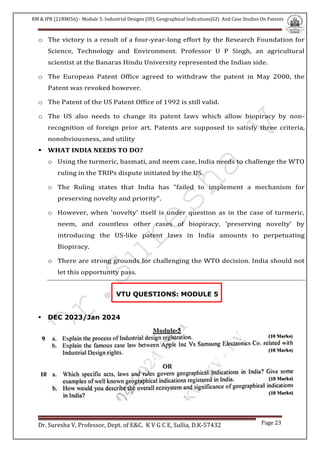
VTU QUESTIONS: MODULE 5
 DEC 2023/Jan 2024
RM & IPR (21RMI56) - Module 5: Industrial Designs (ID), Geographical Indications(GI) And Case Studies On Patents
Dr. Suresha V, Professor, Dept. of E&C. K V G C E, Sullia, D.K-57432 Page 24
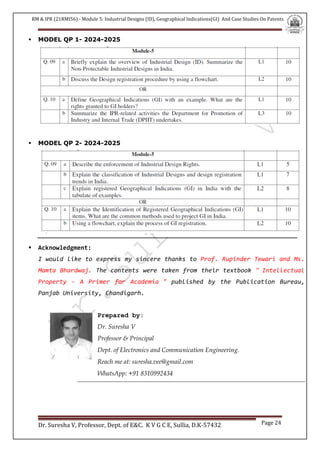
 MODEL QP 1- 2024-2025
 MODEL QP 2- 2024-2025
 Acknowledgment:
I would like to express my sincere thanks to Prof. Rupinder Tewari and Ms.
Mamta Bhardwaj. The contents were taken from their textbook " Intellectual
Property - A Primer for Academia " published by the Publication Bureau,
Panjab University, Chandigarh.
Prepared by:
Dr. Suresha V
Professor & Principal
Dept. of Electronics and Communication Engineering.
Reach me at: suresha.vee@gmail.com
WhatsApp: +91 8310992434

RM&IPR_BRMK557-Module 5-Final-Dr.Suresha V.pdf

  • 1.
    RESEARCH METHODOLOGY & INTELLECTUALPROPERTY RIGHTS (IPR) Course Code: BRMK557 MODULE - 5 Industrial Designs (ID), Geographical Indications (GI) and Case Studies on Patents A Simplified Notes for the 5th Semester As per VTU Syllabus - 2022 Scheme Dr. SURESHA V Professor, Department of E&CE K.V.G. College of Engineering, Sullia, D.K-574 327
  • 2.
    RM & IPR(21RMI56) - Module 5: Industrial Designs (ID), Geographical Indications(GI) And Case Studies On Patents Dr. Suresha V, Professor, Dept. of E&C. K V G C E, Sullia, D.K-57432 Page 1 MODULE 5 INDUSTRIAL DESIGNS (ID), GEOGRAPHICAL INDICATIONS(GI) AND CASE STUDIES ON PATENTS Learning Module Outcomes After reading this Module, the student will be able to: o To Learn the knowledge of the legal framework governing industrial designs and their protection mechanisms. o To identify and evaluate products eligible for geographical indication protection. o Familiarise with landmark patent cases and their implications on intellectual property law. Chapter 2.4: Industrial Designs (Textbook 2: Page 80-89) Eligibility Criteria. Acts and Laws to Govern Industrial Designs. Design Rights. Enforcement of Design Rights. Non-Protectable Industrial Designs India. Protection Term. Procedure for Registration of Industrial Designs. Prior Art Search. Application for Registration. Duration of Registration of a Design. Importance of Design Registration. Cancellation of the Registered Design. Application Forms. Classification of Industrial Designs. Designs Registration Trend in India. International Treaties. Famous Case Law: Apple Inc. vs. Samsung Electronics Co. Chapter 2.5: Geographical Indications (Textbook 2: Page 90 - 98) Acts, Laws, and Rules About GI. Ownership of GI. Rights Granted to the Holders. Registered GI in India. Identification of Registered GI. Classes of GI. Non-Registerable GI. Protection of GI. Collective or Certification Marks. Enforcement of GI Rights. Procedure for GI Registration. Documents Required for GI Registration. GI Ecosystem in India. Chapter: Case Studies on Patents. Case study of Curcuma (Turmeric) Patent, a Case study of Neem Patenta , Case study of Basmati patent. IP Organizations In India. Schemes and Programmes Text Book: “Intellectual Property: A Primer for Academia” by Prof. Rupinder Tewari Ms Mamta Bhardwaj, Publication Bureau Panjab University Chandigarh.
  • 3.
    RM & IPR(21RMI56) - Module 5: Industrial Designs (ID), Geographical Indications(GI) And Case Studies On Patents Dr. Suresha V, Professor, Dept. of E&C. K V G C E, Sullia, D.K-57432 Page 2 Chapter 2.4: Industrial Designs (ID) 2.4.0. Overview and definition o The word “design” is defined as the features of shape, configuration, pattern, ornament, or composition of lines or colors applied to any article. o The Design may be of any dimension i.e. one or two or three dimensional or a combination of these. o An industrial design right protects only the appearance or aesthetic features of a product, it does not protect the technical or functional features of a product. o In addition, it may be created by any industrial process or any means, that appeals to and is judged solely by the eye in the finished article. o The main object of the registration of industrial Designs is to protect and incentivize the original creativity of the originator and encourage others to work towards the art of creativity. 2.4.1 Eligibility Criteria for Industrial Designs o It must be novel or original i.e., should not be disclosed to the public by prior publication or by prior use or in any other way. o The Design should be significantly distinguishable from the already registered Designs existing in the public domain. 2.4.2. Acts and Laws to Govern Industrial Designs o In India, Industrial Designs are governed under 'The Designs Act' 2000 and Design Rules 2001. which have been amended from time to time in 2008, 2013, 2014, and 2019. o The Design should include the following characteristics: - It should be novel and original. - It should apply to a functional article. - It should be visible on a finished article. - There should be no prior publication or disclosure of the Design. o Some of the famous Industrial Designs are mentioned below: 1. Coca-Cola Bottle 2. Piaggio Vespa 3. iPhone 4. Mini Cooper
  • 4.
    RM & IPR(21RMI56) - Module 5: Industrial Designs (ID), Geographical Indications(GI) And Case Studies On Patents Dr. Suresha V, Professor, Dept. of E&C. K V G C E, Sullia, D.K-57432 Page 3 2.4.3. Design Rights o Right to prevent unauthorized copying or imitation of the design. o Right to all others from making, reproducing, offering, importing, exporting, or selling any product in which the design is incorporated or to which it is applied. o The Design registration is particularly useful for entities where the shape of the product has aesthetic and commercial value. 2.4.4. Enforcement of Design Rights o The design owner has the right to sue the person if the pirated products of his registered design are being used. o He can file the infringement case in the court (not lower than the District Court) to stop such exploitation and claim any damage to which the registered proprietor is legally entitled. o The court will ensure first that the Design of the said product is registered under the Designs Act, 2000. o If the Design is found not registered under the Act, there will not be legal action against the infringer. o If the infringer is found guilty of piracy or infringement, the court can ask him to pay the damage (₹ 50,000/-) in respect of infringement of one registered Design. 2.4.5. Non-Protectable Industrial Designs in India o Any Industrial Design that is against public moral values. o Industrial Designs including flags, emblems, or signs of any country. o Industrial Designs of integrated circuits. o Any Design describing the process of making an article. o Industrial Designs of books, calendars, certificates, forms and other documents, dressmaking patterns, greeting cards, leaflets, maps and plan cards, postcards, stamps, and medals. o The artistic work defined under the Copyright Act, of 1957 is not a subject matter for registration for Industrial Designs, such as: o Paintings, sculptures & drawings including a diagram, map, chart, or plan. o Photographs and work of architecture. o Any other work related to artistic craftsmanship. o Industrial Designs does not include any Trademark.
  • 5.
    RM & IPR(21RMI56) - Module 5: Industrial Designs (ID), Geographical Indications(GI) And Case Studies On Patents Dr. Suresha V, Professor, Dept. of E&C. K V G C E, Sullia, D.K-57432 Page 4 2.4.6. Protection Term o The registered Designs are protected for 10 years in India and can be extended by 5 years after making a renewal application. 2.4.7. Procedure for Registration of Industrial Designs *****  Prior Art Search o Before applying for registration of Industrial Designs, it is advisable to ensure that the same or similar Design has not been registered earlier. o This search can be carried out using various search engines, such as Design Search Utility (CGPDTM), Global Design Database (WIPO), etc.  Application for Registration: Flowchart for the process of Design registration as shown figure below Figure: Flowchart for the process of Design registration Source: https://allthingspatent.wordpress.com (slightly modified)
  • 6.
    RM & IPR(21RMI56) - Module 5: Industrial Designs (ID), Geographical Indications(GI) And Case Studies On Patents Dr. Suresha V, Professor, Dept. of E&C. K V G C E, Sullia, D.K-57432 Page 5  Design registration procedure as follows o The application for registration of Design can be filed by an individual, small entity, institution, organization or industry. o The application may be filed through a professional patent agent or legal practitioner. o If the applicant is not a resident of India, an agent residing in India has to be employed for this purpose. o The applicant submits the registration application to the Design Office Deputy Controller of Patents & Designs at Kolkata. o After the application has been filed, an officer (examiner) analyses the application for qualifying the minimum standards laid down for eligibility criteria for registration. o In case of any query, the same is sent to the applicant and he is supposed to respond within 6 months from the objection raised. o Once the objections are removed, the application is accepted for registration. 2.4.8. Duration of the Registration of a Design o Initially, the Design registration is valid for TEN years from the date of registration. o The period of registration may be extended further for FIVE years. An application has to be made in Form-3 accompanied by prescribed fees to the Controller General before the expiry of the said initial period of ten years. 2.4.9. Importance of Design Registration o Registration of Design ensures the exclusive rights of the applicant on the Design. o The owner can prevent the registered Design products from piracy and imitation. o This helps the owner boost the sale of the products and establish goodwill in the market. 2.4.10. Cancellation of the Registered Design o The registration of a Design may be canceled at any time. The petition has to be filed in Form-8 with the prescribed fee to the Controller of Designs. The application can be made on the following grounds: o Design has already been registered. o Design has been published in India or elsewhere before the date of registration. o Design is not novel and original.
  • 7.
    RM & IPR(21RMI56) - Module 5: Industrial Designs (ID), Geographical Indications(GI) And Case Studies On Patents Dr. Suresha V, Professor, Dept. of E&C. K V G C E, Sullia, D.K-57432 Page 6 2.4.12. Classification of Industrial Designs o Designs are registered in different classes as per the Locarno Agreement, 1968. o The classification comprises a list of classes and subclasses with a list of goods that constitute Industrial Designs. o There are 32 classes and 237 subclasses that can be searched in two languages i.e. English and French. o For example, Class 1 includes foodstuffs for human beings, foodstuffs for animals, and dietetic foods excluding packages because they are classified under Class 9 (Bottles, Flasks, Pots, Carboys, Demijohns, and Pressurized Containers). o Class 32 classifies the Design of graphic symbols and logos, surface patterns, and ornamentation. 2.4.13. Designs Registration Trend in India o The below figure represents the statistics for Industrial Designs (filed, examined, and registered) for the period 2010-20. o During this period, an increase of 88%, 117%, and 33% was observed in the parameters of Designs filed, examined, and registered, respectively. o In all three parameters, the graph depicts a similar pattern (more or less) with the highest numbers observed in 2019-20 for Designs filed (12,268), examined (13,644), and registered (14,272). Figure: Industrial Designs profile (India) for the period 2010-20). Source: Annual Reports, Office of CGPDTM, Mumbai (2011-20) (https://dipp.gov.in/sites/default/files/annualReport-English2020-21.pdf)
  • 8.
    RM & IPR(21RMI56) - Module 5: Industrial Designs (ID), Geographical Indications(GI) And Case Studies On Patents Dr. Suresha V, Professor, Dept. of E&C. K V G C E, Sullia, D.K-57432 Page 7 2.4.14. International Treaties: The WIPO has put in place two important treaties (international) dealing with the smooth functioning of various aspects of Industrial Designs: 1. Hague Agreement for International Registration (1925) 2. Locarno Agreement (1968) for international classification 2.4.15. Famous Case Law:  Apple Inc. vs. Samsung Electronics Co. o In 2011, Apple Inc. filed a case against Samsung Electronics Co. in the United States District Court for the Northern District of California for infringing their Designs and Utility Patents of the user interface like screen app grid and tap to zoom. o As evidence, Apple Inc. submitted a side-by-side image comparison of the iPhone 3GS and the i9000 Galaxy S to demonstrate the alleged similarities in both models. o However, later it was found that the images were tempered by the Apple Company to match the dimensions and features of the controversial Designs. o So the counsel for Samsung Electronics blamed Apple for submitting false and misleading evidence to the court and the company countersued Apple Company in - Seoul, South Korea; - Tokyo, Japan; and - Mannheim, Germany, - United States District Court for the District of Delaware, and with the United States International Trade Commission (ITC) in Washington D.C. o The proceedings continued for 7 years in various courts. In June 2018 both companies reached a settlement and Samsung was ordered to pay $539 million to Apple Inc. for infringing on its patents.
  • 9.
    RM & IPR(21RMI56) - Module 5: Industrial Designs (ID), Geographical Indications(GI) And Case Studies On Patents Dr. Suresha V, Professor, Dept. of E&C. K V G C E, Sullia, D.K-57432 Page 8 2.5 Geographical Indications (GI) 2.5.0. Overview and definition o A Geographical Indication (GI) is defined as a sign that can be used on products belonging to a particular geographical location/region and possesses qualities or a reputation associated with that region. o In GI, there is a strong link between the product and its original place of production. o Example: Tirupati Laddu from AP. Rasgulla from Oddisha, Kashmir Saffron from J and K, Champagne from France, Kanchipuram silk saree from TN. 2.5.1. Acts, Laws, and Rules About GI o In India, GI was introduced in 2003 and is governed under the Geographical Indications of Goods (Registration & Protection) Act, of 1999. o Geographical Indications of Goods (Registration & Protection) Rules, 2002. 2.5.2. Ownership of GI o The ownership/holders of GI (registered) can be of the producers, as a group of association/ cooperative society or associate, on or in certain cases, government. 2.5.3 Rights Granted to the Holders: The following rights are associated with GI 1. Right to grant the license to others: The holder has the right to gift, sell, transfer/grant a license, mortgage, or enter into any other arrangement for consideration regarding their product. A license or assignment must be given in writing and registered with the Registrar of GI, for it to be valid and legitimate. 2. Right to sue: The holder of GI has the right to use and take legal action against a person who uses the product without his consent. 3. Right to exploit: The holder of GI can authorize users with exclusive rights to use goods for which the GI is registered. 4. Right to get reliefs: Registered proprietors and authorized users have the right to obtain relief concerning the violation of such GI products 2.5.4. Registered GI in India o GI products registered in India belong to the domains of handicrafts, agriculture, foodstuffs, alcoholic beverages, etc.
  • 10.
    RM & IPR(21RMI56) - Module 5: Industrial Designs (ID), Geographical Indications(GI) And Case Studies On Patents Dr. Suresha V, Professor, Dept. of E&C. K V G C E, Sullia, D.K-57432 Page 9 o The first GI tag was granted in 2004 to Darjeeling Tea, the latest being Kashmir Saffron and Manipur Black rice (Chakhao) in May 2020. o A total of 370 GI have been registered in India till May 2020. o Nearly 58% of these belong to handicrafts, followed by agriculture (30%). o Other categories belong to foodstuff, manufacturing, and natural goods. o In the Handicraft category, Tamilnadu holds the maximum number (21) of GI followed by Uttar Pradesh (20) and Karnataka (19). o A few standards are mentioned in the table below GI Type State Darjeeling Tea Agriculture West Bengal Mysore Silk Handicraft Karnataka Kashmir Pashmina Handicraft Jammu & Kashmir Banaras Brocades and Sarees Handicraft Uttar Pradesh Naga Mircha Agriculture Nagal Tirupathi Laddu Foodstuff Andhra Pradesh Basmathi Agriculture India 2.5.5. Identification of Registered GI o Registered GI products are granted a tag, which is printed on the registered products. o The tag confirms the genuineness of the product in terms of its production (by set standards) and location of production. o Non-registered GI products cannot use/exploit this tag. o GI tags represent the place of origin (of the product) along with cultural and/or historical identity e.g. Darjeeling Tea, Mysore Silk, Tirupathi Laddu, etc. o In India GI tags are issued by the Geographical Indication Registry under the Department DPIIT Ministry of Commerce and Industry. o The head of the GI registry is at the G I Registry IPO Building in Chennai. o GI-registered products can be grown/produced in any part of the world using standards laid down by the GI Registry. o However, these products cannot be labeled as GI as they are not produced/ manufactured in a specific geographical location o For example, plants of Darjeeling Tea can be grown in any part of India. However, the tea leaves of these plants cannot be sold under the brand name Darjeeling Tea, as the concerned plants were not grown in the soil and climate of the Darjeeling area.
  • 11.
    RM & IPR(21RMI56) - Module 5: Industrial Designs (ID), Geographical Indications(GI) And Case Studies On Patents Dr. Suresha V, Professor, Dept. of E&C. K V G C E, Sullia, D.K-57432 Page 10 2.5.6. Classes of GI: GI-certified goods are classified under 34 different classes. o Class 1: chemicals used in industry, science, photography, agriculture, horticulture, and forestry; unprocessed artificial resins, unprocessed plastics, manures; fire extinguishing compositions; tempering and soldering preparations; chemical substances for preserving foodstuffs; tanning substances; adhesives used in industry. o Class 33 is for alcoholic beverages (except beers). o Class 34 is related to tobacco, smoker‘s articles, and matches. 2.5.7. Non-Registerable GI: As per GI Act, 1999, which prohibits registration of a GI mentioned below: o The use of which would be likely to deceive or cause confusion. o The use of which would be contrary to any law. o Which comprises or contains scandalous or obscene matter. o Which comprises or contains any matter likely to hurt the sentiments of society, Religious susceptibilities of any class or section of the citizens of India o Which are determined to be generic names or indications of goods and are, therefore, not or ceased to be protected in their country of origin or which have fallen into disuse in that country. 2.5.8. Protection of GI o The IP rights to GI are enforced by the court of law of the concerned country. o The GI registration of a product has certain advantages. o It enables to identification of pirated/non-genuine stuff, provides more commercial value to the product, and also strengthens the case if it reaches the judicial courts. o The two common methods of protecting a GI are: - Many countries, including India protect GI by using the sui generis system. - This decision was taken after the TRIPS agreement (1995) and an option was given to the countries to choose either TRIPS standards or the sui generis system. - This was decided because every country has different legislation and geographical structures & resources. Therefore, this system is not uniform in all countries and varies according to the jurisdiction and legislation of the particular country.
  • 12.
    RM & IPR(21RMI56) - Module 5: Industrial Designs (ID), Geographical Indications(GI) And Case Studies On Patents Dr. Suresha V, Professor, Dept. of E&C. K V G C E, Sullia, D.K-57432 Page 11 2.5.9. Collective or Certification Marks o Certification marks aim to certify the products comply with specific quality standards irrespective of their origin. o The purpose of certification marks is to distinguish certified goods from non- certified ones. o Collective marks are owned by associations ensuring compliance with the agreed standards. o Collective marks signify that a good or service originates from a member of a particular association. o The Collective mark is used by cooperating enterprises that have agreed to comply with defined quality standards for goods or services that share common characteristics. 2.5.10. Enforcement of GI Rights o The rights to GI protection are typically enforced by the court of law. o The sanctions provided could be civil (injunctions restraining or prohibiting unlawful acts, actions for damages, etc.), criminal, or administrative. 2.5.11. Procedure for GI Registration o Before applying for registering GI, it is prudent to search whether the concerned GI is already protected or not. This can be done by using search engines created by WIPO. o The list of registered GI in India can be accessed from the official website of CGPDTM. o Once the prior search for registered GI is done, the applicant has to apply. o The application for GI can be forwarded by an individual or an organization or authority of people established under Indian law. o The application in a prescribed format is submitted to the Registrar, Geographical Indications along with the prescribed fee. o IIn the application, the applicant needs to mention the interest of the producers of the concerned product. o The application should be duly signed by the applicant or his agent with all the details about the GI and how its standard will be maintained. o The submission of three certified copies of the map of the region where the GI belongs is mandatory.
  • 13.
    RM & IPR(21RMI56) - Module 5: Industrial Designs (ID), Geographical Indications(GI) And Case Studies On Patents Dr. Suresha V, Professor, Dept. of E&C. K V G C E, Sullia, D.K-57432 Page 12 o Once the application is filed at the GI Registry, the Examiner will scrutinize the application for any deficiencies or similarities. o If the examiner finds any discrepancy, he will communicate the same to the applicant, which is to be replied to within one month of the communication of the discrepancy. o Once the examiner is satisfied with the response/s, he files an examination report and hands over the same to the Registrar. Once again, the application is scrutinized. o If need be, the applicant is asked to clear any doubts/objections within two months of the communication otherwise, the application will be rejected. Figure: Flow chart for the process of GI registration o After getting a green signal from the Registrar, the application is published in the official Geographical Indication Journal for seeking any objections to the claims mentioned in the application.
  • 14.
    RM & IPR(21RMI56) - Module 5: Industrial Designs (ID), Geographical Indications(GI) And Case Studies On Patents Dr. Suresha V, Professor, Dept. of E&C. K V G C E, Sullia, D.K-57432 Page 13 o The objections have to be filed within four months of the publication. If no opposition is received, the GI gets registered by allotting the filing date as the registration date. o Initially, GI is registered for ten years but is renewable on the payment of the fee. 2.5.12. Documents Required for GI Registration o Details about the applicant‘s name, dress, and particulars. o Application form GI-1A. o Statement about the designated goods being protected under GI. o Class of good and Characteristics of GI. o Affidavit to establish the claim of genuinely representing the interest of the producers. Finally, the special human skill required (if any). 2.5.13. GI Ecosystem in India o India is among the geographically and traditionally rich countries. o The scope of generating GI products in India is enormous. These products can contribute to the economic development of a particular region or society. o However, till June 2021, a total of 370 GI have been registered in India, which is much below its potential. o The below Figure represents the statistics for GI (filed, and registered) for the period 2010-20. The maximum number (148) of GI was filed in 2011-12 whereas, the minimum number (17) was observed in 2015-16. o Not much change in the number of GI registrations was observed during the period 2010- 20. Each year the number hovered around in the twenties, with maximum registrations (34) seen in 2016-17. Chapter 5: IP Organizations In India o Each country has established dedicated bodies for the promotion, admins, traction and implementation of IP activities.
  • 15.
    RM & IPR(21RMI56) - Module 5: Industrial Designs (ID), Geographical Indications(GI) And Case Studies On Patents Dr. Suresha V, Professor, Dept. of E&C. K V G C E, Sullia, D.K-57432 Page 14 o In India, categories of IPR and their governing bodies are shown below table Table 5.1: Categories of IPR and their governing bodies in India Sl. No. Type of IP Governing Body 1. Patents, Copyrights, Industrial Designs, Trademarks Geographical Indications, Semiconductor Integrate Department for Promotion of Industry and Internal Trade(DPIIT), New Delhi 2. Traditional Knowledge, Digital Library CSIR & Ministry of AYUSH 3. Plant Variety Protection Ministry of Agriculture and Farmers Welfare, New Delhi 4. Biological Diversity Protection Ministry of Environment, Forest and Climate Change, New Delhi 5. Indian Indianan Contract Act, 1872, Copyright Act, 1957 Information Technology Act 2000, etc. o In India, the key organizations engaged in IP affairs are 1. Department for Promotion of Industry and Internal Trade (DPIIT). 2. The Council of Scientific & Industrial Research (CSIR) 5.1. Department for Promotion of Industry and Internal Trade (DPIIT). o It came into existence in 1995 and is the main body for regulating and administering the industrial sector. o The major categories of IPs are being governed and administered by the DPIIT (Table 5.1). Table 5.1: Categories of IPR and their governing bodies in India. Sl no. Type of IP Governing Body 1. Patents, Copyrights, Industrial Designs Trademarks, Geographical Indications Semiconductor Integrated, Circuits Layout-Design Department for Promotion of Industry and Internal Trade, New Delhi 2. Traditional Knowledge Digital Library CSIR & Ministry of AYUSH* 3. Plant Variety Protection Ministry of Agriculture and Farmers Welfare, New Delhi 4. Biological Diversity Protection Ministry of Environment, Forest and Climate Change, New Delhi 5. Trade Secrets No specific body governs Trade Secrets. These are protected under various statutes like Indian Contract Act, 1872 Copyright Act, 1957 Information Technology Act 2000. o DPIIT has a dedicated and robust Office of the Controller General of Patents, Designs, and Trade Marks (CGPDTM) for formulating as well as implementing the policies, rules, and regulations about IPR.
  • 16.
    RM & IPR(21RMI56) - Module 5: Industrial Designs (ID), Geographical Indications(GI) And Case Studies On Patents Dr. Suresha V, Professor, Dept. of E&C. K V G C E, Sullia, D.K-57432 Page 15 o In addition, DPIIT also undertakes the following IPR-related activities: a. Modernization and strengthening of Intellectual Property Office. b. Strengthening of physical infrastructure. c. Enhancement of human resources. d. Expansion of physical infrastructure at Delhi, Mumbai, Kolkata and Chennai. e. IT up-gradation. f. Development of software required for ISA/IPEA and Madrid Protocol. g. Subscription to non-patent literature required for PCT minimum documentation. h. Digitization of records and Sensitization and awareness programs. i. Establishment of the electronic library. j. Furniture and office equipment for the modernized environment in IP offices. k. DPIIT also collaborates with WIPO and other apex industry organizations to promote and strengthen the IP ecosystem. l. It also provides inputs on various issues related to the TRIPS agreement. 5.1.1. Intellectual Property Appellate Board and its Amendment o With an increase in the IPR regime all over the world, a higher number of disputes has also been observed. Because of the overoccupancy of the judicial courts in India, there was a significant delay in the judgments related to IPR cases. o To overcome this issue, in 2003 Government of India established the Intellectual Property Appellate Board (IPAB), a statutory body under DPIIT. 5.1.2. Draft Model Guidelines on Implementation of IPR Policy for Academic Institutions o To implement the policy for enhancing the IP ecosystem, IP commercialization, Entrepreneurship, and start-up ecosystem in academic institutions, DPIIT has prepared a draft of guidelines for the implementation of IPR policy for academic institutions. 5.1.3. Scheme for Facilitating Start-ups Intellectual Property Protection (SIPP) o This scheme is to facilitate the protection of Patents, Trademarks, and Designs generated by start-ups.
  • 17.
    RM & IPR(21RMI56) - Module 5: Industrial Designs (ID), Geographical Indications(GI) And Case Studies On Patents Dr. Suresha V, Professor, Dept. of E&C. K V G C E, Sullia, D.K-57432 Page 16 o The scheme is inclined to nurture and mentor innovative and emerging technologies among the start-ups and assist them in protection and commercialization by providing them access to high-quality IP services and resources. 5.1.4. Office of the Controller General of Patents, Designs, and Trademarks (CGPDTM): It supervises the functioning of the following IP offices: o The Patent Offices (including the Design Wing) at Chennai, Delhi, Kolkata & Mumbai. o The Patent Information System (PIS) and Rajiv Gandhi National Institute of Intellectual Property Management (RGNIIPM) at Nagpur. o The Trademarks Registry at Ahmadabad, Chennai, Delhi, Kolkata & Mumbai. o The Geographical Indications Registry (GIR) at Chennai. o The Copyright Office in Delhi. o The Semiconductor Integrated Circuits Layout-Design Registry at Delhi.  Salient features of CGPDTM are: - It administers all the Acts and laws related to Patents, Trademarks, Industrial Designs, Geographical Indications, Copyrights, and Semiconductor Integrated Circuits Layout-Design Registry. - Applicants can file their applications related to Patents, Designs, Trademarks, and GI througa‗E gateway‘ - The office has designed a dedicated public search engine to search the detailthroughregistered IP and the status of the applications filed. These search engines are available free of cost for the public at large. - The office publishes official journals of Patents, Trademarks, and GI every week, which contain the details of applications published, abandoned, First Examination Report (FER), and Patents granted by the controller general. - The details and amendments in the Rules and Acts are administered by the office and the same is notified by the Office regularly. - The Office publishes an annual report every year containing statistics about all IPs. The report also contains information regarding the international applications filed and granted in India through PCT and Conventions. - The details of the revenue incurred and generated in the respective financial year are also depicted in the report.
  • 18.
    RM & IPR(21RMI56) - Module 5: Industrial Designs (ID), Geographical Indications(GI) And Case Studies On Patents Dr. Suresha V, Professor, Dept. of E&C. K V G C E, Sullia, D.K-57432 Page 17 - The Office notifies the vacancies for Patent Examiners‘ and holds the exams of Patent Agents from time to time. Figure 5.1: Organizational structure of IPR regime in India.  Case Studies on Patents. 1. Case study of Basmati patent. 2. Case study of Curcuma (Turmeric) Patent 3. Case study of Neem Patent 1. Case study of Basmati patent:  Introduction: o Dr. Vandana Shiva, an Indian environmental activist once quoted that, “Bio- piracy (is) biological theft; an illegal collection of indigenous plants by corporations who patent them or their use and benefit”. o Shiva has challenged the bio-piracy of Neem, Basmati, and wheat by developed countries. o The importance of analyzing the issue of Basmati Rice is that India has a bundle of traditional knowledge and rich heritage which if patented by other nations can put restrictions on the use of such resources by the indigenous communities. o India is a signatory country that complies with the provisions stated in the (TRIPs) for IP, wherein, most countries have been committed to providing minimum standards of protection to intellectual property.
  • 19.
    RM & IPR(21RMI56) - Module 5: Industrial Designs (ID), Geographical Indications(GI) And Case Studies On Patents Dr. Suresha V, Professor, Dept. of E&C. K V G C E, Sullia, D.K-57432 Page 18  Description: o Basmati rice means the "queen of fragrance or the perfumed one." This type of rice has been grown in the foothills of the Himalayas for thousands of years. o Basmati, a longgrained rice with a fine texture is the costliest rice in the world and has been favored by emperors and praised by poets for hundreds of years. o According to the Agricultural and Processed Food Products Export Development Authority (APEDA), India is the second largest producer of rice after China and grows over a tenth of the world's wheat. o In 1993, Basmati rice attracted the highest premium because it is a very long- grained rice, with an aroma of its own which enhances the flavors it mixed with.  The Fact of the incident o Originally from India and Pakistan, Basmati became a controversial ‘issue’ after RiceTec, a Texas-based company, in 1997, patented some types of rice they developed as “American basmati”. o The company claimed the protection of new varieties of ‘basmati’ crops with better qualities than the original crop. o RiceTec Inc., had been trying to enter the international Basmati market with brands like “Kasmati” and “Texmati”. o Ultimately, the company claimed to have developed a new strain of aromatic rice by interbreeding basmati with another variety. o They sought to call the allegedly new variety Texmati or American Basmati. o RiceTec Inc., was issued the Patent number 5663484 on Basmati rice lines and grains on September 2, 1997. o This was objected to by two Indian nongovernmental organizations (NGOs) — Centre for Food Safety, an international NGO that campaigns against biopiracy, and the Research Foundation for Science, Technology and Ecology, an Indian environmental NGO that filed legal petitions in the United States. o The Indian government, after putting together the evidence, officially challenged the patent in June 2000.  The Issues raised Several issues were raised at the occurrence of this controversy, which mainly were concentrated on the emerging patents, bio-piracy and g, and geographical indication laws.
  • 20.
    RM & IPR(21RMI56) - Module 5: Industrial Designs (ID), Geographical Indications(GI) And Case Studies On Patents Dr. Suresha V, Professor, Dept. of E&C. K V G C E, Sullia, D.K-57432 Page 19 o The major issues raised included: - Whether the name ‘basmati’ is a ‘generic’ term or specifically originates from the aromatic rice grown in India and various South-Asian countries? - Whether the grain developed by Ricetec Inc. a novel variety and strain? - Is Ricetec Inc. guilty of bio-piracy and violation of traditional knowledge belonging to indigenous communities of Southern-Asian countries? - Whether the patent granted to Ricetec must be revoked due to protests by various NGOs and Indigenous Communities?  Case Analysis: o RiceTec has a patent for three things: growing rice plants with certain characteristics identical to Basmati, the grain produced by such plants, and the method of selecting rice based on a starch index (SI) test devised by RiceTec, Inc. o The patent was challenged on the fact that the plant varieties and grains already exist as a staple in India. o 75 percent of U.S. rice imports are from Thailand and the remainder is from India and Pakistan and both varieties are rice that cannot be grown in the US. o The legal theory is that the patent is not novel and for an obvious invention, being based on rice that is already being imported into the United States, therefore it should not have been granted in the first place. o India’s attorneys also seek to challenge the use of the term ‘basmati’ in conjunction with the patent and the king of the rice. Such use of the term creates confusion as to geographic origin and usurps the goodwill and recognition established with basmati rice grown and sold from India. o On January 29, 2002, the United States Patent and Trademark Office issued a Reexamination Certificate canceling claims. o As a result of the re-examination application filed by the Indian government, RiceTec agreed to withdraw several of the claims.  Conclusion o The companies like Ricetec are violating our traditional knowledge by committing the crime of bio-piracy. o This utter spread of bio-piracy not only hurts the sentiments of local communities but results in economic losses. o To restrict the further conduct of bio-piracy by other developed nations, India prepared a database called ‘Traditional Knowledge Digital Library’.
  • 21.
    RM & IPR(21RMI56) - Module 5: Industrial Designs (ID), Geographical Indications(GI) And Case Studies On Patents Dr. Suresha V, Professor, Dept. of E&C. K V G C E, Sullia, D.K-57432 Page 20 2. Case study of Curcuma (Turmeric) Patent o Turmeric is widely used in India as a medicine, a food ingredient, and a dye to name a few of its uses. o In the ancient Indian medical system, Ayurveda, a poultice of turmeric paste is used to treat common eye infections dress wounds, treat bites, burns, acne, and various skin diseases o In 1995, the United States awarded patent no 5,401,504 on turmeric to the University of Mississippi Medical Center for wound healing properties. o The claimed subject matter was the use of "turmeric powder and its administration", both oral as well as topical, for wound healing. It was specially awarded for the ‘use of turmeric in wound healing o In1996, the Indian Council for Scientific and Industrial Research (CSIR) objected to the patent granted. Due to extensive research, 32 references were located in different languages namely Sanskrit, Urdu, and Hindi on the traditional use of turmeric. o After a legal battle the patent was revoked, stating that the claims made in the patent were obvious and anticipated, and agreeing that the use of turmeric was an old art of healing wounds. o A re-examination claim with USPTO was filed for the invalidation of patent application no. 5401540 by CSIR on October 1996 as the patent lacked the element of novelty on the ground of the healing power of turmeric powder which was already found and put into practice in India for ages. o In 1997, the six claims were rejected by the USPTO anhe, and the patent was declared invalid. o The Traditional Knowledge that belonged to India was safeguarded ithe n the Turmeric case. 3. Case study of Neem Patent  Introduction: o The NEEM tree is a tropical evergreen tree native to India and is also found in other southeast countries. o In India, neem is known as “the village pharmacy” because of its healing versatility, and it has been used in Ayurvedic medicine for more than 4,000 years due to its medicinal properties.
  • 22.
    RM & IPR(21RMI56) - Module 5: Industrial Designs (ID), Geographical Indications(GI) And Case Studies On Patents Dr. Suresha V, Professor, Dept. of E&C. K V G C E, Sullia, D.K-57432 Page 21 o Neem is also called ‘arista’ in SansSanskritd which means ‘perfect, complete and imperishable’. o The seeds, bark, and leaves contain compounds with proven antiseptic, antiviral, antipyretic, anti-inflammatory, anti-ulcer, and antifungal uses.  Patentingoff Neem: A Case Of Biopiracy: o Biopiracy is the theft of genetic materials especially plants and other biological materials by the patent process. o Corporations of the Western world have for the past two decades or so, been reaping immense profits by patenting the knowledge and genetic resources of Third World communities, which also form biodiversity hotspots. o Once patented, the patent owner can effectively prevent competitors from producing the product, occasionally even interfering with the lifestyles of the community which is the origin of the patented information. o In such cases, farmer and community livelihoods are threatened  The Problem: o For centuries the Western world ignored the neem tree and its properties: the practices of Indian peasants and doctors were not deemed worthy of attention by the majority of British, French, and Portuguese colonialists. o In 1971, US timber importer Robert Larson observed the tree's usefulness in India and began importing neem seed to his company. o Over the next decade he conducted safety and performance tests on a pesticidal neem extract called Margosan-O and in 1985 received clearance for the product from the US Environmental Protection Agency (EPA). o Three years later he sold the patent for the product to the multinational chemical corporation, W R Grace and Co. o Since 1985, over a dozen US patents have been taken out by US and Japanese firms on formulae for stable neem-based solutions and emulsions and even for a neem-based toothpaste. o In 1992, W.R. Grace secured its rights to the formula that used the emulsion from the Neem tree's seeds to make a powerful pesticide. o It also began suing Indian companies for making the emulsion.
  • 23.
    RM & IPR(21RMI56) - Module 5: Industrial Designs (ID), Geographical Indications(GI) And Case Studies On Patents Dr. Suresha V, Professor, Dept. of E&C. K V G C E, Sullia, D.K-57432 Page 22  Dispute: o The controversy over who has the rights to the Neem tree raised many questions. India claims that what the US Companies are calling discoveries are the actual stealing and pirating of the indigenous practices and knowledge of its people o The Indians and members of the Green Party in the European Union oppose big businesses owning the rights to living organisms because they believe that the rights of poor farmers in developing countries will be harmed. o The United States, on the other hand, states that what they are doing will help the Indian economy. o Another issue is whether the neem tree is patentable since it is a product of nature. o The problem is that W.R. Grace does not have a patent on the tree itself, but rather on the process of making the emulsion.  The Neem Campaign o The Neem Campaign consisting of a group of NGOs and individuals, was initiated in 1993 in India. o This was done to mobilize worldwide support to protect indigenous knowledge systems and resources of the Third World from piracy by the West, particularly in light of emerging threats from intellectual property rights regimes under WTO and TRIPS. o The Neem patent became the first case to challenge European and US patents on grounds of biopiracy.  Case Judgement o On the 30th of September 1997, the European Patent Office (EPO) delivered a favorable interim judgment on the challenge of a European patent on the fungicidal effects of neem oil (Patent No. 436 257 B1) owned by W. R. Grace & Co. o The European Patents Office accepted the arguments offered by Indian scientists and rejected the order of the US patents office to award the patent to W R Grace, a US-based company, at the last hearing of the case. o The Indian scientists argued that the people of India have known the medicinal properties of neem for thousands of years and hence no other company can patent its properties. The EPO accepted the argument.
  • 24.
    RM & IPR(21RMI56) - Module 5: Industrial Designs (ID), Geographical Indications(GI) And Case Studies On Patents Dr. Suresha V, Professor, Dept. of E&C. K V G C E, Sullia, D.K-57432 Page 23 o The victory is a result of a four-year-long effort by the Research Foundation for Science, Technology and Environment. Professor U P Singh, an agricultural scientist at the Banaras Hindu University represented the Indian side. o The European Patent Office agreed to withdraw the patent in May 2000, the Patent was revoked however. o The Patent of the US Patent Office of 1992 is still valid. o The US also needs to change its patent laws which allow biopiracy by non- recognition of foreign prior art. Patents are supposed to satisfy three criteria, nonobviousness, and utility  WHAT INDIA NEEDS TO DO? o Using the turmeric, basmati, and neem case, India needs to challenge the WTO ruling in the TRIPs dispute initiated by the US. o The Ruling states that India has "failed to implement a mechanism for preserving novelty and priority". o However, when 'novelty' itself is under question as in the case of turmeric, neem, and countless other cases of biopiracy, 'preserving novelty' by introducing the US-like patent laws in India amounts to perpetuating Biopiracy. o There are strong grounds for challenging the WTO decision. India should not let this opportunity pass. VTU QUESTIONS: MODULE 5  DEC 2023/Jan 2024
  • 25.
    RM & IPR(21RMI56) - Module 5: Industrial Designs (ID), Geographical Indications(GI) And Case Studies On Patents Dr. Suresha V, Professor, Dept. of E&C. K V G C E, Sullia, D.K-57432 Page 24  MODEL QP 1- 2024-2025  MODEL QP 2- 2024-2025  Acknowledgment: I would like to express my sincere thanks to Prof. Rupinder Tewari and Ms. Mamta Bhardwaj. The contents were taken from their textbook " Intellectual Property - A Primer for Academia " published by the Publication Bureau, Panjab University, Chandigarh. Prepared by: Dr. Suresha V Professor & Principal Dept. of Electronics and Communication Engineering. Reach me at: suresha.vee@gmail.com WhatsApp: +91 8310992434