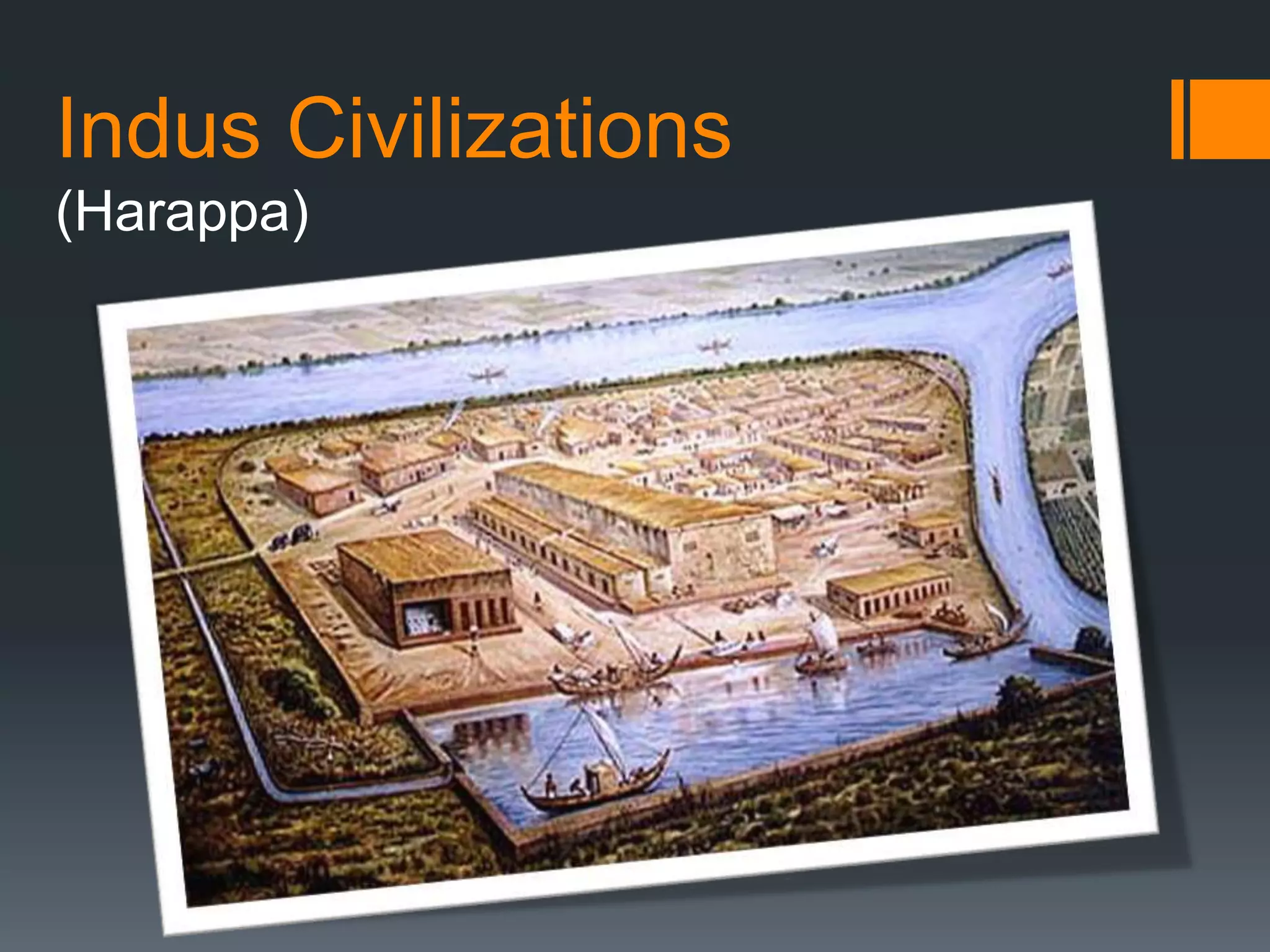


Indus Civilizations
(Harappa)
Group Members
 Habib Rehman Solangi D-13-PG-23
 Syed Waheeb D-13-PG-17
 Asif Turi D-13-PG-53
 Faisal Qadir D-13-PG-35
Context
Introduction to Civilization
Culture
Early humans and their culture
Harappa
Background
Origin and extent
Town planning
Economic activities
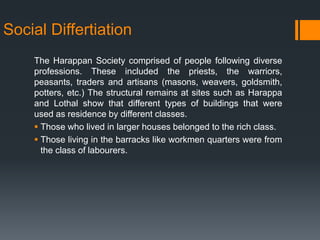
Social Dedifferentiation
Cloths and Embellish
Religious belief and practices
Decline of Harappan Civilization
conclusion
Introduction to civilization
Civilization: A form of human culture marked by urbanism, technological
adaptation, social complexity, long-distance trade, and symbolic communication.
The earliest humans lived by hunting, fishing, and collecting wild plants. Around
10,000 years ago, they learned to cultivate plants, herd animals, and make airtight
pottery for storage. These discoveries transformed them from gatherers to
producers, allowing them to grow in number and to lead a settled life. Beginning
about 5,000 years ago, a far more complex way of life began to appear in some
parts of the world. In these places humans learned how to increase harvests
through irrigation and other methods. Much larger populations came together in
towns, cities, and other centers, where they erected impressive structures and
where industry and commerce flourished. They developed writing, enabling them to
keep inventories of food and other resources. Specialized occupations emerged,
complex religions took form, and social divisions in-creased. These changes marked
the birth of civilization.
Culture
 The learned patterns of behavior and thoughts that help a
group adapt to it's surroundings.
 Culture consists of norms and ideas of behavior which
humans have created and which have no existence apart
from the human being and the human mankind.
 Cultural anthropologists, like Kroeber and Ruth Bendict,
defined culture as a pattern of behavior or design for living.
 The learned behavior and symbols that allow people to live
in group. The primary means by which human adapts to their
environments. The way of life characteristics of particular
human society.
Early Humans And Their Culture
Humans are cultural beings. Culture is the sum total of the ways of
living built up by a group and passed on from one generation to
another. Culture includes behavior such as courtship or child-
rearing practices; material things such as tools, clothing, and
shelter; and ideas, institutions, and beliefs. Language, apparently
a uniquely human trait, lies behind our ability to create ideas and
institutions and to transmit culture from one generation to another.
Our flexible and dexterous hands enable us to hold and make
tools and so to create the material artifacts of culture. Because
culture is learned and not inherited, it permits rapid adaptation to
changing conditions, making possible the spread of humanity to
almost all lands of the globe.
Harappa
Harappa was the third of the three earliest known civilizations.
1. There were the people who stomped the grounds of
Mesopotamia,
2. The culture which developed in Egypt, and
3. The society that arose in the Indus Valley neighborhood.
Harappan
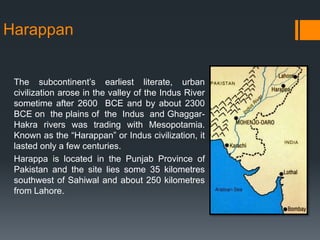
The subcontinent’s earliest literate, urban
civilization arose in the valley of the Indus River
sometime after 2600 BCE and by about 2300
BCE on the plains of the Indus and Ghaggar-
Hakra rivers was trading with Mesopotamia.
Known as the “Harappan” or Indus civilization, it
lasted only a few centuries.
Harappa is located in the Punjab Province of
Pakistan and the site lies some 35 kilometres
southwest of Sahiwal and about 250 kilometres
from Lahore.
Background
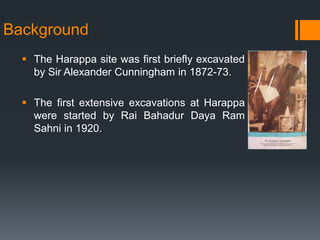
 The Harappa site was first briefly excavated
by Sir Alexander Cunningham in 1872-73.
 The first extensive excavations at Harappa
were started by Rai Bahadur Daya Ram
Sahni in 1920.
Cont..
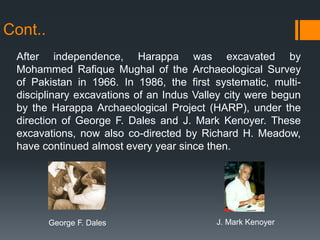
After independence, Harappa was excavated by
Mohammed Rafique Mughal of the Archaeological Survey
of Pakistan in 1966. In 1986, the first systematic, multi-
disciplinary excavations of an Indus Valley city were begun
by the Harappa Archaeological Project (HARP), under the
direction of George F. Dales and J. Mark Kenoyer. These
excavations, now also co-directed by Richard H. Meadow,
have continued almost every year since then.
George F. Dales J. Mark Kenoyer
Origin and Extent
The archaeological remains show that before the emergence of Harappan
civilization the people lived in small villages. As the time passed, there was
the emergence of small towns which ultimately led to full-fledged towns
during the Harappan period.
The whole period of Harappan civilization is in fact divided into three phases:
1. Early Harappan phase (3500 BC–2600 BC) – it was marked by some
town-planning in the form of mud structures, elementary trade, arts and
crafts, etc.,
2. Mature Harappan phase (2600 BC–1900 BC) – it was the period in which
we notice well developed towns with burnt brick structures, inland and
foreign trade, crafts of various types, etc.,
3. Late Harappan phase (1900 BC–1400 BC) – it was the phase of decline
during which many cities were abandoned and the trade disappeared
leading to the gradual decay of the significant urban traits.
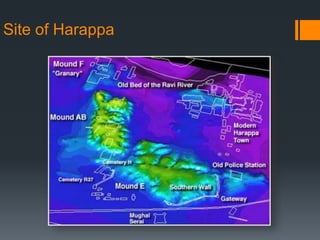
Site of Harappa
Town Planning
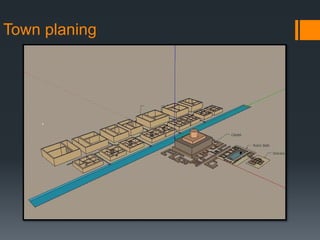
The site is divided into two parts
1. A citadel on higher mound on the western side. The citadel contain large
structures which might have functioned as administrative or ritual centre.
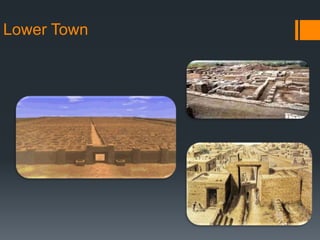
2. A lower town on the eastern side of the settlement.. The residential
buildings are built in the lower town.
The streets intersect each other at right angles in a criss-cross pattern. It divides
the city in several residential blocks. The main street is connected by narrow
lanes. The doors of the houses opened in these lanes and not the main streets.
The houses of common people, however, differed in size from a single-room
house in Harappa to bigger structures. The houses were largely built of burnt
bricks. The bigger houses had many rooms surrounding a square courtyard.
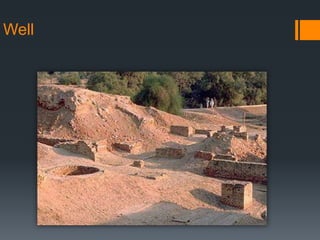
These houses were provided with private wells, kitchens and bathing plateforms.
The difference in the size of the houses suggests that the rich lived in the larger
houses whereas the one-room buildings or barracks might have been intended for
the poorer section of the society. The drainage system of the Harappans was
elaborate and well laid out. Every house had drains, which opened into the street
drains. These drains were covered with manholes bricks or stone slabs (which
could be removed for cleaning) were constructed at regular intervals by the side of
the streets for cleaning. This shows that the people were well acquainted with the
science of sanitation.
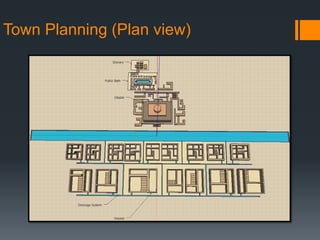
Town Planning (Plan view)
Town planing
Lower Town
Granary
Well
Economic Activities
 Agriculture and Pastoralism
 Industries and crafts
 Trade
Agriculture and Pastoralism
 Agriculture along with pastoralism (cattle-rearing) was the
base of Harappan economy.
 The irrigation was carried on a small scale by drawing water
from wells or by diverting river water into channels.
 The chief food crops included wheat, barley, sesasum,
mustard, peas, jejube, etc.
Industries and Crafts
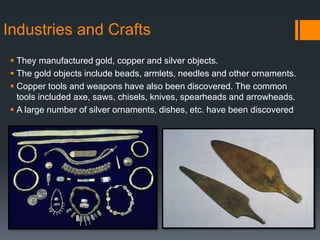
 They manufactured gold, copper and silver objects.
 The gold objects include beads, armlets, needles and other ornaments.
 Copper tools and weapons have also been discovered. The common
tools included axe, saws, chisels, knives, spearheads and arrowheads.
 A large number of silver ornaments, dishes, etc. have been discovered
Pottery
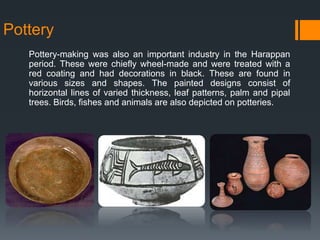
Pottery-making was also an important industry in the Harappan
period. These were chiefly wheel-made and were treated with a
red coating and had decorations in black. These are found in
various sizes and shapes. The painted designs consist of
horizontal lines of varied thickness, leaf patterns, palm and pipal
trees. Birds, fishes and animals are also depicted on potteries.
Bead making
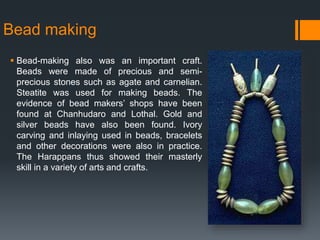
 Bead-making also was an important craft.
Beads were made of precious and semi-
precious stones such as agate and carnelian.
Steatite was used for making beads. The
evidence of bead makers’ shops have been
found at Chanhudaro and Lothal. Gold and
silver beads have also been found. Ivory
carving and inlaying used in beads, bracelets
and other decorations were also in practice.
The Harappans thus showed their masterly
skill in a variety of arts and crafts.
Seals
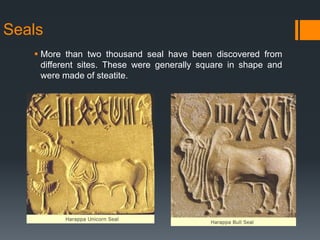
 More than two thousand seal have been discovered from
different sites. These were generally square in shape and
were made of steatite.
Trade
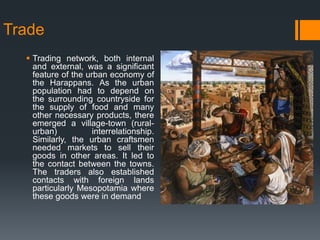
 Trading network, both internal
and external, was a significant
feature of the urban economy of
the Harappans. As the urban
population had to depend on
the surrounding countryside for
the supply of food and many
other necessary products, there
emerged a village-town (rural-
urban) interrelationship.
Similarly, the urban craftsmen
needed markets to sell their
goods in other areas. It led to
the contact between the towns.
The traders also established
contacts with foreign lands
particularly Mesopotamia where
these goods were in demand
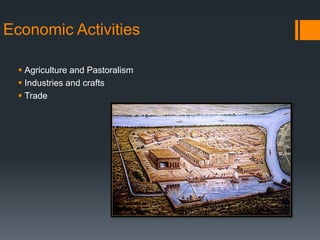
Dockyard for trade
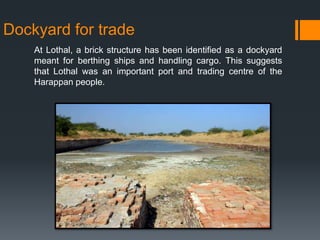
At Lothal, a brick structure has been identified as a dockyard
meant for berthing ships and handling cargo. This suggests
that Lothal was an important port and trading centre of the
Harappan people.
Social Differtiation
The Harappan Society comprised of people following diverse
professions. These included the priests, the warriors,
peasants, traders and artisans (masons, weavers, goldsmith,
potters, etc.) The structural remains at sites such as Harappa
and Lothal show that different types of buildings that were
used as residence by different classes.
 Those who lived in larger houses belonged to the rich class.
 Those living in the barracks like workmen quarters were from
the class of labourers.
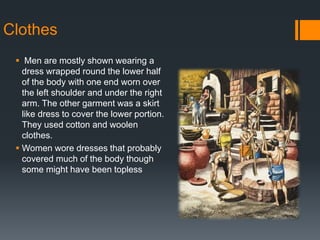
Clothes
 Men are mostly shown wearing a
dress wrapped round the lower half
of the body with one end worn over
the left shoulder and under the right
arm. The other garment was a skirt
like dress to cover the lower portion.
They used cotton and woolen
clothes.
 Women wore dresses that probably
covered much of the body though
some might have been topless
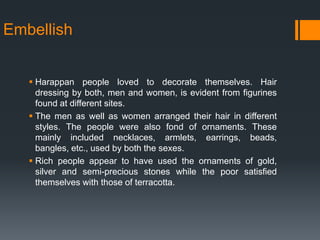
Embellish
 Harappan people loved to decorate themselves. Hair
dressing by both, men and women, is evident from figurines
found at different sites.
 The men as well as women arranged their hair in different
styles. The people were also fond of ornaments. These
mainly included necklaces, armlets, earrings, beads,
bangles, etc., used by both the sexes.
 Rich people appear to have used the ornaments of gold,
silver and semi-precious stones while the poor satisfied
themselves with those of terracotta.
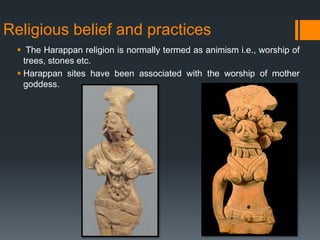
Religious belief and practices
 The Harappan religion is normally termed as animism i.e., worship of
trees, stones etc.
 Harappan sites have been associated with the worship of mother
goddess.
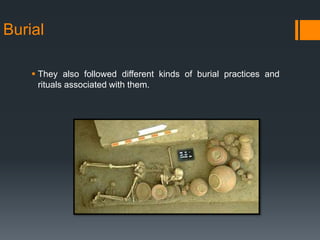
Burial
 They also followed different kinds of burial practices and
rituals associated with them.
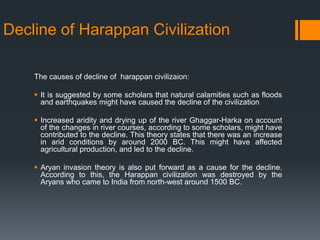
Decline of Harappan Civilization
The causes of decline of harappan civilizaion:
 It is suggested by some scholars that natural calamities such as floods
and earthquakes might have caused the decline of the civilization
 Increased aridity and drying up of the river Ghaggar-Harka on account
of the changes in river courses, according to some scholars, might have
contributed to the decline. This theory states that there was an increase
in arid conditions by around 2000 BC. This might have affected
agricultural production, and led to the decline.
 Aryan invasion theory is also put forward as a cause for the decline.
According to this, the Harappan civilization was destroyed by the
Aryans who came to India from north-west around 1500 BC.
Conclusion
 The subcontinent’s earliest literate, urban civilization arose in the
valley of the Indus River.
 Well-planned towns can be observed at some Harappan centres.
These towns were characterized by two broad divisions a citadel on
a higher mound and the lower town.
 Though there were skilled craftsmen who worked in copper and
other metals, the stone tools were still in common use.
 They had commercial links with Mesopotamian cities through Oman
and Bahrain in the Persian Gulf. The merchants traded in various
commodities of import and export.
 The people followed different professions such as those of priests,
physicians, warriors, peasants, traders and artisans
 Though the Harappans wore simple clothes made of cotton and
wool, they were fond of decorating themselves with various kinds of
ornaments.
 Scholars have suggested various factors such as natural calamities,
increased aridity, and the Aryan invasion for the decline of the
culture. The archaeological evidence suggests that this civilization
did not face a sudden collapse but had a gradual decline
Reference
 http://www.harappa.com/
 http://www.bbc.co.uk/schools/primaryhistory/indus_valley/home_life/
 http://www.ancient.eu.com/Indus_Valley_Civilization/
 http://www.britannica.com/EBchecked/topic/286837/Indus-civilization
 Ancient India Chapter 3 Harappan civilization

Presentation

  • 1.
  • 2.
    Group Members  HabibRehman Solangi D-13-PG-23  Syed Waheeb D-13-PG-17  Asif Turi D-13-PG-53  Faisal Qadir D-13-PG-35
  • 3.
    Context Introduction to Civilization Culture Earlyhumans and their culture Harappa Background Origin and extent Town planning Economic activities Social Dedifferentiation Cloths and Embellish Religious belief and practices Decline of Harappan Civilization conclusion
  • 4.
    Introduction to civilization Civilization:A form of human culture marked by urbanism, technological adaptation, social complexity, long-distance trade, and symbolic communication. The earliest humans lived by hunting, fishing, and collecting wild plants. Around 10,000 years ago, they learned to cultivate plants, herd animals, and make airtight pottery for storage. These discoveries transformed them from gatherers to producers, allowing them to grow in number and to lead a settled life. Beginning about 5,000 years ago, a far more complex way of life began to appear in some parts of the world. In these places humans learned how to increase harvests through irrigation and other methods. Much larger populations came together in towns, cities, and other centers, where they erected impressive structures and where industry and commerce flourished. They developed writing, enabling them to keep inventories of food and other resources. Specialized occupations emerged, complex religions took form, and social divisions in-creased. These changes marked the birth of civilization.
  • 5.
    Culture  The learnedpatterns of behavior and thoughts that help a group adapt to it's surroundings.  Culture consists of norms and ideas of behavior which humans have created and which have no existence apart from the human being and the human mankind.  Cultural anthropologists, like Kroeber and Ruth Bendict, defined culture as a pattern of behavior or design for living.  The learned behavior and symbols that allow people to live in group. The primary means by which human adapts to their environments. The way of life characteristics of particular human society.
  • 6.
    Early Humans AndTheir Culture Humans are cultural beings. Culture is the sum total of the ways of living built up by a group and passed on from one generation to another. Culture includes behavior such as courtship or child- rearing practices; material things such as tools, clothing, and shelter; and ideas, institutions, and beliefs. Language, apparently a uniquely human trait, lies behind our ability to create ideas and institutions and to transmit culture from one generation to another. Our flexible and dexterous hands enable us to hold and make tools and so to create the material artifacts of culture. Because culture is learned and not inherited, it permits rapid adaptation to changing conditions, making possible the spread of humanity to almost all lands of the globe.
  • 7.
    Harappa Harappa was thethird of the three earliest known civilizations. 1. There were the people who stomped the grounds of Mesopotamia, 2. The culture which developed in Egypt, and 3. The society that arose in the Indus Valley neighborhood.
  • 8.
    Harappan The subcontinent’s earliestliterate, urban civilization arose in the valley of the Indus River sometime after 2600 BCE and by about 2300 BCE on the plains of the Indus and Ghaggar- Hakra rivers was trading with Mesopotamia. Known as the “Harappan” or Indus civilization, it lasted only a few centuries. Harappa is located in the Punjab Province of Pakistan and the site lies some 35 kilometres southwest of Sahiwal and about 250 kilometres from Lahore.
  • 9.
    Background  The Harappasite was first briefly excavated by Sir Alexander Cunningham in 1872-73.  The first extensive excavations at Harappa were started by Rai Bahadur Daya Ram Sahni in 1920.
  • 10.
    Cont.. After independence, Harappawas excavated by Mohammed Rafique Mughal of the Archaeological Survey of Pakistan in 1966. In 1986, the first systematic, multi- disciplinary excavations of an Indus Valley city were begun by the Harappa Archaeological Project (HARP), under the direction of George F. Dales and J. Mark Kenoyer. These excavations, now also co-directed by Richard H. Meadow, have continued almost every year since then. George F. Dales J. Mark Kenoyer
  • 11.
    Origin and Extent Thearchaeological remains show that before the emergence of Harappan civilization the people lived in small villages. As the time passed, there was the emergence of small towns which ultimately led to full-fledged towns during the Harappan period. The whole period of Harappan civilization is in fact divided into three phases: 1. Early Harappan phase (3500 BC–2600 BC) – it was marked by some town-planning in the form of mud structures, elementary trade, arts and crafts, etc., 2. Mature Harappan phase (2600 BC–1900 BC) – it was the period in which we notice well developed towns with burnt brick structures, inland and foreign trade, crafts of various types, etc., 3. Late Harappan phase (1900 BC–1400 BC) – it was the phase of decline during which many cities were abandoned and the trade disappeared leading to the gradual decay of the significant urban traits.
  • 12.
  • 13.
    Town Planning The siteis divided into two parts 1. A citadel on higher mound on the western side. The citadel contain large structures which might have functioned as administrative or ritual centre. 2. A lower town on the eastern side of the settlement.. The residential buildings are built in the lower town. The streets intersect each other at right angles in a criss-cross pattern. It divides the city in several residential blocks. The main street is connected by narrow lanes. The doors of the houses opened in these lanes and not the main streets. The houses of common people, however, differed in size from a single-room house in Harappa to bigger structures. The houses were largely built of burnt bricks. The bigger houses had many rooms surrounding a square courtyard. These houses were provided with private wells, kitchens and bathing plateforms. The difference in the size of the houses suggests that the rich lived in the larger houses whereas the one-room buildings or barracks might have been intended for the poorer section of the society. The drainage system of the Harappans was elaborate and well laid out. Every house had drains, which opened into the street drains. These drains were covered with manholes bricks or stone slabs (which could be removed for cleaning) were constructed at regular intervals by the side of the streets for cleaning. This shows that the people were well acquainted with the science of sanitation.
  • 14.
  • 15.
  • 16.
  • 17.
  • 18.
  • 19.
    Economic Activities  Agricultureand Pastoralism  Industries and crafts  Trade
  • 20.
    Agriculture and Pastoralism Agriculture along with pastoralism (cattle-rearing) was the base of Harappan economy.  The irrigation was carried on a small scale by drawing water from wells or by diverting river water into channels.  The chief food crops included wheat, barley, sesasum, mustard, peas, jejube, etc.
  • 21.
    Industries and Crafts They manufactured gold, copper and silver objects.  The gold objects include beads, armlets, needles and other ornaments.  Copper tools and weapons have also been discovered. The common tools included axe, saws, chisels, knives, spearheads and arrowheads.  A large number of silver ornaments, dishes, etc. have been discovered
  • 22.
    Pottery Pottery-making was alsoan important industry in the Harappan period. These were chiefly wheel-made and were treated with a red coating and had decorations in black. These are found in various sizes and shapes. The painted designs consist of horizontal lines of varied thickness, leaf patterns, palm and pipal trees. Birds, fishes and animals are also depicted on potteries.
  • 23.
    Bead making  Bead-makingalso was an important craft. Beads were made of precious and semi- precious stones such as agate and carnelian. Steatite was used for making beads. The evidence of bead makers’ shops have been found at Chanhudaro and Lothal. Gold and silver beads have also been found. Ivory carving and inlaying used in beads, bracelets and other decorations were also in practice. The Harappans thus showed their masterly skill in a variety of arts and crafts.
  • 24.
    Seals  More thantwo thousand seal have been discovered from different sites. These were generally square in shape and were made of steatite.
  • 25.
    Trade  Trading network,both internal and external, was a significant feature of the urban economy of the Harappans. As the urban population had to depend on the surrounding countryside for the supply of food and many other necessary products, there emerged a village-town (rural- urban) interrelationship. Similarly, the urban craftsmen needed markets to sell their goods in other areas. It led to the contact between the towns. The traders also established contacts with foreign lands particularly Mesopotamia where these goods were in demand
  • 26.
    Dockyard for trade AtLothal, a brick structure has been identified as a dockyard meant for berthing ships and handling cargo. This suggests that Lothal was an important port and trading centre of the Harappan people.
  • 27.
    Social Differtiation The HarappanSociety comprised of people following diverse professions. These included the priests, the warriors, peasants, traders and artisans (masons, weavers, goldsmith, potters, etc.) The structural remains at sites such as Harappa and Lothal show that different types of buildings that were used as residence by different classes.  Those who lived in larger houses belonged to the rich class.  Those living in the barracks like workmen quarters were from the class of labourers.
  • 28.
    Clothes  Men aremostly shown wearing a dress wrapped round the lower half of the body with one end worn over the left shoulder and under the right arm. The other garment was a skirt like dress to cover the lower portion. They used cotton and woolen clothes.  Women wore dresses that probably covered much of the body though some might have been topless
  • 29.
    Embellish  Harappan peopleloved to decorate themselves. Hair dressing by both, men and women, is evident from figurines found at different sites.  The men as well as women arranged their hair in different styles. The people were also fond of ornaments. These mainly included necklaces, armlets, earrings, beads, bangles, etc., used by both the sexes.  Rich people appear to have used the ornaments of gold, silver and semi-precious stones while the poor satisfied themselves with those of terracotta.
  • 30.
    Religious belief andpractices  The Harappan religion is normally termed as animism i.e., worship of trees, stones etc.  Harappan sites have been associated with the worship of mother goddess.
  • 31.
    Burial  They alsofollowed different kinds of burial practices and rituals associated with them.
  • 32.
    Decline of HarappanCivilization The causes of decline of harappan civilizaion:  It is suggested by some scholars that natural calamities such as floods and earthquakes might have caused the decline of the civilization  Increased aridity and drying up of the river Ghaggar-Harka on account of the changes in river courses, according to some scholars, might have contributed to the decline. This theory states that there was an increase in arid conditions by around 2000 BC. This might have affected agricultural production, and led to the decline.  Aryan invasion theory is also put forward as a cause for the decline. According to this, the Harappan civilization was destroyed by the Aryans who came to India from north-west around 1500 BC.
  • 33.
    Conclusion  The subcontinent’searliest literate, urban civilization arose in the valley of the Indus River.  Well-planned towns can be observed at some Harappan centres. These towns were characterized by two broad divisions a citadel on a higher mound and the lower town.  Though there were skilled craftsmen who worked in copper and other metals, the stone tools were still in common use.  They had commercial links with Mesopotamian cities through Oman and Bahrain in the Persian Gulf. The merchants traded in various commodities of import and export.  The people followed different professions such as those of priests, physicians, warriors, peasants, traders and artisans  Though the Harappans wore simple clothes made of cotton and wool, they were fond of decorating themselves with various kinds of ornaments.  Scholars have suggested various factors such as natural calamities, increased aridity, and the Aryan invasion for the decline of the culture. The archaeological evidence suggests that this civilization did not face a sudden collapse but had a gradual decline
  • 34.
    Reference  http://www.harappa.com/  http://www.bbc.co.uk/schools/primaryhistory/indus_valley/home_life/ http://www.ancient.eu.com/Indus_Valley_Civilization/  http://www.britannica.com/EBchecked/topic/286837/Indus-civilization  Ancient India Chapter 3 Harappan civilization