Task 1 - Research
Op Art – Optical Art
• Op Art is a form of art which consists of warping or swelling of
shapes. The artist gives an impression of movement or vibrations and
can even show hidden images or flashing.
• Key Words:
• Optical illusions
• Perspective
• Movement
• Bold
2.4
Task 1 – Research – Web source
Title/Weblink/Date accessed:
2.2
2.3
The origin go back to pre-war
including the constructivist ideas of the
1920s Bauhaus Design School in Germany
Josef Albers (a lecture) from Bauhaus Design
School left to America where he designed the
Famous “Homage To The Square” (Picture on
the right)
https://www.google.com/search?q=Homage+to+the+Square&safe=strict&sxsrf=ACYBGNRXUPAzkjw-
K8ZbFYJE_By7vIDGhg:1568034043100&tbm=isch&source=iu&ictx=1&fir=gc6O1_2TbQ2ehM%253A%252Cmy3NLQR5diElWM%252C%252Fg%252F11cncmfnvl&vet=1&usg=AI4_-
kTqfO3YrSpCHLp7jlBxiXI7iiTeSw&sa=X&ved=2ahUKEwj1vIeB5sPkAhW7QxUIHbZZCMgQ_B0wE3oECAMQAw&cshid=1568034235595494#imgrc=f7BtnwerNaUhIM:&vet=1
Task 1 – Research – Web source
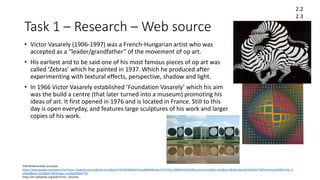
• Victor Vasarely (1906-1997) was a French-Hungarian artist who was
accepted as a “leader/grandfather” of the movement of op art.
• His earliest and to be said one of his most famous pieces of op art was
called ‘Zebras’ which he painted in 1937. Which he produced after
experimenting with textural effects, perspective, shadow and light.
• In 1966 Victor Vasarely established ‘Foundation Vasarely’ which his aim
was the build a centre (that later turned into a museum) promoting his
ideas of art. It first opened in 1976 and is located in France. Still to this
day is open everyday, and features large sculptures of his work and larger
copies of his work.
2.2
2.3
Title/Weblink/Date accessed:
https://www.google.com/search?q=Victor+Vasarely+op+art&safe=strict&sxsrf=ACYBGNRQvIPfrVtydbQXRWofwL72TATKFg:1568034433556&source=lnms&tbm=isch&sa=X&ved=0ahUKEwiHhKG758PkAhVnUxUIHZBnC1IQ_A
UIEigB&biw=1256&bih=905#imgrc=coVXgNSfdXeF7M:
https://en.wikipedia.org/wiki/Victor_Vasarely
Task 1 – Research – Book source
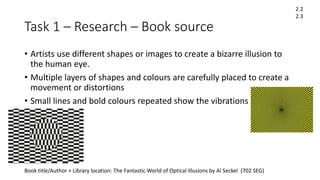
• Artists use different shapes or images to create a bizarre illusion to
the human eye.
• Multiple layers of shapes and colours are carefully placed to create a
movement or distortions
• Small lines and bold colours repeated show the vibrations
Book title/Author + Library location: The Fantastic World of Optical Illusions by Al Seckel (702 SEG)
2.2
2.3
Task 1 – Research – Book source
2.2
2.3
Book title/Author + Library location: The Fantastic World of Optical Illusions by Al Seckel (702 SEG)
Artist: Bridget
Riley
Task 2a – Idea Generation [individual]
Optical illusion art is usually
used to convey visuals of a
drug trip without being under
the influence.
Task 2a – Idea Generation [group]
As a group we decided to use
drug trip art, mix it with the style
of Op Art to create an art
exhibition.
We looked at artists such as Bridget Riley,
Victor Vasarely and Josef Albers.
Josef Albers
Bridget Riley
Victor Vasarely
Task 2b – Action Plan/Schedule
Session Activity Who is responsibile
1 Research Web/Book All
2 Research Web/Book All
3 Idea Generation Individual/ group
4 Production individual
5 Production individual
6 Production individual
7 Evaluation
3.1
Task 2b – Action Plan/Schedule
3.1
• Add notes here on how you stuck to your plan/had to change your
plan and why
• Keeping the same aspect of illusions as the main effect in the poster
• Going to add the Lahaina Banyan Tree in Hawaii to showcase the
evolvement of Op Art which also links with the title being a Hawaiian
language
Task 2c – Planning
• Use these slides to show your planning of your products, think about
structure and the components for each product [evidence for this
may include storyboards, flat plans, sketches, etc]
3.2
Task 2c – Planning
• Use these slides to show your planning of your products, think about
structure and the components for each product [evidence for this
may include storyboards, flat plans, sketches, etc]
• The main aspect of the design is the Lahaina Banyan Tree in Hawaii,
this because of many different reasons. First of the location of Hawaii
links with the Title being in the Hawaiian language. Second the fact it
is a tree symbolises the growth of Op Art throughout the year and
how much it has progressed. Similar to that the Tree has a 0.66 acre
size rout which is showing how little of Op Art has been discovered
and how much potential Op Art still has.
3.2
Task 2c – Planning
• Use these slides to show your planning of your products, think about
structure and the components for each product [evidence for this
may include storyboards, flat plans, sketches, etc]
• Added a TV to make a multi layer affect to improve illusion both in
and outside of the TV
• The location (weed Museum in Amsterdam) is used because it links in
nicely with the title “Drug Trip”
• The date show cases 420 a slang used for Weed, also linked with the
title
3.2
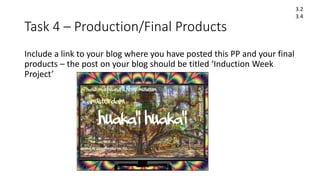
Task 4 – Production/Final Products
Include a link to your blog where you have posted this PP and your final
products – the post on your blog should be titled ‘Induction Week
Project’
3.2
3.4
Task 5 – Evaluation – Problem Solving
• Describe three problems you faced in your project and how you
solved these
• 1 Working out how to use Photoshop to its full potential
• 2 As a group we where unsure on what title to use on the poster
• 3 Working out how to make my design unique to everyone else
3.3
Task 5 – Evaluation – Working with others
• Choose three aspects of your production where you worked well with
your team and this benefited the project
• 1 Ben helped me how to use Photoshop, such as rotating and scaling
photos
• 2 Good coordination skills, for example Jodie did the book research as
me and Ben did Web research
• 3 Good communication skills within the group that helped come to a
plan quickly
1.2b
Task 5 – Evaluation - Feedback
• Discuss the feedback you received from your tutor during the project
and how you used this to improve the project
• Tutor talked about how I could mix the contrast of the illusion with
the Lahaina Banyan Tree to make it compact and ultimately make it
more complete.
• He also spoke about the hierarchy of the text and the size that would
mix the best with the poster design
3.5
Task 5 – Evaluation – Active Engagement
• Define active engagement in your studies and briefly explain how you
used it in this project
• I studied the state of the US, Hawaii and found the most important
monuments in the region & I found the Lahiana Banyan Tree. I used it
as a concept that the size of the Tree and how much it has grown links
in with how much Op Art has grown. Also the size of the root
corresponds with how much is yet to be explored in Op Art.
1.2a
Task 5 – Evaluation
Accessing and storing information
• Explain where the books/resources are for your area in the LC
• 2nd floor Library in college
• Explain how to take a book/resource out of the LC
• Book a book out at the library with my lanyard
2.1
Task 5 – Evaluation
Accessing and storing information
• Explain where to store electronic information on the college network
• OneDrive, email, desktop
• Explain where you upload work when it is completed
• Bloggers
2.1
Task 6 - How do you learn best?
• Explain some of the ways you think you learn best [refer to the VAK
questionnaire results in tutorial]:
1.1
Task 6 - How do you learn best?
• What makes it hard for you to study?
• What strategies do you think would benefit your studies?
1.1

Induction Project

  • 1.
    Task 1 -Research Op Art – Optical Art • Op Art is a form of art which consists of warping or swelling of shapes. The artist gives an impression of movement or vibrations and can even show hidden images or flashing. • Key Words: • Optical illusions • Perspective • Movement • Bold 2.4
  • 3.
    Task 1 –Research – Web source Title/Weblink/Date accessed: 2.2 2.3 The origin go back to pre-war including the constructivist ideas of the 1920s Bauhaus Design School in Germany Josef Albers (a lecture) from Bauhaus Design School left to America where he designed the Famous “Homage To The Square” (Picture on the right) https://www.google.com/search?q=Homage+to+the+Square&safe=strict&sxsrf=ACYBGNRXUPAzkjw- K8ZbFYJE_By7vIDGhg:1568034043100&tbm=isch&source=iu&ictx=1&fir=gc6O1_2TbQ2ehM%253A%252Cmy3NLQR5diElWM%252C%252Fg%252F11cncmfnvl&vet=1&usg=AI4_- kTqfO3YrSpCHLp7jlBxiXI7iiTeSw&sa=X&ved=2ahUKEwj1vIeB5sPkAhW7QxUIHbZZCMgQ_B0wE3oECAMQAw&cshid=1568034235595494#imgrc=f7BtnwerNaUhIM:&vet=1
  • 4.
    Task 1 –Research – Web source • Victor Vasarely (1906-1997) was a French-Hungarian artist who was accepted as a “leader/grandfather” of the movement of op art. • His earliest and to be said one of his most famous pieces of op art was called ‘Zebras’ which he painted in 1937. Which he produced after experimenting with textural effects, perspective, shadow and light. • In 1966 Victor Vasarely established ‘Foundation Vasarely’ which his aim was the build a centre (that later turned into a museum) promoting his ideas of art. It first opened in 1976 and is located in France. Still to this day is open everyday, and features large sculptures of his work and larger copies of his work. 2.2 2.3 Title/Weblink/Date accessed: https://www.google.com/search?q=Victor+Vasarely+op+art&safe=strict&sxsrf=ACYBGNRQvIPfrVtydbQXRWofwL72TATKFg:1568034433556&source=lnms&tbm=isch&sa=X&ved=0ahUKEwiHhKG758PkAhVnUxUIHZBnC1IQ_A UIEigB&biw=1256&bih=905#imgrc=coVXgNSfdXeF7M: https://en.wikipedia.org/wiki/Victor_Vasarely
  • 5.
    Task 1 –Research – Book source • Artists use different shapes or images to create a bizarre illusion to the human eye. • Multiple layers of shapes and colours are carefully placed to create a movement or distortions • Small lines and bold colours repeated show the vibrations Book title/Author + Library location: The Fantastic World of Optical Illusions by Al Seckel (702 SEG) 2.2 2.3
  • 6.
    Task 1 –Research – Book source 2.2 2.3 Book title/Author + Library location: The Fantastic World of Optical Illusions by Al Seckel (702 SEG) Artist: Bridget Riley
  • 7.
    Task 2a –Idea Generation [individual] Optical illusion art is usually used to convey visuals of a drug trip without being under the influence.
  • 8.
    Task 2a –Idea Generation [group] As a group we decided to use drug trip art, mix it with the style of Op Art to create an art exhibition. We looked at artists such as Bridget Riley, Victor Vasarely and Josef Albers. Josef Albers Bridget Riley Victor Vasarely
  • 9.
    Task 2b –Action Plan/Schedule Session Activity Who is responsibile 1 Research Web/Book All 2 Research Web/Book All 3 Idea Generation Individual/ group 4 Production individual 5 Production individual 6 Production individual 7 Evaluation 3.1
  • 10.
    Task 2b –Action Plan/Schedule 3.1 • Add notes here on how you stuck to your plan/had to change your plan and why • Keeping the same aspect of illusions as the main effect in the poster • Going to add the Lahaina Banyan Tree in Hawaii to showcase the evolvement of Op Art which also links with the title being a Hawaiian language
  • 11.
    Task 2c –Planning • Use these slides to show your planning of your products, think about structure and the components for each product [evidence for this may include storyboards, flat plans, sketches, etc] 3.2
  • 12.
    Task 2c –Planning • Use these slides to show your planning of your products, think about structure and the components for each product [evidence for this may include storyboards, flat plans, sketches, etc] • The main aspect of the design is the Lahaina Banyan Tree in Hawaii, this because of many different reasons. First of the location of Hawaii links with the Title being in the Hawaiian language. Second the fact it is a tree symbolises the growth of Op Art throughout the year and how much it has progressed. Similar to that the Tree has a 0.66 acre size rout which is showing how little of Op Art has been discovered and how much potential Op Art still has. 3.2
  • 13.
    Task 2c –Planning • Use these slides to show your planning of your products, think about structure and the components for each product [evidence for this may include storyboards, flat plans, sketches, etc] • Added a TV to make a multi layer affect to improve illusion both in and outside of the TV • The location (weed Museum in Amsterdam) is used because it links in nicely with the title “Drug Trip” • The date show cases 420 a slang used for Weed, also linked with the title 3.2
  • 14.
    Task 4 –Production/Final Products Include a link to your blog where you have posted this PP and your final products – the post on your blog should be titled ‘Induction Week Project’ 3.2 3.4
  • 15.
    Task 5 –Evaluation – Problem Solving • Describe three problems you faced in your project and how you solved these • 1 Working out how to use Photoshop to its full potential • 2 As a group we where unsure on what title to use on the poster • 3 Working out how to make my design unique to everyone else 3.3
  • 16.
    Task 5 –Evaluation – Working with others • Choose three aspects of your production where you worked well with your team and this benefited the project • 1 Ben helped me how to use Photoshop, such as rotating and scaling photos • 2 Good coordination skills, for example Jodie did the book research as me and Ben did Web research • 3 Good communication skills within the group that helped come to a plan quickly 1.2b
  • 17.
    Task 5 –Evaluation - Feedback • Discuss the feedback you received from your tutor during the project and how you used this to improve the project • Tutor talked about how I could mix the contrast of the illusion with the Lahaina Banyan Tree to make it compact and ultimately make it more complete. • He also spoke about the hierarchy of the text and the size that would mix the best with the poster design 3.5
  • 18.
    Task 5 –Evaluation – Active Engagement • Define active engagement in your studies and briefly explain how you used it in this project • I studied the state of the US, Hawaii and found the most important monuments in the region & I found the Lahiana Banyan Tree. I used it as a concept that the size of the Tree and how much it has grown links in with how much Op Art has grown. Also the size of the root corresponds with how much is yet to be explored in Op Art. 1.2a
  • 19.
    Task 5 –Evaluation Accessing and storing information • Explain where the books/resources are for your area in the LC • 2nd floor Library in college • Explain how to take a book/resource out of the LC • Book a book out at the library with my lanyard 2.1
  • 20.
    Task 5 –Evaluation Accessing and storing information • Explain where to store electronic information on the college network • OneDrive, email, desktop • Explain where you upload work when it is completed • Bloggers 2.1
  • 21.
    Task 6 -How do you learn best? • Explain some of the ways you think you learn best [refer to the VAK questionnaire results in tutorial]: 1.1
  • 22.
    Task 6 -How do you learn best? • What makes it hard for you to study? • What strategies do you think would benefit your studies? 1.1