211EEE1301-
Basic Electrical and Electronics Engineering
YOU DON'T NEED ANYONE PERMISSION TO MAKE SOMETHING GREAT.-MASSIMO BANZI
UNIT-III
ELECTRICAL MACHINES
Induction Motor
© Kalasalingam academy of research and education
Induction Motor
Induction motors are used worldwide in many residential,
commercial, industrial, and utility applications.
Induction Motors transform electrical energy into mechanical
energy.
It can be part of a pump or fan, or connected to some other form
of mechanical equipment such as a winder, conveyor, or mixer.
2
© Kalasalingam academy of research and education
Types
Three Phase Induction motor
Single Phase Induction motor
3
© Kalasalingam academy of research and education
3 Phase IM Construction
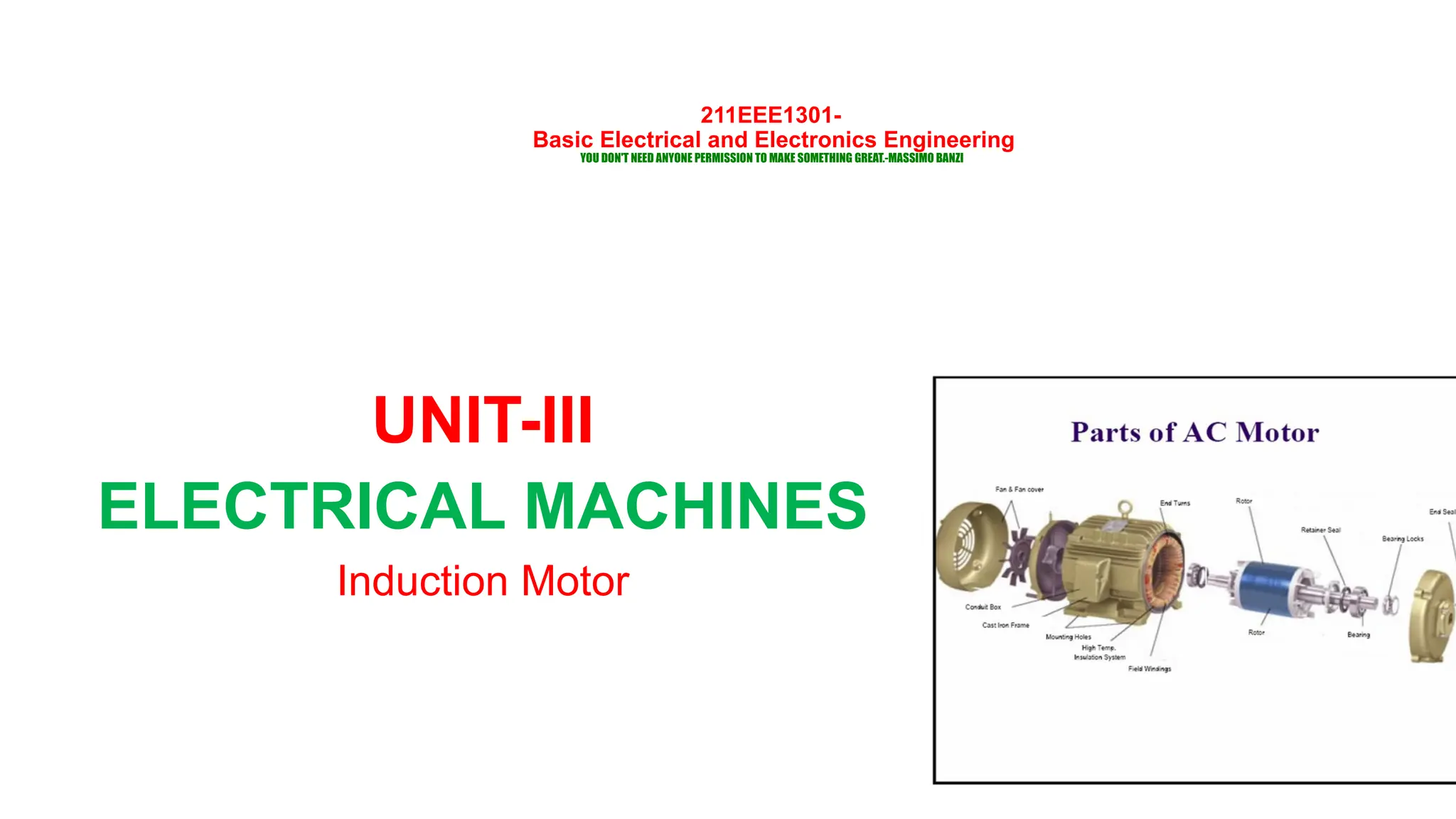
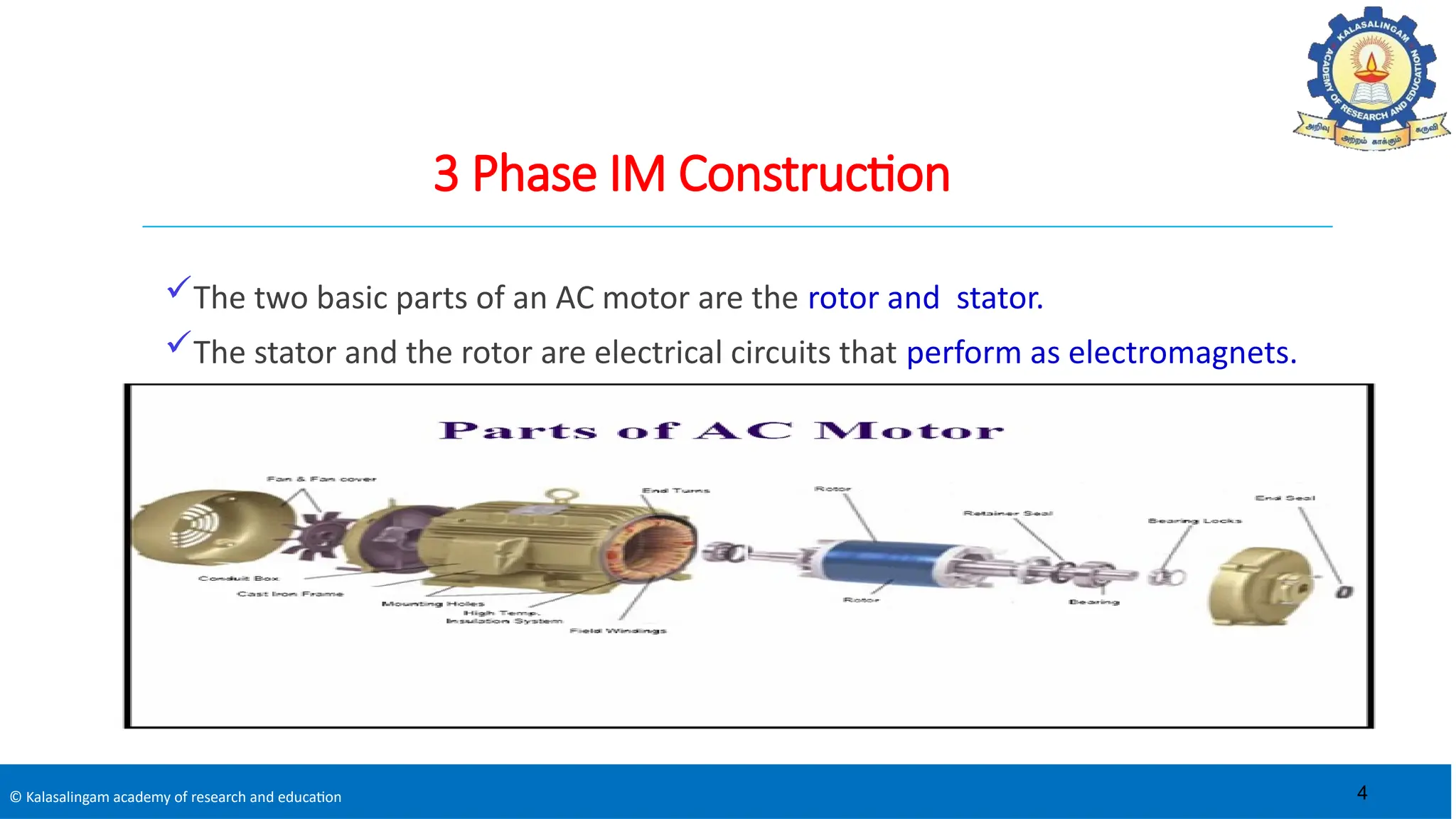
The two basic parts of an AC motor are the rotor and stator.
The stator and the rotor are electrical circuits that perform as electromagnets.
4
© Kalasalingam academy of research and education
Construction (Stator construction)
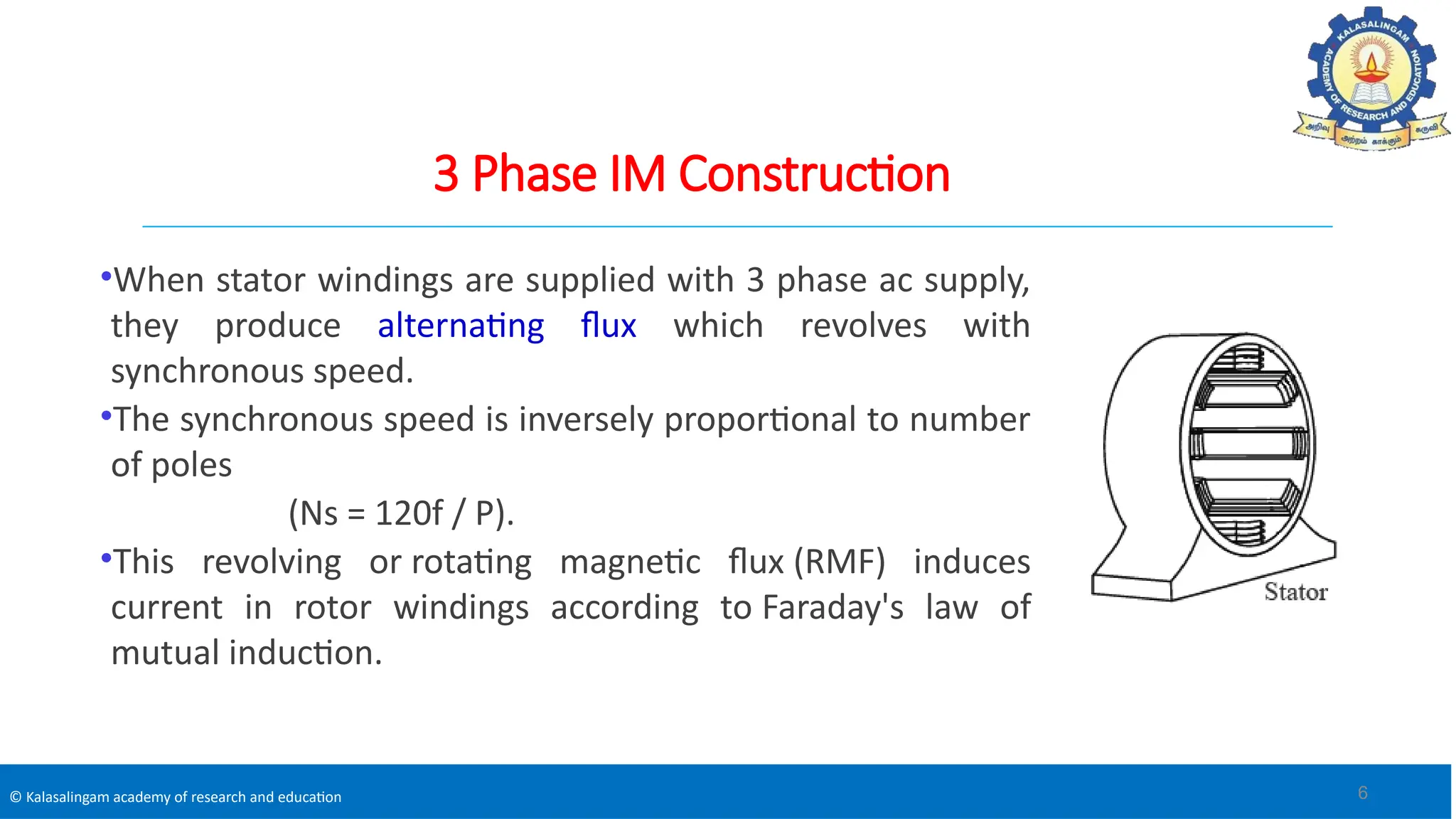
The stator is the stationary electrical part of the motor.
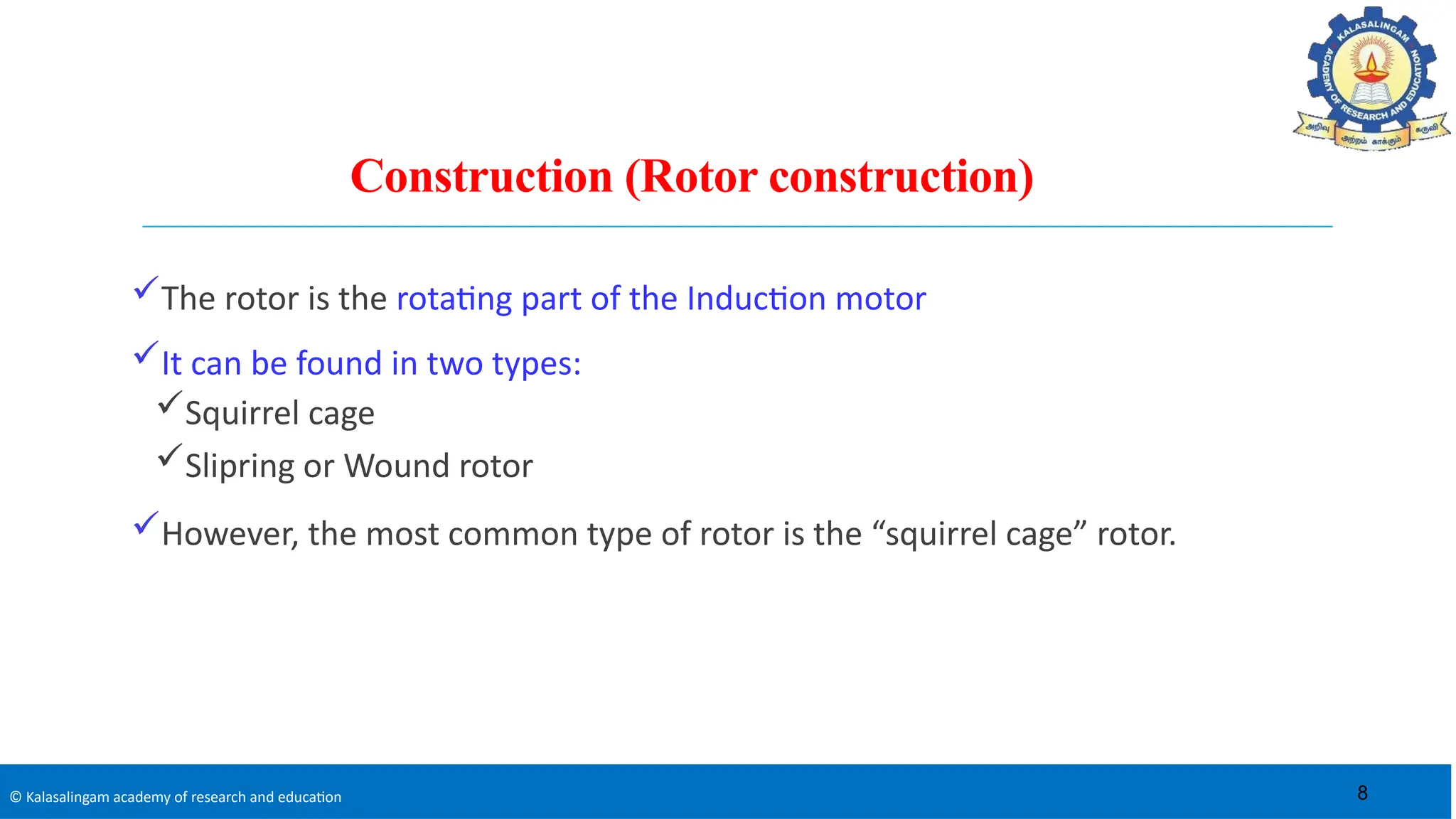
The stator of a 3 phase IM (Induction Motor) is made up with number of
stampings, and these stampings are slotted to receive the stator winding.
The stator is wound with a 3 phase winding which is fed from a 3 phase
supply.
 It is wound for a defined number of poles, and the number of poles is
determined from the required speed.
5
© Kalasalingam academy of research and education
3 Phase IM Construction
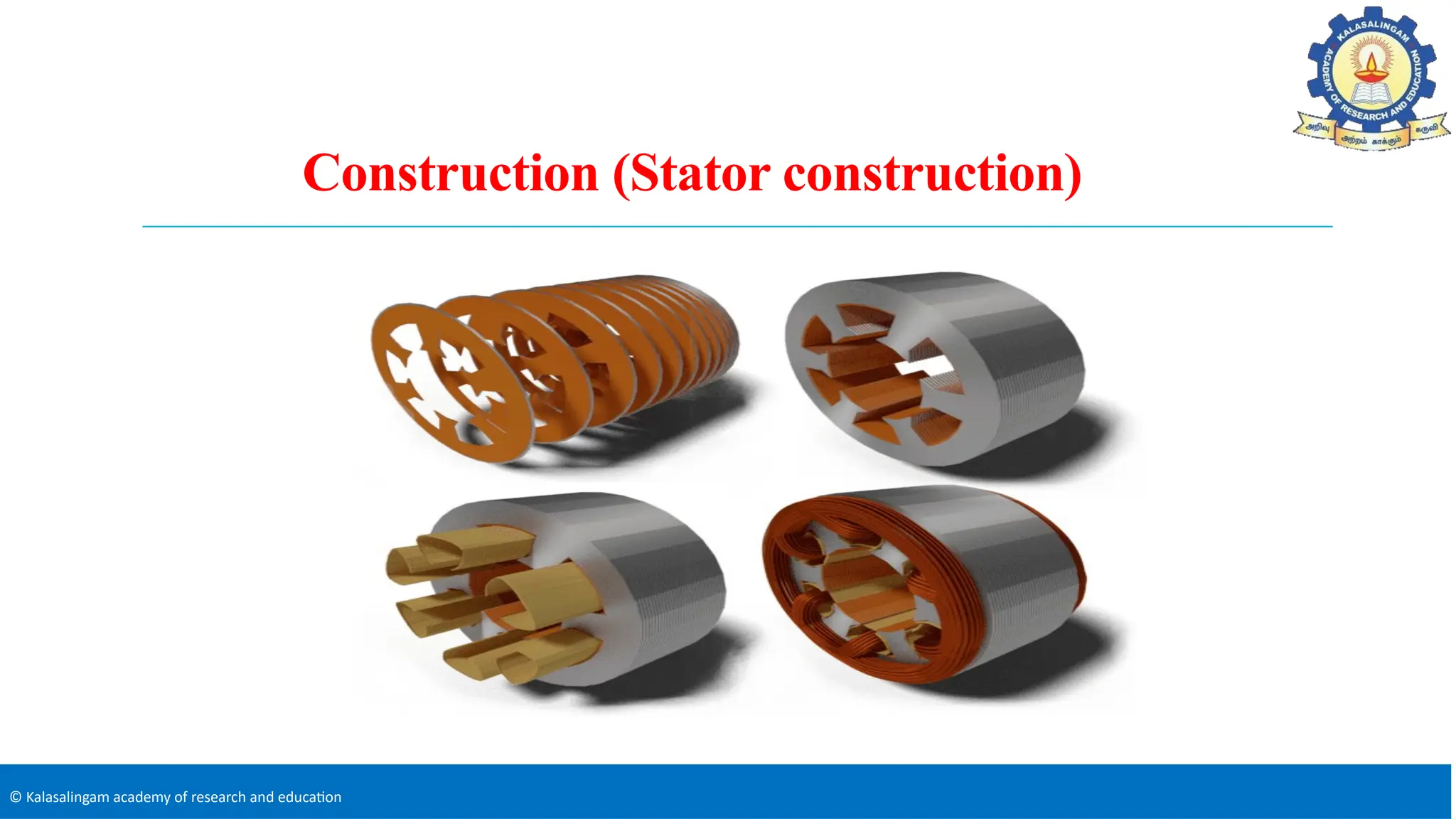
•When stator windings are supplied with 3 phase ac supply,
they produce alternating flux which revolves with
synchronous speed.
•The synchronous speed is inversely proportional to number
of poles
(Ns = 120f / P).
•This revolving or rotating magnetic flux (RMF) induces
current in rotor windings according to Faraday's law of
mutual induction.
6
© Kalasalingam academy of research and education
Construction (Stator construction)
© Kalasalingam academy of research and education
Construction (Rotor construction)
The rotor is the rotating part of the Induction motor
It can be found in two types:
Squirrel cage
Slipring or Wound rotor
However, the most common type of rotor is the “squirrel cage” rotor.
8
© Kalasalingam academy of research and education
Construction (Rotor construction)

Induction motor types:
◦ Squirrel cage type:
Rotor winding is composed of copper bars embedded in the rotor slots and shorted at both end by end rings
Simple, low cost, robust, low maintenance
◦ Slipring or Wound rotor type:
Rotor winding is wound by wires. The winding terminals can be connected to external circuits through slip
rings and brushes.
Easy to control speed, more expensive.
9
© Kalasalingam academy of research and education
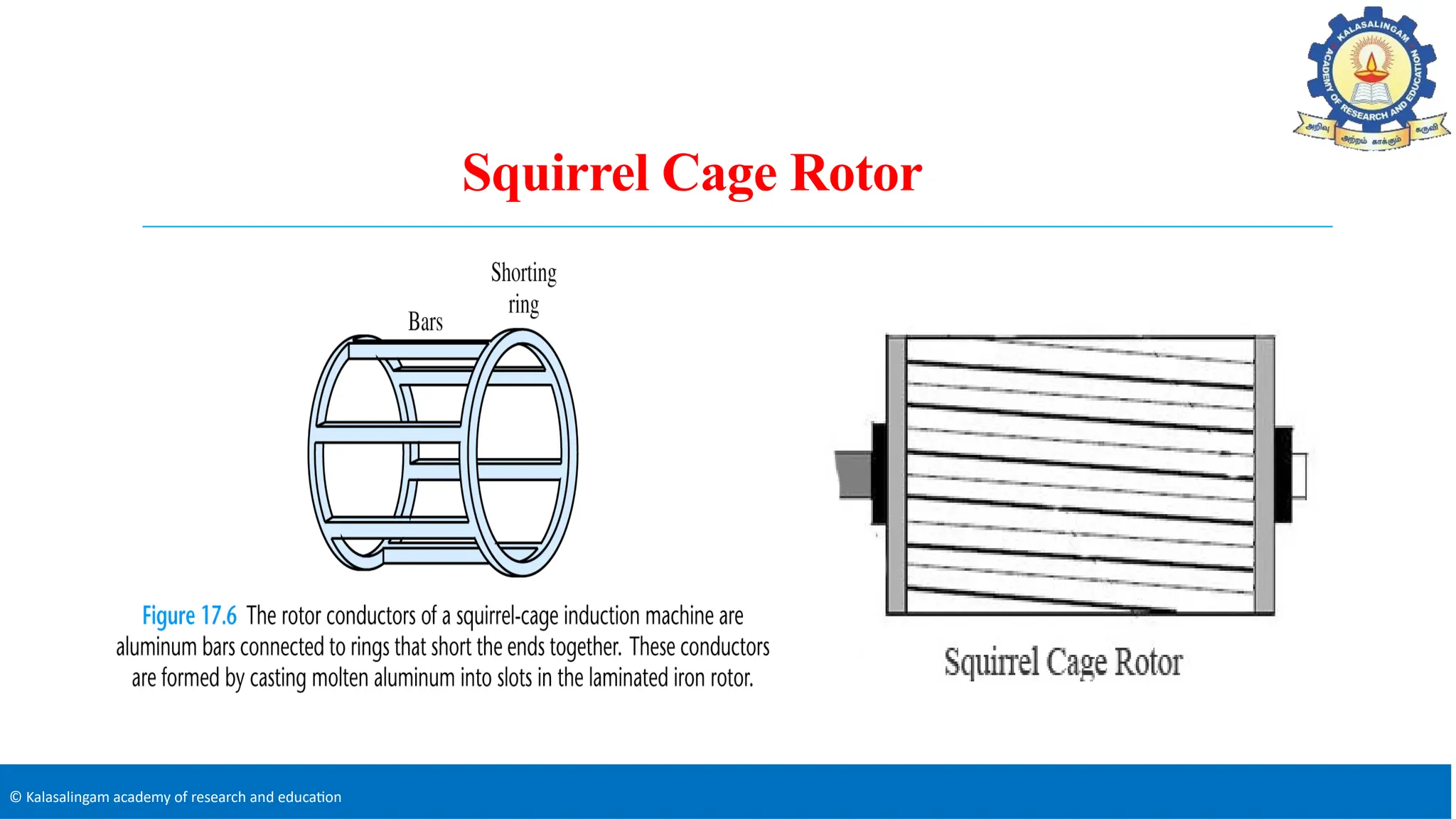
Squirrel Cage Rotor
Most of the induction motors (upto 90%) are of squirrel cage type.
Squirrel cage type rotor has very simple construction.
This type of rotor consist of a cylindrical laminated core, having parallel slots on
it.
These parallel slots carry rotor conductors.
In this type of rotor, heavy bars of copper, aluminum or alloys are used as rotor
conductors instead of wires.
The rotor bars are electrically welded to short circuiting end rings at both ends.
Thus this rotor construction looks like a squirrel cage and hence we call it.
 The rotor bars are permanently short circuited, hence it is not possible to add any
external resistance to armature circuit.
10
© Kalasalingam academy of research and education
Squirrel Cage Rotor
© Kalasalingam academy of research and education
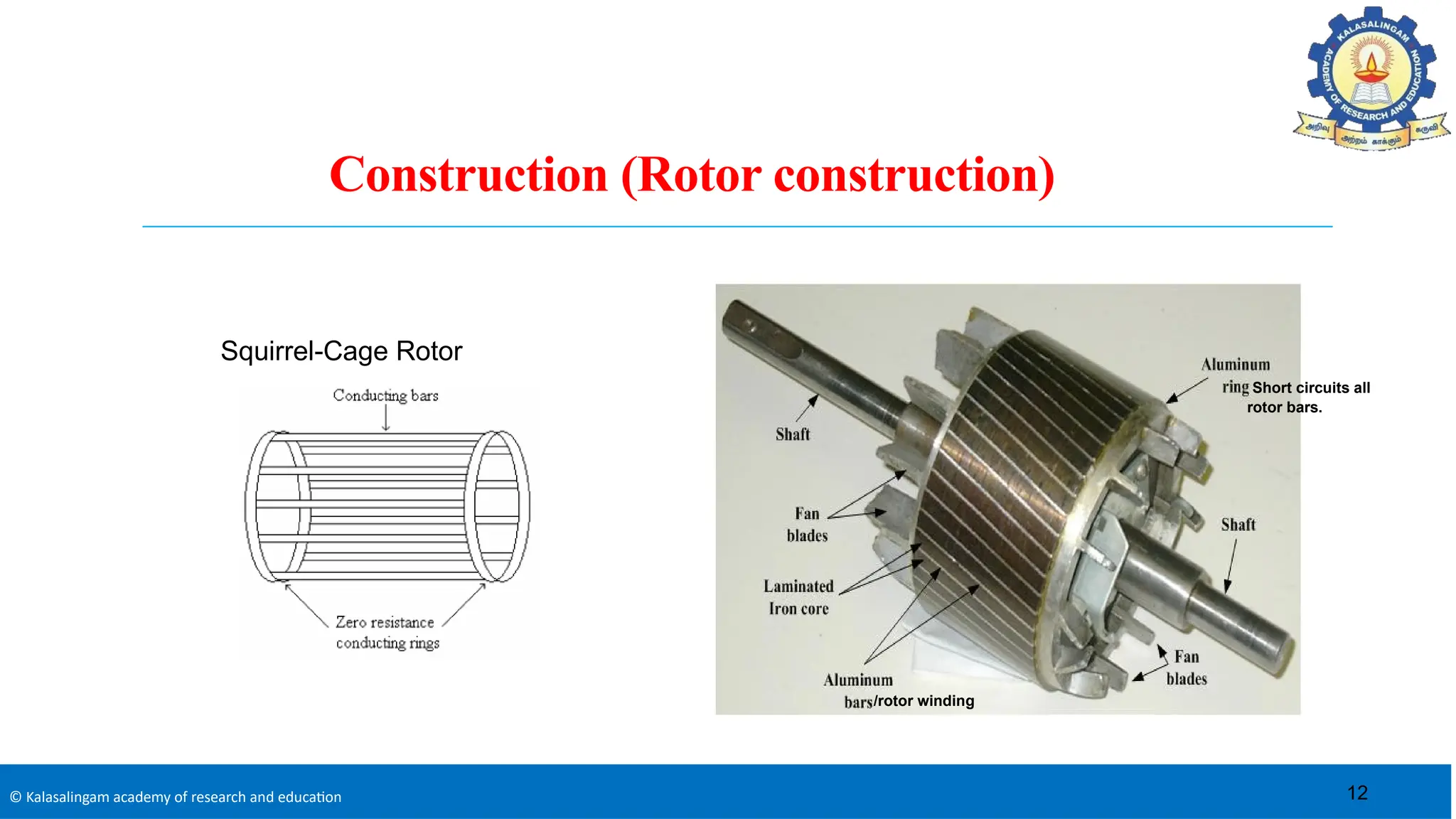
Construction (Rotor construction)
12
Squirrel-Cage Rotor
/rotor winding
Short circuits all
rotor bars.
© Kalasalingam academy of research and education
Slipring or Wound rotor type
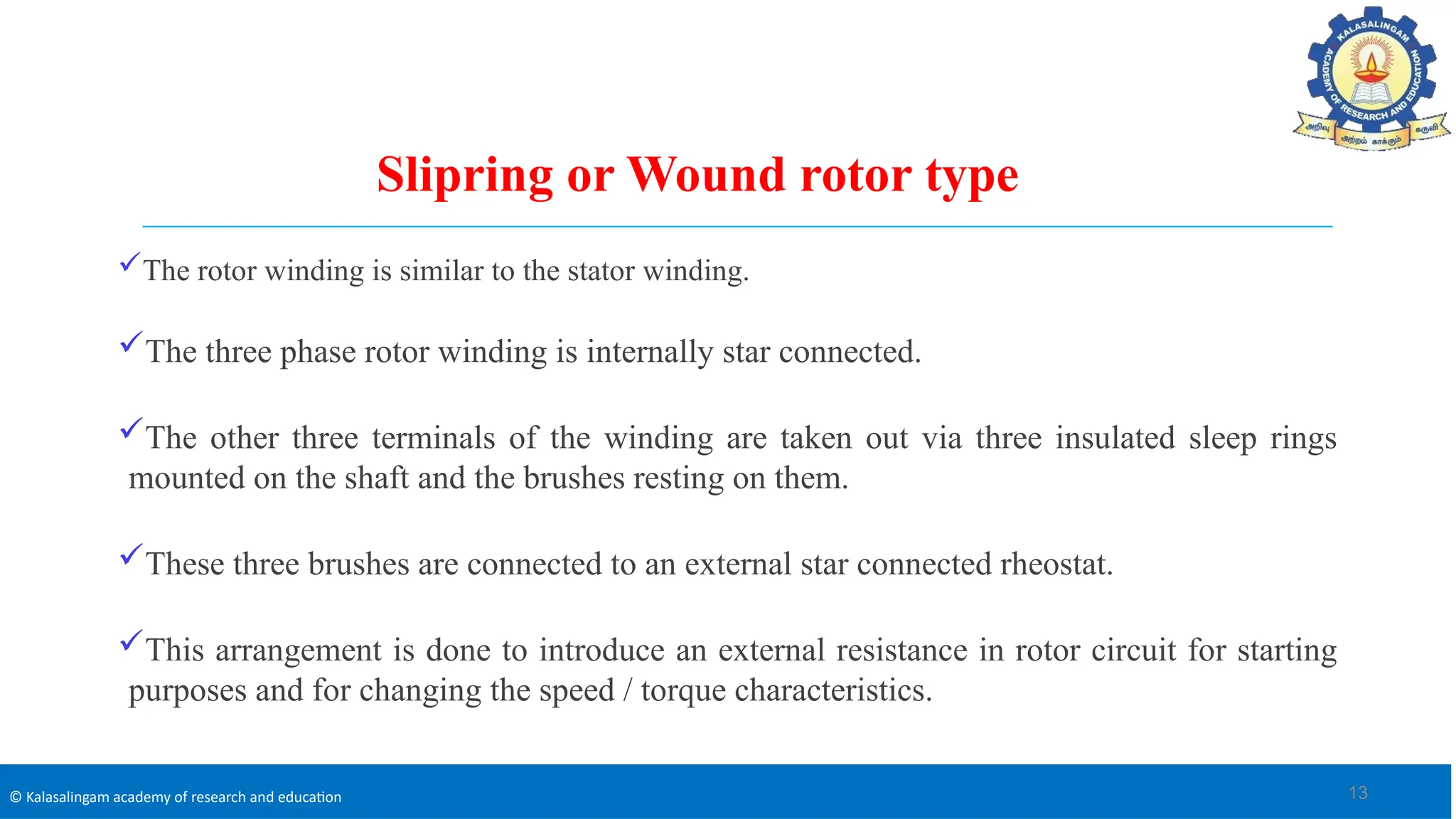
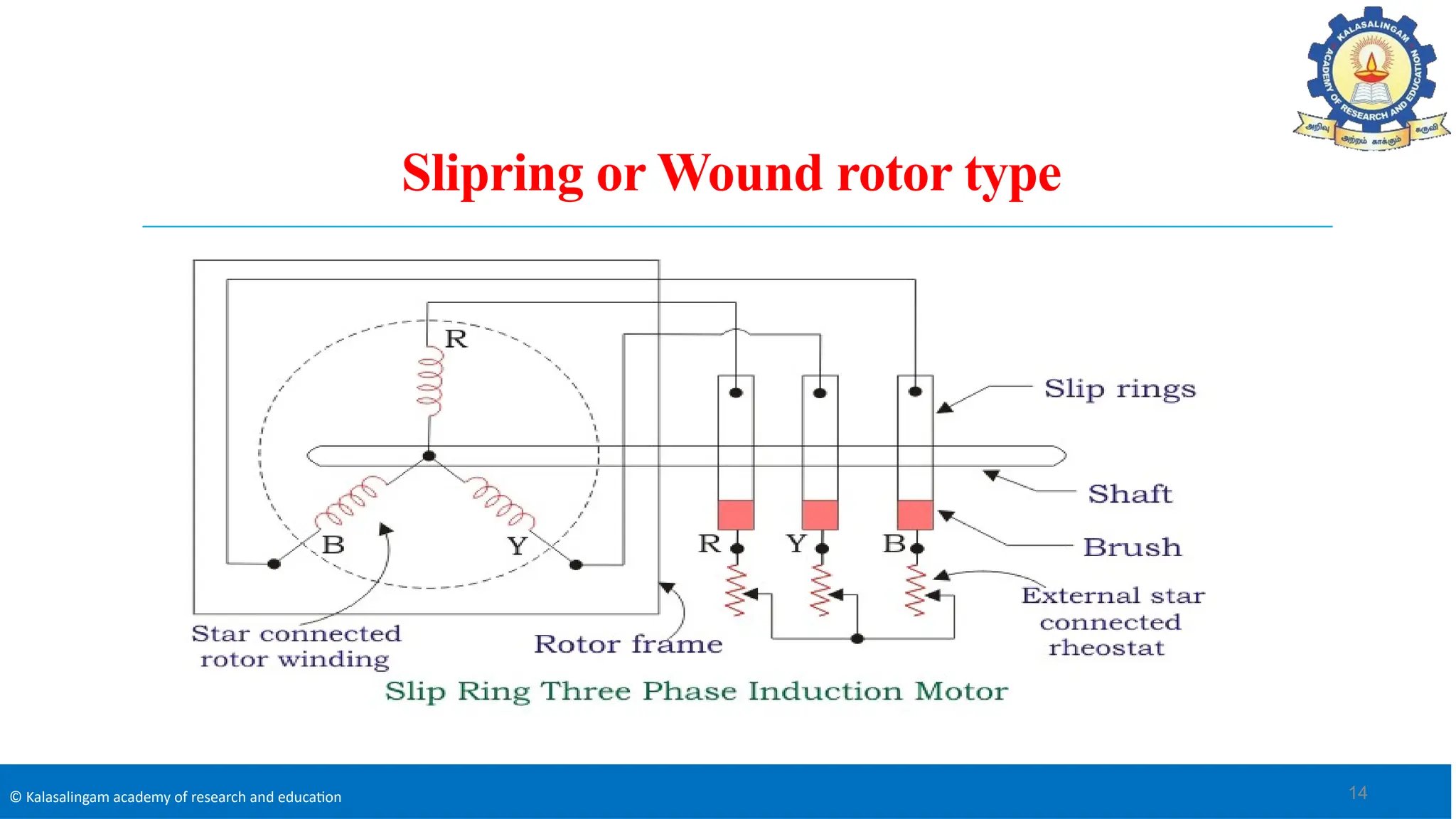
The rotor winding is similar to the stator winding.
The three phase rotor winding is internally star connected.
The other three terminals of the winding are taken out via three insulated sleep rings
mounted on the shaft and the brushes resting on them.
These three brushes are connected to an external star connected rheostat.
This arrangement is done to introduce an external resistance in rotor circuit for starting
purposes and for changing the speed / torque characteristics.
13
© Kalasalingam academy of research and education
Slipring or Wound rotor type
14
© Kalasalingam academy of research and education
Difference between Slip Ring and Squirrel Cage
Induction Motor
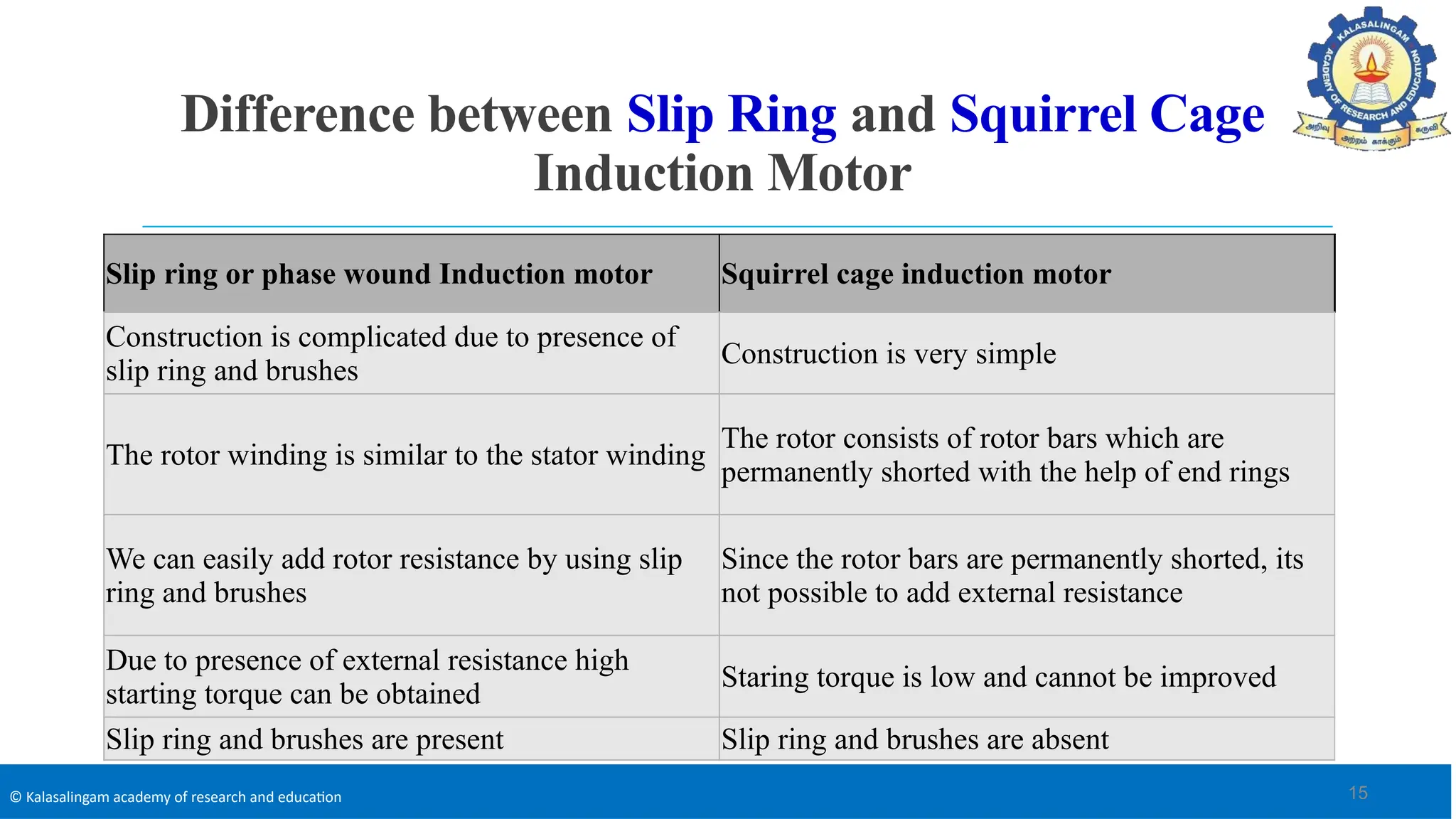
Slip ring or phase wound Induction motor Squirrel cage induction motor
Construction is complicated due to presence of
slip ring and brushes
Construction is very simple
The rotor winding is similar to the stator winding
The rotor consists of rotor bars which are
permanently shorted with the help of end rings
We can easily add rotor resistance by using slip
ring and brushes
Since the rotor bars are permanently shorted, its
not possible to add external resistance
Due to presence of external resistance high
starting torque can be obtained
Staring torque is low and cannot be improved
Slip ring and brushes are present Slip ring and brushes are absent
15
© Kalasalingam academy of research and education
Difference between Slip Ring and Squirrel Cage
Induction Motor
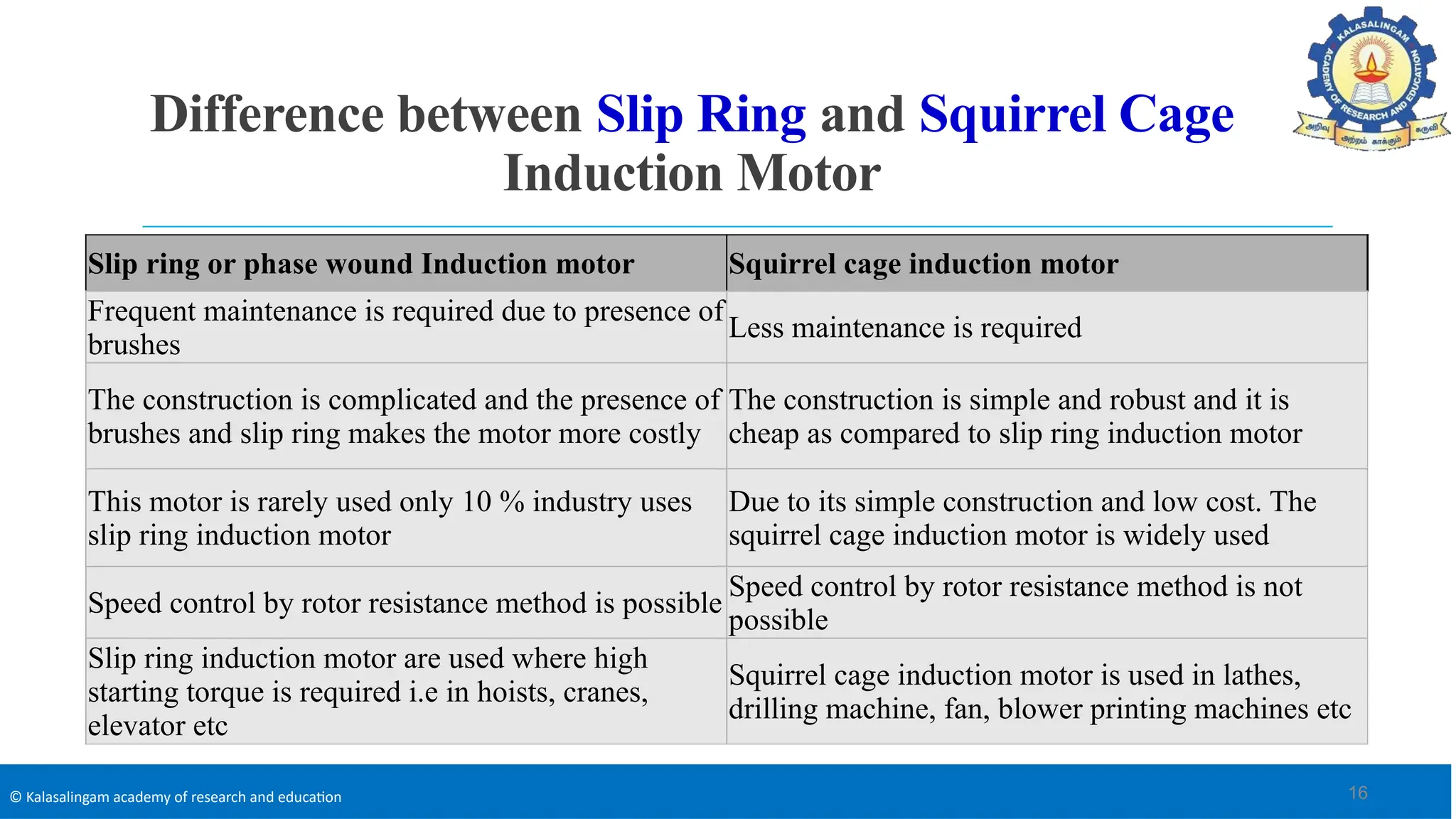
Slip ring or phase wound Induction motor Squirrel cage induction motor
Frequent maintenance is required due to presence of
brushes
Less maintenance is required
The construction is complicated and the presence of
brushes and slip ring makes the motor more costly
The construction is simple and robust and it is
cheap as compared to slip ring induction motor
This motor is rarely used only 10 % industry uses
slip ring induction motor
Due to its simple construction and low cost. The
squirrel cage induction motor is widely used
Speed control by rotor resistance method is possible
Speed control by rotor resistance method is not
possible
Slip ring induction motor are used where high
starting torque is required i.e in hoists, cranes,
elevator etc
Squirrel cage induction motor is used in lathes,
drilling machine, fan, blower printing machines etc
16
© Kalasalingam academy of research and education
Rotating Magnetic Field
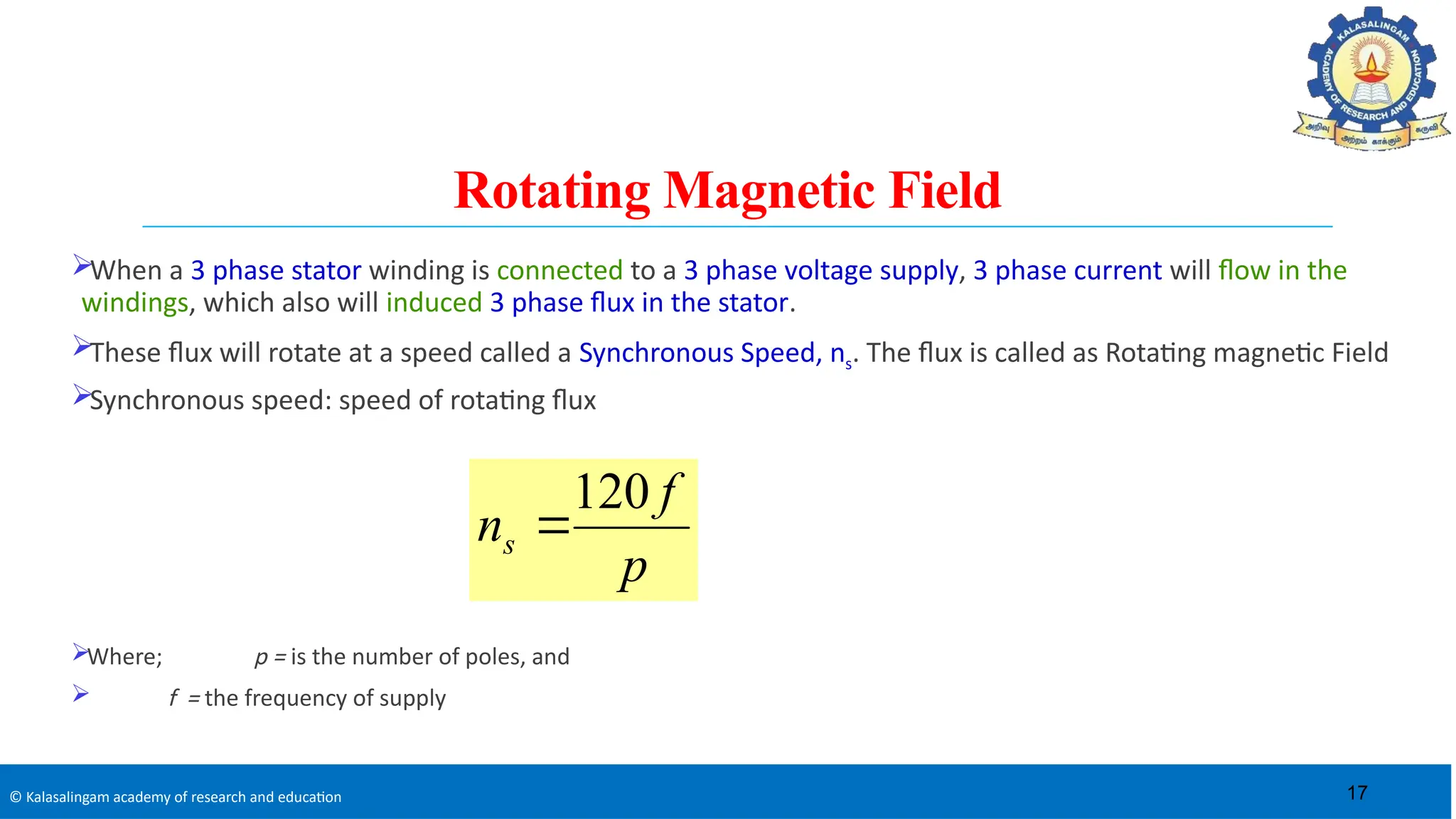
When a 3 phase stator winding is connected to a 3 phase voltage supply, 3 phase current will flow in the
windings, which also will induced 3 phase flux in the stator.
These flux will rotate at a speed called a Synchronous Speed, ns. The flux is called as Rotating magnetic Field
Synchronous speed: speed of rotating flux
Where; p = is the number of poles, and
 f = the frequency of supply
p
f
ns
120

17
© Kalasalingam academy of research and education
Principle of Operation
© Kalasalingam academy of research and education
Principle of Operation
Principle similar to transformer induction principle
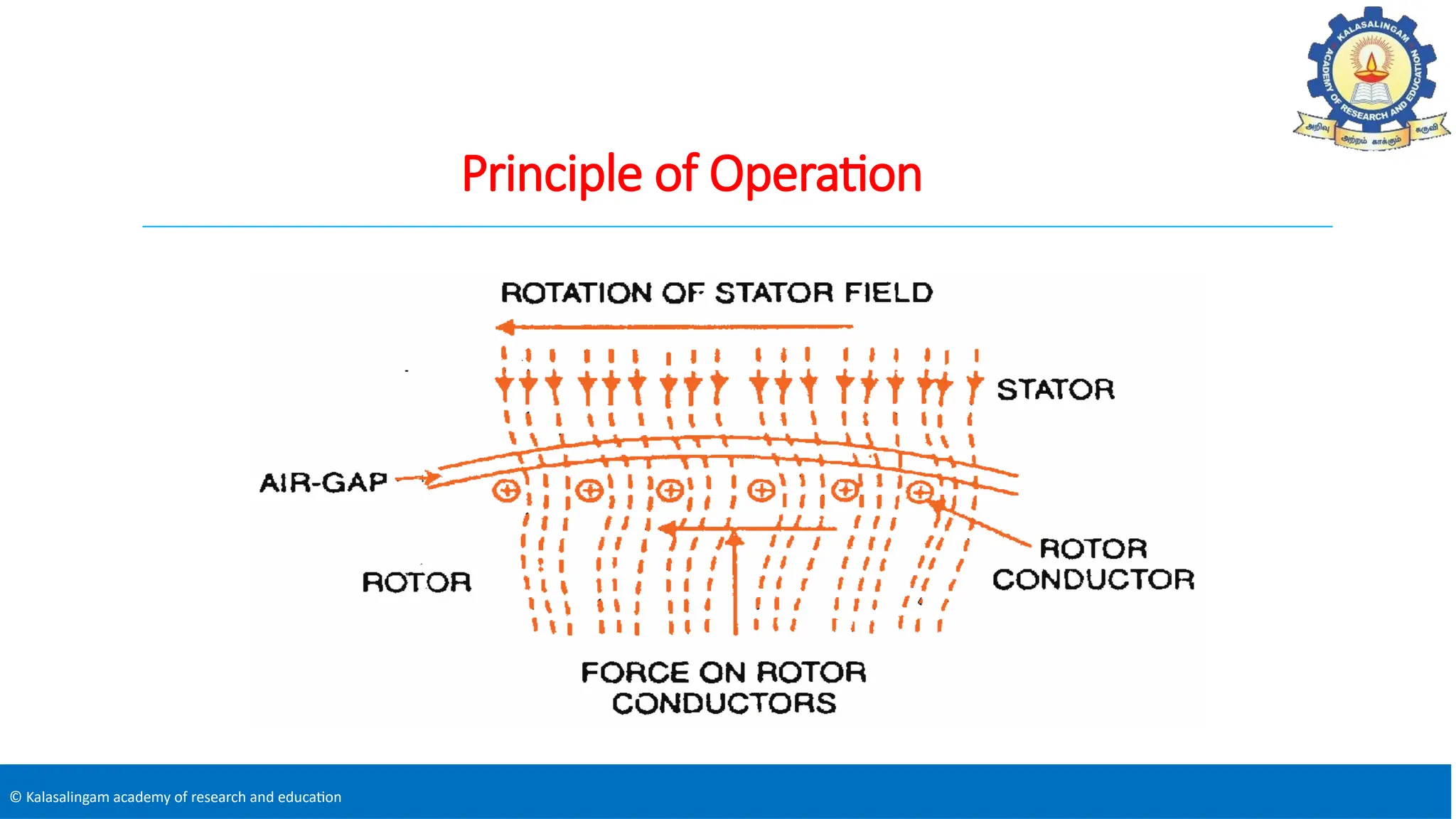
When a 3 phase stator winding is connected to a 3 phase voltage supply, 3 phase current
will flow in the windings, hence the stator is energized.
A rotating flux Φ is produced in the air gap. The flux Φ induces a voltage Ea in the rotor
winding (like a transformer).
The induced voltage produces rotor current, if rotor circuit is closed.
The rotor current interacts with the flux Φ, producing torque. The rotor rotates in the
direction of the rotating flux.
If Stator and rotor runs at same speed, there is no current in rotor, hence motor slow
down and then stop.
Hence stator and rotor runs at different speed, this machine is called as Asynchronous
machine.
 Also called as rotating transformer.
19
© Kalasalingam academy of research and education
Slip
Slip s
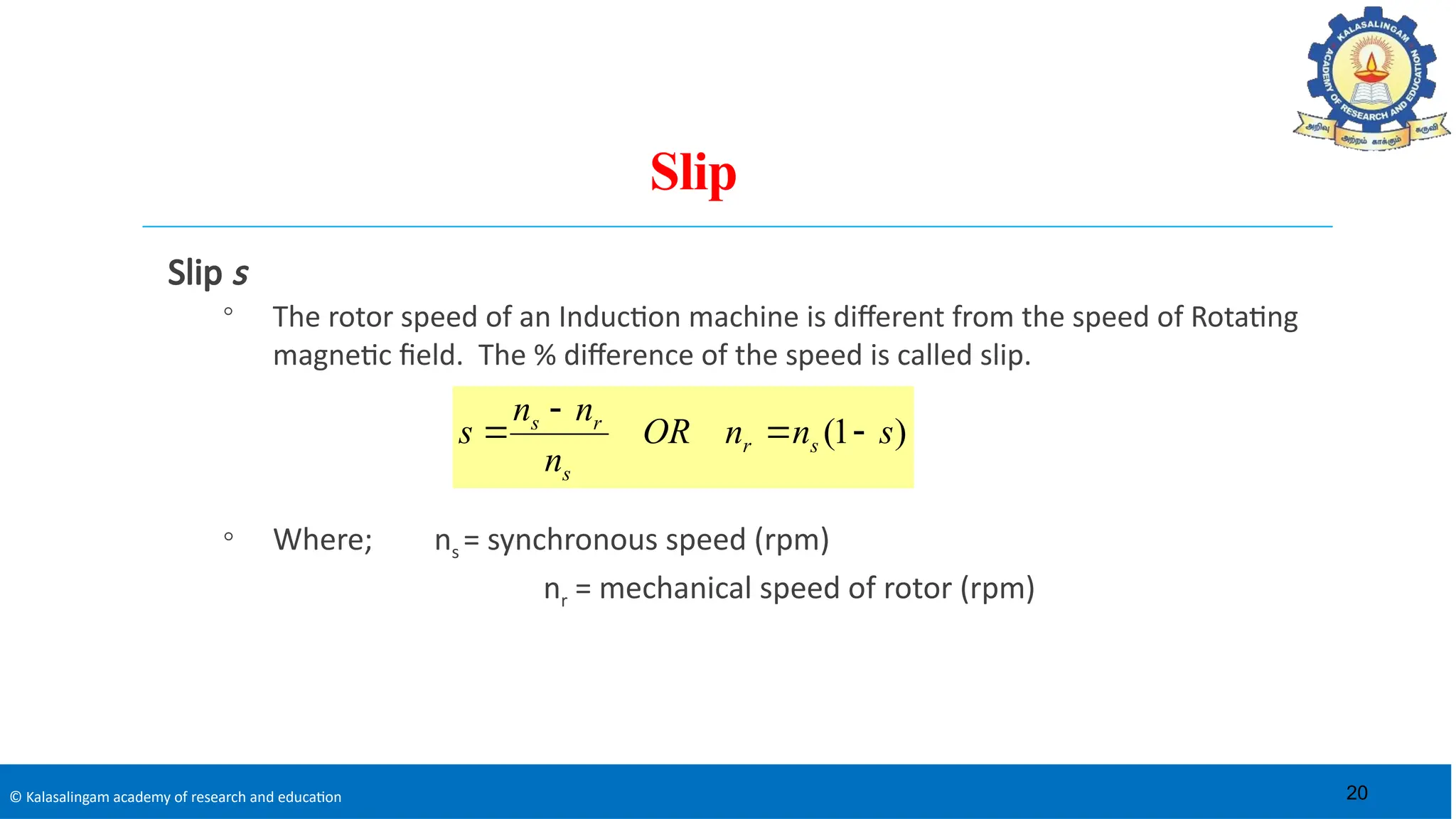
◦ The rotor speed of an Induction machine is different from the speed of Rotating
magnetic field. The % difference of the speed is called slip.
◦ Where; ns = synchronous speed (rpm)
nr = mechanical speed of rotor (rpm)
)
1
( s
n
n
OR
n
n
n
s s
r
s
r
s




20
© Kalasalingam academy of research and education
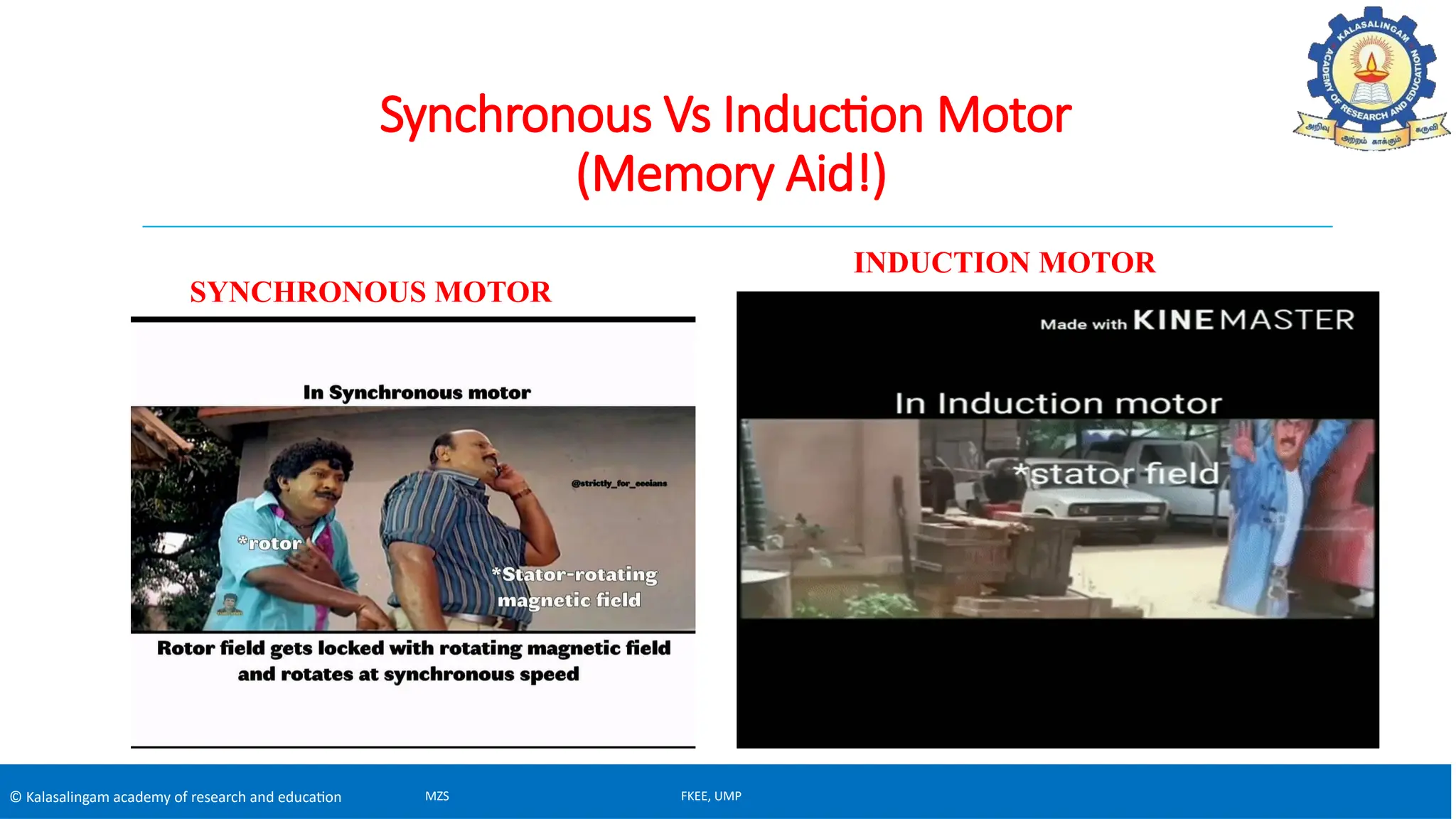
Synchronous Vs Induction Motor
(Memory Aid!)
SYNCHRONOUS MOTOR
INDUCTION MOTOR
MZS FKEE, UMP
© Kalasalingam academy of research and education
Advantages of 3 PHASE IM
They have very simple and rugged (almost unbreakable)
construction
they are very reliable and having low cost
they have high efficiency and good power factor
minimum maintenance required
3 phase induction motor is self starting hence extra starting motor
or any special starting arrangement is not required
© Kalasalingam academy of research and education
Single Phase induction Motor
 There are two basic reasons for the use of single-phase motors rather than
3-phase motors,
1. For reason of economy, most houses, offices and also rural areas are supplied
with single phase a.c, as power requirements of individual load items are
rather small.
2. Single phase motors are simple in construction, reliable, easy to repair .
 Non self starting motor
© Kalasalingam academy of research and education
Why a single phase induction motor does not self start?
When a single phase supply is fed to the single phase induction
motor.
Its stator winding produces a flux which only alternates along one
space axis.
Hence only pulsating torque will be induced in the rotor.
It is not a synchronously revolving field (Rotating magnetic field),
as in the case of a 2 or 3phase stator winding, fed from 2 or 3 phase
supply.
© Kalasalingam academy of research and education
Types of single phase induction Motors
Types are,
Split phase induction motor (Resistance split induction Motor)
Capacitor start motors
Capacitor start – capacitor run motors
Shaded pole induction motor
© Kalasalingam academy of research and education
Capacitor Start Induction Motor
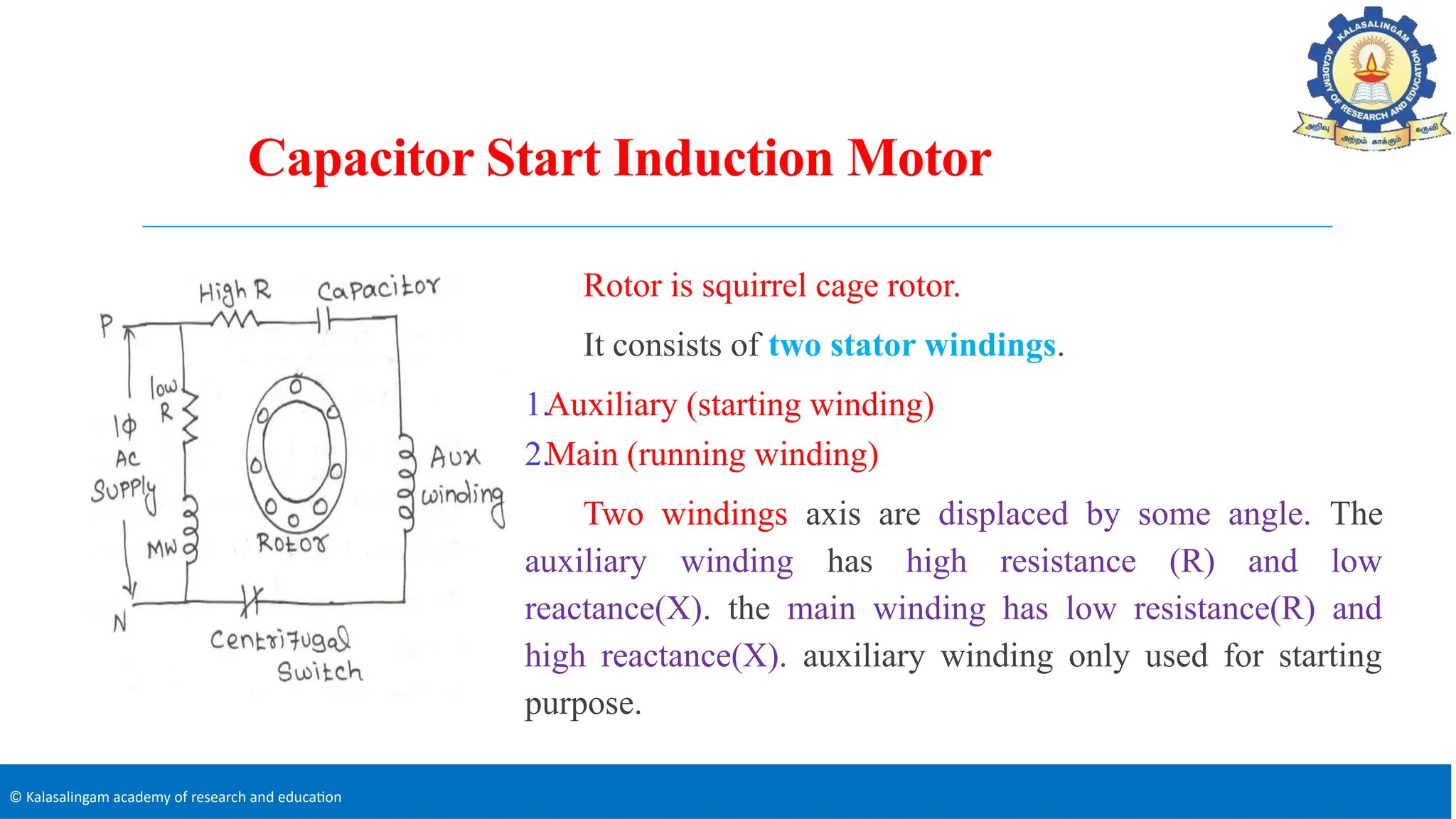
Rotor is squirrel cage rotor.
It consists of two stator windings.
1.Auxiliary (starting winding)
2.Main (running winding)
Two windings axis are displaced by some angle. The
auxiliary winding has high resistance (R) and low
reactance(X). the main winding has low resistance(R) and
high reactance(X). auxiliary winding only used for starting
purpose.
© Kalasalingam academy of research and education
Capacitor Start Induction Motor
A capacitor is connected in series with auxiliary winding for getting higher starting torque.
The value of capacitor is so chosen that Is leads Im by about 80° (α= 80°) which is greater than
split phase motor, hence staring torque (Ts= k*Im *Is* Sin α) is high in capacitor start motor.
The starting current Is leads voltage because of capacitor.
After reaching 75% of speed, the auxiliary winding is disconnected by centrifugal switch. So
capacitor also disconnected.
This type used where very high starting torque is required and where starting period may be long.
Applications: Compressors, Large fans, Pumps, High inertia loads
Power rating: 120 W to 750 W.
© Kalasalingam academy of research and education
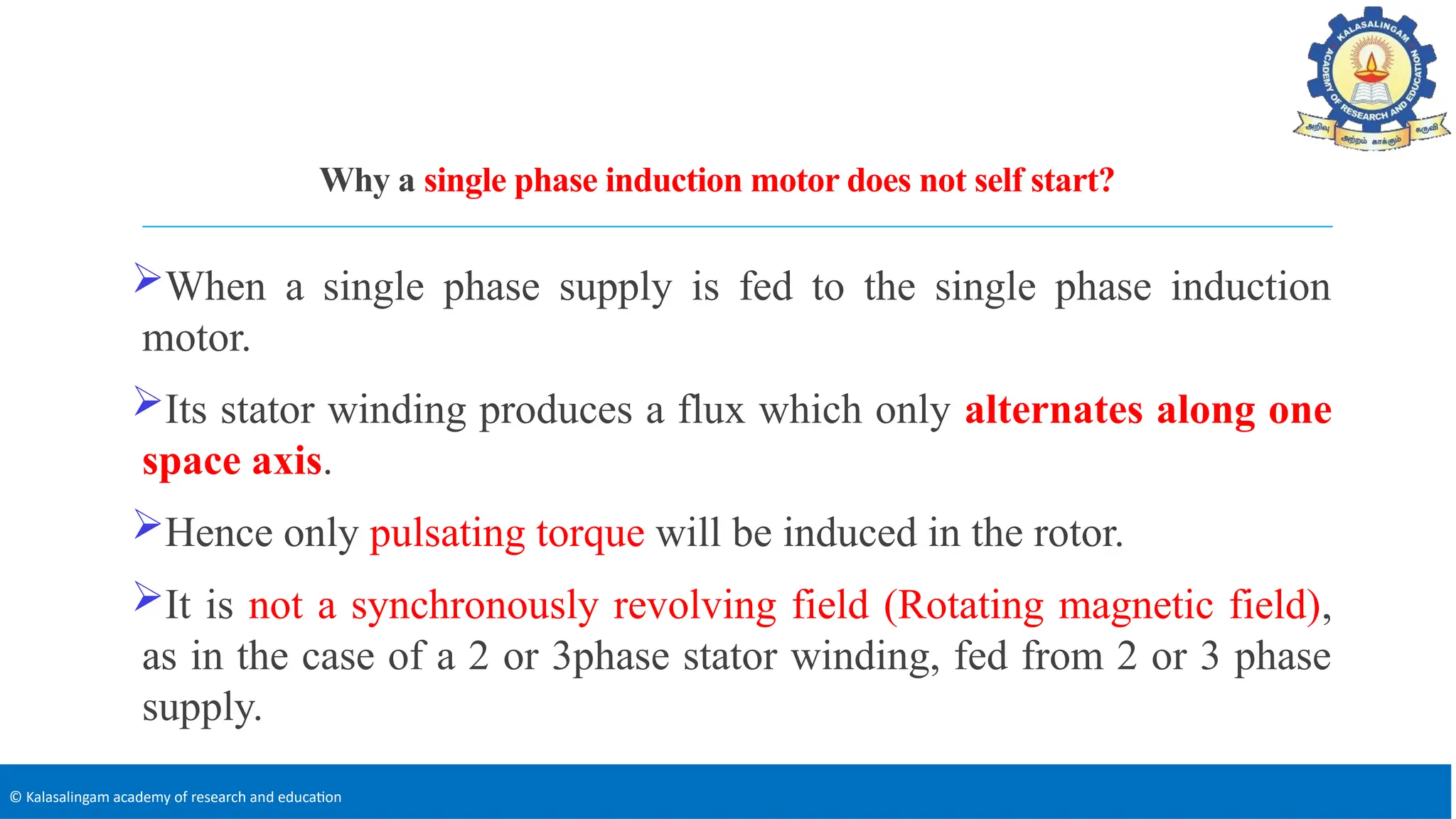
Capacitor start – capacitor run motor
Here two capacitors used
Cs – Starting capacitor
Cr – Running capacitor
Cr cannot permanently with auxiliary winding. After reaching
75% of rated speed starting capacitor (Cs) is disconnected by
using switch.
Advantages: Vibration free, high starting torque, high
efficiency.
Since the motor is vibration free, this can be used in
 Hospitals, studios, and other places where silence is
important.

Induction Machinhajkakakakkakakkaakakke.pptx

  • 1.
    211EEE1301- Basic Electrical andElectronics Engineering YOU DON'T NEED ANYONE PERMISSION TO MAKE SOMETHING GREAT.-MASSIMO BANZI UNIT-III ELECTRICAL MACHINES Induction Motor
  • 2.
    © Kalasalingam academyof research and education Induction Motor Induction motors are used worldwide in many residential, commercial, industrial, and utility applications. Induction Motors transform electrical energy into mechanical energy. It can be part of a pump or fan, or connected to some other form of mechanical equipment such as a winder, conveyor, or mixer. 2
  • 3.
    © Kalasalingam academyof research and education Types Three Phase Induction motor Single Phase Induction motor 3
  • 4.
    © Kalasalingam academyof research and education 3 Phase IM Construction The two basic parts of an AC motor are the rotor and stator. The stator and the rotor are electrical circuits that perform as electromagnets. 4
  • 5.
    © Kalasalingam academyof research and education Construction (Stator construction) The stator is the stationary electrical part of the motor. The stator of a 3 phase IM (Induction Motor) is made up with number of stampings, and these stampings are slotted to receive the stator winding. The stator is wound with a 3 phase winding which is fed from a 3 phase supply.  It is wound for a defined number of poles, and the number of poles is determined from the required speed. 5
  • 6.
    © Kalasalingam academyof research and education 3 Phase IM Construction •When stator windings are supplied with 3 phase ac supply, they produce alternating flux which revolves with synchronous speed. •The synchronous speed is inversely proportional to number of poles (Ns = 120f / P). •This revolving or rotating magnetic flux (RMF) induces current in rotor windings according to Faraday's law of mutual induction. 6
  • 7.
    © Kalasalingam academyof research and education Construction (Stator construction)
  • 8.
    © Kalasalingam academyof research and education Construction (Rotor construction) The rotor is the rotating part of the Induction motor It can be found in two types: Squirrel cage Slipring or Wound rotor However, the most common type of rotor is the “squirrel cage” rotor. 8
  • 9.
    © Kalasalingam academyof research and education Construction (Rotor construction)  Induction motor types: ◦ Squirrel cage type: Rotor winding is composed of copper bars embedded in the rotor slots and shorted at both end by end rings Simple, low cost, robust, low maintenance ◦ Slipring or Wound rotor type: Rotor winding is wound by wires. The winding terminals can be connected to external circuits through slip rings and brushes. Easy to control speed, more expensive. 9
  • 10.
    © Kalasalingam academyof research and education Squirrel Cage Rotor Most of the induction motors (upto 90%) are of squirrel cage type. Squirrel cage type rotor has very simple construction. This type of rotor consist of a cylindrical laminated core, having parallel slots on it. These parallel slots carry rotor conductors. In this type of rotor, heavy bars of copper, aluminum or alloys are used as rotor conductors instead of wires. The rotor bars are electrically welded to short circuiting end rings at both ends. Thus this rotor construction looks like a squirrel cage and hence we call it.  The rotor bars are permanently short circuited, hence it is not possible to add any external resistance to armature circuit. 10
  • 11.
    © Kalasalingam academyof research and education Squirrel Cage Rotor
  • 12.
    © Kalasalingam academyof research and education Construction (Rotor construction) 12 Squirrel-Cage Rotor /rotor winding Short circuits all rotor bars.
  • 13.
    © Kalasalingam academyof research and education Slipring or Wound rotor type The rotor winding is similar to the stator winding. The three phase rotor winding is internally star connected. The other three terminals of the winding are taken out via three insulated sleep rings mounted on the shaft and the brushes resting on them. These three brushes are connected to an external star connected rheostat. This arrangement is done to introduce an external resistance in rotor circuit for starting purposes and for changing the speed / torque characteristics. 13
  • 14.
    © Kalasalingam academyof research and education Slipring or Wound rotor type 14
  • 15.
    © Kalasalingam academyof research and education Difference between Slip Ring and Squirrel Cage Induction Motor Slip ring or phase wound Induction motor Squirrel cage induction motor Construction is complicated due to presence of slip ring and brushes Construction is very simple The rotor winding is similar to the stator winding The rotor consists of rotor bars which are permanently shorted with the help of end rings We can easily add rotor resistance by using slip ring and brushes Since the rotor bars are permanently shorted, its not possible to add external resistance Due to presence of external resistance high starting torque can be obtained Staring torque is low and cannot be improved Slip ring and brushes are present Slip ring and brushes are absent 15
  • 16.
    © Kalasalingam academyof research and education Difference between Slip Ring and Squirrel Cage Induction Motor Slip ring or phase wound Induction motor Squirrel cage induction motor Frequent maintenance is required due to presence of brushes Less maintenance is required The construction is complicated and the presence of brushes and slip ring makes the motor more costly The construction is simple and robust and it is cheap as compared to slip ring induction motor This motor is rarely used only 10 % industry uses slip ring induction motor Due to its simple construction and low cost. The squirrel cage induction motor is widely used Speed control by rotor resistance method is possible Speed control by rotor resistance method is not possible Slip ring induction motor are used where high starting torque is required i.e in hoists, cranes, elevator etc Squirrel cage induction motor is used in lathes, drilling machine, fan, blower printing machines etc 16
  • 17.
    © Kalasalingam academyof research and education Rotating Magnetic Field When a 3 phase stator winding is connected to a 3 phase voltage supply, 3 phase current will flow in the windings, which also will induced 3 phase flux in the stator. These flux will rotate at a speed called a Synchronous Speed, ns. The flux is called as Rotating magnetic Field Synchronous speed: speed of rotating flux Where; p = is the number of poles, and  f = the frequency of supply p f ns 120  17
  • 18.
    © Kalasalingam academyof research and education Principle of Operation
  • 19.
    © Kalasalingam academyof research and education Principle of Operation Principle similar to transformer induction principle When a 3 phase stator winding is connected to a 3 phase voltage supply, 3 phase current will flow in the windings, hence the stator is energized. A rotating flux Φ is produced in the air gap. The flux Φ induces a voltage Ea in the rotor winding (like a transformer). The induced voltage produces rotor current, if rotor circuit is closed. The rotor current interacts with the flux Φ, producing torque. The rotor rotates in the direction of the rotating flux. If Stator and rotor runs at same speed, there is no current in rotor, hence motor slow down and then stop. Hence stator and rotor runs at different speed, this machine is called as Asynchronous machine.  Also called as rotating transformer. 19
  • 20.
    © Kalasalingam academyof research and education Slip Slip s ◦ The rotor speed of an Induction machine is different from the speed of Rotating magnetic field. The % difference of the speed is called slip. ◦ Where; ns = synchronous speed (rpm) nr = mechanical speed of rotor (rpm) ) 1 ( s n n OR n n n s s r s r s     20
  • 21.
    © Kalasalingam academyof research and education Synchronous Vs Induction Motor (Memory Aid!) SYNCHRONOUS MOTOR INDUCTION MOTOR MZS FKEE, UMP
  • 22.
    © Kalasalingam academyof research and education Advantages of 3 PHASE IM They have very simple and rugged (almost unbreakable) construction they are very reliable and having low cost they have high efficiency and good power factor minimum maintenance required 3 phase induction motor is self starting hence extra starting motor or any special starting arrangement is not required
  • 23.
    © Kalasalingam academyof research and education Single Phase induction Motor  There are two basic reasons for the use of single-phase motors rather than 3-phase motors, 1. For reason of economy, most houses, offices and also rural areas are supplied with single phase a.c, as power requirements of individual load items are rather small. 2. Single phase motors are simple in construction, reliable, easy to repair .  Non self starting motor
  • 24.
    © Kalasalingam academyof research and education Why a single phase induction motor does not self start? When a single phase supply is fed to the single phase induction motor. Its stator winding produces a flux which only alternates along one space axis. Hence only pulsating torque will be induced in the rotor. It is not a synchronously revolving field (Rotating magnetic field), as in the case of a 2 or 3phase stator winding, fed from 2 or 3 phase supply.
  • 25.
    © Kalasalingam academyof research and education Types of single phase induction Motors Types are, Split phase induction motor (Resistance split induction Motor) Capacitor start motors Capacitor start – capacitor run motors Shaded pole induction motor
  • 26.
    © Kalasalingam academyof research and education Capacitor Start Induction Motor Rotor is squirrel cage rotor. It consists of two stator windings. 1.Auxiliary (starting winding) 2.Main (running winding) Two windings axis are displaced by some angle. The auxiliary winding has high resistance (R) and low reactance(X). the main winding has low resistance(R) and high reactance(X). auxiliary winding only used for starting purpose.
  • 27.
    © Kalasalingam academyof research and education Capacitor Start Induction Motor A capacitor is connected in series with auxiliary winding for getting higher starting torque. The value of capacitor is so chosen that Is leads Im by about 80° (α= 80°) which is greater than split phase motor, hence staring torque (Ts= k*Im *Is* Sin α) is high in capacitor start motor. The starting current Is leads voltage because of capacitor. After reaching 75% of speed, the auxiliary winding is disconnected by centrifugal switch. So capacitor also disconnected. This type used where very high starting torque is required and where starting period may be long. Applications: Compressors, Large fans, Pumps, High inertia loads Power rating: 120 W to 750 W.
  • 28.
    © Kalasalingam academyof research and education Capacitor start – capacitor run motor Here two capacitors used Cs – Starting capacitor Cr – Running capacitor Cr cannot permanently with auxiliary winding. After reaching 75% of rated speed starting capacitor (Cs) is disconnected by using switch. Advantages: Vibration free, high starting torque, high efficiency. Since the motor is vibration free, this can be used in  Hospitals, studios, and other places where silence is important.