EPM AcademyEPM Academy
Webinar February 25, 2015
Induction heating of strips and sheetsInduction heating of strips and sheets
Bernard Nacke
Institute of Electrotechnology
Leibniz University of Hannover
Hannover / GermanyHannover / Germany
B. Nacke: 25-02-2015
1
Outline
Introd ctionIntroduction
Fundamentals of induction strip heating
Methods of induction strip heating
Longitudinal flux heatingg g
Modified longitudinal flux heating
Transverse flux heatingTransverse flux heating
Heating of sheets
C l iConclusions
B. Nacke: 25-02-2015
2
Heating of stripsg p
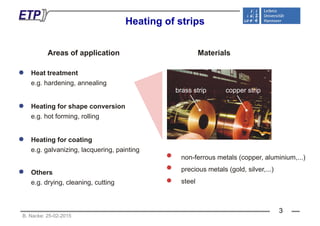
A f li ti M t i l
Heat treatment
Areas of application Materials
eat t eat e t
e.g. hardening, annealing
brass strip copper strip
Heating for shape conversion
e.g. hot forming, rolling
Heating for coating
e g galvanizing lacquering painting
non-ferrous metals (copper, aluminium,...)
precious metals (gold, silver,...)Others
e.g. galvanizing, lacquering, painting
steele.g. drying, cleaning, cutting
B. Nacke: 25-02-2015
3
Needs for Flexible Heating SystemsNeeds for Flexible Heating Systems
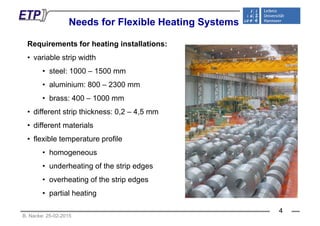
Requirements for heating installations:
• variable strip width
• steel: 1000 – 1500 mm
• aluminium: 800 – 2300 mm
• brass: 400 – 1000 mmbrass: 400 1000 mm
• different strip thickness: 0,2 – 4,5 mm
• different materials• different materials
• flexible temperature profile
h• homogeneous
• underheating of the strip edges
• overheating of the strip edges
• partial heating
B. Nacke: 25-02-2015
4
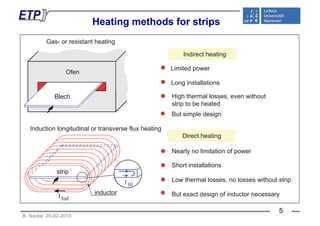
Heating methods for strips
Gas- or resistant heating
Heating methods for strips
Indirect heating
Limited power
Ofen
Blech
Long installations
High thermal losses, even without
strip to be heated
But simple design
Induction longitudinal or transverse flux heating
Nearly no limitation of power
Direct heating
strip
Nearly no limitation of power
Short installations
inductor
Low thermal losses, no losses without strip
IInd
I Bl
But exact design of inductor necessary
B. Nacke: 25-02-2015
5
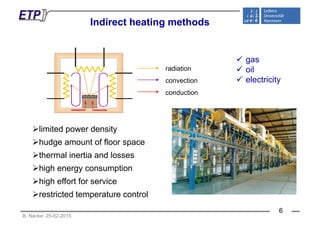
Indirect heating methodsIndirect heating methods
gas
oilradiation
electricityconvection
conduction
limited power density
hudge amount of floor space
thermal inertia and losses
high energy consumption
high effort for service
restricted temperature control
B. Nacke: 25-02-2015
6
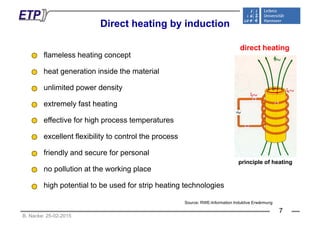
Direct heating by inductionDirect heating by induction
direct heating
• flameless heating concept
• heat generation inside the material
direct heating
g
• unlimited power density
• extremely fast heating
• effective for high process temperatures
• excellent flexibility to control the process
f i dl d f l• friendly and secure for personal
• no pollution at the working place
principle of heating
• high potential to be used for strip heating technologies
B. Nacke: 25-02-2015
Source: RWE-Information Induktive Erwärmung
7
Fundamentals of induction strip heating
B. Nacke: 25-02-2015
8
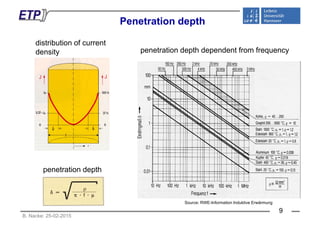
Penetration depthp
distribution of current
d it penetration depth dependent from frequencydensity penetration depth dependent from frequency
penetration depth
B. Nacke: 25-02-2015
Source: RWE-Information Induktive Erwärmung
9
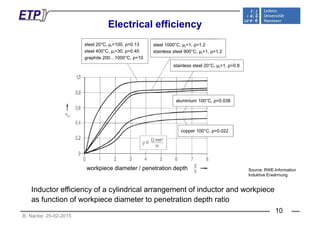
Electrical efficiencyElectrical efficiency
steel 20°C, μr=100, ρ=0.13
t l 400°C 30 0 45
steel 1000°C, μr=1, ρ=1.2
t i l t l 900°C 1 1 2steel 400°C, μr=30, ρ=0.45
graphite 200…1000°C, ρ=10
stainless steel 900°C, μr=1, ρ=1.2
stainless steel 20°C, μr=1, ρ=0.8
aluminium 100°C ρ=0 038aluminium 100 C, ρ=0.038
copper 100°C, ρ=0.022
Source: RWE-Information
Induktive Erwärmung
workpiece diameter / penetration depth
Inductor efficiency of a cylindrical arrangement of inductor and workpiece
as function of workpiece diameter to penetration depth ratio
Induktive Erwärmung
B. Nacke: 25-02-2015
as function of workpiece diameter to penetration depth ratio
10
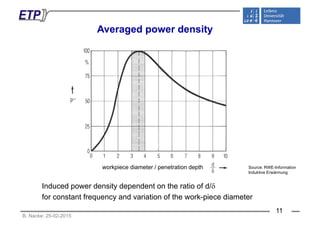
Averaged power density
Source: RWE-Information
Induktive Erwärmung
workpiece diameter / penetration depth
Induced power density dependent on the ratio of d/δ
for constant frequency and variation of the work-piece diameter
B. Nacke: 25-02-2015
q y p
11
Methods of induction strip heating
B. Nacke: 25-02-2015
12
Induction heating of strips and sheetsInduction heating of strips and sheets
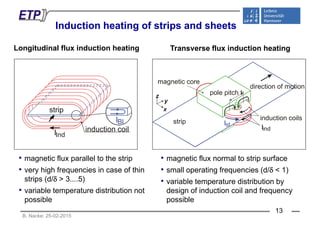
Longitudinal flux induction heating Transverse flux induction heatingLongitudinal flux induction heating Transverse flux induction heating
y
z
magnetic core
direction of motion
pole pitch t
strip
IBl
x
y
B
induction coils
strip
I
Ist
induction coilIInd
Iind
st
• magnetic flux parallel to the strip
• very high frequencies in case of thin
• magnetic flux normal to strip surface
• small operating frequencies (d/δ < 1)
strips (d/δ > 3....5)
• variable temperature distribution not
possible
• variable temperature distribution by
design of induction coil and frequency
possible
B. Nacke: 25-02-2015
possible possible
13
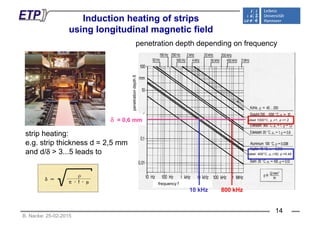
Induction heating of strips
using longitudinal magnetic field
penetration depth depending on frequency
δrationdepthδpenet
δ = 0,6 mm steel 1000°C, μ r=1, ρ =1.2
strip heating:
e.g. strip thickness d = 2,5 mm
and d/δ > 3 5 leads toand d/δ > 3...5 leads to steel 400°C, μ r=30, ρ =0.45
800 kHz
frequency f
10 kHz
B. Nacke: 25-02-2015
14
Longitudinal flux heating
B. Nacke: 25-02-2015
15
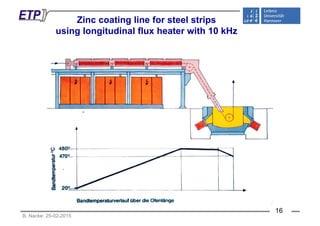
Zinc coating line for steel strips
using longitudinal flux heater with 10 kHz
B. Nacke: 25-02-2015
16
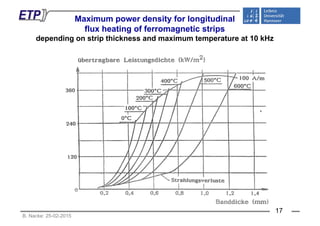
Maximum power density for longitudinal
flux heating of ferromagnetic strips
depending on strip thickness and maximum temperature at 10 kHz
B. Nacke: 25-02-2015
17
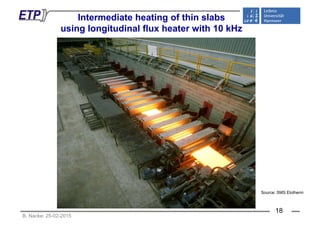
Intermediate heating of thin slabs
i l i di l fl h i h 10 kHusing longitudinal flux heater with 10 kHz
Source: SMS Elotherm
B. Nacke: 25-02-2015
18
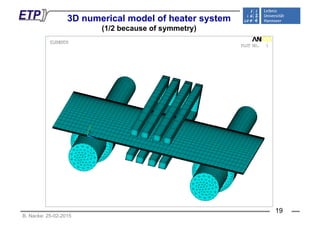
3D numerical model of heater system
(1/2 because of symmetry)
B. Nacke: 25-02-2015
19
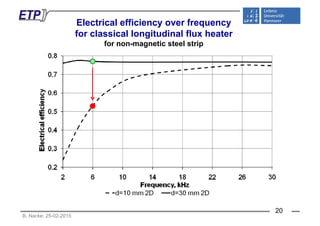
Electrical efficiency over frequencyElectrical efficiency over frequency
for classical longitudinal flux heater
for non-magnetic steel strip
B. Nacke: 25-02-2015
20
Modified longitudinal flux heating
method
B. Nacke: 25-02-2015
21
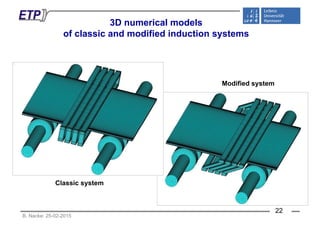
3D numerical models3D numerical models
of classic and modified induction systems
Modified system
Classic system
B. Nacke: 25-02-2015
22
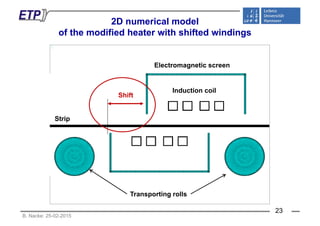
2D numerical model
of the modified heater with shifted windings
Electromagnetic screen
Induction coil
Shift
Strip
Transporting rolls
B. Nacke: 25-02-2015
23
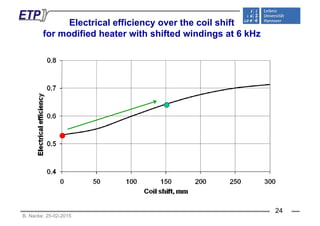
Electrical efficiency over the coil shiftElectrical efficiency over the coil shift
for modified heater with shifted windings at 6 kHz
B. Nacke: 25-02-2015
24
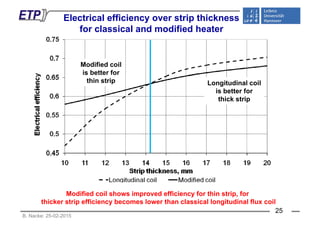
Electrical efficiency over strip thickness
for classical and modified heater
Modified coil
is better for
thin strip Longitudinal coil
is better for
thick stripthick strip
Modified coil shows improved efficiency for thin strip, for
thicker strip efficiency becomes lower than classical longitudinal flux coil
B. Nacke: 25-02-2015
thicker strip efficiency becomes lower than classical longitudinal flux coil
25
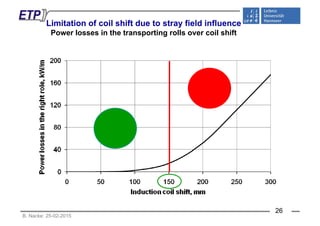
Limitation of coil shift due to stray field influenceLimitation of coil shift due to stray field influence
Power losses in the transporting rolls over coil shift
B. Nacke: 25-02-2015
26
Transverse flux heating
B. Nacke: 25-02-2015
27
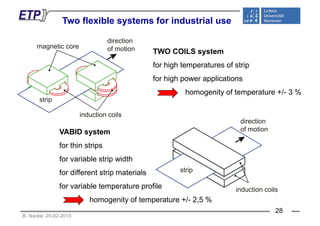
Two flexible systems for industrial usey
TWO COILS system
magnetic core
direction
of motion TWO COILS system
for high temperatures of strip
of motion
for high power applications
homogenity of temperature +/- 3 %
strip
induction coils
strip
direction
VABID system
for thin strips
of motion
for variable strip width
for different strip materials stripp
for variable temperature profile
homogenity of temperature +/- 2 5 %
induction coils
B. Nacke: 25-02-2015
homogenity of temperature +/ 2,5 %
28
Basic principle of TFH two coils systemBasic principle of TFH two coils system
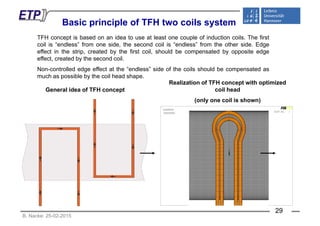
TFH concept is based on an idea to use at least one couple of induction coils. The first
coil is “endless” from one side, the second coil is “endless” from the other side. Edge
ff t i th t i t d b th fi t il h ld b t d b it deffect in the strip, created by the first coil, should be compensated by opposite edge
effect, created by the second coil.
Non-controlled edge effect at the “endless” side of the coils should be compensated as
much as possible by the coil head shapemuch as possible by the coil head shape.
General idea of TFH concept
Realization of TFH concept with optimized
coil head
(only one coil is shown)(only one coil is shown)
B. Nacke: 25-02-2015
29
Integrated Joule heat of TFH two coilsg
concept with optimized coil shape
1.4E+06
1.2E+06
1.0E+06
m]
6 0E+05
8.0E+05
cificpower[W/m
4.0E+05
6.0E+05
Spec
2.0E+05
0.0E+00
-700 -600 -500 -400 -300 -200 -100 0 100 200 300 400 500 600 700
Strip width [mm]
B. Nacke: 25-02-2015
JH1 JH2 JHsum
30
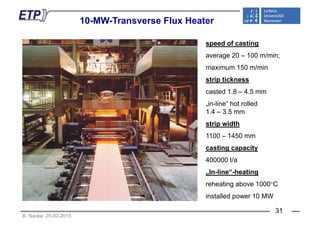
10-MW-Transverse Flux Heater
speed of casting
tundisch
average 20 – 100 m/min;
maximum 150 m/min
casting ladle
coolingheating
strip tickness
casted 1.8 – 4.5 mm
„in-line“ hot rolled
1.4 – 3.5 mm
strip width
loop rolling mill coiling
strip width
1100 – 1450 mm
casting capacity
sketch of thin strip casting installation of
ThyssenKruppNirosta in Krefeld
g p y
400000 t/a
„In-line“-heating
reheating above 1000°C
installed power 10 MW
B. Nacke: 25-02-2015
31
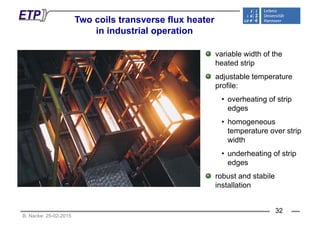
Two coils transverse flux heater
in industrial operation
variable width of the
heated strip
adjustable temperatureadjustable temperature
profile:
• overheating of stripoverheating of strip
edges
• homogeneousg
temperature over strip
width
f• underheating of strip
edges
robust and stabilerobust and stabile
installation
B. Nacke: 25-02-2015
32
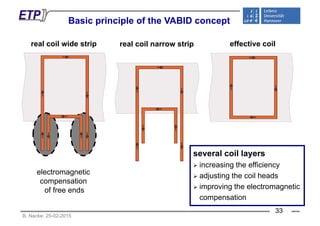
Basic principle of the VABID conceptp p p
real coil wide strip real coil narrow strip effective coil
l il lseveral coil layers
increasing the efficiency
adjusting the coil headselectromagnetic adjusting the coil heads
improving the electromagnetic
compensation
g
compensation
of free ends
B. Nacke: 25-02-2015
p
33
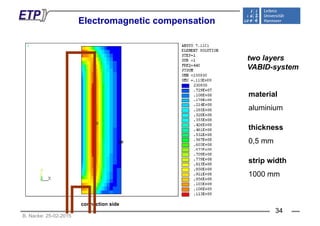
Electromagnetic compensationg p
two layers
VABID-system
material
aluminium
thi kthickness
0,5 mm
strip width
1000 mm1000 mm
B. Nacke: 25-02-2015
connection side
34
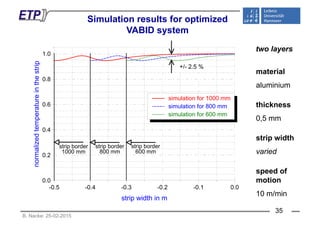
Simulation results for optimized
VABID system
two layers
material
1.0
strip
+/- 2.5 %
two layers
aluminium
0.8
reinthe
simulation for 1000 mm
thickness
0,5 mm
0.6
mperatu
simulation for 800 mm
simulation for 600 mm
strip width
varied
0.4
alizedte
strip border
1000
strip border
800 mm
strip border
600 mm varied
speed of
0.2
norma
1000 mm 800 mm 600 mm
motion
10 m/min
0.0
-0.5 -0.4 -0.3 -0.2 -0.1 0.0
strip width in m
B. Nacke: 25-02-2015
p
35
Induction heating of sheets
B. Nacke: 25-02-2015
36
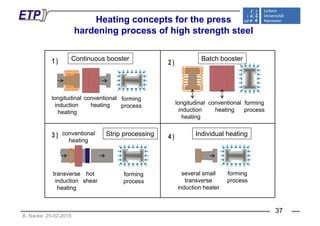
Heating concepts for the press
hardening process of high strength steel
Continuous booster Batch booster
longitudinal formingconventionalg
induction
heating
longitudinal
induction
heating
forming
process
forming
process
heating conventional
heating
conventional
heating
Individual heatingStrip processing
forming formingseveral smallhottransverse forming
process
g
processtransverse
induction heater
hot
shear
transverse
induction
heating
B. Nacke: 25-02-2015
37
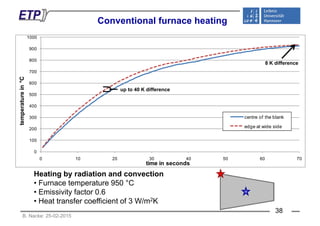
Conventional furnace heatingg
900
1000
700
800
900
8 K difference
500
600
urein°C
up to 40 K difference
300
400
temperatu
centre of the blank
d t id id
0
100
200
edge at wide side
0
0 10 20 30 40 50 60 70
time in seconds
Heating by radiation and convectionHeating by radiation and convection
• Furnace temperature 950 °C
• Emissivity factor 0.6
• Heat transfer coefficient of 3 W/m2K
B. Nacke: 25-02-2015
• Heat transfer coefficient of 3 W/m2K
38
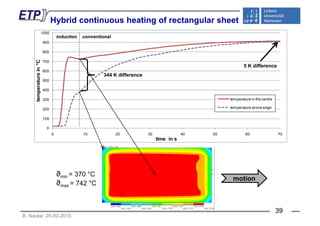
Hybrid continuous heating of rectangular sheet
900
1000
induction conventional
600
700
800
ein°C
344 K difference
5 K difference
300
400
500
temperature
temperature in the centre
344 K difference
100
200
300
t
temperature in the centre
temperature atone edge
0
0 10 20 30 40 50 60 70
time in s
ϑ i = 370 °C
motion
ϑmin 370 C
ϑmax = 742 °C
B. Nacke: 25-02-2015
39
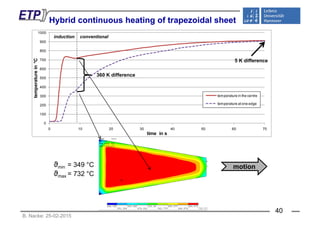
Hybrid continuous heating of trapezoidal sheet
800
900
1000
induction conventional
600
700
800
rein°C
360 K difference
5 K difference
300
400
500
temperatu
temperature in the centre
360 K difference
0
100
200 temperature atone edge
0 10 20 30 40 50 60 70
time in s
motionϑmin = 349 °C
ϑmax = 732 °Cϑmax 732 C
B. Nacke: 25-02-2015
40
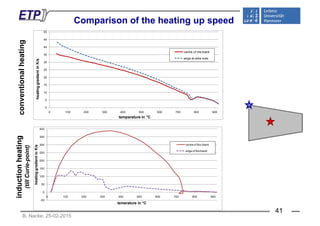
Comparison of the heating up speedp g p ping
40
45
50
alheati
25
30
35
entinK/s
centre of the blank
edge at wide side
vention
5
10
15
20
heatinggradie
conv
0
5
0 100 200 300 400 500 600 700 800 900
temperature in °C
300
350
400
K/s
centre of the blank
edge of the blank
ating
nt)
100
150
200
250
nggradientin
edge of the blank
ionhea
Curie-poin
-50
0
50
100
0 100 200 300 400 500 600 700 800 900
heatin
induct
(tillC
B. Nacke: 25-02-2015
50
temerature in °C
41
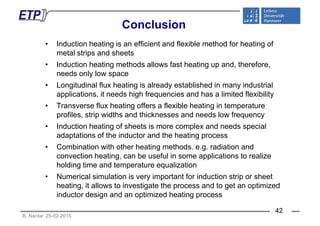
ConclusionConclusion
• Induction heating is an efficient and flexible method for heating of
l i d hmetal strips and sheets
• Induction heating methods allows fast heating up and, therefore,
needs only low spaceneeds only low space
• Longitudinal flux heating is already established in many industrial
applications, it needs high frequencies and has a limited flexibility
• Transverse flux heating offers a flexible heating in temperature
profiles, strip widths and thicknesses and needs low frequency
• Induction heating of sheets is more complex and needs special• Induction heating of sheets is more complex and needs special
adaptations of the inductor and the heating process
• Combination with other heating methods. e.g. radiation andg g
convection heating, can be useful in some applications to realize
holding time and temperature equalization
• Numerical simulation is very important for induction strip or sheet• Numerical simulation is very important for induction strip or sheet
heating, it allows to investigate the process and to get an optimized
inductor design and an optimized heating process
B. Nacke: 25-02-2015
42
Thank you for your attention!Thank you for your attention!
B. Nacke: 25-02-2015
43

Induction heating of strips and sheets

  • 1.
    EPM AcademyEPM Academy WebinarFebruary 25, 2015 Induction heating of strips and sheetsInduction heating of strips and sheets Bernard Nacke Institute of Electrotechnology Leibniz University of Hannover Hannover / GermanyHannover / Germany B. Nacke: 25-02-2015 1
  • 2.
    Outline Introd ctionIntroduction Fundamentals ofinduction strip heating Methods of induction strip heating Longitudinal flux heatingg g Modified longitudinal flux heating Transverse flux heatingTransverse flux heating Heating of sheets C l iConclusions B. Nacke: 25-02-2015 2
  • 3.
    Heating of stripsgp A f li ti M t i l Heat treatment Areas of application Materials eat t eat e t e.g. hardening, annealing brass strip copper strip Heating for shape conversion e.g. hot forming, rolling Heating for coating e g galvanizing lacquering painting non-ferrous metals (copper, aluminium,...) precious metals (gold, silver,...)Others e.g. galvanizing, lacquering, painting steele.g. drying, cleaning, cutting B. Nacke: 25-02-2015 3
  • 4.
    Needs for FlexibleHeating SystemsNeeds for Flexible Heating Systems Requirements for heating installations: • variable strip width • steel: 1000 – 1500 mm • aluminium: 800 – 2300 mm • brass: 400 – 1000 mmbrass: 400 1000 mm • different strip thickness: 0,2 – 4,5 mm • different materials• different materials • flexible temperature profile h• homogeneous • underheating of the strip edges • overheating of the strip edges • partial heating B. Nacke: 25-02-2015 4
  • 5.
    Heating methods forstrips Gas- or resistant heating Heating methods for strips Indirect heating Limited power Ofen Blech Long installations High thermal losses, even without strip to be heated But simple design Induction longitudinal or transverse flux heating Nearly no limitation of power Direct heating strip Nearly no limitation of power Short installations inductor Low thermal losses, no losses without strip IInd I Bl But exact design of inductor necessary B. Nacke: 25-02-2015 5
  • 6.
    Indirect heating methodsIndirectheating methods gas oilradiation electricityconvection conduction limited power density hudge amount of floor space thermal inertia and losses high energy consumption high effort for service restricted temperature control B. Nacke: 25-02-2015 6
  • 7.
    Direct heating byinductionDirect heating by induction direct heating • flameless heating concept • heat generation inside the material direct heating g • unlimited power density • extremely fast heating • effective for high process temperatures • excellent flexibility to control the process f i dl d f l• friendly and secure for personal • no pollution at the working place principle of heating • high potential to be used for strip heating technologies B. Nacke: 25-02-2015 Source: RWE-Information Induktive Erwärmung 7
  • 8.
    Fundamentals of inductionstrip heating B. Nacke: 25-02-2015 8
  • 9.
    Penetration depthp distribution ofcurrent d it penetration depth dependent from frequencydensity penetration depth dependent from frequency penetration depth B. Nacke: 25-02-2015 Source: RWE-Information Induktive Erwärmung 9
  • 10.
    Electrical efficiencyElectrical efficiency steel20°C, μr=100, ρ=0.13 t l 400°C 30 0 45 steel 1000°C, μr=1, ρ=1.2 t i l t l 900°C 1 1 2steel 400°C, μr=30, ρ=0.45 graphite 200…1000°C, ρ=10 stainless steel 900°C, μr=1, ρ=1.2 stainless steel 20°C, μr=1, ρ=0.8 aluminium 100°C ρ=0 038aluminium 100 C, ρ=0.038 copper 100°C, ρ=0.022 Source: RWE-Information Induktive Erwärmung workpiece diameter / penetration depth Inductor efficiency of a cylindrical arrangement of inductor and workpiece as function of workpiece diameter to penetration depth ratio Induktive Erwärmung B. Nacke: 25-02-2015 as function of workpiece diameter to penetration depth ratio 10
  • 11.
    Averaged power density Source:RWE-Information Induktive Erwärmung workpiece diameter / penetration depth Induced power density dependent on the ratio of d/δ for constant frequency and variation of the work-piece diameter B. Nacke: 25-02-2015 q y p 11
  • 12.
    Methods of inductionstrip heating B. Nacke: 25-02-2015 12
  • 13.
    Induction heating ofstrips and sheetsInduction heating of strips and sheets Longitudinal flux induction heating Transverse flux induction heatingLongitudinal flux induction heating Transverse flux induction heating y z magnetic core direction of motion pole pitch t strip IBl x y B induction coils strip I Ist induction coilIInd Iind st • magnetic flux parallel to the strip • very high frequencies in case of thin • magnetic flux normal to strip surface • small operating frequencies (d/δ < 1) strips (d/δ > 3....5) • variable temperature distribution not possible • variable temperature distribution by design of induction coil and frequency possible B. Nacke: 25-02-2015 possible possible 13
  • 14.
    Induction heating ofstrips using longitudinal magnetic field penetration depth depending on frequency δrationdepthδpenet δ = 0,6 mm steel 1000°C, μ r=1, ρ =1.2 strip heating: e.g. strip thickness d = 2,5 mm and d/δ > 3 5 leads toand d/δ > 3...5 leads to steel 400°C, μ r=30, ρ =0.45 800 kHz frequency f 10 kHz B. Nacke: 25-02-2015 14
  • 15.
    Longitudinal flux heating B.Nacke: 25-02-2015 15
  • 16.
    Zinc coating linefor steel strips using longitudinal flux heater with 10 kHz B. Nacke: 25-02-2015 16
  • 17.
    Maximum power densityfor longitudinal flux heating of ferromagnetic strips depending on strip thickness and maximum temperature at 10 kHz B. Nacke: 25-02-2015 17
  • 18.
    Intermediate heating ofthin slabs i l i di l fl h i h 10 kHusing longitudinal flux heater with 10 kHz Source: SMS Elotherm B. Nacke: 25-02-2015 18
  • 19.
    3D numerical modelof heater system (1/2 because of symmetry) B. Nacke: 25-02-2015 19
  • 20.
    Electrical efficiency overfrequencyElectrical efficiency over frequency for classical longitudinal flux heater for non-magnetic steel strip B. Nacke: 25-02-2015 20
  • 21.
    Modified longitudinal fluxheating method B. Nacke: 25-02-2015 21
  • 22.
    3D numerical models3Dnumerical models of classic and modified induction systems Modified system Classic system B. Nacke: 25-02-2015 22
  • 23.
    2D numerical model ofthe modified heater with shifted windings Electromagnetic screen Induction coil Shift Strip Transporting rolls B. Nacke: 25-02-2015 23
  • 24.
    Electrical efficiency overthe coil shiftElectrical efficiency over the coil shift for modified heater with shifted windings at 6 kHz B. Nacke: 25-02-2015 24
  • 25.
    Electrical efficiency overstrip thickness for classical and modified heater Modified coil is better for thin strip Longitudinal coil is better for thick stripthick strip Modified coil shows improved efficiency for thin strip, for thicker strip efficiency becomes lower than classical longitudinal flux coil B. Nacke: 25-02-2015 thicker strip efficiency becomes lower than classical longitudinal flux coil 25
  • 26.
    Limitation of coilshift due to stray field influenceLimitation of coil shift due to stray field influence Power losses in the transporting rolls over coil shift B. Nacke: 25-02-2015 26
  • 27.
    Transverse flux heating B.Nacke: 25-02-2015 27
  • 28.
    Two flexible systemsfor industrial usey TWO COILS system magnetic core direction of motion TWO COILS system for high temperatures of strip of motion for high power applications homogenity of temperature +/- 3 % strip induction coils strip direction VABID system for thin strips of motion for variable strip width for different strip materials stripp for variable temperature profile homogenity of temperature +/- 2 5 % induction coils B. Nacke: 25-02-2015 homogenity of temperature +/ 2,5 % 28
  • 29.
    Basic principle ofTFH two coils systemBasic principle of TFH two coils system TFH concept is based on an idea to use at least one couple of induction coils. The first coil is “endless” from one side, the second coil is “endless” from the other side. Edge ff t i th t i t d b th fi t il h ld b t d b it deffect in the strip, created by the first coil, should be compensated by opposite edge effect, created by the second coil. Non-controlled edge effect at the “endless” side of the coils should be compensated as much as possible by the coil head shapemuch as possible by the coil head shape. General idea of TFH concept Realization of TFH concept with optimized coil head (only one coil is shown)(only one coil is shown) B. Nacke: 25-02-2015 29
  • 30.
    Integrated Joule heatof TFH two coilsg concept with optimized coil shape 1.4E+06 1.2E+06 1.0E+06 m] 6 0E+05 8.0E+05 cificpower[W/m 4.0E+05 6.0E+05 Spec 2.0E+05 0.0E+00 -700 -600 -500 -400 -300 -200 -100 0 100 200 300 400 500 600 700 Strip width [mm] B. Nacke: 25-02-2015 JH1 JH2 JHsum 30
  • 31.
    10-MW-Transverse Flux Heater speedof casting tundisch average 20 – 100 m/min; maximum 150 m/min casting ladle coolingheating strip tickness casted 1.8 – 4.5 mm „in-line“ hot rolled 1.4 – 3.5 mm strip width loop rolling mill coiling strip width 1100 – 1450 mm casting capacity sketch of thin strip casting installation of ThyssenKruppNirosta in Krefeld g p y 400000 t/a „In-line“-heating reheating above 1000°C installed power 10 MW B. Nacke: 25-02-2015 31
  • 32.
    Two coils transverseflux heater in industrial operation variable width of the heated strip adjustable temperatureadjustable temperature profile: • overheating of stripoverheating of strip edges • homogeneousg temperature over strip width f• underheating of strip edges robust and stabilerobust and stabile installation B. Nacke: 25-02-2015 32
  • 33.
    Basic principle ofthe VABID conceptp p p real coil wide strip real coil narrow strip effective coil l il lseveral coil layers increasing the efficiency adjusting the coil headselectromagnetic adjusting the coil heads improving the electromagnetic compensation g compensation of free ends B. Nacke: 25-02-2015 p 33
  • 34.
    Electromagnetic compensationg p twolayers VABID-system material aluminium thi kthickness 0,5 mm strip width 1000 mm1000 mm B. Nacke: 25-02-2015 connection side 34
  • 35.
    Simulation results foroptimized VABID system two layers material 1.0 strip +/- 2.5 % two layers aluminium 0.8 reinthe simulation for 1000 mm thickness 0,5 mm 0.6 mperatu simulation for 800 mm simulation for 600 mm strip width varied 0.4 alizedte strip border 1000 strip border 800 mm strip border 600 mm varied speed of 0.2 norma 1000 mm 800 mm 600 mm motion 10 m/min 0.0 -0.5 -0.4 -0.3 -0.2 -0.1 0.0 strip width in m B. Nacke: 25-02-2015 p 35
  • 36.
    Induction heating ofsheets B. Nacke: 25-02-2015 36
  • 37.
    Heating concepts forthe press hardening process of high strength steel Continuous booster Batch booster longitudinal formingconventionalg induction heating longitudinal induction heating forming process forming process heating conventional heating conventional heating Individual heatingStrip processing forming formingseveral smallhottransverse forming process g processtransverse induction heater hot shear transverse induction heating B. Nacke: 25-02-2015 37
  • 38.
    Conventional furnace heatingg 900 1000 700 800 900 8K difference 500 600 urein°C up to 40 K difference 300 400 temperatu centre of the blank d t id id 0 100 200 edge at wide side 0 0 10 20 30 40 50 60 70 time in seconds Heating by radiation and convectionHeating by radiation and convection • Furnace temperature 950 °C • Emissivity factor 0.6 • Heat transfer coefficient of 3 W/m2K B. Nacke: 25-02-2015 • Heat transfer coefficient of 3 W/m2K 38
  • 39.
    Hybrid continuous heatingof rectangular sheet 900 1000 induction conventional 600 700 800 ein°C 344 K difference 5 K difference 300 400 500 temperature temperature in the centre 344 K difference 100 200 300 t temperature in the centre temperature atone edge 0 0 10 20 30 40 50 60 70 time in s ϑ i = 370 °C motion ϑmin 370 C ϑmax = 742 °C B. Nacke: 25-02-2015 39
  • 40.
    Hybrid continuous heatingof trapezoidal sheet 800 900 1000 induction conventional 600 700 800 rein°C 360 K difference 5 K difference 300 400 500 temperatu temperature in the centre 360 K difference 0 100 200 temperature atone edge 0 10 20 30 40 50 60 70 time in s motionϑmin = 349 °C ϑmax = 732 °Cϑmax 732 C B. Nacke: 25-02-2015 40
  • 41.
    Comparison of theheating up speedp g p ping 40 45 50 alheati 25 30 35 entinK/s centre of the blank edge at wide side vention 5 10 15 20 heatinggradie conv 0 5 0 100 200 300 400 500 600 700 800 900 temperature in °C 300 350 400 K/s centre of the blank edge of the blank ating nt) 100 150 200 250 nggradientin edge of the blank ionhea Curie-poin -50 0 50 100 0 100 200 300 400 500 600 700 800 900 heatin induct (tillC B. Nacke: 25-02-2015 50 temerature in °C 41
  • 42.
    ConclusionConclusion • Induction heatingis an efficient and flexible method for heating of l i d hmetal strips and sheets • Induction heating methods allows fast heating up and, therefore, needs only low spaceneeds only low space • Longitudinal flux heating is already established in many industrial applications, it needs high frequencies and has a limited flexibility • Transverse flux heating offers a flexible heating in temperature profiles, strip widths and thicknesses and needs low frequency • Induction heating of sheets is more complex and needs special• Induction heating of sheets is more complex and needs special adaptations of the inductor and the heating process • Combination with other heating methods. e.g. radiation andg g convection heating, can be useful in some applications to realize holding time and temperature equalization • Numerical simulation is very important for induction strip or sheet• Numerical simulation is very important for induction strip or sheet heating, it allows to investigate the process and to get an optimized inductor design and an optimized heating process B. Nacke: 25-02-2015 42
  • 43.
    Thank you foryour attention!Thank you for your attention! B. Nacke: 25-02-2015 43