Asia’s second largest rail network
Railways Budget
 Interim Railway Budget 2014-15 presented in the Lok
Sabha by Railway Minister Mallikarjun Kharge.
 Union Railways Minister Pawan Kumar Bansal
presented the Railway Budget in the Lok Sabha in New
Delhi on Feb 26, 2013.
Highlights of Budget 2014-15
No increase in passenger fares and freight charges.
17 new premium trains, 38 express trains and 10
passenger trains to be launched.
Premium AC trains with dynamic fares on Delhi-Mumbai
route with shorter advance reservation period.
Passenger rail service to Katra and Vaishno Devi to start
shortly.
Railways to expand services to Meghalaya.
Highlights…
Three new factories - Rail Wheel Plant in district
Chhapra, Bihar; Rail Coach Factory at Rae Bareli in
Uttar Pradesh; and Diesel Component Factory at
Dankuni, West Bengal, have become functional and
commenced production during 2013-14.
An independent Rail Tariff Authority to be set up to
advise the government on fixing fares and freight
charges.
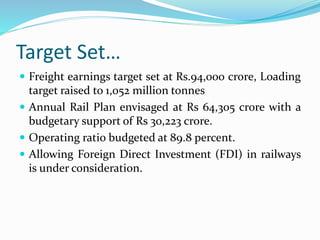
Target Set…
 Freight earnings target set at Rs.94,000 crore, Loading
target raised to 1,052 million tonnes
 Annual Rail Plan envisaged at Rs 64,305 crore with a
budgetary support of Rs 30,223 crore.
 Operating ratio budgeted at 89.8 percent.
 Allowing Foreign Direct Investment (FDI) in railways
is under consideration.
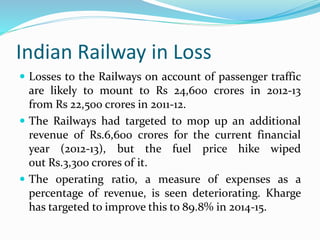
Indian Railway in Loss
 Losses to the Railways on account of passenger traffic
are likely to mount to Rs 24,600 crores in 2012-13
from Rs 22,500 crores in 2011-12.
 The Railways had targeted to mop up an additional
revenue of Rs.6,600 crores for the current financial
year (2012-13), but the fuel price hike wiped
out Rs.3,300 crores of it.
 The operating ratio, a measure of expenses as a
percentage of revenue, is seen deteriorating. Kharge
has targeted to improve this to 89.8% in 2014-15.
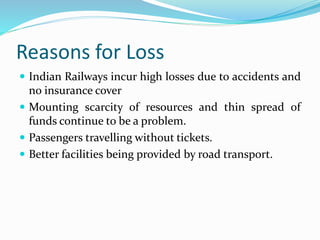
Reasons for Loss
 Indian Railways incur high losses due to accidents and
no insurance cover
 Mounting scarcity of resources and thin spread of
funds continue to be a problem.
 Passengers travelling without tickets.
 Better facilities being provided by road transport.

Indian Railway Budget 2014-15

  • 1.
  • 2.
    Railways Budget  InterimRailway Budget 2014-15 presented in the Lok Sabha by Railway Minister Mallikarjun Kharge.  Union Railways Minister Pawan Kumar Bansal presented the Railway Budget in the Lok Sabha in New Delhi on Feb 26, 2013.
  • 3.
    Highlights of Budget2014-15 No increase in passenger fares and freight charges. 17 new premium trains, 38 express trains and 10 passenger trains to be launched. Premium AC trains with dynamic fares on Delhi-Mumbai route with shorter advance reservation period. Passenger rail service to Katra and Vaishno Devi to start shortly. Railways to expand services to Meghalaya.
  • 4.
    Highlights… Three new factories- Rail Wheel Plant in district Chhapra, Bihar; Rail Coach Factory at Rae Bareli in Uttar Pradesh; and Diesel Component Factory at Dankuni, West Bengal, have become functional and commenced production during 2013-14. An independent Rail Tariff Authority to be set up to advise the government on fixing fares and freight charges.
  • 5.
    Target Set…  Freightearnings target set at Rs.94,000 crore, Loading target raised to 1,052 million tonnes  Annual Rail Plan envisaged at Rs 64,305 crore with a budgetary support of Rs 30,223 crore.  Operating ratio budgeted at 89.8 percent.  Allowing Foreign Direct Investment (FDI) in railways is under consideration.
  • 6.
    Indian Railway inLoss  Losses to the Railways on account of passenger traffic are likely to mount to Rs 24,600 crores in 2012-13 from Rs 22,500 crores in 2011-12.  The Railways had targeted to mop up an additional revenue of Rs.6,600 crores for the current financial year (2012-13), but the fuel price hike wiped out Rs.3,300 crores of it.  The operating ratio, a measure of expenses as a percentage of revenue, is seen deteriorating. Kharge has targeted to improve this to 89.8% in 2014-15.
  • 7.
    Reasons for Loss Indian Railways incur high losses due to accidents and no insurance cover  Mounting scarcity of resources and thin spread of funds continue to be a problem.  Passengers travelling without tickets.  Better facilities being provided by road transport.