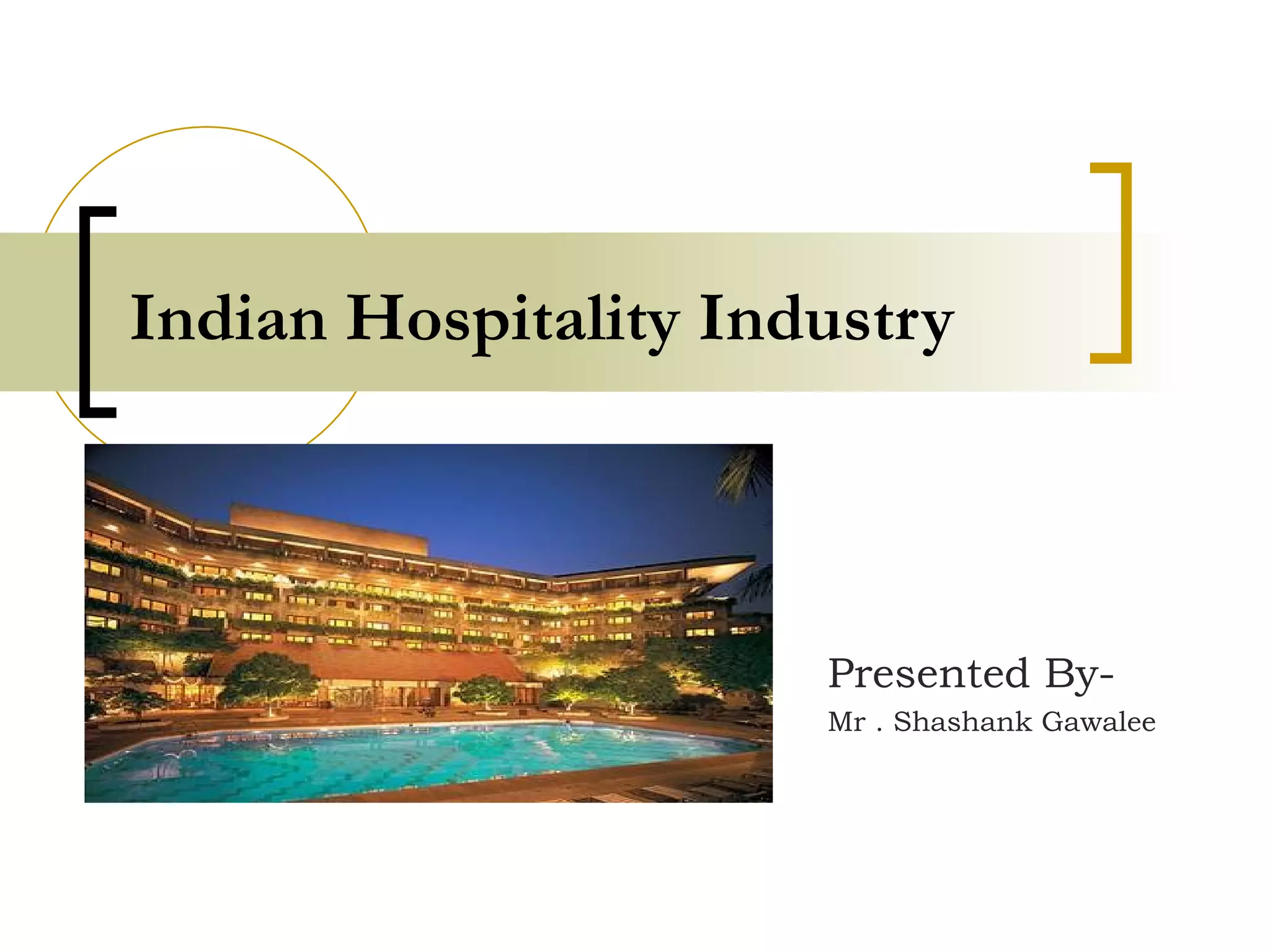
Indian Hospitality Industry Presented By- Mr . Shashank Gawalee
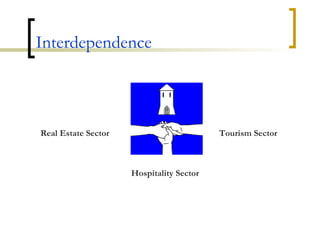
Interdependence Tourism Sector Hospitality Sector Real Estate Sector
Tourism Sector
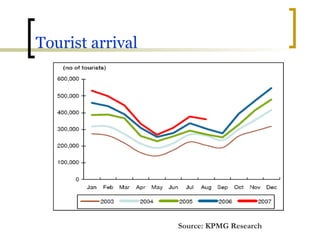
Overview Important part of global economy. Slack season: March to September September-March period accounts 60% of the total tourist arrivals. Focused largely on foreign tourists, with almost 70%  of the business coming from this segment. Inbound tourist expenditure per head is third highest in the world and even more than global average tourist spending. the cumulative FDI into the hotel and tourism sector from 1991 to March 2007 has been US$ 517.83 million, representing 1.18 per cent of the total FDI in to the country.  Tourism is the third largest earner of foreign exchange for the country.
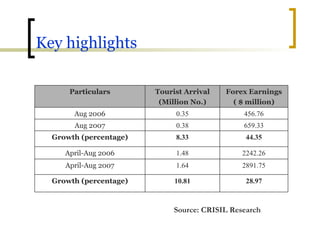
Key highlights Source: CRISIL Research 28.97 10.81 Growth (percentage) 2891.75 1.64 April-Aug 2007 2242.26 1.48 April-Aug 2006 44.35 8.33 Growth (percentage) 659.33 0.38 Aug 2007 456.76 0.35 Aug 2006 Tourist Arrival (Million No.) Forex Earnings ( $ million) Particulars
Tourist arrival Source: KPMG Research
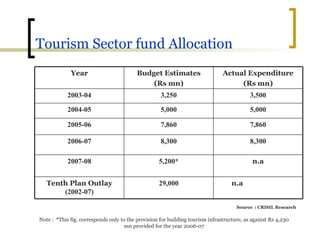
Tourism Sector fund Allocation Note :  * This fig. corresponds only to the provision for building tourism infrastructure, as against Rs 4,230 mn provided for the year 2006-07 Source  : CRISIL Research n.a 5,200* 2007-08 n.a  29,000 Tenth Plan Outlay  (2002-07) 8,300 8,300 2006-07 7,860 7,860 2005-06 5,000 5,000 2004-05 3,500 3,250 2003-04 Actual Expenditure (Rs mn) Budget Estimates (Rs mn) Year
Growth drivers Discovering/Expanding new/niche markets  Booming economy. Growth in IT enabled services & IT industry. Rising stock indices. Entry of low cost airlines. Low Cost medical facilities. Globalization & Liberalization gave it new impetus.
HOTEL INDUSTRY India's hotel industry is experiencing an unprecedented boom, driven by increasing numbers of business and tourist arrivals. But how long can the good times last?
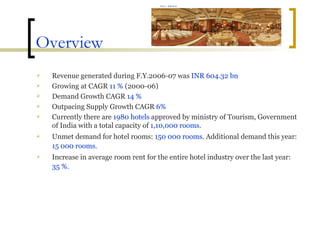
Overview Revenue generated during F.Y.2006-07 was  INR 604.32 bn Growing at CAGR  11 %  (2000-06) Demand Growth CAGR  14 %   Outpacing Supply Growth CAGR  6% Currently there are  1980 hotels  approved by ministry of Tourism, Government of India with a total capacity of  1,10,000 rooms. Unmet demand for hotel rooms:  150 000 rooms . Additional demand this year:  15 000 rooms. Increase in average room rent for the entire hotel industry over the last year:  35 %.
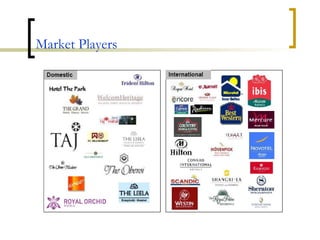
Market Players
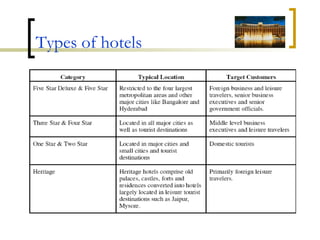
Types of hotels
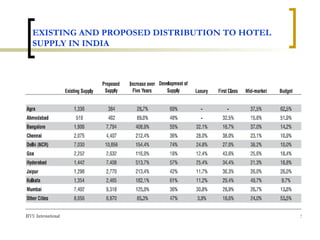
EXISTING AND PROPOSED DISTRIBUTION TO HOTEL SUPPLY IN INDIA
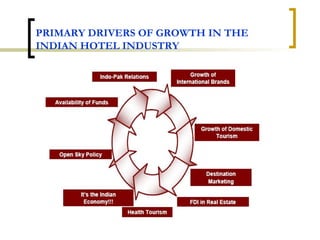
PRIMARY DRIVERS OF GROWTH IN THE INDIAN HOTEL INDUSTRY
Emerging Hotel Concepts Ecotel Resorts Motels Floatels Service Apartments
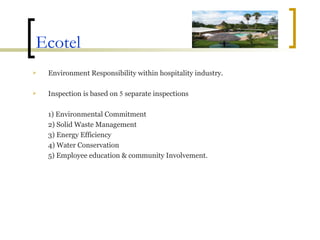
Ecotel Environment Responsibility within hospitality industry. Inspection is based on  5  separate inspections 1) Environmental Commitment 2) Solid Waste Management 3) Energy Efficiency 4) Water Conservation 5) Employee education & community Involvement.
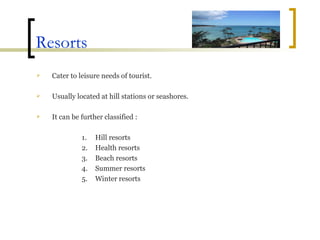
Resorts Cater to leisure needs of tourist. Usually located at hill stations or seashores. It can be further classified : Hill resorts Health resorts  Beach resorts Summer resorts  Winter resorts
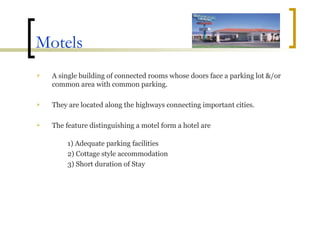
Motels A single building of connected rooms whose doors face a parking lot &/or common area with common parking. They are located along the highways connecting important cities. The feature distinguishing a motel form a hotel are 1) Adequate parking facilities 2) Cottage style accommodation 3) Short duration of Stay
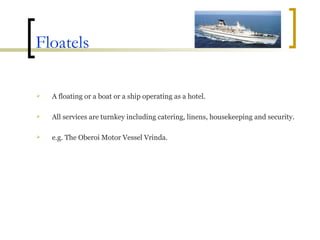
Floatels A floating or a boat or a ship operating as a hotel. All services are turnkey including catering, linens, housekeeping and security.  e.g. The Oberoi Motor Vessel Vrinda.
Service Apartments This concept is slowly gaining ground in the industry.  They mainly target emigrant & long duration visitors [business & leisure]. Service apartments are preferred to hotels for the following reasons : Business executives  find them safe, convenient, affordable & well maintained. They are larger than hotel rooms No rental deposits required in this case. They are beneficial for SME for their roving representatives.
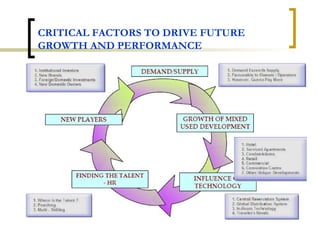
CRITICAL FACTORS TO DRIVE FUTURE GROWTH AND PERFORMANCE
Challenges of Hotel Industry The  3  challenges that clearly emerge for the industry are : 1) Managing Demand 2) Optimising Customer Mix 3) Optimising channel Mix
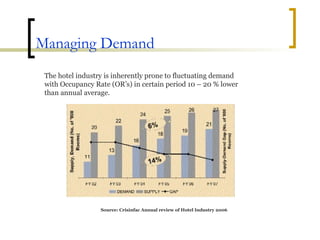
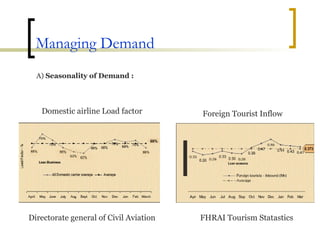
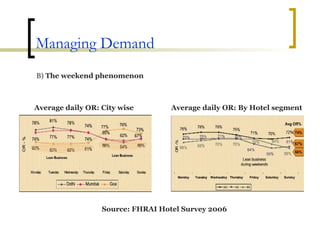
Managing Demand The hotel industry is inherently prone to fluctuating demand with Occupancy Rate (OR’s) in certain period 10 – 20 % lower than annual average. Source: Crisinfac Annual review of Hotel Industry 2006
Managing Demand A)  Seasonality of Demand : Domestic airline Load factor Directorate general of Civil Aviation Foreign Tourist Inflow FHRAI Tourism Statastics
Managing Demand B)  The weekend phenomenon Average daily OR: City wise Average daily OR: By Hotel segment Source: FHRAI Hotel Survey 2006
Managing Demand C)  Preference of hotels to maximize RevPAR through ARR growth over OR (Occupancy Rate) 1) It raises the overall industry ARR levels 2) Revenue growth achieved at no extra cost. 3) Favorable impact on bottom line
Managing Customer Mix Challenges : A)   Customer Mix governed by product offerings, brand positioning, segmenting & location B) Hotel employs tie ups, promotions, targeted pricing etc. Options : A) Revenue can increased by strategic customer segmentation & offer management. B) This hidden opportunity has potential to boost revenues by 3 to 5 percent.
Managing the Channel Sales Mix Challenges : A) Increase in online bookings has restructured the sale channel mix for hotels. B) Compelling channel partners to reposition & restructure themselves. C) Large number of intermediaries which are integral part of system result in  i)  Higher Complexities 11) Lower Profitability iii) Commoditization of hotels Options : A) Maximize profitability through optimization of channel mix & minimization of  intermediaries. B) By optimizing channel mix could result in intermediary cost by 1 to 3 percent.
Real Estate Sector
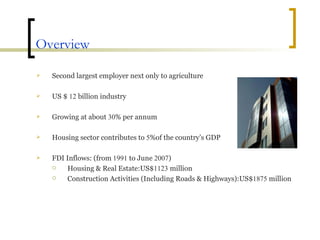
Overview Second largest employer next only to agriculture  US $  12  billion industry Growing at about  30 % per annum Housing sector contributes to  5 %of the country’s GDP FDI Inflows: (from  1991  to June  2007 ) Housing & Real Estate:US$ 1123  million Construction Activities (Including Roads & Highways):US$ 1875  million
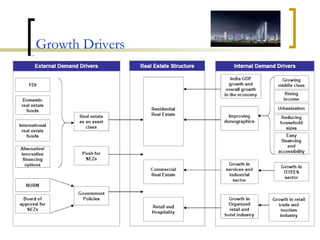
Growth Drivers
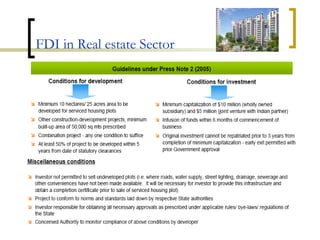
FDI in Real estate Sector
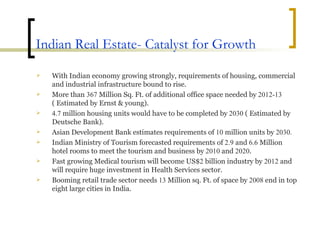
Indian Real Estate- Catalyst for Growth With Indian economy growing strongly, requirements of housing, commercial and industrial infrastructure bound to rise. More than  367  Million Sq. Ft. of additional office space needed by  2012-13  ( Estimated by Ernst & young). 4.7  million housing units would have to be completed by  2030  ( Estimated by Deutsche Bank). Asian Development Bank estimates requirements of  10  million units by  2030. Indian Ministry of Tourism forecasted requirements of  2.9  and  6.6  Million hotel rooms to meet the tourism and business by  2010  and  2020 . Fast growing Medical tourism will become US$ 2  billion industry by  2012  and will require huge investment in Health Services sector. Booming retail trade sector needs  13  Million sq. Ft. of space by  2008  end in top eight large cities in India.
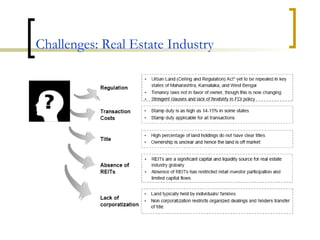
Challenges: Real Estate Industry
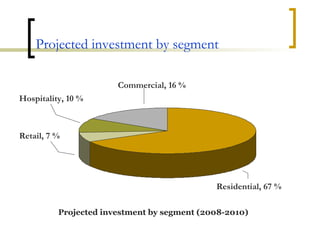
Projected investment by segment Residential, 67 % Commercial, 16 % Hospitality, 10 % Retail, 7 % Projected investment by segment (2008-2010)
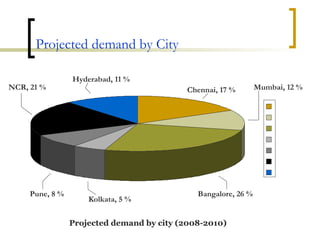
Projected demand by City Chennai, 17 % Mumbai, 12 % Bangalore, 26 % Kolkata, 5 % Pune, 8 % NCR, 21 % Hyderabad, 11 % Projected demand by city (2008-2010)
Funding Options
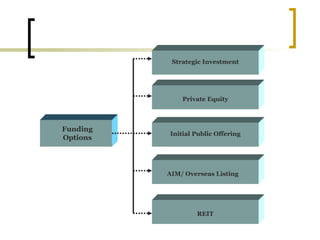
Funding Options Strategic Investment Private Equity Initial Public Offering AIM/ Overseas Listing REIT
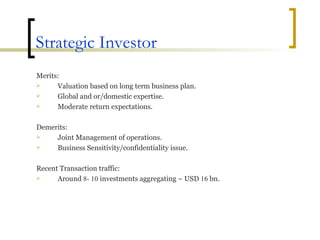
Strategic Investor Merits: Valuation based on long term business plan. Global and or/domestic expertise. Moderate return expectations. Demerits:  Joint Management of operations. Business Sensitivity/confidentiality issue. Recent Transaction traffic: Around  8- 10  investments aggregating ~ USD  16  bn.
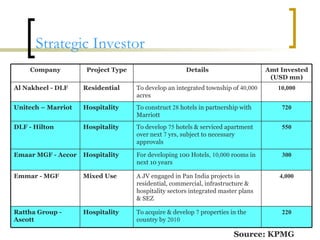
Strategic Investor Source: KPMG 10,000 To develop an integrated township of  40,000  acres Residential Al Nakheel - DLF 4,000 A JV engaged in Pan India projects in residential, commercial, infrastructure & hospitality sectors integrated master plans & SEZ Mixed Use Emmar - MGF 300 For developing 100 Hotels , 10,000  rooms in next 10 years Hospitality Emaar MGF - Accor 220 To acquire & develop  7  properties in the country by  2010 Hospitality Rattha Group - Ascott 550 To develop  75  hotels & serviced apartment over next  7  yrs, subject to necessary approvals Hospitality DLF - Hilton 720 To construct  28  hotels in partnership with Marriott Hospitality Unitech – Marriot Amt Invested (USD mn) Details Project Type Company
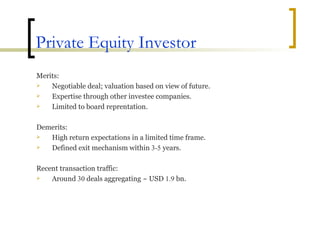
Private Equity Investor Merits: Negotiable deal; valuation based on view of future. Expertise through other investee companies. Limited to board reprentation. Demerits: High return expectations in a limited time frame. Defined exit mechanism within  3-5  years. Recent transaction traffic: Around  30  deals aggregating ~ USD  1.9  bn.
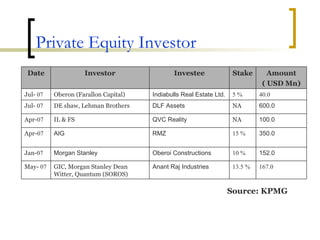
Private Equity Investor Source: KPMG 600.0 NA DLF Assets DE shaw, Lehman Brothers Jul-  07 167.0 13.5 % Anant Raj Industries GIC, Morgan Stanley Dean Witter, Quantum (SOROS) May-  07 152.0 10 % Oberoi Constructions Morgan Stanley Jan- 07 350.0 15 % RMZ AIG Apr- 07 100.0 NA QVC Reality IL & FS Apr- 07 40.0 5 % Indiabulls Real Estate Ltd. Oberon (Farallon Capital) Jul-  07 Amount ( USD Mn) Stake Investee Investor Date
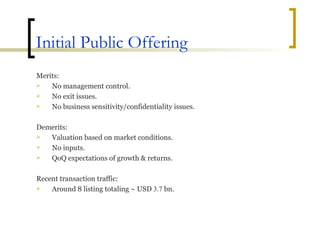
Initial Public Offering Merits: No management control. No exit issues. No business sensitivity/confidentiality issues. Demerits: Valuation based on market conditions. No inputs. QoQ expectations of growth & returns. Recent transaction traffic: Around 8 listing totaling ~ USD  3.7  bn.
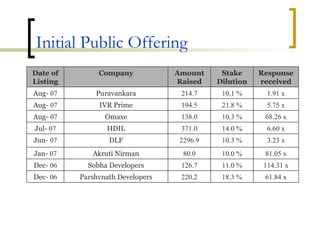
Initial Public Offering 114.31 x 11.0 % 126.7 Sobha Developers Dec-  06 61.84 x 18.3 % 220.2 Parshvnath Developers Dec-  06 81.05 x 10.0 % 80.0 Akruti Nirman Jan-  07 3.23 x 10.3 % 2296.9 DLF Jun-  07 6.60 x 14.0 % 371.0 HDIL Jul-  07 68.26 x 10.3 % 138.0 Omaxe Aug-  07 5.75 x 21.8 % 194.5 IVR Prime Aug-  07 1.91 x 10.1 % 214.7 Puravankara Aug-  07 Response received Stake Dilution Amount Raised Company Date of Listing
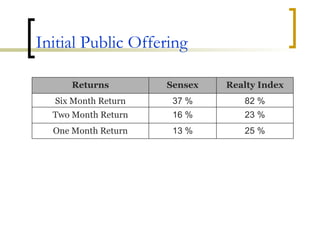
Initial Public Offering 25 % 13 % One Month Return 23 % 16 % Two Month Return 82 % 37 % Six Month Return Realty Index Sensex Returns
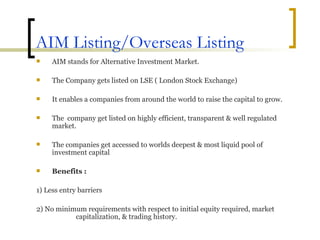
AIM Listing/Overseas Listing AIM stands for Alternative Investment Market. The Company gets listed on LSE ( London Stock Exchange)  It enables a companies from around the world to raise the capital to grow. The  company get listed on highly efficient, transparent & well regulated market. The companies get accessed to worlds deepest & most liquid pool of investment capital Benefits : 1) Less entry barriers 2) No minimum requirements with respect to initial equity required, market  capitalization, & trading history.
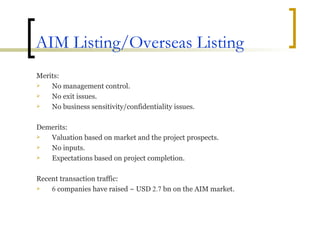
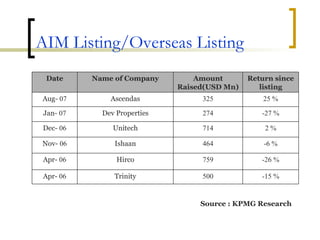
AIM Listing/Overseas Listing Merits: No management control. No exit issues. No business sensitivity/confidentiality issues. Demerits: Valuation based on market and the project prospects. No inputs. Expectations based on project completion. Recent transaction traffic: 6  companies have raised ~ USD  2.7  bn on the AIM market.
AIM Listing/Overseas Listing Source : KPMG Research -15 % 500 Trinity Apr-  06 -26 % 759 Hirco Apr-  06 -6 % 464 Ishaan Nov-  06 2 % 714 Unitech Dec-  06 -27 % 274 Dev Properties Jan-  07 25 % 325 Ascendas Aug-  07 Return since listing Amount Raised(USD Mn) Name of Company Date
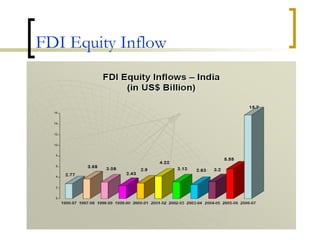
FDI Equity Inflow
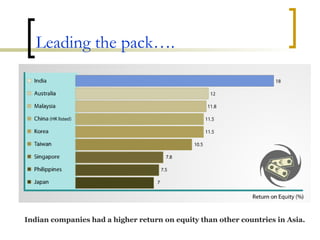
Leading the pack…. Indian companies had a higher return on equity than other countries in Asia.
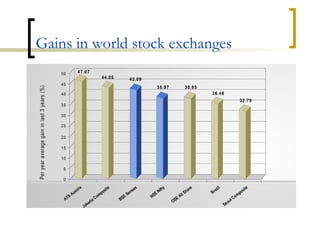
Gains in world stock exchanges
Government initiatives The “Incredible India” campaign. Open skies policy. New airports. International conventional centers. Reduction in travel cost. Reduction in taxes on hotel industry. Extension of infrastructure status. Introduction of M-Visa.
Key factors to invest in hotel stocks The Strategy & Capex plan of the company. Changes in global Geopolitical situations. The hotel chain should not be leveraged on any specific segment.
Concluding Remarks…. Since there is a lot of potential for growth & development of Hotel sector. It needs to be infused with fresh inflows of capital.  The fund raising options are as follows  Strategic investment, Private Equity, IPO, AIM & REIT. The key considerations for the above fund raising alternatives are : Valuation Expectations Industry Expertise Management Control return expectation Exit Mechanism Confidentiality issue Transaction structuring
THANK YOU
Size of real estate industry is currently USD 16 million.

Indian Hospitality Industry

  • 1.
    Indian Hospitality IndustryPresented By- Mr . Shashank Gawalee
  • 2.
    Interdependence Tourism SectorHospitality Sector Real Estate Sector
  • 3.
  • 4.
    Overview Important partof global economy. Slack season: March to September September-March period accounts 60% of the total tourist arrivals. Focused largely on foreign tourists, with almost 70% of the business coming from this segment. Inbound tourist expenditure per head is third highest in the world and even more than global average tourist spending. the cumulative FDI into the hotel and tourism sector from 1991 to March 2007 has been US$ 517.83 million, representing 1.18 per cent of the total FDI in to the country. Tourism is the third largest earner of foreign exchange for the country.
  • 5.
    Key highlights Source:CRISIL Research 28.97 10.81 Growth (percentage) 2891.75 1.64 April-Aug 2007 2242.26 1.48 April-Aug 2006 44.35 8.33 Growth (percentage) 659.33 0.38 Aug 2007 456.76 0.35 Aug 2006 Tourist Arrival (Million No.) Forex Earnings ( $ million) Particulars
  • 6.
  • 7.
    Tourism Sector fundAllocation Note : * This fig. corresponds only to the provision for building tourism infrastructure, as against Rs 4,230 mn provided for the year 2006-07 Source : CRISIL Research n.a 5,200* 2007-08 n.a 29,000 Tenth Plan Outlay (2002-07) 8,300 8,300 2006-07 7,860 7,860 2005-06 5,000 5,000 2004-05 3,500 3,250 2003-04 Actual Expenditure (Rs mn) Budget Estimates (Rs mn) Year
  • 8.
    Growth drivers Discovering/Expandingnew/niche markets Booming economy. Growth in IT enabled services & IT industry. Rising stock indices. Entry of low cost airlines. Low Cost medical facilities. Globalization & Liberalization gave it new impetus.
  • 9.
    HOTEL INDUSTRY India'shotel industry is experiencing an unprecedented boom, driven by increasing numbers of business and tourist arrivals. But how long can the good times last?
  • 10.
    Overview Revenue generatedduring F.Y.2006-07 was INR 604.32 bn Growing at CAGR 11 % (2000-06) Demand Growth CAGR 14 % Outpacing Supply Growth CAGR 6% Currently there are 1980 hotels approved by ministry of Tourism, Government of India with a total capacity of 1,10,000 rooms. Unmet demand for hotel rooms: 150 000 rooms . Additional demand this year: 15 000 rooms. Increase in average room rent for the entire hotel industry over the last year: 35 %.
  • 11.
  • 12.
  • 13.
    EXISTING AND PROPOSEDDISTRIBUTION TO HOTEL SUPPLY IN INDIA
  • 14.
    PRIMARY DRIVERS OFGROWTH IN THE INDIAN HOTEL INDUSTRY
  • 15.
    Emerging Hotel ConceptsEcotel Resorts Motels Floatels Service Apartments
  • 16.
    Ecotel Environment Responsibilitywithin hospitality industry. Inspection is based on 5 separate inspections 1) Environmental Commitment 2) Solid Waste Management 3) Energy Efficiency 4) Water Conservation 5) Employee education & community Involvement.
  • 17.
    Resorts Cater toleisure needs of tourist. Usually located at hill stations or seashores. It can be further classified : Hill resorts Health resorts Beach resorts Summer resorts Winter resorts
  • 18.
    Motels A singlebuilding of connected rooms whose doors face a parking lot &/or common area with common parking. They are located along the highways connecting important cities. The feature distinguishing a motel form a hotel are 1) Adequate parking facilities 2) Cottage style accommodation 3) Short duration of Stay
  • 19.
    Floatels A floatingor a boat or a ship operating as a hotel. All services are turnkey including catering, linens, housekeeping and security. e.g. The Oberoi Motor Vessel Vrinda.
  • 20.
    Service Apartments Thisconcept is slowly gaining ground in the industry. They mainly target emigrant & long duration visitors [business & leisure]. Service apartments are preferred to hotels for the following reasons : Business executives find them safe, convenient, affordable & well maintained. They are larger than hotel rooms No rental deposits required in this case. They are beneficial for SME for their roving representatives.
  • 21.
    CRITICAL FACTORS TODRIVE FUTURE GROWTH AND PERFORMANCE
  • 22.
    Challenges of HotelIndustry The 3 challenges that clearly emerge for the industry are : 1) Managing Demand 2) Optimising Customer Mix 3) Optimising channel Mix
  • 23.
    Managing Demand Thehotel industry is inherently prone to fluctuating demand with Occupancy Rate (OR’s) in certain period 10 – 20 % lower than annual average. Source: Crisinfac Annual review of Hotel Industry 2006
  • 24.
    Managing Demand A) Seasonality of Demand : Domestic airline Load factor Directorate general of Civil Aviation Foreign Tourist Inflow FHRAI Tourism Statastics
  • 25.
    Managing Demand B) The weekend phenomenon Average daily OR: City wise Average daily OR: By Hotel segment Source: FHRAI Hotel Survey 2006
  • 26.
    Managing Demand C) Preference of hotels to maximize RevPAR through ARR growth over OR (Occupancy Rate) 1) It raises the overall industry ARR levels 2) Revenue growth achieved at no extra cost. 3) Favorable impact on bottom line
  • 27.
    Managing Customer MixChallenges : A) Customer Mix governed by product offerings, brand positioning, segmenting & location B) Hotel employs tie ups, promotions, targeted pricing etc. Options : A) Revenue can increased by strategic customer segmentation & offer management. B) This hidden opportunity has potential to boost revenues by 3 to 5 percent.
  • 28.
    Managing the ChannelSales Mix Challenges : A) Increase in online bookings has restructured the sale channel mix for hotels. B) Compelling channel partners to reposition & restructure themselves. C) Large number of intermediaries which are integral part of system result in i) Higher Complexities 11) Lower Profitability iii) Commoditization of hotels Options : A) Maximize profitability through optimization of channel mix & minimization of intermediaries. B) By optimizing channel mix could result in intermediary cost by 1 to 3 percent.
  • 29.
  • 30.
    Overview Second largestemployer next only to agriculture US $ 12 billion industry Growing at about 30 % per annum Housing sector contributes to 5 %of the country’s GDP FDI Inflows: (from 1991 to June 2007 ) Housing & Real Estate:US$ 1123 million Construction Activities (Including Roads & Highways):US$ 1875 million
  • 31.
  • 32.
    FDI in Realestate Sector
  • 33.
    Indian Real Estate-Catalyst for Growth With Indian economy growing strongly, requirements of housing, commercial and industrial infrastructure bound to rise. More than 367 Million Sq. Ft. of additional office space needed by 2012-13 ( Estimated by Ernst & young). 4.7 million housing units would have to be completed by 2030 ( Estimated by Deutsche Bank). Asian Development Bank estimates requirements of 10 million units by 2030. Indian Ministry of Tourism forecasted requirements of 2.9 and 6.6 Million hotel rooms to meet the tourism and business by 2010 and 2020 . Fast growing Medical tourism will become US$ 2 billion industry by 2012 and will require huge investment in Health Services sector. Booming retail trade sector needs 13 Million sq. Ft. of space by 2008 end in top eight large cities in India.
  • 34.
  • 35.
    Projected investment bysegment Residential, 67 % Commercial, 16 % Hospitality, 10 % Retail, 7 % Projected investment by segment (2008-2010)
  • 36.
    Projected demand byCity Chennai, 17 % Mumbai, 12 % Bangalore, 26 % Kolkata, 5 % Pune, 8 % NCR, 21 % Hyderabad, 11 % Projected demand by city (2008-2010)
  • 37.
  • 38.
    Funding Options StrategicInvestment Private Equity Initial Public Offering AIM/ Overseas Listing REIT
  • 39.
    Strategic Investor Merits:Valuation based on long term business plan. Global and or/domestic expertise. Moderate return expectations. Demerits: Joint Management of operations. Business Sensitivity/confidentiality issue. Recent Transaction traffic: Around 8- 10 investments aggregating ~ USD 16 bn.
  • 40.
    Strategic Investor Source:KPMG 10,000 To develop an integrated township of 40,000 acres Residential Al Nakheel - DLF 4,000 A JV engaged in Pan India projects in residential, commercial, infrastructure & hospitality sectors integrated master plans & SEZ Mixed Use Emmar - MGF 300 For developing 100 Hotels , 10,000 rooms in next 10 years Hospitality Emaar MGF - Accor 220 To acquire & develop 7 properties in the country by 2010 Hospitality Rattha Group - Ascott 550 To develop 75 hotels & serviced apartment over next 7 yrs, subject to necessary approvals Hospitality DLF - Hilton 720 To construct 28 hotels in partnership with Marriott Hospitality Unitech – Marriot Amt Invested (USD mn) Details Project Type Company
  • 41.
    Private Equity InvestorMerits: Negotiable deal; valuation based on view of future. Expertise through other investee companies. Limited to board reprentation. Demerits: High return expectations in a limited time frame. Defined exit mechanism within 3-5 years. Recent transaction traffic: Around 30 deals aggregating ~ USD 1.9 bn.
  • 42.
    Private Equity InvestorSource: KPMG 600.0 NA DLF Assets DE shaw, Lehman Brothers Jul- 07 167.0 13.5 % Anant Raj Industries GIC, Morgan Stanley Dean Witter, Quantum (SOROS) May- 07 152.0 10 % Oberoi Constructions Morgan Stanley Jan- 07 350.0 15 % RMZ AIG Apr- 07 100.0 NA QVC Reality IL & FS Apr- 07 40.0 5 % Indiabulls Real Estate Ltd. Oberon (Farallon Capital) Jul- 07 Amount ( USD Mn) Stake Investee Investor Date
  • 43.
    Initial Public OfferingMerits: No management control. No exit issues. No business sensitivity/confidentiality issues. Demerits: Valuation based on market conditions. No inputs. QoQ expectations of growth & returns. Recent transaction traffic: Around 8 listing totaling ~ USD 3.7 bn.
  • 44.
    Initial Public Offering114.31 x 11.0 % 126.7 Sobha Developers Dec- 06 61.84 x 18.3 % 220.2 Parshvnath Developers Dec- 06 81.05 x 10.0 % 80.0 Akruti Nirman Jan- 07 3.23 x 10.3 % 2296.9 DLF Jun- 07 6.60 x 14.0 % 371.0 HDIL Jul- 07 68.26 x 10.3 % 138.0 Omaxe Aug- 07 5.75 x 21.8 % 194.5 IVR Prime Aug- 07 1.91 x 10.1 % 214.7 Puravankara Aug- 07 Response received Stake Dilution Amount Raised Company Date of Listing
  • 45.
    Initial Public Offering25 % 13 % One Month Return 23 % 16 % Two Month Return 82 % 37 % Six Month Return Realty Index Sensex Returns
  • 46.
    AIM Listing/Overseas ListingAIM stands for Alternative Investment Market. The Company gets listed on LSE ( London Stock Exchange) It enables a companies from around the world to raise the capital to grow. The company get listed on highly efficient, transparent & well regulated market. The companies get accessed to worlds deepest & most liquid pool of investment capital Benefits : 1) Less entry barriers 2) No minimum requirements with respect to initial equity required, market capitalization, & trading history.
  • 47.
    AIM Listing/Overseas ListingMerits: No management control. No exit issues. No business sensitivity/confidentiality issues. Demerits: Valuation based on market and the project prospects. No inputs. Expectations based on project completion. Recent transaction traffic: 6 companies have raised ~ USD 2.7 bn on the AIM market.
  • 48.
    AIM Listing/Overseas ListingSource : KPMG Research -15 % 500 Trinity Apr- 06 -26 % 759 Hirco Apr- 06 -6 % 464 Ishaan Nov- 06 2 % 714 Unitech Dec- 06 -27 % 274 Dev Properties Jan- 07 25 % 325 Ascendas Aug- 07 Return since listing Amount Raised(USD Mn) Name of Company Date
  • 49.
  • 50.
    Leading the pack….Indian companies had a higher return on equity than other countries in Asia.
  • 51.
    Gains in worldstock exchanges
  • 52.
    Government initiatives The“Incredible India” campaign. Open skies policy. New airports. International conventional centers. Reduction in travel cost. Reduction in taxes on hotel industry. Extension of infrastructure status. Introduction of M-Visa.
  • 53.
    Key factors toinvest in hotel stocks The Strategy & Capex plan of the company. Changes in global Geopolitical situations. The hotel chain should not be leveraged on any specific segment.
  • 54.
    Concluding Remarks…. Sincethere is a lot of potential for growth & development of Hotel sector. It needs to be infused with fresh inflows of capital. The fund raising options are as follows Strategic investment, Private Equity, IPO, AIM & REIT. The key considerations for the above fund raising alternatives are : Valuation Expectations Industry Expertise Management Control return expectation Exit Mechanism Confidentiality issue Transaction structuring
  • 55.
  • 56.
    Size of realestate industry is currently USD 16 million.