THE INDIAN CONTRACT ACT, 1872
โ€ข โ€˜Contractโ€™ is the most usual method of
defining the rights and duties in a business
transaction.
โ€ข The Indian Contract Act, 1872 codifies the
legal principles that govern โ€˜contractsโ€™
Sec 1-75 deals with general principles
Sec: 124-238: deals with Indemnity and
guarantee, bailment & pledge and agency
WHAT IS A CONTRACT?
โ€ข The term contract is defined under section
2(h) of the Indian Contract Act, 1872 asโ€œan
agreement enforceable by lawโ€.
โ€ข The contract consists of two essential
elements:
โ€ข (i) an agreement, and
โ€ข (ii) its enforceability by law.
(i) Agreement & Promise
โ€ข Agreement - The term โ€˜agreementโ€™ given in Section 2(e) of
the Act is defined as-
โ€ข โ€œevery promise and every set of promises, forming the
consideration for each otherโ€.
โ€ข Section 2 (b) defines promise as
โ€ข โ€œwhen the person to whom the proposal is made signifies
his assent there to, the proposal is said to be accepted.
Proposal when accepted, becomes a promiseโ€.
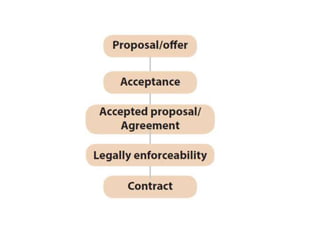
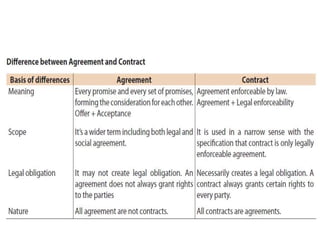
โ€ข Agreement = Offer/Proposal + Acceptance
(ii)Enforceability by Law
โ€ข An agreement to become a contract must give
rise to a legal obligation
โ€ข Contract = Accepted proposal/Agreement +
Enforceability by law
โ€ข However some obligations are outside the
purview of the law of contract.
โ€ข Example:
โ€ข An obligation to maintain wife and children,
an order of the court of law etc. These are
status obligations and so out of the scope of
the Contract Act.
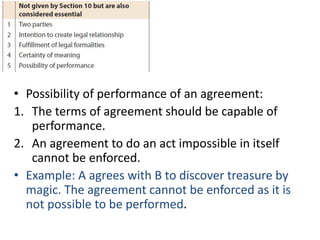
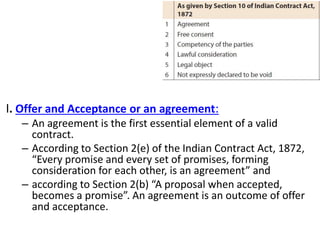
ESSENTIALS OF A VALID CONTRACT
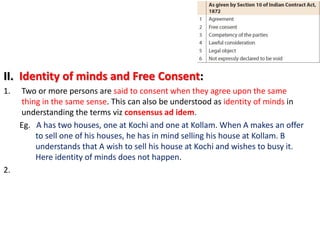
โ€ข Section 10 of the Act,
โ€ข โ€œall agreements are contracts if they are made
by the free consent of the parties competent
to contract, for a lawful consideration and
with a lawful object and are not expressly
declared to be voidโ€.
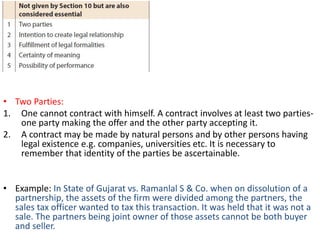
โ€ข Two Parties:
1. One cannot contract with himself. A contract involves at least two parties-
one party making the offer and the other party accepting it.
2. A contract may be made by natural persons and by other persons having
legal existence e.g. companies, universities etc. It is necessary to
remember that identity of the parties be ascertainable.
โ€ข Example: In State of Gujarat vs. Ramanlal S & Co. when on dissolution of a
partnership, the assets of the firm were divided among the partners, the
sales tax officer wanted to tax this transaction. It was held that it was not a
sale. The partners being joint owner of those assets cannot be both buyer
and seller.
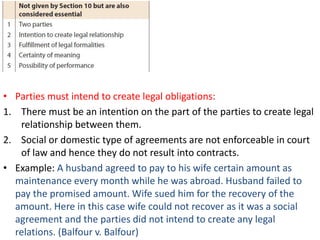
โ€ข Parties must intend to create legal obligations:
1. There must be an intention on the part of the parties to create legal
relationship between them.
2. Social or domestic type of agreements are not enforceable in court
of law and hence they do not result into contracts.
โ€ข Example: A husband agreed to pay to his wife certain amount as
maintenance every month while he was abroad. Husband failed to
pay the promised amount. Wife sued him for the recovery of the
amount. Here in this case wife could not recover as it was a social
agreement and the parties did not intend to create any legal
relations. (Balfour v. Balfour)
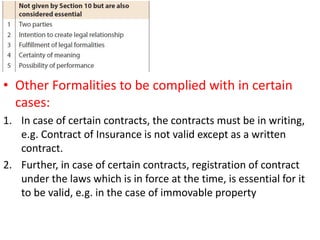
โ€ข Other Formalities to be complied with in certain
cases:
1. In case of certain contracts, the contracts must be in writing,
e.g. Contract of Insurance is not valid except as a written
contract.
2. Further, in case of certain contracts, registration of contract
under the laws which is in force at the time, is essential for it
to be valid, e.g. in the case of immovable property
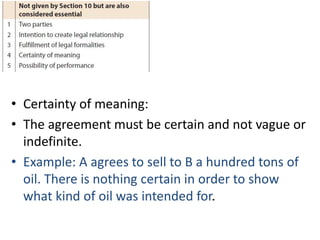
โ€ข Certainty of meaning:
โ€ข The agreement must be certain and not vague or
indefinite.
โ€ข Example: A agrees to sell to B a hundred tons of
oil. There is nothing certain in order to show
what kind of oil was intended for.
โ€ข Possibility of performance of an agreement:
1. The terms of agreement should be capable of
performance.
2. An agreement to do an act impossible in itself
cannot be enforced.
โ€ข Example: A agrees with B to discover treasure by
magic. The agreement cannot be enforced as it is
not possible to be performed.
I. Offer and Acceptance or an agreement:
โ€“ An agreement is the first essential element of a valid
contract.
โ€“ According to Section 2(e) of the Indian Contract Act, 1872,
โ€œEvery promise and every set of promises, forming
consideration for each other, is an agreementโ€ and
โ€“ according to Section 2(b) โ€œA proposal when accepted,
becomes a promiseโ€. An agreement is an outcome of offer
and acceptance.
PROPOSAL / OFFER
[SECTION 2(a) OF THE INDIAN CONTRACT ACT, 1872]
โ€ข Definition of Offer/Proposal:
โ€ข According to Section 2(a) of the Indian
Contract Act, 1872,
โ€œwhen one person signifies to another his
willingness to do or to abstain from doing
anything with a view to obtaining the assent of
that other to such act or abstinence, he is said
to make a proposalโ€.
Essentials of a proposal/offer are
โ€ข 1. The person making the proposal or offer is
called the โ€˜promisorโ€™ or โ€˜offerorโ€™:
โ€“ The person to whom the offer is made is called
the โ€˜offereeโ€™ and the person accepting the offer is
called the โ€˜promiseeโ€™ or โ€˜acceptorโ€™.
โ€ข 2. For a valid offer, the party making it must
express his willingness โ€˜to doโ€™ or โ€˜not to doโ€™
something: Mere expression of willingness
does not constitute an offer.
โ€ข An offer can be positive as well as negative:
Thus โ€œdoingโ€ is a positive act and โ€œnot doingโ€,
or โ€œabstinenceโ€ is a negative act; nonetheless
both these acts have the same effect in the
eyes of law.
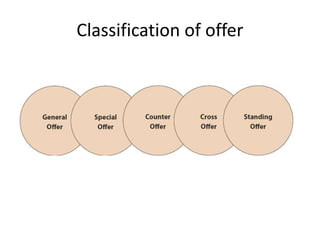
Classification of offer
(a) General offer:
โ€ข It is an offer made to public at large and hence anyone can accept and
do the desired act (Carlill v. Carbolic Smoke Ball Co.).
โ€ข In terms of Section 8 of the Act, anyone performing the conditions of
the offer can be considered to have accepted the offer.
โ€ข Until the general offer is retracted or withdrawn, it can be accepted by
anyone at any time as it is a continuing offer.
โ€ข Case Law: Carlill Vs. Carbolic Smoke Ball Co. (1893) Facts: In this famous
case Carbolic smoke Ball Co. advertised in several newspapers that a
reward of ยฃ100 would be given to any person who contracted influenza
after using the smoke balls produced by the Carbolic Smoke Company
according to printed directions. One lady, Mrs. Carlill, used the smoke
balls as per the directions of company and even then suffered from
influenza. Held, she could recover the amount as by using the smoke
balls she had accepted the offer.
โ€ข (b) Special/specific offer:
โ€ข When the offer is made to a specific or an
ascertained person, it is known as a specific
offer. Specific offer can be accepted only by
that specified person to whom the offer has
been made. [Boulton v. Jones]
โ€ข Example: โ€˜Aโ€™ offers to sell his car to โ€˜Bโ€™ at a
certain cost. This is a specific offer.
โ€ข (c) Cross offer: When two parties exchange identical offers in
ignorance at the time of each otherโ€™s offer, the offers are
called cross offers. There is no binding contract in such a case
because offer made by a person cannot be construed as
acceptance of the anotherโ€™s offer.
โ€ข Example: If A makes a proposal to B to sell his car for ` 2 lacs
and B, without knowing the proposal of A, makes an offer to
purchase the same car at ` 2 lacs from A, it is not an
acceptance, as B was not aware of proposal made by A. It is
only cross proposal (cross offer). And when two persons make
offer to each other, it can not be treated as mutual
acceptance. There is no binding contract in such a case.
โ€ข (d) Counter offer: When the offeree offers to qualified
acceptance of the offer subject to modifications and
variations in the terms of original offer, he is said to
have made a counter offer. Counter-offer amounts to
rejection of the original offer. It is also called as
Conditional Acceptance.
โ€ข Example: โ€˜Aโ€™ offers to sell his plot to โ€˜Bโ€™ for `10 lakhs. โ€™Bโ€™
agrees to buy it for ` 8 lakhs. It amounts to counter
offer. It may result in the termination of the offer of โ€™Aโ€™.
Any if later on โ€˜Bโ€™ agrees to buy the plot for ` 10 lakhs,
โ€™Aโ€™ may refuse
โ€ข (e) Standing or continuing or open offer:
โ€ข An offer which is allowed to remain open for
acceptance over a period of time is known as
standing or continuing or open offer.
Essentials of a valid offer
1. It must be capable of creating legal relations:
A social invitation, even if it is accepted, does not create
legal relations because it is not so intended.
2. Offer must be certain, definite and not vague:
Eg. where A offers to sell B 100 quintals of oil, there is
nothing whatever to show what kind of oil was intended.
3. The offeree will have to accept all the terms of the
offer otherwise the contract will be treated as
invalid.
4. The offer may be either specific or general:
5. It must be communicated to the offeree:
โ€ข An offer, to be complete, must be communicated to
the person to whom it is made, otherwise there can be
no acceptance of it.
โ€ข An acceptance of an offer, in ignorance of the offer, is
not acceptance and does not confer any right on the
acceptor
โ€ข This can be illustrated by the landmark case of Lalman
Shukla v. GauriDutt Facts:
โ€ข G (Gauridutt) sent his servant L (Lalman) to trace his
missing nephew. He then announced that anybody
who traced his nephew would be entitled to a certain
reward. L traced the boy in ignorance of this
announcement. Subsequently when he came to know
of the reward, he claimed it. Held, he was not entitled
to the reward, as he did not know the offer.
6. It must be made with a view to obtaining the assent of
the other party:
7. It may be conditional: An offer can be made subject to
any terms and conditions by the offeror.
Example: Offeror may ask for payment by RTGS, NEFT etc.
8. Offer should not contain a term the non compliance of
which would amount to acceptance:
Example: A proposes B to purchase his android mobile for
`5000 and if no reply by him in a week, it would be
assumed that B had accepted the proposal. This would
not result into contract.
9. Offer is Different from an invitation to offer, a mere
communication of information, and Advertisement.
โ€ข (i) An invitation to make an offer or do business.
โ€ข In case of โ€œan invitation to make an offerโ€, the person
making the invitation does not make an offer rather
invites the other party to make an offer.
โ€ข His objective is to send out the invitation that he is
willing to deal with any person who, on the basis of
such invitation, is ready to enter into contract with him
subject to final terms and conditions.
โ€ข Example:
โ€ข An advertisement for sale of goods by auction is an
invitation to the offer. It merely invites offers/bids
made at the auction.
10. The offer may be express or implied: An offer may be
made either by words or by conduct/
ACCEPTANCE
โ€ข Section 2(b) of the Act, โ€˜the term acceptanceโ€™ is
defined as follows:
โ€ข โ€œWhen the person to whom the proposal is made
signifies his assent thereto, proposal is said to be
accepted. The proposal, when accepted, becomes
a promiseโ€.
Legal Rules regarding a valid acceptance
โ€ข (1) Acceptance can be given only by the person to whom offer is
made:
โ€“ In case of a general offer, it can be accepted by any person who has the
knowledge of the offer
โ€ข (2) The acceptance must be communicated:
โ€“ To conclude a contract between the parties, the acceptance must be
communicated in some perceptible form.
โ€ข (3) Acceptance must be absolute and unqualified:
โ€“ If the proposal prescribes the manner in which it must be accepted,
then it must be accepted accordingly.
โ€ข (4) Acceptance must be in the prescribed mode: email/by post etc
โ€“ Where the mode of acceptance is prescribed in the proposal, it must be
accepted in that manner.
โ€ข (5) Time:
โ€“ Acceptance must be given within the specified time
limit, if any, and if no time is stipulated, acceptance
must be given within the reasonable time and
before the offer lapses.
โ€ข (6) Acceptance by conduct/Implied
Acceptance:
โ€“ Section 8 provides the acceptance of the proposal
by conduct as against other modes of acceptance
โ€“ Eg. When you use public transport
Modes of revocation of offer
โ€ข (i) By notice of revocation : anytime before acceptance
โ€ข (ii) By lapse of time: The time for acceptance can lapse if the acceptance is not given
within the specified time and where no time is specified, then within a reasonable time.
This is for the reason that proposer should not be made to wait indefinitely.
โ€ข (iii) By non fulfillment of condition precedent: Where the acceptor fails to fulfill a
condition precedent to acceptance the proposal gets revoked.
โ€“ Suppose where โ€˜Aโ€™ proposes to sell his house to be โ€˜Bโ€™ for ` 5 lakhs provided โ€˜Bโ€™ leases his land to โ€˜Aโ€™. If โ€˜Bโ€™
refuses to lease the land, the offer of โ€˜Aโ€™ is revoked automatically.
โ€ข (iv) By death or insanity: Death or insanity of the proposer would result in automatic
revocation of the proposal but only if the fact of death or insanity comes to the
knowledge of the acceptor.
โ€ข (v) By counter offer
โ€ข (vi) By the non acceptance of the offer according to the prescribed or usual mode
โ€ข (vii) By subsequent illegality
Revocation of acceptance
โ€ข An acceptance may be revoked at any time before the
communication of acceptance is complete as against
the acceptor.
โ€ข Example: A proposes, by a letter sent by post, to sell
his house to B. B accepts the proposal by a letter sent
by post. B may revoke his acceptance at any time
before or at the moment when the letter
communicating it reaches A, but not afterwards.
Lawful Consideration
โ€ข It is referred to as โ€˜quid pro quoโ€™ i.e. โ€˜something in
returnโ€™.
โ€ข A valuable consideration in the sense of law may consist
either in some right, interest, profit, or benefit accruing
to one party, or some forbearance, detriment, loss or
responsibility given, suffered or undertaken by the other.
โ€ข Example:-
โ€ข A agrees to sell his books to B for ` 100,
โ€ข Bโ€™s promise to pay ` 100 is the consideration for Aโ€™s
promise to sell his books
โ€ข Aโ€™s promise to sell the books is the consideration for Bโ€™s
promise to pay ` 100.
โ€ข Consideration can be an act of doing
something or abstinence- abstain from doing
something.
โ€“ Example- A promises B not to file a suit against
him if he (B) would pay him (A) Rs. 1,00,000. Here
abstinence on the part of A would constitute
consideration against Bโ€™s payment of Rs. 1,00,000
in favor of A.
โ€ข Voluntary acts cannot be consideration
โ€“ When A rescues Bโ€™s articles out of fire, itโ€™s a voluntary act
โ€ข Consideration need not be adequate
โ€“ Example: X promises to sell a house worth `6 lacs for `1 lacs only, the
adequacy of the price in itself shall not render the transaction void,
unless the party pleads that transaction takes place under coercion,
undue influence or fraud
โ€ข Consideration must not be performance of existing duty
โ€“ a promise to pay money to a witness is void, for it is without
consideration
โ€ข Consideration must be real and not illusory
โ€“ Examples: A man promises to discover treasure by magic. This
transaction can be said to be void as it is illusory
โ€ข Consideration must not be unlawful, immoral, or opposed to public policy
Exception to having CONSIDERATION
โ€ข Natural Love and Affection:
โ€“ A written and registered agreement based on natural love and affection between the parties standing in
near relation (e.g., husband and wife) to each other is enforceable even without consideration.
โ€“ Example: A husband, by a registered agreement promised to pay his earnings to his wife. Held the
agreement though without consideration, was valid.
โ€ข Compensation for past voluntary services
โ€“ A promise to compensate, wholly or in part, a person who has already voluntarily done something for the
promisor, is enforceable
โ€“ Example: P finds Rโ€™s purse and gives it to him. R promises to give P `10,000. This is a valid contract
โ€ข Promise to pay time barred debt:
โ€“ Example: A is indebted to C for `60,000 but the debt is barred by the Limitation Act. A signs a written
promise now to pay `50,000 in final settlement of the debt. This is a contract without consideration, but
enforceable.
โ€ข Agency: According to Section 185 of the Indian Contract Act, 1872, no consideration is necessary to
create an agency.
โ€ข Completed gift: In case of completed gifts, the rule no consideration no contract does not apply
โ€ข Charity: If a promisee undertakes the liability on the promise of the person to contribute to charity,
there the contract shall be valid
II. Identity of minds and Free Consent:
1. Two or more persons are said to consent when they agree upon the same
thing in the same sense. This can also be understood as identity of minds in
understanding the terms viz consensus ad idem.
Eg. A has two houses, one at Kochi and one at Kollam. When A makes an offer
to sell one of his houses, he has in mind selling his house at Kollam. B
understands that A wish to sell his house at Kochi and wishes to busy it.
Here identity of minds does not happen.
2.
1. Further such a consent must be free. Consent would be
considered as free consent if it is not caused by
coercion, undue influence, fraud or, misrepresentation
or mistake.
2. When consent to an agreement is caused by coercion,
undue influence, fraud or misrepresentation, the
agreement is a contract voidable at the option of the
party whose consent was so caused. When consent is
vitiated by mistake, the contract becomes void.
Example: A threatened to shoot B if he (B) does not lend
him `2000 and B agreed to it. Here the agreement is entered
into under coercion and hence voidable at the option of B.
โ€ข (I) Coercion (Section 15)
โ€ข โ€œCoercionโ€™ is the committing, or threatening to
commit, any act forbidden by the Indian Penal Code or
the unlawful detaining, or threatening to detain any
property, to the prejudice of any person whatever, with
the intention of causing any person to enter into an
agreement.โ€
โ€“ Example: Where husband obtained a release deed of
property from his wife and son under a threat of
committing suicide, the transaction was set aside on the
ground of coercion, suicide being forbidden by the Indian
Penal Code. The threat of suicide amounts to coercion
within Section 15.
โ€ข Undue influence (Section 16)
โ€ข where the relations subsisting between the
parties are such that one of the parties is in a
position to dominate the will of the other and he
uses that position to obtain an unfair advantage
over the otherโ€.
โ€ข A, a man enfeebled by disease or age, is induced
by Bโ€™s influence over him as his medical
attendant, to agree to pay B an unreasonable
sum for his professional services. B employs
undue influence.
Two ways of undue influence โ€“
โ€ข (a) Where he holds a real or apparent authority over the
other or where he stands in a fiduciary relation to the
other,
โ€“ e.g., minor and guardian; trustee and beneficiary; solicitor and
client.
โ€ข (b) Where he makes a contract with a person whose mental
capacity is temporarily or permanently affected by reason
of age, illness or mental or bodily distress
โ€“ e.g., doctor and patient.
โ€ข In these cases the party has to prove that undue influence
has been exercised on him, there being no presumption as
to existence of undue influence.
โ€ข (III) Fraud (Section 17)
โ€˜Fraudโ€™ means and includes any of the following acts
committed by a party to a contract, or with his connivance, or
by his agent, with an intent to deceive another party thereto
or his agent, or to induce him to enter into the contract:
โ€“ (1) the suggestion, as a fact, of that which is not true, by one
who does not believe it to be true;
โ€“ (2) the active concealment of a fact by one having knowledge or
belief of the fact;
โ€“ (3) a promise made without any intention of performing it;
โ€“ (4) any other act fitted to deceive;
โ€“ (5) any such act or omission as the law specially declares to be
fraudulent.
Contracts Uberrimae Fidei
โ€ข There are contracts in which the law imposes a special duty to act
with the utmost good faith i.e., to disclose all material information.
Failure to disclose such information will render the contract voidable
at the option of the other party.
โ€ข Contracts uberrimae fidei are:
โ€“ (a) Contract of insurance of all kinds: The assured must disclose to the insurer all
material facts and whatever he states must be correct and truthful.
โ€“ (b) Company prospectus: When a company invites the public to subscribe for its shares,
it is under statutory obligation to disclose truthfully the various matters set out in the
Companies Act. Any person responsible for non-disclosure of any of these matters is
liable to damages. Also, the contract to buy shares is voidable where there is a material
false statement or non- disclosure in the prospectus.
โ€“ (c) Contract for the sale of land: The vendor is under a duty to the purchaser to show
good title to the land he has contracted to sell.
โ€“ (d) Contracts of family arrangements: When the members of a family make
agreements or arrangements for the settlement of family property, each member of
the family must make full disclosure of every material fact within his knowledge.
Misrepresentation
โ€ข According to Section 18, there is misrepresentation:
โ€“ (1) statement of fact, which of false, would constitute
misrepresentation if the maker believes it to be true but which is not
justified by the information he possesses;
โ€“ (2) When there is a breach of duty by a person without any intention
to deceive which brings an advantage to him;
โ€“ (3) When a party causes, even though done innocently, the other party
to the agreement to make a mistake as to the subject matter.
โ€ข โ€˜Aโ€™ believed the engine of his motor cycle to be in an excellent
condition. โ€˜Aโ€™ without getting it checked in a workshop, told to โ€˜Bโ€™
that the motor cycle was in excellent condition. On this statement,
โ€˜Bโ€™ bought the motor cycle, whose engine proved to be defective.
Here, โ€˜Aโ€™s statement is misrepresentation as the statement turns
out to be false.
Mistakes
โ€ข Thus, where both the parties to an agreement are
under a mistake as to a matter of fact essential to
agreement, the agreement is void (Section 20).
โ€ข Such a mistake prevents the formation of any
contract at all and the Court will declare it void.
โ€ข For example, A agrees to buy from B a certain
horse. It turns out that the horse was dead at the
time of bargain though neither party was aware
of the fact. The agreement is void.
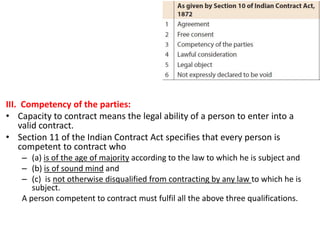
III. Competency of the parties:
โ€ข Capacity to contract means the legal ability of a person to enter into a
valid contract.
โ€ข Section 11 of the Indian Contract Act specifies that every person is
competent to contract who
โ€“ (a) is of the age of majority according to the law to which he is subject and
โ€“ (b) is of sound mind and
โ€“ (c) is not otherwise disqualified from contracting by any law to which he is
subject.
A person competent to contract must fulfil all the above three qualifications.
โ€ข Qualification (a)
โ€ข refers to the age of the contracting person i.e. the person entering into
contract must be of 18 years of age.
โ€ข Persons below 18 years of age are considered minor, therefore, incompetent
to contract.
โ€ข Qualification (b)
โ€ข requires a person to be of sound mind i.e. he should be in his senses so that
he understands the implications of the contract at the time of entering into a
contract.
โ€ข A lunatic, an idiot, a drunken person or under the influence of some
intoxicant is not supposed to be a person of sound mind.
โ€ข Qualification (c)
โ€ข requires that a person entering into a contract should not be disqualified by
his status, in entering into such contracts.
โ€ข Such persons are: an alien enemy, foreign sovereigns, convicts etc. They are
disqualified unless they fulfill certain formalities required by law.
Law relating to Minorโ€™s agreement/Position of Minor
โ€ข A contract made with or by a minor is void ab-initio:
โ€“ Mohori Bibi vs. Dharmo Das Ghose (1903), โ€œA, a minor borrowed `
20,000 from B and as a security for the same executed a mortgage in
his favour. He became a major a few months later and filed a suit for
the declaration that the mortgage executed by him during his minority
was void and should be cancelled. It was held that a mortgage by a
minor was void and B was not entitled to repayment of money.
โ€ข No ratification after attaining majority: A minor cannot ratify the
agreement on attaining majority as the original agreement is void
ab initio and a void agreement can never be ratified.
โ€ข Minor can be a beneficiary or can take benefit out of a contract
โ€“ Example: A minor cannot become partner in a partnership firm.
However, he may with the consent of all the partners, be admitted to
the benefits of partnership
โ€ข A minor can always plead minority: A minor can always plead
minority and is not stopped to do so even where he has taken any
loan or entered into any contract by falsely representing that he
was major. Rule of estoppel cannot be applied against a minor
โ€ข Liability for necessaries
โ€ข A claim for necessaries supplied to a minor is enforceable by law.
โ€ข There is no personal liability of the minor, but only his property is liable.
โ€ข To render minorโ€™s estate liable for necessaries two conditions must be
satisfied.
โ€“ (i) The contract must be for the goods reasonably necessary for his support in the
station in life. Expenses on minorโ€™s education come within the scope of the word
โ€˜necessariesโ€™.
โ€“ (ii) The minor must not have already a sufficient supply of these necessaries.
โ€ข Contract by guardian โ€“
โ€“ minorโ€™s guardian can, under certain circumstances enter into a valid contract on minorโ€™s
behalf.
โ€“ guardian makes a contract for the minor, which is within his competence and which is
for the benefit of the minor, there will be valid contract
โ€“ But all contracts made by guardian on behalf of a minor are not valid. For instance, the
guardian of a minor has no power to bind the minor by a contact for the purchase of
immovable Property. But a contract entered into by a certified guardian (appointed by
the Court) of a minor, with the sanction of the court for the sale of the minorโ€™s property,
may be enforced by either party to the contract.
โ€ข No insolvency: A minor cannot be declared insolvent as he is incapable of contracting debts
and dues are payable from the personal properties of minor and he is not personally liable.
โ€ข Partnership: A minor being incompetent to contract cannot be a partner in a partnership
firm, but under Section 30 of the Indian Partnership Act, he can be admitted to the benefits
of partnership
โ€ข Minor can be an agent: A minor can act as an agent. But he will not be liable to his principal
for his acts
โ€ข Joint contract by minor and adult: In such a case, the adult will be liable on the contract and
not the minor
โ€ข Surety for a minor: In a contract of guarantee when an adult stands surety for a minor then
he (adult) is liable to third party as there is direct contract between the surety and the third
party
โ€ข Minor as Shareholder: A minor, being incompetent to contract can be a shareholder of the
full paidup shares of a company, but not partly paidup shares
โ€ข Liability for torts: A tort is a civil wrong. A minor is liable in tort unless the tort in reality is a
breach of contract. Thus, where a minor borrowed a horse for riding only he was held liable
when he lent the horse to one of his friends who jumped and killed the horse. Similarly, a
minor was held liable for his failure to return certain instruments which he had hired and
then passed on to a friend.
Person of unsound mind:
โ€ข According to section 12 of Indian Contract Act, โ€œa person is said to be of sound mind
for the purposes of making a contract if, at the time when he makes it is capable of
understanding it and of forming a rational judgement as to its effect upon his
interests.โ€
โ€ข A person who is usually of unsound mind, but occasionally of sound mind, may make
a contract when he is of sound mind.
โ€ข A person who is usually of sound mind, but occasionally of unsound mind, may not
make a contract when he is of unsound mind.
โ€ข Position of unsound mind person making a contract: A contract by a person who is not
of sound mind is void.
โ€ข Example 1: A patient in a lunatic asylum, who is at intervals, of sound mind, may
contract during those intervals.
โ€ข Example 2: A sane man, who is delirious from fever, or who is so drunk that he cannot
understand the terms of a contract, or form a rational judgement as to its effect on his
interests, cannot contract whilst such delirium or drunkness lasts.
โ€ข Contract by disqualified persons:
Incompetency to contract may arise from
political status, corporate status, legal status,
etc.
โ€ข The following persons fall in this category:
Foreign Sovereigns and Ambassadors, Alien
enemy, Corporations, Convicts, Insolvent et
Alien enemy
โ€ข A person who is not an Indian citizen is an alien.
An alien may be either an alien friend or a
foreigner whose sovereign or State is at peace
with India, has usually contractual capacity of an
Indian citizen.
โ€ข On the declaration of war between his country
and India he becomes an alien enemy.
โ€ข A contract with an alien enemy becomes
unenforceable on the outbreak of war.
โ€ข Trading with an alien enemy is considered illegal,
being against public policy.
Foreign Sovereigns and Ambassadors
โ€ข Foreign sovereigns and accredited
representatives of foreign states, i.e.,
Ambassadors, High Commissioners, enjoy a
special privilege in that they cannot be sued in
Indian Courts, unless they voluntarily submit to
the jurisdiction of the Indian Courts.
โ€ข Foreign Sovereign Governments can enter into
contracts through agents residing in India. In such
cases the agent becomes personally responsible
for the performance of the contracts.
Corporations
โ€ข A corporation is an artificial person created by law, e.g.,
a company registered under the Companies Act, public
bodies created by statute, such as Municipal
Corporation of Delhi.
โ€ข There are some contracts into which a corporation
cannot enter without its seal, and others not at all. A
company, for instance, cannot contract to marry.
โ€ข Further, its capacity and powers to contract are
limited by its charter or memorandum of association.
Any contract beyond such power in ultra vires and
void.
V. Legal Object:
โ€ข The consideration and object of the agreement must be lawful.
โ€ข Section 23 states that consideration or object is not lawful if it is
prohibited by law, or it is such as would defeat the provisions of law,
if it is fraudulent or involves injury to the person or property of
another or court regards it as immoral or opposed to public policy.
โ€ข Example : โ€˜Aโ€™ promises to drop prosecution instituted against โ€˜Bโ€™ for
robbery and โ€˜Bโ€™ promises to restore the value of the things taken. The
agreement is void, as its object is unlawful.
VI. Not expressly declared to be void:
โ€ข The agreement entered into must not be which the law
declares to be either illegal or void. A void agreement
is one without any legal effects.
โ€ข An illegal agreement is an agreement expressly or
impliedly prohibited by law.
โ€ข Example: Threat to commit murder or
making/publishing defamatory statements or entering
into agreements which are opposed to public policy are
illegal in nature.
Privity of contract
โ€ข A stranger to a contract cannot sue for want of privity of contract.
โ€ข Example:
โ€ข A is debtor of B for Rs. 500 for certain consideration. B has to give
Rs. 500 to C. B asks A to pay C. A does not pay the money. Here A
cannot be sued by C since C is stranger to the contract.
โ€ข Dunlop Tyre Vs Selfridge (1915) D supplied tyres to a wholesaler X
on condition that any retailer to whom X re supplied the tyres
should promise X, not to sell them to the public below Ds list price.
X supplied tyres to S on this condition, but nevertheless S sold the
tyres below the list price.
โ€ข Held D could not obtain damages from S as D had not given any
consideration for Sโ€™s promise to X nor was he party to the contract
between D and X
Exceptions to the privity of contract
โ€ข Beneficiaries in case of trust
โ€ข Marriage settlement, partition or other family
arrangement
โ€ข Contract through agents-principal can sue
โ€ข Assignee of contract
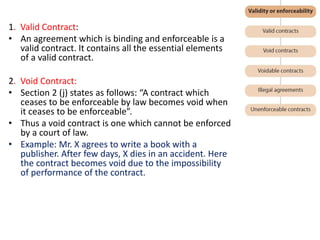
1. Valid Contract:
โ€ข An agreement which is binding and enforceable is a
valid contract. It contains all the essential elements
of a valid contract.
2. Void Contract:
โ€ข Section 2 (j) states as follows: โ€œA contract which
ceases to be enforceable by law becomes void when
it ceases to be enforceableโ€.
โ€ข Thus a void contract is one which cannot be enforced
by a court of law.
โ€ข Example: Mr. X agrees to write a book with a
publisher. After few days, X dies in an accident. Here
the contract becomes void due to the impossibility
of performance of the contract.
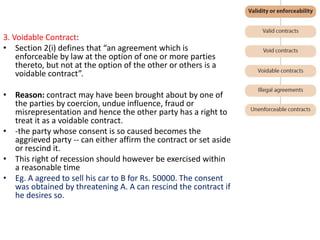
3. Voidable Contract:
โ€ข Section 2(i) defines that โ€œan agreement which is
enforceable by law at the option of one or more parties
thereto, but not at the option of the other or others is a
voidable contractโ€.
โ€ข Reason: contract may have been brought about by one of
the parties by coercion, undue influence, fraud or
misrepresentation and hence the other party has a right to
treat it as a voidable contract.
โ€ข -the party whose consent is so caused becomes the
aggrieved party -- can either affirm the contract or set aside
or rescind it.
โ€ข This right of recession should however be exercised within
a reasonable time
โ€ข Eg. A agreed to sell his car to B for Rs. 50000. The consent
was obtained by threatening A. A can rescind the contract if
he desires so.
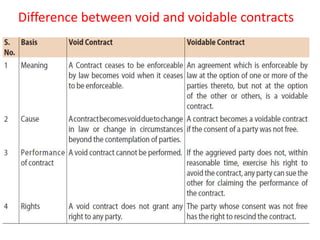
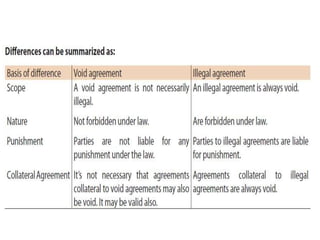
Difference between void and voidable contracts
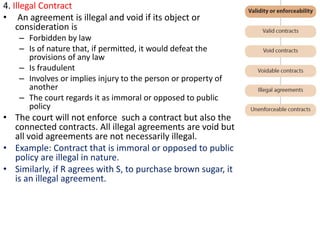
4. Illegal Contract
โ€ข An agreement is illegal and void if its object or
consideration is
โ€“ Forbidden by law
โ€“ Is of nature that, if permitted, it would defeat the
provisions of any law
โ€“ Is fraudulent
โ€“ Involves or implies injury to the person or property of
another
โ€“ The court regards it as immoral or opposed to public
policy
โ€ข The court will not enforce such a contract but also the
connected contracts. All illegal agreements are void but
all void agreements are not necessarily illegal.
โ€ข Example: Contract that is immoral or opposed to public
policy are illegal in nature.
โ€ข Similarly, if R agrees with S, to purchase brown sugar, it
is an illegal agreement.
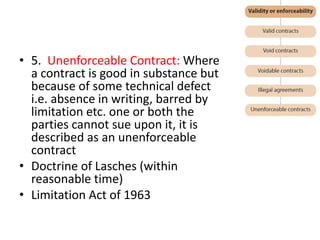
โ€ข 5. Unenforceable Contract: Where
a contract is good in substance but
because of some technical defect
i.e. absence in writing, barred by
limitation etc. one or both the
parties cannot sue upon it, it is
described as an unenforceable
contract
โ€ข Doctrine of Lasches (within
reasonable time)
โ€ข Limitation Act of 1963
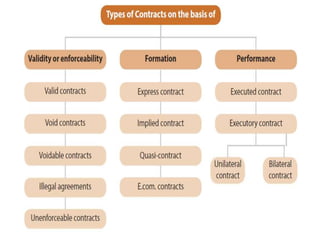
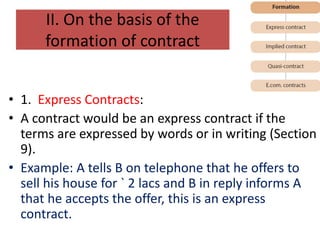
II. On the basis of the
formation of contract
โ€ข 1. Express Contracts:
โ€ข A contract would be an express contract if the
terms are expressed by words or in writing (Section
9).
โ€ข Example: A tells B on telephone that he offers to
sell his house for ` 2 lacs and B in reply informs A
that he accepts the offer, this is an express
contract.
โ€ข 2. Implied Contracts:
โ€ข Implied contracts in contrast come into existence by
implication.
โ€ข Section 9 : proposal or acceptance is made
otherwise than in words, the promise is said to be
implied.
โ€ข Example: Where A gets into a public transport bus,
he wishes to use the facility and he is bound to pay
for the passenger fare, it is an implied contract.
โ€ข Tacit Contracts:
โ€ข The word Tacit means silent.
โ€ข Tacit contracts are those that are inferred through
the conduct of parties without any words spoken or
written.
โ€ข A classic example of tacit contract would be when
cash is withdrawn by a customer of a bank from the
automatic teller machine [ATM].
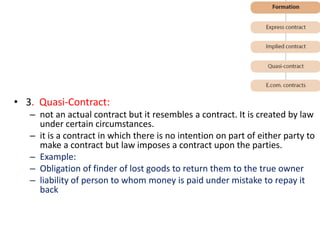
โ€ข 3. Quasi-Contract:
โ€“ not an actual contract but it resembles a contract. It is created by law
under certain circumstances.
โ€“ it is a contract in which there is no intention on part of either party to
make a contract but law imposes a contract upon the parties.
โ€“ Example:
โ€“ Obligation of finder of lost goods to return them to the true owner
โ€“ liability of person to whom money is paid under mistake to repay it
back
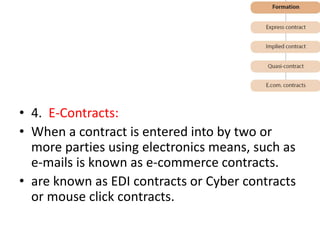
โ€ข 4. E-Contracts:
โ€ข When a contract is entered into by two or
more parties using electronics means, such as
e-mails is known as e-commerce contracts.
โ€ข are known as EDI contracts or Cyber contracts
or mouse click contracts.
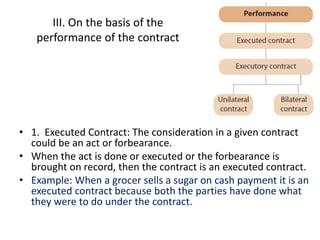
III. On the basis of the
performance of the contract
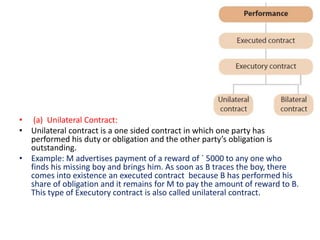
โ€ข 1. Executed Contract: The consideration in a given contract
could be an act or forbearance.
โ€ข When the act is done or executed or the forbearance is
brought on record, then the contract is an executed contract.
โ€ข Example: When a grocer sells a sugar on cash payment it is an
executed contract because both the parties have done what
they were to do under the contract.
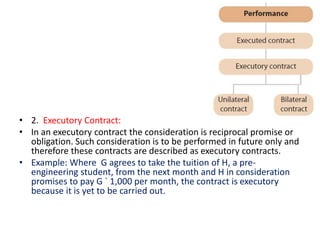
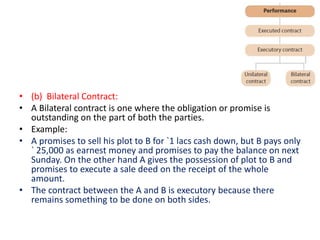
โ€ข 2. Executory Contract:
โ€ข In an executory contract the consideration is reciprocal promise or
obligation. Such consideration is to be performed in future only and
therefore these contracts are described as executory contracts.
โ€ข Example: Where G agrees to take the tuition of H, a pre-
engineering student, from the next month and H in consideration
promises to pay G ` 1,000 per month, the contract is executory
because it is yet to be carried out.
โ€ข (a) Unilateral Contract:
โ€ข Unilateral contract is a one sided contract in which one party has
performed his duty or obligation and the other partyโ€™s obligation is
outstanding.
โ€ข Example: M advertises payment of a reward of ` 5000 to any one who
finds his missing boy and brings him. As soon as B traces the boy, there
comes into existence an executed contract because B has performed his
share of obligation and it remains for M to pay the amount of reward to B.
This type of Executory contract is also called unilateral contract.
โ€ข (b) Bilateral Contract:
โ€ข A Bilateral contract is one where the obligation or promise is
outstanding on the part of both the parties.
โ€ข Example:
โ€ข A promises to sell his plot to B for `1 lacs cash down, but B pays only
` 25,000 as earnest money and promises to pay the balance on next
Sunday. On the other hand A gives the possession of plot to B and
promises to execute a sale deed on the receipt of the whole
amount.
โ€ข The contract between the A and B is executory because there
remains something to be done on both sides.

Indian Contract act ,1872

  • 1.
  • 2.
    โ€ข โ€˜Contractโ€™ isthe most usual method of defining the rights and duties in a business transaction. โ€ข The Indian Contract Act, 1872 codifies the legal principles that govern โ€˜contractsโ€™ Sec 1-75 deals with general principles Sec: 124-238: deals with Indemnity and guarantee, bailment & pledge and agency
  • 3.
    WHAT IS ACONTRACT? โ€ข The term contract is defined under section 2(h) of the Indian Contract Act, 1872 asโ€œan agreement enforceable by lawโ€. โ€ข The contract consists of two essential elements: โ€ข (i) an agreement, and โ€ข (ii) its enforceability by law.
  • 4.
    (i) Agreement &Promise โ€ข Agreement - The term โ€˜agreementโ€™ given in Section 2(e) of the Act is defined as- โ€ข โ€œevery promise and every set of promises, forming the consideration for each otherโ€. โ€ข Section 2 (b) defines promise as โ€ข โ€œwhen the person to whom the proposal is made signifies his assent there to, the proposal is said to be accepted. Proposal when accepted, becomes a promiseโ€. โ€ข Agreement = Offer/Proposal + Acceptance
  • 5.
    (ii)Enforceability by Law โ€ขAn agreement to become a contract must give rise to a legal obligation โ€ข Contract = Accepted proposal/Agreement + Enforceability by law
  • 7.
    โ€ข However someobligations are outside the purview of the law of contract. โ€ข Example: โ€ข An obligation to maintain wife and children, an order of the court of law etc. These are status obligations and so out of the scope of the Contract Act.
  • 9.
    ESSENTIALS OF AVALID CONTRACT โ€ข Section 10 of the Act, โ€ข โ€œall agreements are contracts if they are made by the free consent of the parties competent to contract, for a lawful consideration and with a lawful object and are not expressly declared to be voidโ€.
  • 10.
    โ€ข Two Parties: 1.One cannot contract with himself. A contract involves at least two parties- one party making the offer and the other party accepting it. 2. A contract may be made by natural persons and by other persons having legal existence e.g. companies, universities etc. It is necessary to remember that identity of the parties be ascertainable. โ€ข Example: In State of Gujarat vs. Ramanlal S & Co. when on dissolution of a partnership, the assets of the firm were divided among the partners, the sales tax officer wanted to tax this transaction. It was held that it was not a sale. The partners being joint owner of those assets cannot be both buyer and seller.
  • 11.
    โ€ข Parties mustintend to create legal obligations: 1. There must be an intention on the part of the parties to create legal relationship between them. 2. Social or domestic type of agreements are not enforceable in court of law and hence they do not result into contracts. โ€ข Example: A husband agreed to pay to his wife certain amount as maintenance every month while he was abroad. Husband failed to pay the promised amount. Wife sued him for the recovery of the amount. Here in this case wife could not recover as it was a social agreement and the parties did not intend to create any legal relations. (Balfour v. Balfour)
  • 12.
    โ€ข Other Formalitiesto be complied with in certain cases: 1. In case of certain contracts, the contracts must be in writing, e.g. Contract of Insurance is not valid except as a written contract. 2. Further, in case of certain contracts, registration of contract under the laws which is in force at the time, is essential for it to be valid, e.g. in the case of immovable property
  • 13.
    โ€ข Certainty ofmeaning: โ€ข The agreement must be certain and not vague or indefinite. โ€ข Example: A agrees to sell to B a hundred tons of oil. There is nothing certain in order to show what kind of oil was intended for.
  • 14.
    โ€ข Possibility ofperformance of an agreement: 1. The terms of agreement should be capable of performance. 2. An agreement to do an act impossible in itself cannot be enforced. โ€ข Example: A agrees with B to discover treasure by magic. The agreement cannot be enforced as it is not possible to be performed.
  • 15.
    I. Offer andAcceptance or an agreement: โ€“ An agreement is the first essential element of a valid contract. โ€“ According to Section 2(e) of the Indian Contract Act, 1872, โ€œEvery promise and every set of promises, forming consideration for each other, is an agreementโ€ and โ€“ according to Section 2(b) โ€œA proposal when accepted, becomes a promiseโ€. An agreement is an outcome of offer and acceptance.
  • 16.
    PROPOSAL / OFFER [SECTION2(a) OF THE INDIAN CONTRACT ACT, 1872] โ€ข Definition of Offer/Proposal: โ€ข According to Section 2(a) of the Indian Contract Act, 1872, โ€œwhen one person signifies to another his willingness to do or to abstain from doing anything with a view to obtaining the assent of that other to such act or abstinence, he is said to make a proposalโ€.
  • 17.
    Essentials of aproposal/offer are โ€ข 1. The person making the proposal or offer is called the โ€˜promisorโ€™ or โ€˜offerorโ€™: โ€“ The person to whom the offer is made is called the โ€˜offereeโ€™ and the person accepting the offer is called the โ€˜promiseeโ€™ or โ€˜acceptorโ€™.
  • 18.
    โ€ข 2. Fora valid offer, the party making it must express his willingness โ€˜to doโ€™ or โ€˜not to doโ€™ something: Mere expression of willingness does not constitute an offer. โ€ข An offer can be positive as well as negative: Thus โ€œdoingโ€ is a positive act and โ€œnot doingโ€, or โ€œabstinenceโ€ is a negative act; nonetheless both these acts have the same effect in the eyes of law.
  • 19.
  • 20.
    (a) General offer: โ€ขIt is an offer made to public at large and hence anyone can accept and do the desired act (Carlill v. Carbolic Smoke Ball Co.). โ€ข In terms of Section 8 of the Act, anyone performing the conditions of the offer can be considered to have accepted the offer. โ€ข Until the general offer is retracted or withdrawn, it can be accepted by anyone at any time as it is a continuing offer. โ€ข Case Law: Carlill Vs. Carbolic Smoke Ball Co. (1893) Facts: In this famous case Carbolic smoke Ball Co. advertised in several newspapers that a reward of ยฃ100 would be given to any person who contracted influenza after using the smoke balls produced by the Carbolic Smoke Company according to printed directions. One lady, Mrs. Carlill, used the smoke balls as per the directions of company and even then suffered from influenza. Held, she could recover the amount as by using the smoke balls she had accepted the offer.
  • 21.
    โ€ข (b) Special/specificoffer: โ€ข When the offer is made to a specific or an ascertained person, it is known as a specific offer. Specific offer can be accepted only by that specified person to whom the offer has been made. [Boulton v. Jones] โ€ข Example: โ€˜Aโ€™ offers to sell his car to โ€˜Bโ€™ at a certain cost. This is a specific offer.
  • 22.
    โ€ข (c) Crossoffer: When two parties exchange identical offers in ignorance at the time of each otherโ€™s offer, the offers are called cross offers. There is no binding contract in such a case because offer made by a person cannot be construed as acceptance of the anotherโ€™s offer. โ€ข Example: If A makes a proposal to B to sell his car for ` 2 lacs and B, without knowing the proposal of A, makes an offer to purchase the same car at ` 2 lacs from A, it is not an acceptance, as B was not aware of proposal made by A. It is only cross proposal (cross offer). And when two persons make offer to each other, it can not be treated as mutual acceptance. There is no binding contract in such a case.
  • 23.
    โ€ข (d) Counteroffer: When the offeree offers to qualified acceptance of the offer subject to modifications and variations in the terms of original offer, he is said to have made a counter offer. Counter-offer amounts to rejection of the original offer. It is also called as Conditional Acceptance. โ€ข Example: โ€˜Aโ€™ offers to sell his plot to โ€˜Bโ€™ for `10 lakhs. โ€™Bโ€™ agrees to buy it for ` 8 lakhs. It amounts to counter offer. It may result in the termination of the offer of โ€™Aโ€™. Any if later on โ€˜Bโ€™ agrees to buy the plot for ` 10 lakhs, โ€™Aโ€™ may refuse
  • 24.
    โ€ข (e) Standingor continuing or open offer: โ€ข An offer which is allowed to remain open for acceptance over a period of time is known as standing or continuing or open offer.
  • 25.
    Essentials of avalid offer 1. It must be capable of creating legal relations: A social invitation, even if it is accepted, does not create legal relations because it is not so intended. 2. Offer must be certain, definite and not vague: Eg. where A offers to sell B 100 quintals of oil, there is nothing whatever to show what kind of oil was intended. 3. The offeree will have to accept all the terms of the offer otherwise the contract will be treated as invalid. 4. The offer may be either specific or general:
  • 26.
    5. It mustbe communicated to the offeree: โ€ข An offer, to be complete, must be communicated to the person to whom it is made, otherwise there can be no acceptance of it. โ€ข An acceptance of an offer, in ignorance of the offer, is not acceptance and does not confer any right on the acceptor โ€ข This can be illustrated by the landmark case of Lalman Shukla v. GauriDutt Facts: โ€ข G (Gauridutt) sent his servant L (Lalman) to trace his missing nephew. He then announced that anybody who traced his nephew would be entitled to a certain reward. L traced the boy in ignorance of this announcement. Subsequently when he came to know of the reward, he claimed it. Held, he was not entitled to the reward, as he did not know the offer.
  • 27.
    6. It mustbe made with a view to obtaining the assent of the other party: 7. It may be conditional: An offer can be made subject to any terms and conditions by the offeror. Example: Offeror may ask for payment by RTGS, NEFT etc. 8. Offer should not contain a term the non compliance of which would amount to acceptance: Example: A proposes B to purchase his android mobile for `5000 and if no reply by him in a week, it would be assumed that B had accepted the proposal. This would not result into contract.
  • 28.
    9. Offer isDifferent from an invitation to offer, a mere communication of information, and Advertisement. โ€ข (i) An invitation to make an offer or do business. โ€ข In case of โ€œan invitation to make an offerโ€, the person making the invitation does not make an offer rather invites the other party to make an offer. โ€ข His objective is to send out the invitation that he is willing to deal with any person who, on the basis of such invitation, is ready to enter into contract with him subject to final terms and conditions. โ€ข Example: โ€ข An advertisement for sale of goods by auction is an invitation to the offer. It merely invites offers/bids made at the auction. 10. The offer may be express or implied: An offer may be made either by words or by conduct/
  • 29.
    ACCEPTANCE โ€ข Section 2(b)of the Act, โ€˜the term acceptanceโ€™ is defined as follows: โ€ข โ€œWhen the person to whom the proposal is made signifies his assent thereto, proposal is said to be accepted. The proposal, when accepted, becomes a promiseโ€.
  • 30.
    Legal Rules regardinga valid acceptance โ€ข (1) Acceptance can be given only by the person to whom offer is made: โ€“ In case of a general offer, it can be accepted by any person who has the knowledge of the offer โ€ข (2) The acceptance must be communicated: โ€“ To conclude a contract between the parties, the acceptance must be communicated in some perceptible form. โ€ข (3) Acceptance must be absolute and unqualified: โ€“ If the proposal prescribes the manner in which it must be accepted, then it must be accepted accordingly. โ€ข (4) Acceptance must be in the prescribed mode: email/by post etc โ€“ Where the mode of acceptance is prescribed in the proposal, it must be accepted in that manner.
  • 31.
    โ€ข (5) Time: โ€“Acceptance must be given within the specified time limit, if any, and if no time is stipulated, acceptance must be given within the reasonable time and before the offer lapses. โ€ข (6) Acceptance by conduct/Implied Acceptance: โ€“ Section 8 provides the acceptance of the proposal by conduct as against other modes of acceptance โ€“ Eg. When you use public transport
  • 32.
    Modes of revocationof offer โ€ข (i) By notice of revocation : anytime before acceptance โ€ข (ii) By lapse of time: The time for acceptance can lapse if the acceptance is not given within the specified time and where no time is specified, then within a reasonable time. This is for the reason that proposer should not be made to wait indefinitely. โ€ข (iii) By non fulfillment of condition precedent: Where the acceptor fails to fulfill a condition precedent to acceptance the proposal gets revoked. โ€“ Suppose where โ€˜Aโ€™ proposes to sell his house to be โ€˜Bโ€™ for ` 5 lakhs provided โ€˜Bโ€™ leases his land to โ€˜Aโ€™. If โ€˜Bโ€™ refuses to lease the land, the offer of โ€˜Aโ€™ is revoked automatically. โ€ข (iv) By death or insanity: Death or insanity of the proposer would result in automatic revocation of the proposal but only if the fact of death or insanity comes to the knowledge of the acceptor. โ€ข (v) By counter offer โ€ข (vi) By the non acceptance of the offer according to the prescribed or usual mode โ€ข (vii) By subsequent illegality
  • 33.
    Revocation of acceptance โ€ขAn acceptance may be revoked at any time before the communication of acceptance is complete as against the acceptor. โ€ข Example: A proposes, by a letter sent by post, to sell his house to B. B accepts the proposal by a letter sent by post. B may revoke his acceptance at any time before or at the moment when the letter communicating it reaches A, but not afterwards.
  • 34.
    Lawful Consideration โ€ข Itis referred to as โ€˜quid pro quoโ€™ i.e. โ€˜something in returnโ€™. โ€ข A valuable consideration in the sense of law may consist either in some right, interest, profit, or benefit accruing to one party, or some forbearance, detriment, loss or responsibility given, suffered or undertaken by the other. โ€ข Example:- โ€ข A agrees to sell his books to B for ` 100, โ€ข Bโ€™s promise to pay ` 100 is the consideration for Aโ€™s promise to sell his books โ€ข Aโ€™s promise to sell the books is the consideration for Bโ€™s promise to pay ` 100.
  • 35.
    โ€ข Consideration canbe an act of doing something or abstinence- abstain from doing something. โ€“ Example- A promises B not to file a suit against him if he (B) would pay him (A) Rs. 1,00,000. Here abstinence on the part of A would constitute consideration against Bโ€™s payment of Rs. 1,00,000 in favor of A.
  • 36.
    โ€ข Voluntary actscannot be consideration โ€“ When A rescues Bโ€™s articles out of fire, itโ€™s a voluntary act โ€ข Consideration need not be adequate โ€“ Example: X promises to sell a house worth `6 lacs for `1 lacs only, the adequacy of the price in itself shall not render the transaction void, unless the party pleads that transaction takes place under coercion, undue influence or fraud โ€ข Consideration must not be performance of existing duty โ€“ a promise to pay money to a witness is void, for it is without consideration โ€ข Consideration must be real and not illusory โ€“ Examples: A man promises to discover treasure by magic. This transaction can be said to be void as it is illusory โ€ข Consideration must not be unlawful, immoral, or opposed to public policy
  • 37.
    Exception to havingCONSIDERATION โ€ข Natural Love and Affection: โ€“ A written and registered agreement based on natural love and affection between the parties standing in near relation (e.g., husband and wife) to each other is enforceable even without consideration. โ€“ Example: A husband, by a registered agreement promised to pay his earnings to his wife. Held the agreement though without consideration, was valid. โ€ข Compensation for past voluntary services โ€“ A promise to compensate, wholly or in part, a person who has already voluntarily done something for the promisor, is enforceable โ€“ Example: P finds Rโ€™s purse and gives it to him. R promises to give P `10,000. This is a valid contract โ€ข Promise to pay time barred debt: โ€“ Example: A is indebted to C for `60,000 but the debt is barred by the Limitation Act. A signs a written promise now to pay `50,000 in final settlement of the debt. This is a contract without consideration, but enforceable. โ€ข Agency: According to Section 185 of the Indian Contract Act, 1872, no consideration is necessary to create an agency. โ€ข Completed gift: In case of completed gifts, the rule no consideration no contract does not apply โ€ข Charity: If a promisee undertakes the liability on the promise of the person to contribute to charity, there the contract shall be valid
  • 38.
    II. Identity ofminds and Free Consent: 1. Two or more persons are said to consent when they agree upon the same thing in the same sense. This can also be understood as identity of minds in understanding the terms viz consensus ad idem. Eg. A has two houses, one at Kochi and one at Kollam. When A makes an offer to sell one of his houses, he has in mind selling his house at Kollam. B understands that A wish to sell his house at Kochi and wishes to busy it. Here identity of minds does not happen. 2.
  • 39.
    1. Further sucha consent must be free. Consent would be considered as free consent if it is not caused by coercion, undue influence, fraud or, misrepresentation or mistake. 2. When consent to an agreement is caused by coercion, undue influence, fraud or misrepresentation, the agreement is a contract voidable at the option of the party whose consent was so caused. When consent is vitiated by mistake, the contract becomes void. Example: A threatened to shoot B if he (B) does not lend him `2000 and B agreed to it. Here the agreement is entered into under coercion and hence voidable at the option of B.
  • 40.
    โ€ข (I) Coercion(Section 15) โ€ข โ€œCoercionโ€™ is the committing, or threatening to commit, any act forbidden by the Indian Penal Code or the unlawful detaining, or threatening to detain any property, to the prejudice of any person whatever, with the intention of causing any person to enter into an agreement.โ€ โ€“ Example: Where husband obtained a release deed of property from his wife and son under a threat of committing suicide, the transaction was set aside on the ground of coercion, suicide being forbidden by the Indian Penal Code. The threat of suicide amounts to coercion within Section 15.
  • 41.
    โ€ข Undue influence(Section 16) โ€ข where the relations subsisting between the parties are such that one of the parties is in a position to dominate the will of the other and he uses that position to obtain an unfair advantage over the otherโ€. โ€ข A, a man enfeebled by disease or age, is induced by Bโ€™s influence over him as his medical attendant, to agree to pay B an unreasonable sum for his professional services. B employs undue influence.
  • 42.
    Two ways ofundue influence โ€“ โ€ข (a) Where he holds a real or apparent authority over the other or where he stands in a fiduciary relation to the other, โ€“ e.g., minor and guardian; trustee and beneficiary; solicitor and client. โ€ข (b) Where he makes a contract with a person whose mental capacity is temporarily or permanently affected by reason of age, illness or mental or bodily distress โ€“ e.g., doctor and patient. โ€ข In these cases the party has to prove that undue influence has been exercised on him, there being no presumption as to existence of undue influence.
  • 43.
    โ€ข (III) Fraud(Section 17) โ€˜Fraudโ€™ means and includes any of the following acts committed by a party to a contract, or with his connivance, or by his agent, with an intent to deceive another party thereto or his agent, or to induce him to enter into the contract: โ€“ (1) the suggestion, as a fact, of that which is not true, by one who does not believe it to be true; โ€“ (2) the active concealment of a fact by one having knowledge or belief of the fact; โ€“ (3) a promise made without any intention of performing it; โ€“ (4) any other act fitted to deceive; โ€“ (5) any such act or omission as the law specially declares to be fraudulent.
  • 44.
    Contracts Uberrimae Fidei โ€ขThere are contracts in which the law imposes a special duty to act with the utmost good faith i.e., to disclose all material information. Failure to disclose such information will render the contract voidable at the option of the other party. โ€ข Contracts uberrimae fidei are: โ€“ (a) Contract of insurance of all kinds: The assured must disclose to the insurer all material facts and whatever he states must be correct and truthful. โ€“ (b) Company prospectus: When a company invites the public to subscribe for its shares, it is under statutory obligation to disclose truthfully the various matters set out in the Companies Act. Any person responsible for non-disclosure of any of these matters is liable to damages. Also, the contract to buy shares is voidable where there is a material false statement or non- disclosure in the prospectus. โ€“ (c) Contract for the sale of land: The vendor is under a duty to the purchaser to show good title to the land he has contracted to sell. โ€“ (d) Contracts of family arrangements: When the members of a family make agreements or arrangements for the settlement of family property, each member of the family must make full disclosure of every material fact within his knowledge.
  • 45.
    Misrepresentation โ€ข According toSection 18, there is misrepresentation: โ€“ (1) statement of fact, which of false, would constitute misrepresentation if the maker believes it to be true but which is not justified by the information he possesses; โ€“ (2) When there is a breach of duty by a person without any intention to deceive which brings an advantage to him; โ€“ (3) When a party causes, even though done innocently, the other party to the agreement to make a mistake as to the subject matter. โ€ข โ€˜Aโ€™ believed the engine of his motor cycle to be in an excellent condition. โ€˜Aโ€™ without getting it checked in a workshop, told to โ€˜Bโ€™ that the motor cycle was in excellent condition. On this statement, โ€˜Bโ€™ bought the motor cycle, whose engine proved to be defective. Here, โ€˜Aโ€™s statement is misrepresentation as the statement turns out to be false.
  • 46.
    Mistakes โ€ข Thus, whereboth the parties to an agreement are under a mistake as to a matter of fact essential to agreement, the agreement is void (Section 20). โ€ข Such a mistake prevents the formation of any contract at all and the Court will declare it void. โ€ข For example, A agrees to buy from B a certain horse. It turns out that the horse was dead at the time of bargain though neither party was aware of the fact. The agreement is void.
  • 47.
    III. Competency ofthe parties: โ€ข Capacity to contract means the legal ability of a person to enter into a valid contract. โ€ข Section 11 of the Indian Contract Act specifies that every person is competent to contract who โ€“ (a) is of the age of majority according to the law to which he is subject and โ€“ (b) is of sound mind and โ€“ (c) is not otherwise disqualified from contracting by any law to which he is subject. A person competent to contract must fulfil all the above three qualifications.
  • 48.
    โ€ข Qualification (a) โ€ขrefers to the age of the contracting person i.e. the person entering into contract must be of 18 years of age. โ€ข Persons below 18 years of age are considered minor, therefore, incompetent to contract. โ€ข Qualification (b) โ€ข requires a person to be of sound mind i.e. he should be in his senses so that he understands the implications of the contract at the time of entering into a contract. โ€ข A lunatic, an idiot, a drunken person or under the influence of some intoxicant is not supposed to be a person of sound mind. โ€ข Qualification (c) โ€ข requires that a person entering into a contract should not be disqualified by his status, in entering into such contracts. โ€ข Such persons are: an alien enemy, foreign sovereigns, convicts etc. They are disqualified unless they fulfill certain formalities required by law.
  • 49.
    Law relating toMinorโ€™s agreement/Position of Minor โ€ข A contract made with or by a minor is void ab-initio: โ€“ Mohori Bibi vs. Dharmo Das Ghose (1903), โ€œA, a minor borrowed ` 20,000 from B and as a security for the same executed a mortgage in his favour. He became a major a few months later and filed a suit for the declaration that the mortgage executed by him during his minority was void and should be cancelled. It was held that a mortgage by a minor was void and B was not entitled to repayment of money. โ€ข No ratification after attaining majority: A minor cannot ratify the agreement on attaining majority as the original agreement is void ab initio and a void agreement can never be ratified. โ€ข Minor can be a beneficiary or can take benefit out of a contract โ€“ Example: A minor cannot become partner in a partnership firm. However, he may with the consent of all the partners, be admitted to the benefits of partnership โ€ข A minor can always plead minority: A minor can always plead minority and is not stopped to do so even where he has taken any loan or entered into any contract by falsely representing that he was major. Rule of estoppel cannot be applied against a minor
  • 50.
    โ€ข Liability fornecessaries โ€ข A claim for necessaries supplied to a minor is enforceable by law. โ€ข There is no personal liability of the minor, but only his property is liable. โ€ข To render minorโ€™s estate liable for necessaries two conditions must be satisfied. โ€“ (i) The contract must be for the goods reasonably necessary for his support in the station in life. Expenses on minorโ€™s education come within the scope of the word โ€˜necessariesโ€™. โ€“ (ii) The minor must not have already a sufficient supply of these necessaries. โ€ข Contract by guardian โ€“ โ€“ minorโ€™s guardian can, under certain circumstances enter into a valid contract on minorโ€™s behalf. โ€“ guardian makes a contract for the minor, which is within his competence and which is for the benefit of the minor, there will be valid contract โ€“ But all contracts made by guardian on behalf of a minor are not valid. For instance, the guardian of a minor has no power to bind the minor by a contact for the purchase of immovable Property. But a contract entered into by a certified guardian (appointed by the Court) of a minor, with the sanction of the court for the sale of the minorโ€™s property, may be enforced by either party to the contract.
  • 51.
    โ€ข No insolvency:A minor cannot be declared insolvent as he is incapable of contracting debts and dues are payable from the personal properties of minor and he is not personally liable. โ€ข Partnership: A minor being incompetent to contract cannot be a partner in a partnership firm, but under Section 30 of the Indian Partnership Act, he can be admitted to the benefits of partnership โ€ข Minor can be an agent: A minor can act as an agent. But he will not be liable to his principal for his acts โ€ข Joint contract by minor and adult: In such a case, the adult will be liable on the contract and not the minor โ€ข Surety for a minor: In a contract of guarantee when an adult stands surety for a minor then he (adult) is liable to third party as there is direct contract between the surety and the third party โ€ข Minor as Shareholder: A minor, being incompetent to contract can be a shareholder of the full paidup shares of a company, but not partly paidup shares โ€ข Liability for torts: A tort is a civil wrong. A minor is liable in tort unless the tort in reality is a breach of contract. Thus, where a minor borrowed a horse for riding only he was held liable when he lent the horse to one of his friends who jumped and killed the horse. Similarly, a minor was held liable for his failure to return certain instruments which he had hired and then passed on to a friend.
  • 52.
    Person of unsoundmind: โ€ข According to section 12 of Indian Contract Act, โ€œa person is said to be of sound mind for the purposes of making a contract if, at the time when he makes it is capable of understanding it and of forming a rational judgement as to its effect upon his interests.โ€ โ€ข A person who is usually of unsound mind, but occasionally of sound mind, may make a contract when he is of sound mind. โ€ข A person who is usually of sound mind, but occasionally of unsound mind, may not make a contract when he is of unsound mind. โ€ข Position of unsound mind person making a contract: A contract by a person who is not of sound mind is void. โ€ข Example 1: A patient in a lunatic asylum, who is at intervals, of sound mind, may contract during those intervals. โ€ข Example 2: A sane man, who is delirious from fever, or who is so drunk that he cannot understand the terms of a contract, or form a rational judgement as to its effect on his interests, cannot contract whilst such delirium or drunkness lasts.
  • 53.
    โ€ข Contract bydisqualified persons: Incompetency to contract may arise from political status, corporate status, legal status, etc. โ€ข The following persons fall in this category: Foreign Sovereigns and Ambassadors, Alien enemy, Corporations, Convicts, Insolvent et
  • 54.
    Alien enemy โ€ข Aperson who is not an Indian citizen is an alien. An alien may be either an alien friend or a foreigner whose sovereign or State is at peace with India, has usually contractual capacity of an Indian citizen. โ€ข On the declaration of war between his country and India he becomes an alien enemy. โ€ข A contract with an alien enemy becomes unenforceable on the outbreak of war. โ€ข Trading with an alien enemy is considered illegal, being against public policy.
  • 55.
    Foreign Sovereigns andAmbassadors โ€ข Foreign sovereigns and accredited representatives of foreign states, i.e., Ambassadors, High Commissioners, enjoy a special privilege in that they cannot be sued in Indian Courts, unless they voluntarily submit to the jurisdiction of the Indian Courts. โ€ข Foreign Sovereign Governments can enter into contracts through agents residing in India. In such cases the agent becomes personally responsible for the performance of the contracts.
  • 56.
    Corporations โ€ข A corporationis an artificial person created by law, e.g., a company registered under the Companies Act, public bodies created by statute, such as Municipal Corporation of Delhi. โ€ข There are some contracts into which a corporation cannot enter without its seal, and others not at all. A company, for instance, cannot contract to marry. โ€ข Further, its capacity and powers to contract are limited by its charter or memorandum of association. Any contract beyond such power in ultra vires and void.
  • 57.
    V. Legal Object: โ€ขThe consideration and object of the agreement must be lawful. โ€ข Section 23 states that consideration or object is not lawful if it is prohibited by law, or it is such as would defeat the provisions of law, if it is fraudulent or involves injury to the person or property of another or court regards it as immoral or opposed to public policy. โ€ข Example : โ€˜Aโ€™ promises to drop prosecution instituted against โ€˜Bโ€™ for robbery and โ€˜Bโ€™ promises to restore the value of the things taken. The agreement is void, as its object is unlawful.
  • 58.
    VI. Not expresslydeclared to be void: โ€ข The agreement entered into must not be which the law declares to be either illegal or void. A void agreement is one without any legal effects. โ€ข An illegal agreement is an agreement expressly or impliedly prohibited by law. โ€ข Example: Threat to commit murder or making/publishing defamatory statements or entering into agreements which are opposed to public policy are illegal in nature.
  • 59.
    Privity of contract โ€ขA stranger to a contract cannot sue for want of privity of contract. โ€ข Example: โ€ข A is debtor of B for Rs. 500 for certain consideration. B has to give Rs. 500 to C. B asks A to pay C. A does not pay the money. Here A cannot be sued by C since C is stranger to the contract. โ€ข Dunlop Tyre Vs Selfridge (1915) D supplied tyres to a wholesaler X on condition that any retailer to whom X re supplied the tyres should promise X, not to sell them to the public below Ds list price. X supplied tyres to S on this condition, but nevertheless S sold the tyres below the list price. โ€ข Held D could not obtain damages from S as D had not given any consideration for Sโ€™s promise to X nor was he party to the contract between D and X
  • 60.
    Exceptions to theprivity of contract โ€ข Beneficiaries in case of trust โ€ข Marriage settlement, partition or other family arrangement โ€ข Contract through agents-principal can sue โ€ข Assignee of contract
  • 62.
    1. Valid Contract: โ€ขAn agreement which is binding and enforceable is a valid contract. It contains all the essential elements of a valid contract. 2. Void Contract: โ€ข Section 2 (j) states as follows: โ€œA contract which ceases to be enforceable by law becomes void when it ceases to be enforceableโ€. โ€ข Thus a void contract is one which cannot be enforced by a court of law. โ€ข Example: Mr. X agrees to write a book with a publisher. After few days, X dies in an accident. Here the contract becomes void due to the impossibility of performance of the contract.
  • 63.
    3. Voidable Contract: โ€ขSection 2(i) defines that โ€œan agreement which is enforceable by law at the option of one or more parties thereto, but not at the option of the other or others is a voidable contractโ€. โ€ข Reason: contract may have been brought about by one of the parties by coercion, undue influence, fraud or misrepresentation and hence the other party has a right to treat it as a voidable contract. โ€ข -the party whose consent is so caused becomes the aggrieved party -- can either affirm the contract or set aside or rescind it. โ€ข This right of recession should however be exercised within a reasonable time โ€ข Eg. A agreed to sell his car to B for Rs. 50000. The consent was obtained by threatening A. A can rescind the contract if he desires so.
  • 64.
    Difference between voidand voidable contracts
  • 65.
    4. Illegal Contract โ€ขAn agreement is illegal and void if its object or consideration is โ€“ Forbidden by law โ€“ Is of nature that, if permitted, it would defeat the provisions of any law โ€“ Is fraudulent โ€“ Involves or implies injury to the person or property of another โ€“ The court regards it as immoral or opposed to public policy โ€ข The court will not enforce such a contract but also the connected contracts. All illegal agreements are void but all void agreements are not necessarily illegal. โ€ข Example: Contract that is immoral or opposed to public policy are illegal in nature. โ€ข Similarly, if R agrees with S, to purchase brown sugar, it is an illegal agreement.
  • 67.
    โ€ข 5. UnenforceableContract: Where a contract is good in substance but because of some technical defect i.e. absence in writing, barred by limitation etc. one or both the parties cannot sue upon it, it is described as an unenforceable contract โ€ข Doctrine of Lasches (within reasonable time) โ€ข Limitation Act of 1963
  • 68.
    II. On thebasis of the formation of contract โ€ข 1. Express Contracts: โ€ข A contract would be an express contract if the terms are expressed by words or in writing (Section 9). โ€ข Example: A tells B on telephone that he offers to sell his house for ` 2 lacs and B in reply informs A that he accepts the offer, this is an express contract.
  • 69.
    โ€ข 2. ImpliedContracts: โ€ข Implied contracts in contrast come into existence by implication. โ€ข Section 9 : proposal or acceptance is made otherwise than in words, the promise is said to be implied. โ€ข Example: Where A gets into a public transport bus, he wishes to use the facility and he is bound to pay for the passenger fare, it is an implied contract. โ€ข Tacit Contracts: โ€ข The word Tacit means silent. โ€ข Tacit contracts are those that are inferred through the conduct of parties without any words spoken or written. โ€ข A classic example of tacit contract would be when cash is withdrawn by a customer of a bank from the automatic teller machine [ATM].
  • 70.
    โ€ข 3. Quasi-Contract: โ€“not an actual contract but it resembles a contract. It is created by law under certain circumstances. โ€“ it is a contract in which there is no intention on part of either party to make a contract but law imposes a contract upon the parties. โ€“ Example: โ€“ Obligation of finder of lost goods to return them to the true owner โ€“ liability of person to whom money is paid under mistake to repay it back
  • 71.
    โ€ข 4. E-Contracts: โ€ขWhen a contract is entered into by two or more parties using electronics means, such as e-mails is known as e-commerce contracts. โ€ข are known as EDI contracts or Cyber contracts or mouse click contracts.
  • 72.
    III. On thebasis of the performance of the contract โ€ข 1. Executed Contract: The consideration in a given contract could be an act or forbearance. โ€ข When the act is done or executed or the forbearance is brought on record, then the contract is an executed contract. โ€ข Example: When a grocer sells a sugar on cash payment it is an executed contract because both the parties have done what they were to do under the contract.
  • 73.
    โ€ข 2. ExecutoryContract: โ€ข In an executory contract the consideration is reciprocal promise or obligation. Such consideration is to be performed in future only and therefore these contracts are described as executory contracts. โ€ข Example: Where G agrees to take the tuition of H, a pre- engineering student, from the next month and H in consideration promises to pay G ` 1,000 per month, the contract is executory because it is yet to be carried out.
  • 74.
    โ€ข (a) UnilateralContract: โ€ข Unilateral contract is a one sided contract in which one party has performed his duty or obligation and the other partyโ€™s obligation is outstanding. โ€ข Example: M advertises payment of a reward of ` 5000 to any one who finds his missing boy and brings him. As soon as B traces the boy, there comes into existence an executed contract because B has performed his share of obligation and it remains for M to pay the amount of reward to B. This type of Executory contract is also called unilateral contract.
  • 75.
    โ€ข (b) BilateralContract: โ€ข A Bilateral contract is one where the obligation or promise is outstanding on the part of both the parties. โ€ข Example: โ€ข A promises to sell his plot to B for `1 lacs cash down, but B pays only ` 25,000 as earnest money and promises to pay the balance on next Sunday. On the other hand A gives the possession of plot to B and promises to execute a sale deed on the receipt of the whole amount. โ€ข The contract between the A and B is executory because there remains something to be done on both sides.