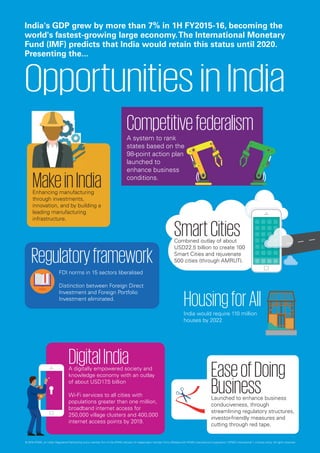
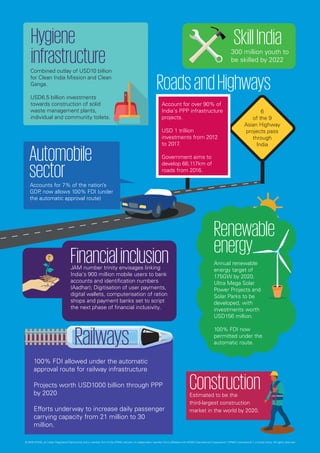
February 2016
KPMG.com/in
KPMG in India
India
soars
high
© 2016 KPMG, an Indian Registered Partnership and a member firm of the KPMG network of independent member firms affiliated with KPMG International Cooperative (“KPMG International”), a Swiss entity. All rights reserved.
Tableofcontents
India - at a glance Key policies of the Indian
government and their
impact on business
01 07
7102
03
Foreword
Overview of the Indian
economy
Reforms at the state
© 2016 KPMG, an Indian Registered Partnership and a member firm of the KPMG network of independent member firms affiliated with KPMG International Cooperative (“KPMG International”), a Swiss entity. All rights reserved.
Foreword
India has long been viewed as a potential economic tiger
that is yet to achieve its potential. Myriad regulations and
the intricate federal structure of the government inhibited
business growth and held back India from achieving its
expected economic potential.
However, that appears to be changing gradually.The state
governments, in lockstep with the central government, have
unveiled several reforms and changes that have made it
comparatively easier to do business in India, than ever before.
And this is not a one off process by the state governments.
The process has been institutionalised by the Department
of Industrial Policy and Promotion, Government of India,
under the ranking mechanism on adoption of business
reforms, supported by theWorld Bank and various industry
associations.This mechanism has been widely acknowledged
as a game changer in transforming India in terms of ease of
doing business.
The Indian economy itself has shown resilience in the face
of global downturns, and has stood up to be one of the
fastest growing economies in the world.The performance
of the USD2 trillion-economy at current price is being keenly
observed by the world. During FY2014-15, India’s domestic
consumption and investment contributed a growth of 57 per
cent and 33.1 per cent, respectively, to the Gross Domestic
Product (GDP). In itself, that played a significant role in keeping
India’s economic sentiments charged up. And now that India’s
GDP growth forecast for 2016 is slated to be 7.5 per cent, India
is firmly on its way to catapult into a global growth engine.This
growth rate also makes India one of the fastest growing large
economy in the world.
I am happy to note that the growth of over 7 per cent GDP
in 1H FY2015-16 presents India’s case strongly to the global
investors. One of the world’s fastest-growing economies,
India is opening up a world of opportunities for investments,
in a significantly conducive and supportive environment. In
1H FY2015-16, India received FDI of USD16.63 billion, an
increase of about 13 per cent to the corresponding period
in the previous fiscal year. Investments into India are
accelerating, demonstrating increased investor confidence on
what India has to offer. And the government is working hard to
significantly reduce the red tape.
In addition, Government of India has launched various
ambitious national programmes that present significant
opportunities for investors to be part of one of the largest
infrastructure programmes in the world.These programmes
are expected to transform not only the cities and the country
as a whole, but also the way business is done in India. Some
of the infrastructure plans are trans-national and would help
India economically integrate more firmly and rapidly with
the regional economies. Proactive policy reforms along with
several campaigns and initiatives, such as Make in India,
Digital India, Skill India, Start-up India and Swachh Bharat
Abhiyan (Clean India Mission), are likely to transform the
extent and the quality of rural and urban infrastructure.
These steps are expected to bring forth a number of
investment opportunities. For example, the initial corpus of
USD6.2 billion by the National Investment and Infrastructure
Fund (NIIF) is expected to bridge the investment gap in
infrastructure, which would be addressed by FDI and private
investments. Further, the investments planned for the Indian
Railways, as an example, is USD133.5 billion over the next five
years ending 2019. And, for roads, the investments planned is
USD32.4 billion during the twelfth FiveYear Plan (FYP) during
2012-17. In a scenario, where the nominal GDP is expected to
reach USD3.4 trillion by FY2019-20 and further, to USD7 trillion
by FY2024-25, the stakes for the return on investments is
expected to be significantly high. It is certainly the right time to
invest in India.
This positive sentiment is reflected by the International
Monetary Fund (IMF) forecast for India’s economic growth at
7.3 per cent for 2015 and 7.5 per cent for 2016.
This report ‘India soars high’ by KPMG in India, gives an insight
about the state of the Indian economy from an investor’s
perspective and I am positive that it would help investors
in their decision-making process while strategising their
investments in India.
I hope this report gives you a better understanding of the
rapidly changing business outlook for India and I take this
opportunity to wish you the best for the NewYear 2016.
RichardRekhy
Chief Executive Officer
KPMG in India
© 2016 KPMG, an Indian Registered Partnership and a member firm of the KPMG network of independent member firms affiliated with KPMG International Cooperative (“KPMG International”), a Swiss entity. All rights reserved.
Overviewofthe
Indianeconomy
© 2016 KPMG, an Indian Registered Partnership and a member firm of the KPMG network of independent member firms affiliated with KPMG International Cooperative (“KPMG International”), a Swiss entity. All rights reserved.
04
An overview
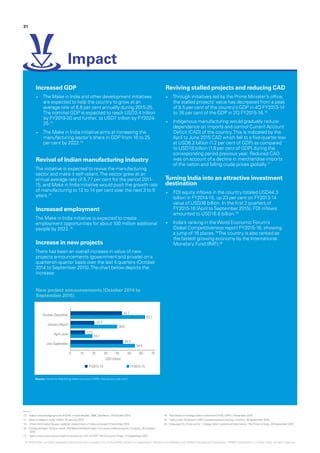
Stable macroeconomic conditions
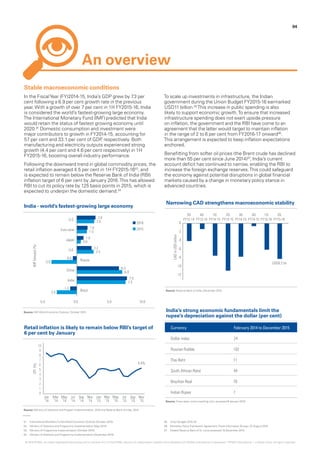
In the FiscalYear (FY)2014-15, India’s GDP grew by 7.3 per
cent following a 6.9 per cent growth rate in the previous
year.With a growth of over 7 per cent in 1H FY2015-16, India
is considered the world’s fastest-growing large economy.
The International Monetary Fund (IMF)predicted that India
would retain the status of fastest growing economy until
2020.01
Domestic consumption and investment were
major contributors to growth in FY2014-15, accounting for
57 per cent and 33.1 per cent of GDP, respectively. Both
manufacturing and electricity outputs experienced strong
growth (4.4 per cent and 4.6 per cent respectively) in 1H
FY2015-16, boosting overall industry performance.
Following the downward trend in global commodity prices, the
retail inflation averaged 4.5 per cent in 1H FY2015-1603
, and
is expected to remain below the Reserve Bank of India (RBI)
inflation target of 6 per cent by January 2016.This has allowed
RBI to cut its policy rate by 125 basis points in 2015, which is
expected to underpin the domestic demand.04
To scale up investments in infrastructure, the Indian
government during the Union Budget FY2015-16 earmarked
USD11 billion.05
This increase in public spending is also
likely to support economic growth.To ensure that increased
infrastructure spending does not exert upside pressure
on inflation, the government and the RBI have come to an
agreement that the latter would target to maintain inflation
in the range of 2 to 6 per cent from FY2016-17 onward06
.
This arrangement is expected to keep inflation expectations
anchored.
Benefitting from softer oil prices (the Brent crude has declined
more than 55 per cent since June 2014)07
, India’s current
account deficit has continued to narrow, enabling the RBI to
increase the foreign exchange reserves.This could safeguard
the economy against potential disruptions in global financial
markets caused by a change in monetary policy stance in
advanced countries.
India - world’s fastest-growing large economy
Source: IMFWorld Economic Outlook, October 2015
01.	 International Monetary Fund’sWorld Economic Outlook (October 2015).
02.	 Ministry of Statistics and Programme Implementation (May 2015)
03.	 Ministry of Programme Implementation (October 2015)
04.	 Ministry of Statistics and Programme Implementation (November 2015)
05.	 Union Budget 2015-16
06.	 Monetary Policy Framework Agreement, Press Information Bureau, 07 August 2015
07.	 Federal Reserve Bank of St. Louis accessed 19 December 2015
Source: Ministry of Statistics and Program Implementation, 2015 and Reserve Bank of India, 2015
Retail inflation is likely to remain below RBI’s target of
6 per cent by January
Narrowing CAD strengthens macroeconomic stability
Source: Reserve Bank of India, December 2015
Currency February 2014 to December 2015
Dollar index 24
Russian Rubble 102
Thai Baht 11
South African Rand 44
Brazilian Real 70
Indian Rupee 7
India’s strong economic fundamentals limit the
rupee’s depreciation against the dollar (per cent)
Source: Forex rates, www.investing.com, accessed 8 January 2016
© 2016 KPMG, an Indian Registered Partnership and a member firm of the KPMG network of independent member firms affiliated with KPMG International Cooperative (“KPMG International”), a Swiss entity. All rights reserved.
05
Fiscal consolidation on track
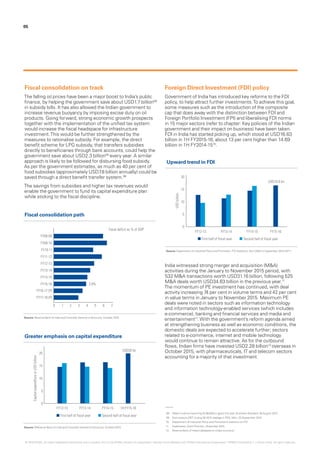
The falling oil prices have been a major boost to India’s public
finance, by helping the government save about USD1.7 billion08
in subsidy bills. It has also allowed the Indian government to
increase revenue buoyancy by imposing excise duty on oil
products. Going forward, strong economic growth prospects
together with the implementation of the unified tax system
would increase the fiscal headspace for infrastructure
investment.This would be further strengthened by the
measures to rationalise subsidy. For example, the direct
benefit scheme for LPG subsidy, that transfers subsidies
directly to beneficiaries through bank accounts, could help the
government save about USD2.3 billion09
every year. A similar
approach is likely to be followed for disbursing food subsidy.
As per the government estimates, as much as 40 per cent of
food subsidies (approximately USD7.8 billion annually) could be
saved through a direct benefit transfer system.09
The savings from subsidies and higher tax revenues would
enable the government to fund its capital expenditure plan
while sticking to the fiscal discipline.
Foreign Direct Investment (FDI) policy
Government of India has introduced key reforms to the FDI
policy, to help attract further investments.To achieve this goal,
some measures such as the introduction of the composite
cap that does away with the distinction between FDI and
Foreign Portfolio Investment (FPI) and liberalising FDI norms
in 15 major sectors (refer to chapter: Key policies of the Indian
government and their impact on business) have been taken.
FDI in India has started picking up, which stood at USD16.63
billion in 1H FY2015-16, about 13 per cent higher than 14.69
billion in 1H FY2014-1510
.
India witnessed strong merger and acquisition (M&A)
activities during the January to November 2015 period, with
532 M&A transactions worth USD31.16 billion, following 525
M&A deals worth USD34.63 billion in the previous year.11
The momentum of PE investment has continued, with deal
activity increasing 74 per cent in volume terms and 42 per cent
in value terms in January to November 2015. Maximum PE
deals were noted in sectors such as information technology
and information technology-enabled services (which includes
e-commerce), banking and financial services and media and
entertainment11
.With the government’s reform agenda aimed
at strengthening business as well as economic conditions, the
domestic deals are expected to accelerate further; sectors
related to e-commerce, internet and mobile technology
would continue to remain attractive. As for the outbound
flows, Indian firms have invested USD2.28 billion12
overseas in
October 2015, with pharmaceuticals, IT and telecom sectors
accounting for a majority of that investment.
08.	 Weak crude oil may bring Rs 88,800-cr gains this year, Business Standard, 08 August 2015
09.	 Govt expects DBT to plug 35-40% leakage in PDS, Mint, 25 September 2015
10.	 Department of Industrial Policy and Promotion’s statistics on FDI
11.	 Dealtracker, GrantThornton, November 2015
12.	 Reserve Bank of India’s database on Indian economy
© 2016 KPMG, an Indian Registered Partnership and a member firm of the KPMG network of independent member firms affiliated with KPMG International Cooperative (“KPMG International”), a Swiss entity. All rights reserved.
Fiscal consolidation path
Source: Reserve Bank of India and Controller General of Accounts, October 2015
Greater emphasis on capital expenditure
Source: RReserve Bank of India and Controller General of Accounts, October 2015
Upward trend in FDI
Source: Department of Industrial Policy and Promotion, FDI Statistics, April 2000 to September 2015 (AP1)
06
Adoption of greater capital account
convertibility
A greater capital account convertibility has its pros and
cons. For instance, while it would bring in stable long-term
investments, it would also lead to volatile short-term money.
India, as an emerging economic power, would need to adopt
greater capital account convertibility at some point in the
future, as sticking to the capital control policy for a longer
time would have its own consequence.Thus, RBI is making a
nuanced and gradual progress toward greater capital account
convertibility.The government’s structural reforms could
prepare the economy to withstand the effects associated with
withdrawal of capital controls.
As part of capital account liberalisation initiatives, the central
bank has eased the External Commercial Borrowing (ECB)
framework, allowing the domestic firms to raise long-term
foreign capital and increase the borrowing limit.The RBI has
also extended the list of lenders from whom Indian firms could
borrow.The list now includes sovereign wealth funds, pension
funds and insurance companies. Also, in a bid to encourage
rupee internationalisation, the central bank has allowed
domestic companies to issue rupee-denominated bonds
abroad.
Critical challenges
While the Indian economy is on a strong growth trajectory,
there are some risks to the recovery. A few of such cases are
discussed below:
1.	 Projects worth USD160 billion13
were stalled as of
December 2015, due to delays in project approvals and raw
material non-availability issues.
2.	The delay in restarting stalled projects has strained
infrastructure companies’ ability to meet their debt
obligations, leading to a surge in banks’ gross non-
performing assets (5.1 per cent as of September 2015).
With banks making higher provisioning against bad loans,
their profitability has come under pressure.
3.	India confronts a situation wherein the utilisation rate
of power generating firms continues to remain low
despite a sharp increase in coal output.This is because
the poor financial health of power distribution companies
(DISCOMs), which have accumulated USD67 billion debt14
,
and impedes them from buying power, thereby reducing
demand.
4.	 India’s exports declined for the twelfth month in a row in
November 2015.15
The exports need to remain stronger for
India to grow at 8 to 10 per cent16
.Thus, the continuous
decline in exports remains a cause for concern.
5.	The labour reform progress has been slow. Flexible labour
reform is key to making India a global manufacturing hub.
6.	Rupee depreciation could impact Indian firms with
exposure to overseas debt by increasing their liabilities. As
of September 2015, non-government sector held USD394
billion worth of external debt.17
To an extent, e-auction of coal blocks and fast tracking of
clearances have resolved fuel supply issues. In order to
encourage road developers to invest in fresh projects, the
government eased exit clause for completed highway projects,
and one-time financial assistance was given to developers
facing temporary financial problems. Also, a new framework
- Hybrid Annuity Model (HAM) - that reduces the upfront
contribution from road developers was unveiled18
. However,
through these initiatives, the government could only make
gradual headway on this issue, especially as addressing
the cause for stalled projects, such as land acquisitions and
environment clearances, requires consensus from various
stakeholders.
The government along with the RBI has been taking initiatives
to address the NPA problem.The government’s recent reform
package for DISCOMs, which involves transferring the latter’s
debt to state governments, is expected to reduce banks’
stressed assets by 10 per cent19
.The RBI on its part unveiled
new norms for Strategic Debt Restructuring (SDR)20
, which
allow lenders to convert debt into equity if the borrower fails to
meet the milestones embedded in a restructuring plan.These
measures would be complemented by the government’s
move towards creating an ecosystem that makes it easier
for troubled businesses to exit while ensuring that banks can
recover a significant part of their loans.The RBI expects that
the NPA problem would cease to exist by March 201721
.
Weakness in external demand is blamed for India’s subdued
exports. As such, recent government measures, such as
subsidised loans and extended duty incentives, could provide
only a temporary relief to exporters. Nevertheless, weak
exports are unlikely to derail India’s above 7 per cent growth
prospects, especially when the domestic demand is expected
to remain robust.
The government has launched a system to rank states based
on the 98-point action plan of business reforms, with an aim
to promote competitive federalism. States have implemented
key business reform measures in a bid to make it significantly
easier to do business and hence attract investments.
The RBI is unlikely to allow excessive depreciation in rupee
and has indicated that it will intervene in the market if needed.
Domestic firms on their part increased their protection against
currency volatility by increasing the hedging of their foreign
currency loans.
In conclusion, India’s macroeconomic conditions have
relatively improved in the recent past. Challenges remain,
however, the government is working towards enhancing the
country’s long-term growth potential.
13.	 No progress on stalled projects while new announcements plunge, Livemint, 5 January 2016
14.	 Cabinet to consider Rs4.3 trillion loan recast of power distribution companies, Mint, 05 October 2015
15.	 Exports fall for 12th straight month, down 24% in Nov, Business Standard, 16 December 2015
16.	 CEA Arvind Subramanian pegs growth at 8-10%, with exports rider, EconomicTimes, 27 July 2015
17.	 Ministry of Finance, External Debt Statistics (December 2015)
18.	 Govt’s hybrid annuity model paves way for road projects, Business Standard, 09 July 2015
19.	 Banks to blame for Amtek Auto’s bloated debt, Mint, 07 December 2015
20.	 Strategic Debt Restructuring Scheme, RBI, 08 June 2015
21.	 RBI, government steps to help banks end NPA woes by March ‘17: Raghuram Rajan, EconomicTimes, 01
December 2015
© 2016 KPMG, an Indian Registered Partnership and a member firm of the KPMG network of independent member firms affiliated with KPMG International Cooperative (“KPMG International”), a Swiss entity. All rights reserved.
Keypolicies
oftheIndian
government
andtheirimpact
onbusiness
© 2016 KPMG, an Indian Registered Partnership and a member firm of the KPMG network of independent member firms affiliated with KPMG International Cooperative (“KPMG International”), a Swiss entity. All rights reserved.
08
India’s macro-economic conditions saw an upswing in FY2014-
15 and there have been early signs that investments are picking
up, primarily due to a rise in public sector expenditure and an
upturn in the capital replacement cycle.01
As the country paces itself for the next phase of growth
in its domestic market, consequent increase in consumer
confidence and greater stability in its macroeconomic
fundamentals, the structural reforms and flagship initiatives
introduced by the Indian government, in the recent past, have
started gaining momentum.The reforms and initiatives are
multi-pronged, cutting across sectors, with the prime objective
of amplifying the collective growth impact.
This report focuses on the major flagship initiatives that hold
the potential to have a transformational impact on the Indian
economy and accelerate India’s growth rate. In the report, the
initiatives have been categorised, under the following broad
focus areas:
Infrastructure investments
As per NITI Ayog’s directional framework released in 2015, the
government plans to focus on 5 major areas of infrastructure
in order to augment overall infrastructure, attract investments
and facilitate overall growth.02
1.	 Railways
2.	 Roads
3.	Sagarmala project (for ports and coastal development)
4.	 Inland waterways
5.	Housing for All by 2022.
Make in India initiative
It has been launched with an aim to boost industrial growth
and make the country a global manufacturing hub.The
programme aims to enhance manufacturing through initiatives
designed to facilitate investment, foster innovation, protect
intellectual property and build best-in-class manufacturing
infrastructure.
Urban development - transforming Indian cities
Smart Cities Mission
This mission is expected to improve the efficiency of
cities and enable local area development, thereby driving
economic growth and improving the quality of life.This
urban transformation is expected to be driven by adopting
technology-based interventions.
Atal Mission for Rejuvenation and UrbanTransformation
(AMRUT)03
AMRUT envisages urban India’s transformation, by aiming:
•	 To ensure that every household has access to a tap with
assured supply of water and a sewerage connection;
•	 To increase the amenity value of cities by developing
greenery and well-maintained open spaces (e.g., parks);
and
•	 To reduce pollution by switching to public transport or
constructing facilities for non-motorised transport (e.g.,
cycling).
Universal energy access and reviving power
sector04
Power forAll programme ―
The programme aims at providing quality, reliable and
affordable power supply 24x7 to all Indian citizens by March
2019.
Ujwal DISCOMAssuranceYojana (UDAY) ―
This scheme has been launched to provide a financial
turnaround for the state-owned power distribution companies
(DISCOMs), by helping overcome outstanding debt of
USD64.8 billion as on March 2015.
Digital India initiative ―
This initiative aims to transform India into a digitally
empowered society and knowledge economy.This umbrella
programme lays emphasis on the national e-governance plan.
Financial and communications inclusivity
The JAM NumberTrinity, or the Jan DhanYojana – Aadhar –
Mobile NumberTrinity, aims at enabling direct subsidy
transfers in order to enable the government to provide
targeted subsidies, reducing distortion and subsidy leakages
while expanding financial inclusion.
Revitalising public sector banks
Indradhanush or the Rainbow initiative spells out a seven-point
reform plan to strengthen governance in the public sector
banks to address their concerns about rising non-performing
assets (NPA).
Skill and entrepreneurship development
Skill India
Skill India seeks to provide the institutional capacity to train a
minimum of 300 million skilled workforce by 2022.
Start-Up India Stand-Up India ―
This initiative aims at creating an optimal environment to
enable both existing and prospective entrepreneurs to carry
out business effectively and seamlessly.
The Start-Up India framework is expected to be launched in
January 2016.05
01.	‘Inside India’, Moody’s Investors Service, 1 December 2015, https://www.moodys.com/research/Moodys-
Indian-investment-levels-showing-nascent-signs-of-recovery--PR_340076
02.	 NITI Ayog website, accessed on 3 December 2015
03.	 Atal Mission For Rejuvenation And UrbanTransformation (AMRUT), http://amrut.gov.in/
04.	 Government of India, Ministry of Power, http://powermin.nic.in/Power-All
05.	 Govt. to launch Start-Up India’s framework on Jan.16: PM Modi, Business Standard, 27 December 2015
© 2016 KPMG, an Indian Registered Partnership and a member firm of the KPMG network of independent member firms affiliated with KPMG International Cooperative (“KPMG International”), a Swiss entity. All rights reserved.
An overview
Hygiene infrastructure
Swachh BharatAbhiyan (Clean India Mission)06
This mission aims at eliminating open defecation, eradicate
manual scavenging, adopt modern and scientific municipal
solid waste management, effect behavioural change for
healthy sanitation practices, generate awareness about
sanitation and its linkage with public health, augment
capacity of Urban Local Bodies (ULBs) and to allow an open
environment for private sector participation in capex (capital
expenditure) and opex (operational expenditure).
National Mission for Clean Ganga (NMCG)
This mission is expected to ensure effective abatement of
pollution and rejuvenation of the river Ganga by adopting a
river basin approach to promote coordination within different
sectors for comprehensive planning and management.
Additionally, it aims at maintaining minimum ecological flows
in the river to ensure better water quality and environmentally
sustainable development along its entire course.
Ease of Doing Business (EoDB)
The initiative has been launched with an aim to create a
conducive business environment by streamlining regulatory
structures and to create an investor-friendly business climate
by cutting through red tape.
09
06.	 Swachh Bharat, Ministry of Urban Development, https://swachhbharaturban.gov.in/ISNAHome.aspx
© 2016 KPMG, an Indian Registered Partnership and a member firm of the KPMG network of independent member firms affiliated with KPMG International Cooperative (“KPMG International”), a Swiss entity. All rights reserved.
Infrastructure
investments-
foundationfor
economic
development
Economic growth of a country is directly proportional to the
development of its infrastructure. Following that principle, the
Indian Government allocates funds to sectors and encourages
private participation through the PPP route to push for infrastructure
developments. It has announced a National Investment and
Infrastructure Fund (NIIF) with an expected initial corpus of USD6.2
billion to bridge the investment gap.Additionally, to make the
infrastructure sector investor-friendly and easier to administer, the
government, through the Kelkar Committee, is reviewing the overall
PPP policy.01
The government plans to focus on the following 5 major areas for
infrastructure developments – Railways, Roads, Sagarmala project (for
ports and coastal development), Housing for All and Inland waterways.
© 2016 KPMG, an Indian Registered Partnership and a member firm of the KPMG network of independent member firms affiliated with KPMG International Cooperative (“KPMG International”), a Swiss entity. All rights reserved.
01.	 Ministry of Finance, accessed 3 December 2015
India has the largest rail network in Asia and the second largest
in the world.03
It covers a track-length of around 114,000 kms,02
running 12,500 trains to carry more than 20 million passengers
daily.03
Additionally, it runs more than 7,400 freight trains carrying
3 million tonnes (MT) of freight every day03
. Some of its significant
characteristics are:
•	 Accounts for India’s 15 per cent of public transport and about 30
per cent of total freight 04
•	 Employs over 1.4 million people, the world’s seventh-largest
employer05
•	 Generated revenues of USD25 billion during FY2014-15.06
Railways-
connecting
India
Objective
The Indian government is aiming to target higher
investments through resource mobilisation, prioritise
decongestion of heavy haul routes and speed up trains.
Providing better passenger amenities and safety, and
improving railway systems through sustainable measures
would also be the focus areas.01
Project outlay
The railway ministry has earmarked an investment of
USD133.5 billion toward development of the railways
sector over the next 5 years ending 2019.01
01.	‘Highlights of the Railway Budget 2015-16’, Indian Railways, http://www.indianrailways.gov.in/railwayboard/
uploads/directorate/finance_budget/Budget_2015-16/English_Speech_Highlights_2015-16.pdf, 25 February
2015
02.	‘Indian Railways - lifeline of the nation’, Railway Ministry, February 2015
03.	‘18 interesting facts about India Railways’, Business Standard, February 2015
04.	‘India’s great Metro-Rail opportunity‘,The Business Standard, 20 January 2015
05.	‘Indian Railways, Army among world’s biggest employers’,The EconomicTimes, June 2015
06.	‘Railways’ Revenue Earnings up by 12.16 Per Cent During FinancialYear 2014-15‘, Press Information Bureau
GoI, 8 April 2015
11
Introduction
© 2016 KPMG, an Indian Registered Partnership and a member firm of the KPMG network of independent member firms affiliated with KPMG International Cooperative (“KPMG International”), a Swiss entity. All rights reserved.
07.	 Railways, Make in India, accessed on 3 December 2015
08.	‘Railways opens up more than Rs 90,000 cr of FDI opportunity‘,The Business Standard, 12 December 2014
09.	‘Do you know the achievements of ministry of railway in OneYear of NDA Government ?‘, India Post, 3
November 2015
10.	 ‘Japan and Google invest in India to help upgrade Indian Railways‘, IndiaToday, 22 September 2015
11.	 ‘Railways awards Rs.40,000 crore of projects in Bihar to GE, Alstom‘, LiveMint, 10 November 2015
12.	 ‘Indian Railways signs 12 000 wagon deal‘, Railway Gazette, 27 November 2015
13.	 ‘India’s great Metro-Rail opportunity‘,The Business Standard, 20 January 2015
14.	 ‘Boom in metro rail projects help India to move forward‘,The National, 21 November 2015
15.	 ‘Google to provide freeWiFi across 400 railway stations in India‘, Indian Railway Catering andTourism
Corporation, 13 September 2015
16.	 ‘Progress in Dedicated Freight Corridor‘, Press Information Bureau GoI, 7 August 2015
17.	 ‘Kashmir Rail Link to be completed by 2020.Will HaveWorld’s Highest Railway Bridge‘, NDTV, 4 July 2015
18.	 ‘Do you know the achievements of ministry of railway in OneYear of NDA Government ?‘, India Post, 3
November 2015
Steps taken so far
Foreign Direct Investments (FDI)
The sector allows for 100 per cent FDI under the automatic
route.This includes construction, operation and maintenance
of suburban corridor projects, high-speed train projects,
dedicated freight lines, railway electrification and signalling
systems, freight and passenger terminals and Mass Rapid
Transit Systems (MRTS).07
FDI worth USD12 billion have already been received (major
projects include Mumbai–Ahmedabad high-speed corridor
project and CSTM–Panvel suburban corridor development
project).08
Multi-lateral partnerships
The government has signed MoUs with China, France, Czech
Republic and Republic of Korea for technology transfer and
technical cooperation in High Speed Rail, modernisation of
infrastructure and maintenance.09
Japan is expected to sign
an MoU to develop 400 stations and assist in zero-accident
mission of the Indian Government.10
Locomotive and wagon manufacturing
•	 Indian railways awarded a 10-year contract to GE and
Alstom for diesel and electric locomotive factories,
respectively, in Bihar, at a cost of about USD6.2 billion (to
manufacture 1,000 diesel locomotives and 800 electric
locomotives over the next decade).The Indian Railways
would have a 24 per cent stake, while the companies
would own 74 per cent in each of the plants.11
•	 The Indian railways also signed agreements worth USD400
million for the SAIL–RITES BengalWagon Industry JV
(SRBWIPL) to supply 1,200 stainless steel wagons and
refurbish the existing 300 wagons over the next 10 years.12
Metro rail projects
Various metro rail projects are currently being developed
across the cities of Delhi, Mumbai, Bengaluru, Chennai,
Hyderabad, Kolkata, Kochi and Jaipur. Other cities where
metro projects have been approved include Ahmedabad,
Nagpur, Pune and Lucknow.13
Canada’s Bombardier has been awarded a USD1.2 billion
contract for vehicles and signalling network.The company won
a contract of supplying 162 additional metro cars in 2015.14
Similarly, Alstom would supply about 20 Metropolis train sets,
each comprising 4 metro cars.14
Project Nilgiri (Wi-Fi services at stations)
Indian railways has partnered with Google to set-upWi-Fi
hotspots in 400 stations in its first phase, while the second
phase would involve providingWi-Fi connection on running
trains.15
Dedicated freight corridor (DFC)
Being implemented in phases, the USD12.5 billion project is
expected to be completed in 2019.16
World’s highest railway bridge
The 110km railway line in Jammu and Kashmir, which is under
construction, would comprise the world’s highest railway
bridge (359 metre high). It is expected to be completed by
2017, while the rail-line would be operational by 2020.17
Others
The following initiatives taken by the government have helped
deliver better services18
:
•	 Launch of e-catering services in 240 trains currently
•	 Launch of Go-India Smart Card on a pilot-basis to enable
passengers to pay for reserved and unreserved tickets
•	 Launching 24x7 helpline and Short Messaging Service

(SMS)-alerts for customers.
Status
12
© 2016 KPMG, an Indian Registered Partnership and a member firm of the KPMG network of independent member firms affiliated with KPMG International Cooperative (“KPMG International”), a Swiss entity. All rights reserved.
19.	 ‘Highlights of the Railway Budget 2015-16’, Indian Railways, 25 February 2015
20.	 Fresh push for PPP projects likely in Union Budget 2016, LiveMint, 9 December 2015
21.	 ‘Govt announces quadrilateral rail project to connect metros’, BusinessToday, 29 April 2015
22.	 Indian Rail Budget, Railway Ministry, accessed on 3 December 2015
Expected next steps19
Expanding the network
The government is working towards the following targets
through various projects:
•	 Increasing the track-length by 20 per cent from 114,000 km
to 138,000 km
•	 Increasing daily passenger carrying capacity from 21
million to 30 million
•	 Increasing the annual freight carrying capacity from 1
billion to 1.5 billion tonnes
•	 Approximately 920 under and over-bridges construction to
replace approximately 3,450 railway crossings at a cost of
USD1 billion
•	 About 400 railway stations (category A and A1) would be
redeveloped/modernised in FY2016-17 through PPP model
expected to be one of the largest PPP railway projects in
the world.20
Revamping of railways
The following key projects are being pursued:
•	 Increasing the speed of 9 railway corridors from 110-
130kmph to 160-200kmph
•	 Increasing the average speed of freight trains to 100kmph
(unloaded trains) and 75kmph (loaded trains)
•	 Diamond Quadrilateral network of high-speed rail to
connect major metro cities
•	 Introduction of bullet trains (350kmph speed) and semi-
high speed trains (160-200kmph speed).21
Environmental initiatives
Environment-friendly initiatives such as waste to energy
conversion plants, bio-toilets and airplane-type vacuum toilets,
conducting energy audits, etc., are a few of the measures
planned during 2015-19.22
Technology
Upgrade of identified stations to international standards with
modern facilities and passenger amenities is being envisaged.
•	 Centrally managed Railway Display Network in over 2,000
stations is planned by 201722
•	 Satellite railway terminals for major cities22
•	 Technology infrastructure enabling unreserved passengers
to purchase tickets within 5 minutes under the
government’s Operation 5 mins plan.22
Safety
Train ProtectionWarning System (TPWS) andTrain Collision
Avoidance System (TCAS) would be installed on select routes.
Installation of surveillance cameras in trains and stations has
also been proposed.22
13
© 2016 KPMG, an Indian Registered Partnership and a member firm of the KPMG network of independent member firms affiliated with KPMG International Cooperative (“KPMG International”), a Swiss entity. All rights reserved.
23.	‘Indian Railways -The Catalyst of Socio-Economic Development‘, Press Information Bureau GoI, accessed on
3 December 2015
24.	 Railways, Make in India, accessed on 3 December 2015, KPMG in India’s analysis
25.	 Railways, Investment andTechnology Promotion Division, Ministry of External Affairs, accessed on 21
December 2015
Logistics development
Railways connect the industrial production centres with
markets and with sources of raw material. It facilitates
industrial development by providing rapid, reliable and
cost-effective bulk transportation to various sectors like
power, agriculture, energy, etc. Development of railway
infrastructure would lead to development in logistics. It
would allow easy and quick transport of coal to the power
market, thus helping in meeting the country’s electricity
needs.
Providing connectivity to masses
Railways link places and enable large-scale, rapid and low-
cost movement of people. In the process, it has become
a symbol of national integration and has made it feasible
for large number of people to travel across the country
for work related and personal reasons. Metros in urban
towns and cities have helped curb traffic and pollution-
related problems and provide convenient and hassle-free
connectivity.
The sector provides employment opportunities accounting
for 6 per cent of total employment in the organised sector
directly and additional 2.5 per cent employment indirectly
through its dependent organisations.With its vast
network of investments in healthcare, education, housing,
etc., it plays an important role in the country’s human
resource development.
Human resources development
The sector accounts for 6 per cent of the total
employment in the organised sector directly and an
additional 2.5 per cent indirectly through its dependent
organisations.
Business opportunities24,25
FDI
Higher FDI limits would encourage more investment.
Countries such as China, France and Japan have shown
interest in the sector, to assist in the development of
modern infrastructure and high-speed rail network.
Private investment in logistics
The government has proposed to set-up logistics parks
to provide warehousing, packaging, labelling, distribution,
door-to-door delivery, consignment tracking, etc.
Mass RapidTransit System (MRTS)
The government expects the share of private investments
toward MRTS development to grow from 13 per cent
during 2007-12 to 42 per cent during 2012-17.
Others
Other areas with potential investment opportunities are:
•	 Dedicated Freight Corridors (DFC)
•	 Railway lines to and from coal mines and ports
•	 Development of high-speed tracks and suburban
corridors
•	 Re-development of railway stations and freight
terminals
•	 Power generation and energy saving
•	 Setting up wagon, coaches and locomotive units
•	 Gauge conversion
•	 Network expansion.
Impact23
14
© 2016 KPMG, an Indian Registered Partnership and a member firm of the KPMG network of independent member firms affiliated with KPMG International Cooperative (“KPMG International”), a Swiss entity. All rights reserved.
Globally, India ranks second in roads network, spanning a total
of 4.7 million kms. Roads offer a logistics lifeline to the economy,
accounting for 60 per cent of total goods movement and 85 per cent
of total passenger traffic in the country. According to the National
Highways Authority of India (NHAI), national highways make up
about 2 per cent of the network but account for 40 per cent of road
traffic.02
Roads-arteries
oftheIndian
logisticsnetwork
Objective(s)
To develop new road infrastructure and modernise the
existing road network, in addition to developing interstate
highways/expressways.
Project outlay
The government earmarked an investment of USD32.4
billion during the twelfth FiveYear Plan (FYP) for the
development of roads in the period 2012-17.01
01.	‘Outcome Budget 2015-16‘, Ministry of RoadTransport and Highways (MORTH), GoI
02.	‘Roads and Highways‘, Investment andTechnology Promotion Division, Ministry of External Affairs
15
Introduction
© 2016 KPMG, an Indian Registered Partnership and a member firm of the KPMG network of independent member firms affiliated with KPMG International Cooperative (“KPMG International”), a Swiss entity. All rights reserved.
03.	 NHAI website, accessed 15 December 2015, http://www.nhai.org/projectawarded201516.asp
04.	‘Investment in Infrastructure: Strengthening PPP Policy framework‘, NITI Aayog, 13 May 2015
05.	‘Five new smart cities to be developed under DMIC project‘, DNA India, accessed on 21 December 2015
Steps taken so far
•	 NHAI and the Ministry of RoadTransport & Highways
have sanctioned projects for 3,161km in FY2013-14 and
2,337km in FY2014-15.03
•	 Over 90 per cent of PPP projects in India are in the road
sector. During FY2014-15 (up to 31 January 2015), projects
with a road length of 5,384km have been awarded. Several
of these projects have been awarded on Engineering
Procurement and Construction (EPC) mode.04
•	 Industrial corridors
A pentagon of corridors is being envisaged to facilitate
manufacturing and to project India as a global
manufacturing destination.The following table lists the
corridors and their respective status.04
Status
16
Corridor Project status
Amritsar Kolkata Industrial
Corridor (AKIC)
Delhi Mumbai Industrial Corridor Development Corporation (DMICDC) would prepare a feasibility report, for which consultants
have been appointed.04
Bengaluru Mumbai Economic
Corridor (BMEC)
•	 The draft perspective plan has been prepared04
•	 Nodes are being identified alongside preparation of a master plan and finalisation of the perspective plan.04
Chennai Bangalore Industrial
Corridor (CBIC)
•	 The perspective plan has been finalised04
•	 The Phase II Study is in progress and the draft final report of master planning for industrial nodes is under consideration in
consultation with stakeholders.04
Delhi Mumbai Industrial Corridor
(DMIC)
•	 The first node/city level Special Purpose Vehicle (SPV) under DMIC Project has been incorporated04
•	 Work on 5 smart industrial townships in Delhi Mumbai Industrial Corridor has been initiated (Dholera in Gujarat, Shendra-
Bidkin in Maharashtra, Greater Noida in UP, Ujjain in MP and Gurgaon in Haryana05
•	 Detailed project report for MRTS between Ahmedabad–Dholera has been finalised04
•	 Model solar power project at Neemrana in Rajasthan is being implemented as an Indo–Japan partnership project04
•	 Logistic data bank project in partnership with the Government of Japan is being taken forward, in partnership with NEC
Corporation of Japan.04
Vizag Chennai Industrial Corridor
(VCIC)
•	 Four nodes have been finalised; Asian Development Bank has agreed to prepare the master plans for 2 identified nodes04
•	 The parcels of land have been identified and the master planning would also be shortly initiated04
•	 Preparation of the regional perspective plan of VCIC area is in progress.04
© 2016 KPMG, an Indian Registered Partnership and a member firm of the KPMG network of independent member firms affiliated with KPMG International Cooperative (“KPMG International”), a Swiss entity. All rights reserved.
06.	‘6 Asian highways in India you probably don’t know about’, IndiaToday Education, accessed 21 December
2015
07.	 ‘India, Nepal, Bhutan and Bangladesh Sign a landmark MotorVehicles Agreement for seamless movement of
road traffic among Four SAARC Countries inThimpu‘, MoRTH GoI, 15 June 2015
08.	‘Fresh push for PPP projects likely in Union Budget 2016’, Live Mint, December 2015
09.	‘Report of theWorking Group on Central Roads Sector’, Ministry of RoadTransport & Highways, 2011
10.	 ‘Budget 2015: Infrastructure investment to be raised by Rs70,000 crore’, Live Mint, March 2015
11.	 Investment andTechnology Promotion Division website, Ministry of External Affairs, accessed 20 December
Trans-border initiatives
•	 Six of the 9 Asian Highway (AH) project (also known as
the Great Asian Highway) — a cooperative project among
countries in Asia and Europe and the United Nations
Economic and Social Commission for Asia and the Pacific
(ESCAP), to improve the highway systems in Asia — pass
through India.06
•	 Under the Bangladesh, Bhutan, India and Nepal (BBIN)
initiative, India signed a road connectivity pact on June 15
to pave way for greater trade and economic co-operation
in the subcontinent.The BBIN agreement is expected to
facilitate efficient road transport, to increase exports and
imports and translate into new opportunities for trade and
business among the countries.07
Expected next steps
•	 Fifteen identified road projects for FY2015-16 would be
bid under the PPP model with an investment of USD1.9
billion.08
•	 NITI Aayog (Policy and PlanningThink tank of the
government) has allocated about 20 per cent of the total
investment of USD1 trillion envisaged during the twelfth
FiveYear Plan (2012-17) to develop roads.The target is
to achieve 85,000 km road network from 79,116 km in
FY2012-13 by the end of plan period.09
•	 The government announced plans for completion of
100,000 km of roads under construction and further
approved 100,000 km to connect remote locations.10
•	 The government aims at building 30km road stretch per day
from 2016, to develop 66,117km of roads.11
17
© 2016 KPMG, an Indian Registered Partnership and a member firm of the KPMG network of independent member firms affiliated with KPMG International Cooperative (“KPMG International”), a Swiss entity. All rights reserved.
12.	 ‘Logistics game changers –Transforming India’s logistics industry’, KPMG in India, 2013
13.	 ‘Govt to create 50 lakh jobs in highways, shipping sectors’,The EconomicTimes, July 2015
14.	 ‘New economic corridors: India on road to redefine trade ties with South Asian neighbours‘,The Indian
Express, 18 November 2015
15.	 Investing in India, KPMG in India, January 2015
16.	 Roads and Highways, http://www.makeinindia.com/sector/roads-and-highways, accessed on 21 December
2015
Impact12
•	 The government has announced several incentives
such as declaring the road sector as an industry,
providing 100 per cent tax exemptions in any
consecutive 10 years out of 20 years, duty free
imports of certain identified equipment for
construction plants, FDI of up to 100 per cent and
increased concession periods of up to 30 years.12
•	 Increased demand for goods and commodities are
expected in view of the completion of the National
Highway Development Project (NHDP), which aims at
developing 50,000km of national highways by 2015 in
7 phases with an investment of USD55.1 billion.12
•	 At least 50 lakh (5 million) jobs expected to be created
in the highways and shipping sectors by 2020.13
•	 The trans-border initiatives within the subcontinent
would foster intra-regional trade and enhance regional
cooperation, leading to an increase in imports, exports
and new opportunities for trade and business.14
•	 Positive impact on social development and inclusion
of distant regions that are still unconnected.
Business opportunities
•	 Significant rise in new investment options, particularly
in many of the projects under Phase III (approximately
9,100km, USD19.41 billion) of the NHDP, which are
expected to be awarded on a BOT basis.15
•	 As FDI of up to 100 per cent under the automatic
route is allowed for support services to road transport,
cargo handling, construction and maintenance of
roads, bridges, and construction and maintenance of
roads and highways could benefit.
•	 Major initiatives to upgrade and strengthen highways
and expressways are:
–– The Eastern Peripheral Expressway — a 135km-
long, six-lane expressway with a total project cost
of USD750 million would decongest Delhi traffic.
An agreement has been signed; expected project
cost (EPC) is — USD3.7 billion.16
–– The Delhi–Meerut Expressway (a 150km project
with a total project cost of USD1 billion).16
–– TheVadodara–Mumbai Expressway, a 473km
expressway with a total project cost of USD4.3
billion would provide faster access to the
economic hubs of Mumbai,Vadodara and
Ahmedabad.TheVadodara–Mumbai Expressway,
a 473km expressway with a total project cost of
USD4.3 billion would provide faster access to
the economic hubs of Mumbai,Vadodara and
Ahmedabad.16
•	 The value of roadways and bridge infrastructure in
India is expected to grow at 17.4 per cent CAGR until
2017, to reach USD10 billion.16
Impact
18
© 2016 KPMG, an Indian Registered Partnership and a member firm of the KPMG network of independent member firms affiliated with KPMG International Cooperative (“KPMG International”), a Swiss entity. All rights reserved.
The Sagarmala initiative is expected to tackle underutilised ports by
focussing on port modernisation, efficient evacuation and coastal
economic development.02
Sagarmala would also complement the Golden Quadrilateral project
and would provide sea connectivity to major industrial centres
approachable through sea route.03
Sagarmala
(coastline
development)
Objective
This project aims at transforming the existing ports and
creating new ones with world-class technology and
infrastructure.This project is also expected to integrate
them with industrial clusters and the hinterland through
rail, road, inland and coastal waterways.01,02
Programme outlay
The government is expected to invest USD16 billion for its
completion.01,02
01.	‘Sagarmala – Building Gateways of Growth‘, Ministry of Shipping, 5 October 2015
02.	‘Modi’s Sagarmala Initiative for Development of Coastal and Port Cities‘, Maps of India, 5 July 2015
03.	‘Press Information Bureau website, accessed, 15 December 2015, http://pib.nic.in/newsite/PrintRelease.
aspx?relid=117691
19
Introduction
© 2016 KPMG, an Indian Registered Partnership and a member firm of the KPMG network of independent member firms affiliated with KPMG International Cooperative (“KPMG International”), a Swiss entity. All rights reserved.
04.	‘Sagarmala project: Government to spend Rs 70,000 crore on 12 major ports, says Nitin Gadkari‘,The
EconomicTimes, 6 October 2015
05.	‘Sagarmala: Concept and implementation towards Blue Revolution’, Government of India, 25 March 2015
06.	‘State submits Rs. 4,000 cr. worth proposals under Sagarmala‘,The Hindu, 18 July 2015
07.	 ‘JNPT SEZ moves ahead, master plan sent for nod‘,TheTimes of India, 14 July 2015
08.	‘Modi’s Sagarmala Initiative for Development of Coastal and Port Cities‘, Maps of India, 5 July 2015
09.	‘10 coastal economic zones to be developed’,TheTimes of India, November 2014
Steps taken so far
Funding for ports
An estimated USD10.9 billion shall be required for the
development of 12 major ports.While a major part of the
investment would be made by the government, some projects
would be developed through the PPP model.04
An estimated initial investment of USD108 million for the first
phase of development in FY2014-15 will be required.05
National study
The government is expected to carry out an extensive study
for thorough and integrated planning for Sagarmala.05
Submission of investment proposals
Andhra Pradesh has submitted investment proposals
worth USD625 million to develop ports and connectivity
infrastructure along its coastline.06
JNPT SEZ sent for approval
•	 The master plan of the Jawaharlal Nehru PortTrust Special
Economic Zone (JNPT SEZ) of approximately 275 hectares
had been sent for approval to the Ministry of Shipping, and
its construction is expected to commence in early 2016.07
•	 The government expects to attract an investment of
USD500 million from Indian and global industrialists.The
PortTrust would invest USD73 million.07
Expected next steps
Port based city development
Developing twelve smart cities near ports at an investment of
USD7.8 billion.08
Redevelopment of existing infrastructure
Port handling equipment would be upgraded, and monitoring
and operations of port activity would be improved.The
government plans to extensively use InformationTechnology
enabled Services (ITeS) for modernising ports.08
Development of CEZ
Ten Coastal Economic Zones (CEZ) would be established.09
Status
20
© 2016 KPMG, an Indian Registered Partnership and a member firm of the KPMG network of independent member firms affiliated with KPMG International Cooperative (“KPMG International”), a Swiss entity. All rights reserved.
10.	 ‘Sagarmala – Building Gateways of Growth‘, Ministry of Shipping, 5 October 2015
11.	 ‘Modi’s Sagarmala Initiative for Development of Coastal and Port Cities’, Maps of India, 5 July 2015
12.	 Ministry of Shipping, accessed 18 December 2015
13.	 ‘Government to spend Rs 7000 crore on 12 major ports’,The EconomicTimes, October 2015
14.	 ‘India’s Sagarmala Project: An IdeaWhoseTime Has Come‘, NexusNovus, 13 April 2015
15.	 ‘Sagarmala project to up DCI revenue‘,The Business Standard, 25 February 2004
16.	 ‘PolicyWatch: Sagarmala- Port of call‘, DNA India, 1 June 2015
Impact10
Economic boost
The development of CEZs would lead to increased
economic activity, aiding 2 per cent boost to GDP
growth.11
Increased traffic and capacity
The coastal and inland waterways traffic is expected
to increase 15 times over the next 20 years. Similarly,
capacity augmentation would lead to 5 times their current
traffic capacity over the mentioned period from the
existing 350 million tonnes.12
Urbanisation and development
The project would lead to the urbanisation of coasts and
development of cities/states along the coastline.
Renewable energy development
Offshore wind power generation is expected to be
tapped along the coastline development, for offering
viable offshore wind power generation.
Business opportunities
Development of ports
The government is expected to invest USD10.9 billion on
the development of 12 major ports involving large-scale
construction projects.13
Development of CEZs and townships
To establish CEZs along the coastline and develop areas
in the vicinity of the ports, the government is expected
to push development of townships to provide extensive
opportunities for real estate developments.
Development of national and inland waterways
The project would lead to the development of fully
integrated coastline through inland and mega waterways.
TheWorld Bank has provided USD655 million for the
development of 5 existing national waterways.14
Logistics parks
Port development will facilitate new logistic parks and
lead to development of road and rail connectivity around
the region.
Dredging business	
The Sagarmala project aims to involve the widening and
deepening of channels to accommodate large vessels.
Considering that dredging activities constitute at least
5 per cent of the port development costs, the sector is
expected to add an additional revenue of USD78 million
every year.15
Tourism
The development of marinas and modern jetties, along
with coastal tourist circuits, along the coastline is
expected to increase the scope of tourism activities, such
as luxury yachting and holiday cruises.16
Ship building and repair
Coastline development will boost ship building and
related MRO activities across the country. Foreign
participation would play a key role here.
Skilling infrastructure
Skill development centers such as maritime institutes
would benefit from this programme; there will be
greater need for skilled manpower to operate modern
infrastructure.
Impact
21
© 2016 KPMG, an Indian Registered Partnership and a member firm of the KPMG network of independent member firms affiliated with KPMG International Cooperative (“KPMG International”), a Swiss entity. All rights reserved.
01.	‘Inland waterways policy: Dredging through the silt‘,The Indian Express, 19 August 2015
02.	 Presentation on Indian InlandWaterways, 13 March 2012, IWAI; KPMG in India’s analysis
22
Within the scope of 14,500km navigable inland waterways, 5
NationalWaterways (NWs) — NWs 1, 2, 3, 4 and 5 — spanning
approximately 4,400km have been outlined as potential inland
waterways, which are the Ganges river, the Brahmaputra river, the
West Coast Canal, Godavari and Krishna river, and the East Coast
Canal, respectively. Also proposed is NW 6, which stretches along
121km of the Barak river.02
Inland waterways account for only 3 per cent of India’s total
transport, compared with 47 per cent in China and 44 per cent in the
European Union.01
Inlandwaterways-
developinganalternate
modeoftransportation
Objective(s)
Developing InlandWaterwaysTransport (IWT) to help
enhance an alternative mode for transportation of
goods, to decongest existing models as well as realising
advantages in terms of fuel and cost savings.01
Investment
The proposed 101 inland waterways would require an
estimated investment of USD5.5 billion over the next 2
years.01
Introduction
© 2016 KPMG, an Indian Registered Partnership and a member firm of the KPMG network of independent member firms affiliated with KPMG International Cooperative (“KPMG International”), a Swiss entity. All rights reserved.
03.	‘Inland waterways policy: Dredging through the silt‘,The Indian Express, 19 August 2015
04.	‘Rice-ferrying toTripura starts via Kolkata-Bangladesh route’, Business Standard, March 2015
05.	‘NTPC takes river route to ship coal’,TheTelegraph, October 2013
06.	‘Bilateral water transport deal favours Bangladesh’, BusinessLine, July 2012
07.	 ‘New waterways in offing to link India, Bangladesh‘, BusinessToday, 27 October 2015
08.	‘After Myanmar, NewWaterways in Offing to Link India, Bangladesh’,The New Indian Express, October 2015
09.	‘Indian Bangladesh business set to grow through ports, waterways’,The EconomicTimes, June 2015
10.	 Logistics game changers –Transforming India’s logistics industry, KPMG in India, February 2013
23
Steps taken so far
•	 The Union Cabinet has decided to approve 101 additional
inland waterways as NW for navigation.03
•	 IWT has its advantage over road and rail, especially for bulk
transportation (coal and cement) and over dimension cargo.
The following are among some flagship examples that
employ IWT as a cost-effective transport option:
–– Food grains from Kolkata toTripura via Ashuganj and
within Assam04
–– Transportation of coal for NationalThermal Power
Station (NTPC) — Farakka project05
–– Transportation of fly ash fromWest Bengal to
Bangladesh06
–– Hot-rolled (HR) coils from Kolkata toTripura via
Ashuganj.07
•	 According to the InlandWaterways Authority of India
(IWAI), 16 waterway projects have already been completed
at a cost of USD2.3 million.07
•	 Construction of 17-metre-long floating terminals has
been completed at 20 places on the Brahmaputra river.
Further such projects have been initiated at 15 places by
the Assam government, scheduled to be completed by
December 2016.08
Trans-border initiatives
•	 India and Bangladesh inked an agreement on coastal
shipping for two-way trade through ports in June 2015,
renewing the 1972 Protocol on InlandWaterways
Transit andTrade (PIWTT) for using their waterways for
commerce.09
•	 The Kaladan Multi-ModalTransitTransport Project was
jointly identified by India and Myanmar to create multi-
modal transport for shipment of cargo between the nations.
The project includes construction of an integrated port
and inland water transport (IWT) terminal, development
of a navigational channel, and construction of a highway
transhipment terminal.10
Expected next steps
Infrastructure and capacity10
•	 Incentives to develop additional smaller berths for
domestic cargo ships (which use 55 per cent of total
voyage time in port delays) at ports
•	 Increasing vessel capacity
•	 Domestic cargo corridors for first and last mile connectivity
with ports.
Policy initiatives10
•	 Co–loading of domestic and EXIM cargo is expected on
coastal vessels; while co-loading is already allowed for
Indian flag vessels, decision is awaited for foreign flag
vessels.
•	 Policies around subsidies for capital investments in coastal
shipping could be revisited, similar to roads, rails and air
sectors.
•	 IWT governance could be centralised under a single body
(e.g. IWAI), which is, at present, carried out under multiple
authorities such as CIWTC, port authorities and state
governments.
Status
© 2016 KPMG, an Indian Registered Partnership and a member firm of the KPMG network of independent member firms affiliated with KPMG International Cooperative (“KPMG International”), a Swiss entity. All rights reserved.
11.	 Logistics game changers –Transforming India’s logistics industry, KPMG in India, February 2013
12.	 ‘Inland waterways policy: Dredging through the silt‘,The Indian Express, 19 August 2015
24
Impact11
•	 Developments in power projects in the north eastern
region are expected to generate cargo movements
of about 50 to100 million metric tonnes over a period
of 20 years, where IWT could complement the cargo
transportation needs.
•	 Domestic shipping is advantageous over road and rail
transport, as fuel consumption for every tonne–km of
freight shipped is only 15 per cent and 54 per cent of
fuel consumed by road and by rail, respectively, with
comparable less emissions.
•	 For bulky consignments, coast-to-coast and inland
carriage of goods by shipping costs merely 21 per
cent and 42 per cent by road and by rail, respectively.
Business opportunities
•	 Several investments would be channelised towards
infrastructure development.12
•	 NW 4 and NW 5 would span 1,078km and 588km,
respectively, and are expected to be developed
at approximately USD1 billion and USD2.7 billion,
respectively; commercially viable stretches would be
developed through the PPP route.11
•	 Specialised modernisation and technological
knowledge would be significant considerations for the
participating companies.
Impact
© 2016 KPMG, an Indian Registered Partnership and a member firm of the KPMG network of independent member firms affiliated with KPMG International Cooperative (“KPMG International”), a Swiss entity. All rights reserved.
By 2050, the urban population is set to reach more than 814
million, an increase of about 400 million from the current
level.02
Moreover, EWS and LIGs account for 96 per cent of
the current housing shortage in urban India.03
Hence, the
government aims at constructing 20 million houses in the next
7 years by 2022 to counter the shortage.04
The plan shall be implemented in 3 phases – Phase I (April
2015 to March 2017) to cover 100 cities, Phase II (April 2017 to
March 2019) to cover additional 200 cities and Phase III (April
2019 to March 2022) to cover the remaining Cities. Benefits
according to the Credit linked subsidy component would be
started across the country in all statutory towns immediately.01
HousingforAllby2022-
ahomeforeveryfamily
Objective
Launched in June 2015, Housing for All by 2022 (HFA)
aims at providing a home for all Indian families by
2022, by promoting affordable housing for the weaker
sections through credit-linked subsidy and providing
affordable housing through public and private stakeholder
collaborations. It also seeks to provide subsidy for
beneficiary-led individual house construction or
betterment.01
Investment/outlay01
•	 The central government would grant USD1,505 per
house, on an average, under the slum rehabilitation
programme.The state governments could also deploy
the slum rehabilitation grant to applicable projects.
•	 Subsidy pay-out on Net PresentValue (NPV)
basis would be about USD3,400 per house for
EconomicallyWeaker Sections (EWS) and Low
Income Groups (LIG) categories.
•	 Under the Affordable Housing in Partnership scheme,
central assistance of approximately USD2,200 per
house for EWS category would be provided for
individual house construction/enhancement.
01.	‘Housing for All by 2022’ Mission – National Mission for Urban Housing,’ accessed on 3rd December 2015
02.	 ‘India builds first ‘smart’ city as urban population swells’,TheTimes of India, April 2015
03.	‘Housing for All scheme gets govt nod: All you need to know’, BusinessToday, September 2015
04.	‘Government’s housing scheme can give Rs 15 trillion boost to GDP’,The EconomicTimes, July 2015
25
Introduction
© 2016 KPMG, an Indian Registered Partnership and a member firm of the KPMG network of independent member firms affiliated with KPMG International Cooperative (“KPMG International”), a Swiss entity. All rights reserved.
03.	‘Housing for All scheme gets govt nod: All you need to know,’ accessed on 3rd December 2015
04.	‘Progress – PMAY,’ accessed on 3rd December 2015
05.	‘305 cities and towns identified for building homes under ‘Housing for All by 2022’ mission,’ accessed on 3rd
December 2015
06.	‘Maharashtra Cabinet nod for ‘Housing for All’ scheme’,The Hindu, December 2015
07.	 ‘Decoding housing for all by 2022,’ accessed on 3rd December 2015
Steps taken so far
Increase in annual income cap
Annual income cap has been raised to USD4,516 from
USD1,505 earlier for EWS and to USD4,516 to 9,031 from
USD1,505 to 3,010 earlier for LIG.03
Increase in unit size for EWS
Minimum unit size for EWS housing has been increased to 30
sq m from the current 25 to 27 sq m.03
Increase in interest subsidy component
Interest subvention component has been increased to 6.50
per cent on loans.03
MoA signed by 22 states
By December 2015, 22 states signed a Memorandum of
Agreement (MoA) with the housing ministry to implement 6
mandatory reforms to make the housing mission a success,
which include Andhra Pradesh, Arunachal Pradesh, Bihar,
Chhattisgarh, Gujarat, Himachal Pradesh, Jammu & Kashmir,
Jharkhand, Kerala, Madhya Pradesh, Manipur, Meghalaya,
Mizoram, Nagaland, Odisha, Punjab, Rajasthan, Sikkim,Tamil
Nadu,Telangana, Uttarakhand andWest Bengal.04
States agreed upon the following reforms05
•	 Do away with the requirement of a separate non-
agricultural permission if the land for the project fell in a
zone earmarked in the master plan of the city/town as
residential.
•	 Amend or make master plans by earmarking land for
affordable housing.
•	 Make a single-window and time-bound clearance system
for layout approvals and building permissions.
•	 Do away with approvals below certain built-up area size or
plot size for EWS and LIGs.
•	 Change existing rent laws, in line with the ModelTenancy
Act.
•	 Provide additional floor area ratio (FAR), floor space index
(FSI) or transferable development rights (TDR) and relax
density norms for slum redevelopment and low-cost
housing.
Maharashtra government clears HFA
In December 2015, the Maharashtra Cabinet cleared a
decision to implement the Housing for All by 2022 scheme in
51 towns.06
SLNAs established
As on 1 December 2015, the above mentioned 22 had
established State Level Nodal Agencies (SLNAs).04
SLSMCs formed
As on 1 December 2015, 18 states had formed the State Level
Sanctioning and Monitoring Committee (SLSMC) — Andhra
Pradesh, Arunachal Pradesh, Bihar, Chhattisgarh, Gujarat,
Haryana, Himachal Pradesh, Jharkhand, Madhya Pradesh,
Mizoram, Nagaland, Odisha, Puducherry, Rajasthan,Tamil
Nadu,TelanganaUttarakhand andWest Bengal.04
Cities selected for HFA
About 1,049 cities (278 Class I cities) of 22 states already
selected — Andhra Pradesh (60), Arunachal Pradesh (29),
Chhattisgarh (36), Gujarat (57), Haryana (9), Himachal Pradesh
(13), Jammu & Kashmir (25), Jharkhand (14), Kerala (14),
Madhya Pradesh (74), Manipur (28), Meghalaya (10), Mizoram
(23), Nagaland (23), Odisha (42), Punjab (139), Rajasthan(40),
Sikkim (8),Tamil Nadu (191),Telengana (28), Uttarakhand (61)
andWest Bengal (125).04
Expected next steps
Shorter timelines
Shorten the long gestation period of 6 to 8 years for real
estate projects by reducing multiple approvals from multiple
authorities.
Funding
Provide adequate long-term funding across the project life
cycle for it to be developed smoothly.
Reduce fees and taxes
Rationalise multiple fees and taxes across project stages,
which increases construction cost by 30 to 35 per cent.
Incentives in real estate sector
Invite additional investments in the real estate sector by
providing several incentives.The 5 to 6 per cent CAGR
observed in housing investments over the last few years
would fall short of requirements.
Granting infrastructure status
The government could look at granting an infrastructure status
to affordable housing to attract higher investment.07
The following statistics depict the current progress of the
Housing for All by 2022 scheme04
:
26
Measure Number
Cities/towns selected 1,049
States signed MoA 22
States where SLNAs established 22
States where SLSMCs formed 18
Status
© 2016 KPMG, an Indian Registered Partnership and a member firm of the KPMG network of independent member firms affiliated with KPMG International Cooperative (“KPMG International”), a Swiss entity. All rights reserved.
08.	‘Decoding housing for all by 2022,’ accessed on 3rd December 2015
Impact
•	 To boost economy significantly by 2022
–– Sectors like cement, iron and steel, which supply
inputs to the construction industry would be one
of the leading beneficiaries
–– Other sectors like construction equipment, paints,
etc., would also benefit.
•	 Safe and hygienic conditions to lead to healthier
lifestyle
–– Relocation of population from slums into house
would ensure lesser chances of diseases and
infections.
•	 Employment rates would increase, considering the
labour-intensive nature of the real estate sector;
increased employment would aid in poverty
alleviation.
Business opportunities
•	 Significant business opportunities for players in
the construction and real estate industry, who are
also likely to attract significant investments due to
business demand.
•	 According to a report published by KPMG in India and
NAREDCO, India would require 110 million houses by
2022. Currently, it has a shortage of around 60 million
units.This would lead to employment generation as
the sector’s manpower requirement would soar to 92
million by 2022.08
•	 Ancillary equipment and service providers to the real
estate sector would receive a demand boost.
27
Impact
© 2016 KPMG, an Indian Registered Partnership and a member firm of the KPMG network of independent member firms affiliated with KPMG International Cooperative (“KPMG International”), a Swiss entity. All rights reserved.
MakeinIndia-
makingIndiathe
go-todestination
formanufacturing
Objective(s)01
The initiative aims at enhancing manufacturing through investment,
innovation, and by building best-in-class manufacturing infrastructure.
© 2016 KPMG, an Indian Registered Partnership and a member firm of the KPMG network of independent member firms affiliated with KPMG International Cooperative (“KPMG International”), a Swiss entity. All rights reserved.
01.	 Make in India, http://www.makeinindia.com/home
01.	 Make in India website, http://www.makeinindia.com/article/-/v/make-in-india-we-1 accessed on 4 December
2015
02.	‘e-Book of DIPP on Good governance 2014-15‘, DIPP, 15 June 2015
29
Accelerating growth of the manufacturing sector is key to
stimulate higher economic growth of a nation.To this effect,
the Make in India flagship initiative was launched in 2014
to give a comprehensive push to industrial development
by introducing a business friendly regulatory environment,
enhancing the ease of doing business and improving
manufacturing infrastructure, among others.
The initiative is based on 4 fundamental principles, which are
mentioned below:
New processes
The Government of India (GoI) recognised Ease of Doing
Business (EoDB) is critical to attract investments into
the country.Thus, it introduced new de-licensing and
deregulation measures to significantly reduce complexity in
the government procedures and help increase efficiency and
transparency.01
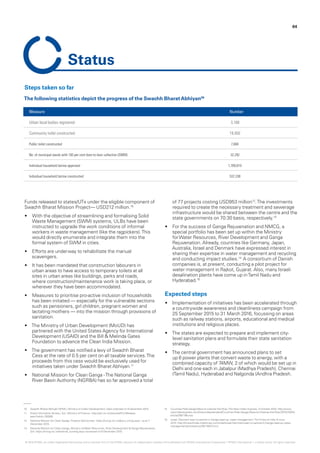
New infrastructure
The manufacturing infrastructure and innovation capacity are
expected to witness growth owing to the development of
smart cities and industrial clusters across different regions
identified as potential investment destinations.01
New sectors
The government has liberalised norms and opened up new
sectors for foreign investments under the Make in India
initiative.The 10 key sectors identified by the government to
play a major role in manufacturing are01
:
•	 Aerospace and defence
•	 Automobiles and automobile components
•	 Chemicals and petrochemicals
•	 Construction equipment, materials and technology
•	 Food processing
•	 Infrastructure development
•	 IT and electronics
•	 Industrial equipment and machinery
•	 Pharmaceuticals
•	 Textiles.
New mind-set
Aiming global recognition, the government tried to represent
an attitudinal shift in its relation with investors through
the Make in India initiative, which limits interventions in
setting-up and operating manufacturing units and promotes
governance.01
Introduction
Steps taken so far
Invest India - investor facilitation cell
•	 The government has set up an Invest India agency — a
joint venture between the Federation of Indian Chambers
of Commerce & Industry (FICCI), Department of Industrial
Policy & Promotion (DIPP) and the state governments — to
promote and facilitate investments.
•	 The agency established an Investor Facilitation Cell to
guide, assist and handhold investors during the entire life
cycle of the business.02
Ease of Doing Business
•	 India improved its EoDB ranking to 130 in 2015 by
constantly working on parameters that address investors’
concerns on conducting business in India.
•	 The government has released a 98-point action plan
for states and union territories, on which they were
ranked on ease for investors to acquire land, get access
to infrastructure related utilities such as electricity, get
clearances and approvals from the government and pay
taxes.
Liberalised FDI norms
The government, under its Make in India initiative, has eased
FDI norms in key sectors which include defence, insurance,
railways infrastructure, etc., resulting in a surge in proposals
and investments that the country received in FY2015-16.
Status
© 2016 KPMG, an Indian Registered Partnership and a member firm of the KPMG network of independent member firms affiliated with KPMG International Cooperative (“KPMG International”), a Swiss entity. All rights reserved.
03.	‘e-Book of DIPP on Good governance 2014-15‘, DIPP, 15 June 2015
04.	‘Government Announces Enhanced Support for Export ofVarious Products and Covers Some Additional
ProductsThrough Merchandise Exports from India Scheme (MEIS)‘, Press Information Bureau GoI, 30
October 2015
05.	‘Govt adds 110 new products under MEIS to boost exports‘, CNBC, 30 October 2015
06.	‘PM wants zero balance for electronics’ import- export‘,The Business Standard, 5 August 2014
07.	 ‘Narendra Modi to make key announcements on Startup India: MoS Jayant Sinha‘,The Indian Express, 18
October 2015
08.	‘Automotive Mission Plan: 2016-26 (A Curtain Raiser)‘, SIAM, 8 September 2015
09.	‘Give industry status to gems and jewellery sector: Assocham‘, DNA India, 4 November 2015
10.	 ‘ASSOCHAM suggests 7-pronged strategy & industry status for G&J sector‘, ASSOCHAM India, 3 November
2015Invest India website, accessed on 11 January 2016, http://www.investindia.gov.in/gems-and-jewelry-
sector/
11.	 Invest India website, accessed on 11 January 2016, http://www.investindia.gov.in/gems-and-jewelry-sector/
12.	 ‘MUDRA Bank:Weighing the Possible Benefits‘, Maps of India, 8 April 2015
Modified Industrial Infrastructure Upgradation Scheme
(MIIUS)
•	 Under MIIUS, 24 projects have been approved in principle,
involving a central grant of about USD100 million. Out of
the 24 projects, final approval was accorded to 11 projects
in February 2014, and a grant of USD2.7 million was further
released for 5 projects.
•	 So far, 5 projects have been completed in FY2014-15 as
compared to 2 in FY2013-14.03
Promoting merchant exports through incentives
To overcome challenges faced by exporters to ship products,
the government has extended duty incentives on several
products. About 110 new tariff lines or products have been
introduced, including the textiles and electronics sectors, to
the existing list of 2,228 products under the Merchandise
Exports from India Scheme (MEIS).The duty benefits are a
part of increased allocations, from USD2.8 billion to USD3.3
billion, for MEIS.04,05
Protection of Intellectual Property Rights (IPR)
To modernise and strengthen Intellectual Property (IP)
offices, the scheme aims at reducing transaction costs,
improving transparency in the functioning of the IP offices and
augmenting human resources to enable timely evaluation of
applications.
Expected next steps
Net zero imports by 2020
The government aims at curtailing the net import-export
balance for the electronics and IT sectors to zero by 2020.
Proposals worth USD12.5 billion have been received for
reviewed under the Modified Special Incentives Scheme
(MSIS), launched by the government. According to the
scheme, electronics manufacturers get a capital subsidy of 20
to 25 per cent from the government.06
Start-up India mission
•	 The Start-up India mission to be run by DIPP, would
promote bank financing for start-ups and offer them
incentives. India also announced setting up of the
Aspiration Fund and Atal Innovation Mission (AIM) to
encourage start-ups.07
•	 The government is expected to launch a slew of measures
to enable and promote entrepreneurship and make India a
leader in start-ups across the world.
Automotive Mission Plan
•	 The Automotive Mission Plan (AMP) 2016-26 was
announced in September 2015 by the Society of Indian
Automotive Manufacturers (SIAM) and GoI to make
the country among the top 3 automotive industries in
the world.The plan also envisages to grow the Indian
automotive industry to USD260 to 300 billion by 2026.
•	 AMP aims to make the Indian automotive industry the
engine of Make in India initiative.08
Industry status for gems and jewellery sector proposed
•	 At present, India is a leader in global jewellery consumption
with a share of 29 per cent.09
The sector contributes 6 to
7 per cent to the Gross Domestic Product (GDP) and is
the second highest contributor to the nation’s commodity
exports with a share of 13 per cent, after petroleum
products.09
During April to September 2015, the exports
from gems and jewellery sector was USD19.2 billion.10
•	 India is the world’s largest cutting and polishing centre for
diamonds and has made technological advancements in
diamond cutting. It is also one of the lowest-cost producers
of polished gems and jewellery.11
Micro Units Development and RefinanceAgency Ltd
(MUDRA)
The GoI launched MUDRAYojana (plan) in April 2015 with
a corpus of USD3.1 billion and a credit guarantee fund of
approximately USD470 million.The objective is to provide
finance and credit support to the Micro-Finance Institutions
(MFI) and other agencies, which lend money to small
businesses and individuals.12
It would also help in registering
all the MFIs and introduce a system of performance rating and
accreditation and thus, help the last-mile borrowers of finance
to evaluate and approach the best MFIs.12
30
© 2016 KPMG, an Indian Registered Partnership and a member firm of the KPMG network of independent member firms affiliated with KPMG International Cooperative (“KPMG International”), a Swiss entity. All rights reserved.
13.	 ‘India to see average growth of 8.8% in next decade: D&B‘, ZeeNews, 29 October 2015
14.	 ‘Note on Make In India‘, CMAI, 20 January 2015
15.	 Press Information Bureau website, Government of India, accessed 5 December 2015
16.	 ‘Ending red tape: Once a month, PM Narendra Modi steps in to revive stalled projects‘, Firstpost, 30 October
2015
17.	 ‘April-June current account deficit narrows to 1.2% of GDP‘,The EconomicTimes, 12 September 2015
18.	 ‘Fact Sheet on Foreign Direct Investment (FDI)‘, DIPP, 1 December 2015
19.	 ‘India jumps 16 places inWEF competitiveness ranking‘, Livemint, 30 September 2015
20.	‘India pips US, China as No. 1 foreign direct investment destination‘,TheTimes of India, 30 September 2015
Increased GDP
•	 The Make in India and other development initiatives
are expected to help the country to grow at an
average rate of 8.8 per cent annually during 2015-25.
The nominal GDP is expected to reach USD3.4 trillion
by FY2019-20 and further, to USD7 trillion by FY2024-
25.13
•	 The Make in India initiative aims at increasing the
manufacturing sector’s share in GDP from 16 to 25
per cent by 2022.14
Revival of Indian manufacturing industry
The initiative is expected to revive the manufacturing
sector and make it self-reliant.The sector grew at an
annual average rate of 5.77 per cent for the period 2011-
15, and Make in India initiative would push the growth rate
of manufacturing to 12 to 14 per cent over the next 3 to 5
years.14
Increased employment
The Make in India initiative is expected to create
employment opportunities for about 100 million additional
people by 2022.15
Increase in new projects
There has been an overall increase in value of new
projects announcements (government and private) on a
quarter-on-quarter basis over the last 4 quarters (October
2014 to September 2015).The chart below depicts the
increase:
Reviving stalled projects and reducing CAD
•	 Through initiatives led by the Prime Minister’s office,
the stalled projects’ value has decreased from a peak
of 8.5 per cent of the country’s GDP in 4Q FY2013-14
to 7.6 per cent of the GDP in 2Q FY2015-16.16
•	 Indigenous manufacturing would gradually reduce
dependence on imports and control Current Account
Deficit (CAD) of the country.This is indicated by the
April to June 2015 CAD which fell to a five-quarter low
at USD6.2 billion (1.2 per cent of GDP) as compared
to USD7.8 billion (1.6 per cent of GDP) during the
corresponding period previous year. Reduced CAD
was on account of a decline in merchandise imports
of the nation and falling crude prices globally.17
Turning India into an attractive investment
destination
•	 FDI equity inflows in the country totaled USD44.3
billion in FY2014-15, up 23 per cent on FY2013-14
value of USD36 billion. In the first 2 quarters of
FY2015-16 (April to September 2015), FDI inflows
amounted to USD16.6 billion.18
•	 India’s ranking in theWorld Economic Forum’s
Global Competitiveness report FY2015-16, showing
a jump of 16 places.19
The country is also ranked as
the fastest growing economy by the International
Monetary Fund (IMF).20
Impact
31
© 2016 KPMG, an Indian Registered Partnership and a member firm of the KPMG network of independent member firms affiliated with KPMG International Cooperative (“KPMG International”), a Swiss entity. All rights reserved.
New project announcements (October 2014 to
September 2015)
Source: Centre for Monitoring Indian Economy (CMIE), http://www.cmie.com/
21.	 ‘Investment Opportunities under India’s Mega Plans‘, FICCI, 13 January 2015
22.	 Make in India website, accessed on 5 December 2015, http://www.makeinindia.com/sectors
23.	‘Make in India effect: Foreign investment up 164 pc in auto industry‘,The EconomicTimes, 17 July 2015
24.	‘Automotive Mission Plan: 2016-26 (A Curtain Raiser)‘, SIAM, 8 September 2015
25.	 Press Information Bureau, Government of India, accessed 5 December 2015
26.	‘Conference Indian Aviation Sector‘, Ministry of Civil Aviation, 24 April 2015
27.	 ‘Indian aviation growth fastest globally‘, DNA India, 7 August 2015
28.	 Tata Strategic Management Group, October 2015
29.	‘Investment opportunities under India’s mega plans’, FICCI, January 2015
30.	‘Housing for All by 2022’ Mission – National Mission for Urban Housing,’ accessed on 3rd December 2015
32
Business opportunities
Sector Sector brief and recent measures Likely growth
Automobile and auto components The Indian automobile sector accounts for 7 per cent
of India’s GDP and is estimated to be the third largest
market globally with an annual turnover of USD145
billion by 2016.
The government allows 100 per cent FDI in the sector
through the automatic approval route.
Foreign investments in the sector increased by 164
per cent to reach USD2.2 billion during October 2014
to April 2015 as compared to USD0.8 billion during
October 2013 to April 2014.23
The Automotive Mission Plan 2026 plan envisages that
the Indian automotive industry will grow to USD260 to
300 billion by 2026.
It is expected to create 65 million additional jobs and
contribute over 12 per cent to India’s GDP.24
The government also launched National Mission for
Electric Mobility (NMEM) 2020 to foster adoption
of electric and hybrid vehicles and encourage their
manufacturing in India.25
Aviation India is the ninth largest aviation market globally,
worth USD16 billion and is poised to be the third
largest market by 2020.26
About 100 per cent FDI is permitted in greenfield
airport projects under the automatic approval route.
The government has recently permitted 49 per cent
FDI through the automatic route for regional air
transport services. Additionally, foreign equity caps for
non-scheduled air transport services, ground handling
services, satellites-establishment and operation and
credit information companies have been increased
from 74 to 100 per cent.21,22
India became the fastest growing aviation market of
the world in June 2015, by registering a growth rate of
16 per cent y-o-y, ahead of the U.S., China and Russia.27
The sector is expected to grow significantly with
the emergence of Low Cost Carriers (LCC). Special
emphasis is being given on infrastructure development,
by modernising airports and navigation systems.
About 200 low-cost airports by 2035 have been
proposed by the government; an investment of USD1.3
billion on non-metro projects by 2017 to modernise and
upgrade airports is also proposed.27
About 300 business jets, 300 small aircrafts and 250
helicopters are expected to be added to the existing
fleet.27
Additionally, steps are being taken to make India the
aviation Maintenance, Repair and Overhaul (MRO) hub
of Asia.
Chemical and petrochemical The chemicals industry accounts for 2.1 per cent of
the nation’s GDP with estimated revenues of USD144
billion. India is currently the third largest producer of
chemicals in Asia and sixth (by output) in the world.
The government permits 100 per cent FDI under the
automatic approval route.21,22
The industry is expected to grow at 9 per cent per
annum to reach USD214 billion by FY2018-19.28
Construction Construction activities contribute to more than 10 per
cent of India’s GDP. The industry is valued at USD126
billion, employing more than 35 million people.
About 100 per cent FDI is permitted through the
automatic route for townships, cities and infrastructure
development.
The sector accounts for second highest FDI flow into
the country. The government has, thus, eased some of
its FDI restrictions for the investors recently.21,22
The sector is expected to grow to USD186.2 billion
by 2017 and would need a 76.5 million workforce by
2022.29
An investment worth USD1,000 billion is projected for
the sector until 2017, 40 per cent of which would be
funded by the private sector.29
At present, India has an urban housing shortage
of 18.8 million units. The shortage in rural India is
estimated at about 48 million.29
The GoI launched
Housing for All by 2022 scheme in June 2015 to
provide a home for all Indians, thus presenting a
significant opportunity for the investors in the sector.30
© 2016 KPMG, an Indian Registered Partnership and a member firm of the KPMG network of independent member firms affiliated with KPMG International Cooperative (“KPMG International”), a Swiss entity. All rights reserved.
Sector Sector brief and recent measures Likely growth
Defence manufacturing India spends 40 per cent of its total defence budget in
capital acquisitions.
India meets 70 per cent of its defence requirements
through imports. The government has recently allowed
49 per cent FDI under automatic approval route. The
portfolio investment limit has also been increased from
24 to 49 per cent.301,32
The private sector participation is expected to enable
foreign investors to enter into strategic partnerships with
Indian companies and leverage the domestic market
demand.33,34
India’s defence budget is expected to grow at a CAGR of 8
per cent to reach a value of USD64 billion by 2020.33,34
The sector’s offset clause also presents opportunities
to investors. According to the clause, any foreign arms
manufacturer who secures a deal/order worth more
than USD46.8 million from India is required to source
components worth 30 per cent of the deal value from the
country.33,34
This presents a USD15 billion opportunity in
the next 10 to 15 years.34,35
The government is expected to finalise a deal with France
to procure 36 Rafael Fighter aircraft at a cost of USD8.3
billion.35
The 30 per cent offset clause would present a
USD2 billion opportunity for the Indian defence sector.36
IT and electronics The Information Technology-Business Process
Management (IT-BPM) industry constitutes 8.1 per
cent of India’s GDP, adding about USD115 to 120 billion
to the Indian economy. The sector is India’s largest
private employer and employs 3.1 million people.
The Electronic System and Design Manufacturing
(ESDM) industry is estimated at USD90 to 95 billion.36
The government has received proposals worth
USD1,716 billion from various companies since the
launch of the Make in India initiative.37
The government allows 100 per cent FDI under the
automatic approval route in ESDM38
and various
IT-BPM sub-segments including software development,
testing, consultancy, research and analysis services.
The Digital India initiative aims at digitalising and
providing basic government services online. Here, the
IT-BPM sector could leverage the opportunity. Further, the
sector could tap the consumer electronics market, which is
expected to reach USD29 billion by 2020.39
The government plans to set-up semiconductor fabrication
plants in the country. Two such facilities are expected
to be set-up in Gujarat and Uttar Pradesh, where the
government would invest USD10 billion for computer-chip
manufacturing.39
India would also invest USD400 million
to develop a microprocessor.39
A dedicated Electronics
Development Fund had been created to leverage the use of
venture capital funds to promote start-ups in the sector.40
The government also launched the Digital India initiative,
and the India Inc. has committed an investment of USD70.2
billion to provide telephony and fast internet.41
Food processing India’s food processing sector ranks fifth globally
in terms of exports, production and consumption.
The sector amounted USD13.2 billion in FY2012-13,
accounting for 9.8 per cent of the GDP.42
The government allows 100 per cent FDI through the
automatic approval route for most food products.43
It
has also set up 42 mega food parks through PPP model
with an investment of USD1.5 billion.44
India’s strategic geographic location and proximity to food-
importing nations makes it a favourable choice for export of
processed food.
India is the largest beef exporter, largest pulses and millet
producer, and the second-largest rice and wheat producer
globally.45,46
Therefore, the food processing market presents
ample opportunities for investors. Additionally, a shift
toward high-protein, low-fat and organic food diet among
consumers offers growth opportunities.
The sector is expected to grow at a rate of 11 per cent
until 201847
, driven by consumer demand for packaged and
ready-to-eat food.
31.	 ‘Investment Opportunities under India’s Mega Plans‘, FICCI, 13 January 2015
32.	 Make in India website, accessed on 5 December 2015, http://www.makeinindia.com/sectors
33.	‘Housing for All by 2022’ Mission – National Mission for Urban Housing,’ accessed on 3rd December 2015
34.	‘Relaxation of Offset Clause for Defence Procurement‘, Press Information Bureau GoI, 21 July 2015
35.	‘Defence equipment business has companies interested like never before‘, LiveMint, 20 February 2015
36.	‘Rafale deal to be signed on eve of Hollande’s India visit‘,The Indian Express, 26 November 2015
37.	 ‘PM Modi’s ‘Make in India’ turns one: All you need to know about the initiative‘, DNA, 25 September 2015
38.	‘FAQs on various aspects related to Foreign Direct Investment in ESDM sector‘, Department of Electronics
and InformationTechnology (DeitY), accessed 02 December 2015
39.	‘Electronic Systems‘, Make in India, accessed on 22 December 2015
40.	‘Indian Govt to Invest $10 bn for Semiconductor Fab‘,TeleAnalysis, 28 March 2015
41.	 ‘Digital India: India Inc. commits to invest Rs 4.5 trillion‘, BGR, 2 July 2015
42.	‘Contribution of Food Processing Sector to GDP (at 2004-05 prices)’, Ministry of Food Processing Industries,
accessed 11 December 2015
43.	‘FDI Policy – Food Processing Sector‘, Make in India, accessed 02 December 2015
44.	‘42 mega food parks worth Rs 2,000 crore to be set up in the country’,The EconomicTimes, December 2015
45.	‘India StaysWorld’sTop Beef Exporter Despite New Bans on Slaughtering Cows‘,TheTime, 23 April 2015
46.	 FAO website – 2013 data, http://faostat3.fao.org/browse/rankings/commodities_by_country/E accessed on
7 December 2015
47.	 ‘The Next Manufacturing Destination‘, Make in India, accessed 02 December 2015
33
© 2016 KPMG, an Indian Registered Partnership and a member firm of the KPMG network of independent member firms affiliated with KPMG International Cooperative (“KPMG International”), a Swiss entity. All rights reserved.
48.	‘Railways‘, Investment andTechnology Promotion Division GoI, September 2015
49.	 Make in India website, accessed on 5 December 2015, http://www.makeinindia.com/sectors
50.	‘Highlights of the Railway Budget 2015-16‘, Indian Railways, 25 February 2015
51.	 Indian Railways website, http://www.indianrailways.gov.in/railwayboard/uploads/directorate/finance_
budget/Budget_2015-16/English_Speech_Highlights_2015-16.pdf accessed 11 December 2015
52.	‘Renewable Energy in India: Growth andTargets‘, Ministry of New and Renewable Energy, 13 May 2015
53.	‘For Investors, India’s Solar Push Could Signal A Gold Rush‘,The Forbes, 7 July 2015
54.	‘India’s Supreme Court Reinforces Renewable EnergyTargets for Industry‘,World Resources Institute, 17
June 2015
34
Sector Sector brief and recent measures Likely growth
Railways With a network spanning more than 65,000 kms, the
sector at present employs 1.4 million people.48
The government has recently allowed 100 per cent
FDI under automatic approval route for railway
infrastructure.49
Railways offer investment opportunities in
infrastructure modernisation and high speed rail
networks. The government aims to award projects
worth USD1,000 billion through the PPP model.48
The railway ministry envisages an investment of
USD132.4 billion by 2020.50
The government’s proposal to expand the rail network
— increasing the track length by 20 per cent, increasing
the passenger and freight carrying capacities — would
present multi-billion opportunities for investors.51
Also,
increased manufacturing activity would entail the
need of transporting commodities and coal within the
country.
Renewable energy Under the automatic approval route, 100 per cent FDI
is permitted for renewable energy generation and
distribution projects.51
India has a current installed capacity of 34.5GW of
renewable energy with a major share of wind energy
at 22.6GW.52
The country has revised its renewable energy targets
for 2022, totalling 175GW from the sector, constituting:
•	 Solar energy — 100GW
•	 Wind energy — 60GW
•	 Biomass energy — 10GW
•	 Small hydro energy — 5GW.53
The government has announced development of Ultra
Mega Solar Power Projects and Solar Parks with
an investment of USD156 million. Additionally, the
country has untapped potential of 102.8GW of wind
energy as compared to current capacity of 21.1GW.53
About 4.8GW of solar power capacity would be
auctioned during November 2015 to April 2016, with
90 per cent of the capacity to be floated through the
central government. To tap the potential market, a
Japanese consortium has set up a Joint Venture (JV)
with an Indian telecom provider to bid for contracts.
Similarly, a U.S. based renewable energy firm intends
to invest USD15 billion by 2022 in India.53
India is likely
to add 10.8GW solar capacity in FY2016-17.51
A recent Supreme Court judgement also makes it
mandatory for industries with captive power plants to
procure a percentage of their energy from renewable
sources.54
© 2016 KPMG, an Indian Registered Partnership and a member firm of the KPMG network of independent member firms affiliated with KPMG International Cooperative (“KPMG International”), a Swiss entity. All rights reserved.
Sector Sector brief and recent measures Likely growth
Textile and garments India has the second largest manufacturing capacity
globally in textiles and garments.55
The industry
contributes 14 per cent to country’s industrial
production, 4 per cent to GDP and 13 per cent to
exports, and is expected to reach a value of USD100
billion by 2017.56
Under the automatic approval route in the textile
sector, 100 per cent FDI is allowed.55
The Indian textile and apparel industry (domestic sales
and exports) is expected to grow from USD107 billion
at present to USD223 billion by 2021.57
The sector has a potential to generate additional 6.31
million jobs between 2013 and 2022.58
Tourism and hospitality Tourism accounted for 7 per cent of the country’s GDP
in 2014, contributing USD119.2 billion and generating
36.7 million jobs.59
In tourism and hospitality, 100 per cent FDI is allowed
under the automatic approval route.55
India offers a geographical diversity, world heritage
sites and niche tourism products like cruises,
adventure, medical, eco-tourism, film, rural and
religion tourism.
The segment offers opportunities for resorts,
convention centres, motels, heritage hotels, tour
operations and travel guides, and other stakeholders.
55.	 Make in India website, accessed on 5 December 2015, http://www.makeinindia.com/sectors
56.	‘Textiles and Garments‘, Make in India, accessed on 22 December 2015
57.	 ‘India ITME-2016 - the ‘Game changer & catalyst’ forTextile industry &Textile Machinery manufacturers‘,
Textile Association of India, 15 October 2015
58.	‘Textiles and Clothing Sector (2013-17, 2017-22)‘, NSDC report, accessed on 02 December 2015
59.	‘Travel and tourism industry to grow 7.5% in 2015: report‘, Live Mint, 24 March 2015
35
© 2016 KPMG, an Indian Registered Partnership and a member firm of the KPMG network of independent member firms affiliated with KPMG International Cooperative (“KPMG International”), a Swiss entity. All rights reserved.
Urban
development-
transforming
Indiancities
Project outlay
The estimated outlay for the Smart Cities Mission from FY2015-16 to
FY2019-20 is more than USD15 billion.01
The estimated outlay for the Atal Mission for Rejuvenation and Urban
Transformation (AMRUT) from FY2015-16 to FY2019-20 is approximately
USD7.5 billion.02
01.	 Smart Cities Mission Statement & Guidelines, Ministry of Urban Development, Government of India, June 2015, http://
smartcities.gov.in/writereaddata/SmartCityGuidelines.pdf
02.	 AMRUT Mission Statement and Guidelines, Ministry of Urban Development, Government of India, June 2015, http://amrut.
gov.in/writereaddata/AMRUT%20Guidelines%20.pdf
The Smart Cities initiative will help create cities which
optimally tap into digital and information technologies, urban
planning best practices, public-private partnerships, and
positive policy changes.
The mission shall be implemented through area-based and
pan-city developments.The area-based developments would
include the following:
•	 Retrofitting which shall include transformation of existing
built-up areas through more intensive infrastructure
services and smart applications (e.g. city centres and
central zones).
•	 Redevelopment of existing areas, including replacement
of existing built-up environments to enable co-creation of
new layouts with better infrastructure and land-use (e.g.
redevelopment of slums).
•	 Greenfield developments to introduce smart solutions to
the cities through innovation planning, financial planning
and implementation planning tools to accommodate
expanding populations (e.g. Industrial andTechnology
Parks and clusters, such as the Gujarat International
FinanceTec-City (GIFT City) in Gujarat.
In addition to the above, pan-city developments would aim to
enable the application of identified smart solutions to existing
infrastructure across the cities.The application would leverage
state-of-the-art Information and CommunicationTechnology
(ICT) tools to improve the living conditions and governance.
(e.g. intelligent traffic management systems, waste water
recycling, smart metering, etc.).
The above mentioned developments have been set in place, to
accommodate expanding populations in cities while improving
the livability of the entire city.
Further, the core infrastructure of a smart city would include
the following elements:
•	 Adequate water supply
•	 Assured electricity supply
•	 Sanitation, including solid waste management
•	 Efficient urban mobility and public transport
•	 Affordable housing, especially for the poor
•	 Robust IT connectivity and digitisation
•	 Good governance, especially e-governance and citizen
participation
•	 Sustainable environment
•	 Safety and security of citizens, particularly women,
children and the elderly, and
•	 Health and education.
It has been envisaged that the area-based and pan-city
development objectives would converge with other initiatives
including AMRUT and Clean India Mission.
SmartCities
Mission
Objective(s)
The Smart Cities Mission aims to drive economic growth
and improve the quality of life in the country by enabling
local area development and harnessing technology,
especially technology that leads to Smart outcomes.01
01.	 Smart Cities Mission Statement & Guidelines, Ministry of Urban Development, Government of India, June
2015, http://smartcities.gov.in/writereaddata/SmartCityGuidelines.pdf
37
Introduction01
© 2016 KPMG, an Indian Registered Partnership and a member firm of the KPMG network of independent member firms affiliated with KPMG International Cooperative (“KPMG International”), a Swiss entity. All rights reserved.
02.	 Smart Cities Mission Statement & Guidelines, Ministry of Urban Development, Government of India, June
2015, http://smartcities.gov.in/writereaddata/SmartCityGuidelines.pdf
03.	 FDI in insurance to be hiked to 49 per cent: Jaitley,The Indian Express, 10 July 2014, http://indianexpress.
com/article/india/politics/fdi-in-insurance-to-be-hiked-to-49-per-cent-jaitley/
04.	 India Smart Cities Challenge, http://smartcitieschallenge.in – accessed on 30 November 2015
Steps taken so far
Smart cities
Identification and allocation of smart cities for each state/
UnionTerritory(UT)
•	 A total of 100 cities have been identified for the mission02
.
•	 First phase of India Smart Cities Challenge was conducted
to promote competitive and cooperative federalism; about
97 cities submitted their Smart Cities Proposals (SCPs) to
the Ministry of Urban Development (MoUD). Up to 20 of
the best SCPs are set to be shortlisted to receive funding
from MoUD after the first round.
Financing strategy
•	 The Smart Cities Mission is to be implemented as a
centrally sponsored scheme with central government
providing financial support to the extent of approximately
USD7.2 billion over 5 years, which would be matched
up by respective states and ULBs02
. In addition, it is
expected that funding shall come from PPP, commercial/
multinational bodies.The private sector would have a role
to play — by taking up projects in PPP mode or work as
contractors, consultants, etc.
•	 Certain sectors of urban infrastructure such as power,
ICT and integrated townships would bear the maximum
impact of transformation. Both in terms of requirement
(resources) and impact, these sectors are expected to play
vital roles, and thus warrant conceptualisation of focussed
financing mechanisms.
Mission statement and guidelines02
•	 MoUD has made a comprehensive guide available, to
assist states and ULBs to formulate their strategies and
SCPs.The document also prescribes the implementation
of Special PurposeVehicles (SPVs) to plan, evaluate,
release funds, operate and monitor the development
projects under the initiative.
•	 Greenfield developments and other urban initiatives such
as international airports, port cities and industrial clusters,
among others are also being taken up to complement the
Smart Cities Mission.
•	 To encourage the development of smart cities providing
habitation for the neo-middle class, the requirement
for the built up area and capital conditions for FDI are
being reduced from 50,000 sq m to 20,000 sq m and
from USD10 million to USD5 million, respectively. As a
further impetus, projects that commit at least 30 per cent
of the total project cost for low cost affordable housing
would be exempted from the minimum built-up area and
capitalisation requirements03
.
Expected next steps02,04
•	 With the conclusion of the first round of the Smart Cities
Challenge, up to 20 cities will be selected in the first
year, which would be eligible to receive funding of up to
USD75.75 million from the government over the next 5
years in a phased manner.
•	 Special PurposeVehicles (SPVs) would be set up for the
implementation of the projects as per the plan envisaged
in the SCPs.
•	 The remaining 77 cities are expected to be funded for
Smart Cities transformation, over the next 2 years.
38
Status
© 2016 KPMG, an Indian Registered Partnership and a member firm of the KPMG network of independent member firms affiliated with KPMG International Cooperative (“KPMG International”), a Swiss entity. All rights reserved.
Impact
Transformative impact on urban infrastructure
The envisaged spend for the initiative is stated to come
from the MoUD, the concerned states, ULBs and PPP/
commercial/multinational bodies.
Creation of market for manufactured goods and
commodities
An approach towards urban living and smart living
would entail significant procurement of steel, cement,
electronics, furnishings, electrical equipment, sewage
plants, ICT equipment and services, etc. triggering a
growth in global trade.
Improved economic efficiency
Smart cities would require augmented safety, security,
sustainability and energy efficiency that could help trigger
a virtuous cycle of efficiency.
Business opportunities
Significant business opportunities are foreseen for both
domestic and global players in light of the potential
investments required for the implementation of the
Smart Cities projects.
Investment potential
•	 The Centre’s Expenditure Finance Committee has
approved a central funding of approximately USD42
billion to develop 100 smart cities and upgrade the
basic civic infrastructure in another 500 cities during
the next 10 years05
. However, given the scale of
development, the total funding requirement would be
more than USD1 trillion at present value terms over
the next 20 years.
•	 The magnitude of investments is extremely
significant for the economy. For instance, the state
of Maharashtra has been allocated 10 smart cities,
which would add up to a spending of approximately
USD6 billion over 5 years.
•	 India has also invited other countries for partnership
in developing the smart cities and has signed
agreements to build 8 such cities — 3 with
Germany, 3 with the U.S., and 1 each with Spain and
Singapore06
.
39
Impact
Sector Investment potential
Smart governance USD83 million allocated for Digital India initiative.
Smart energy •	 Implementation of 8 smart grid pilot projects in India with an investment of USD10 million for energy storage
•	 The Power Grid Corporation of India has planned to invest USD26 billion in the next 5 years; about 130 million smart
meters would be installed by 2021.
Smart environment The Ministry of Water Resources plans to invest USD50 billion in the water sector in the coming years.
Smart transportation •	 The Government of India has approved a USD4.13 billion plan to spur electric and hybrid vehicle production by setting
up an ambitious target of 6 million vehicles by 2020.
•	 MoUD plans to invest more than USD20 billion on the metro rail projects in the coming years.
•	 The proposed 534km Mumbai-Ahmedabad high speed rail project would have an investment of about USD10.5 billion.
Smart ICT •	 Cloud computing is expected to evolve into a USD4.5 billion market in India by 2016.
•	 Under the flagship Safe City project, the Union Ministry proposes USD333 million to make 7 big cities (Delhi, Mumbai,
Kolkata, Chennai, Ahmedabad, Bengaluru and Hyderabad) to focus on technological advancement rather than
manpower disaster management.
05.	 Top govt panel approves Rs 2.73 lakh crore to modernise cities, HindustanTimes, 28 March 2015, http://
www.hindustantimes.com/india/top-govt-panel-approves-rs-2-73-lakh-crore-to-modernise-cities/story-
UL8VEEHPHRMe6V8eTjVDpO.html - accessed on 3 December 2015
06.	 India’s Smart City vision is part of a larger agenda of creating Industrial Corridors between India’s big
metropolitan cities in India, Make in India, http://www.makeinindia.com/article/-/v/internet-of-things -
accessed on 3 December 2015
© 2016 KPMG, an Indian Registered Partnership and a member firm of the KPMG network of independent member firms affiliated with KPMG International Cooperative (“KPMG International”), a Swiss entity. All rights reserved.
The following table lists the potential business opportunities for both domestic and foreign investors through different
schemes in each sector:
Sector Investment potential
Smart building •	 India is expected to emerge as the world’s third largest construction market by 2020, by adding 11.5 million homes
every year.
•	 The Intelligent Building Management Systems market is estimated to be worth USD621 million and is expected to
reach USD1,891 million by 2016.
Smart health and education •	 The health budget was up by 27 per cent in FY2013-14 to USD5.26 billion, with special focus on improving affordable
healthcare for all.
•	 FDI limit in the insurance sector increased to 49 per cent from 26 per cent.
•	 The Indian medical devices market is expected to reach USD11 billion by 2023.
40
Source: India’s Smart City vision is part of a larger agenda of creating Industrial Corridors between India’s big metropolitan cities in India, Make in India, http://www.makeinindia.com/article/-/v/internet-of-things -
accessed on 3 December 2015
© 2016 KPMG, an Indian Registered Partnership and a member firm of the KPMG network of independent member firms affiliated with KPMG International Cooperative (“KPMG International”), a Swiss entity. All rights reserved.
The primary purpose of the flagship initiative, AMRUT, is
to provide basic services such as water supply, sewerage
and urban transport to every household in order to improve
the quality of life, while promoting equitable access to city
services. Among the estimated 4,040 urban zones in India,
about 500 would be targeted through AMRUT.
The objectives of AMRUT constitute the Service Level
Benchmarks (SLBs).The capacity building and supportive
reforms, which act as integral parts of the mission, aim at
improving service delivery, resource mobilisation and greater
transparency in municipal functioning and capacity building in
order to empower municipalities and increase their operational
efficiency.
The mission envisages to focus on the followingThrust
Areas02
:
•	 Water supply
•	 Sewerage facilities and septage management
•	 Storm water drains to reduce flooding
•	 Pedestrian, non-motorised and public transport facilities,
parking spaces, and
•	 Enhancing amenity value of cities by creating and
upgrading green spaces, parks and recreation centres,
especially for children.
AMRUT-
rejuvenationof
500cities
Objective(s)01
Atal Mission for Rejuvenation and UrbanTransformation
(AMRUT) envisages urban India’s transformation, by
aiming to:
1.	 Ensure that every household has access to a tap with
assured supply of water and a sewerage connection;
2.	 Increase the amenity value of cities by developing
greenery and well maintained open spaces (e.g.,
parks); and
3.	Reduce pollution by switching to public transport or
constructing facilities for non-motorised transport
(e.g., walking and cycling).­
01.	 The Mission, AMRUT, Ministry of Urban Development, Government of India, http://amrut.gov.in/
writereaddata/The%20Mission.pdf
02.	 Thrust Areas, AMRUT, Ministry of Urban Development, Government of India, http://amrut.gov.in/
writereaddata/Thrust%20Areas.pdf
41
Introduction01
© 2016 KPMG, an Indian Registered Partnership and a member firm of the KPMG network of independent member firms affiliated with KPMG International Cooperative (“KPMG International”), a Swiss entity. All rights reserved.
03.	 Coverage, AMRUT, Ministry of Urban Development, Government of India, http://amrut.gov.in/writereaddata/
Coverage.pdf
04.	 The Mission, AMRUT, Ministry of Urban Development, Government of India, http://amrut.gov.in/
writereaddata/The%20Mission.pdf
05.	 Fund Allocation, AMRUT, Ministry of Urban Development, Government of India, http://amrut.gov.in/
writereaddata/Fund%20Allocation.pdf
06.	 List of Reforms, AMRUT, Ministry of Urban Development, Government of India, http://amrut.gov.in/
writereaddata/List%20of%20Reforms.pdf
07.	 Individual Capacity Building, AMRUT, Ministry of Urban Development, Government of India, http://amrut.gov.
in/writereaddata/Individual%20Capacity%20Building%20Plan.pdf
08.	 AMRUT Action Plans for 474 cities cleared with a project outlay of Rs.19,170cr, Press Information Bureau,
Government of India, 15 December 2015, http://pib.nic.in/newsite/printrelease.aspx?relid=133300
09.	 Execution Steps, AMRUT, Ministry of Urban Development, Government of India, http://amrut.gov.in/
writereaddata/Execution%20Steps.pdf
Steps taken so far
Identification of cities03
About 500 cities have been selected based on the following
criteria:
•	 All cities and towns with a population greater than 100,000,
having notified municipalities, including cantonment
boards (civilian areas)
•	 All capital cities/towns of states/UTs, not covered under
the 100 Smart Cities Mission
•	 All cities/towns classified as heritage cities by MoUD
•	 Thirteen cities and towns on the stem of the main rivers
with a population between 75,000 and 100,000
•	 Ten cities from hill states, islands and tourist destinations
(not more than 1 from each state).
Identification of mission components04
MoUD has identified capacity building, reform implementation,
water supply, sewerage and septage management, storm
water drainage, urban transport and green-space development
as the chief components of the mission.
Finance strategy05
With a total estimated outlay of USD7.5 billion for the period
between FY2014-15 and FY2018-19, the initiative is to be
operated as a centrally sponsored scheme.The funds would
consist of the following:
1.	 Project fund (80 per cent of the annual budgetary
allocation)
2.	 Incentive for reforms (10 per cent of the annual budgetary
allocation)
3.	State funds for administrative and office expenses (8 per
cent of the annual budgetary allocation)
4.	 MoUD funds for administrative and office expenses (2 per
cent of the annual budgetary allocation).
Reform milestones06
The reform milestones with corresponding timelines for
AMRUT cities have been created in order to constitute a
guiding source for ULBs and states.The areas covered by the
milestones are e-governance, creation and adding professional
approach to municipal cadre, review of building by-laws,
accountability and auditing, city level plans, devolution of
funds, setting up financial intermediaries, tax and user fee
collection, credit rating, energy and water audit, sanitation and
hygiene (alignment with the Clean India Mission).
Capacity building
For individual capacity building07
, key departments in ULBs
have been identified as follows:
•	 Finance and revenue
Financial planning and management, and revenue
mobilisation
•	 Engineering and public health
Water and sanitation, drainage and solid waste
management
•	 Town planning
Urban planning including pro-poor planning approaches
•	 Administration
e-Governance, computer and soft skills.
The aim of institutional capacity building07
, is to improve
institutional outcomes including accountability and
transparency, service delivery, citizen empowerment and
resource mobilisation. Institutional capacity could be built
upon accountability and transparency, service delivery, citizen
empowerment and resource mobilisation.
Expected next steps08
•	 State governments shall formulate and submit their State
Annual Action Plans (SAAP) under AMRUT.
•	 Post the appraisal and approval by the Apex Committee,
states shall invite consultants to help formulate the plans.
•	 Consequently, the states shall invite vendors to execute
the plans.
•	 City level Action Plans have been approved for 474 cities
in 18 States and union territories with a total project
expenditure of about USD2.94 billion under AMRUT for
FY2015-1609
.
42
Status
© 2016 KPMG, an Indian Registered Partnership and a member firm of the KPMG network of independent member firms affiliated with KPMG International Cooperative (“KPMG International”), a Swiss entity. All rights reserved.
10.	 The Mission, AMRUT, Ministry of Urban Development, Government of India, http://amrut.gov.in/
writereaddata/The%20Mission.pdf
11.	 Fund Allocation, AMRUT, Ministry of Urban Development, Government of India, http://amrut.gov.in/
writereaddata/Fund%20Allocation.pdf
Impact
Multiplier effect/complementarity
AMRUT holds significant implications for urban
transformation vis-à-vis the 100 Smart Cities Mission.
While the former has a project-based approach, the latter
follows an area-based strategy.
On the other hand, at the planning stage itself, cities
have been instructed to converge their smart city
planning, aligning them to the objectives of AMRUT,
Clean India Mission, National Heritage City Development
and AugmentationYojana (HRIDAY), Digital India, Skill
Development, Housing for All, construction of museums
funded by the Department of Culture and other
programmes connected to social infrastructure such as
health, education and culture.
Enhanced operational efficiencies of cities10
The reforms of the mission aim at enhancing the
operations and efficiencies of ULBs and capacity building
in order to empower municipal functionaries and enable
timely completion of projects.
Business opportunities
As per the fund allocation statement, the scope of
investment is estimated at USD15.15 million per city, for
500 cities, over the next 5 years11
. AMRUT is expected
to impact the following spheres of urban living, implying
opportunities for investments:
1.	 Digitisation of ULBs offers scope for integrated
platforms and services such as digital registries
(births, deaths, marriages, pensions, etc.), property
registration and taxation, issuance of licenses,
construction permits, personnel training, MIS,
grievance redressal system, energy and water audit,
e-procurement and e-governance.
2.	 Creation of municipal cadre where personnel
requirements to operationalise the objectives of
capacity building in ULBs would present scope for
specialised cadre training programmes.
3.	Water management components of the mission
present scope for investment in water treatment
plants, pipelines, metering and grid management
solutions, de-silting, ground-water recharge, etc.
4.	 Waste management components would include
decentralised underground sewerage networks,
sewage treatment plants, waste collection-transport-
treatment integration, septage cleaning-transport-
treatment, storm water drainage and reuse, etc.
5.	Urban transport component would present the scope
to invest in ferry vessels, pathways, skywalks, non-
motorised transport, multi-level smart parking, bus
rapid transport system, etc.
6.	Green zone components would entail scope for
landscaping, creating of green infrastructure (parks,
ponds, etc.), vertical greening, etc.
7.	 Reform implementation would need services
like implementation, consulting, monitoring and
evaluation services.
43
Impact
© 2016 KPMG, an Indian Registered Partnership and a member firm of the KPMG network of independent member firms affiliated with KPMG International Cooperative (“KPMG International”), a Swiss entity. All rights reserved.
PowerforAll-―
asteptoward
affordablepower
Objective
Launched with an aim of providing 24x7 quality, reliable and affordable
power supply to all Indian citizens by March 2019.01
Investment outlay
The Government of India has planned an investment of USD45.2 billion in
power transmission and distribution business to achieve its targets under
the Power for All initiative.01
01.	 Government eyes Rs 3-trn investment, reforms to light up power sector‘,The Financial
express, 28 December 2015.
© 2016 KPMG, an Indian Registered Partnership and a member firm of the KPMG network of independent member firms affiliated with KPMG International Cooperative (“KPMG International”), a Swiss entity. All rights reserved.
01.	 Government eyes Rs 3-trn investment, reforms to light up power sector‘,The Financial express, 28
December 2015.
02.	 ‘Power for All programme‘,Vikaspedia, Department of Electronics and InformationTechnology, Ministry of
Communications & InformationTechnology, Government of India.
03.	 ‘A Joint Initiative of Government of India and Government of Andhra Pradesh‘, Power for All, Ministry of
Power, Government of India.
04.	 Govt scheme for 24x7 power still in nascent stage, Business Standard, 17 June 2015
05.	 ‘When the NDA Promised Power for All, itTook on its Greatest Challenge‘,TheWire, 20 June 2015.
06.	 Landmark InitiativesTowards Achieving 24x7 Power for All, Press Information Bureau, 28 December 2014.
07.	 Reforms in Power Sector, Press Information Bureau, 01 December 2014.
08.	 ‘Govt begins work on National Electricity Plan‘, Business Standard, 20 September 2015.
09.	 Government aims to add 10,000 MW per year to lift wind energy sector,The EconomicTimes, 12 August
2014.
10.	 Renewable Energy Programmes Gets A New Impetus, Press Information Bureau, 21 December 2014.
11.	 India sets new solar capacity target of 100,000 MW by 2022,The EconomicTimes, 17 June 2015.
12.	 Parliament Passes the Coal Mines (Special Provisions) Bill, 2015, Press Information Bureau, 20 March 2015.
13.	 ‘Power sector in India: All you wanted to know in 5 points‘,The Financial Express, 19 October 2015.
14.	 ‘2014:When India inched forward on providing power for all‘, BusinessToday, 29 December 2014.
15.	 ‘Will ensure 24x7 electricity to all Indians by March 2019, Piyush Goyal says‘,TheTimes of India, 5 December
2014.
16.	 Coal India to produce 1 billion tonnes by 2019: Goyal,The Hindu, 06 November 2014.
17.	 ‘Electricity supply to all Indian households by 2019?‘, Rediff, 18 June 2015.
As a joint initiative of the Government of India (GoI) and the
state governments, 24x7 - Power for All (24x7 PFA), has an
objective of providing 24x7 power to all households, industry,
commercial businesses, agriculture farm holdings, and any
other electricity consuming entity by FY2018-19.02
The Power for All programme, covers the entire spectrum
of the power sector, including generation, transmission,
distribution, renewables, energy conservation and customer
initiatives.The programme is focussed on modernising
transmission and distribution infrastructure in India.
In the first phase of the programme, Andhra Pradesh has
been selected, along with Rajasthan and Delhi.03
Andhra
Pradesh requires an investment of USD8.2 billion to electrify
households and provide 24×7 power to all.04
While, Rajasthan
needs to provide connection to an additional 3 million
households, which requires investment of around USD11.8
billion.05
In 2014, the government sanctioned an amount of USD30
million to support the power transmission system in Delhi,
which would enhance the reliability of power supply to
consumers in the Delhi region.06
Steps taken so far
•	 The Deendayal Upadhyaya Gram JyotiYojana and
Integrated Power Development Scheme, worth USD6.5
billion, have already been initiated by the government to
enhance theT&D network.07
•	 National Electricity Plan for the next 5 years to outline the
sector’s projections is drafted.
–– The committee entrusted to chart out the National
Electricity Plan, constitutes 11 sub-committees to deal
with different aspects of the sector.08
•	 To boost electricity distribution, GoI has announced to
make amendments in the existing Electricity Act, including
stricter penalties for power defaulters and providing the
consumer an option to choose the power distribution
company, thus encouraging competition in the sector.01
•	 The target of 10,000 MW of wind power installations per
year has been set.09
•	 The Renewable Energy Bill is prepared to expedite speedy
growth of clean power generation in the country.10
•	 The government has announced the installation of 100,000
MW (or 100 GW) of solar power generating capacity by
2019, of which 20,000MW would be contributed by solar
parks and 40,000MW each from roof-top and distributed
generation projects.11
•	 To increase the production of coal, the Parliament passed
the Coal Mines Special Provisions Bill, 2015 to allocate coal
blocks to state entities and private companies through
auctioning.12
As of October 2015, the government had
auctioned 29 coal blocks and another 38 were allotted to
the state-owned entities.13
Expected next steps14
•	 The government has planned to increase solar power
capacity from 20GW currently, to 100GW and wind to
60GW, by 2022.05
•	 The government aims at establishing IT-enabled smart
grids with its application from power generation to power
consumption for achieving its Power for All programme.15
•	 The government plans to focus efforts to achieve its target
to double the production of Coal India Limited, (CIL) by
201916
, with 18 per cent CAGR.
•	 The government is expected to set up coal–based 5 new
Ultra Mega Power Projects (UMPPs), under the plug
and play model, involving investments of approximately
USD15.1 billion.13
•	 The government has set a goal to add 115,603 MW of
power capacity by 2017 and 101,745 MW between 2017
and 2022.17
•	 The Ministry of Power has come up with a scheme – UDAY
(Ujjwal DISCOM AssuranceYojana) to deal with over
USD60.2 billion loans of power distribution companies
(discoms) to reduce their liabilities.13
45
Introduction01
Status
© 2016 KPMG, an Indian Registered Partnership and a member firm of the KPMG network of independent member firms affiliated with KPMG International Cooperative (“KPMG International”), a Swiss entity. All rights reserved.
18.	 ‘Power sector in India: All you wanted to know in 5 points‘,The Financial express, 19 October 2015.
19.	 ‘Strategy for Providing 24x7 Power Supply’, Forum of Regulators, December 2014.
•	 To boost clean energy generation in India, the government
is drafting a legal framework to waive off transmission
charges for electricity generated from renewable
sources.18
•	 Linkages with sectors such as rail and road could be
helpful for power producers.Thus, the government could
emphasise on the enhancement in rail connectivity to
critical mines in the states of Jharkhand, Chhattisgarh
and Odisha, which would improve the coal production by
200MT.
•	 To make electricity available to every Indian, there is a
need for developing an off–grid solution for areas where
conventional grids are unfeasible, owing to unfavourable
internal conditions.
46
Year Thermal Nuclear Hydro Renewable Total
Till 31/08/14 176,119 5,780 40,798 31,692 254,389
FY2015-16 15,000 2,400 3,989 7,810 29,199
FY2016-17 14,000 1,900 5,100 15,000 36,000
FY2017-18 11,280 3,600 2,400 9,000 26,280
FY2018-19 11,280 3,600 2,400 9,000 26,280
Total 227,679 17,280 54,687 72,502 372,148
The following statistics shows the GenerationAddition Planned (in MW) Summary19
© 2016 KPMG, an Indian Registered Partnership and a member firm of the KPMG network of independent member firms affiliated with KPMG International Cooperative (“KPMG International”), a Swiss entity. All rights reserved.
20.	‘Achieving 100 GW power by 2019 is a big challenge for Modi‘, Rediff, 3 November 2014.
21.	 Government aims to add 10,000 MW per year to lift wind energy sector,The EconomicTimes, 12 August
2014.
22.	‘Japan’s foreign aid arm plans to finance India solar power parks‘, Live Mint, 24 July 2015.
23.	 SoftBank, Bharti Enterprises, Foxconn announce $20 bn solar project,The Financial Express, 22 June 2015.
Business opportunities
•	 The Power for All programme presents immense
opportunities for foreign companies/investors for
building equipment as well as setting up new utilities
and run them.20
•	 Given the significant power capacity addition plans
of GoI, there exists good opportunities for foreign
companies with expertise in building transmission
and distribution infrastructure.
•	 GoI has pushed renewable energy to the top of its
energy security agenda, to curtail India’s dependency
on coal-fuelled electricity.The government has
set the target of achieving 175 GW of renewable
energy by 202221
. It has waived off transmission
charges for cleaner sources of power. Significant
opportunities lies in the generation of solar energy,
as the government plans to set up 25 solar power
parks in India.22
A Japanese telecom company
announced USD20 billion investment in solar energy
projects in partnership with an Indian telecom giant
and aTaiwanese telecom company.23
KPMG in India
expects solar power to disrupt the traditional power
generation ecosystem as early as 2017 by becoming
cheaper.
47
Impact
© 2016 KPMG, an Indian Registered Partnership and a member firm of the KPMG network of independent member firms affiliated with KPMG International Cooperative (“KPMG International”), a Swiss entity. All rights reserved.
UDAY-
asteptowards
brighterIndia
Objective
Launched to provide financial turnaround for the state-owned
power distribution companies (DISCOMs), by helping them
overcome outstanding debt of USD64.8 billion, as on March 2015.01
01.	 UDAY Scheme for Operational and FinancialTurnaround of DISCOMs, Ministry of Power,
20 November 2015.
© 2016 KPMG, an Indian Registered Partnership and a member firm of the KPMG network of independent member firms affiliated with KPMG International Cooperative (“KPMG International”), a Swiss entity. All rights reserved.
02.	 ‘Impact Assessment of UDAY Scheme Approved by Government of India for FinancialTurnaround of State
Distribution Utilities‘, ICRA, November 2015.
03.	 http://articles.economictimes.indiatimes.com/2015-11-06/news/68071359_1_state-discoms-power-finance-
corporation-rural-electrification-corporation.
04.	 ‘Centre OK’s UDAY to turn around crisis hit discoms, bring affordable power:Top 10 things to know‘,The
Financial express, 6 November 2015.
05.	 Cabinet green signals rescue package for ailing discoms,The Hindu Business Line, 05, November 2015.
06.	 UDAY Scheme for Operational and FinancialTurnaround of DISCOMs, Ministry of Power, 20 November 2015.
07.	 ‘Cabinet clears $7-billion reform package to boost discoms‘,The EconomicTimes, 6 November 2015
UDAY (Ujwal DISCOM AssuranceYojana) was approved by the
Government of India (GoI) on 5 November 2015.
The scheme aims at improving the financial health of
DISCOMs by helping them reduce interest burden and
allowing them to buy power to ensure an uninterrupted supply.
UDAY provides a permanent resolution to the key issues faced
by the power sector through 4 key initiatives:
•	 Reduction in interest cost of DISCOMs, primarily through
a phase-wise takeover of the DISCOMs’ debt by the state
governments
•	 Reducing the cost of power purchase
•	 Enhancing operational efficiencies of DISCOMs
•	 Enforcing financial discipline on DISCOMs through an
alignment with state finances.
UDAY envisages support in the form of taking over of 75 per
cent of DISCOMs’ debt (50 per cent in 2H FY2015-16 and 25
per cent in FY2016-17)03
by the respective state governments.
Further, the reduction in interest rate for the balance 25
per cent of DISCOMs’ debt, which may be issued in the
form of DISCOM bonds, is guaranteed by respective state
governments.
From FY2016-17, under the scheme, the states would take
over the future losses of DISCOMs, in a categorised manner.
The scheme also includes the following benefits02
:
a.	 Access to additional/priority funding for implementation of
capital expenditure schemes
b.	Availability of cheaper linkage coal in substantial quantity
and low cost power from central public sector.
There are no cash incentives to state governments for debt
takeover or loss reduction under this scheme.The scheme,
which is optional, would be operationalised through a tri-partite
agreement among the Ministry of Power, a state government
and the DISCOM concerned.04
Steps taken so far
•	 The government has outlined the following measures to
ensure effective implementation of the UDAY scheme05
:
–– Hard budget constraints: For the DISCOMs’ debt that
is taken over by the respective state governments, non-
SLR (statutory liquidity ratio) bonds would be issued
and this would not be included in calculating the fiscal
deficit of respective states in FY2015-16 and FY2016-17.
•	 Losses incurred by Discoms from FY2017-18
onwards would to be taken over by respective states
in a phased manner — 5 per cent of FY2016-17
loss in FY2017-18, 10 per cent of FY2017-18 loss in
FY2018-19, 25 per cent of FY2018-19 loss in FY2019-
20 and 50 per cent of FY2019-20 loss in FY2020-21
— the funding of which would be included while
computing the fiscal deficit.
–– Regular monitoring: The government has mandated
regular monitoring on the progress of this scheme
through meetings involving representatives from the
central government, state government and DISCOMs
on the tenth day of every month.06
–– Restriction on bank funding:To ensure DISCOMs
are operated in a profitable and sustainable manner,
the government has made provisions in the scheme
to make states more accountable for operations of
DISCOMs and by restricting banks from funding their
operational losses.06
•	 The central government has linked availability of
several central government funds such as Deendayal
Upadhyaya Gram JyotiYojana (DDUGJY) and Integrated
Power Development Scheme (IPDS) to the successful
implementation of UDAY.07
•	 The states entering into agreement for UDAY scheme
would get additional coal, at notified prices, and if possible
cheaper power from state firms.07
Expected next steps
•	 The government would focus on tackling losses as a
consequence of power theft and unsustainable direct
subsidies.
•	 Formulating strategies for the state governments to
sustain the losses of DISCOMs transferred to them.
49
Introduction
Status
© 2016 KPMG, an Indian Registered Partnership and a member firm of the KPMG network of independent member firms affiliated with KPMG International Cooperative (“KPMG International”), a Swiss entity. All rights reserved.
50
Impact
•	 Indian power plants operated at 65 per cent
capacities in FY2014–15, lowest in more than 15
years. Despite strong demand from customers,
financially-stressed DISCOMs have not been
able to purchase power due to their poor financial
health, contributing to low power load factors (PLF).
Increasing the power generation capacity alone
is unlikely to address the power shortage issue;
financial troubles of distribution companies need to
be addressed to ensure 24x7 power supply across
India. Essentially, the success of the government’s
flagship programmes, such as Power for All, Make in
India and Digital India, depends on undisrupted power
availability.
•	 The scheme is likely to benefit DISCOMs through
higher liquidity on account of immediate reduction in
interest burden.
•	 Implementation of UDAY is likely to result in further
savings, as the scheme charts out reduction in cost of
power and efficiency improvement.
•	 The implementation of UDAY would benefit private
players in the power generation sector, as the
demand for power is expected to increase with an
improvement in the financial health of DISCOMs.
•	 The UDAY scheme would not only improve the
capability of distribution companies, but it would also
account for capital savings of about USD1.8 billion for
Public Sector Banks (PSBs).
Business opportunities
•	 Due to implementation of UDAY scheme, the power
generating companies would witness an increase in
the demand for power.
•	 The renewable energy developers are likely to
have more bankable PPAs with improvement in
the financial position of DISCOMs.This is a good
opportunity for domestic as well as foreign companies
involved in renewable energy business.
•	 Strategy and management consulting firms could
look to work with state governments and advise them
to devise plans for the successful adoption of UDAY
scheme.
•	 Improving the financial health of the DISCOMs would
encourage them to invest in new electrical equipment.
Impact
© 2016 KPMG, an Indian Registered Partnership and a member firm of the KPMG network of independent member firms affiliated with KPMG International Cooperative (“KPMG International”), a Swiss entity. All rights reserved.
DigitalIndia-
harnessing
technologyto
enhanceIndia’s
connectivity
Objective01
The vision of Digital India programme is to transform India
into a digitally empowered society and knowledge economy.
It would work as an ‘umbrella programme’ covering various
sectors under its purview to lay emphasis on the national
e-governance plan.
Total outlay01
About USD17.5 billion02
for 5 years ending 2019.
01.	 Digital India, Department of Electronics and InformationTechnology,
http://www.digitalindia.gov.in/content/vision-and-vision-areas.
02.	 ‘Digital India’ is to be A Game Changer for the Country, Press
Information Bureau, GoI -, 24 December 2014, http://pib.nic.in/
newsite/PrintRelease.aspx?relid=114054.
© 2016 KPMG, an Indian Registered Partnership and a member firm of the KPMG network of independent member firms affiliated with KPMG International Cooperative (“KPMG International”), a Swiss entity. All rights reserved.
Digital India is a flagship programme unveiled on 1 July 2015
and is designed to build capabilities across infrastructure,
manufacturing, processes, skill sets and delivery platforms,
which in turn would lead to the creation of a self-reliant
knowledge economy.The programme builds on existing
initiatives and is expected to impact almost all ministries
such as Communications and InformationTechnology, Rural
Development, Human Resource Development and Health &
FamilyWelfare.
The vision of Digital India programme entails 3 key areas:
•	 Digital infrastructure for every citizen:This includes
internet availability, digital identity, mobile phones, bank
accounts, safe and secure cyber space, etc.
•	 Governance and services on demand: It includes real-
time availability of services on mobile phones and online
platforms, enabling electronic and cashless financial
transactions possible, etc.
•	 Digital empowerment of citizens: It encompasses
universal digital literacy, availability of digital resources in
Indian languages, etc.
The Digital India programme is structured on 9 pillars, with
each pillar specifying a different sector that is expected to be
revamped and digitalised in phases through 2018. Following
are the 9 pillars under its portfolio04,05
:
1.	 Broadband highways: to provide internet connectivity
to 2.5 lakh Gram Panchayats (local government bodies at
the village level) by December 2016, with an investment
of approximately USD5 billion. DeitY would be the nodal
department.
–– Virtual network operators to be leveraged for service
delivery in all new urban developments. Additionally,
nationwide infrastructure have been planned to be
facilitated through National Knowledge Network and
National Optic Fiber Network by 2016.
2.	Universal access to mobile connectivity: the initiative
is to focus on network penetration and fill the gaps in
connectivity in the country.
–– Altogether 42,300 villages would be covered for
providing universal mobile connectivity in the country.
–– DoT would be the nodal department and the project
cost is expected to be about USD2.5 billion during the
period FY2014–18.
3.	Public InternetAccess Programme: the Common
Service Centres (CSCs) would be made viable through
multi-functional end-points for delivery of government and
business services.
–– Number of CSCs to be increased from approximately
135,000 operational at present to 250,000 i.e. 1 CSC
in each gram panchayat. DeitY would be the nodal
department to implement the scheme.
–– Additionally, a total of 150,000 post offices are
proposed to be converted into multi-service centres
by 2016.The Department of Posts would be the nodal
department to implement this scheme.
4.	 E-governance: this would focus on government business
process re-engineering using IT to improve transactions.
Its focus would also cover the use of electronic databases,
automation of workflow in government offices with an aim
to enable government work efficiently by using IT for public
grievance redressal.
5.	eKranti: aims at providing electronic delivery of services
like education, healthcare, justice, emergency services
and disaster related services, financial inclusion and cyber
security.
6.	 Information for all: involves effective use of open data
platform and online hosting of information and documents
to facilitate open and easy access to information for
citizens. Also, the platform would facilitate crowdsourcing
through MyGov.in for consultation/dialogue with citizens.
7.	 Electronics manufacturing: aims to target net zero
imports by 2020, through increased local manufacturing.
Coordinated efforts would be taken to provide clarity
on taxation, incentives, economies of scale, incubators,
clusters, skill development and government procurement
procedures.
8.	 IT for jobs: aims at training people in smaller towns and
villages and in the north-eastern region.The telecom
service providers are expected to train 500,000 people in 5
years to create rural workforce to cater to their own needs.
9.	Early harvest programme: it consists of those projects
which are to be implemented within short timeline.
All central government ministries and departments
would come up with their individual projects that could
be delivered to public using ICT like health services,
education, judicial services, biometric attendance,Wi-Fi
in all universities, secured email proposition within the
bureaucratic domain, disaster alerts, national portal for lost
and found children, etc.
03.	 Digital India, Department of Electronics and InformationTechnology, http://www.digitalindia.gov.in/ -
accessed on 7 December 2015.
04.	 Digital India, Department of Electronics and InformationTechnology, http://www.digitalindia.gov.in/content/
programme-pillars - .
05.	 Digital India, Press Information Bureau, GoI, http://pib.nic.in/newsite/efeatures.aspx?relid=115276 –
accessed on 7 December 2015.
52
Introduction03
© 2016 KPMG, an Indian Registered Partnership and a member firm of the KPMG network of independent member firms affiliated with KPMG International Cooperative (“KPMG International”), a Swiss entity. All rights reserved.
06.	 Digital IndiaWeek, Press Information Bureau, GoI, http://pib.nic.in/newsite/PrintRelease.aspx?relid=122895,
accessed on 7 December 2015.
07.	 Digilocker, Department of Electronics & InformationTechnology, GoI, https://digitallocker.gov.in/ - accessed
on 3 December 2015.
08.	 Online appointment system reduces waiting period in AIIMS, but leaves out some patients, the Indian
Express, 29 August 2015.
09.	 Digital India :Industry pledges Rs 4.5 lakh crore to create 1.8 million jobs & end Digital Divide – Press
Information Bureau.
10.	 Digital India, Press Information Bureau, GoI, http://pib.nic.in/newsite/efeatures.aspx?relid=115276 –
accessed on 7 December 2015.
11.	 PM Modi’s Digital India project: Government to ensure that every Indian has smartphone by 2019,The
EconomicTimes, 25 August 2014.
Steps taken06
•	 Digital locker system was introduced to minimise the use
of physical documents and enable sharing of e-documents
across agencies.With a personal storage space of 10MB,
it is linked to the Aadhar number of the user. India has
1,016,375 registered users and has 1,209,241 documents
stored in digital form as at 3 December 2015.07
•	 The Online Registration System (ORS) was introduced
under e-Hospital application to provide services such as
online registration, payment of fees and appointment,
online diagnostic reports and enquiring availability of blood
online.The portal has seen over 46,000 online bookings
since May 2015.08
•	 The Department of Electronics & InformationTechnology
(DeitY) has undertaken an initiative Digitize India Platform
(DIP) for large scale digitisation of records in the country
that would facilitate efficient delivery of services to the
citizens.
•	 The Bharat Net initiative is a high speed digital highway to
connect all 2.5 lakh Gram Panchayats.This is expected to
be the world’s largest rural broadband connectivity project
using optical fibres.This would have a significant bearing
on the e-commerce in the country.
•	 Next Generation Network (NGN) has been introduced
to replace 30-year-old exchanges, which is an IP-based
technology to manage all types of services like voice, data,
multi-media, etc.
Expected next steps
•	 India Inc. has pledged a collective investment worth
USD69.5 billion09
toward several projects, which
companies would undertake in the future.
•	 A total of 150,000 post offices are proposed to be
converted into multi-service centres.10
•	 To focus on setting up BPOs to facilitate ICT-enabled
growth in each state in the north-eastern region.10
•	 To train 3 lakh service delivery agents as part of skill
development initiative to run viable businesses delivering
IT services.10
•	 To train 5 lakh rural workforce in telecom and telecom-
related services.10
•	 Within government, emails would be the primary mode
of communication. All books would be converted into
e-Books. SMS-based weather information and disaster
alerts would be provided to citizens.10
•	 For instant signing of their documents securely in a legally
acceptable form, e-Sign framework would be introduced to
Aadhar card holders.06
•	 Implementation of biometric attendance currently
underway — to cover the central government offices in
Delhi to begin with. Over 1,000 biometric attendance
terminals are under installation at entry gates of various
government buildings, which would be connected with
Wi-Fi access points and mobile phones.10
•	 Cities with a population of more than 1 million would have
tourist centres with publicWi-Fi hotspots to promote
digital cities.The scheme would be implemented by DoT
and the Ministry of Urban Development (MoUD).10
•	 The government aims at establishing the first
manufacturing cluster for electronic goods by March
2016.11
This is expected to create jobs and encourage local
manufacturing and research & development (R&D).
53
Status
© 2016 KPMG, an Indian Registered Partnership and a member firm of the KPMG network of independent member firms affiliated with KPMG International Cooperative (“KPMG International”), a Swiss entity. All rights reserved.
12.	 ‘India internet – Unlocking the potential of a billion digital users.’ - Goldman Sachs.
54
Impact
The estimated impact of Digital India by 2019:
•	 Last mile internet connectivity enabled along
with better access to government services and
development of IT skills
•	 Setting up of a pan-India fibre-optic network by June
2016
•	 Provision ofWi-Fi services in cities with a population
of more than 1 million, as well as major tourist centres
•	 Provision of broadband internet access to 250,000
village clusters by 2019
•	 Availability of ‘digital lockers‘ to each citizen,
allowing them to store all their original identification
documents and records
•	 Development of 100 smart cities in India
•	 Universal mobile phone connectivity
•	 Setting up of 400,000 internet access points
•	 Net Zero Imports to be realised by 2020
•	 Digital inclusion to target job creation for
approximately 1.7 crore people, trained in IT, telecom
and electronics
•	 Creation of at least 8.5 crore indirect IT-related jobs
•	 Focus on moving toward automation in delivery of
government services
•	 Achievement of a leadership position in IT toward
betterment of health, education and banking services
•	 Widened internet access and an enabled use of
shareable private space on a public cloud model in
order to empower citizens digitally.
Business opportunities
The Digital India initiative would bring significant
opportunities for different sectors:
•	 IT sector: the programme is expected to bring
significant business opportunities for the IT sector
•	 Telecom: help India achieve connectivity and
convergence, supporting the growth of the telecom
sector
•	 Healthcare: affordable healthcare across the country
could be realised through digital services like online
registration, eHealth, electronic records maintenance,
etc.
•	 Education: eBooks, online information repository,
digitally approved finances, etc., would help the
education sector grow, as digital connectivity would
leverage the educational devices being distributed by
the government
•	 Significant investment opportunities in start-ups
•	 Manufacturing sector expected to get an impetus due
to a rising demand for internet-related peripherals
(routers, switches and devices)
•	 Open access to broadband highways is expected
to facilitate trade across the country, including
e-commerce — which is projected to cross USD80
billion by 2020 and USD300 billion by 203012
•	 Unpenetrated markets and financially excluded
segments offer growth opportunities
•	 Demographic dividend is likely to create a sizable
digital-savvy customer segment.
Impact
© 2016 KPMG, an Indian Registered Partnership and a member firm of the KPMG network of independent member firms affiliated with KPMG International Cooperative (“KPMG International”), a Swiss entity. All rights reserved.
01.	‘Wiping every tear from every eye’: the JAM NumberTrinity Solution, Economic Survey 2014-15,
http://indiabudget.nic.in/es2014-15/echapvol1-03.pdf.
Financialand
SocialInclusivity
Infrastructure–
JAMNumberTrinity
Objective(s)
The JAM NumberTrinity or the ‘Jan DhanYojana – Aadhar – Mobile Number
Trinity’ aims at enabling direct subsidy transfers in order to enable the
government to provide targeted subsidies, reducing distortion and subsidy
leakages, and to provide financial inclusivity.01
© 2016 KPMG, an Indian Registered Partnership and a member firm of the KPMG network of independent member firms affiliated with KPMG International Cooperative (“KPMG International”), a Swiss entity. All rights reserved.
The Pradhan Mantri Jan DhanYojana (Financial Inclusivity
Programme) has helped create more than 194 million bank
accounts with deposits worth more than USD4 billion in 10
months.02
The Aadhar (Unique Identification Number) initiative is
estimated to have over 1 billion citizen registrations (by the end
of December 2015).01
India is estimated to have more than 900 million mobile phone
users, of which about 370 million (41.1 per cent) are estimated
to be based in rural regions.02
The JAM NumberTrinity aims at linking the above mentioned
initiatives to create a compact and optimally inclusive financial
transfer mechanism to transfer subsides with maximum
efficiency.
02.	 Pradhan Mantri Jan DhanYojana Home Page, Ministry of Finance, Government of India, http://www.pmjdy.
gov.in/account.
56
Economic impact01
•	 The JAM NumberTrinity could help alleviate subsidy
leakage significantly, enabling targeted subsidies,
and thus in turn, allowing greater space for the
government to increase public expenditure.
•	 Moreover, the initiative primarily targets families in
the Below Poverty Line (BPL) category, who have a
significant share in national consumption.
Compact social security mechanism01
•	 The implementation of JAM NumberTrinity is
estimated to enable rolling of all subsidies into one or
just a few monthly transfers, thus helping structure
India’s social security and support the poor with a
direct income source.
Targeting alleviation of leakages01
•	 Leakages in price subsidies bear both direct costs
and opportunity costs of wastage on fiscal resources.
Thus, conversion of price subsidies into direct benefit
transfers could be a viable goal for a government
policy.
•	 For instance, the subsidies for kerosene — used as
a source of energy by non-electrified households -
totalled to more than USD4.2 billion in FY2013-14.The
poor sections of the society were estimated to be
consuming only 46 per cent of subsidised kerosene,
and the fiscal cost of leakages is estimated at about
USD1.5 billion, implying a significant opportunity cost.
Alternate/hybrid financial transfer
mechanisms01
•	 JAM NumberTrinity might enable mobile money.
The linking of 900 million mobile users (estimated
figure) with their Aadhar accounts could revolutionise
financial transactions and create a comprehensive
mobile platform for banking.With more than 40 per
cent of mobile phone users estimated to be based in
rural regions, mobile money would be a viable solution
to address the challenge of last mile connectivity.
•	 India also has the world’s largest network of post
offices (estimated at about 155,015) of which 89.76
per cent are in the rural areas.The postal network-
Aadhar benefits transfer architecture would help
post offices mobilise Aadhar-linked accounts, thus
enabling financial transfers to geographically isolated
consumers.
Business opportunities
•	 Telecommunications, ICT, user payment
digitisation services and digital wallets have
become stakeholder sectors in the implementation
of JAM NumberTrinity and enabling last mile
connectivity.
•	 E-commerce: Digitisation of banking, user fees and
benefit-transfers would act as an impetus to the
country’s e-commerce industry.
•	 Computerisation of ration shops: Biometric
registries and economic status databases could help
enhance transparency and efficiency of food rationing
shops.
•	 Payment bank licenses:The Reserve Bank of India,
in principle, has given approval to 11 entities to set up
payment banks in order to facilitate money transfers,
ATM/debit cards and sell financial products.
•	 Financial products: Empowering citizens through
provision of financial security would boost insurance
and mutual fund sectors.
Introduction
Impact
© 2016 KPMG, an Indian Registered Partnership and a member firm of the KPMG network of independent member firms affiliated with KPMG International Cooperative (“KPMG International”), a Swiss entity. All rights reserved.
Indradhanush-
revitalisingpublic
sectorbanks
Objective(s)
A seven-point reform plan to strengthen governance in public
sector banks and address the NPA problem.01
01.	 Banks Are Facing ChallengingTime But No Cause Of Panic, Press Information Bureau,
14 August 2015.
© 2016 KPMG, an Indian Registered Partnership and a member firm of the KPMG network of independent member firms affiliated with KPMG International Cooperative (“KPMG International”), a Swiss entity. All rights reserved.
The Public Sector Banks (PSBs) have played a vital role in the
Indian economy. Since they account for a significant share of
infrastructure financing, delays in project implementation and
an economic slowdown led to a rise in non-performing assets.
The high NPAs affected banks’ profitability as they have to
increase provision against such loans. In order to revamp the
functioning of PSBs and de-stress them from high NPAs, the
government has launched a seven point reform plan which
aims at not only infusing capital but also addressing the
fundamental issues such as infusing right skills and expertise
in Indian banks.
58
Steps taken so far02
•	 Appointments:The post of Chairman and Managing
Director would be separated.The CEO is expected to get
the designation of MD and CEO, and another person would
be selected for non-executive Chairman position.
•	 Bank Board Bureau (BBB): BBB, a body of eminent
professionals, would replace the appointments board for
the appointment of whole-time directors. BBB would have
a chairman and consist of 6 members, including 2 banking
sector experts, and is expected to start functioning from
April 2016.
•	 Capitalisation: PSB’s capital requirement up to FY2018-19
is estimated to be USD28 billion.The government would
allocate USD11 billion over the next 4 years, and the
remaining part would be raised from the financial market.
•	 De-stressing PSBs: Measures have been proposed to de-
stress PSB include speeding up pending approvals/permits,
addressing long-term availability of fuel, reforming power
distribution companies and asking promoters to bring in
additional equity.
•	 Strengthening risk control measures and NPA
disclosures: Creation of a central repository of information
on large credits to provide banks with data on credit
exposures of approximately USD0.8 million and above;
Joint Lenders Forum was formed to incentivise early
identification of problem cases.
•	 Empowerment: Greater autonomy would be given to
banks and they would be expected to take business
decisions without government interference. Greater
flexibility would be provided to banks for hiring
professionals.To make banks more accountable, they were
asked to create robust grievances redressal mechanism for
customers.
•	 Framework of accountability: A new framework of Key
Performance Indicators (KPIs) to measure the performance
of PSBs has been unveiled.This new framework divides
the KPI into 4 sections totalling up to 100 marks. 25 marks
are given to indicators measuring efficiency of capital
use and diversification of business, 15 marks to NPA
management and financial inclusion, and 20 marks to
qualitative criteria, such as strategic initiatives, taken to
improve asset quality.
Expected steps
•	 About USD11 billion capital would be allocated as follows:
USD4 billion and USD4 billion are is expected to be given
in FY2015-16 and FY2016-17, respectively. Later, banks are
expected to receive USD1.5 billion and USD1.5 billion in
FY2017-18 and FY2018-19, respectively.02
•	 The government has appointed private sector professionals
to run the Bank of Baroda and the Canara Bank03
. More
private sector professionals are likely to be recruited
for mid-level positions. BBB would be responsible for
recruiting top officials.
•	 Bank Investment Committee, a holding company for all
public sector banks, would be set up.The government’s
stake in all PSBs would be transferred to this holding
company, which would also help the former to lower its
stake in PSBs.04
•	 Banks are expected to reduce NPAs by March 2017.05
Business opportunities
•	 Compliance with Basel III norms by March 2019 would
result in significant investment in technology. Many
Indian banks are expected to focus on improving their
credit systems to contain a rise in NPAs in the future by
deploying credit risk management and financial services
analytics.This might create business opportunities for
companies specialised in performing credit risk analysis
digitally.
•	 Banks’ financial inclusion initiatives would require them to
adopt technology that facilitates significant card issuance.
Until now, banks issued 160 million06
RuPay cards (an
Indian version of credit/debit card) and this figure is
expected to cross 500 million mark by 2020.
Introduction02
Status
02.	 Banks Are Facing ChallengingTime But No Cause Of Panic, Press Information Bureau, 14 August 2015.
03.	 Private sector professionals to head Bank of Baroda, Canara Bank,The Financial Express, 14 August 2015.
04.	 Bank Board Bureau likely to be set up for creating holding company model,The EconomicTimes, 10
December 2015.
05.	 RBI, government steps to help banks end NPA woes by March ‘17: Raghuram Rajan,The EconomicTimes,
01 December 2015.
06.	 RuPay credit cards coming next year,The Hindu Business Line, 16 June 2015.
© 2016 KPMG, an Indian Registered Partnership and a member firm of the KPMG network of independent member firms affiliated with KPMG International Cooperative (“KPMG International”), a Swiss entity. All rights reserved.
SkillIndiaand
entrepreneurship
development–
makingIndiaglobally
competitive
Objective(s)
Skill India seeks to provide the
institutional capacity to train a minimum
of 300 million skilled people by 2022.01
‘Start-Up India Stand-Up India’ aims to
create an optimally enabling environment
for both existing and prospective
entrepreneurs.02
Total outlay03
USD234 million of which USD174
million will be spent on skill training
of 14 lakh youth and another USD34
million has been earmarked for a special
emphasis to recognition of prior learning.
The Start-Up India framework is expected
to be launched in January 2016.04
01.	 PIB Backgrounder-National Mission for Skill Development, http://
pibmumbai.gov.in/scripts/detail.asp?releaseId=E2015FR41#.
02.	 PM’s address to the nation on 69th Independence Day, Press
Information Bureau, GoI, 15 August 2015, http://pib.nic.in/
newsite/PrintRelease.aspx?relid=126088.
03.	 Pradhan Mantri KaushalVikasYojana, Press Information Bureau -
http://pib.nic.in/newsite/PrintRelease.aspx?relid=117547.
04.	 Govt. to launch Start-Up India’s framework on Jan.16: PM Modi,
Business Standard, 27 December 2015.
© 2016 KPMG, an Indian Registered Partnership and a member firm of the KPMG network of independent member firms affiliated with KPMG International Cooperative (“KPMG International”), a Swiss entity. All rights reserved.
By 2030, India is expected to have the largest labour force
in the world.05
With more than 12 million people joining
the workforce every year, the country needs to create job
opportunities for all of them.06
The skill development initiative
is aimed at bridging this gap between understanding the
needs of the market and preparing the youth for the same.
Ministry for skill development and entrepreneurship was set
up in November 2014 to add impetus to the Skill India agenda.
National policy of skill development and entrepreneurship
2015 aims to provide an umbrella framework to all skilling
activities being carried out within the country. It is envisaged
as a multi-skill development programme for nationwide job
creation and entrepreneurship.
60
Steps taken so far
•	 Efforts taken to create a positive environment for increased
apprenticeship opportunities in the country through active
industry participation.
•	 Creation of a national portal on entrepreneurship as a
one-stop shop to provide optimal information services
and interaction platform to start ups and existing
entrepreneurs.
•	 The Pradhan Mantri KaushalVikasYojana (PMKVY),
demand-driven, reward-based skill training scheme
launched to incentivise skill training by providing financial
rewards to candidates who successfully complete
approved skill training programmes.
•	 PMKVY expected to skill 24 lakh youth, across India by the
end of 2016. For the first time, the skills of young people
who lack formal certification, such as workers in India’s
vast unorganised sector, will be recognised.Through an
initiative known as ‘Recognition of Prior Learning’ (RPL), 10
lakh youth will be assessed and certified for the skills that
they already possess.
•	 Skill loan scheme has been introduced. Under this, loans
ranging from USD77.8 to USD0.2 million will be made
available to 34 lakh youth of India seeking to attend skill
development programmes over the next 5 years.
•	 A national SMS campaign is being rolled out to build
awareness of the program, reaching about 40 crore
subscribers.
•	 Integration of skilling in formal education and seamless
movement between vocational training and formal
education to ignite student interest.
•	 TheWorld Bank has agreed to provide by USD1 billion
for activities ranging from strengthening skill training
infrastructure in underserved areas to informing Indian
workers about employment opportunities abroad and
facilitating their movement to foreign shores.
Expected next steps07
•	 A national campaign to be launched to create awareness
and a positive pro-skilling environment.
•	 New ITIs to be set up in PPP mode. Further, higher order
skilling to be promoted through ATIs and Multi Skill
Institutes (MSIs) set up in PPP mode with strong industry
linkage.
•	 National skills universities and institutes will be promoted
in partnership with states as centres of excellence for skill
development and training of trainers.
•	 All National Skills Qualification Framework (NSQF)
compliant assessment and certification bodies to be set up
to assess skilling component of vocational education and
training, wherever required.
•	 Government to support the creation and use of
infrastructure in both public and private domain through
appropriate equity, grant and loan support.
•	 A national Labour Market Information System (LMIS)
is expected to be created.To oversee this function,
Government of India has already notified a national
steering committee with representatives from various
ministries and organisations.
•	 In addition, entrepreneurship education to be integrated
into the mainstream curriculum in 3,000 colleges around
India.
•	 A network of Entrepreneurship Hubs (e-Hub) to be
established to deliver support to entrepreneurs, including
coordinated delivery of national and state government
entrepreneurship programmes and access to enabling
resources.
Introduction
Status
05.	 ‘Seizing India’s Moment’ by Christine Lagarde, Managing Director, International Monetary Fund, Lady Shri
Ram College, New Delhi, 16 March 2015, https://www.imf.org/external/np/speeches/2015/031615.htm.
06.	 ‘Govt sets target to skill 500 million people b y 2022,’TheTimes of India, 10 January 2012,TheTimes of India
Group.
07.	 Ministry of Skill Development and Entrepreneurship, ‘National Policy for Skill Development and
Entrepreneurship, 2015’.
© 2016 KPMG, an Indian Registered Partnership and a member firm of the KPMG network of independent member firms affiliated with KPMG International Cooperative (“KPMG International”), a Swiss entity. All rights reserved.
08.	 NSSO 68th Round EU Survey, Industry Estimates, NSDC Skill Gap Studies, KPMG in India analysis; data
excludes mining, quarrying and other allied activities.
•	 The initiatives towards skill development and
entrepreneurship development shall lead to bridging
the skill gaps in the country in addition to the
development of micro-enterprises.This will help
ensure developing strong backward and forward
linkages
•	 Better access to skilled labour with cheaper labour
costs is likely to attract a lot of companies to set-up
their businesses in India. More jobs could translate
into more spending power, more consumption and
more output, thus unleashing virtuous productivity
cycles
•	 Currently only 2.3 per cent of the current Indian
workforce has undergone skills training, hence
substantial investment in vocational education
and training (VET) could see significant returns for
India’s economy.This also points to a large training
capacity tthat is spread between existing and new
infrastructure across vocations, thus opening up
significant investment opportunities.
Business opportunities
•	 The skill and entrepreneurship revolution might mark
a comprehensive impetus to Small and Medium
Enterprises (SMEs) in India
•	 Idea incubators, legal advisory, business advisory,
marketing, integrated digitisation solutions, HR, etc.
are some areas that are expected to attract investor
interest
•	 Strong integration of general, vocational and technical
education opens up opportunities for international
training providers to showcase their expertise
•	 Sectors that are likely to play a major role in
generating job opportunities in the future
–– Building, construction and real estate
–– Retail
–– Textile and clothing
–– Handloom and handicraft
–– Auto and auto components
–– Food processing
–– Tourism, hospitality and travel.
Creating adequate employment opportunities in
manufacturing and services segments is critical to
harness the benefits of country’s demographic dividend.
These 8 selected sectors are expected to create 67
per cent of additional jobs during next decade.This is
expected to open opportunities for capacity building for
Indian training institutes.08
61
S.
No.
Sector
Employment base in 2015
(million)
Projected employment by
2020 (million)
Projected employment by
2025 (million)
Increase in employment
between 2015 and 2025
(million)
1 Auto and auto
components
11.0 12.4 14.4 3.4
2 Food processing 7.0 8.5 11.0 4.0
3 Retail 38.6 43.7 54.0 15.4
4 Handlooms and
handicrafts
11.7 13.5 17.2 5.6
5 Tourism, hospitality
and travel
7.0 9.4 13.0 6.1
6 Building, construction
and real estate
45.4 57.5 74.2 28.7
7 Textile and clothing 15.2 17.5 20.9 5.6
8 Transportation and
logistics
9 Other sectors 323.6 328.4 355.8 32.2
Grand total 459.5 490.9 560.5 101.0
Impact
© 2016 KPMG, an Indian Registered Partnership and a member firm of the KPMG network of independent member firms affiliated with KPMG International Cooperative (“KPMG International”), a Swiss entity. All rights reserved.
Hygieneinfrastructure-
asteptowardssanitation
andrejuvenation
Objectives
A. Swachh BharatAbhiyaan (Clean India initiaitive)01
•	 Elimination of open defecation
•	 Eradication of manual scavenging
•	 Modern and scientific municipal solid waste management
•	 To effect behavioural change for healthy sanitation practices
•	 Generate awareness about sanitation and its linkage with public health
•	 Capacity augmentation for Urban Local Bodies (ULBs)
•	 To create an enabling environment for private sector participation in
capex (capital expenditure) and opex (operational expenditure).
B. National Mission for Clean Ganga (NMCG)02
•	 To ensure effective abatement of pollution and rejuvenation of the river
Ganga by adopting a river basin approach to promote inter-sectoral
co-ordination for comprehensive planning and management.
•	 To maintain minimum ecological flows in the river Ganga with the
aim of ensuring water quality and environmentally sustainable
development.
Total outlay
A. The total cost of the Swachh BharatAbhiyan is estimated at USD9.6
billion03
•	 Share of the central government amounts to USD2.3 billion, while
USD760 million is expected to be contributed by the states and ULBs
as their share.
•	 The funding of the projects/incentives would be shared in the ratio of
75:25 between the central government and the states/ULBs.
B. National Mission for Clean Ganga - USD317 million has been allocated
for an Integrated Ganga Conservation Mission called ‘Namami Gange’. In
addition, a corpus of USD15 million was announced for the development
of ghats and beautification of the river fronts.04
01.	 Swachh Bharat, Ministry of Urban Development, GoI, https://
swachhbharaturban.gov.in/writereaddata/Mission_objective.
pdf - accessed on 6 December 2015.
02.	 National Mission for Clean Ganga, Ministry ofWater Resources,
River Development & Ganga Rejuvenation, GoI, https://nmcg.
nic.in/aims_obj.aspx - accessed on 6 December 2015.
03.	 Guidelines for Swachh Bharat Mission (SBM) - https://
swachhbharaturban.gov.in/writereaddata/SBM_Guideline.pdf -
accessed on 6 December 2015.
04.	 National Mission for Clean Ganga, Ministry ofWater Resources,
River Development & Ganga Rejuvenation, GoI, https://nmcg.
nic.in/NamamiGanga.aspx- accessed on 6 December 2015.
© 2016 KPMG, an Indian Registered Partnership and a member firm of the KPMG network of independent member firms affiliated with KPMG International Cooperative (“KPMG International”), a Swiss entity. All rights reserved.
05.	 Swachh Bharat Programme for Urban Areas, Ministry of Urban Development, GoI, 24 September 2014.
06.	 Expenditure BudgetVol.I, Plan Outlay 2015-2016 - Union Budget - http://indiabudget.nic.in/ub2015-16/eb/
po.pdf - accessed on 6 December 2016.
07.	 Smt. Maneka Sanjay Gandhi launches the nationwide Bal Swachhta Mission, Smt. Maneka Sanjay Gandhi
launches the nationwide Bal Swachhta Mission, GoI, 14 November 2014.
08.	 National Mission for Clean Ganga, Ministry ofWater Resources, River Development & Ganga Rejuvenation,
GoI, https://nmcg.nic.in/NamamiGanga.aspx- accessed on 6 December 2015.
09.	 Swachh Bharat Abhiyan, Ministry of Urban Development, GoI, https://swachhbharaturban.gov.in/RPT_
DashBoard.aspx?id=5ebe21011208101bd1636de15d12a23c – accessed on 2 Dec 2015.
•	 Government of India launched the Swachh Bharat
Abhiyan, undertaking a cleanliness pledge, with the
aim of making India clean.The programme targets the
construction of 10 million household toilets and 0.3 million
public toilets by 2019.05
•	 Swachh Bharat Abhiyan projects have been launched in the
entire rural India covering 627 districts in 31 states/UTs, for
which a provision of USD565 million— including USD156
million for urban sanitation — has been made for the year
2015–16. Out of the allocated provision, about USD56
million — including USD16 million for the urban sector —
is earmarked for the northeast region and Sikkim. Further,
about 22 per cent and 10 per cent of the total allocation
have been earmarked for meeting expenditure on Schedule
Caste Sub-Plan andTribal Sub-Plan, respectively.06
•	 The Bal Swachhta Mission07
(Hygiene for Children) is part
of the Swachh Bharat Abhiyaan and has the following 6
themes:
–– Clean anganwadis (meaning ‘courtyard shelter’; started
in 1975 as part of the Integrated Child Development
Services programme to combat child hunger and
malnutrition)
–– Clean surroundings like playgrounds
–– Clean self (personal hygiene/child health)
–– Clean food
–– Clean drinking water
–– Clean toilets.
•	 On similar lines, NMCG08
aims at ensuring effective
abatement of pollution and rejuvenation of the river
Ganga.The investments required to create the necessary
treatment and sewerage infrastructure would be shared
between the centre and the state governments on 70:30
basis, respectively.The government has also set up a Clean
Ganga Fund, which is open for contributions from Indian
citizens as well as non-resident Indians (NRIs) and Person
of Indian Origin (PIO).
63
Introduction
© 2016 KPMG, an Indian Registered Partnership and a member firm of the KPMG network of independent member firms affiliated with KPMG International Cooperative (“KPMG International”), a Swiss entity. All rights reserved.
Funds released to states/UTs under the eligible component of
Swachh Bharat Mission Project— USD212 million.10
•	 With the objective of streamlining and formalising Solid
Waste Management (SWM) systems, ULBs have been
instructed to upgrade the work conditions of informal
workers in waste management (like the ragpickers).This
would directly enumerate and integrate them into the
formal system of SWM in cities.
•	 Efforts are underway to rehabilitate the manual
scavengers.
•	 It has been mandated that construction labourers in
urban areas to have access to temporary toilets at all
sites in urban areas like buildings, parks and roads,
where construction/maintenance work is taking place, or
wherever they have been accommodated.
•	 Measures to prioritise pro-active inclusion of households
has been initiated — especially for the vulnerable sections
such as pensioners, girl children, pregnant women and
lactating mothers — into the mission through provisions of
sanitation.
•	 The Ministry of Urban Development (MoUD) has
partnered with the United States Agency for International
Development (USAID) and the Bill & Melinda Gates
Foundation to advance the Clean India Mission.
•	 The government has notified a levy of Swachh Bharat
Cess at the rate of 0.5 per cent on all taxable services.The
proceeds from this cess would be exclusively used for
initiatives taken under Swachh Bharat Abhiyan.11
•	 National Mission for Clean Ganga -The National Ganga
River Basin Authority (NGRBA) has so far approved a total
of 77 projects costing USD953 million12
.The investments
required to create the necessary treatment and sewerage
infrastructure would be shared between the centre and the
state governments on 70:30 basis, respectively.13
•	 For the success of Ganga Rejuvenation and NMCG, a
special portfolio has been set up within the Ministry
forWater Resources, River Development and Ganga
Rejuvenation. Already, countries like Germany, Japan,
Australia, Israel and Denmark have expressed interest in
sharing their expertise in water management and recycling
and conducting impact studies.14
A consortium of Danish
companies is, at present, conducting a pilot project for
water management in Rajkot, Gujarat. Also, many Israeli
desalination plants have come up inTamil Nadu and
Hyderabad.15
Expected steps
•	 Implementation of initiatives has been accelerated through
a countrywide awareness and cleanliness campaign from
25 September 2015 to 31 March 2016, focussing on areas
such as railway stations, airports, educational and medical
institutions and religious places.
•	 The states are expected to prepare and implement city-
level sanitation plans and formulate their state sanitation
strategy.
•	 The central government has announced plans to set
up 6 power plants that convert waste to energy, with a
combined capacity of 74MW, 2 of which would be set up in
Delhi and one each in Jabalpur (Madhya Pradesh), Chennai
(Tamil Nadu), Hyderabad and Nalgonda (Andhra Pradesh.
10.	 Swachh Bharat Abhiyan NPMU, Ministry of Urban Development, Data collected on 9 December 2015.
11.	 Press Information Bureau, GoI, Ministry of Finance - http://pib.nic.in/newsite/PrintRelease.
aspx?relid=130308.
12.	 National Mission for Clean Ganga, Projects Sanctioned - https://nmcg.nic.in/about_nmcg.aspx - as at 7
December 2015.
13.	 National Mission for Clean Ganga, Ministry ofWater Resources, River Development & Ganga Rejuvenation,
GoI, https://nmcg.nic.in/external_funding.aspx- accessed on 6 December 2015.
14.	 Countries Ride GangaWave to Cleanse the River,The New Indian Express, 4 October 2015, http://www.
newindianexpress.com/thesundaystandard/Countries-Ride-Ganga-Wave-to-Cleanse-the-River/2015/10/04/
article3061186.ece.
15.	 Israel, Denmark keen to partner in Ganga cleanup, water management,TheTimes of India, 6 June
2014, http://timesofindia.indiatimes.com/india/Israel-Denmark-keen-to-partner-in-Ganga-cleanup-water-
management/articleshow/36119037.cms.
64
Status
Steps taken so far
Measure Number
Urban local bodies registered 3,168
Community toilet constructed 19,450
Public toilet constructed 7,684
No. of municipal wards with 100 per cent door-to-door collection (SWM) 32,292
Individual household latrine approved 1,769,819
Individual household latrine constructed 537,338
The following statistics depict the progress of the Swachh BharatAbhiyan09
© 2016 KPMG, an Indian Registered Partnership and a member firm of the KPMG network of independent member firms affiliated with KPMG International Cooperative (“KPMG International”), a Swiss entity. All rights reserved.
16.	 Many States can achieve the Open-Defecation Free status well before the target of 2nd October 2019:
Birender Singh, Press Information Bureau, GoI, 7 October 2015 - http://pib.nic.in/newsite/PrintRelease.
aspx?relid=128522.
17.	 National Mission for Clean Ganga - https://nmcg.nic.in/about_nmcg.aspx - as at 7 December 2015.
18.	 Swachh Bharat - an android application to keep your city clean, Deccan Chronicle, 6 October 2014, http://
www.deccanchronicle.com/141006/technology-latest/article/swachh-bharat-android-application-keep-your-
city-clean.
19.	 Press Information Bureau, GoI, MoUD - http://pib.nic.in/newsite/mbErel.aspx?relid=114133.
20.	 India Inc Gifts Rs 1k Crore to PM’s Swachh Bharat Mission - India CSR, 23 March 2015.
21.	 National Mission for Clean Ganga - https://nmcg.nic.in/pollution.aspx.
•	 Achieving alleviation of open defecation and
manual scavenging by encouraging healthy
sanitation lifestyle approach: States likeWest
Bengal, Karnataka, Rajasthan and Maharashtra have
taken the lead in constructing individual household
latrines and community toilets.These states may
achieve the target of Open-Defecation Free status
in 2017 or 2018, well in advance of the target of 2
October 2019.16
•	 Cost effective productivity gains: Hygiene standard
directly contributes to the productivity of an individual
and society at large.The programme, hence, would
help reduce health costs and facilitate availability
of labour measured in active days/hours, thereby
contributing to country’s economic growth.
•	 Better conservation of water resources through
public awareness: As part of NMCG, about 77
projects17
have been approved for the creation of
treatment capacity.This would lead to more water
availability in cities and for several industries.
•	 Digital approach to awareness: A Swachh Bharat
Abhiyan mobile app has been developed18
, which
states the goals, sources and contacts, an interactive
sanitation information and communication channels
for citizens and government organisations, to spread
awareness swiftly.
Business opportunities
•	 Given the enormous investments required for the
mission, the government is majorly looking at PPP-
based approach.The government has set a target of
attracting private sector investments worth USD6.5
billion, for construction of solid waste management
plants and individual and community toilets19
. Further,
India Inc. has pledged its support by earmarking over
USD155 million for projects ranging from building
toilets in distant villages, running workshops to bring
in behavioural changes, waste management to water
hygiene and sanitation.20
•	 According to the government’s policy document,
water pipelines facilitating, on-demand tap
connection would be provided to all households by
2019, which presents an opportunity for the pipeline
industry.
•	 The Indian tourism and hospitality industry, one of
the key drivers of growth among the services sector
in India, fails to achieve optimum potential due to
lack of hygiene in tourist destinations.The Clean
India Mission would complement the Incredible
India campaign, to attract tourists and increase
employment opportunities.
•	 In the Ganga basin, approximately 12,000 million
litres per day (mld) sewage is generated, for which,
at present, there is a treatment capacity of only
about 4,000 mld.21
The initiative presents business
opportunities for firms engaged in infrastructure,
clean technology, sewerage collection, treatment
of solid waste, water filtration, treatment, recycle
and reuse of treated water/grey water, waste
management, watershed management, water
harvesting, transportation, sanitation and urban
planning.
65
Impact
© 2016 KPMG, an Indian Registered Partnership and a member firm of the KPMG network of independent member firms affiliated with KPMG International Cooperative (“KPMG International”), a Swiss entity. All rights reserved.
EaseofDoing
Business-creatinga
conducivebusiness
environment
Objective
Launched with an aim to create conducive business environment by
streamlining the regulatory structures, to create an investor-friendly
business climate by cutting through red tape.
© 2016 KPMG, an Indian Registered Partnership and a member firm of the KPMG network of independent member firms affiliated with KPMG International Cooperative (“KPMG International”), a Swiss entity. All rights reserved.
Ease of Doing Business (EoDB) in India is an attempt to
simplify the processes involved in conducting business in India.
It measures and tracks changes in regulations affecting 11
areas of a business life cycle i.e., starting a business, dealing
with construction permits, getting electricity, registering
property, getting credit, protecting minority investors, paying
taxes, trading across borders, enforcing contracts, resolving
insolvency and labour market regulation.
India has shown an improvement on theWorld Bank’s
latest ease of doing business report (from 134 in 2015
to 130 in 2016), and the current government set itself an
ambitious target of getting the ranking within the top 50
by 2017.01
67
Introduction
Daysrequiredtostart
abusinessinIndia02
2015
34
2016
29
01.	 India’sWorld Bank ranking on ‘ease of business’ will improve further: Arun Jaitley,The EconomicTimes, 29
October 2015.
02.	 TheWorld Bank’s Doing Business database, accessed on 15 December 2015.
© 2016 KPMG, an Indian Registered Partnership and a member firm of the KPMG network of independent member firms affiliated with KPMG International Cooperative (“KPMG International”), a Swiss entity. All rights reserved.
Steps taken so far
Central government initiatives03
•	 To promote competitive federalism and improve business
condition across the country, the central government has
conducted an assessment of state implementation of
business reforms.
•	 A proposition of unified online portal for: registration of
Labour Identification Number (LIN), combined filing returns
under 8 labour laws and simplified grievance redressal.
•	 Online portals for Employees State Insurance Corporation
(ESIC) and Employees Provident Fund Organisation
(EPFO) for: real-time registration and payments through 56
accredited banks.
•	 For single-window clearance, 14 central government
services are integrated with e-Biz portal.Through the e-Biz
website, entrepreneurs can apply for Industrial License (IL)
and Industrial Entrepreneur Memorandum (IEM) on a 24x7
basis.
•	 The distinction between partial and full commencement of
production for all products is no longer applicable.
•	 Colour-coded maps for locations requiring NOC from the
Airports Authority of India (AAI) could be viewed online.
•	 Documents required for export and import businesses
have been reduced from 7 to 3.
•	 The Companies Act has been amended to remove the
provision of minimum paid-up capital to start a new
business in the country.To simplify and fast track the
procedure for company registration in India, the Ministry
of Corporate Affairs (MCA) has introduced Form INC-29 —
Integrated Incorporation Form.
•	 Arbitration Act has been amended to fix deadline to finish
commercial disputes.
•	 The Bankruptcy Law Reform Committee submitted its
report to the Finance Ministry on 4 November 2015, to
make bankruptcy process faster and fair for improving
EoDB (Ease of Doing Business).
•	 A checklist with specific time-lines has been introduced to
process all applications filed by foreign investors for cases
related to retail/NRI/EoU foreign investments.
•	 An Investor Facilitation Cell has been established to guide,
assist and handhold investors during the entire life cycle of
a business.
Sector initiatives
Aviation
•	 Proposed open sky policy allows countries beyond
5,000km to expand their network and frequencies in
India.04
•	 MRO activities are proposed to be excluded from service
tax; tools and parts imported for MRO activities are
proposed to be exempted from customs duty.05
•	 Such tools and parts would be allowed to be stored for 3
years without any taxes.05
•	 Airport royalty and additional levies on MRO service
providers will be rationalised in consultation with airport
operators.05
Defence
•	 Up to 49 per cent FDI in defence sector is allowed under
automatic route.06
•	 If state-of-the-art technology is provided in India, 100 per
cent FDI is allowed.07
•	 Retrospective changes have been brought in offsets policy,
allowing foreign firms with more flexibility in selecting
partners.08
•	 Validity of industrial license has been extended to 15 years
and could be extended further for 3 years.09
Telecom10
•	 New spectrum trading guidelines could free up unused
airwaves for telecom companies.
Petrochemical
•	 Customs duty structure has been rationalised, augmenting
competitiveness of the domestic petrochemical industry.
•	 Four Petroleum, Chemicals and Petrochemical Investment
Regions (PCPIRs) have been approved in the states of
Andhra Pradesh, Gujarat, Odisha andTamil Nadu.The
4 regions have so far attracted around USD23.4 billion
investment.11
Coal
•	 Policy for automatic transfer of coal linkage in case of
scrapping of old thermal plants and replacing them with
new supercritical plants.12
•	 Swapping of coal between state-owned power companies
and central power utilities has been allowed.13
•	 One billion tonne coal production target has been set for
state-owned coal India.14
•	 Three rounds of e-auctioning of coal blocks have generated
proceeds over USD47 billion.15
•	 Online Coal Project Monitoring Portal (CPMP) has been
launched to interact with all the stakeholders to resolve
issues and avoid delay.16
68
Status
03.	 Make in India website, accessed on 20 December 2015.
04.	 TheWorld Bank’s Doing Business database, accessed on 15 December 2015.
05.	 Draft aviation policy: India eyes MRO hub ambitions,The Financial Express, 30 October 2015.
06.	 Opposition to challenge government’s defence FDI notification,The EconomicTimes, 13 November 2015.
07.	 Boost domestic R&D in defence technology,The EconomicTimes, 04 November 2015.
08.	 Defence Ministry brings major retrospective changes in offsets policy,The EconomicTimes, 13 August 2015.
09.	 Industrial licence validity for defence raised to 15 years,The EconomicTimes, 23 September 2015.
10.	 Government approves spectrum trading norms for telecom firms,TheTimes of India, 09 September 2015.
11.	 Setting up of Petroleum, Chemicals and Petrochemical investment Regions, Press Information Bureau, GoI,
10 March 2015.
12.	 Coal Ministry ApprovesTransfer of Existing Coal Linkage of PanipatTPS, Press Information Bureau, 17 April
2015.
13.	 Government mulls swapping of coal supplies only for state-run utilities, the EconomicTimes, 06 February
2015.
14.	 Coal India output up 8.8% over last year’s production, Mint, 26 December 2015.
15.	 Government to auction 9 coal blocks in fourth round, BusinessToday, 10 December 2015.
16.	 Coal Minister launches online project monitoring portal, the Hindu Business Line, 26 March 2015.
© 2016 KPMG, an Indian Registered Partnership and a member firm of the KPMG network of independent member firms affiliated with KPMG International Cooperative (“KPMG International”), a Swiss entity. All rights reserved.
Oil and gas17
•	 Government of India approved the auctioning of 69 oil and
gas marginal fields.
•	 A more transparent and market-oriented regime has been
adopted to auctioning the fields.
•	 Single license is expected to cover all types of
hydrocarbons, as opposed to the earlier system where a
separate license for each product.
•	 Successful bidders would be given freedom to sell oil
products at market prices.
•	 The existing cost recovery method (successful bidders are
allowed to recover their expenditure before paying their
share to the government) is replaced by revenue-sharing
model.
Tax-related initiatives
Measures to reduce litigation and provide certainty
•	 Central Board of DirectTaxes (CBDT) clarified on phasing
out plan of deductions under the Income-tax Act pursuant
to reduction in corporate tax rate from 30 per cent to 25
per cent.18
•	 Government of India has clarified that Minimum Alternate
Tax (MAT) shall not be applicable to foreign companies
having no permanent establishment/place of business in
India.19
•	 Constitution of high level committee headed by Justice A.P.
Shah to look into the issue of MAT on Foreign Institutional
Investors (FIIs) as well as other issues.20
•	 CBDT has clarified that dividend declared and paid by a
foreign company outside India would not be taxable under
the indirect transfer provisions of the Income-tax Act.21
•	 CBDT sets-up a committee to examine fresh cases
referred by the tax officer in respect of indirect transfer of
assets prior to 1 April 2012.22
•	 CBDT has clarified on whether tax is required to be
deducted on the whole sum remitted or only the portion
representing the sum chargeable to tax while making
payment to non-resident.23
•	 Constitution of local committee to deal with taxpayers
grievances from high pitched scrutiny assessment.24
•	 CBDT instructs tax officers to expeditiously decide FPIs
claim of tax treaty benefits.25
•	 CBDT clarified on the tax treatment in the case of
Alternative Investment Funds.26
•	 CBDT clarified on allowability of deduction under Section
10A/10AA on transfer of technical manpower in the case of
software industry.27
•	 Constitution of Bench of the Supreme Court to deal
exclusively with tax matters.28
•	 Government announces setting-up of 2 additional benches
of AAR (Authority for Advanced Ruling) at NCR (National
Capital region) and Mumbai.29
Use of new technology to ease various procedural
requirements
•	 New facility of pre-fillingTDS data while submitting online
rectification.30
•	 Use of email based communication for paperless
assessment proceedings.31
•	 Usage of the Digital Signature Certificate for electronic
filing of customs documents.32
GST
•	 The advantage of GST is that it will widen the tax base,
subsume several central and state taxes and give one tax
rate, give input credit and also push the gross domestic
product up.The committee headed by the Chief Economic
Adviser Dr. Arvind Subramanian on possible tax rates
under GST has submitted its report to the Finance Minister
in December 2015.33
•	 The joint committee issued a report on the GST return
process.34
69
17.	 Govt to auction 69 oil, gas fields under revenue-sharing model, Mint, 03 September 2015.
18.	 IndiaTax Konnect, KPMG in India, December 2015.
19.	 Government of India decides that Minimum AlternateTax shall not be applicable to foreign companies
having no permanent establishment/place of business in India, KPMG in India,Tax Flash News, 24
September 2015.
20.	 High Level Committee (HLC) Headed by Justice A.P. Shah on DirectTax Matters Constituted, Press
Information Bureau, GoI, 20 May 2015.
21.	 CBDT clarifies that dividend declared and paid by a foreign company outside India would not be taxable
under the indirect transfer provisions of the Income-tax Act, KPMG in India,Tax Flash News 27 March 2015.
22.	 CBDT sets-up a committee to examine fresh cases referred by the tax officer in respect of indirect transfer
of assets prior to 1 April 2012, KPMG in India, KPMG Flash News, 1 September 2014.
23.	 CBDT clarifies on ‘amounts not deductible’ under Section 40(a)(i) of the Income-tax Act, KPMG in India,
KPMG Flash News, 16 February 2015.
24.	 Set up local committees for grievances: CBDT to IT officials,The EconomicTimes, 9 November 2015.
25.	 CBDT’s instructions to tax officers to expeditiously decide FPIs claim of tax treaty benefits, KPMG in India,
Tax Flash News, 24 April 2015.
26.	 CBDT clarification on the tax treatment in the case of Alternative Investment Funds, KPMG in India, KPMG
Flash News, 4 August 2014.
27.	 CBDT clarifies on allowability of deduction under Section 10A/10AA on transfer of technical manpower in
the case of software industry, KPMG in India, KPMG Flash News, 29 July 2014.
28.	 Constitution of Bench of the Supreme Court to deal exclusively with tax matters on all working days -
Circular - Dated 10-3-2015 - IncomeTax.
29.	 2 more Benches for advance I-T rulings, Business Standard, 26 February 2015.
30.	 New facility of pre-fillingTDS data while submitting online rectification, Press Information Bureau, GoI, 10
December 2015.
31.	 Going paperless: CBDT to roll out pilot project on e-assessments,The Hindu BusinessLine, 20 October
2015.
32.	 Usage of Digital Signature Certificate in Remote EDI filing (RES) of Customs Documents, Circular No.
10/2015-Customs, Ministry of Finance Department of Revenue, 31 March 2015.
33.	 Press Information Bureau, GoI, 4 December 2015.
34.	 The Joint Committee report on the Goods and ServicesTax return process, KPMG in India,Tax Flash News,
23 October 2015.
© 2016 KPMG, an Indian Registered Partnership and a member firm of the KPMG network of independent member firms affiliated with KPMG International Cooperative (“KPMG International”), a Swiss entity. All rights reserved.
70
Transfer Pricing
•	 CBDT revises and updates guidance for selection and
referral of transfer pricing cases for assessments.35
•	 CBDT issues important directives on Safe Harbour Rules.36
•	 Safe harbour rules for transfer pricing documentation:
notified for specified domestic transactions of electricity
companies run by the government.37
•	 CBDT issues FAQs on Advance Pricing Agreement (APA)
rollback provisions.38
•	 Rollback rules notified and pre-filing consultation made
optional.39
FDI-related initiatives
•	 FDI regime has been simplified by introducing a composite
cap that combines FDI, FPI and investments by NRIs40
;
various notifications related to FDI are likely to be
consolidated in a single booklet.
•	 Warrants and partly-paid shares are issued by Indian
companies that would be eligible instruments for FDI.41
•	 Investments in India by firms owned and controlled by
NRIs shall be deemed as domestic.
•	 Government of India has permitted 100 per cent FDI under
automatic route for Limited Liability Partnerships (LLPs) in
sectors that do not require government’s approval.42
•	 For ease of transfer of ownership, government approval
will be required only if the company functions in the sector
in which government’s approval is required rather than
capped sectors.42
•	 Government’s approval will not be required for
selling product through wholesale or retail including
e-commerce.42
•	 Threshold equity investment has been raised to
approximately USD780 million from USD467 million and
proposals above USD780 million will now go to CCEA.42
S.
No.
Sector Change in policy
1 Construction Floor area restriction and minimum capitalisation removed; each phase of construction will be
considered a separate project; easy exit for foreign investors if project or trunk infra completed or
3 years of lock-in for each tranche completed; and 100 per cent FDI in automatic route permitted
for operation of townships, malls, and business centres.
2 Direct-to-home (DTH) and multi-system operators (MSOs) Cap raised to 100 per cent (49 per cent automatic and beyond Government approval).
3 Non-news broadcasters FDI limit raised to 100 per cent from 74 per cent (automatic route).
4 News, current affairs and FM radio FDI limit raised to 49 per cent from 24 per cent(FIPB approval).
5 Private banks Full fungibility of foreign investment with sectoral limit at 74 per cent.
6 Plantation Coffee, rubber, cardamom, palm oil and olive oil opened up to 100 per cent.
7 Single brand retail trading A single entity can undertake both wholesale and single-brand retail as long as both business
arms comply to the conditions of FDI policy.
8 Regional air transport FDI limit raised to 49 per cent under automatic route.
9 Non-scheduled air transport, ground
handling services, satellites and credit
information companies
FDI limit raised from 74 per cent to 100 per cent under automatic route.
Other FDI reforms (sector-wise)42
35.	 CBDT revises and updates guidance for selection and referral of transfer pricing cases for assessments,
KPMG in India,Tax Flash News, 21 October 2015.
36.	 CBDT issues important directives on safe harbour rules, KPMG in India, KPMG Flash News, 6 January 2014.
37.	 Safe harbour rules for transfer pricing documentation: notified for specified domestic transactions of
electricity companies run by the government. KPMG in India, KPMG Flash News, 10 February 2015.
38.	 CBDT issues FAQs on Advance Pricing Agreement (APA) rollback provisions, KPMG in India,Tax Flash News,
12 June 2015.
39.	 Indian Advance Pricing Agreements - Rollback rules notified and pre-filing consultation made optional, KPMG
in India, KPMG Flash News, 16 March 2015.
40.	 Nod to composite cap on foreign investment, Business Standard, 17 June 2015.
41.	 Govt opens FDI door wider by allowing partly-paid shares,The Hindu Business Line, 15 September 2015.
42.	 Reforms in FDI, Press Information Bureau, 10 November 2015.
© 2016 KPMG, an Indian Registered Partnership and a member firm of the KPMG network of independent member firms affiliated with KPMG International Cooperative (“KPMG International”), a Swiss entity. All rights reserved.
Reformsat
thestate
The subsequent sections delve on the
major reforms implemented by the state
governments to improve the ease of doing
business conditions in the respective states.
© 2016 KPMG, an Indian Registered Partnership and a member firm of the KPMG network of independent member firms affiliated with KPMG International Cooperative (“KPMG International”), a Swiss entity. All rights reserved.
72
The reforms have been depicted under 3 broad categories:
1.	 Policy or regulatory reforms
2.	 Process reforms
3.	Sector-related reforms.
For each category, key reforms are highlighted with a ‘Reform
versus Benefits’ assessment represented for exemplary
states.The benefits and investments shown represent the
ground-level impact of the reforms implemented by the state
governments over the past 18 months and the investments
received/announced during that period. It represents the
changes witnessed by the industry and investors, and have
been captured through direct interactions with industry
leaders, key government representatives and major investors.
Regulatory framework
In an effort to make the states more competitive in attracting
investments and facilitating business operations, the
Government of India (GoI), through its Department of
Industrial Policy and Promotion (DIPP), launched an effort (in
collaboration with theWorld Bank) to present an action plan
to all states and UnionTerritories (UT) to improve their Ease of
Doing Business conditions.
Based on their reforms and actions in the 6 months from
January to June 2015, states were assessed on 8 broad
parameters of Ease of Doing Business and assigned a score
representative of the implementation status of their reforms.
The chart below depicts the national average score on the
8 parameters, obtained by adding the weighted average of
scores of individual states and UTs:
.
Introduction
Ease of Doing Business score
Source: Assessment of State Implementation of Business Reforms, DIPP Report, September 2015
© 2016 KPMG, an Indian Registered Partnership and a member firm of the KPMG network of independent member firms affiliated with KPMG International Cooperative (“KPMG International”), a Swiss entity. All rights reserved.
73
The map below represents the 3 categories of states and UTs highlighted based on the scores/implementation
status in June 2015.The 3 categories of states include:01
01.	‘Assessment of State Implementation of Business Reforms’, DIPP Report, September 2015.
© 2016 KPMG, an Indian Registered Partnership and a member firm of the KPMG network of independent member firms affiliated with KPMG International Cooperative (“KPMG International”), a Swiss entity. All rights reserved.
74
Key reforms
The state governments have taken several initiatives in
the form of introducing new policies, altering regulations,
introducing sector policies and reforms, etc. to make the
business environment more conducive and to help the
development of states and the nation as a whole.The sections
below highlight some of the key reforms implemented by the
states.
In January 2015, theTamil Nadu government appended
a section to the centre’s Right to Fair Compensation and
Transparency in Land Acquisition, Rehabilitation and
Resettlement Act (RFCTLARRA) 2013, exempting 3 state
land acquisition acts from the purview of the central act,02,03
namely:
i.	 TheTamil Nadu Highways Act, 2001
ii.	 TheTamil Nadu Acquisition of Land for Industrial Purposes
Act, 1997
iii.	TheTamil Nadu Acquisition of Land for HarijanWelfare
Schemes Act, 1978.
The state of Andhra Pradesh, in efforts to build its new capital
city, launched ‘Land Pooling Scheme’ in December 2014,
based on the following model:
•	 Voluntary transfer of land ownership: Unlike land
acquisition, where land is acquired by the government
and the land-owners are compensated in the form of
money, the ‘Land Pooling Scheme’ encourages land
owners to voluntarily provide the ownership rights to the
government agency. Later, the government allocates a
share (around one-third) of the developed land back to the
owners.04
As a result, acquiring land for industrial and
infrastructural purposes under the mentioned 3 acts
has become easier:
•	 Consent clause removed: Consent is not required
for land acquisition, from 70 per cent land owners
for PPP-model, and 80 per cent land owners for
private projects
•	 SIA clause removed: Social Impact Assessment
(SIA) is not required for land acquired under the
above-mentioned acts.
•	 Majority land acquired:The capital city of
Amaravathi, is expected to occupy around 21,600
Hectares (Ha) of land out of which approximately
8,400 Ha is already owned by the government.
Further, the state government has acquired an
additional 12,400 Ha of land under this scheme.05
Policy/regulatory reforms
Potential benefits
Potential benefits
Tamil Nadu
Andhra Pradesh
Several states have amended their land
acquisition and allotment policies to make
it easier for the investors to acquire land
for industrial purposes with minimum
government interference.
Land
acquisition
02.	 ‘Tutorial fromTamil Nadu for states to get around land acquisition‘, Firstpost, 3 September 2015.
03.	 ‘Tamil Nadu Government Gazette‘, Government ofTamil Nadu, 5 January 2015.
04.	 ‘The Big Land Pooling Experiment!‘,The Firm – CNBC, 24 October 2014.
05.	‘ Land pooling strategy for the new Andhra capital could become a model for India’s Smart Cities‘, Scroll.in,
12 August 2015.
© 2016 KPMG, an Indian Registered Partnership and a member firm of the KPMG network of independent member firms affiliated with KPMG International Cooperative (“KPMG International”), a Swiss entity. All rights reserved.
75
The Labour Laws Amendment Act was implemented in
September 2015 with the following key provisions:06
•	 Reduced restrictions on labour management:
Restrictions on reducing labour force have been relaxed
and a regime of collaborative approach to payment of
compensation has been introduced for units located in
Special Investment Regions (SIR) and National Investment
and Manufacturing Zones (NIMZ).
•	 Rationalisation of time window for labour to raise
objections: The time limit for workers to raise objections
on decisions taken by industries has been rationalised
from 3 years to 1 year.
•	 Rajasthan implemented labour law amendments in
November 2014 to make it easier for employers to hire, train
and rationalise the workforce.07
•	 Major reforms under the amendments include:
–– Simplification of shutdown process and workforce
rationalisation: Government permission is not required
for workforce rationalisation or shutting down of units
which have an employee strength of less than 300.07
–– More representative labour unions:To form labour
unions, employee strength of at least 30 per cent of
total membership is required.07
–– Relaxed applicability of the FactoriesAct:The
Factories Act would now be applicable to companies
employing more than 20 people (with electricity) and
to companies employing more than 40 people (without
electricity).07
•	 Significantly eased scaling up and scaling down of
operations; ease of exit is enhanced.
•	 Ease of exit of operations: A Jaipur-based
manufacturer and exporter of canvas bags and
aprons – with an employee strength of 70, are
able to easily exit their operations and allow the
employees to be reengaged more productively
elsewhere, after Rajasthan implemented its labour
law amendments.08
Potential benefits
Potential benefits
Gujarat
Rajasthan
State governments have implemented labour
reforms in their respective jurisdictions to
make it easier for investors and industrialists
to manage labour issues and address labour
demands at the same time.
Labour
06.	 ‘Controversial labour law amendments to come into force in a week in Gujrat‘,TheTimes Of India, 22
September 2015.
07.	 ‘President nod to Rajasthan labour law amendments‘,TheTimes of India, 9 November 2014.
08.	 ‘Why Rajasthan’s labour laws are a peek into India’s bleak future‘, CatchNews, 1 September 2015.
© 2016 KPMG, an Indian Registered Partnership and a member firm of the KPMG network of independent member firms affiliated with KPMG International Cooperative (“KPMG International”), a Swiss entity. All rights reserved.
76
The Government of Punjab notified ‘Fiscal Incentives
for Industrial Promotion (Revised), 2013’ amendment in
November 2015 to boost investment and industrial growth in
the state.The following highlights its key features09,10
:
•	 Broader purview of incentives: Extending incentives to
units located in industrial zones, apart from units located
in industrial parks.
•	 Affordable power: Power at a cost of less than INR5 per
unit for establishments setting up their businesses during
Invest Punjab and having a utilisation factor of 50 per cent
or more.
•	 Focus sectors: Manufacturing, textiles, electronic
hardware and IT, tourism and health, and agriculture and
food.
•	 Tax incentives: No input tax levied on new food
processing companies.11
Additionally, the state
government is offeringVAT/CST retentions, stamp-duty,
electricity duty and property tax exemptions depending on
the scale of investment.12
The state launched Industrial Development Policy (IDP) 2015
to 2020 in April 2015 to support the development of various
industries and provide financial assistance under the following
major categories14,15
:
•	 Large industries: Industries with an investment of less
than or equal to USD75.5 million on plant and machinery
fall under this category.The incentives given to them
include:
–– Reimbursement of 100 per cent stamp duty and
transfer duty on purchase of land.
–– Reimbursement of 50 per cent netVAT/CST/SGST for
a period of 7 years.
–– Subsidies on plant and machinery costs and on
sustainable eco-friendly measures.
•	 Mega industry projects: Projects with an investment
of at least USD75.5 million or direct employment of
2,000 people, fall under this category.The government
would extend tailor-made benefits to such projects to suit
investors’ requirements.
•	 Punjab received investment proposals
worth USD17.4 billion: In its Progressive
Punjab Investor’s Summit held in October 2015,
around 380 companies signed MoUs with the
state government with investment proposals
amounting to USD17.4 billion.13
•	 Investments from the U.S.: Around 15
companies from the U.S. have assured a collective
investments of approximately USD750 million
in Andhra Pradesh; majorly being pumped in the
renewable energy sector.16
Investments received
Punjab
Andhra Pradesh
Several states have launched new industrial
policies or made amendments to existing ones,
to provide investors with a favourable business
climate.The objective is to create a more
conducive eco-system to develop industries
and make them more competitive globally.
Industrial
policy
09.	 ‘Notification‘, Government of Punjab, 9 November 2015.
10.	 ‘Nod to host of incentives to boost industries, investors‘, Daily Post, 27 October 2015.
11.	 ‘How Punjab is wooing investors at a time when the law and order situation has hit rock bottom‘,The Economic
Times, 1 November 2015.
12.	 ‘Fiscal sops to continue for investors in Punjab during GST regime: Sukhbir Singh Badal‘,The Business Standard,
20 October 2015.
13.	 ‘Punjab gets investment proposals worth Rs 1.15 lakh crore‘,The EconomicTimes, 29 October 2015.
14.	 ‘Industries & Commerce Department – ‘Industrial Development Policy 2015-2020’ - Orders-Issued‘, GoAP, 29
April 2015.
15.	 ‘Andhra Pradesh unveils new industrial policy‘,The Business Standard, 1 April 2015.
16.	 ‘15 companies assure Rs 5,000 crore investment in Andhra Pradesh, to create 10,000 jobs‘,The Economic
Times, 12 July 2015.
© 2016 KPMG, an Indian Registered Partnership and a member firm of the KPMG network of independent member firms affiliated with KPMG International Cooperative (“KPMG International”), a Swiss entity. All rights reserved.
77
Telangana launched a bold and investor-friendly Industrial
Policy in June 2015 to attract investments from the country as
well as from global industrialists.The following are some of
the policy’s key reforms17
:
•	 Rapid clearances: Industrialists have been accorded
with the ‘Right to timely clearances’, assuring clearances
within 15 days for mega projects (investments worth
USD30 million or more) and maximum of 30 days for all
other categories.
•	 Self-certification:TS-iPASS (Telangana State Industrial
Project Approval and Self-certification Services) Act has
been implemented to provide speedy processing and
approvals based on self-certification by companies.
•	 Automatic clearances and punitive measures: Projects
would be deemed approved if no clearances are given by
the government in a specified number of days. Moreover,
a penalty of USD15 per day would be levied on the officer-
in-charge for causing such unnecessary delays.
•	 Others: Round-the-clock power supply, tax concessions
and zero-tolerance for corruption.18
•	 Scrapping RRZ:The Maharashtra State Government
scrapped its River Regulation Zone (RRZ) policy in January
2015. As a result, the areas within 2 km of high flood lines
on either side of the river basins would no longer come
under no-development zones.21
•	 Increasing FSI:The State Government increased the Floor
Space Index (FSI) for industry activities from 0.1 to 1, while
delegating the power to sanction projects to collectors to
speed up the projects. Agricultural land, classified as No-
Development Zone earlier, would also be accessible to the
industry with a maximum FSI of 1.22,23
•	 New record set: The Government ofTelangana
had cleared 17 projects worth USD225 million
within 10 days of launching the new industrial
policy.19
•	 ITC investment plan: An investment of USD1.2
billion was announced by ITC reacting to the
government’s announcement of its investor-
friendly Industrial Policy.20
•	 Scrapping of the RRZ policy could result in
approvals for projects worth USD1.1 billion in
the river zone.21
Investments received
Telangana
Maharashtra
17.	 ‘Telangana Industrial Policy 2015‘, Sakshi Education, 17 June 2015.
18.	 ‘TSiPass to Kick off with Clearances to 164 Industries‘,The New Indian Express, 11 June 2015.
19.	 ‘Telangana govt sets record with new industrial policy, clears 17 projects worth Rs 1500 crore in 10 days‘,The
Indian Express, 22 June 2015.
20.	 ‘Telangana announces industrial policy, ITC responds with Rs 8,000 crore investment plan‘, BusinessToday, 12
June 2015.
21.	 ‘Maharashtra government scraps RRZ policy, draws greens’ wrath‘, DNAIndia, 22 January 2015.
22.	 ‘New FSI policy to help Maharashtra industry‘,The EconomicTimes, 23 December 2014.
23.	 ‘Maharashtra govt unlocks agricultural land for industry, education institutes‘,TheTimes of India, 13 June 2015.
© 2016 KPMG, an Indian Registered Partnership and a member firm of the KPMG network of independent member firms affiliated with KPMG International Cooperative (“KPMG International”), a Swiss entity. All rights reserved.
Process reforms
Several states have introduced
single-window clearance
mechanisms to provide an easy
approach to investors’ queries
and requisite clearances in a
short time-frame.
Effectivesingle-
windowapproval
78
The Government of Rajasthan amended the Rajasthan
Investment Promotion Scheme 2010 to implement the new
scheme in 2014 providing financial assistance and subsidies to
new as well as existing enterprises seeking expansion.24,25
•	 Various exemptions: 50 per cent exemption is given to
manufacturing and service enterprises on electricity duty,
land tax, mandi fee, stamp duty and conversion charges for
a period of 7 years.
Rajasthan
To make the business environment more
investor friendly and to improve their Ease of
Doing Business rankings, several states have
adopted new investment promotion policies
or amended the existing ones.
Investment
promotion
•	 All industrial clearances under one agency: The Punjab
Bureau of Investment Promotion (PBIP) acts as a unified
agency that provides a One-Stop Clearance System
(OSCS) for all 27 state-level regulatory and fiscal incentive
approvals, including pollution control, excise and taxation,
labour issues, factory licences, boiler registrations, town
and country planning, land and power issues and revenue
issues26
•	 Deemed approvals:The state has provisions for deemed
approvals in cases where the required clearances are not
given within a specified time frame.27
•	 Punjab ranked number 1 in DIPP’s State
Assessment report in the ‘Setting-up of Business’
parameter of Ease of Doing Business byWorld
Bank; business can be set-up in 35 to 40 days now.
Potential benefits
Punjab
24.	 ‘Business Opportunities and State Initiatives – Rajasthan‘, OIFC, November 2014.
25.	 ‘Rajasthan Investment Promotion Scheme, 2014‘, Government of Rajasthan, August 2014.
26.	 ‘Punjab best state to startup, Andhra Pradesh second‘,The EconomicTimes, 14 September 2015.
27.	 ‘States asked to follow Punjab model to attract investors‘,The Financial Express, 26 March 2015.
•	 Increased subsidies are given onVAT and CST, ranging
from 20 to 50 per cent under different categories.
•	 Additional benefits to thrust sectors:These sectors
would include ceramic and glass, dairy, electronic system
and design manufacturing, industrial glass, pharma, plastic
to oil manufacturing, power loom, textiles, tourism, etc.
© 2016 KPMG, an Indian Registered Partnership and a member firm of the KPMG network of independent member firms affiliated with KPMG International Cooperative (“KPMG International”), a Swiss entity. All rights reserved.
79
•	 Clearances in 21 days:The state government
implemented a Single Desk Clearance mechanism to
provide all industrial clearances, except for heavy units,
within 21 days.28 •	 Quick clearance to Xiaomi: Owing to the state’s
Single Desk Clearance, Xiaomi received approval
for itsVishakhapatnam plant in 8 days.29
Potential benefits
Andhra Pradesh
•	 Online CLMS portal: Jharkhand introduced a
Comprehensive Labour Management System (CLMS) to
enable industrialists access to all departmental services,
like registration of workers, licensing, annual returns, etc.,
online – resulting in speedy approvals and clearances.30
–– The department introduced self-certification for
renewals and returns, and mandated a single joint
inspection every 5 years under 14 labour laws.
–– The initiatives allowed the state to reach a compliance
rate of 72 per cent as compared to the national
average of 19.5.31
•	 The state implemented aVoluntary Compliance Scheme
(VCS) to quicken services related to labour law compliance,
maintaining registers and filing returns:32
–– Exemption from surprise inspections under 16
labour laws.
–– Maintaining only 1 consolidated register instead of
61.
–– Filing only 2 returns annually instead of 13.
•	 Improved ease of managing workers.
•	 Significant reduction in government intervention
for inspection, leading to decline in corruption.
•	 Improved ease of compliance.
Potential benefits
Potential benefits
Jharkhand
Madhya Pradesh
Several state governments have established
labour reforms in their respective
jurisdictions to make it easier for investors
and industrialists to manage labour issues
and address labours’ demands.
Labour
28.	 ‘Investors in Andhra Pradesh to get nod in 21 days‘,TheTimes of India, 2 April 2015.
29.	 ‘Xiaomi got clearance forVizag plant in just 8 days‘,The Mobile Indian, 10 August 2015.
30.	 ‘Jharkhand launches ‘Ease of Doing Business’‘,The Business Standard, 3 May 2015.
31.	 ‘World Bank to take up Jharkhand as case study‘, Daily Pioneer, 29 November 2015.
32.	 ‘Voluntary Compliance Scheme for industries implemented in State‘,The Pioneer, 20 October 2014.
© 2016 KPMG, an Indian Registered Partnership and a member firm of the KPMG network of independent member firms affiliated with KPMG International Cooperative (“KPMG International”), a Swiss entity. All rights reserved.
80
•	 Simplified tax registration: The state government
amended the MVAT and CST registration processes
creating a unified process requiring single ID forVAT and
ProfessionalTax registration.33
•	 Online tax payment:The state implemented an online
system for payment ofVAT, CST, Professional tax, luxury tax
and entry tax.34
•	 Investment facilitation cell: Maharashtra Industry,Trade
and Investment (MAITRI) facilitation cell was launched
to support and guide investors through hand-holding
and approve all investment-related information including
incentives, subsidies, grievances and other clearances.35
Investments received
Maharashtra
By adopting online tools and
techniques, several state
governments are ensuring that filing
of returns, tax-paying procedures and
other financial processes are easier
for investors to carry out.
Finance
andtax
•	 Foxconn investing in Maharashtra: Foxconn
signed an MoU with the Maharashtra Government
in August 2015 to invest USD5 billion in the state
over the next 5 years.36
•	 GM investing in the state: General Motors (GM)
had signed an MoU with the state government
to expand its manufacturing capacity in Pune by
investing USD1 billion.36
33.	 ‘State Government Initiatives‘, Government of India, accessed on 23 November 2015 For electronic sources,
please provide the entire url. Carry out this change across the document.
34.	 ‘Ease of doing business: Here’s all you need to know about the top 10 states‘, DNAIndia, 22 January 2015.
35.	 ‘Govt of Maharashtra launches MAITRI‘, ProjectsToday, 27 February 2014.
36.	 ‘Foxconn to ‘Make in India’, will invest $5bn in Maharashtra‘,The HindustanTimes, 8 August 2015.
Rajasthan E-Governance IT and ITeS Policy 2015
•	 For manufacturing enterprises with investments of more
than USD4 million
–– 70 per cent ofVAT and CST deposited for 7 years will
be reimbursed
–– Employment generation subsidy of 10 per cent ofVAT
and CST deposited for 7 years will be deposited
–– 50 per cent of the electricity duty will be exempted for
7 years
–– 50 per cent of the land tax (tax payable under chapter
VII of the Rajasthan Finance Act, 2006) will be
exempted for 7 years.
•	 For service providers
–– 50 per cent of theVAT paid on equipment and
machinery for a period of 7 years will be reimbursed;
for service providers engaged in providing
entertainment, 25 per cent of theVAT will be
reimbursed
–– 50 per cent of the electricity duty will be exempted for
7 years
–– 50 per cent of the land tax.
•	 Customised fiscal incentive packages could be provided
to enterprises investing over USD31 million and providing
employment to 400 people (for manufacturing enterprises),
or 500 people (for service providers).
•	 100 per cent exemption of stamp duty on purchase/lease
of land will be provided for enterprises with investments of
over USD0.8 million.
Rajasthan
Sector reforms
The Indian IT-BPM industry is pegged to grow at a rate of 13 per cent
in the current fiscal to reach USD146 billion. By 2020, the industry is
expected to achieve a revenue of USD300 billion.The landscape of
Indian IT-BPM is dominated by exports, mainly to the U.S. In FY2014-
15, Indian IT exports are expected to touch USD98 billion, which is an
approximate 12 per cent increase as compared with FY2013-14.
ITand
ITeS NASSCOM Strategic Report 2015.
© 2016 KPMG, an Indian Registered Partnership and a member firm of the KPMG network of independent member firms affiliated with KPMG International Cooperative (“KPMG International”), a Swiss entity. All rights reserved.
Chhattisgarh Electronics, IT and ITeS Investment Policy
2015-20
•	 Interest benefits: Units established in the state will be
reimbursed 75 per cent of the total interest paid annually for
8 years with a maximum limit of USD166,300 per annum.
•	 Capital investment subsidy: 50 per cent of the fixed
capital investment will be reimbursed to units, subject to a
limit of USD200,000.
•	 Subsidy on land premium: 85 per cent of the land
premium will be reimbursed to units that are established in
notified IT areas.
•	 Tax exemptions: 100 per cent exemption on electricity duty
will be reimbursed for a period of 12 years; 100 per cent
exemptions on CST and entry tax will be reimbursed for
a period of 10 years; 100 per cent stamp duty will also be
reimbursed.
•	 Training incentives: USD300 per employee will be paid to
units for recruitment and training for the first 3 years, up to a
limit of USD15,600.
Investments received
Chhattisgarh
•	 The state government signed an agreement with
a Chinese company, Forstar Industry Limited
(FIL) to set up a manufacturing plant for computer
systems and mobile devices.
•	 Chhattisgarh government would be investing
USD1.6 billion in the coming 2 to 3 years (2015-18)
to build the upcoming new capital city of Naya
Raipur into a smart city. Approximately USD1
billion had already been spent to create the basic
infrastructure including connectivity and power
supply.37
Andhra Pradesh IT Policy 2014-2020
•	 Registration and stamp duty reimbursement: IT
companies will be eligible for 100 per cent reimbursement
of stamp duty, transfer duty and registration fee on the
first sale/lease deal transaction, and 50 per cent on the
second transaction.
•	 Exemption of electricity duty: New IT units will be
provided 100 per cent exemption on electricity duty for a
period of 5 years.
•	 Incentive for mega projects: For projects that can create
employment of 5,000 or more in 5 years (mega projects).
–– For lease/rental, a subsidy of INR10 per square foot per
month will be provided for 3 years
–– 10 per cent of capital expenditure will be reimbursed
for mega project that enter into an MoU with the state
by 2016.
Investments received
Andhra Pradesh
•	 Andhra Pradesh attracted investments worth
approximately USD500 million in the IT sector,
with around 37 companies planning to setup their
bases in the state.39
•	 The state expects a total of approximately USD2
billion investments in the sector by 2020.40
Manipur IT-Policy 201538
•	 Special incentive for mega IT/ITeS projects: Projects
with a new investment of USD3.1 million and above
(excluding land cost) and with an employment capability
of 200 or more (for IT unit) and 500 or more (for ITeS unit)
would come under this category. A special incentive to the
tune of 5 per cent of investment would be offered after the
second year of the operation – available to maximum 2
such projects.
Manipur
•	 Registration and stamp-duty concessions: IT/
ITeS units intending to establish or expand would
be eligible for 100 per cent reimbursement of stamp
duty and registration fee on sale/lease/transfer
of land for the first transaction and 50 per cent
reimbursement subsequently.
•	 Other incentives: Other incentives include
performance-based lease rental subsidy, electricity
duty exemptions, land allotment facilitation, etc.
37.	 ‘Chhattisgarh to invest Rs 10K crore in new capital city‘, Money Control, 11 February 2015.
38.	 ‘Manipur IT Policy 2015‘, Government of Manipur, 13 March 2015.
39.	 ‘AP attracts Rs 3,000 cr investments in IT‘,The Hindu, 11 May 2015.
40.	 ‘Andhra Pradesh expects Rs 42,000 crore investments in IT, electronics sector’, Deccan Chronicle, 28
September 2014.
81
© 2016 KPMG, an Indian Registered Partnership and a member firm of the KPMG network of independent member firms affiliated with KPMG International Cooperative (“KPMG International”), a Swiss entity. All rights reserved.
In July 2015, the government of India revised its solar power
generation capacity target to 100,000 MW from 20,000 MW.
The capacity is proposed to be achieved through 40,000 MW
of rooftop solar projects and 60,000 MW of ground-mounted
solar projects.
Solar
energy
Solar Energy Policy 201441
•	 Generation of electricity from solar parks would be
treated as an eligible industry; incentives under Rajasthan
Investment Promotional Scheme will be available to solar
parks.
•	 Promotional schemes: Various fiscal incentives such
asVAT, CST subsidies, 50 per cent land tax exemption,
electricity duty and stamp duty exemption will be offered.
•	 Water availability: Adequate water would be provided
for power generation with fast clearances from the state
pollution control board.42
Solar Power Policy 201545
•	 Transmission and distribution charges exemption:
Transmission and distribution charges would be exempted
for wheeling of power generated from projects for captive
use or third-party sale within the state.
•	 Tax and other benefits: Electricity duty, cross subsidy
surcharge is exempted for captive consumption and sale
within the state.
•	 Solar power projects will be given industry status and will
be eligible for incentives available to industrial units.
•	 The state government will help facilitate infrastructure for
power evacuation, water requirement and internal roads.
Jharkhand Solar Policy 201547
•	 Transmission and distribution charges exemption:
Transmission and distribution charges would be exempted
for wheeling of power generated from projects for captive
use or third-party sale within the state.
•	 Tax and other benefits: Electricity duty, cross subsidy
surcharge is exempted for captive consumption and sale
within the state; also, equipment purchased would be
exempted fromVAT and entry tax.
•	 Solar power projects will be given industry status and will
be eligible for incentives available to industrial units.
•	 Four companies have signed MoUs to develop
solar power projects under the state’s solar
policy; the 4 projects combined would contribute
about one-fourth (26 GW) of India’s solar power
generation target by 2022.43
–– Adani Enterprises will develop a 10 GW solar
park in Rajasthan by 202544
–– IL&FS Energy Ltd. and Essel Infra Projects Ltd.
each of them are expected to develop solar
parks of 5 GW capacity43
–– Reliance Power is expected to develop a solar
park with a capacity of 6 GW by 2021.43
•	 The 4 projects would need an investment of
USD24.3 billion.43
•	 SoftBank (a Japanese telecom and Internet
company) will set up a 20 GW solar plant in
Andhra Pradesh (timelines not disclosed yet).46
•	 A large Indian conglomerate is planning to set
up a 1 GW solar power plant at an investment of
USD1.1 billion (timelines not disclosed yet).48
Investments received
Rajasthan
Andhra Pradesh
Jharkhand
‘Ministry of New and Renewable Energy‘, accessed on 14 December 2015.
41.	 ‘Rajasthan solar policy 2014’, accessed 23 November 2015.
42.	 ‘Solar for a brighter future,’ accessed on 23 November 2015.
43.	 ‘Rajasthan clears solar power projects worth Rs.1.56 lakh crore’, accessed on 13 December 2015.
44.	‘Adani to develop 10,000 MW solar parks in Rajasthan’, accessed on 20 November 2015.
45.	‘AP Solar Power Policy’, accessed on 19 November 2015.
46.	‘SoftBank to set up 20 GW solar plant in Andhra Pradesh’, accessed on 25 November 2015.
47.	 ‘Jharkhand Solar Power Policy’, accessed 14 December 2015.
48.	‘Adani to set up 1000MW solar power plant in Jharkhand’, accessed on 14 December 2015.
82
© 2016 KPMG, an Indian Registered Partnership and a member firm of the KPMG network of independent member firms affiliated with KPMG International Cooperative (“KPMG International”), a Swiss entity. All rights reserved.
Tamil NaduAutomobile andAuto Components Policy 201449
•	 Infrastructural setup: Automotive Industrial Development
Centre (AIDC) would be formed offering investment
facilitation services, like policy implementation,
interventions and corrections, and assisting investors in
decision making.
–– Automotive Suppliers Park would be setup to improve
logistics competitiveness.
–– Auto City would be set-up as a state-of-the-art industrial
park catering to domestic and global automotive and
component design, manufacturing
and remanufacturing.
–– Auto Industrial Parks and auto clusters would be
promoted to extend various infrastructural and other
facilities with an aim to attract more investments.
•	 Land Rebate: Ultra mega50
and super mega projects51
to be
offered a rebate in cost of land procured from SIPCOT at 10
per cent and 5 per cent.
•	 Capital subsidy and stamp duty benefit: 50 per cent
stamp duty concession and further capital subsidy of 5
per cent.52
MaharashtraVAT incentives 2014
•	 VAT refund: The state re-amended its 2011 policy in favour
of the industry, and theVAT refund to auto-manufacturers
would now be given to companies on gross basis instead
of net basis.55
•	 Ultra mega projects benefit: 100 per cent gross
VAT refund was proposed for ultra-mega project with
investments over USD235 million.55
Investments received
Tamil Nadu
Maharashtra
The Indian automotive sector’s current output value is around
USD72.4 billion and is envisaged to grow 3.5 to 4 times its current
value to about USD265 billion by 2026 according to the Automotive
Mission Plan (AMP2026).
Indian automotive exports grew by 14.9 per cent in April-March 2015
over the same period last year.
Automotive
•	 MRF proposed to invest USD680 million to
manufacture truck and passenger car radial
tyres.54
•	 ApolloTyres proposed to invest USD400 million
for manufacturing truck and bus radial tyres.54
•	 Mahindra & Mahindra signed an MoU with the
Tamil Nadu government to invest USD600 million
for setting up a test track and an automotive
plant.53
•	 Renault-Nissan has committed an investment of
USD780 million to expand itsTamil Nadu plant.54
•	 Maharashtra received investment commitments
from global automakers and signed MoUs worth
USD1.8 billion which include55
:
–– Mahindra & Mahindra andTata Motors to invest
USD625 million each
–– Bajaj Auto planning to invest USD310 million
–– Volkswagen India to invest USD235 million by
2021.
SIAM, accessed on 25 November 2015, http://www.siamindia.com/uploads/filemanager/47AUTOMOTIVEMISSIONPLAN.pdf,
http://www.siamindia.com/statistics.aspx?mpgid=8&pgidtrail=9.
49.	 ‘Tamil Nadu Automobile and Auto Components Policy 2014’, Government ofTamil Nadu, 21 February 2014.
50.	 ‘Ultra mega projects are ones with investments of over USD755.8 million and creation of 700 jobs in 7 years in
A category districts and over USD604.6 million and creation of 600 jobs in 7 years in B category districts.
51.	 ‘Super mega projects are ones with investments of USD226.7 – 453.5 million and creation of 400 jobs in 5
years in A category districts and USD151.2 – 302.3 million and creation of 300 jobs in 5 years in B category
districts.
52.	 ‘TN Automobile and Auto Components Policy 2014,’ accessed on 18 November 2015.
53.	 ‘Tamil Nadu attracts mega investments at Global Investors Meet,’ accessed on 25 November 2015.
54.	 ‘Renault-Nissan plans to invest Rs 5,000 crore to expandTamil Nadu plant’, DNA India, 23 April 2015.
55.	 ‘Maharashtra government, automakers reach agreement overVAT; Rs 11,510-crore plans rev up’,The Economic
Times, 29 August 2014.
83
© 2016 KPMG, an Indian Registered Partnership and a member firm of the KPMG network of independent member firms affiliated with KPMG International Cooperative (“KPMG International”), a Swiss entity. All rights reserved.
The travel and tourism industry is one of the largest service industries in
India. During 2014, the industry contributed USD120 billion to the country’s
GDP which is expected to grow at the rate of 7.8 per cent annually till 2018.
The investment in the industry stood at USD33 billion and is expected to
rise by 6.5 per cent to reach a figure of USD67 billion by 2025.Tourism
The Indian A&D sector present a robust growth potential in the
coming years. A&D expenditure on acquisitions are estimated
to be around USD100 billion over the next decade, 2015-25.
The Indian civil aviation industry is among the top ten globally
with a market size of USD16 billion in 2014 and is expected to
be among the top 3 by 2020.
Aerospaceand
defence(A&D)
Andhra PradeshA&D Policy 2015-2056
•	 Aerospace and Defence Park: Proposed set-up of A&D
Park, under PPP-model, in Ananthapur and Chittoor/
Nellore districts, comprising of technology and training
centres. Further a subsidy of up to 50 per cent of the cost
of land, building and plant and machinery is proposed.
•	 Aetropolis set-up:The government would set up an
Aetropolis at Bhogapuram which would comprise of an
MRO-hub with full aircraft base maintenance services for
regional and global aircrafts and an Air Cargo complex with
integrated processing, storage and handling facilities.
•	 Tax benefits:VAT/CST/SGST reimbursements and 100 per
cent exemption from entry tax on plant and machinery and
capital goods for first 3 years will be offered.
•	 Maintenance benefits: Aircrafts brought in for
maintenance and overhaul would receive 100 per cent
reimbursement ofVAT on input material, excluding
aviation turbine fuel.
Tourism Policy 2015-202061
•	 Capital subsidies: An investment of over USD7.6 million
for tourism units will get a subsidy of 15 per cent, up to a
maximum of USD1.5 million.
•	 Stamp duty reimbursements:Tourism Units will qualify
for 100 per cent reimbursement of stamp duty and
registration charges on sale/lease/transfer of land for the
first transaction only.
•	 Exemption from LuxuryTax and EntertainmentTax for
eligibleTourism Units for 5 years from commencement
of commercial operations or the date of completion of
expansion.
•	 Complete exemption from Electricity Duty for 5 years for
new tourism units only.
•	 USD3 billion investments by 2020:The new A&D
Policy is expected to attract investments worth USD3
billion by 2020.The investments are expected from
various companies such as Airbus, Essel Infra, SREI
Infra, etc., which have shown interest in setting-up
defence and aerospace parks.57
•	 An Indian company is setting up its defence systems
integration complex in Anantapur district with an
estimated investment of USD78 million.58
•	 Indian-made helicopter production: Airbus
announced a JV with an Indian defence manufacturer
to produce helicopters in India.The investment is
likely to come up in Hyderabad.59
•	 Major globalA&D companies interested to invest:
According to the policy advisory group of theWorld
Economic Forum (WEF), 12 to 13 out of the 30 major
global A&D industries such as American GE, Boeing,
etc., have evinced interest to invest in the state.60
•	 As per theWorldTravel &Tourism Council,
investments estimated to the tune of USD4 billion
is likely to come into the state by 2025.62
Investments received
Andhra Pradesh
Gujarat
56.	 ‘Aerospace Defence Manufacturing Policy 2015-20,’ GoAP, 16 June 2015.
57.	 ‘Andhra Pradesh looks to attract Rs 20,000 crore in defence, aerospace parks,’The EconomicTimes, 25 August
2015.
58.	 Bharat Electronics to set up new defence systems integration complex in Andhra Pradesh,’ accessed on
November 2015.
59.	 ‘Investment likely in defence, aerospace, atomic energy’,The Hindu, 6 September 2015.
60.	 ‘GE, Boeing Keen to Invest in AP’,The New Indian Express, 14 December 2015.
61.	 ‘Gujarat govt unveils new tourism policy, in a first tourism gets ‘industry status’,’ accessed on 23 November 2015.
62.	 ‘Gujarat govt unveils new tourism policy, in a first tourism gets ‘industry status’’,The Indian Express, September
2015.
‘Indian Aviation 2014’ report by FICCI-KPMG, Make in India website - accessed on 15 December 2015.
A brief report on Tourism in India by Corporate Catalyst (India) Pvt Ltd; Travel and tourism industry to grow 7.5% in 2015, Mint, 24 March 2015
84
© 2016 KPMG, an Indian Registered Partnership and a member firm of the KPMG network of independent member firms affiliated with KPMG International Cooperative (“KPMG International”), a Swiss entity. All rights reserved.
•	 The state of Goa introduced its Investment Policy in 2014
to promote tourism and other industries, with a focus on
private or public-private investments 63
:
–– Establishment of hotels: The government targets
granting permissions to hotels to build a cumulative
additional capacity of around 8,000 beds in 5 years till
2019.
–– More focus on high-spending tourists:The
government would focus on high spending tourists
and encourage development of boutique and luxury
hotels in the state. Investments in other high-end
tourism products such as tourism hubs – including
oceanariums, theme parks, shopping malls,
entertainment centres, etc., convention centres, water
and adventure sports, marinas and hinterland river
cruise, heritage tourism, etc. would be encouraged.
–– Medical tourism:To boost the state’s medical
tourism the government is encouraging large
healthcare facilities to set-up hospitals in
Goa. It also intends to put the details of each
healthcare facility along with its procedures
online on a web portal.
•	 Tourism master plan: The Goa government is
working to develop a vision for tourism for the
state.The project includes development of a
implementable master plan over the short-term (5
years), medium term (15 years) and long-term (25
years) with a framework for deciding appropriate
tourism products and right type of tourists.64
KarnatakaTourism Policy 2015-2065
•	 Identification of tourism destinations: 319 destinations
have been identified across the state for developing into
tourist destinations.
•	 Focus on research and infrastructure:The policy would
focus more on research and infrastructural development
instead of concessions and incentives.
•	 Other benefits:
–– Mega projects worth more than USD7.8 million would
be eligible for special incentives
–– 100 per cent exemption on entertainment tax for small
and medium theme parks
–– Transfer of development rights also in the offing
through Development Rights Certificate, for the
development of heritage buildings.
Investments received
Goa
Karnataka
•	 Six MoUs have been signed with corporates for
adoption of tourist destinations in the state.66
•	 An investment worth USD8.4 billion is estimated
in the sector over the policy period, out of which
50 per cent is expected from the private sector.66
63.	 ‘Goa Investment Policy 2014’, Directorate of Industries,Trade & Commerce, 18 June 2014.
64.	 ‘Finally, a tourism master plan’,TheTimes of India, 22 July 2014.
65.	 ‘KarnatakaTourism Policy 2015-2020’, 17 July 2015.
66.	 ‘Karnataka’s new tourism policy forges PPP push’, Deccan Herald, 17 July 2015.
85
© 2016 KPMG, an Indian Registered Partnership and a member firm of the KPMG network of independent member firms affiliated with KPMG International Cooperative (“KPMG International”), a Swiss entity. All rights reserved.
ChhattisgarhTourism Policy 201467
•	 Development of Gangrel Dam:The ChhattisgarhTourism
Board (CTB) is developing Gangrel Dam as a mega water
sports adventure destination. It would invest around
USD3.9 million in the dam’s development and apart from
leisure activities for attracting Meetings, Incentives,
Conferencing and Exhibition (MICE) would also be
developed.
•	 South-EastAsian tourists: Sirpur, would be highlighted
as a Buddhist site to attract inbound tourists, especially
from the South-East Asia region.
•	 Others: The CTB would focus on developing convention
centres and niche segments for camping and promoting
caravan tourism, promote light and sound show, and
develop mega eco-tourist circuit in the state.
•	 The CTB received USD17 million project
prioritisation from GoI’s Ministry ofTourism.67
Investments received
Chhattisgarh
Electronics Manufacturing Policy 201468
•	 Capital subsidy of 15 per cent on fixed capital other than
land, will be offered to the first 10 companies operating in
electronics manufacturing clusters, subject to a maximum
of USD0.8 million.
•	 Tax and other benefits: Units will be eligible for 100
per cent exemption from stamp duty on purchase/lease
of land for establishment of electronic manufacturing
clusters, and 100 per cent reimbursement onVAT/CST for
a period of 10 years.
•	 Land Rebate: 25 per cent rebate on sector rates on
purchase of land from state agencies will be offered.
•	 Industrial promotion: Industrial promotion subsidy
equivalent to 50 per cent of the incentives applicable
for new units would also be extended to existing units if
additional capacity investment of 25 per cent or more is
made within 3 years of commencement.
•	 Samsung announced an investment worth USD80
million, to expand its manufacturing facility in
Noida.69
•	 Spice group announced plans to set up a
manufacturing unit in Uttar Pradesh worth USD75
million.70
•	 In August 2015,TheTaiwan Electrical and Electronic
Manufacturers’ Association (TEEMA) signed an
MoU to invest USD200 million to develop a 210
acre greenfield electronic manufacturing cluster in
Greater Noida.71
•	 Similar agreements were also signed with Lava
International for USD90 million, EON Electric for
USD30 million, Pacetel System for USD75 million.72
Investments received
Uttar Pradesh
India is one of the fastest growing markets for electronics, globally.
The sector was valued at around USD70 billion in FY2013-14 and is
expected to reach USD400 billion by 2020.
The domestic manufacturing base is expected to be USD104 billion by
2020, thus leading to a demand-supply gap of approximately USD300
billion in the country, presenting significant investment opportunities.
Electronics
67.	 ChhattisgarhTourism prepares blueprint plan for tourism”,The Financial Express, 10 July 2014,http://
archivetravel.financialexpress.com/sections/market-section/2740-chhattisgarh-tourism-prepares-blueprint-plan-
for-tourism.
68.	 ‘Uttar Pradesh Electronics Manufacturing Policy-2014’, Deity, 5 September 2014.
69.	 ‘Samsung to expand Noida facility, invests Rs 517 crore’, accessed on 18 November 2015.
70.	 ‘UP Government ropes in Rs 5k cr investment for mobile manufacturing units’, accessed on 19 November 2015.
71.	 ‘Taiwanese firms ink MoU for electronic cluster in Gr Noida’, accessed on 26 November 2015.
72.	‘UP to sign MoUs of Rs 5,000 cr for electronics manufacturing,’The Business Standard, 25 January 2015.
DEiTY website, accessed on 15 December 2015, http://deity.gov.in/esdm.
86
© 2016 KPMG, an Indian Registered Partnership and a member firm of the KPMG network of independent member firms affiliated with KPMG International Cooperative (“KPMG International”), a Swiss entity. All rights reserved.
Electronics Policy 2014-2073
•	 Building infrastructure:The following establishments are
proposed to be set-up through the PPP model:
–– Mega Electronics Hub inVisakhapatnam
–– Electronics Hardware Park in Kakinada
–– 20 Electronic Manufacturing Clusters (EMCs) across the
state
•	 Tax and duty costs: Units will be given 100 per cent
reimbursement of stamp duty, transfer duty and
registration fee on sale and lease deeds. Additionally,
100 per centVAT/CST reimbursement will be offered
for a period of 5 years for new units and for products
manufactured and sold in Andhra Pradesh.
•	 Reimbursement of patent costs for companies
headquartered in Andhra Pradesh (a maximum of USD7,500
for domestic and USD15,000 for international companies).
•	 Special incentives will be offered to mega projects with
over USD40 million in investment.
•	 Analog Semiconductor Fabrication (FAB) Investment
Policy 201576
–– Land provision: Contiguous land measuring up to 30
Hectares (Ha), would be provided free of cost on a 50
year renewable lease to new units.
–– Construction cost:The cost of construction of the
building shell used for housing the FAB unit would be
reimbursed by the state government.
–– Other incentives:
•	 Stamp duty and registration fee is exempted for FAB
units
•	 Reimbursement of cost of internal training is also
available.
•	 Electronic Manufacturing Cluster (EMC) Scheme: The
state also launched this scheme to support creation of
advanced infrastructure for attracting investments in the
ESDM sector.77
–– Financial assistance under this scheme: Greenfield
EMCs would get an assistance of 50 per cent of the
project cost, while Brownfield EMCs would receive an
assistance up to 75 per cent of the project cost subject
to a maximum of USD8 million.
Investments received
Andhra Pradesh
Madhya Pradesh
•	 Lava (a mobile handset manufacturer) announced an
investment of USD75 million in its Andhra Pradesh
manufacturing plant atTirupati.74
•	 Micromax, Karbonn and Celkon (mobile handset
manufacturers) have also signed up with Andhra
Pradesh to set up their manufacturing facilities near
Tirupati with a total investment of USD110 million.75
•	 Foxconn (mobile handset manufacturer) had earlier
set up a facility in Sri City multi-product economic
zone for manufacturing of mobile phones for Xiaomi,
Asus and Oppo among others.75
•	 Reliance group has announced investment to the
tune of USD4.2 billion in the electronics sector in
Madhya Pradesh to make ingots and polysilicons
used in solar panels.78
•	 The Union Communications and IT Minister also
laid the foundation stone for 2 EMCs in the state
in October 2014, and pledged an investment of
USD31 million.79
73.	 ‘ITE&C DEPT - Andhra Pradesh Electronics Policy 2014-2020- Orders –Issued’, GoAP, 9 September 2014.
74.	 ‘Lava to invest Rs 500 crore in Andhra Pradesh manufacturing plant’, accessed on 25 November 2015.
75.	 ‘Big boost for cellular, electronics manufacture in AP’, accessed on 23 November 2015.
76.	 Analog Semiconductor Fabrication (FAB) Investment Policy 2015,’ Deity, 10 February 2014.
77.	 Madhya Pradesh Government website, accessed on 15 December 2015.
78.	 ‘Anil Ambani-led Reliance Group to further invest Rs 46,000 crore in defence, IT in Madhya Pradesh’,The
EconomicTimes, 22 October 2015.
79.	 ‘Madhya Pradesh gets twin electronics clusters’,The HindustanTimes, 7 October 2014.
87
© 2016 KPMG, an Indian Registered Partnership and a member firm of the KPMG network of independent member firms affiliated with KPMG International Cooperative (“KPMG International”), a Swiss entity. All rights reserved.
The food processing sector contributed USD132 billion to India’s GDP in FY2012-
13, accounting for 1.5 per cent of the GDP.The sector is expected to grow to
USD230 billion by FY2016-17.
The sector is a key contributor to India’s exports, and contributed to 11.8 per cent
of Indian exports in FY2014-15, valued at USD35 billion.
Foodand
beverage
Food Processing Policy 2015-202080
•	 Establishment of food parks:The policy aims to
establish 3 categories of food parks across the state:
–– Integrated Food Parks: Consisting of minimum 10
food processing units, grant of 50 per cent of project
cost for setting-up these food parks would be provided
with a limit of USD3 million.
–– Mega Food Park: Consisting of minimum 20 food
processing units, grant of 50 per cent of project cost
would be provided with a limit of USD8 million.
–– Ultra Mega Food Park: Consisting of state-of-the-
art infrastructure with plug-and-play facilities and
customised incentives.
•	 Capital subsidy: Up to 25 per cent of project cost (limited
to USD0.8 million) will be provided as capital investment
subsidy for new units, for existing players capital subsidy
of 25 per cent for new equipment is available (limited to
USD150,000).
•	 Others: 100 per cent reimbursement of stamp duty and
transfer duty on purchase/lease of land will be provided.
Additionally,VAT/CST reimbursements, export incentives
and marketing assistance are also provided under the
policy’s purview.
•	 The North-Eastern state announced its Industrial &
Investment Policy in 2014 where the following food parks
are either proposed to be set-up or are under development
currently.81
–– North East Mega Food Park: A mega food park
accommodating 27 food processing units is being
developed under the PPP-model in the Nalbari district in
Assam at a cost of USD12 million
–– Tea Park:The state of Assam is popular for its tea.To
provide adequate blending, storage and transhipment
facilities of its tea in the world market, aTea Park is being
set-up in the Kamrup district.
•	 The policy targets to attract new investments
worth USD780 million by 2020.80
–– Marketing infrastructure: Assam is also
constructing marketing infrastructure for
its agro-food processing industry.The
infrastructure would be created at 5 locations
within the state to promote the Food
Processing sector and to provide storage
facilities to farmers.
Investments received
Andhra Pradesh
Assam
‘Contribution of Food Processing Sector to GDP (at 2004-05 prices)’, Ministry of Food Processing Industries, http://mofpi.nic.in/WriteReadData/FPI_
GDP.xlsx, accessed 11 December 2015; ‘Contribution of Food Processing Sector to GDP (at 2004-05 prices)’, Ministry of Food Processing Industries,
http://mofpi.nic.in/WriteReadData/FPI_GDP.xlsx, accessed 11 December 2015; NSDC – Food processing report 2013-17; Export-Import Database,
Ministry of Commerce, http://www.commerce.nic.in/eidb/, accessed 11 December 2015; KPMG in India analysis, 2015
80.	 ‘AP Food Processing Policy’, accessed on 23 November 2015.
81.	 ‘Industrial & Investment Policy of Assam 2014’, MoFPI, 22 February 2014.
88
© 2016 KPMG, an Indian Registered Partnership and a member firm of the KPMG network of independent member firms affiliated with KPMG International Cooperative (“KPMG International”), a Swiss entity. All rights reserved.
89
1
MadhyaPradesh
Obtaining
construction permits
and infrastructure
related utilities
The state of Madhya Pradesh has shown significant improvements in easing the process
of land allotment and obtaining construction permits. One key differentiating feature of the
state’s practice is the Automatic Building Plan Approval System (ABPAS).
•	 ABPAS: This is a thorough and automated approval system that allows various activities
of obtaining construction permits for investors to be carried out online, such as:
–– Online application and status tracking
–– Scrutiny of drawings
–– Uploading remarks, reports or photographs via a mobile during site inspection
–– Fee calculation and online payment
–– Final certificate issuance.
•	 Reduction in approval time:The land allotment and construction permit reforms
have been effective in bringing down the building approval period from 30-60 days to
21 days.
•	 Innovation award:The state’s Urban Administration and Development Department
(UADD) was awarded under the ‘Gold’ category of ‘Innovative use ofTechnology in
E-Governance’ for implementing the project.
•	 Role-model:The software, which helps ensure transparency in scrutinising the
building plans and leaves no scope of manual intervention, is being studied by
the union government’s Ministry of Housing and Urban Poverty Alleviation for
implementation across the country.
‘Centre For Innovations In Public Systems’, CIPS website, 26 August 2014; ‘M Ramachandran: City stories’, Smart Investor website, 19 October 2014; ‘Building
plan approval system hogs limelight’, The Hindu, 1 February 2015.
Chhattisgarh
Tax reforms
To enhance Ease of Doing Business in the state, Chhattisgarh in its budget document
introduced tax reforms such as:
•	 Exemption from filing quarterly returns: Traders with an annual turnover of up to
USD156,000 have been exempted from filing quarterly returns.
•	 Online tax payment: The government has mandated e-payment of taxes and same-
day registration ofVAT.
•	 VAT incentives: VAT on re-rolled products and aviation turbine fuel has been reduced
to 4 per cent, while all industrial inputs including lubricants, light diesel oil, electric
panels, etc., have been brought under the 5 per centVAT slab.
•	 Entry tax reliefs: Entry tax exemption has been extended to investments up to
USD780,000 in plant and machinery for MSMEs. Similarly,VAT and EntryTax has been
exempted for construction of bio-toilets to boost the centre’s Clean India initiative.
‘Youth, Infrastructure and Industry the Focus of Dr Raman Singh’s Budget for Chhattisgarh’, Sales Tax India website, 13 March 2015; ‘Adani to invest Rs 25,200
crore in Chhattisgarh’, The Business Standard, 25 August 2015.
Case studies
2
© 2016 KPMG, an Indian Registered Partnership and a member firm of the KPMG network of independent member firms affiliated with KPMG International Cooperative (“KPMG International”), a Swiss entity. All rights reserved.
90
Karnataka
an established leader
in theA&D sector
•	 The presence of various public sector institutions in defence, viz. HAL, BEML, BHEL,
NAL, DRDO, ISRO, etc., has positioned Karnataka as a hub for the aerospace industry
in India.
•	 The aerospace policy launched by Karnataka for 2013-23 was the first by any Indian
state and aims to make the state an aerospace hub for Asia by 2018 and a top global
aerospace and MRO destination by 2023.
•	 The salient features of the policy include the following:
–– Infrastructure: Setting up Bangalore Aerospace Park (BAP) and Bangalore
Aerospace SEZ (BASEZ) at Devanahalli and Aerospace Parks at potential locations
like Mysore, Hubli, Mangalore, Belgaum through PPP model.
–– Financial assistance: It was proposed to provide 50 per cent of land cost,
building, plant and machinery up to USD3 million for testing centres, USD3.8
million toTechnology Innovation/Certification/Calibration Centres and USD7.6
million for Common Facility Centres. Additionally companies would be funded
through Karnataka AerospaceVenture Capital (KARAVEN) Fund with a corpus of
USD30 million.
–– Research and talent pool: Proposed to commission a ‘Karnataka Aerospace
Research & Innovation Centre’ and launch a new Aerospace University in the
state; Hindustan Aeronautics Ltd later announced that it would help in setting up
the University.
–– Others incentives: Anchor Unit subsidy of USD0.8 million to the first ten
Aerospace OEM enterprises; stamp duty, electricity duty, CST and EntryTax.
•	 Aerospace Park set up near Bengaluru airport in Devanahalli, operational since mid-
2014.
–– Wipro and Swiss machine tools manufacturer Starrag set up shop
–– Further, more than 40 companies were allotted land at the park.
•	 Rolls-Royce, which also operates and manages 2 engineering service centres in
Bengaluru with QuEST andTCS, is looking to set-up a new facility in Bengaluru and
hire 500 engineers by 2017.
•	 Honeywell, a global giant in products and services across aerospace and defence,
announced that it would invest USD211 million in India for a new campus spread
across 5.4 acres.
•	 Recently, Aequs Aerospace, a leading aerospace parts manufacturing firm and a major
supplier of Airbus Group, has expressed interest to invest USD50 million to set up
a new manufacturing facility in the Aequs Special Economic Zone (SEZ) in Belagavi,
Karnataka.
•	 USD9.1 billion
investments
expected
•	 Karnataka is home
to global aerospace
giants like Boeing,
Honeywell, Airbus,
EADS, Pratt &
Whitney, Rolls
Royce, UTC. ‘Karnataka Aerospace Policy 2013-23,’ assessed on 18 November 2015; Invest in Karnataka, accessed 15 December 2015; ‘Aequs Aerospace to spend Rs 334
crore on its Belagavi unit’,The Economic Times, September 2015; ‘Rolls-Royce to hire 500 engineers for new Bengaluru facility’, The Hindu, April 2015; ‘CM
Siddaramaiah woos US aerospace firms to ‘Make in Karnataka’, The Economic Times, November 2015.
3
© 2016 KPMG, an Indian Registered Partnership and a member firm of the KPMG network of independent member firms affiliated with KPMG International Cooperative (“KPMG International”), a Swiss entity. All rights reserved.
Simplification and handholding
Compliance regime based on self-certification
Startups shall be allowed to self-certify compliance with nine
labour and environment laws. In case of the labour laws,
no inspections will be conducted for the first three years.
Startups may be inspected on receipt of credible and verifiable
complaints of a violation, filed in writing and approved by at
least one level senior to the inspecting officer.
In case of the environment laws, startups which fall under the
‘white category’, would be able to self-certify compliance, and
only random checks would be carried out in such cases.
Startup India hub
The objective is to create a single point of contact for the
entire startup ecosystem and enable knowledge exchange
and access to funding. Among other objectives, the hub shall
assist startups through their lifecycle with specific focus on
important aspects like obtain finance, test feasibility, advise
business structuring, enhance marketing skills, technology
commercialisation and management evaluation.
Rolling out of mobile application and website
The objective of the mobile application and website is to
serve as a single platform for startups to interact with the
government and regulatory bodies.The mobile application
shall provide accessibility to startups to register themselves
with relevant government agencies, track status of the
registration application, file for compliances and obtain
information on various clearances/approvals/registrations,
collaborate with various startup ecosystems partners and
apply for various schemes being undertaken under the Action
Plan.
Legal support and fast-track patent examination at lower
costs2
The scheme for ‘Startup Intellectual Property Protection’ (SIPP)
shall facilitate the filing of patents, trademarks and designs
by innovative startups. Fast track startup patent applications,
form a panel of facilitators who can assist in filing of IP
applications, 80 per cent rebate on filing of applications, etc.
are some measure being planned by the government.
Relaxed norms of public procurement for startups
To promote startups, the government shall exempt them
(in the manufacturing sector) from the criteria of ‘prior
experience/turnover’ without any relaxation in quality
standards or technical parameters.The startups are required to
demonstrate the requisite capability to execute the project and
should have their own manufacturing facility in India.
Faster exit for startups
The objective is to make it easier for startups to wrap up
operations.The Insolvency and Bankruptcy Bill 2015, provides
the timeline for startups to wrap-up operations on a fast-track
basis within 90 days, from date of making application.
Funding support and incentives
Funding support through a ’fund of funds’ with a corpus of
INR10,000 crore
To provide funding support to startups, the government shall
set-up a fund with an initial corpus of INR2,500 crore and a
total corpus of INR10,000 crore over a period four years (i.e.
INR2,500 crore per year).The fund will be in the nature of
a ‘fund of funds’, which means that the government shall not
invest directly into startups, but shall participate in the capital
of SEBI registered venture funds.
Credit guarantee fund for startups
Debt funding to startups is perceived as a high-risk area and to
encourage banks and other lenders to provide venture debts to
startups, a credit guarantee mechanism through the National
Credit GuaranteeTrust Company (NCGTC)/SIDBI is being
envisaged with a budgetary corpus of INR500 crore per year
for the next four years.
Tax exemption on capital gains
The exemption shall be given to individuals who have capital
gains during the year, if they have invested such capital gains in
the ‘fund of funds’ recognised by the government. In addition,
existing capital gain tax exemption for investment in newly
formed manufacturing Micro, Small and Medium Enterprises
(MSMEs) by individuals shall be extended to all startups.
Tax exemption to startups for three years
With the objective of encourage development of startups, its
profits shall be exempted from income tax for three years.This
fiscal exemption shall facilitate the growth of business and
meet the working capital requirements during the initial years
of operation.The exemption shall be available subject to non-
distribution of dividend by the startup.
StartupIndia–
anenablingecosystemforentrepreneurs
The ’Startup India’ initiative announced on 15 August 2015
aims to foster entrepreneurship and promote innovation
by creating an ecosystem that is conducive for the growth
of startups, in the country.
The initiative was launched on 16 January 2016 by Prime
Minister of India, Shri Narendra Modi who unveiled the
Action Plan highlighting initiatives and schemes being
undertaken by the government to address various aspects
relating to developing a conducive startup ecosystem in
the country.The key highlights of the Action Plan are as
below:1
01.	 http://dipp.nic.in/English/Investor/startupIndia/StartupIndia_ActionPlan_16January2016.pdf
© 2016 KPMG, an Indian Registered Partnership and a member firm of the KPMG network of independent member firms affiliated with KPMG International Cooperative (“KPMG International”), a Swiss entity. All rights reserved.
02.	 http://www.ipindia.nic.in/iponew/facilating_StatupIndia_SIPP_18Janaury2016.pdf 03.	 https://www.rbi.org.in/Scripts/BS_PressReleaseDisplay.aspx?prid=36126
Tax exemption on investments above Fair MarketValue
Under the Income tax Act, 1961, where a startup (company)
receives any consideration for issue of shares which exceeds
the Fair MarketValue (FMV) of such shares, such excess
consideration is taxable in the hands of a recipient as ‘income
from other sources’. Currently, investment by venture
capital funds in startups is exempted from operations of this
provision.The same shall be extended to the investment made
by incubators in the startups.
Industry academia partnership and incubation
Organise startup festivals to showcase innovate products/
services and provide a collaboration platform
To bolster the startup ecosystem in India, the government
proposes to introduce annual startup festivals at both, national
and international levels.
Launch ofAtal Innovation Mission with Self-Employment
andTalent Utilisation programme
Atal Innovation Mission (AIM) shall have two core functions:
1.	 Promote entrepreneurship through Self-Employment
and Talent Utilisation (SETU):
•	 Establish sector specific incubators including in PPP mode
•	 Establish 500 tinkering labs
•	 Provide pre-incubation training to potential entrepreneurs
in various technology areas in collaboration with various
academic institutions with expertise in the field
•	 Strengthen incubation facilities in existing incubators and
mentor startups
•	 Provide seed funding to potentially successful and high
growth startups.
2.	 Promote innovative products and services:
•	 Institution of Innovation Awards -Three per state/UT and
three at the national level
•	 Provide support to ‘State Innovation Councils’ for creating
awareness and organising state level workshops/
conferences
•	 Launch of grand ‘Innovation Challenge Awards’ for finding
ultra-low cost solutions to resolve India’s pressing and
intractable problems.
Harness private sector’s expertise for incubator set-up
The government shall encourage setting up of:		
a. Nearly 35 new incubators in existing institutions. Central
government shall provide funding support of 40 per cent
(subject to a maximum of INR10 crore) for establishing
new incubators, for which 40 per cent funding from
respective state governments and 20 per cent funding
from private sector has been committed.The incubators
shall be managed and operated by the private sector.
b. Nearly 35 new private sector incubators. Central
government shall provide a grant of 50 per cent (subject to
a maximum of INR10 crore) for incubators established by
private sector in existing institutions.The incubator shall
be managed and operated by the private sector.
Build innovation centres at national institutes
To augment incubation and R&D efforts in the country, the
government shall set-up/scale-up 31 centres (to provide
facilities for over 1,200 new startups) of innovation and
entrepreneurship at national institutes.This shall include
setting up 13 startup centres with annual funding support of
INR50 lakh and setting -up/scaling-up 18 technology business
incubators at NIITs/IITs/IIMs etc.
Set-up seven new research parks modeled on the research
park set-up at IIT, Madras
The government shall set-up seven new research parks,
based on the research park set-up at IIT Madras, in identified
institutes with an initial investment of INR100 crore each.This
is to propel successful innovation through incubation and joint
R&D efforts between academia and industry.
Promote startups in the biotechnology sector
The government shall set-up five new bio-clusters, 50 new
bio-incubators, 150 technology transfer offices, 20 bio-connect
offices and biotech equity funds to foster and facilitate bio-
entrepreneurship.
Launch innovation focussed programmes for students
To promote research and innovation among young students,
the government shall initiate innovation core programme to
target school kids with an outreach of 10 lakh innovations
from 5 lakh schools. In addition, government programmes
such as the ‘National Initiative for Developing and Harnessing
Innovations’ (NIDHI) programme and ‘Uchhattar Avishkar
Yojana’ shall also be instituted to promote research and
innovation among students and youth.
Annual incubator grand challenge
In order to build an effective startup ecosystem, the
government proposes to make forward-looking investments
towards building effective, well equipped incubators.These
incubators would be given INR10 crore each as financial
assistance which may be used to ramp-up the quality of
service offerings. An annual ‘Incubator Grand Challenge’
exercise shall be carried out to identify such incubators.
With the above proposed measures, Government of India
has set the tone for laying the foundation of a new chapter
in India’s economic growth.With the launch of scheme for
facilitation of Startups Intellectual Property Protection, the
government seems to be working aggressively to promote
innovative startups in the country.2
In addition, the RBI has
proposed regulatory relaxations such as permitting FVCI to
invest into startups, allowing access to rupee denominated
ECB, issuance of convertible loans, issue of sweat equity to
promoters, etc.3
Further, the RBI has simplified processes
on select FDI related filings (online facility) to make the life of
startups easier.
The various interventions being planned are all parts
of a massive impetus to aid entrepreneurs have a less
cumbersome journey, from the inception of ideas to starting
and operationalising their businesses, thereby encouraging
innovation and entrepreneurship among India’s thriving startup
generation.
© 2016 KPMG, an Indian Registered Partnership and a member firm of the KPMG network of independent member firms affiliated with KPMG International Cooperative (“KPMG International”), a Swiss entity. All rights reserved.
Futurepointers
The narrative of India is gradually
changing. At a time when the
global economies are facing
headwinds in recent years, India
is moving on a higher economic
growth trajectory.
While cities and urban areas
show progressive rise in the
average per capita spending,
proactive measures directed
towards benefitting rural
India to help increase its
income opportunities would
contribute towards increasing
total domestic consumption
in India. In this context, large
rural infrastructure projects
such as interlinking the rivers
and building rural roads, would
ensure less dependence on the
monsoons for the agricultural
output and a more efficient farm
to fork supply chain.This in turn
shall help ensure a more broad-
based consumption pattern.
On the other hand, the
rising efficiency of the
cities, through Smart Cities
initiative, is expected to
allow for higher productivity,
leading to increased wages
and disposable incomes,
contributing to the growth of
domestic consumption.
In addition, India has embarked
on a process of increasing
connectivity to its neighbouring
economies, thus integrating
more tightly with these
economies. By connecting its
roads, highways and industrial
corridors such as the Amritsar–
Kolkata Industrial Corridor
(AKIC), Bengaluru–Mumbai
Economic Corridor (BMEC),
Chennai–Bangalore Industrial
Corridor (CBIC) and Delhi–
Mumbai Industrial Corridor
(DMIC) to the neighbouring
South Asian and South-East
Asian economies, India shall
become the epicenter of an
economic structure that is
significantly larger than its own
economy.The process of tighter
economic integration with
neighbouring economies has
started off with initiatives such
as South Asian Association of
Regional Cooperation (SAARC),
Bangladesh, Bhutan, India and
Nepal (BBIN) initiative, BBIN-
MotorVehicle Agreement,
Kolkata-Dhaka-Agartala bus
service, transnational inland
water-ways with Bangladesh,
road agreements with
Association of Southeast Asian
Nations (ASEAN). Also, 6 of the
9 Asian Highway (AH) projects
pass through India – a befitting
case in point to leverage
India’s strategic location as an
economic hub. Furthermore,
India’s coastline infrastructure
is being further strengthened
to support regional coastal
shipping. Investors based out
of India will thus have easy
access to a market size that is
much larger than the 1.3 billion
people in India and an economy
that is much larger than the
USD2 trillion Indian economy,
and combined will be one of
the fastest growing set of
economies in the world.
India’s macro story is expected
to continue to become more
attractive. Reform measures
initiated by the government
has underpinned India’s long-
term growth potential while
the reduction in the current
account deficit on the back of
falling oil prices enabled the RBI
to increase foreign exchange
reserves, which could act as a
cushion against external shocks.
Inflation has remained benign
and inflation expectations are
likely to be anchored by the
inflation targeting mechanism.
Turning to fiscal policy, the
government is committed to
bring the fiscal deficit to 3 per
cent by FY2017-18.Thus the
Indian economy is expected to
become even more resilient,
thus giving sufficient operational
comfort to investors.
The Government of India
has announced intentions of
mobilising more investments
towards urban development.
Among its many proposed
initiatives, the government
has announced its intentions
to create a comprehensive
National Energy Policy, enhance
sector-wide efficiency, and
improve the quality of energy
infrastructure and technology.
These initiatives will start
bearing fruit in coming years.
The push given by the
government on innovation
and startups will also add to
the growth of the economy.
Creating 20 one billion dollar
Unicorns would lead to a 1 per
cent growth in the economy.
The government has put
together a fund of funds, the
India Aspiration Fund, to support
the startup ecosystem in India.
Surely, these initiatives will pay
off and contribute to the growth
of the economy.
To conclude, with favourable
macroeconomic conditions,
a prudent fiscal policy,
responsible government spend
and a pro-reform government,
India shall continue to evolve
into an even more attractive and
stable investment destination.
© 2016 KPMG, an Indian Registered Partnership and a member firm of the KPMG network of independent member firms affiliated with KPMG International Cooperative (“KPMG International”), a Swiss entity. All rights reserved.
Acknowledgements
We acknowledge the efforts put in by:
•	 Jaijit Bhattacharya
•	 Pranjal Sharma
•	 Preeti Sitaram
•	 Mahalakshmy Gopalswamy
•	 Balamurali Radhakrishnan
•	 Prapthi Mahendranath
•	 Sankho Ghosh
•	 Pooja Ahluwalia
•	 BhaveshVerma
•	 Arjun Kariyal
•	 Jiten Ganatra
•	 Sheekha Panwala
•	 Shveta Pednekar
•	 Rahil Uppal
•	 Priyanka Agarwal
•	 Sharon D’silva
from KPMG in India in preparing this publication.
© 2016 KPMG, an Indian Registered Partnership and a member firm of the KPMG network of independent member firms affiliated with KPMG International Cooperative (“KPMG International”), a Swiss entity. All rights reserved.
Keycontacts:
Richard Rekhy
Chief Executive Officer
KPMG in India
T: +91 124 307 4303
E: rrekhy@kpmg.com
Jaijit Bhattacharya
Partner
Infrastructure and Government Services
KPMG in India
T: +91 124 307 4302
E: jaijitb@kpmg.com
KPMG.com/in
NitinAtroley
Partner and Head
Sales and Markets
KPMG in India
T: +91 124 307 4887
E: nitinatroley@kpmg.com
Amarjeet Singh
Partner
Tax and Regulatory Services
KPMG in India
T: +91 124 334 5022
E: amarjeetsingh@kpmg.com
Arvind Mahajan
Partner and Head
Infrastructure and Government Services
KPMG in India
T: +91 22 3090 1740
E: arvindmahajan@kpmg.com
NilayaVarma
Partner and Head
Government and Healthcare
KPMG in India
T: +91 124 668 4668
E: nilaya@kpmg.com
Follow us on:
kpmg.com/in/socialmedia
The information contained herein is of a general nature and is not intended to address the circumstances of any particular individual or entity. Although we endeavour to
provide accurate and timely information, there can be no guarantee that such information is accurate as of the date it is received or that it will continue to be accurate in
the future. No one should act on such information without appropriate professional advice after a thorough examination of the particular situation.
© 2016 KPMG, an Indian Registered Partnership and a member firm of the KPMG network of independent member firms affiliated with KPMG International
Cooperative (“KPMG International”), a Swiss entity. All rights reserved.
The KPMG name and logo are registered trademarks or trademarks of KPMG International.
Printed in India. (042_THL1215)
Download the KPMG India application:

India soars high by kpmg

  • 1.
    February 2016 KPMG.com/in KPMG inIndia India soars high
  • 2.
    © 2016 KPMG,an Indian Registered Partnership and a member firm of the KPMG network of independent member firms affiliated with KPMG International Cooperative (“KPMG International”), a Swiss entity. All rights reserved.
  • 3.
    © 2016 KPMG,an Indian Registered Partnership and a member firm of the KPMG network of independent member firms affiliated with KPMG International Cooperative (“KPMG International”), a Swiss entity. All rights reserved.
  • 4.
    © 2016 KPMG,an Indian Registered Partnership and a member firm of the KPMG network of independent member firms affiliated with KPMG International Cooperative (“KPMG International”), a Swiss entity. All rights reserved.
  • 5.
    © 2016 KPMG,an Indian Registered Partnership and a member firm of the KPMG network of independent member firms affiliated with KPMG International Cooperative (“KPMG International”), a Swiss entity. All rights reserved. Tableofcontents India - at a glance Key policies of the Indian government and their impact on business 01 07 7102 03 Foreword Overview of the Indian economy Reforms at the state
  • 6.
    © 2016 KPMG,an Indian Registered Partnership and a member firm of the KPMG network of independent member firms affiliated with KPMG International Cooperative (“KPMG International”), a Swiss entity. All rights reserved.
  • 7.
    Foreword India has longbeen viewed as a potential economic tiger that is yet to achieve its potential. Myriad regulations and the intricate federal structure of the government inhibited business growth and held back India from achieving its expected economic potential. However, that appears to be changing gradually.The state governments, in lockstep with the central government, have unveiled several reforms and changes that have made it comparatively easier to do business in India, than ever before. And this is not a one off process by the state governments. The process has been institutionalised by the Department of Industrial Policy and Promotion, Government of India, under the ranking mechanism on adoption of business reforms, supported by theWorld Bank and various industry associations.This mechanism has been widely acknowledged as a game changer in transforming India in terms of ease of doing business. The Indian economy itself has shown resilience in the face of global downturns, and has stood up to be one of the fastest growing economies in the world.The performance of the USD2 trillion-economy at current price is being keenly observed by the world. During FY2014-15, India’s domestic consumption and investment contributed a growth of 57 per cent and 33.1 per cent, respectively, to the Gross Domestic Product (GDP). In itself, that played a significant role in keeping India’s economic sentiments charged up. And now that India’s GDP growth forecast for 2016 is slated to be 7.5 per cent, India is firmly on its way to catapult into a global growth engine.This growth rate also makes India one of the fastest growing large economy in the world. I am happy to note that the growth of over 7 per cent GDP in 1H FY2015-16 presents India’s case strongly to the global investors. One of the world’s fastest-growing economies, India is opening up a world of opportunities for investments, in a significantly conducive and supportive environment. In 1H FY2015-16, India received FDI of USD16.63 billion, an increase of about 13 per cent to the corresponding period in the previous fiscal year. Investments into India are accelerating, demonstrating increased investor confidence on what India has to offer. And the government is working hard to significantly reduce the red tape. In addition, Government of India has launched various ambitious national programmes that present significant opportunities for investors to be part of one of the largest infrastructure programmes in the world.These programmes are expected to transform not only the cities and the country as a whole, but also the way business is done in India. Some of the infrastructure plans are trans-national and would help India economically integrate more firmly and rapidly with the regional economies. Proactive policy reforms along with several campaigns and initiatives, such as Make in India, Digital India, Skill India, Start-up India and Swachh Bharat Abhiyan (Clean India Mission), are likely to transform the extent and the quality of rural and urban infrastructure. These steps are expected to bring forth a number of investment opportunities. For example, the initial corpus of USD6.2 billion by the National Investment and Infrastructure Fund (NIIF) is expected to bridge the investment gap in infrastructure, which would be addressed by FDI and private investments. Further, the investments planned for the Indian Railways, as an example, is USD133.5 billion over the next five years ending 2019. And, for roads, the investments planned is USD32.4 billion during the twelfth FiveYear Plan (FYP) during 2012-17. In a scenario, where the nominal GDP is expected to reach USD3.4 trillion by FY2019-20 and further, to USD7 trillion by FY2024-25, the stakes for the return on investments is expected to be significantly high. It is certainly the right time to invest in India. This positive sentiment is reflected by the International Monetary Fund (IMF) forecast for India’s economic growth at 7.3 per cent for 2015 and 7.5 per cent for 2016. This report ‘India soars high’ by KPMG in India, gives an insight about the state of the Indian economy from an investor’s perspective and I am positive that it would help investors in their decision-making process while strategising their investments in India. I hope this report gives you a better understanding of the rapidly changing business outlook for India and I take this opportunity to wish you the best for the NewYear 2016. RichardRekhy Chief Executive Officer KPMG in India © 2016 KPMG, an Indian Registered Partnership and a member firm of the KPMG network of independent member firms affiliated with KPMG International Cooperative (“KPMG International”), a Swiss entity. All rights reserved.
  • 8.
    Overviewofthe Indianeconomy © 2016 KPMG,an Indian Registered Partnership and a member firm of the KPMG network of independent member firms affiliated with KPMG International Cooperative (“KPMG International”), a Swiss entity. All rights reserved.
  • 9.
    04 An overview Stable macroeconomicconditions In the FiscalYear (FY)2014-15, India’s GDP grew by 7.3 per cent following a 6.9 per cent growth rate in the previous year.With a growth of over 7 per cent in 1H FY2015-16, India is considered the world’s fastest-growing large economy. The International Monetary Fund (IMF)predicted that India would retain the status of fastest growing economy until 2020.01 Domestic consumption and investment were major contributors to growth in FY2014-15, accounting for 57 per cent and 33.1 per cent of GDP, respectively. Both manufacturing and electricity outputs experienced strong growth (4.4 per cent and 4.6 per cent respectively) in 1H FY2015-16, boosting overall industry performance. Following the downward trend in global commodity prices, the retail inflation averaged 4.5 per cent in 1H FY2015-1603 , and is expected to remain below the Reserve Bank of India (RBI) inflation target of 6 per cent by January 2016.This has allowed RBI to cut its policy rate by 125 basis points in 2015, which is expected to underpin the domestic demand.04 To scale up investments in infrastructure, the Indian government during the Union Budget FY2015-16 earmarked USD11 billion.05 This increase in public spending is also likely to support economic growth.To ensure that increased infrastructure spending does not exert upside pressure on inflation, the government and the RBI have come to an agreement that the latter would target to maintain inflation in the range of 2 to 6 per cent from FY2016-17 onward06 . This arrangement is expected to keep inflation expectations anchored. Benefitting from softer oil prices (the Brent crude has declined more than 55 per cent since June 2014)07 , India’s current account deficit has continued to narrow, enabling the RBI to increase the foreign exchange reserves.This could safeguard the economy against potential disruptions in global financial markets caused by a change in monetary policy stance in advanced countries. India - world’s fastest-growing large economy Source: IMFWorld Economic Outlook, October 2015 01. International Monetary Fund’sWorld Economic Outlook (October 2015). 02. Ministry of Statistics and Programme Implementation (May 2015) 03. Ministry of Programme Implementation (October 2015) 04. Ministry of Statistics and Programme Implementation (November 2015) 05. Union Budget 2015-16 06. Monetary Policy Framework Agreement, Press Information Bureau, 07 August 2015 07. Federal Reserve Bank of St. Louis accessed 19 December 2015 Source: Ministry of Statistics and Program Implementation, 2015 and Reserve Bank of India, 2015 Retail inflation is likely to remain below RBI’s target of 6 per cent by January Narrowing CAD strengthens macroeconomic stability Source: Reserve Bank of India, December 2015 Currency February 2014 to December 2015 Dollar index 24 Russian Rubble 102 Thai Baht 11 South African Rand 44 Brazilian Real 70 Indian Rupee 7 India’s strong economic fundamentals limit the rupee’s depreciation against the dollar (per cent) Source: Forex rates, www.investing.com, accessed 8 January 2016 © 2016 KPMG, an Indian Registered Partnership and a member firm of the KPMG network of independent member firms affiliated with KPMG International Cooperative (“KPMG International”), a Swiss entity. All rights reserved.
  • 10.
    05 Fiscal consolidation ontrack The falling oil prices have been a major boost to India’s public finance, by helping the government save about USD1.7 billion08 in subsidy bills. It has also allowed the Indian government to increase revenue buoyancy by imposing excise duty on oil products. Going forward, strong economic growth prospects together with the implementation of the unified tax system would increase the fiscal headspace for infrastructure investment.This would be further strengthened by the measures to rationalise subsidy. For example, the direct benefit scheme for LPG subsidy, that transfers subsidies directly to beneficiaries through bank accounts, could help the government save about USD2.3 billion09 every year. A similar approach is likely to be followed for disbursing food subsidy. As per the government estimates, as much as 40 per cent of food subsidies (approximately USD7.8 billion annually) could be saved through a direct benefit transfer system.09 The savings from subsidies and higher tax revenues would enable the government to fund its capital expenditure plan while sticking to the fiscal discipline. Foreign Direct Investment (FDI) policy Government of India has introduced key reforms to the FDI policy, to help attract further investments.To achieve this goal, some measures such as the introduction of the composite cap that does away with the distinction between FDI and Foreign Portfolio Investment (FPI) and liberalising FDI norms in 15 major sectors (refer to chapter: Key policies of the Indian government and their impact on business) have been taken. FDI in India has started picking up, which stood at USD16.63 billion in 1H FY2015-16, about 13 per cent higher than 14.69 billion in 1H FY2014-1510 . India witnessed strong merger and acquisition (M&A) activities during the January to November 2015 period, with 532 M&A transactions worth USD31.16 billion, following 525 M&A deals worth USD34.63 billion in the previous year.11 The momentum of PE investment has continued, with deal activity increasing 74 per cent in volume terms and 42 per cent in value terms in January to November 2015. Maximum PE deals were noted in sectors such as information technology and information technology-enabled services (which includes e-commerce), banking and financial services and media and entertainment11 .With the government’s reform agenda aimed at strengthening business as well as economic conditions, the domestic deals are expected to accelerate further; sectors related to e-commerce, internet and mobile technology would continue to remain attractive. As for the outbound flows, Indian firms have invested USD2.28 billion12 overseas in October 2015, with pharmaceuticals, IT and telecom sectors accounting for a majority of that investment. 08. Weak crude oil may bring Rs 88,800-cr gains this year, Business Standard, 08 August 2015 09. Govt expects DBT to plug 35-40% leakage in PDS, Mint, 25 September 2015 10. Department of Industrial Policy and Promotion’s statistics on FDI 11. Dealtracker, GrantThornton, November 2015 12. Reserve Bank of India’s database on Indian economy © 2016 KPMG, an Indian Registered Partnership and a member firm of the KPMG network of independent member firms affiliated with KPMG International Cooperative (“KPMG International”), a Swiss entity. All rights reserved. Fiscal consolidation path Source: Reserve Bank of India and Controller General of Accounts, October 2015 Greater emphasis on capital expenditure Source: RReserve Bank of India and Controller General of Accounts, October 2015 Upward trend in FDI Source: Department of Industrial Policy and Promotion, FDI Statistics, April 2000 to September 2015 (AP1)
  • 11.
    06 Adoption of greatercapital account convertibility A greater capital account convertibility has its pros and cons. For instance, while it would bring in stable long-term investments, it would also lead to volatile short-term money. India, as an emerging economic power, would need to adopt greater capital account convertibility at some point in the future, as sticking to the capital control policy for a longer time would have its own consequence.Thus, RBI is making a nuanced and gradual progress toward greater capital account convertibility.The government’s structural reforms could prepare the economy to withstand the effects associated with withdrawal of capital controls. As part of capital account liberalisation initiatives, the central bank has eased the External Commercial Borrowing (ECB) framework, allowing the domestic firms to raise long-term foreign capital and increase the borrowing limit.The RBI has also extended the list of lenders from whom Indian firms could borrow.The list now includes sovereign wealth funds, pension funds and insurance companies. Also, in a bid to encourage rupee internationalisation, the central bank has allowed domestic companies to issue rupee-denominated bonds abroad. Critical challenges While the Indian economy is on a strong growth trajectory, there are some risks to the recovery. A few of such cases are discussed below: 1. Projects worth USD160 billion13 were stalled as of December 2015, due to delays in project approvals and raw material non-availability issues. 2. The delay in restarting stalled projects has strained infrastructure companies’ ability to meet their debt obligations, leading to a surge in banks’ gross non- performing assets (5.1 per cent as of September 2015). With banks making higher provisioning against bad loans, their profitability has come under pressure. 3. India confronts a situation wherein the utilisation rate of power generating firms continues to remain low despite a sharp increase in coal output.This is because the poor financial health of power distribution companies (DISCOMs), which have accumulated USD67 billion debt14 , and impedes them from buying power, thereby reducing demand. 4. India’s exports declined for the twelfth month in a row in November 2015.15 The exports need to remain stronger for India to grow at 8 to 10 per cent16 .Thus, the continuous decline in exports remains a cause for concern. 5. The labour reform progress has been slow. Flexible labour reform is key to making India a global manufacturing hub. 6. Rupee depreciation could impact Indian firms with exposure to overseas debt by increasing their liabilities. As of September 2015, non-government sector held USD394 billion worth of external debt.17 To an extent, e-auction of coal blocks and fast tracking of clearances have resolved fuel supply issues. In order to encourage road developers to invest in fresh projects, the government eased exit clause for completed highway projects, and one-time financial assistance was given to developers facing temporary financial problems. Also, a new framework - Hybrid Annuity Model (HAM) - that reduces the upfront contribution from road developers was unveiled18 . However, through these initiatives, the government could only make gradual headway on this issue, especially as addressing the cause for stalled projects, such as land acquisitions and environment clearances, requires consensus from various stakeholders. The government along with the RBI has been taking initiatives to address the NPA problem.The government’s recent reform package for DISCOMs, which involves transferring the latter’s debt to state governments, is expected to reduce banks’ stressed assets by 10 per cent19 .The RBI on its part unveiled new norms for Strategic Debt Restructuring (SDR)20 , which allow lenders to convert debt into equity if the borrower fails to meet the milestones embedded in a restructuring plan.These measures would be complemented by the government’s move towards creating an ecosystem that makes it easier for troubled businesses to exit while ensuring that banks can recover a significant part of their loans.The RBI expects that the NPA problem would cease to exist by March 201721 . Weakness in external demand is blamed for India’s subdued exports. As such, recent government measures, such as subsidised loans and extended duty incentives, could provide only a temporary relief to exporters. Nevertheless, weak exports are unlikely to derail India’s above 7 per cent growth prospects, especially when the domestic demand is expected to remain robust. The government has launched a system to rank states based on the 98-point action plan of business reforms, with an aim to promote competitive federalism. States have implemented key business reform measures in a bid to make it significantly easier to do business and hence attract investments. The RBI is unlikely to allow excessive depreciation in rupee and has indicated that it will intervene in the market if needed. Domestic firms on their part increased their protection against currency volatility by increasing the hedging of their foreign currency loans. In conclusion, India’s macroeconomic conditions have relatively improved in the recent past. Challenges remain, however, the government is working towards enhancing the country’s long-term growth potential. 13. No progress on stalled projects while new announcements plunge, Livemint, 5 January 2016 14. Cabinet to consider Rs4.3 trillion loan recast of power distribution companies, Mint, 05 October 2015 15. Exports fall for 12th straight month, down 24% in Nov, Business Standard, 16 December 2015 16. CEA Arvind Subramanian pegs growth at 8-10%, with exports rider, EconomicTimes, 27 July 2015 17. Ministry of Finance, External Debt Statistics (December 2015) 18. Govt’s hybrid annuity model paves way for road projects, Business Standard, 09 July 2015 19. Banks to blame for Amtek Auto’s bloated debt, Mint, 07 December 2015 20. Strategic Debt Restructuring Scheme, RBI, 08 June 2015 21. RBI, government steps to help banks end NPA woes by March ‘17: Raghuram Rajan, EconomicTimes, 01 December 2015 © 2016 KPMG, an Indian Registered Partnership and a member firm of the KPMG network of independent member firms affiliated with KPMG International Cooperative (“KPMG International”), a Swiss entity. All rights reserved.
  • 12.
    Keypolicies oftheIndian government andtheirimpact onbusiness © 2016 KPMG,an Indian Registered Partnership and a member firm of the KPMG network of independent member firms affiliated with KPMG International Cooperative (“KPMG International”), a Swiss entity. All rights reserved.
  • 13.
    08 India’s macro-economic conditionssaw an upswing in FY2014- 15 and there have been early signs that investments are picking up, primarily due to a rise in public sector expenditure and an upturn in the capital replacement cycle.01 As the country paces itself for the next phase of growth in its domestic market, consequent increase in consumer confidence and greater stability in its macroeconomic fundamentals, the structural reforms and flagship initiatives introduced by the Indian government, in the recent past, have started gaining momentum.The reforms and initiatives are multi-pronged, cutting across sectors, with the prime objective of amplifying the collective growth impact. This report focuses on the major flagship initiatives that hold the potential to have a transformational impact on the Indian economy and accelerate India’s growth rate. In the report, the initiatives have been categorised, under the following broad focus areas: Infrastructure investments As per NITI Ayog’s directional framework released in 2015, the government plans to focus on 5 major areas of infrastructure in order to augment overall infrastructure, attract investments and facilitate overall growth.02 1. Railways 2. Roads 3. Sagarmala project (for ports and coastal development) 4. Inland waterways 5. Housing for All by 2022. Make in India initiative It has been launched with an aim to boost industrial growth and make the country a global manufacturing hub.The programme aims to enhance manufacturing through initiatives designed to facilitate investment, foster innovation, protect intellectual property and build best-in-class manufacturing infrastructure. Urban development - transforming Indian cities Smart Cities Mission This mission is expected to improve the efficiency of cities and enable local area development, thereby driving economic growth and improving the quality of life.This urban transformation is expected to be driven by adopting technology-based interventions. Atal Mission for Rejuvenation and UrbanTransformation (AMRUT)03 AMRUT envisages urban India’s transformation, by aiming: • To ensure that every household has access to a tap with assured supply of water and a sewerage connection; • To increase the amenity value of cities by developing greenery and well-maintained open spaces (e.g., parks); and • To reduce pollution by switching to public transport or constructing facilities for non-motorised transport (e.g., cycling). Universal energy access and reviving power sector04 Power forAll programme ― The programme aims at providing quality, reliable and affordable power supply 24x7 to all Indian citizens by March 2019. Ujwal DISCOMAssuranceYojana (UDAY) ― This scheme has been launched to provide a financial turnaround for the state-owned power distribution companies (DISCOMs), by helping overcome outstanding debt of USD64.8 billion as on March 2015. Digital India initiative ― This initiative aims to transform India into a digitally empowered society and knowledge economy.This umbrella programme lays emphasis on the national e-governance plan. Financial and communications inclusivity The JAM NumberTrinity, or the Jan DhanYojana – Aadhar – Mobile NumberTrinity, aims at enabling direct subsidy transfers in order to enable the government to provide targeted subsidies, reducing distortion and subsidy leakages while expanding financial inclusion. Revitalising public sector banks Indradhanush or the Rainbow initiative spells out a seven-point reform plan to strengthen governance in the public sector banks to address their concerns about rising non-performing assets (NPA). Skill and entrepreneurship development Skill India Skill India seeks to provide the institutional capacity to train a minimum of 300 million skilled workforce by 2022. Start-Up India Stand-Up India ― This initiative aims at creating an optimal environment to enable both existing and prospective entrepreneurs to carry out business effectively and seamlessly. The Start-Up India framework is expected to be launched in January 2016.05 01. ‘Inside India’, Moody’s Investors Service, 1 December 2015, https://www.moodys.com/research/Moodys- Indian-investment-levels-showing-nascent-signs-of-recovery--PR_340076 02. NITI Ayog website, accessed on 3 December 2015 03. Atal Mission For Rejuvenation And UrbanTransformation (AMRUT), http://amrut.gov.in/ 04. Government of India, Ministry of Power, http://powermin.nic.in/Power-All 05. Govt. to launch Start-Up India’s framework on Jan.16: PM Modi, Business Standard, 27 December 2015 © 2016 KPMG, an Indian Registered Partnership and a member firm of the KPMG network of independent member firms affiliated with KPMG International Cooperative (“KPMG International”), a Swiss entity. All rights reserved. An overview
  • 14.
    Hygiene infrastructure Swachh BharatAbhiyan(Clean India Mission)06 This mission aims at eliminating open defecation, eradicate manual scavenging, adopt modern and scientific municipal solid waste management, effect behavioural change for healthy sanitation practices, generate awareness about sanitation and its linkage with public health, augment capacity of Urban Local Bodies (ULBs) and to allow an open environment for private sector participation in capex (capital expenditure) and opex (operational expenditure). National Mission for Clean Ganga (NMCG) This mission is expected to ensure effective abatement of pollution and rejuvenation of the river Ganga by adopting a river basin approach to promote coordination within different sectors for comprehensive planning and management. Additionally, it aims at maintaining minimum ecological flows in the river to ensure better water quality and environmentally sustainable development along its entire course. Ease of Doing Business (EoDB) The initiative has been launched with an aim to create a conducive business environment by streamlining regulatory structures and to create an investor-friendly business climate by cutting through red tape. 09 06. Swachh Bharat, Ministry of Urban Development, https://swachhbharaturban.gov.in/ISNAHome.aspx © 2016 KPMG, an Indian Registered Partnership and a member firm of the KPMG network of independent member firms affiliated with KPMG International Cooperative (“KPMG International”), a Swiss entity. All rights reserved.
  • 15.
    Infrastructure investments- foundationfor economic development Economic growth ofa country is directly proportional to the development of its infrastructure. Following that principle, the Indian Government allocates funds to sectors and encourages private participation through the PPP route to push for infrastructure developments. It has announced a National Investment and Infrastructure Fund (NIIF) with an expected initial corpus of USD6.2 billion to bridge the investment gap.Additionally, to make the infrastructure sector investor-friendly and easier to administer, the government, through the Kelkar Committee, is reviewing the overall PPP policy.01 The government plans to focus on the following 5 major areas for infrastructure developments – Railways, Roads, Sagarmala project (for ports and coastal development), Housing for All and Inland waterways. © 2016 KPMG, an Indian Registered Partnership and a member firm of the KPMG network of independent member firms affiliated with KPMG International Cooperative (“KPMG International”), a Swiss entity. All rights reserved. 01. Ministry of Finance, accessed 3 December 2015
  • 16.
    India has thelargest rail network in Asia and the second largest in the world.03 It covers a track-length of around 114,000 kms,02 running 12,500 trains to carry more than 20 million passengers daily.03 Additionally, it runs more than 7,400 freight trains carrying 3 million tonnes (MT) of freight every day03 . Some of its significant characteristics are: • Accounts for India’s 15 per cent of public transport and about 30 per cent of total freight 04 • Employs over 1.4 million people, the world’s seventh-largest employer05 • Generated revenues of USD25 billion during FY2014-15.06 Railways- connecting India Objective The Indian government is aiming to target higher investments through resource mobilisation, prioritise decongestion of heavy haul routes and speed up trains. Providing better passenger amenities and safety, and improving railway systems through sustainable measures would also be the focus areas.01 Project outlay The railway ministry has earmarked an investment of USD133.5 billion toward development of the railways sector over the next 5 years ending 2019.01 01. ‘Highlights of the Railway Budget 2015-16’, Indian Railways, http://www.indianrailways.gov.in/railwayboard/ uploads/directorate/finance_budget/Budget_2015-16/English_Speech_Highlights_2015-16.pdf, 25 February 2015 02. ‘Indian Railways - lifeline of the nation’, Railway Ministry, February 2015 03. ‘18 interesting facts about India Railways’, Business Standard, February 2015 04. ‘India’s great Metro-Rail opportunity‘,The Business Standard, 20 January 2015 05. ‘Indian Railways, Army among world’s biggest employers’,The EconomicTimes, June 2015 06. ‘Railways’ Revenue Earnings up by 12.16 Per Cent During FinancialYear 2014-15‘, Press Information Bureau GoI, 8 April 2015 11 Introduction © 2016 KPMG, an Indian Registered Partnership and a member firm of the KPMG network of independent member firms affiliated with KPMG International Cooperative (“KPMG International”), a Swiss entity. All rights reserved.
  • 17.
    07. Railways, Makein India, accessed on 3 December 2015 08. ‘Railways opens up more than Rs 90,000 cr of FDI opportunity‘,The Business Standard, 12 December 2014 09. ‘Do you know the achievements of ministry of railway in OneYear of NDA Government ?‘, India Post, 3 November 2015 10. ‘Japan and Google invest in India to help upgrade Indian Railways‘, IndiaToday, 22 September 2015 11. ‘Railways awards Rs.40,000 crore of projects in Bihar to GE, Alstom‘, LiveMint, 10 November 2015 12. ‘Indian Railways signs 12 000 wagon deal‘, Railway Gazette, 27 November 2015 13. ‘India’s great Metro-Rail opportunity‘,The Business Standard, 20 January 2015 14. ‘Boom in metro rail projects help India to move forward‘,The National, 21 November 2015 15. ‘Google to provide freeWiFi across 400 railway stations in India‘, Indian Railway Catering andTourism Corporation, 13 September 2015 16. ‘Progress in Dedicated Freight Corridor‘, Press Information Bureau GoI, 7 August 2015 17. ‘Kashmir Rail Link to be completed by 2020.Will HaveWorld’s Highest Railway Bridge‘, NDTV, 4 July 2015 18. ‘Do you know the achievements of ministry of railway in OneYear of NDA Government ?‘, India Post, 3 November 2015 Steps taken so far Foreign Direct Investments (FDI) The sector allows for 100 per cent FDI under the automatic route.This includes construction, operation and maintenance of suburban corridor projects, high-speed train projects, dedicated freight lines, railway electrification and signalling systems, freight and passenger terminals and Mass Rapid Transit Systems (MRTS).07 FDI worth USD12 billion have already been received (major projects include Mumbai–Ahmedabad high-speed corridor project and CSTM–Panvel suburban corridor development project).08 Multi-lateral partnerships The government has signed MoUs with China, France, Czech Republic and Republic of Korea for technology transfer and technical cooperation in High Speed Rail, modernisation of infrastructure and maintenance.09 Japan is expected to sign an MoU to develop 400 stations and assist in zero-accident mission of the Indian Government.10 Locomotive and wagon manufacturing • Indian railways awarded a 10-year contract to GE and Alstom for diesel and electric locomotive factories, respectively, in Bihar, at a cost of about USD6.2 billion (to manufacture 1,000 diesel locomotives and 800 electric locomotives over the next decade).The Indian Railways would have a 24 per cent stake, while the companies would own 74 per cent in each of the plants.11 • The Indian railways also signed agreements worth USD400 million for the SAIL–RITES BengalWagon Industry JV (SRBWIPL) to supply 1,200 stainless steel wagons and refurbish the existing 300 wagons over the next 10 years.12 Metro rail projects Various metro rail projects are currently being developed across the cities of Delhi, Mumbai, Bengaluru, Chennai, Hyderabad, Kolkata, Kochi and Jaipur. Other cities where metro projects have been approved include Ahmedabad, Nagpur, Pune and Lucknow.13 Canada’s Bombardier has been awarded a USD1.2 billion contract for vehicles and signalling network.The company won a contract of supplying 162 additional metro cars in 2015.14 Similarly, Alstom would supply about 20 Metropolis train sets, each comprising 4 metro cars.14 Project Nilgiri (Wi-Fi services at stations) Indian railways has partnered with Google to set-upWi-Fi hotspots in 400 stations in its first phase, while the second phase would involve providingWi-Fi connection on running trains.15 Dedicated freight corridor (DFC) Being implemented in phases, the USD12.5 billion project is expected to be completed in 2019.16 World’s highest railway bridge The 110km railway line in Jammu and Kashmir, which is under construction, would comprise the world’s highest railway bridge (359 metre high). It is expected to be completed by 2017, while the rail-line would be operational by 2020.17 Others The following initiatives taken by the government have helped deliver better services18 : • Launch of e-catering services in 240 trains currently • Launch of Go-India Smart Card on a pilot-basis to enable passengers to pay for reserved and unreserved tickets • Launching 24x7 helpline and Short Messaging Service (SMS)-alerts for customers. Status 12 © 2016 KPMG, an Indian Registered Partnership and a member firm of the KPMG network of independent member firms affiliated with KPMG International Cooperative (“KPMG International”), a Swiss entity. All rights reserved.
  • 18.
    19. ‘Highlights ofthe Railway Budget 2015-16’, Indian Railways, 25 February 2015 20. Fresh push for PPP projects likely in Union Budget 2016, LiveMint, 9 December 2015 21. ‘Govt announces quadrilateral rail project to connect metros’, BusinessToday, 29 April 2015 22. Indian Rail Budget, Railway Ministry, accessed on 3 December 2015 Expected next steps19 Expanding the network The government is working towards the following targets through various projects: • Increasing the track-length by 20 per cent from 114,000 km to 138,000 km • Increasing daily passenger carrying capacity from 21 million to 30 million • Increasing the annual freight carrying capacity from 1 billion to 1.5 billion tonnes • Approximately 920 under and over-bridges construction to replace approximately 3,450 railway crossings at a cost of USD1 billion • About 400 railway stations (category A and A1) would be redeveloped/modernised in FY2016-17 through PPP model expected to be one of the largest PPP railway projects in the world.20 Revamping of railways The following key projects are being pursued: • Increasing the speed of 9 railway corridors from 110- 130kmph to 160-200kmph • Increasing the average speed of freight trains to 100kmph (unloaded trains) and 75kmph (loaded trains) • Diamond Quadrilateral network of high-speed rail to connect major metro cities • Introduction of bullet trains (350kmph speed) and semi- high speed trains (160-200kmph speed).21 Environmental initiatives Environment-friendly initiatives such as waste to energy conversion plants, bio-toilets and airplane-type vacuum toilets, conducting energy audits, etc., are a few of the measures planned during 2015-19.22 Technology Upgrade of identified stations to international standards with modern facilities and passenger amenities is being envisaged. • Centrally managed Railway Display Network in over 2,000 stations is planned by 201722 • Satellite railway terminals for major cities22 • Technology infrastructure enabling unreserved passengers to purchase tickets within 5 minutes under the government’s Operation 5 mins plan.22 Safety Train ProtectionWarning System (TPWS) andTrain Collision Avoidance System (TCAS) would be installed on select routes. Installation of surveillance cameras in trains and stations has also been proposed.22 13 © 2016 KPMG, an Indian Registered Partnership and a member firm of the KPMG network of independent member firms affiliated with KPMG International Cooperative (“KPMG International”), a Swiss entity. All rights reserved.
  • 19.
    23. ‘Indian Railways -TheCatalyst of Socio-Economic Development‘, Press Information Bureau GoI, accessed on 3 December 2015 24. Railways, Make in India, accessed on 3 December 2015, KPMG in India’s analysis 25. Railways, Investment andTechnology Promotion Division, Ministry of External Affairs, accessed on 21 December 2015 Logistics development Railways connect the industrial production centres with markets and with sources of raw material. It facilitates industrial development by providing rapid, reliable and cost-effective bulk transportation to various sectors like power, agriculture, energy, etc. Development of railway infrastructure would lead to development in logistics. It would allow easy and quick transport of coal to the power market, thus helping in meeting the country’s electricity needs. Providing connectivity to masses Railways link places and enable large-scale, rapid and low- cost movement of people. In the process, it has become a symbol of national integration and has made it feasible for large number of people to travel across the country for work related and personal reasons. Metros in urban towns and cities have helped curb traffic and pollution- related problems and provide convenient and hassle-free connectivity. The sector provides employment opportunities accounting for 6 per cent of total employment in the organised sector directly and additional 2.5 per cent employment indirectly through its dependent organisations.With its vast network of investments in healthcare, education, housing, etc., it plays an important role in the country’s human resource development. Human resources development The sector accounts for 6 per cent of the total employment in the organised sector directly and an additional 2.5 per cent indirectly through its dependent organisations. Business opportunities24,25 FDI Higher FDI limits would encourage more investment. Countries such as China, France and Japan have shown interest in the sector, to assist in the development of modern infrastructure and high-speed rail network. Private investment in logistics The government has proposed to set-up logistics parks to provide warehousing, packaging, labelling, distribution, door-to-door delivery, consignment tracking, etc. Mass RapidTransit System (MRTS) The government expects the share of private investments toward MRTS development to grow from 13 per cent during 2007-12 to 42 per cent during 2012-17. Others Other areas with potential investment opportunities are: • Dedicated Freight Corridors (DFC) • Railway lines to and from coal mines and ports • Development of high-speed tracks and suburban corridors • Re-development of railway stations and freight terminals • Power generation and energy saving • Setting up wagon, coaches and locomotive units • Gauge conversion • Network expansion. Impact23 14 © 2016 KPMG, an Indian Registered Partnership and a member firm of the KPMG network of independent member firms affiliated with KPMG International Cooperative (“KPMG International”), a Swiss entity. All rights reserved.
  • 20.
    Globally, India rankssecond in roads network, spanning a total of 4.7 million kms. Roads offer a logistics lifeline to the economy, accounting for 60 per cent of total goods movement and 85 per cent of total passenger traffic in the country. According to the National Highways Authority of India (NHAI), national highways make up about 2 per cent of the network but account for 40 per cent of road traffic.02 Roads-arteries oftheIndian logisticsnetwork Objective(s) To develop new road infrastructure and modernise the existing road network, in addition to developing interstate highways/expressways. Project outlay The government earmarked an investment of USD32.4 billion during the twelfth FiveYear Plan (FYP) for the development of roads in the period 2012-17.01 01. ‘Outcome Budget 2015-16‘, Ministry of RoadTransport and Highways (MORTH), GoI 02. ‘Roads and Highways‘, Investment andTechnology Promotion Division, Ministry of External Affairs 15 Introduction © 2016 KPMG, an Indian Registered Partnership and a member firm of the KPMG network of independent member firms affiliated with KPMG International Cooperative (“KPMG International”), a Swiss entity. All rights reserved.
  • 21.
    03. NHAI website,accessed 15 December 2015, http://www.nhai.org/projectawarded201516.asp 04. ‘Investment in Infrastructure: Strengthening PPP Policy framework‘, NITI Aayog, 13 May 2015 05. ‘Five new smart cities to be developed under DMIC project‘, DNA India, accessed on 21 December 2015 Steps taken so far • NHAI and the Ministry of RoadTransport & Highways have sanctioned projects for 3,161km in FY2013-14 and 2,337km in FY2014-15.03 • Over 90 per cent of PPP projects in India are in the road sector. During FY2014-15 (up to 31 January 2015), projects with a road length of 5,384km have been awarded. Several of these projects have been awarded on Engineering Procurement and Construction (EPC) mode.04 • Industrial corridors A pentagon of corridors is being envisaged to facilitate manufacturing and to project India as a global manufacturing destination.The following table lists the corridors and their respective status.04 Status 16 Corridor Project status Amritsar Kolkata Industrial Corridor (AKIC) Delhi Mumbai Industrial Corridor Development Corporation (DMICDC) would prepare a feasibility report, for which consultants have been appointed.04 Bengaluru Mumbai Economic Corridor (BMEC) • The draft perspective plan has been prepared04 • Nodes are being identified alongside preparation of a master plan and finalisation of the perspective plan.04 Chennai Bangalore Industrial Corridor (CBIC) • The perspective plan has been finalised04 • The Phase II Study is in progress and the draft final report of master planning for industrial nodes is under consideration in consultation with stakeholders.04 Delhi Mumbai Industrial Corridor (DMIC) • The first node/city level Special Purpose Vehicle (SPV) under DMIC Project has been incorporated04 • Work on 5 smart industrial townships in Delhi Mumbai Industrial Corridor has been initiated (Dholera in Gujarat, Shendra- Bidkin in Maharashtra, Greater Noida in UP, Ujjain in MP and Gurgaon in Haryana05 • Detailed project report for MRTS between Ahmedabad–Dholera has been finalised04 • Model solar power project at Neemrana in Rajasthan is being implemented as an Indo–Japan partnership project04 • Logistic data bank project in partnership with the Government of Japan is being taken forward, in partnership with NEC Corporation of Japan.04 Vizag Chennai Industrial Corridor (VCIC) • Four nodes have been finalised; Asian Development Bank has agreed to prepare the master plans for 2 identified nodes04 • The parcels of land have been identified and the master planning would also be shortly initiated04 • Preparation of the regional perspective plan of VCIC area is in progress.04 © 2016 KPMG, an Indian Registered Partnership and a member firm of the KPMG network of independent member firms affiliated with KPMG International Cooperative (“KPMG International”), a Swiss entity. All rights reserved.
  • 22.
    06. ‘6 Asian highwaysin India you probably don’t know about’, IndiaToday Education, accessed 21 December 2015 07. ‘India, Nepal, Bhutan and Bangladesh Sign a landmark MotorVehicles Agreement for seamless movement of road traffic among Four SAARC Countries inThimpu‘, MoRTH GoI, 15 June 2015 08. ‘Fresh push for PPP projects likely in Union Budget 2016’, Live Mint, December 2015 09. ‘Report of theWorking Group on Central Roads Sector’, Ministry of RoadTransport & Highways, 2011 10. ‘Budget 2015: Infrastructure investment to be raised by Rs70,000 crore’, Live Mint, March 2015 11. Investment andTechnology Promotion Division website, Ministry of External Affairs, accessed 20 December Trans-border initiatives • Six of the 9 Asian Highway (AH) project (also known as the Great Asian Highway) — a cooperative project among countries in Asia and Europe and the United Nations Economic and Social Commission for Asia and the Pacific (ESCAP), to improve the highway systems in Asia — pass through India.06 • Under the Bangladesh, Bhutan, India and Nepal (BBIN) initiative, India signed a road connectivity pact on June 15 to pave way for greater trade and economic co-operation in the subcontinent.The BBIN agreement is expected to facilitate efficient road transport, to increase exports and imports and translate into new opportunities for trade and business among the countries.07 Expected next steps • Fifteen identified road projects for FY2015-16 would be bid under the PPP model with an investment of USD1.9 billion.08 • NITI Aayog (Policy and PlanningThink tank of the government) has allocated about 20 per cent of the total investment of USD1 trillion envisaged during the twelfth FiveYear Plan (2012-17) to develop roads.The target is to achieve 85,000 km road network from 79,116 km in FY2012-13 by the end of plan period.09 • The government announced plans for completion of 100,000 km of roads under construction and further approved 100,000 km to connect remote locations.10 • The government aims at building 30km road stretch per day from 2016, to develop 66,117km of roads.11 17 © 2016 KPMG, an Indian Registered Partnership and a member firm of the KPMG network of independent member firms affiliated with KPMG International Cooperative (“KPMG International”), a Swiss entity. All rights reserved.
  • 23.
    12. ‘Logistics gamechangers –Transforming India’s logistics industry’, KPMG in India, 2013 13. ‘Govt to create 50 lakh jobs in highways, shipping sectors’,The EconomicTimes, July 2015 14. ‘New economic corridors: India on road to redefine trade ties with South Asian neighbours‘,The Indian Express, 18 November 2015 15. Investing in India, KPMG in India, January 2015 16. Roads and Highways, http://www.makeinindia.com/sector/roads-and-highways, accessed on 21 December 2015 Impact12 • The government has announced several incentives such as declaring the road sector as an industry, providing 100 per cent tax exemptions in any consecutive 10 years out of 20 years, duty free imports of certain identified equipment for construction plants, FDI of up to 100 per cent and increased concession periods of up to 30 years.12 • Increased demand for goods and commodities are expected in view of the completion of the National Highway Development Project (NHDP), which aims at developing 50,000km of national highways by 2015 in 7 phases with an investment of USD55.1 billion.12 • At least 50 lakh (5 million) jobs expected to be created in the highways and shipping sectors by 2020.13 • The trans-border initiatives within the subcontinent would foster intra-regional trade and enhance regional cooperation, leading to an increase in imports, exports and new opportunities for trade and business.14 • Positive impact on social development and inclusion of distant regions that are still unconnected. Business opportunities • Significant rise in new investment options, particularly in many of the projects under Phase III (approximately 9,100km, USD19.41 billion) of the NHDP, which are expected to be awarded on a BOT basis.15 • As FDI of up to 100 per cent under the automatic route is allowed for support services to road transport, cargo handling, construction and maintenance of roads, bridges, and construction and maintenance of roads and highways could benefit. • Major initiatives to upgrade and strengthen highways and expressways are: –– The Eastern Peripheral Expressway — a 135km- long, six-lane expressway with a total project cost of USD750 million would decongest Delhi traffic. An agreement has been signed; expected project cost (EPC) is — USD3.7 billion.16 –– The Delhi–Meerut Expressway (a 150km project with a total project cost of USD1 billion).16 –– TheVadodara–Mumbai Expressway, a 473km expressway with a total project cost of USD4.3 billion would provide faster access to the economic hubs of Mumbai,Vadodara and Ahmedabad.TheVadodara–Mumbai Expressway, a 473km expressway with a total project cost of USD4.3 billion would provide faster access to the economic hubs of Mumbai,Vadodara and Ahmedabad.16 • The value of roadways and bridge infrastructure in India is expected to grow at 17.4 per cent CAGR until 2017, to reach USD10 billion.16 Impact 18 © 2016 KPMG, an Indian Registered Partnership and a member firm of the KPMG network of independent member firms affiliated with KPMG International Cooperative (“KPMG International”), a Swiss entity. All rights reserved.
  • 24.
    The Sagarmala initiativeis expected to tackle underutilised ports by focussing on port modernisation, efficient evacuation and coastal economic development.02 Sagarmala would also complement the Golden Quadrilateral project and would provide sea connectivity to major industrial centres approachable through sea route.03 Sagarmala (coastline development) Objective This project aims at transforming the existing ports and creating new ones with world-class technology and infrastructure.This project is also expected to integrate them with industrial clusters and the hinterland through rail, road, inland and coastal waterways.01,02 Programme outlay The government is expected to invest USD16 billion for its completion.01,02 01. ‘Sagarmala – Building Gateways of Growth‘, Ministry of Shipping, 5 October 2015 02. ‘Modi’s Sagarmala Initiative for Development of Coastal and Port Cities‘, Maps of India, 5 July 2015 03. ‘Press Information Bureau website, accessed, 15 December 2015, http://pib.nic.in/newsite/PrintRelease. aspx?relid=117691 19 Introduction © 2016 KPMG, an Indian Registered Partnership and a member firm of the KPMG network of independent member firms affiliated with KPMG International Cooperative (“KPMG International”), a Swiss entity. All rights reserved.
  • 25.
    04. ‘Sagarmala project: Governmentto spend Rs 70,000 crore on 12 major ports, says Nitin Gadkari‘,The EconomicTimes, 6 October 2015 05. ‘Sagarmala: Concept and implementation towards Blue Revolution’, Government of India, 25 March 2015 06. ‘State submits Rs. 4,000 cr. worth proposals under Sagarmala‘,The Hindu, 18 July 2015 07. ‘JNPT SEZ moves ahead, master plan sent for nod‘,TheTimes of India, 14 July 2015 08. ‘Modi’s Sagarmala Initiative for Development of Coastal and Port Cities‘, Maps of India, 5 July 2015 09. ‘10 coastal economic zones to be developed’,TheTimes of India, November 2014 Steps taken so far Funding for ports An estimated USD10.9 billion shall be required for the development of 12 major ports.While a major part of the investment would be made by the government, some projects would be developed through the PPP model.04 An estimated initial investment of USD108 million for the first phase of development in FY2014-15 will be required.05 National study The government is expected to carry out an extensive study for thorough and integrated planning for Sagarmala.05 Submission of investment proposals Andhra Pradesh has submitted investment proposals worth USD625 million to develop ports and connectivity infrastructure along its coastline.06 JNPT SEZ sent for approval • The master plan of the Jawaharlal Nehru PortTrust Special Economic Zone (JNPT SEZ) of approximately 275 hectares had been sent for approval to the Ministry of Shipping, and its construction is expected to commence in early 2016.07 • The government expects to attract an investment of USD500 million from Indian and global industrialists.The PortTrust would invest USD73 million.07 Expected next steps Port based city development Developing twelve smart cities near ports at an investment of USD7.8 billion.08 Redevelopment of existing infrastructure Port handling equipment would be upgraded, and monitoring and operations of port activity would be improved.The government plans to extensively use InformationTechnology enabled Services (ITeS) for modernising ports.08 Development of CEZ Ten Coastal Economic Zones (CEZ) would be established.09 Status 20 © 2016 KPMG, an Indian Registered Partnership and a member firm of the KPMG network of independent member firms affiliated with KPMG International Cooperative (“KPMG International”), a Swiss entity. All rights reserved.
  • 26.
    10. ‘Sagarmala –Building Gateways of Growth‘, Ministry of Shipping, 5 October 2015 11. ‘Modi’s Sagarmala Initiative for Development of Coastal and Port Cities’, Maps of India, 5 July 2015 12. Ministry of Shipping, accessed 18 December 2015 13. ‘Government to spend Rs 7000 crore on 12 major ports’,The EconomicTimes, October 2015 14. ‘India’s Sagarmala Project: An IdeaWhoseTime Has Come‘, NexusNovus, 13 April 2015 15. ‘Sagarmala project to up DCI revenue‘,The Business Standard, 25 February 2004 16. ‘PolicyWatch: Sagarmala- Port of call‘, DNA India, 1 June 2015 Impact10 Economic boost The development of CEZs would lead to increased economic activity, aiding 2 per cent boost to GDP growth.11 Increased traffic and capacity The coastal and inland waterways traffic is expected to increase 15 times over the next 20 years. Similarly, capacity augmentation would lead to 5 times their current traffic capacity over the mentioned period from the existing 350 million tonnes.12 Urbanisation and development The project would lead to the urbanisation of coasts and development of cities/states along the coastline. Renewable energy development Offshore wind power generation is expected to be tapped along the coastline development, for offering viable offshore wind power generation. Business opportunities Development of ports The government is expected to invest USD10.9 billion on the development of 12 major ports involving large-scale construction projects.13 Development of CEZs and townships To establish CEZs along the coastline and develop areas in the vicinity of the ports, the government is expected to push development of townships to provide extensive opportunities for real estate developments. Development of national and inland waterways The project would lead to the development of fully integrated coastline through inland and mega waterways. TheWorld Bank has provided USD655 million for the development of 5 existing national waterways.14 Logistics parks Port development will facilitate new logistic parks and lead to development of road and rail connectivity around the region. Dredging business The Sagarmala project aims to involve the widening and deepening of channels to accommodate large vessels. Considering that dredging activities constitute at least 5 per cent of the port development costs, the sector is expected to add an additional revenue of USD78 million every year.15 Tourism The development of marinas and modern jetties, along with coastal tourist circuits, along the coastline is expected to increase the scope of tourism activities, such as luxury yachting and holiday cruises.16 Ship building and repair Coastline development will boost ship building and related MRO activities across the country. Foreign participation would play a key role here. Skilling infrastructure Skill development centers such as maritime institutes would benefit from this programme; there will be greater need for skilled manpower to operate modern infrastructure. Impact 21 © 2016 KPMG, an Indian Registered Partnership and a member firm of the KPMG network of independent member firms affiliated with KPMG International Cooperative (“KPMG International”), a Swiss entity. All rights reserved.
  • 27.
    01. ‘Inland waterways policy:Dredging through the silt‘,The Indian Express, 19 August 2015 02. Presentation on Indian InlandWaterways, 13 March 2012, IWAI; KPMG in India’s analysis 22 Within the scope of 14,500km navigable inland waterways, 5 NationalWaterways (NWs) — NWs 1, 2, 3, 4 and 5 — spanning approximately 4,400km have been outlined as potential inland waterways, which are the Ganges river, the Brahmaputra river, the West Coast Canal, Godavari and Krishna river, and the East Coast Canal, respectively. Also proposed is NW 6, which stretches along 121km of the Barak river.02 Inland waterways account for only 3 per cent of India’s total transport, compared with 47 per cent in China and 44 per cent in the European Union.01 Inlandwaterways- developinganalternate modeoftransportation Objective(s) Developing InlandWaterwaysTransport (IWT) to help enhance an alternative mode for transportation of goods, to decongest existing models as well as realising advantages in terms of fuel and cost savings.01 Investment The proposed 101 inland waterways would require an estimated investment of USD5.5 billion over the next 2 years.01 Introduction © 2016 KPMG, an Indian Registered Partnership and a member firm of the KPMG network of independent member firms affiliated with KPMG International Cooperative (“KPMG International”), a Swiss entity. All rights reserved.
  • 28.
    03. ‘Inland waterways policy:Dredging through the silt‘,The Indian Express, 19 August 2015 04. ‘Rice-ferrying toTripura starts via Kolkata-Bangladesh route’, Business Standard, March 2015 05. ‘NTPC takes river route to ship coal’,TheTelegraph, October 2013 06. ‘Bilateral water transport deal favours Bangladesh’, BusinessLine, July 2012 07. ‘New waterways in offing to link India, Bangladesh‘, BusinessToday, 27 October 2015 08. ‘After Myanmar, NewWaterways in Offing to Link India, Bangladesh’,The New Indian Express, October 2015 09. ‘Indian Bangladesh business set to grow through ports, waterways’,The EconomicTimes, June 2015 10. Logistics game changers –Transforming India’s logistics industry, KPMG in India, February 2013 23 Steps taken so far • The Union Cabinet has decided to approve 101 additional inland waterways as NW for navigation.03 • IWT has its advantage over road and rail, especially for bulk transportation (coal and cement) and over dimension cargo. The following are among some flagship examples that employ IWT as a cost-effective transport option: –– Food grains from Kolkata toTripura via Ashuganj and within Assam04 –– Transportation of coal for NationalThermal Power Station (NTPC) — Farakka project05 –– Transportation of fly ash fromWest Bengal to Bangladesh06 –– Hot-rolled (HR) coils from Kolkata toTripura via Ashuganj.07 • According to the InlandWaterways Authority of India (IWAI), 16 waterway projects have already been completed at a cost of USD2.3 million.07 • Construction of 17-metre-long floating terminals has been completed at 20 places on the Brahmaputra river. Further such projects have been initiated at 15 places by the Assam government, scheduled to be completed by December 2016.08 Trans-border initiatives • India and Bangladesh inked an agreement on coastal shipping for two-way trade through ports in June 2015, renewing the 1972 Protocol on InlandWaterways Transit andTrade (PIWTT) for using their waterways for commerce.09 • The Kaladan Multi-ModalTransitTransport Project was jointly identified by India and Myanmar to create multi- modal transport for shipment of cargo between the nations. The project includes construction of an integrated port and inland water transport (IWT) terminal, development of a navigational channel, and construction of a highway transhipment terminal.10 Expected next steps Infrastructure and capacity10 • Incentives to develop additional smaller berths for domestic cargo ships (which use 55 per cent of total voyage time in port delays) at ports • Increasing vessel capacity • Domestic cargo corridors for first and last mile connectivity with ports. Policy initiatives10 • Co–loading of domestic and EXIM cargo is expected on coastal vessels; while co-loading is already allowed for Indian flag vessels, decision is awaited for foreign flag vessels. • Policies around subsidies for capital investments in coastal shipping could be revisited, similar to roads, rails and air sectors. • IWT governance could be centralised under a single body (e.g. IWAI), which is, at present, carried out under multiple authorities such as CIWTC, port authorities and state governments. Status © 2016 KPMG, an Indian Registered Partnership and a member firm of the KPMG network of independent member firms affiliated with KPMG International Cooperative (“KPMG International”), a Swiss entity. All rights reserved.
  • 29.
    11. Logistics gamechangers –Transforming India’s logistics industry, KPMG in India, February 2013 12. ‘Inland waterways policy: Dredging through the silt‘,The Indian Express, 19 August 2015 24 Impact11 • Developments in power projects in the north eastern region are expected to generate cargo movements of about 50 to100 million metric tonnes over a period of 20 years, where IWT could complement the cargo transportation needs. • Domestic shipping is advantageous over road and rail transport, as fuel consumption for every tonne–km of freight shipped is only 15 per cent and 54 per cent of fuel consumed by road and by rail, respectively, with comparable less emissions. • For bulky consignments, coast-to-coast and inland carriage of goods by shipping costs merely 21 per cent and 42 per cent by road and by rail, respectively. Business opportunities • Several investments would be channelised towards infrastructure development.12 • NW 4 and NW 5 would span 1,078km and 588km, respectively, and are expected to be developed at approximately USD1 billion and USD2.7 billion, respectively; commercially viable stretches would be developed through the PPP route.11 • Specialised modernisation and technological knowledge would be significant considerations for the participating companies. Impact © 2016 KPMG, an Indian Registered Partnership and a member firm of the KPMG network of independent member firms affiliated with KPMG International Cooperative (“KPMG International”), a Swiss entity. All rights reserved.
  • 30.
    By 2050, theurban population is set to reach more than 814 million, an increase of about 400 million from the current level.02 Moreover, EWS and LIGs account for 96 per cent of the current housing shortage in urban India.03 Hence, the government aims at constructing 20 million houses in the next 7 years by 2022 to counter the shortage.04 The plan shall be implemented in 3 phases – Phase I (April 2015 to March 2017) to cover 100 cities, Phase II (April 2017 to March 2019) to cover additional 200 cities and Phase III (April 2019 to March 2022) to cover the remaining Cities. Benefits according to the Credit linked subsidy component would be started across the country in all statutory towns immediately.01 HousingforAllby2022- ahomeforeveryfamily Objective Launched in June 2015, Housing for All by 2022 (HFA) aims at providing a home for all Indian families by 2022, by promoting affordable housing for the weaker sections through credit-linked subsidy and providing affordable housing through public and private stakeholder collaborations. It also seeks to provide subsidy for beneficiary-led individual house construction or betterment.01 Investment/outlay01 • The central government would grant USD1,505 per house, on an average, under the slum rehabilitation programme.The state governments could also deploy the slum rehabilitation grant to applicable projects. • Subsidy pay-out on Net PresentValue (NPV) basis would be about USD3,400 per house for EconomicallyWeaker Sections (EWS) and Low Income Groups (LIG) categories. • Under the Affordable Housing in Partnership scheme, central assistance of approximately USD2,200 per house for EWS category would be provided for individual house construction/enhancement. 01. ‘Housing for All by 2022’ Mission – National Mission for Urban Housing,’ accessed on 3rd December 2015 02. ‘India builds first ‘smart’ city as urban population swells’,TheTimes of India, April 2015 03. ‘Housing for All scheme gets govt nod: All you need to know’, BusinessToday, September 2015 04. ‘Government’s housing scheme can give Rs 15 trillion boost to GDP’,The EconomicTimes, July 2015 25 Introduction © 2016 KPMG, an Indian Registered Partnership and a member firm of the KPMG network of independent member firms affiliated with KPMG International Cooperative (“KPMG International”), a Swiss entity. All rights reserved.
  • 31.
    03. ‘Housing for Allscheme gets govt nod: All you need to know,’ accessed on 3rd December 2015 04. ‘Progress – PMAY,’ accessed on 3rd December 2015 05. ‘305 cities and towns identified for building homes under ‘Housing for All by 2022’ mission,’ accessed on 3rd December 2015 06. ‘Maharashtra Cabinet nod for ‘Housing for All’ scheme’,The Hindu, December 2015 07. ‘Decoding housing for all by 2022,’ accessed on 3rd December 2015 Steps taken so far Increase in annual income cap Annual income cap has been raised to USD4,516 from USD1,505 earlier for EWS and to USD4,516 to 9,031 from USD1,505 to 3,010 earlier for LIG.03 Increase in unit size for EWS Minimum unit size for EWS housing has been increased to 30 sq m from the current 25 to 27 sq m.03 Increase in interest subsidy component Interest subvention component has been increased to 6.50 per cent on loans.03 MoA signed by 22 states By December 2015, 22 states signed a Memorandum of Agreement (MoA) with the housing ministry to implement 6 mandatory reforms to make the housing mission a success, which include Andhra Pradesh, Arunachal Pradesh, Bihar, Chhattisgarh, Gujarat, Himachal Pradesh, Jammu & Kashmir, Jharkhand, Kerala, Madhya Pradesh, Manipur, Meghalaya, Mizoram, Nagaland, Odisha, Punjab, Rajasthan, Sikkim,Tamil Nadu,Telangana, Uttarakhand andWest Bengal.04 States agreed upon the following reforms05 • Do away with the requirement of a separate non- agricultural permission if the land for the project fell in a zone earmarked in the master plan of the city/town as residential. • Amend or make master plans by earmarking land for affordable housing. • Make a single-window and time-bound clearance system for layout approvals and building permissions. • Do away with approvals below certain built-up area size or plot size for EWS and LIGs. • Change existing rent laws, in line with the ModelTenancy Act. • Provide additional floor area ratio (FAR), floor space index (FSI) or transferable development rights (TDR) and relax density norms for slum redevelopment and low-cost housing. Maharashtra government clears HFA In December 2015, the Maharashtra Cabinet cleared a decision to implement the Housing for All by 2022 scheme in 51 towns.06 SLNAs established As on 1 December 2015, the above mentioned 22 had established State Level Nodal Agencies (SLNAs).04 SLSMCs formed As on 1 December 2015, 18 states had formed the State Level Sanctioning and Monitoring Committee (SLSMC) — Andhra Pradesh, Arunachal Pradesh, Bihar, Chhattisgarh, Gujarat, Haryana, Himachal Pradesh, Jharkhand, Madhya Pradesh, Mizoram, Nagaland, Odisha, Puducherry, Rajasthan,Tamil Nadu,TelanganaUttarakhand andWest Bengal.04 Cities selected for HFA About 1,049 cities (278 Class I cities) of 22 states already selected — Andhra Pradesh (60), Arunachal Pradesh (29), Chhattisgarh (36), Gujarat (57), Haryana (9), Himachal Pradesh (13), Jammu & Kashmir (25), Jharkhand (14), Kerala (14), Madhya Pradesh (74), Manipur (28), Meghalaya (10), Mizoram (23), Nagaland (23), Odisha (42), Punjab (139), Rajasthan(40), Sikkim (8),Tamil Nadu (191),Telengana (28), Uttarakhand (61) andWest Bengal (125).04 Expected next steps Shorter timelines Shorten the long gestation period of 6 to 8 years for real estate projects by reducing multiple approvals from multiple authorities. Funding Provide adequate long-term funding across the project life cycle for it to be developed smoothly. Reduce fees and taxes Rationalise multiple fees and taxes across project stages, which increases construction cost by 30 to 35 per cent. Incentives in real estate sector Invite additional investments in the real estate sector by providing several incentives.The 5 to 6 per cent CAGR observed in housing investments over the last few years would fall short of requirements. Granting infrastructure status The government could look at granting an infrastructure status to affordable housing to attract higher investment.07 The following statistics depict the current progress of the Housing for All by 2022 scheme04 : 26 Measure Number Cities/towns selected 1,049 States signed MoA 22 States where SLNAs established 22 States where SLSMCs formed 18 Status © 2016 KPMG, an Indian Registered Partnership and a member firm of the KPMG network of independent member firms affiliated with KPMG International Cooperative (“KPMG International”), a Swiss entity. All rights reserved.
  • 32.
    08. ‘Decoding housing forall by 2022,’ accessed on 3rd December 2015 Impact • To boost economy significantly by 2022 –– Sectors like cement, iron and steel, which supply inputs to the construction industry would be one of the leading beneficiaries –– Other sectors like construction equipment, paints, etc., would also benefit. • Safe and hygienic conditions to lead to healthier lifestyle –– Relocation of population from slums into house would ensure lesser chances of diseases and infections. • Employment rates would increase, considering the labour-intensive nature of the real estate sector; increased employment would aid in poverty alleviation. Business opportunities • Significant business opportunities for players in the construction and real estate industry, who are also likely to attract significant investments due to business demand. • According to a report published by KPMG in India and NAREDCO, India would require 110 million houses by 2022. Currently, it has a shortage of around 60 million units.This would lead to employment generation as the sector’s manpower requirement would soar to 92 million by 2022.08 • Ancillary equipment and service providers to the real estate sector would receive a demand boost. 27 Impact © 2016 KPMG, an Indian Registered Partnership and a member firm of the KPMG network of independent member firms affiliated with KPMG International Cooperative (“KPMG International”), a Swiss entity. All rights reserved.
  • 33.
    MakeinIndia- makingIndiathe go-todestination formanufacturing Objective(s)01 The initiative aimsat enhancing manufacturing through investment, innovation, and by building best-in-class manufacturing infrastructure. © 2016 KPMG, an Indian Registered Partnership and a member firm of the KPMG network of independent member firms affiliated with KPMG International Cooperative (“KPMG International”), a Swiss entity. All rights reserved. 01. Make in India, http://www.makeinindia.com/home
  • 34.
    01. Make inIndia website, http://www.makeinindia.com/article/-/v/make-in-india-we-1 accessed on 4 December 2015 02. ‘e-Book of DIPP on Good governance 2014-15‘, DIPP, 15 June 2015 29 Accelerating growth of the manufacturing sector is key to stimulate higher economic growth of a nation.To this effect, the Make in India flagship initiative was launched in 2014 to give a comprehensive push to industrial development by introducing a business friendly regulatory environment, enhancing the ease of doing business and improving manufacturing infrastructure, among others. The initiative is based on 4 fundamental principles, which are mentioned below: New processes The Government of India (GoI) recognised Ease of Doing Business (EoDB) is critical to attract investments into the country.Thus, it introduced new de-licensing and deregulation measures to significantly reduce complexity in the government procedures and help increase efficiency and transparency.01 New infrastructure The manufacturing infrastructure and innovation capacity are expected to witness growth owing to the development of smart cities and industrial clusters across different regions identified as potential investment destinations.01 New sectors The government has liberalised norms and opened up new sectors for foreign investments under the Make in India initiative.The 10 key sectors identified by the government to play a major role in manufacturing are01 : • Aerospace and defence • Automobiles and automobile components • Chemicals and petrochemicals • Construction equipment, materials and technology • Food processing • Infrastructure development • IT and electronics • Industrial equipment and machinery • Pharmaceuticals • Textiles. New mind-set Aiming global recognition, the government tried to represent an attitudinal shift in its relation with investors through the Make in India initiative, which limits interventions in setting-up and operating manufacturing units and promotes governance.01 Introduction Steps taken so far Invest India - investor facilitation cell • The government has set up an Invest India agency — a joint venture between the Federation of Indian Chambers of Commerce & Industry (FICCI), Department of Industrial Policy & Promotion (DIPP) and the state governments — to promote and facilitate investments. • The agency established an Investor Facilitation Cell to guide, assist and handhold investors during the entire life cycle of the business.02 Ease of Doing Business • India improved its EoDB ranking to 130 in 2015 by constantly working on parameters that address investors’ concerns on conducting business in India. • The government has released a 98-point action plan for states and union territories, on which they were ranked on ease for investors to acquire land, get access to infrastructure related utilities such as electricity, get clearances and approvals from the government and pay taxes. Liberalised FDI norms The government, under its Make in India initiative, has eased FDI norms in key sectors which include defence, insurance, railways infrastructure, etc., resulting in a surge in proposals and investments that the country received in FY2015-16. Status © 2016 KPMG, an Indian Registered Partnership and a member firm of the KPMG network of independent member firms affiliated with KPMG International Cooperative (“KPMG International”), a Swiss entity. All rights reserved.
  • 35.
    03. ‘e-Book of DIPPon Good governance 2014-15‘, DIPP, 15 June 2015 04. ‘Government Announces Enhanced Support for Export ofVarious Products and Covers Some Additional ProductsThrough Merchandise Exports from India Scheme (MEIS)‘, Press Information Bureau GoI, 30 October 2015 05. ‘Govt adds 110 new products under MEIS to boost exports‘, CNBC, 30 October 2015 06. ‘PM wants zero balance for electronics’ import- export‘,The Business Standard, 5 August 2014 07. ‘Narendra Modi to make key announcements on Startup India: MoS Jayant Sinha‘,The Indian Express, 18 October 2015 08. ‘Automotive Mission Plan: 2016-26 (A Curtain Raiser)‘, SIAM, 8 September 2015 09. ‘Give industry status to gems and jewellery sector: Assocham‘, DNA India, 4 November 2015 10. ‘ASSOCHAM suggests 7-pronged strategy & industry status for G&J sector‘, ASSOCHAM India, 3 November 2015Invest India website, accessed on 11 January 2016, http://www.investindia.gov.in/gems-and-jewelry- sector/ 11. Invest India website, accessed on 11 January 2016, http://www.investindia.gov.in/gems-and-jewelry-sector/ 12. ‘MUDRA Bank:Weighing the Possible Benefits‘, Maps of India, 8 April 2015 Modified Industrial Infrastructure Upgradation Scheme (MIIUS) • Under MIIUS, 24 projects have been approved in principle, involving a central grant of about USD100 million. Out of the 24 projects, final approval was accorded to 11 projects in February 2014, and a grant of USD2.7 million was further released for 5 projects. • So far, 5 projects have been completed in FY2014-15 as compared to 2 in FY2013-14.03 Promoting merchant exports through incentives To overcome challenges faced by exporters to ship products, the government has extended duty incentives on several products. About 110 new tariff lines or products have been introduced, including the textiles and electronics sectors, to the existing list of 2,228 products under the Merchandise Exports from India Scheme (MEIS).The duty benefits are a part of increased allocations, from USD2.8 billion to USD3.3 billion, for MEIS.04,05 Protection of Intellectual Property Rights (IPR) To modernise and strengthen Intellectual Property (IP) offices, the scheme aims at reducing transaction costs, improving transparency in the functioning of the IP offices and augmenting human resources to enable timely evaluation of applications. Expected next steps Net zero imports by 2020 The government aims at curtailing the net import-export balance for the electronics and IT sectors to zero by 2020. Proposals worth USD12.5 billion have been received for reviewed under the Modified Special Incentives Scheme (MSIS), launched by the government. According to the scheme, electronics manufacturers get a capital subsidy of 20 to 25 per cent from the government.06 Start-up India mission • The Start-up India mission to be run by DIPP, would promote bank financing for start-ups and offer them incentives. India also announced setting up of the Aspiration Fund and Atal Innovation Mission (AIM) to encourage start-ups.07 • The government is expected to launch a slew of measures to enable and promote entrepreneurship and make India a leader in start-ups across the world. Automotive Mission Plan • The Automotive Mission Plan (AMP) 2016-26 was announced in September 2015 by the Society of Indian Automotive Manufacturers (SIAM) and GoI to make the country among the top 3 automotive industries in the world.The plan also envisages to grow the Indian automotive industry to USD260 to 300 billion by 2026. • AMP aims to make the Indian automotive industry the engine of Make in India initiative.08 Industry status for gems and jewellery sector proposed • At present, India is a leader in global jewellery consumption with a share of 29 per cent.09 The sector contributes 6 to 7 per cent to the Gross Domestic Product (GDP) and is the second highest contributor to the nation’s commodity exports with a share of 13 per cent, after petroleum products.09 During April to September 2015, the exports from gems and jewellery sector was USD19.2 billion.10 • India is the world’s largest cutting and polishing centre for diamonds and has made technological advancements in diamond cutting. It is also one of the lowest-cost producers of polished gems and jewellery.11 Micro Units Development and RefinanceAgency Ltd (MUDRA) The GoI launched MUDRAYojana (plan) in April 2015 with a corpus of USD3.1 billion and a credit guarantee fund of approximately USD470 million.The objective is to provide finance and credit support to the Micro-Finance Institutions (MFI) and other agencies, which lend money to small businesses and individuals.12 It would also help in registering all the MFIs and introduce a system of performance rating and accreditation and thus, help the last-mile borrowers of finance to evaluate and approach the best MFIs.12 30 © 2016 KPMG, an Indian Registered Partnership and a member firm of the KPMG network of independent member firms affiliated with KPMG International Cooperative (“KPMG International”), a Swiss entity. All rights reserved.
  • 36.
    13. ‘India tosee average growth of 8.8% in next decade: D&B‘, ZeeNews, 29 October 2015 14. ‘Note on Make In India‘, CMAI, 20 January 2015 15. Press Information Bureau website, Government of India, accessed 5 December 2015 16. ‘Ending red tape: Once a month, PM Narendra Modi steps in to revive stalled projects‘, Firstpost, 30 October 2015 17. ‘April-June current account deficit narrows to 1.2% of GDP‘,The EconomicTimes, 12 September 2015 18. ‘Fact Sheet on Foreign Direct Investment (FDI)‘, DIPP, 1 December 2015 19. ‘India jumps 16 places inWEF competitiveness ranking‘, Livemint, 30 September 2015 20. ‘India pips US, China as No. 1 foreign direct investment destination‘,TheTimes of India, 30 September 2015 Increased GDP • The Make in India and other development initiatives are expected to help the country to grow at an average rate of 8.8 per cent annually during 2015-25. The nominal GDP is expected to reach USD3.4 trillion by FY2019-20 and further, to USD7 trillion by FY2024- 25.13 • The Make in India initiative aims at increasing the manufacturing sector’s share in GDP from 16 to 25 per cent by 2022.14 Revival of Indian manufacturing industry The initiative is expected to revive the manufacturing sector and make it self-reliant.The sector grew at an annual average rate of 5.77 per cent for the period 2011- 15, and Make in India initiative would push the growth rate of manufacturing to 12 to 14 per cent over the next 3 to 5 years.14 Increased employment The Make in India initiative is expected to create employment opportunities for about 100 million additional people by 2022.15 Increase in new projects There has been an overall increase in value of new projects announcements (government and private) on a quarter-on-quarter basis over the last 4 quarters (October 2014 to September 2015).The chart below depicts the increase: Reviving stalled projects and reducing CAD • Through initiatives led by the Prime Minister’s office, the stalled projects’ value has decreased from a peak of 8.5 per cent of the country’s GDP in 4Q FY2013-14 to 7.6 per cent of the GDP in 2Q FY2015-16.16 • Indigenous manufacturing would gradually reduce dependence on imports and control Current Account Deficit (CAD) of the country.This is indicated by the April to June 2015 CAD which fell to a five-quarter low at USD6.2 billion (1.2 per cent of GDP) as compared to USD7.8 billion (1.6 per cent of GDP) during the corresponding period previous year. Reduced CAD was on account of a decline in merchandise imports of the nation and falling crude prices globally.17 Turning India into an attractive investment destination • FDI equity inflows in the country totaled USD44.3 billion in FY2014-15, up 23 per cent on FY2013-14 value of USD36 billion. In the first 2 quarters of FY2015-16 (April to September 2015), FDI inflows amounted to USD16.6 billion.18 • India’s ranking in theWorld Economic Forum’s Global Competitiveness report FY2015-16, showing a jump of 16 places.19 The country is also ranked as the fastest growing economy by the International Monetary Fund (IMF).20 Impact 31 © 2016 KPMG, an Indian Registered Partnership and a member firm of the KPMG network of independent member firms affiliated with KPMG International Cooperative (“KPMG International”), a Swiss entity. All rights reserved. New project announcements (October 2014 to September 2015) Source: Centre for Monitoring Indian Economy (CMIE), http://www.cmie.com/
  • 37.
    21. ‘Investment Opportunitiesunder India’s Mega Plans‘, FICCI, 13 January 2015 22. Make in India website, accessed on 5 December 2015, http://www.makeinindia.com/sectors 23. ‘Make in India effect: Foreign investment up 164 pc in auto industry‘,The EconomicTimes, 17 July 2015 24. ‘Automotive Mission Plan: 2016-26 (A Curtain Raiser)‘, SIAM, 8 September 2015 25. Press Information Bureau, Government of India, accessed 5 December 2015 26. ‘Conference Indian Aviation Sector‘, Ministry of Civil Aviation, 24 April 2015 27. ‘Indian aviation growth fastest globally‘, DNA India, 7 August 2015 28. Tata Strategic Management Group, October 2015 29. ‘Investment opportunities under India’s mega plans’, FICCI, January 2015 30. ‘Housing for All by 2022’ Mission – National Mission for Urban Housing,’ accessed on 3rd December 2015 32 Business opportunities Sector Sector brief and recent measures Likely growth Automobile and auto components The Indian automobile sector accounts for 7 per cent of India’s GDP and is estimated to be the third largest market globally with an annual turnover of USD145 billion by 2016. The government allows 100 per cent FDI in the sector through the automatic approval route. Foreign investments in the sector increased by 164 per cent to reach USD2.2 billion during October 2014 to April 2015 as compared to USD0.8 billion during October 2013 to April 2014.23 The Automotive Mission Plan 2026 plan envisages that the Indian automotive industry will grow to USD260 to 300 billion by 2026. It is expected to create 65 million additional jobs and contribute over 12 per cent to India’s GDP.24 The government also launched National Mission for Electric Mobility (NMEM) 2020 to foster adoption of electric and hybrid vehicles and encourage their manufacturing in India.25 Aviation India is the ninth largest aviation market globally, worth USD16 billion and is poised to be the third largest market by 2020.26 About 100 per cent FDI is permitted in greenfield airport projects under the automatic approval route. The government has recently permitted 49 per cent FDI through the automatic route for regional air transport services. Additionally, foreign equity caps for non-scheduled air transport services, ground handling services, satellites-establishment and operation and credit information companies have been increased from 74 to 100 per cent.21,22 India became the fastest growing aviation market of the world in June 2015, by registering a growth rate of 16 per cent y-o-y, ahead of the U.S., China and Russia.27 The sector is expected to grow significantly with the emergence of Low Cost Carriers (LCC). Special emphasis is being given on infrastructure development, by modernising airports and navigation systems. About 200 low-cost airports by 2035 have been proposed by the government; an investment of USD1.3 billion on non-metro projects by 2017 to modernise and upgrade airports is also proposed.27 About 300 business jets, 300 small aircrafts and 250 helicopters are expected to be added to the existing fleet.27 Additionally, steps are being taken to make India the aviation Maintenance, Repair and Overhaul (MRO) hub of Asia. Chemical and petrochemical The chemicals industry accounts for 2.1 per cent of the nation’s GDP with estimated revenues of USD144 billion. India is currently the third largest producer of chemicals in Asia and sixth (by output) in the world. The government permits 100 per cent FDI under the automatic approval route.21,22 The industry is expected to grow at 9 per cent per annum to reach USD214 billion by FY2018-19.28 Construction Construction activities contribute to more than 10 per cent of India’s GDP. The industry is valued at USD126 billion, employing more than 35 million people. About 100 per cent FDI is permitted through the automatic route for townships, cities and infrastructure development. The sector accounts for second highest FDI flow into the country. The government has, thus, eased some of its FDI restrictions for the investors recently.21,22 The sector is expected to grow to USD186.2 billion by 2017 and would need a 76.5 million workforce by 2022.29 An investment worth USD1,000 billion is projected for the sector until 2017, 40 per cent of which would be funded by the private sector.29 At present, India has an urban housing shortage of 18.8 million units. The shortage in rural India is estimated at about 48 million.29 The GoI launched Housing for All by 2022 scheme in June 2015 to provide a home for all Indians, thus presenting a significant opportunity for the investors in the sector.30 © 2016 KPMG, an Indian Registered Partnership and a member firm of the KPMG network of independent member firms affiliated with KPMG International Cooperative (“KPMG International”), a Swiss entity. All rights reserved.
  • 38.
    Sector Sector briefand recent measures Likely growth Defence manufacturing India spends 40 per cent of its total defence budget in capital acquisitions. India meets 70 per cent of its defence requirements through imports. The government has recently allowed 49 per cent FDI under automatic approval route. The portfolio investment limit has also been increased from 24 to 49 per cent.301,32 The private sector participation is expected to enable foreign investors to enter into strategic partnerships with Indian companies and leverage the domestic market demand.33,34 India’s defence budget is expected to grow at a CAGR of 8 per cent to reach a value of USD64 billion by 2020.33,34 The sector’s offset clause also presents opportunities to investors. According to the clause, any foreign arms manufacturer who secures a deal/order worth more than USD46.8 million from India is required to source components worth 30 per cent of the deal value from the country.33,34 This presents a USD15 billion opportunity in the next 10 to 15 years.34,35 The government is expected to finalise a deal with France to procure 36 Rafael Fighter aircraft at a cost of USD8.3 billion.35 The 30 per cent offset clause would present a USD2 billion opportunity for the Indian defence sector.36 IT and electronics The Information Technology-Business Process Management (IT-BPM) industry constitutes 8.1 per cent of India’s GDP, adding about USD115 to 120 billion to the Indian economy. The sector is India’s largest private employer and employs 3.1 million people. The Electronic System and Design Manufacturing (ESDM) industry is estimated at USD90 to 95 billion.36 The government has received proposals worth USD1,716 billion from various companies since the launch of the Make in India initiative.37 The government allows 100 per cent FDI under the automatic approval route in ESDM38 and various IT-BPM sub-segments including software development, testing, consultancy, research and analysis services. The Digital India initiative aims at digitalising and providing basic government services online. Here, the IT-BPM sector could leverage the opportunity. Further, the sector could tap the consumer electronics market, which is expected to reach USD29 billion by 2020.39 The government plans to set-up semiconductor fabrication plants in the country. Two such facilities are expected to be set-up in Gujarat and Uttar Pradesh, where the government would invest USD10 billion for computer-chip manufacturing.39 India would also invest USD400 million to develop a microprocessor.39 A dedicated Electronics Development Fund had been created to leverage the use of venture capital funds to promote start-ups in the sector.40 The government also launched the Digital India initiative, and the India Inc. has committed an investment of USD70.2 billion to provide telephony and fast internet.41 Food processing India’s food processing sector ranks fifth globally in terms of exports, production and consumption. The sector amounted USD13.2 billion in FY2012-13, accounting for 9.8 per cent of the GDP.42 The government allows 100 per cent FDI through the automatic approval route for most food products.43 It has also set up 42 mega food parks through PPP model with an investment of USD1.5 billion.44 India’s strategic geographic location and proximity to food- importing nations makes it a favourable choice for export of processed food. India is the largest beef exporter, largest pulses and millet producer, and the second-largest rice and wheat producer globally.45,46 Therefore, the food processing market presents ample opportunities for investors. Additionally, a shift toward high-protein, low-fat and organic food diet among consumers offers growth opportunities. The sector is expected to grow at a rate of 11 per cent until 201847 , driven by consumer demand for packaged and ready-to-eat food. 31. ‘Investment Opportunities under India’s Mega Plans‘, FICCI, 13 January 2015 32. Make in India website, accessed on 5 December 2015, http://www.makeinindia.com/sectors 33. ‘Housing for All by 2022’ Mission – National Mission for Urban Housing,’ accessed on 3rd December 2015 34. ‘Relaxation of Offset Clause for Defence Procurement‘, Press Information Bureau GoI, 21 July 2015 35. ‘Defence equipment business has companies interested like never before‘, LiveMint, 20 February 2015 36. ‘Rafale deal to be signed on eve of Hollande’s India visit‘,The Indian Express, 26 November 2015 37. ‘PM Modi’s ‘Make in India’ turns one: All you need to know about the initiative‘, DNA, 25 September 2015 38. ‘FAQs on various aspects related to Foreign Direct Investment in ESDM sector‘, Department of Electronics and InformationTechnology (DeitY), accessed 02 December 2015 39. ‘Electronic Systems‘, Make in India, accessed on 22 December 2015 40. ‘Indian Govt to Invest $10 bn for Semiconductor Fab‘,TeleAnalysis, 28 March 2015 41. ‘Digital India: India Inc. commits to invest Rs 4.5 trillion‘, BGR, 2 July 2015 42. ‘Contribution of Food Processing Sector to GDP (at 2004-05 prices)’, Ministry of Food Processing Industries, accessed 11 December 2015 43. ‘FDI Policy – Food Processing Sector‘, Make in India, accessed 02 December 2015 44. ‘42 mega food parks worth Rs 2,000 crore to be set up in the country’,The EconomicTimes, December 2015 45. ‘India StaysWorld’sTop Beef Exporter Despite New Bans on Slaughtering Cows‘,TheTime, 23 April 2015 46. FAO website – 2013 data, http://faostat3.fao.org/browse/rankings/commodities_by_country/E accessed on 7 December 2015 47. ‘The Next Manufacturing Destination‘, Make in India, accessed 02 December 2015 33 © 2016 KPMG, an Indian Registered Partnership and a member firm of the KPMG network of independent member firms affiliated with KPMG International Cooperative (“KPMG International”), a Swiss entity. All rights reserved.
  • 39.
    48. ‘Railways‘, Investment andTechnologyPromotion Division GoI, September 2015 49. Make in India website, accessed on 5 December 2015, http://www.makeinindia.com/sectors 50. ‘Highlights of the Railway Budget 2015-16‘, Indian Railways, 25 February 2015 51. Indian Railways website, http://www.indianrailways.gov.in/railwayboard/uploads/directorate/finance_ budget/Budget_2015-16/English_Speech_Highlights_2015-16.pdf accessed 11 December 2015 52. ‘Renewable Energy in India: Growth andTargets‘, Ministry of New and Renewable Energy, 13 May 2015 53. ‘For Investors, India’s Solar Push Could Signal A Gold Rush‘,The Forbes, 7 July 2015 54. ‘India’s Supreme Court Reinforces Renewable EnergyTargets for Industry‘,World Resources Institute, 17 June 2015 34 Sector Sector brief and recent measures Likely growth Railways With a network spanning more than 65,000 kms, the sector at present employs 1.4 million people.48 The government has recently allowed 100 per cent FDI under automatic approval route for railway infrastructure.49 Railways offer investment opportunities in infrastructure modernisation and high speed rail networks. The government aims to award projects worth USD1,000 billion through the PPP model.48 The railway ministry envisages an investment of USD132.4 billion by 2020.50 The government’s proposal to expand the rail network — increasing the track length by 20 per cent, increasing the passenger and freight carrying capacities — would present multi-billion opportunities for investors.51 Also, increased manufacturing activity would entail the need of transporting commodities and coal within the country. Renewable energy Under the automatic approval route, 100 per cent FDI is permitted for renewable energy generation and distribution projects.51 India has a current installed capacity of 34.5GW of renewable energy with a major share of wind energy at 22.6GW.52 The country has revised its renewable energy targets for 2022, totalling 175GW from the sector, constituting: • Solar energy — 100GW • Wind energy — 60GW • Biomass energy — 10GW • Small hydro energy — 5GW.53 The government has announced development of Ultra Mega Solar Power Projects and Solar Parks with an investment of USD156 million. Additionally, the country has untapped potential of 102.8GW of wind energy as compared to current capacity of 21.1GW.53 About 4.8GW of solar power capacity would be auctioned during November 2015 to April 2016, with 90 per cent of the capacity to be floated through the central government. To tap the potential market, a Japanese consortium has set up a Joint Venture (JV) with an Indian telecom provider to bid for contracts. Similarly, a U.S. based renewable energy firm intends to invest USD15 billion by 2022 in India.53 India is likely to add 10.8GW solar capacity in FY2016-17.51 A recent Supreme Court judgement also makes it mandatory for industries with captive power plants to procure a percentage of their energy from renewable sources.54 © 2016 KPMG, an Indian Registered Partnership and a member firm of the KPMG network of independent member firms affiliated with KPMG International Cooperative (“KPMG International”), a Swiss entity. All rights reserved.
  • 40.
    Sector Sector briefand recent measures Likely growth Textile and garments India has the second largest manufacturing capacity globally in textiles and garments.55 The industry contributes 14 per cent to country’s industrial production, 4 per cent to GDP and 13 per cent to exports, and is expected to reach a value of USD100 billion by 2017.56 Under the automatic approval route in the textile sector, 100 per cent FDI is allowed.55 The Indian textile and apparel industry (domestic sales and exports) is expected to grow from USD107 billion at present to USD223 billion by 2021.57 The sector has a potential to generate additional 6.31 million jobs between 2013 and 2022.58 Tourism and hospitality Tourism accounted for 7 per cent of the country’s GDP in 2014, contributing USD119.2 billion and generating 36.7 million jobs.59 In tourism and hospitality, 100 per cent FDI is allowed under the automatic approval route.55 India offers a geographical diversity, world heritage sites and niche tourism products like cruises, adventure, medical, eco-tourism, film, rural and religion tourism. The segment offers opportunities for resorts, convention centres, motels, heritage hotels, tour operations and travel guides, and other stakeholders. 55. Make in India website, accessed on 5 December 2015, http://www.makeinindia.com/sectors 56. ‘Textiles and Garments‘, Make in India, accessed on 22 December 2015 57. ‘India ITME-2016 - the ‘Game changer & catalyst’ forTextile industry &Textile Machinery manufacturers‘, Textile Association of India, 15 October 2015 58. ‘Textiles and Clothing Sector (2013-17, 2017-22)‘, NSDC report, accessed on 02 December 2015 59. ‘Travel and tourism industry to grow 7.5% in 2015: report‘, Live Mint, 24 March 2015 35 © 2016 KPMG, an Indian Registered Partnership and a member firm of the KPMG network of independent member firms affiliated with KPMG International Cooperative (“KPMG International”), a Swiss entity. All rights reserved.
  • 41.
    © 2016 KPMG,an Indian Registered Partnership and a member firm of the KPMG network of independent member firms affiliated with KPMG International Cooperative (“KPMG International”), a Swiss entity. All rights reserved. Urban development- transforming Indiancities Project outlay The estimated outlay for the Smart Cities Mission from FY2015-16 to FY2019-20 is more than USD15 billion.01 The estimated outlay for the Atal Mission for Rejuvenation and Urban Transformation (AMRUT) from FY2015-16 to FY2019-20 is approximately USD7.5 billion.02 01. Smart Cities Mission Statement & Guidelines, Ministry of Urban Development, Government of India, June 2015, http:// smartcities.gov.in/writereaddata/SmartCityGuidelines.pdf 02. AMRUT Mission Statement and Guidelines, Ministry of Urban Development, Government of India, June 2015, http://amrut. gov.in/writereaddata/AMRUT%20Guidelines%20.pdf
  • 42.
    The Smart Citiesinitiative will help create cities which optimally tap into digital and information technologies, urban planning best practices, public-private partnerships, and positive policy changes. The mission shall be implemented through area-based and pan-city developments.The area-based developments would include the following: • Retrofitting which shall include transformation of existing built-up areas through more intensive infrastructure services and smart applications (e.g. city centres and central zones). • Redevelopment of existing areas, including replacement of existing built-up environments to enable co-creation of new layouts with better infrastructure and land-use (e.g. redevelopment of slums). • Greenfield developments to introduce smart solutions to the cities through innovation planning, financial planning and implementation planning tools to accommodate expanding populations (e.g. Industrial andTechnology Parks and clusters, such as the Gujarat International FinanceTec-City (GIFT City) in Gujarat. In addition to the above, pan-city developments would aim to enable the application of identified smart solutions to existing infrastructure across the cities.The application would leverage state-of-the-art Information and CommunicationTechnology (ICT) tools to improve the living conditions and governance. (e.g. intelligent traffic management systems, waste water recycling, smart metering, etc.). The above mentioned developments have been set in place, to accommodate expanding populations in cities while improving the livability of the entire city. Further, the core infrastructure of a smart city would include the following elements: • Adequate water supply • Assured electricity supply • Sanitation, including solid waste management • Efficient urban mobility and public transport • Affordable housing, especially for the poor • Robust IT connectivity and digitisation • Good governance, especially e-governance and citizen participation • Sustainable environment • Safety and security of citizens, particularly women, children and the elderly, and • Health and education. It has been envisaged that the area-based and pan-city development objectives would converge with other initiatives including AMRUT and Clean India Mission. SmartCities Mission Objective(s) The Smart Cities Mission aims to drive economic growth and improve the quality of life in the country by enabling local area development and harnessing technology, especially technology that leads to Smart outcomes.01 01. Smart Cities Mission Statement & Guidelines, Ministry of Urban Development, Government of India, June 2015, http://smartcities.gov.in/writereaddata/SmartCityGuidelines.pdf 37 Introduction01 © 2016 KPMG, an Indian Registered Partnership and a member firm of the KPMG network of independent member firms affiliated with KPMG International Cooperative (“KPMG International”), a Swiss entity. All rights reserved.
  • 43.
    02. Smart CitiesMission Statement & Guidelines, Ministry of Urban Development, Government of India, June 2015, http://smartcities.gov.in/writereaddata/SmartCityGuidelines.pdf 03. FDI in insurance to be hiked to 49 per cent: Jaitley,The Indian Express, 10 July 2014, http://indianexpress. com/article/india/politics/fdi-in-insurance-to-be-hiked-to-49-per-cent-jaitley/ 04. India Smart Cities Challenge, http://smartcitieschallenge.in – accessed on 30 November 2015 Steps taken so far Smart cities Identification and allocation of smart cities for each state/ UnionTerritory(UT) • A total of 100 cities have been identified for the mission02 . • First phase of India Smart Cities Challenge was conducted to promote competitive and cooperative federalism; about 97 cities submitted their Smart Cities Proposals (SCPs) to the Ministry of Urban Development (MoUD). Up to 20 of the best SCPs are set to be shortlisted to receive funding from MoUD after the first round. Financing strategy • The Smart Cities Mission is to be implemented as a centrally sponsored scheme with central government providing financial support to the extent of approximately USD7.2 billion over 5 years, which would be matched up by respective states and ULBs02 . In addition, it is expected that funding shall come from PPP, commercial/ multinational bodies.The private sector would have a role to play — by taking up projects in PPP mode or work as contractors, consultants, etc. • Certain sectors of urban infrastructure such as power, ICT and integrated townships would bear the maximum impact of transformation. Both in terms of requirement (resources) and impact, these sectors are expected to play vital roles, and thus warrant conceptualisation of focussed financing mechanisms. Mission statement and guidelines02 • MoUD has made a comprehensive guide available, to assist states and ULBs to formulate their strategies and SCPs.The document also prescribes the implementation of Special PurposeVehicles (SPVs) to plan, evaluate, release funds, operate and monitor the development projects under the initiative. • Greenfield developments and other urban initiatives such as international airports, port cities and industrial clusters, among others are also being taken up to complement the Smart Cities Mission. • To encourage the development of smart cities providing habitation for the neo-middle class, the requirement for the built up area and capital conditions for FDI are being reduced from 50,000 sq m to 20,000 sq m and from USD10 million to USD5 million, respectively. As a further impetus, projects that commit at least 30 per cent of the total project cost for low cost affordable housing would be exempted from the minimum built-up area and capitalisation requirements03 . Expected next steps02,04 • With the conclusion of the first round of the Smart Cities Challenge, up to 20 cities will be selected in the first year, which would be eligible to receive funding of up to USD75.75 million from the government over the next 5 years in a phased manner. • Special PurposeVehicles (SPVs) would be set up for the implementation of the projects as per the plan envisaged in the SCPs. • The remaining 77 cities are expected to be funded for Smart Cities transformation, over the next 2 years. 38 Status © 2016 KPMG, an Indian Registered Partnership and a member firm of the KPMG network of independent member firms affiliated with KPMG International Cooperative (“KPMG International”), a Swiss entity. All rights reserved.
  • 44.
    Impact Transformative impact onurban infrastructure The envisaged spend for the initiative is stated to come from the MoUD, the concerned states, ULBs and PPP/ commercial/multinational bodies. Creation of market for manufactured goods and commodities An approach towards urban living and smart living would entail significant procurement of steel, cement, electronics, furnishings, electrical equipment, sewage plants, ICT equipment and services, etc. triggering a growth in global trade. Improved economic efficiency Smart cities would require augmented safety, security, sustainability and energy efficiency that could help trigger a virtuous cycle of efficiency. Business opportunities Significant business opportunities are foreseen for both domestic and global players in light of the potential investments required for the implementation of the Smart Cities projects. Investment potential • The Centre’s Expenditure Finance Committee has approved a central funding of approximately USD42 billion to develop 100 smart cities and upgrade the basic civic infrastructure in another 500 cities during the next 10 years05 . However, given the scale of development, the total funding requirement would be more than USD1 trillion at present value terms over the next 20 years. • The magnitude of investments is extremely significant for the economy. For instance, the state of Maharashtra has been allocated 10 smart cities, which would add up to a spending of approximately USD6 billion over 5 years. • India has also invited other countries for partnership in developing the smart cities and has signed agreements to build 8 such cities — 3 with Germany, 3 with the U.S., and 1 each with Spain and Singapore06 . 39 Impact Sector Investment potential Smart governance USD83 million allocated for Digital India initiative. Smart energy • Implementation of 8 smart grid pilot projects in India with an investment of USD10 million for energy storage • The Power Grid Corporation of India has planned to invest USD26 billion in the next 5 years; about 130 million smart meters would be installed by 2021. Smart environment The Ministry of Water Resources plans to invest USD50 billion in the water sector in the coming years. Smart transportation • The Government of India has approved a USD4.13 billion plan to spur electric and hybrid vehicle production by setting up an ambitious target of 6 million vehicles by 2020. • MoUD plans to invest more than USD20 billion on the metro rail projects in the coming years. • The proposed 534km Mumbai-Ahmedabad high speed rail project would have an investment of about USD10.5 billion. Smart ICT • Cloud computing is expected to evolve into a USD4.5 billion market in India by 2016. • Under the flagship Safe City project, the Union Ministry proposes USD333 million to make 7 big cities (Delhi, Mumbai, Kolkata, Chennai, Ahmedabad, Bengaluru and Hyderabad) to focus on technological advancement rather than manpower disaster management. 05. Top govt panel approves Rs 2.73 lakh crore to modernise cities, HindustanTimes, 28 March 2015, http:// www.hindustantimes.com/india/top-govt-panel-approves-rs-2-73-lakh-crore-to-modernise-cities/story- UL8VEEHPHRMe6V8eTjVDpO.html - accessed on 3 December 2015 06. India’s Smart City vision is part of a larger agenda of creating Industrial Corridors between India’s big metropolitan cities in India, Make in India, http://www.makeinindia.com/article/-/v/internet-of-things - accessed on 3 December 2015 © 2016 KPMG, an Indian Registered Partnership and a member firm of the KPMG network of independent member firms affiliated with KPMG International Cooperative (“KPMG International”), a Swiss entity. All rights reserved. The following table lists the potential business opportunities for both domestic and foreign investors through different schemes in each sector:
  • 45.
    Sector Investment potential Smartbuilding • India is expected to emerge as the world’s third largest construction market by 2020, by adding 11.5 million homes every year. • The Intelligent Building Management Systems market is estimated to be worth USD621 million and is expected to reach USD1,891 million by 2016. Smart health and education • The health budget was up by 27 per cent in FY2013-14 to USD5.26 billion, with special focus on improving affordable healthcare for all. • FDI limit in the insurance sector increased to 49 per cent from 26 per cent. • The Indian medical devices market is expected to reach USD11 billion by 2023. 40 Source: India’s Smart City vision is part of a larger agenda of creating Industrial Corridors between India’s big metropolitan cities in India, Make in India, http://www.makeinindia.com/article/-/v/internet-of-things - accessed on 3 December 2015 © 2016 KPMG, an Indian Registered Partnership and a member firm of the KPMG network of independent member firms affiliated with KPMG International Cooperative (“KPMG International”), a Swiss entity. All rights reserved.
  • 46.
    The primary purposeof the flagship initiative, AMRUT, is to provide basic services such as water supply, sewerage and urban transport to every household in order to improve the quality of life, while promoting equitable access to city services. Among the estimated 4,040 urban zones in India, about 500 would be targeted through AMRUT. The objectives of AMRUT constitute the Service Level Benchmarks (SLBs).The capacity building and supportive reforms, which act as integral parts of the mission, aim at improving service delivery, resource mobilisation and greater transparency in municipal functioning and capacity building in order to empower municipalities and increase their operational efficiency. The mission envisages to focus on the followingThrust Areas02 : • Water supply • Sewerage facilities and septage management • Storm water drains to reduce flooding • Pedestrian, non-motorised and public transport facilities, parking spaces, and • Enhancing amenity value of cities by creating and upgrading green spaces, parks and recreation centres, especially for children. AMRUT- rejuvenationof 500cities Objective(s)01 Atal Mission for Rejuvenation and UrbanTransformation (AMRUT) envisages urban India’s transformation, by aiming to: 1. Ensure that every household has access to a tap with assured supply of water and a sewerage connection; 2. Increase the amenity value of cities by developing greenery and well maintained open spaces (e.g., parks); and 3. Reduce pollution by switching to public transport or constructing facilities for non-motorised transport (e.g., walking and cycling).­ 01. The Mission, AMRUT, Ministry of Urban Development, Government of India, http://amrut.gov.in/ writereaddata/The%20Mission.pdf 02. Thrust Areas, AMRUT, Ministry of Urban Development, Government of India, http://amrut.gov.in/ writereaddata/Thrust%20Areas.pdf 41 Introduction01 © 2016 KPMG, an Indian Registered Partnership and a member firm of the KPMG network of independent member firms affiliated with KPMG International Cooperative (“KPMG International”), a Swiss entity. All rights reserved.
  • 47.
    03. Coverage, AMRUT,Ministry of Urban Development, Government of India, http://amrut.gov.in/writereaddata/ Coverage.pdf 04. The Mission, AMRUT, Ministry of Urban Development, Government of India, http://amrut.gov.in/ writereaddata/The%20Mission.pdf 05. Fund Allocation, AMRUT, Ministry of Urban Development, Government of India, http://amrut.gov.in/ writereaddata/Fund%20Allocation.pdf 06. List of Reforms, AMRUT, Ministry of Urban Development, Government of India, http://amrut.gov.in/ writereaddata/List%20of%20Reforms.pdf 07. Individual Capacity Building, AMRUT, Ministry of Urban Development, Government of India, http://amrut.gov. in/writereaddata/Individual%20Capacity%20Building%20Plan.pdf 08. AMRUT Action Plans for 474 cities cleared with a project outlay of Rs.19,170cr, Press Information Bureau, Government of India, 15 December 2015, http://pib.nic.in/newsite/printrelease.aspx?relid=133300 09. Execution Steps, AMRUT, Ministry of Urban Development, Government of India, http://amrut.gov.in/ writereaddata/Execution%20Steps.pdf Steps taken so far Identification of cities03 About 500 cities have been selected based on the following criteria: • All cities and towns with a population greater than 100,000, having notified municipalities, including cantonment boards (civilian areas) • All capital cities/towns of states/UTs, not covered under the 100 Smart Cities Mission • All cities/towns classified as heritage cities by MoUD • Thirteen cities and towns on the stem of the main rivers with a population between 75,000 and 100,000 • Ten cities from hill states, islands and tourist destinations (not more than 1 from each state). Identification of mission components04 MoUD has identified capacity building, reform implementation, water supply, sewerage and septage management, storm water drainage, urban transport and green-space development as the chief components of the mission. Finance strategy05 With a total estimated outlay of USD7.5 billion for the period between FY2014-15 and FY2018-19, the initiative is to be operated as a centrally sponsored scheme.The funds would consist of the following: 1. Project fund (80 per cent of the annual budgetary allocation) 2. Incentive for reforms (10 per cent of the annual budgetary allocation) 3. State funds for administrative and office expenses (8 per cent of the annual budgetary allocation) 4. MoUD funds for administrative and office expenses (2 per cent of the annual budgetary allocation). Reform milestones06 The reform milestones with corresponding timelines for AMRUT cities have been created in order to constitute a guiding source for ULBs and states.The areas covered by the milestones are e-governance, creation and adding professional approach to municipal cadre, review of building by-laws, accountability and auditing, city level plans, devolution of funds, setting up financial intermediaries, tax and user fee collection, credit rating, energy and water audit, sanitation and hygiene (alignment with the Clean India Mission). Capacity building For individual capacity building07 , key departments in ULBs have been identified as follows: • Finance and revenue Financial planning and management, and revenue mobilisation • Engineering and public health Water and sanitation, drainage and solid waste management • Town planning Urban planning including pro-poor planning approaches • Administration e-Governance, computer and soft skills. The aim of institutional capacity building07 , is to improve institutional outcomes including accountability and transparency, service delivery, citizen empowerment and resource mobilisation. Institutional capacity could be built upon accountability and transparency, service delivery, citizen empowerment and resource mobilisation. Expected next steps08 • State governments shall formulate and submit their State Annual Action Plans (SAAP) under AMRUT. • Post the appraisal and approval by the Apex Committee, states shall invite consultants to help formulate the plans. • Consequently, the states shall invite vendors to execute the plans. • City level Action Plans have been approved for 474 cities in 18 States and union territories with a total project expenditure of about USD2.94 billion under AMRUT for FY2015-1609 . 42 Status © 2016 KPMG, an Indian Registered Partnership and a member firm of the KPMG network of independent member firms affiliated with KPMG International Cooperative (“KPMG International”), a Swiss entity. All rights reserved.
  • 48.
    10. The Mission,AMRUT, Ministry of Urban Development, Government of India, http://amrut.gov.in/ writereaddata/The%20Mission.pdf 11. Fund Allocation, AMRUT, Ministry of Urban Development, Government of India, http://amrut.gov.in/ writereaddata/Fund%20Allocation.pdf Impact Multiplier effect/complementarity AMRUT holds significant implications for urban transformation vis-à-vis the 100 Smart Cities Mission. While the former has a project-based approach, the latter follows an area-based strategy. On the other hand, at the planning stage itself, cities have been instructed to converge their smart city planning, aligning them to the objectives of AMRUT, Clean India Mission, National Heritage City Development and AugmentationYojana (HRIDAY), Digital India, Skill Development, Housing for All, construction of museums funded by the Department of Culture and other programmes connected to social infrastructure such as health, education and culture. Enhanced operational efficiencies of cities10 The reforms of the mission aim at enhancing the operations and efficiencies of ULBs and capacity building in order to empower municipal functionaries and enable timely completion of projects. Business opportunities As per the fund allocation statement, the scope of investment is estimated at USD15.15 million per city, for 500 cities, over the next 5 years11 . AMRUT is expected to impact the following spheres of urban living, implying opportunities for investments: 1. Digitisation of ULBs offers scope for integrated platforms and services such as digital registries (births, deaths, marriages, pensions, etc.), property registration and taxation, issuance of licenses, construction permits, personnel training, MIS, grievance redressal system, energy and water audit, e-procurement and e-governance. 2. Creation of municipal cadre where personnel requirements to operationalise the objectives of capacity building in ULBs would present scope for specialised cadre training programmes. 3. Water management components of the mission present scope for investment in water treatment plants, pipelines, metering and grid management solutions, de-silting, ground-water recharge, etc. 4. Waste management components would include decentralised underground sewerage networks, sewage treatment plants, waste collection-transport- treatment integration, septage cleaning-transport- treatment, storm water drainage and reuse, etc. 5. Urban transport component would present the scope to invest in ferry vessels, pathways, skywalks, non- motorised transport, multi-level smart parking, bus rapid transport system, etc. 6. Green zone components would entail scope for landscaping, creating of green infrastructure (parks, ponds, etc.), vertical greening, etc. 7. Reform implementation would need services like implementation, consulting, monitoring and evaluation services. 43 Impact © 2016 KPMG, an Indian Registered Partnership and a member firm of the KPMG network of independent member firms affiliated with KPMG International Cooperative (“KPMG International”), a Swiss entity. All rights reserved.
  • 49.
    PowerforAll-― asteptoward affordablepower Objective Launched with anaim of providing 24x7 quality, reliable and affordable power supply to all Indian citizens by March 2019.01 Investment outlay The Government of India has planned an investment of USD45.2 billion in power transmission and distribution business to achieve its targets under the Power for All initiative.01 01. Government eyes Rs 3-trn investment, reforms to light up power sector‘,The Financial express, 28 December 2015. © 2016 KPMG, an Indian Registered Partnership and a member firm of the KPMG network of independent member firms affiliated with KPMG International Cooperative (“KPMG International”), a Swiss entity. All rights reserved.
  • 50.
    01. Government eyesRs 3-trn investment, reforms to light up power sector‘,The Financial express, 28 December 2015. 02. ‘Power for All programme‘,Vikaspedia, Department of Electronics and InformationTechnology, Ministry of Communications & InformationTechnology, Government of India. 03. ‘A Joint Initiative of Government of India and Government of Andhra Pradesh‘, Power for All, Ministry of Power, Government of India. 04. Govt scheme for 24x7 power still in nascent stage, Business Standard, 17 June 2015 05. ‘When the NDA Promised Power for All, itTook on its Greatest Challenge‘,TheWire, 20 June 2015. 06. Landmark InitiativesTowards Achieving 24x7 Power for All, Press Information Bureau, 28 December 2014. 07. Reforms in Power Sector, Press Information Bureau, 01 December 2014. 08. ‘Govt begins work on National Electricity Plan‘, Business Standard, 20 September 2015. 09. Government aims to add 10,000 MW per year to lift wind energy sector,The EconomicTimes, 12 August 2014. 10. Renewable Energy Programmes Gets A New Impetus, Press Information Bureau, 21 December 2014. 11. India sets new solar capacity target of 100,000 MW by 2022,The EconomicTimes, 17 June 2015. 12. Parliament Passes the Coal Mines (Special Provisions) Bill, 2015, Press Information Bureau, 20 March 2015. 13. ‘Power sector in India: All you wanted to know in 5 points‘,The Financial Express, 19 October 2015. 14. ‘2014:When India inched forward on providing power for all‘, BusinessToday, 29 December 2014. 15. ‘Will ensure 24x7 electricity to all Indians by March 2019, Piyush Goyal says‘,TheTimes of India, 5 December 2014. 16. Coal India to produce 1 billion tonnes by 2019: Goyal,The Hindu, 06 November 2014. 17. ‘Electricity supply to all Indian households by 2019?‘, Rediff, 18 June 2015. As a joint initiative of the Government of India (GoI) and the state governments, 24x7 - Power for All (24x7 PFA), has an objective of providing 24x7 power to all households, industry, commercial businesses, agriculture farm holdings, and any other electricity consuming entity by FY2018-19.02 The Power for All programme, covers the entire spectrum of the power sector, including generation, transmission, distribution, renewables, energy conservation and customer initiatives.The programme is focussed on modernising transmission and distribution infrastructure in India. In the first phase of the programme, Andhra Pradesh has been selected, along with Rajasthan and Delhi.03 Andhra Pradesh requires an investment of USD8.2 billion to electrify households and provide 24×7 power to all.04 While, Rajasthan needs to provide connection to an additional 3 million households, which requires investment of around USD11.8 billion.05 In 2014, the government sanctioned an amount of USD30 million to support the power transmission system in Delhi, which would enhance the reliability of power supply to consumers in the Delhi region.06 Steps taken so far • The Deendayal Upadhyaya Gram JyotiYojana and Integrated Power Development Scheme, worth USD6.5 billion, have already been initiated by the government to enhance theT&D network.07 • National Electricity Plan for the next 5 years to outline the sector’s projections is drafted. –– The committee entrusted to chart out the National Electricity Plan, constitutes 11 sub-committees to deal with different aspects of the sector.08 • To boost electricity distribution, GoI has announced to make amendments in the existing Electricity Act, including stricter penalties for power defaulters and providing the consumer an option to choose the power distribution company, thus encouraging competition in the sector.01 • The target of 10,000 MW of wind power installations per year has been set.09 • The Renewable Energy Bill is prepared to expedite speedy growth of clean power generation in the country.10 • The government has announced the installation of 100,000 MW (or 100 GW) of solar power generating capacity by 2019, of which 20,000MW would be contributed by solar parks and 40,000MW each from roof-top and distributed generation projects.11 • To increase the production of coal, the Parliament passed the Coal Mines Special Provisions Bill, 2015 to allocate coal blocks to state entities and private companies through auctioning.12 As of October 2015, the government had auctioned 29 coal blocks and another 38 were allotted to the state-owned entities.13 Expected next steps14 • The government has planned to increase solar power capacity from 20GW currently, to 100GW and wind to 60GW, by 2022.05 • The government aims at establishing IT-enabled smart grids with its application from power generation to power consumption for achieving its Power for All programme.15 • The government plans to focus efforts to achieve its target to double the production of Coal India Limited, (CIL) by 201916 , with 18 per cent CAGR. • The government is expected to set up coal–based 5 new Ultra Mega Power Projects (UMPPs), under the plug and play model, involving investments of approximately USD15.1 billion.13 • The government has set a goal to add 115,603 MW of power capacity by 2017 and 101,745 MW between 2017 and 2022.17 • The Ministry of Power has come up with a scheme – UDAY (Ujjwal DISCOM AssuranceYojana) to deal with over USD60.2 billion loans of power distribution companies (discoms) to reduce their liabilities.13 45 Introduction01 Status © 2016 KPMG, an Indian Registered Partnership and a member firm of the KPMG network of independent member firms affiliated with KPMG International Cooperative (“KPMG International”), a Swiss entity. All rights reserved.
  • 51.
    18. ‘Power sectorin India: All you wanted to know in 5 points‘,The Financial express, 19 October 2015. 19. ‘Strategy for Providing 24x7 Power Supply’, Forum of Regulators, December 2014. • To boost clean energy generation in India, the government is drafting a legal framework to waive off transmission charges for electricity generated from renewable sources.18 • Linkages with sectors such as rail and road could be helpful for power producers.Thus, the government could emphasise on the enhancement in rail connectivity to critical mines in the states of Jharkhand, Chhattisgarh and Odisha, which would improve the coal production by 200MT. • To make electricity available to every Indian, there is a need for developing an off–grid solution for areas where conventional grids are unfeasible, owing to unfavourable internal conditions. 46 Year Thermal Nuclear Hydro Renewable Total Till 31/08/14 176,119 5,780 40,798 31,692 254,389 FY2015-16 15,000 2,400 3,989 7,810 29,199 FY2016-17 14,000 1,900 5,100 15,000 36,000 FY2017-18 11,280 3,600 2,400 9,000 26,280 FY2018-19 11,280 3,600 2,400 9,000 26,280 Total 227,679 17,280 54,687 72,502 372,148 The following statistics shows the GenerationAddition Planned (in MW) Summary19 © 2016 KPMG, an Indian Registered Partnership and a member firm of the KPMG network of independent member firms affiliated with KPMG International Cooperative (“KPMG International”), a Swiss entity. All rights reserved.
  • 52.
    20. ‘Achieving 100 GWpower by 2019 is a big challenge for Modi‘, Rediff, 3 November 2014. 21. Government aims to add 10,000 MW per year to lift wind energy sector,The EconomicTimes, 12 August 2014. 22. ‘Japan’s foreign aid arm plans to finance India solar power parks‘, Live Mint, 24 July 2015. 23. SoftBank, Bharti Enterprises, Foxconn announce $20 bn solar project,The Financial Express, 22 June 2015. Business opportunities • The Power for All programme presents immense opportunities for foreign companies/investors for building equipment as well as setting up new utilities and run them.20 • Given the significant power capacity addition plans of GoI, there exists good opportunities for foreign companies with expertise in building transmission and distribution infrastructure. • GoI has pushed renewable energy to the top of its energy security agenda, to curtail India’s dependency on coal-fuelled electricity.The government has set the target of achieving 175 GW of renewable energy by 202221 . It has waived off transmission charges for cleaner sources of power. Significant opportunities lies in the generation of solar energy, as the government plans to set up 25 solar power parks in India.22 A Japanese telecom company announced USD20 billion investment in solar energy projects in partnership with an Indian telecom giant and aTaiwanese telecom company.23 KPMG in India expects solar power to disrupt the traditional power generation ecosystem as early as 2017 by becoming cheaper. 47 Impact © 2016 KPMG, an Indian Registered Partnership and a member firm of the KPMG network of independent member firms affiliated with KPMG International Cooperative (“KPMG International”), a Swiss entity. All rights reserved.
  • 53.
    UDAY- asteptowards brighterIndia Objective Launched to providefinancial turnaround for the state-owned power distribution companies (DISCOMs), by helping them overcome outstanding debt of USD64.8 billion, as on March 2015.01 01. UDAY Scheme for Operational and FinancialTurnaround of DISCOMs, Ministry of Power, 20 November 2015. © 2016 KPMG, an Indian Registered Partnership and a member firm of the KPMG network of independent member firms affiliated with KPMG International Cooperative (“KPMG International”), a Swiss entity. All rights reserved.
  • 54.
    02. ‘Impact Assessmentof UDAY Scheme Approved by Government of India for FinancialTurnaround of State Distribution Utilities‘, ICRA, November 2015. 03. http://articles.economictimes.indiatimes.com/2015-11-06/news/68071359_1_state-discoms-power-finance- corporation-rural-electrification-corporation. 04. ‘Centre OK’s UDAY to turn around crisis hit discoms, bring affordable power:Top 10 things to know‘,The Financial express, 6 November 2015. 05. Cabinet green signals rescue package for ailing discoms,The Hindu Business Line, 05, November 2015. 06. UDAY Scheme for Operational and FinancialTurnaround of DISCOMs, Ministry of Power, 20 November 2015. 07. ‘Cabinet clears $7-billion reform package to boost discoms‘,The EconomicTimes, 6 November 2015 UDAY (Ujwal DISCOM AssuranceYojana) was approved by the Government of India (GoI) on 5 November 2015. The scheme aims at improving the financial health of DISCOMs by helping them reduce interest burden and allowing them to buy power to ensure an uninterrupted supply. UDAY provides a permanent resolution to the key issues faced by the power sector through 4 key initiatives: • Reduction in interest cost of DISCOMs, primarily through a phase-wise takeover of the DISCOMs’ debt by the state governments • Reducing the cost of power purchase • Enhancing operational efficiencies of DISCOMs • Enforcing financial discipline on DISCOMs through an alignment with state finances. UDAY envisages support in the form of taking over of 75 per cent of DISCOMs’ debt (50 per cent in 2H FY2015-16 and 25 per cent in FY2016-17)03 by the respective state governments. Further, the reduction in interest rate for the balance 25 per cent of DISCOMs’ debt, which may be issued in the form of DISCOM bonds, is guaranteed by respective state governments. From FY2016-17, under the scheme, the states would take over the future losses of DISCOMs, in a categorised manner. The scheme also includes the following benefits02 : a. Access to additional/priority funding for implementation of capital expenditure schemes b. Availability of cheaper linkage coal in substantial quantity and low cost power from central public sector. There are no cash incentives to state governments for debt takeover or loss reduction under this scheme.The scheme, which is optional, would be operationalised through a tri-partite agreement among the Ministry of Power, a state government and the DISCOM concerned.04 Steps taken so far • The government has outlined the following measures to ensure effective implementation of the UDAY scheme05 : –– Hard budget constraints: For the DISCOMs’ debt that is taken over by the respective state governments, non- SLR (statutory liquidity ratio) bonds would be issued and this would not be included in calculating the fiscal deficit of respective states in FY2015-16 and FY2016-17. • Losses incurred by Discoms from FY2017-18 onwards would to be taken over by respective states in a phased manner — 5 per cent of FY2016-17 loss in FY2017-18, 10 per cent of FY2017-18 loss in FY2018-19, 25 per cent of FY2018-19 loss in FY2019- 20 and 50 per cent of FY2019-20 loss in FY2020-21 — the funding of which would be included while computing the fiscal deficit. –– Regular monitoring: The government has mandated regular monitoring on the progress of this scheme through meetings involving representatives from the central government, state government and DISCOMs on the tenth day of every month.06 –– Restriction on bank funding:To ensure DISCOMs are operated in a profitable and sustainable manner, the government has made provisions in the scheme to make states more accountable for operations of DISCOMs and by restricting banks from funding their operational losses.06 • The central government has linked availability of several central government funds such as Deendayal Upadhyaya Gram JyotiYojana (DDUGJY) and Integrated Power Development Scheme (IPDS) to the successful implementation of UDAY.07 • The states entering into agreement for UDAY scheme would get additional coal, at notified prices, and if possible cheaper power from state firms.07 Expected next steps • The government would focus on tackling losses as a consequence of power theft and unsustainable direct subsidies. • Formulating strategies for the state governments to sustain the losses of DISCOMs transferred to them. 49 Introduction Status © 2016 KPMG, an Indian Registered Partnership and a member firm of the KPMG network of independent member firms affiliated with KPMG International Cooperative (“KPMG International”), a Swiss entity. All rights reserved.
  • 55.
    50 Impact • Indian powerplants operated at 65 per cent capacities in FY2014–15, lowest in more than 15 years. Despite strong demand from customers, financially-stressed DISCOMs have not been able to purchase power due to their poor financial health, contributing to low power load factors (PLF). Increasing the power generation capacity alone is unlikely to address the power shortage issue; financial troubles of distribution companies need to be addressed to ensure 24x7 power supply across India. Essentially, the success of the government’s flagship programmes, such as Power for All, Make in India and Digital India, depends on undisrupted power availability. • The scheme is likely to benefit DISCOMs through higher liquidity on account of immediate reduction in interest burden. • Implementation of UDAY is likely to result in further savings, as the scheme charts out reduction in cost of power and efficiency improvement. • The implementation of UDAY would benefit private players in the power generation sector, as the demand for power is expected to increase with an improvement in the financial health of DISCOMs. • The UDAY scheme would not only improve the capability of distribution companies, but it would also account for capital savings of about USD1.8 billion for Public Sector Banks (PSBs). Business opportunities • Due to implementation of UDAY scheme, the power generating companies would witness an increase in the demand for power. • The renewable energy developers are likely to have more bankable PPAs with improvement in the financial position of DISCOMs.This is a good opportunity for domestic as well as foreign companies involved in renewable energy business. • Strategy and management consulting firms could look to work with state governments and advise them to devise plans for the successful adoption of UDAY scheme. • Improving the financial health of the DISCOMs would encourage them to invest in new electrical equipment. Impact © 2016 KPMG, an Indian Registered Partnership and a member firm of the KPMG network of independent member firms affiliated with KPMG International Cooperative (“KPMG International”), a Swiss entity. All rights reserved.
  • 56.
    DigitalIndia- harnessing technologyto enhanceIndia’s connectivity Objective01 The vision ofDigital India programme is to transform India into a digitally empowered society and knowledge economy. It would work as an ‘umbrella programme’ covering various sectors under its purview to lay emphasis on the national e-governance plan. Total outlay01 About USD17.5 billion02 for 5 years ending 2019. 01. Digital India, Department of Electronics and InformationTechnology, http://www.digitalindia.gov.in/content/vision-and-vision-areas. 02. ‘Digital India’ is to be A Game Changer for the Country, Press Information Bureau, GoI -, 24 December 2014, http://pib.nic.in/ newsite/PrintRelease.aspx?relid=114054. © 2016 KPMG, an Indian Registered Partnership and a member firm of the KPMG network of independent member firms affiliated with KPMG International Cooperative (“KPMG International”), a Swiss entity. All rights reserved.
  • 57.
    Digital India isa flagship programme unveiled on 1 July 2015 and is designed to build capabilities across infrastructure, manufacturing, processes, skill sets and delivery platforms, which in turn would lead to the creation of a self-reliant knowledge economy.The programme builds on existing initiatives and is expected to impact almost all ministries such as Communications and InformationTechnology, Rural Development, Human Resource Development and Health & FamilyWelfare. The vision of Digital India programme entails 3 key areas: • Digital infrastructure for every citizen:This includes internet availability, digital identity, mobile phones, bank accounts, safe and secure cyber space, etc. • Governance and services on demand: It includes real- time availability of services on mobile phones and online platforms, enabling electronic and cashless financial transactions possible, etc. • Digital empowerment of citizens: It encompasses universal digital literacy, availability of digital resources in Indian languages, etc. The Digital India programme is structured on 9 pillars, with each pillar specifying a different sector that is expected to be revamped and digitalised in phases through 2018. Following are the 9 pillars under its portfolio04,05 : 1. Broadband highways: to provide internet connectivity to 2.5 lakh Gram Panchayats (local government bodies at the village level) by December 2016, with an investment of approximately USD5 billion. DeitY would be the nodal department. –– Virtual network operators to be leveraged for service delivery in all new urban developments. Additionally, nationwide infrastructure have been planned to be facilitated through National Knowledge Network and National Optic Fiber Network by 2016. 2. Universal access to mobile connectivity: the initiative is to focus on network penetration and fill the gaps in connectivity in the country. –– Altogether 42,300 villages would be covered for providing universal mobile connectivity in the country. –– DoT would be the nodal department and the project cost is expected to be about USD2.5 billion during the period FY2014–18. 3. Public InternetAccess Programme: the Common Service Centres (CSCs) would be made viable through multi-functional end-points for delivery of government and business services. –– Number of CSCs to be increased from approximately 135,000 operational at present to 250,000 i.e. 1 CSC in each gram panchayat. DeitY would be the nodal department to implement the scheme. –– Additionally, a total of 150,000 post offices are proposed to be converted into multi-service centres by 2016.The Department of Posts would be the nodal department to implement this scheme. 4. E-governance: this would focus on government business process re-engineering using IT to improve transactions. Its focus would also cover the use of electronic databases, automation of workflow in government offices with an aim to enable government work efficiently by using IT for public grievance redressal. 5. eKranti: aims at providing electronic delivery of services like education, healthcare, justice, emergency services and disaster related services, financial inclusion and cyber security. 6. Information for all: involves effective use of open data platform and online hosting of information and documents to facilitate open and easy access to information for citizens. Also, the platform would facilitate crowdsourcing through MyGov.in for consultation/dialogue with citizens. 7. Electronics manufacturing: aims to target net zero imports by 2020, through increased local manufacturing. Coordinated efforts would be taken to provide clarity on taxation, incentives, economies of scale, incubators, clusters, skill development and government procurement procedures. 8. IT for jobs: aims at training people in smaller towns and villages and in the north-eastern region.The telecom service providers are expected to train 500,000 people in 5 years to create rural workforce to cater to their own needs. 9. Early harvest programme: it consists of those projects which are to be implemented within short timeline. All central government ministries and departments would come up with their individual projects that could be delivered to public using ICT like health services, education, judicial services, biometric attendance,Wi-Fi in all universities, secured email proposition within the bureaucratic domain, disaster alerts, national portal for lost and found children, etc. 03. Digital India, Department of Electronics and InformationTechnology, http://www.digitalindia.gov.in/ - accessed on 7 December 2015. 04. Digital India, Department of Electronics and InformationTechnology, http://www.digitalindia.gov.in/content/ programme-pillars - . 05. Digital India, Press Information Bureau, GoI, http://pib.nic.in/newsite/efeatures.aspx?relid=115276 – accessed on 7 December 2015. 52 Introduction03 © 2016 KPMG, an Indian Registered Partnership and a member firm of the KPMG network of independent member firms affiliated with KPMG International Cooperative (“KPMG International”), a Swiss entity. All rights reserved.
  • 58.
    06. Digital IndiaWeek,Press Information Bureau, GoI, http://pib.nic.in/newsite/PrintRelease.aspx?relid=122895, accessed on 7 December 2015. 07. Digilocker, Department of Electronics & InformationTechnology, GoI, https://digitallocker.gov.in/ - accessed on 3 December 2015. 08. Online appointment system reduces waiting period in AIIMS, but leaves out some patients, the Indian Express, 29 August 2015. 09. Digital India :Industry pledges Rs 4.5 lakh crore to create 1.8 million jobs & end Digital Divide – Press Information Bureau. 10. Digital India, Press Information Bureau, GoI, http://pib.nic.in/newsite/efeatures.aspx?relid=115276 – accessed on 7 December 2015. 11. PM Modi’s Digital India project: Government to ensure that every Indian has smartphone by 2019,The EconomicTimes, 25 August 2014. Steps taken06 • Digital locker system was introduced to minimise the use of physical documents and enable sharing of e-documents across agencies.With a personal storage space of 10MB, it is linked to the Aadhar number of the user. India has 1,016,375 registered users and has 1,209,241 documents stored in digital form as at 3 December 2015.07 • The Online Registration System (ORS) was introduced under e-Hospital application to provide services such as online registration, payment of fees and appointment, online diagnostic reports and enquiring availability of blood online.The portal has seen over 46,000 online bookings since May 2015.08 • The Department of Electronics & InformationTechnology (DeitY) has undertaken an initiative Digitize India Platform (DIP) for large scale digitisation of records in the country that would facilitate efficient delivery of services to the citizens. • The Bharat Net initiative is a high speed digital highway to connect all 2.5 lakh Gram Panchayats.This is expected to be the world’s largest rural broadband connectivity project using optical fibres.This would have a significant bearing on the e-commerce in the country. • Next Generation Network (NGN) has been introduced to replace 30-year-old exchanges, which is an IP-based technology to manage all types of services like voice, data, multi-media, etc. Expected next steps • India Inc. has pledged a collective investment worth USD69.5 billion09 toward several projects, which companies would undertake in the future. • A total of 150,000 post offices are proposed to be converted into multi-service centres.10 • To focus on setting up BPOs to facilitate ICT-enabled growth in each state in the north-eastern region.10 • To train 3 lakh service delivery agents as part of skill development initiative to run viable businesses delivering IT services.10 • To train 5 lakh rural workforce in telecom and telecom- related services.10 • Within government, emails would be the primary mode of communication. All books would be converted into e-Books. SMS-based weather information and disaster alerts would be provided to citizens.10 • For instant signing of their documents securely in a legally acceptable form, e-Sign framework would be introduced to Aadhar card holders.06 • Implementation of biometric attendance currently underway — to cover the central government offices in Delhi to begin with. Over 1,000 biometric attendance terminals are under installation at entry gates of various government buildings, which would be connected with Wi-Fi access points and mobile phones.10 • Cities with a population of more than 1 million would have tourist centres with publicWi-Fi hotspots to promote digital cities.The scheme would be implemented by DoT and the Ministry of Urban Development (MoUD).10 • The government aims at establishing the first manufacturing cluster for electronic goods by March 2016.11 This is expected to create jobs and encourage local manufacturing and research & development (R&D). 53 Status © 2016 KPMG, an Indian Registered Partnership and a member firm of the KPMG network of independent member firms affiliated with KPMG International Cooperative (“KPMG International”), a Swiss entity. All rights reserved.
  • 59.
    12. ‘India internet– Unlocking the potential of a billion digital users.’ - Goldman Sachs. 54 Impact The estimated impact of Digital India by 2019: • Last mile internet connectivity enabled along with better access to government services and development of IT skills • Setting up of a pan-India fibre-optic network by June 2016 • Provision ofWi-Fi services in cities with a population of more than 1 million, as well as major tourist centres • Provision of broadband internet access to 250,000 village clusters by 2019 • Availability of ‘digital lockers‘ to each citizen, allowing them to store all their original identification documents and records • Development of 100 smart cities in India • Universal mobile phone connectivity • Setting up of 400,000 internet access points • Net Zero Imports to be realised by 2020 • Digital inclusion to target job creation for approximately 1.7 crore people, trained in IT, telecom and electronics • Creation of at least 8.5 crore indirect IT-related jobs • Focus on moving toward automation in delivery of government services • Achievement of a leadership position in IT toward betterment of health, education and banking services • Widened internet access and an enabled use of shareable private space on a public cloud model in order to empower citizens digitally. Business opportunities The Digital India initiative would bring significant opportunities for different sectors: • IT sector: the programme is expected to bring significant business opportunities for the IT sector • Telecom: help India achieve connectivity and convergence, supporting the growth of the telecom sector • Healthcare: affordable healthcare across the country could be realised through digital services like online registration, eHealth, electronic records maintenance, etc. • Education: eBooks, online information repository, digitally approved finances, etc., would help the education sector grow, as digital connectivity would leverage the educational devices being distributed by the government • Significant investment opportunities in start-ups • Manufacturing sector expected to get an impetus due to a rising demand for internet-related peripherals (routers, switches and devices) • Open access to broadband highways is expected to facilitate trade across the country, including e-commerce — which is projected to cross USD80 billion by 2020 and USD300 billion by 203012 • Unpenetrated markets and financially excluded segments offer growth opportunities • Demographic dividend is likely to create a sizable digital-savvy customer segment. Impact © 2016 KPMG, an Indian Registered Partnership and a member firm of the KPMG network of independent member firms affiliated with KPMG International Cooperative (“KPMG International”), a Swiss entity. All rights reserved.
  • 60.
    01. ‘Wiping every tearfrom every eye’: the JAM NumberTrinity Solution, Economic Survey 2014-15, http://indiabudget.nic.in/es2014-15/echapvol1-03.pdf. Financialand SocialInclusivity Infrastructure– JAMNumberTrinity Objective(s) The JAM NumberTrinity or the ‘Jan DhanYojana – Aadhar – Mobile Number Trinity’ aims at enabling direct subsidy transfers in order to enable the government to provide targeted subsidies, reducing distortion and subsidy leakages, and to provide financial inclusivity.01 © 2016 KPMG, an Indian Registered Partnership and a member firm of the KPMG network of independent member firms affiliated with KPMG International Cooperative (“KPMG International”), a Swiss entity. All rights reserved.
  • 61.
    The Pradhan MantriJan DhanYojana (Financial Inclusivity Programme) has helped create more than 194 million bank accounts with deposits worth more than USD4 billion in 10 months.02 The Aadhar (Unique Identification Number) initiative is estimated to have over 1 billion citizen registrations (by the end of December 2015).01 India is estimated to have more than 900 million mobile phone users, of which about 370 million (41.1 per cent) are estimated to be based in rural regions.02 The JAM NumberTrinity aims at linking the above mentioned initiatives to create a compact and optimally inclusive financial transfer mechanism to transfer subsides with maximum efficiency. 02. Pradhan Mantri Jan DhanYojana Home Page, Ministry of Finance, Government of India, http://www.pmjdy. gov.in/account. 56 Economic impact01 • The JAM NumberTrinity could help alleviate subsidy leakage significantly, enabling targeted subsidies, and thus in turn, allowing greater space for the government to increase public expenditure. • Moreover, the initiative primarily targets families in the Below Poverty Line (BPL) category, who have a significant share in national consumption. Compact social security mechanism01 • The implementation of JAM NumberTrinity is estimated to enable rolling of all subsidies into one or just a few monthly transfers, thus helping structure India’s social security and support the poor with a direct income source. Targeting alleviation of leakages01 • Leakages in price subsidies bear both direct costs and opportunity costs of wastage on fiscal resources. Thus, conversion of price subsidies into direct benefit transfers could be a viable goal for a government policy. • For instance, the subsidies for kerosene — used as a source of energy by non-electrified households - totalled to more than USD4.2 billion in FY2013-14.The poor sections of the society were estimated to be consuming only 46 per cent of subsidised kerosene, and the fiscal cost of leakages is estimated at about USD1.5 billion, implying a significant opportunity cost. Alternate/hybrid financial transfer mechanisms01 • JAM NumberTrinity might enable mobile money. The linking of 900 million mobile users (estimated figure) with their Aadhar accounts could revolutionise financial transactions and create a comprehensive mobile platform for banking.With more than 40 per cent of mobile phone users estimated to be based in rural regions, mobile money would be a viable solution to address the challenge of last mile connectivity. • India also has the world’s largest network of post offices (estimated at about 155,015) of which 89.76 per cent are in the rural areas.The postal network- Aadhar benefits transfer architecture would help post offices mobilise Aadhar-linked accounts, thus enabling financial transfers to geographically isolated consumers. Business opportunities • Telecommunications, ICT, user payment digitisation services and digital wallets have become stakeholder sectors in the implementation of JAM NumberTrinity and enabling last mile connectivity. • E-commerce: Digitisation of banking, user fees and benefit-transfers would act as an impetus to the country’s e-commerce industry. • Computerisation of ration shops: Biometric registries and economic status databases could help enhance transparency and efficiency of food rationing shops. • Payment bank licenses:The Reserve Bank of India, in principle, has given approval to 11 entities to set up payment banks in order to facilitate money transfers, ATM/debit cards and sell financial products. • Financial products: Empowering citizens through provision of financial security would boost insurance and mutual fund sectors. Introduction Impact © 2016 KPMG, an Indian Registered Partnership and a member firm of the KPMG network of independent member firms affiliated with KPMG International Cooperative (“KPMG International”), a Swiss entity. All rights reserved.
  • 62.
    Indradhanush- revitalisingpublic sectorbanks Objective(s) A seven-point reformplan to strengthen governance in public sector banks and address the NPA problem.01 01. Banks Are Facing ChallengingTime But No Cause Of Panic, Press Information Bureau, 14 August 2015. © 2016 KPMG, an Indian Registered Partnership and a member firm of the KPMG network of independent member firms affiliated with KPMG International Cooperative (“KPMG International”), a Swiss entity. All rights reserved.
  • 63.
    The Public SectorBanks (PSBs) have played a vital role in the Indian economy. Since they account for a significant share of infrastructure financing, delays in project implementation and an economic slowdown led to a rise in non-performing assets. The high NPAs affected banks’ profitability as they have to increase provision against such loans. In order to revamp the functioning of PSBs and de-stress them from high NPAs, the government has launched a seven point reform plan which aims at not only infusing capital but also addressing the fundamental issues such as infusing right skills and expertise in Indian banks. 58 Steps taken so far02 • Appointments:The post of Chairman and Managing Director would be separated.The CEO is expected to get the designation of MD and CEO, and another person would be selected for non-executive Chairman position. • Bank Board Bureau (BBB): BBB, a body of eminent professionals, would replace the appointments board for the appointment of whole-time directors. BBB would have a chairman and consist of 6 members, including 2 banking sector experts, and is expected to start functioning from April 2016. • Capitalisation: PSB’s capital requirement up to FY2018-19 is estimated to be USD28 billion.The government would allocate USD11 billion over the next 4 years, and the remaining part would be raised from the financial market. • De-stressing PSBs: Measures have been proposed to de- stress PSB include speeding up pending approvals/permits, addressing long-term availability of fuel, reforming power distribution companies and asking promoters to bring in additional equity. • Strengthening risk control measures and NPA disclosures: Creation of a central repository of information on large credits to provide banks with data on credit exposures of approximately USD0.8 million and above; Joint Lenders Forum was formed to incentivise early identification of problem cases. • Empowerment: Greater autonomy would be given to banks and they would be expected to take business decisions without government interference. Greater flexibility would be provided to banks for hiring professionals.To make banks more accountable, they were asked to create robust grievances redressal mechanism for customers. • Framework of accountability: A new framework of Key Performance Indicators (KPIs) to measure the performance of PSBs has been unveiled.This new framework divides the KPI into 4 sections totalling up to 100 marks. 25 marks are given to indicators measuring efficiency of capital use and diversification of business, 15 marks to NPA management and financial inclusion, and 20 marks to qualitative criteria, such as strategic initiatives, taken to improve asset quality. Expected steps • About USD11 billion capital would be allocated as follows: USD4 billion and USD4 billion are is expected to be given in FY2015-16 and FY2016-17, respectively. Later, banks are expected to receive USD1.5 billion and USD1.5 billion in FY2017-18 and FY2018-19, respectively.02 • The government has appointed private sector professionals to run the Bank of Baroda and the Canara Bank03 . More private sector professionals are likely to be recruited for mid-level positions. BBB would be responsible for recruiting top officials. • Bank Investment Committee, a holding company for all public sector banks, would be set up.The government’s stake in all PSBs would be transferred to this holding company, which would also help the former to lower its stake in PSBs.04 • Banks are expected to reduce NPAs by March 2017.05 Business opportunities • Compliance with Basel III norms by March 2019 would result in significant investment in technology. Many Indian banks are expected to focus on improving their credit systems to contain a rise in NPAs in the future by deploying credit risk management and financial services analytics.This might create business opportunities for companies specialised in performing credit risk analysis digitally. • Banks’ financial inclusion initiatives would require them to adopt technology that facilitates significant card issuance. Until now, banks issued 160 million06 RuPay cards (an Indian version of credit/debit card) and this figure is expected to cross 500 million mark by 2020. Introduction02 Status 02. Banks Are Facing ChallengingTime But No Cause Of Panic, Press Information Bureau, 14 August 2015. 03. Private sector professionals to head Bank of Baroda, Canara Bank,The Financial Express, 14 August 2015. 04. Bank Board Bureau likely to be set up for creating holding company model,The EconomicTimes, 10 December 2015. 05. RBI, government steps to help banks end NPA woes by March ‘17: Raghuram Rajan,The EconomicTimes, 01 December 2015. 06. RuPay credit cards coming next year,The Hindu Business Line, 16 June 2015. © 2016 KPMG, an Indian Registered Partnership and a member firm of the KPMG network of independent member firms affiliated with KPMG International Cooperative (“KPMG International”), a Swiss entity. All rights reserved.
  • 64.
    SkillIndiaand entrepreneurship development– makingIndiaglobally competitive Objective(s) Skill India seeksto provide the institutional capacity to train a minimum of 300 million skilled people by 2022.01 ‘Start-Up India Stand-Up India’ aims to create an optimally enabling environment for both existing and prospective entrepreneurs.02 Total outlay03 USD234 million of which USD174 million will be spent on skill training of 14 lakh youth and another USD34 million has been earmarked for a special emphasis to recognition of prior learning. The Start-Up India framework is expected to be launched in January 2016.04 01. PIB Backgrounder-National Mission for Skill Development, http:// pibmumbai.gov.in/scripts/detail.asp?releaseId=E2015FR41#. 02. PM’s address to the nation on 69th Independence Day, Press Information Bureau, GoI, 15 August 2015, http://pib.nic.in/ newsite/PrintRelease.aspx?relid=126088. 03. Pradhan Mantri KaushalVikasYojana, Press Information Bureau - http://pib.nic.in/newsite/PrintRelease.aspx?relid=117547. 04. Govt. to launch Start-Up India’s framework on Jan.16: PM Modi, Business Standard, 27 December 2015. © 2016 KPMG, an Indian Registered Partnership and a member firm of the KPMG network of independent member firms affiliated with KPMG International Cooperative (“KPMG International”), a Swiss entity. All rights reserved.
  • 65.
    By 2030, Indiais expected to have the largest labour force in the world.05 With more than 12 million people joining the workforce every year, the country needs to create job opportunities for all of them.06 The skill development initiative is aimed at bridging this gap between understanding the needs of the market and preparing the youth for the same. Ministry for skill development and entrepreneurship was set up in November 2014 to add impetus to the Skill India agenda. National policy of skill development and entrepreneurship 2015 aims to provide an umbrella framework to all skilling activities being carried out within the country. It is envisaged as a multi-skill development programme for nationwide job creation and entrepreneurship. 60 Steps taken so far • Efforts taken to create a positive environment for increased apprenticeship opportunities in the country through active industry participation. • Creation of a national portal on entrepreneurship as a one-stop shop to provide optimal information services and interaction platform to start ups and existing entrepreneurs. • The Pradhan Mantri KaushalVikasYojana (PMKVY), demand-driven, reward-based skill training scheme launched to incentivise skill training by providing financial rewards to candidates who successfully complete approved skill training programmes. • PMKVY expected to skill 24 lakh youth, across India by the end of 2016. For the first time, the skills of young people who lack formal certification, such as workers in India’s vast unorganised sector, will be recognised.Through an initiative known as ‘Recognition of Prior Learning’ (RPL), 10 lakh youth will be assessed and certified for the skills that they already possess. • Skill loan scheme has been introduced. Under this, loans ranging from USD77.8 to USD0.2 million will be made available to 34 lakh youth of India seeking to attend skill development programmes over the next 5 years. • A national SMS campaign is being rolled out to build awareness of the program, reaching about 40 crore subscribers. • Integration of skilling in formal education and seamless movement between vocational training and formal education to ignite student interest. • TheWorld Bank has agreed to provide by USD1 billion for activities ranging from strengthening skill training infrastructure in underserved areas to informing Indian workers about employment opportunities abroad and facilitating their movement to foreign shores. Expected next steps07 • A national campaign to be launched to create awareness and a positive pro-skilling environment. • New ITIs to be set up in PPP mode. Further, higher order skilling to be promoted through ATIs and Multi Skill Institutes (MSIs) set up in PPP mode with strong industry linkage. • National skills universities and institutes will be promoted in partnership with states as centres of excellence for skill development and training of trainers. • All National Skills Qualification Framework (NSQF) compliant assessment and certification bodies to be set up to assess skilling component of vocational education and training, wherever required. • Government to support the creation and use of infrastructure in both public and private domain through appropriate equity, grant and loan support. • A national Labour Market Information System (LMIS) is expected to be created.To oversee this function, Government of India has already notified a national steering committee with representatives from various ministries and organisations. • In addition, entrepreneurship education to be integrated into the mainstream curriculum in 3,000 colleges around India. • A network of Entrepreneurship Hubs (e-Hub) to be established to deliver support to entrepreneurs, including coordinated delivery of national and state government entrepreneurship programmes and access to enabling resources. Introduction Status 05. ‘Seizing India’s Moment’ by Christine Lagarde, Managing Director, International Monetary Fund, Lady Shri Ram College, New Delhi, 16 March 2015, https://www.imf.org/external/np/speeches/2015/031615.htm. 06. ‘Govt sets target to skill 500 million people b y 2022,’TheTimes of India, 10 January 2012,TheTimes of India Group. 07. Ministry of Skill Development and Entrepreneurship, ‘National Policy for Skill Development and Entrepreneurship, 2015’. © 2016 KPMG, an Indian Registered Partnership and a member firm of the KPMG network of independent member firms affiliated with KPMG International Cooperative (“KPMG International”), a Swiss entity. All rights reserved.
  • 66.
    08. NSSO 68thRound EU Survey, Industry Estimates, NSDC Skill Gap Studies, KPMG in India analysis; data excludes mining, quarrying and other allied activities. • The initiatives towards skill development and entrepreneurship development shall lead to bridging the skill gaps in the country in addition to the development of micro-enterprises.This will help ensure developing strong backward and forward linkages • Better access to skilled labour with cheaper labour costs is likely to attract a lot of companies to set-up their businesses in India. More jobs could translate into more spending power, more consumption and more output, thus unleashing virtuous productivity cycles • Currently only 2.3 per cent of the current Indian workforce has undergone skills training, hence substantial investment in vocational education and training (VET) could see significant returns for India’s economy.This also points to a large training capacity tthat is spread between existing and new infrastructure across vocations, thus opening up significant investment opportunities. Business opportunities • The skill and entrepreneurship revolution might mark a comprehensive impetus to Small and Medium Enterprises (SMEs) in India • Idea incubators, legal advisory, business advisory, marketing, integrated digitisation solutions, HR, etc. are some areas that are expected to attract investor interest • Strong integration of general, vocational and technical education opens up opportunities for international training providers to showcase their expertise • Sectors that are likely to play a major role in generating job opportunities in the future –– Building, construction and real estate –– Retail –– Textile and clothing –– Handloom and handicraft –– Auto and auto components –– Food processing –– Tourism, hospitality and travel. Creating adequate employment opportunities in manufacturing and services segments is critical to harness the benefits of country’s demographic dividend. These 8 selected sectors are expected to create 67 per cent of additional jobs during next decade.This is expected to open opportunities for capacity building for Indian training institutes.08 61 S. No. Sector Employment base in 2015 (million) Projected employment by 2020 (million) Projected employment by 2025 (million) Increase in employment between 2015 and 2025 (million) 1 Auto and auto components 11.0 12.4 14.4 3.4 2 Food processing 7.0 8.5 11.0 4.0 3 Retail 38.6 43.7 54.0 15.4 4 Handlooms and handicrafts 11.7 13.5 17.2 5.6 5 Tourism, hospitality and travel 7.0 9.4 13.0 6.1 6 Building, construction and real estate 45.4 57.5 74.2 28.7 7 Textile and clothing 15.2 17.5 20.9 5.6 8 Transportation and logistics 9 Other sectors 323.6 328.4 355.8 32.2 Grand total 459.5 490.9 560.5 101.0 Impact © 2016 KPMG, an Indian Registered Partnership and a member firm of the KPMG network of independent member firms affiliated with KPMG International Cooperative (“KPMG International”), a Swiss entity. All rights reserved.
  • 67.
    Hygieneinfrastructure- asteptowardssanitation andrejuvenation Objectives A. Swachh BharatAbhiyaan(Clean India initiaitive)01 • Elimination of open defecation • Eradication of manual scavenging • Modern and scientific municipal solid waste management • To effect behavioural change for healthy sanitation practices • Generate awareness about sanitation and its linkage with public health • Capacity augmentation for Urban Local Bodies (ULBs) • To create an enabling environment for private sector participation in capex (capital expenditure) and opex (operational expenditure). B. National Mission for Clean Ganga (NMCG)02 • To ensure effective abatement of pollution and rejuvenation of the river Ganga by adopting a river basin approach to promote inter-sectoral co-ordination for comprehensive planning and management. • To maintain minimum ecological flows in the river Ganga with the aim of ensuring water quality and environmentally sustainable development. Total outlay A. The total cost of the Swachh BharatAbhiyan is estimated at USD9.6 billion03 • Share of the central government amounts to USD2.3 billion, while USD760 million is expected to be contributed by the states and ULBs as their share. • The funding of the projects/incentives would be shared in the ratio of 75:25 between the central government and the states/ULBs. B. National Mission for Clean Ganga - USD317 million has been allocated for an Integrated Ganga Conservation Mission called ‘Namami Gange’. In addition, a corpus of USD15 million was announced for the development of ghats and beautification of the river fronts.04 01. Swachh Bharat, Ministry of Urban Development, GoI, https:// swachhbharaturban.gov.in/writereaddata/Mission_objective. pdf - accessed on 6 December 2015. 02. National Mission for Clean Ganga, Ministry ofWater Resources, River Development & Ganga Rejuvenation, GoI, https://nmcg. nic.in/aims_obj.aspx - accessed on 6 December 2015. 03. Guidelines for Swachh Bharat Mission (SBM) - https:// swachhbharaturban.gov.in/writereaddata/SBM_Guideline.pdf - accessed on 6 December 2015. 04. National Mission for Clean Ganga, Ministry ofWater Resources, River Development & Ganga Rejuvenation, GoI, https://nmcg. nic.in/NamamiGanga.aspx- accessed on 6 December 2015. © 2016 KPMG, an Indian Registered Partnership and a member firm of the KPMG network of independent member firms affiliated with KPMG International Cooperative (“KPMG International”), a Swiss entity. All rights reserved.
  • 68.
    05. Swachh BharatProgramme for Urban Areas, Ministry of Urban Development, GoI, 24 September 2014. 06. Expenditure BudgetVol.I, Plan Outlay 2015-2016 - Union Budget - http://indiabudget.nic.in/ub2015-16/eb/ po.pdf - accessed on 6 December 2016. 07. Smt. Maneka Sanjay Gandhi launches the nationwide Bal Swachhta Mission, Smt. Maneka Sanjay Gandhi launches the nationwide Bal Swachhta Mission, GoI, 14 November 2014. 08. National Mission for Clean Ganga, Ministry ofWater Resources, River Development & Ganga Rejuvenation, GoI, https://nmcg.nic.in/NamamiGanga.aspx- accessed on 6 December 2015. 09. Swachh Bharat Abhiyan, Ministry of Urban Development, GoI, https://swachhbharaturban.gov.in/RPT_ DashBoard.aspx?id=5ebe21011208101bd1636de15d12a23c – accessed on 2 Dec 2015. • Government of India launched the Swachh Bharat Abhiyan, undertaking a cleanliness pledge, with the aim of making India clean.The programme targets the construction of 10 million household toilets and 0.3 million public toilets by 2019.05 • Swachh Bharat Abhiyan projects have been launched in the entire rural India covering 627 districts in 31 states/UTs, for which a provision of USD565 million— including USD156 million for urban sanitation — has been made for the year 2015–16. Out of the allocated provision, about USD56 million — including USD16 million for the urban sector — is earmarked for the northeast region and Sikkim. Further, about 22 per cent and 10 per cent of the total allocation have been earmarked for meeting expenditure on Schedule Caste Sub-Plan andTribal Sub-Plan, respectively.06 • The Bal Swachhta Mission07 (Hygiene for Children) is part of the Swachh Bharat Abhiyaan and has the following 6 themes: –– Clean anganwadis (meaning ‘courtyard shelter’; started in 1975 as part of the Integrated Child Development Services programme to combat child hunger and malnutrition) –– Clean surroundings like playgrounds –– Clean self (personal hygiene/child health) –– Clean food –– Clean drinking water –– Clean toilets. • On similar lines, NMCG08 aims at ensuring effective abatement of pollution and rejuvenation of the river Ganga.The investments required to create the necessary treatment and sewerage infrastructure would be shared between the centre and the state governments on 70:30 basis, respectively.The government has also set up a Clean Ganga Fund, which is open for contributions from Indian citizens as well as non-resident Indians (NRIs) and Person of Indian Origin (PIO). 63 Introduction © 2016 KPMG, an Indian Registered Partnership and a member firm of the KPMG network of independent member firms affiliated with KPMG International Cooperative (“KPMG International”), a Swiss entity. All rights reserved.
  • 69.
    Funds released tostates/UTs under the eligible component of Swachh Bharat Mission Project— USD212 million.10 • With the objective of streamlining and formalising Solid Waste Management (SWM) systems, ULBs have been instructed to upgrade the work conditions of informal workers in waste management (like the ragpickers).This would directly enumerate and integrate them into the formal system of SWM in cities. • Efforts are underway to rehabilitate the manual scavengers. • It has been mandated that construction labourers in urban areas to have access to temporary toilets at all sites in urban areas like buildings, parks and roads, where construction/maintenance work is taking place, or wherever they have been accommodated. • Measures to prioritise pro-active inclusion of households has been initiated — especially for the vulnerable sections such as pensioners, girl children, pregnant women and lactating mothers — into the mission through provisions of sanitation. • The Ministry of Urban Development (MoUD) has partnered with the United States Agency for International Development (USAID) and the Bill & Melinda Gates Foundation to advance the Clean India Mission. • The government has notified a levy of Swachh Bharat Cess at the rate of 0.5 per cent on all taxable services.The proceeds from this cess would be exclusively used for initiatives taken under Swachh Bharat Abhiyan.11 • National Mission for Clean Ganga -The National Ganga River Basin Authority (NGRBA) has so far approved a total of 77 projects costing USD953 million12 .The investments required to create the necessary treatment and sewerage infrastructure would be shared between the centre and the state governments on 70:30 basis, respectively.13 • For the success of Ganga Rejuvenation and NMCG, a special portfolio has been set up within the Ministry forWater Resources, River Development and Ganga Rejuvenation. Already, countries like Germany, Japan, Australia, Israel and Denmark have expressed interest in sharing their expertise in water management and recycling and conducting impact studies.14 A consortium of Danish companies is, at present, conducting a pilot project for water management in Rajkot, Gujarat. Also, many Israeli desalination plants have come up inTamil Nadu and Hyderabad.15 Expected steps • Implementation of initiatives has been accelerated through a countrywide awareness and cleanliness campaign from 25 September 2015 to 31 March 2016, focussing on areas such as railway stations, airports, educational and medical institutions and religious places. • The states are expected to prepare and implement city- level sanitation plans and formulate their state sanitation strategy. • The central government has announced plans to set up 6 power plants that convert waste to energy, with a combined capacity of 74MW, 2 of which would be set up in Delhi and one each in Jabalpur (Madhya Pradesh), Chennai (Tamil Nadu), Hyderabad and Nalgonda (Andhra Pradesh. 10. Swachh Bharat Abhiyan NPMU, Ministry of Urban Development, Data collected on 9 December 2015. 11. Press Information Bureau, GoI, Ministry of Finance - http://pib.nic.in/newsite/PrintRelease. aspx?relid=130308. 12. National Mission for Clean Ganga, Projects Sanctioned - https://nmcg.nic.in/about_nmcg.aspx - as at 7 December 2015. 13. National Mission for Clean Ganga, Ministry ofWater Resources, River Development & Ganga Rejuvenation, GoI, https://nmcg.nic.in/external_funding.aspx- accessed on 6 December 2015. 14. Countries Ride GangaWave to Cleanse the River,The New Indian Express, 4 October 2015, http://www. newindianexpress.com/thesundaystandard/Countries-Ride-Ganga-Wave-to-Cleanse-the-River/2015/10/04/ article3061186.ece. 15. Israel, Denmark keen to partner in Ganga cleanup, water management,TheTimes of India, 6 June 2014, http://timesofindia.indiatimes.com/india/Israel-Denmark-keen-to-partner-in-Ganga-cleanup-water- management/articleshow/36119037.cms. 64 Status Steps taken so far Measure Number Urban local bodies registered 3,168 Community toilet constructed 19,450 Public toilet constructed 7,684 No. of municipal wards with 100 per cent door-to-door collection (SWM) 32,292 Individual household latrine approved 1,769,819 Individual household latrine constructed 537,338 The following statistics depict the progress of the Swachh BharatAbhiyan09 © 2016 KPMG, an Indian Registered Partnership and a member firm of the KPMG network of independent member firms affiliated with KPMG International Cooperative (“KPMG International”), a Swiss entity. All rights reserved.
  • 70.
    16. Many Statescan achieve the Open-Defecation Free status well before the target of 2nd October 2019: Birender Singh, Press Information Bureau, GoI, 7 October 2015 - http://pib.nic.in/newsite/PrintRelease. aspx?relid=128522. 17. National Mission for Clean Ganga - https://nmcg.nic.in/about_nmcg.aspx - as at 7 December 2015. 18. Swachh Bharat - an android application to keep your city clean, Deccan Chronicle, 6 October 2014, http:// www.deccanchronicle.com/141006/technology-latest/article/swachh-bharat-android-application-keep-your- city-clean. 19. Press Information Bureau, GoI, MoUD - http://pib.nic.in/newsite/mbErel.aspx?relid=114133. 20. India Inc Gifts Rs 1k Crore to PM’s Swachh Bharat Mission - India CSR, 23 March 2015. 21. National Mission for Clean Ganga - https://nmcg.nic.in/pollution.aspx. • Achieving alleviation of open defecation and manual scavenging by encouraging healthy sanitation lifestyle approach: States likeWest Bengal, Karnataka, Rajasthan and Maharashtra have taken the lead in constructing individual household latrines and community toilets.These states may achieve the target of Open-Defecation Free status in 2017 or 2018, well in advance of the target of 2 October 2019.16 • Cost effective productivity gains: Hygiene standard directly contributes to the productivity of an individual and society at large.The programme, hence, would help reduce health costs and facilitate availability of labour measured in active days/hours, thereby contributing to country’s economic growth. • Better conservation of water resources through public awareness: As part of NMCG, about 77 projects17 have been approved for the creation of treatment capacity.This would lead to more water availability in cities and for several industries. • Digital approach to awareness: A Swachh Bharat Abhiyan mobile app has been developed18 , which states the goals, sources and contacts, an interactive sanitation information and communication channels for citizens and government organisations, to spread awareness swiftly. Business opportunities • Given the enormous investments required for the mission, the government is majorly looking at PPP- based approach.The government has set a target of attracting private sector investments worth USD6.5 billion, for construction of solid waste management plants and individual and community toilets19 . Further, India Inc. has pledged its support by earmarking over USD155 million for projects ranging from building toilets in distant villages, running workshops to bring in behavioural changes, waste management to water hygiene and sanitation.20 • According to the government’s policy document, water pipelines facilitating, on-demand tap connection would be provided to all households by 2019, which presents an opportunity for the pipeline industry. • The Indian tourism and hospitality industry, one of the key drivers of growth among the services sector in India, fails to achieve optimum potential due to lack of hygiene in tourist destinations.The Clean India Mission would complement the Incredible India campaign, to attract tourists and increase employment opportunities. • In the Ganga basin, approximately 12,000 million litres per day (mld) sewage is generated, for which, at present, there is a treatment capacity of only about 4,000 mld.21 The initiative presents business opportunities for firms engaged in infrastructure, clean technology, sewerage collection, treatment of solid waste, water filtration, treatment, recycle and reuse of treated water/grey water, waste management, watershed management, water harvesting, transportation, sanitation and urban planning. 65 Impact © 2016 KPMG, an Indian Registered Partnership and a member firm of the KPMG network of independent member firms affiliated with KPMG International Cooperative (“KPMG International”), a Swiss entity. All rights reserved.
  • 71.
    EaseofDoing Business-creatinga conducivebusiness environment Objective Launched with anaim to create conducive business environment by streamlining the regulatory structures, to create an investor-friendly business climate by cutting through red tape. © 2016 KPMG, an Indian Registered Partnership and a member firm of the KPMG network of independent member firms affiliated with KPMG International Cooperative (“KPMG International”), a Swiss entity. All rights reserved.
  • 72.
    Ease of DoingBusiness (EoDB) in India is an attempt to simplify the processes involved in conducting business in India. It measures and tracks changes in regulations affecting 11 areas of a business life cycle i.e., starting a business, dealing with construction permits, getting electricity, registering property, getting credit, protecting minority investors, paying taxes, trading across borders, enforcing contracts, resolving insolvency and labour market regulation. India has shown an improvement on theWorld Bank’s latest ease of doing business report (from 134 in 2015 to 130 in 2016), and the current government set itself an ambitious target of getting the ranking within the top 50 by 2017.01 67 Introduction Daysrequiredtostart abusinessinIndia02 2015 34 2016 29 01. India’sWorld Bank ranking on ‘ease of business’ will improve further: Arun Jaitley,The EconomicTimes, 29 October 2015. 02. TheWorld Bank’s Doing Business database, accessed on 15 December 2015. © 2016 KPMG, an Indian Registered Partnership and a member firm of the KPMG network of independent member firms affiliated with KPMG International Cooperative (“KPMG International”), a Swiss entity. All rights reserved.
  • 73.
    Steps taken sofar Central government initiatives03 • To promote competitive federalism and improve business condition across the country, the central government has conducted an assessment of state implementation of business reforms. • A proposition of unified online portal for: registration of Labour Identification Number (LIN), combined filing returns under 8 labour laws and simplified grievance redressal. • Online portals for Employees State Insurance Corporation (ESIC) and Employees Provident Fund Organisation (EPFO) for: real-time registration and payments through 56 accredited banks. • For single-window clearance, 14 central government services are integrated with e-Biz portal.Through the e-Biz website, entrepreneurs can apply for Industrial License (IL) and Industrial Entrepreneur Memorandum (IEM) on a 24x7 basis. • The distinction between partial and full commencement of production for all products is no longer applicable. • Colour-coded maps for locations requiring NOC from the Airports Authority of India (AAI) could be viewed online. • Documents required for export and import businesses have been reduced from 7 to 3. • The Companies Act has been amended to remove the provision of minimum paid-up capital to start a new business in the country.To simplify and fast track the procedure for company registration in India, the Ministry of Corporate Affairs (MCA) has introduced Form INC-29 — Integrated Incorporation Form. • Arbitration Act has been amended to fix deadline to finish commercial disputes. • The Bankruptcy Law Reform Committee submitted its report to the Finance Ministry on 4 November 2015, to make bankruptcy process faster and fair for improving EoDB (Ease of Doing Business). • A checklist with specific time-lines has been introduced to process all applications filed by foreign investors for cases related to retail/NRI/EoU foreign investments. • An Investor Facilitation Cell has been established to guide, assist and handhold investors during the entire life cycle of a business. Sector initiatives Aviation • Proposed open sky policy allows countries beyond 5,000km to expand their network and frequencies in India.04 • MRO activities are proposed to be excluded from service tax; tools and parts imported for MRO activities are proposed to be exempted from customs duty.05 • Such tools and parts would be allowed to be stored for 3 years without any taxes.05 • Airport royalty and additional levies on MRO service providers will be rationalised in consultation with airport operators.05 Defence • Up to 49 per cent FDI in defence sector is allowed under automatic route.06 • If state-of-the-art technology is provided in India, 100 per cent FDI is allowed.07 • Retrospective changes have been brought in offsets policy, allowing foreign firms with more flexibility in selecting partners.08 • Validity of industrial license has been extended to 15 years and could be extended further for 3 years.09 Telecom10 • New spectrum trading guidelines could free up unused airwaves for telecom companies. Petrochemical • Customs duty structure has been rationalised, augmenting competitiveness of the domestic petrochemical industry. • Four Petroleum, Chemicals and Petrochemical Investment Regions (PCPIRs) have been approved in the states of Andhra Pradesh, Gujarat, Odisha andTamil Nadu.The 4 regions have so far attracted around USD23.4 billion investment.11 Coal • Policy for automatic transfer of coal linkage in case of scrapping of old thermal plants and replacing them with new supercritical plants.12 • Swapping of coal between state-owned power companies and central power utilities has been allowed.13 • One billion tonne coal production target has been set for state-owned coal India.14 • Three rounds of e-auctioning of coal blocks have generated proceeds over USD47 billion.15 • Online Coal Project Monitoring Portal (CPMP) has been launched to interact with all the stakeholders to resolve issues and avoid delay.16 68 Status 03. Make in India website, accessed on 20 December 2015. 04. TheWorld Bank’s Doing Business database, accessed on 15 December 2015. 05. Draft aviation policy: India eyes MRO hub ambitions,The Financial Express, 30 October 2015. 06. Opposition to challenge government’s defence FDI notification,The EconomicTimes, 13 November 2015. 07. Boost domestic R&D in defence technology,The EconomicTimes, 04 November 2015. 08. Defence Ministry brings major retrospective changes in offsets policy,The EconomicTimes, 13 August 2015. 09. Industrial licence validity for defence raised to 15 years,The EconomicTimes, 23 September 2015. 10. Government approves spectrum trading norms for telecom firms,TheTimes of India, 09 September 2015. 11. Setting up of Petroleum, Chemicals and Petrochemical investment Regions, Press Information Bureau, GoI, 10 March 2015. 12. Coal Ministry ApprovesTransfer of Existing Coal Linkage of PanipatTPS, Press Information Bureau, 17 April 2015. 13. Government mulls swapping of coal supplies only for state-run utilities, the EconomicTimes, 06 February 2015. 14. Coal India output up 8.8% over last year’s production, Mint, 26 December 2015. 15. Government to auction 9 coal blocks in fourth round, BusinessToday, 10 December 2015. 16. Coal Minister launches online project monitoring portal, the Hindu Business Line, 26 March 2015. © 2016 KPMG, an Indian Registered Partnership and a member firm of the KPMG network of independent member firms affiliated with KPMG International Cooperative (“KPMG International”), a Swiss entity. All rights reserved.
  • 74.
    Oil and gas17 • Government of India approved the auctioning of 69 oil and gas marginal fields. • A more transparent and market-oriented regime has been adopted to auctioning the fields. • Single license is expected to cover all types of hydrocarbons, as opposed to the earlier system where a separate license for each product. • Successful bidders would be given freedom to sell oil products at market prices. • The existing cost recovery method (successful bidders are allowed to recover their expenditure before paying their share to the government) is replaced by revenue-sharing model. Tax-related initiatives Measures to reduce litigation and provide certainty • Central Board of DirectTaxes (CBDT) clarified on phasing out plan of deductions under the Income-tax Act pursuant to reduction in corporate tax rate from 30 per cent to 25 per cent.18 • Government of India has clarified that Minimum Alternate Tax (MAT) shall not be applicable to foreign companies having no permanent establishment/place of business in India.19 • Constitution of high level committee headed by Justice A.P. Shah to look into the issue of MAT on Foreign Institutional Investors (FIIs) as well as other issues.20 • CBDT has clarified that dividend declared and paid by a foreign company outside India would not be taxable under the indirect transfer provisions of the Income-tax Act.21 • CBDT sets-up a committee to examine fresh cases referred by the tax officer in respect of indirect transfer of assets prior to 1 April 2012.22 • CBDT has clarified on whether tax is required to be deducted on the whole sum remitted or only the portion representing the sum chargeable to tax while making payment to non-resident.23 • Constitution of local committee to deal with taxpayers grievances from high pitched scrutiny assessment.24 • CBDT instructs tax officers to expeditiously decide FPIs claim of tax treaty benefits.25 • CBDT clarified on the tax treatment in the case of Alternative Investment Funds.26 • CBDT clarified on allowability of deduction under Section 10A/10AA on transfer of technical manpower in the case of software industry.27 • Constitution of Bench of the Supreme Court to deal exclusively with tax matters.28 • Government announces setting-up of 2 additional benches of AAR (Authority for Advanced Ruling) at NCR (National Capital region) and Mumbai.29 Use of new technology to ease various procedural requirements • New facility of pre-fillingTDS data while submitting online rectification.30 • Use of email based communication for paperless assessment proceedings.31 • Usage of the Digital Signature Certificate for electronic filing of customs documents.32 GST • The advantage of GST is that it will widen the tax base, subsume several central and state taxes and give one tax rate, give input credit and also push the gross domestic product up.The committee headed by the Chief Economic Adviser Dr. Arvind Subramanian on possible tax rates under GST has submitted its report to the Finance Minister in December 2015.33 • The joint committee issued a report on the GST return process.34 69 17. Govt to auction 69 oil, gas fields under revenue-sharing model, Mint, 03 September 2015. 18. IndiaTax Konnect, KPMG in India, December 2015. 19. Government of India decides that Minimum AlternateTax shall not be applicable to foreign companies having no permanent establishment/place of business in India, KPMG in India,Tax Flash News, 24 September 2015. 20. High Level Committee (HLC) Headed by Justice A.P. Shah on DirectTax Matters Constituted, Press Information Bureau, GoI, 20 May 2015. 21. CBDT clarifies that dividend declared and paid by a foreign company outside India would not be taxable under the indirect transfer provisions of the Income-tax Act, KPMG in India,Tax Flash News 27 March 2015. 22. CBDT sets-up a committee to examine fresh cases referred by the tax officer in respect of indirect transfer of assets prior to 1 April 2012, KPMG in India, KPMG Flash News, 1 September 2014. 23. CBDT clarifies on ‘amounts not deductible’ under Section 40(a)(i) of the Income-tax Act, KPMG in India, KPMG Flash News, 16 February 2015. 24. Set up local committees for grievances: CBDT to IT officials,The EconomicTimes, 9 November 2015. 25. CBDT’s instructions to tax officers to expeditiously decide FPIs claim of tax treaty benefits, KPMG in India, Tax Flash News, 24 April 2015. 26. CBDT clarification on the tax treatment in the case of Alternative Investment Funds, KPMG in India, KPMG Flash News, 4 August 2014. 27. CBDT clarifies on allowability of deduction under Section 10A/10AA on transfer of technical manpower in the case of software industry, KPMG in India, KPMG Flash News, 29 July 2014. 28. Constitution of Bench of the Supreme Court to deal exclusively with tax matters on all working days - Circular - Dated 10-3-2015 - IncomeTax. 29. 2 more Benches for advance I-T rulings, Business Standard, 26 February 2015. 30. New facility of pre-fillingTDS data while submitting online rectification, Press Information Bureau, GoI, 10 December 2015. 31. Going paperless: CBDT to roll out pilot project on e-assessments,The Hindu BusinessLine, 20 October 2015. 32. Usage of Digital Signature Certificate in Remote EDI filing (RES) of Customs Documents, Circular No. 10/2015-Customs, Ministry of Finance Department of Revenue, 31 March 2015. 33. Press Information Bureau, GoI, 4 December 2015. 34. The Joint Committee report on the Goods and ServicesTax return process, KPMG in India,Tax Flash News, 23 October 2015. © 2016 KPMG, an Indian Registered Partnership and a member firm of the KPMG network of independent member firms affiliated with KPMG International Cooperative (“KPMG International”), a Swiss entity. All rights reserved.
  • 75.
    70 Transfer Pricing • CBDTrevises and updates guidance for selection and referral of transfer pricing cases for assessments.35 • CBDT issues important directives on Safe Harbour Rules.36 • Safe harbour rules for transfer pricing documentation: notified for specified domestic transactions of electricity companies run by the government.37 • CBDT issues FAQs on Advance Pricing Agreement (APA) rollback provisions.38 • Rollback rules notified and pre-filing consultation made optional.39 FDI-related initiatives • FDI regime has been simplified by introducing a composite cap that combines FDI, FPI and investments by NRIs40 ; various notifications related to FDI are likely to be consolidated in a single booklet. • Warrants and partly-paid shares are issued by Indian companies that would be eligible instruments for FDI.41 • Investments in India by firms owned and controlled by NRIs shall be deemed as domestic. • Government of India has permitted 100 per cent FDI under automatic route for Limited Liability Partnerships (LLPs) in sectors that do not require government’s approval.42 • For ease of transfer of ownership, government approval will be required only if the company functions in the sector in which government’s approval is required rather than capped sectors.42 • Government’s approval will not be required for selling product through wholesale or retail including e-commerce.42 • Threshold equity investment has been raised to approximately USD780 million from USD467 million and proposals above USD780 million will now go to CCEA.42 S. No. Sector Change in policy 1 Construction Floor area restriction and minimum capitalisation removed; each phase of construction will be considered a separate project; easy exit for foreign investors if project or trunk infra completed or 3 years of lock-in for each tranche completed; and 100 per cent FDI in automatic route permitted for operation of townships, malls, and business centres. 2 Direct-to-home (DTH) and multi-system operators (MSOs) Cap raised to 100 per cent (49 per cent automatic and beyond Government approval). 3 Non-news broadcasters FDI limit raised to 100 per cent from 74 per cent (automatic route). 4 News, current affairs and FM radio FDI limit raised to 49 per cent from 24 per cent(FIPB approval). 5 Private banks Full fungibility of foreign investment with sectoral limit at 74 per cent. 6 Plantation Coffee, rubber, cardamom, palm oil and olive oil opened up to 100 per cent. 7 Single brand retail trading A single entity can undertake both wholesale and single-brand retail as long as both business arms comply to the conditions of FDI policy. 8 Regional air transport FDI limit raised to 49 per cent under automatic route. 9 Non-scheduled air transport, ground handling services, satellites and credit information companies FDI limit raised from 74 per cent to 100 per cent under automatic route. Other FDI reforms (sector-wise)42 35. CBDT revises and updates guidance for selection and referral of transfer pricing cases for assessments, KPMG in India,Tax Flash News, 21 October 2015. 36. CBDT issues important directives on safe harbour rules, KPMG in India, KPMG Flash News, 6 January 2014. 37. Safe harbour rules for transfer pricing documentation: notified for specified domestic transactions of electricity companies run by the government. KPMG in India, KPMG Flash News, 10 February 2015. 38. CBDT issues FAQs on Advance Pricing Agreement (APA) rollback provisions, KPMG in India,Tax Flash News, 12 June 2015. 39. Indian Advance Pricing Agreements - Rollback rules notified and pre-filing consultation made optional, KPMG in India, KPMG Flash News, 16 March 2015. 40. Nod to composite cap on foreign investment, Business Standard, 17 June 2015. 41. Govt opens FDI door wider by allowing partly-paid shares,The Hindu Business Line, 15 September 2015. 42. Reforms in FDI, Press Information Bureau, 10 November 2015. © 2016 KPMG, an Indian Registered Partnership and a member firm of the KPMG network of independent member firms affiliated with KPMG International Cooperative (“KPMG International”), a Swiss entity. All rights reserved.
  • 76.
    Reformsat thestate The subsequent sectionsdelve on the major reforms implemented by the state governments to improve the ease of doing business conditions in the respective states. © 2016 KPMG, an Indian Registered Partnership and a member firm of the KPMG network of independent member firms affiliated with KPMG International Cooperative (“KPMG International”), a Swiss entity. All rights reserved.
  • 77.
    72 The reforms havebeen depicted under 3 broad categories: 1. Policy or regulatory reforms 2. Process reforms 3. Sector-related reforms. For each category, key reforms are highlighted with a ‘Reform versus Benefits’ assessment represented for exemplary states.The benefits and investments shown represent the ground-level impact of the reforms implemented by the state governments over the past 18 months and the investments received/announced during that period. It represents the changes witnessed by the industry and investors, and have been captured through direct interactions with industry leaders, key government representatives and major investors. Regulatory framework In an effort to make the states more competitive in attracting investments and facilitating business operations, the Government of India (GoI), through its Department of Industrial Policy and Promotion (DIPP), launched an effort (in collaboration with theWorld Bank) to present an action plan to all states and UnionTerritories (UT) to improve their Ease of Doing Business conditions. Based on their reforms and actions in the 6 months from January to June 2015, states were assessed on 8 broad parameters of Ease of Doing Business and assigned a score representative of the implementation status of their reforms. The chart below depicts the national average score on the 8 parameters, obtained by adding the weighted average of scores of individual states and UTs: . Introduction Ease of Doing Business score Source: Assessment of State Implementation of Business Reforms, DIPP Report, September 2015 © 2016 KPMG, an Indian Registered Partnership and a member firm of the KPMG network of independent member firms affiliated with KPMG International Cooperative (“KPMG International”), a Swiss entity. All rights reserved.
  • 78.
    73 The map belowrepresents the 3 categories of states and UTs highlighted based on the scores/implementation status in June 2015.The 3 categories of states include:01 01. ‘Assessment of State Implementation of Business Reforms’, DIPP Report, September 2015. © 2016 KPMG, an Indian Registered Partnership and a member firm of the KPMG network of independent member firms affiliated with KPMG International Cooperative (“KPMG International”), a Swiss entity. All rights reserved.
  • 79.
    74 Key reforms The stategovernments have taken several initiatives in the form of introducing new policies, altering regulations, introducing sector policies and reforms, etc. to make the business environment more conducive and to help the development of states and the nation as a whole.The sections below highlight some of the key reforms implemented by the states. In January 2015, theTamil Nadu government appended a section to the centre’s Right to Fair Compensation and Transparency in Land Acquisition, Rehabilitation and Resettlement Act (RFCTLARRA) 2013, exempting 3 state land acquisition acts from the purview of the central act,02,03 namely: i. TheTamil Nadu Highways Act, 2001 ii. TheTamil Nadu Acquisition of Land for Industrial Purposes Act, 1997 iii. TheTamil Nadu Acquisition of Land for HarijanWelfare Schemes Act, 1978. The state of Andhra Pradesh, in efforts to build its new capital city, launched ‘Land Pooling Scheme’ in December 2014, based on the following model: • Voluntary transfer of land ownership: Unlike land acquisition, where land is acquired by the government and the land-owners are compensated in the form of money, the ‘Land Pooling Scheme’ encourages land owners to voluntarily provide the ownership rights to the government agency. Later, the government allocates a share (around one-third) of the developed land back to the owners.04 As a result, acquiring land for industrial and infrastructural purposes under the mentioned 3 acts has become easier: • Consent clause removed: Consent is not required for land acquisition, from 70 per cent land owners for PPP-model, and 80 per cent land owners for private projects • SIA clause removed: Social Impact Assessment (SIA) is not required for land acquired under the above-mentioned acts. • Majority land acquired:The capital city of Amaravathi, is expected to occupy around 21,600 Hectares (Ha) of land out of which approximately 8,400 Ha is already owned by the government. Further, the state government has acquired an additional 12,400 Ha of land under this scheme.05 Policy/regulatory reforms Potential benefits Potential benefits Tamil Nadu Andhra Pradesh Several states have amended their land acquisition and allotment policies to make it easier for the investors to acquire land for industrial purposes with minimum government interference. Land acquisition 02. ‘Tutorial fromTamil Nadu for states to get around land acquisition‘, Firstpost, 3 September 2015. 03. ‘Tamil Nadu Government Gazette‘, Government ofTamil Nadu, 5 January 2015. 04. ‘The Big Land Pooling Experiment!‘,The Firm – CNBC, 24 October 2014. 05. ‘ Land pooling strategy for the new Andhra capital could become a model for India’s Smart Cities‘, Scroll.in, 12 August 2015. © 2016 KPMG, an Indian Registered Partnership and a member firm of the KPMG network of independent member firms affiliated with KPMG International Cooperative (“KPMG International”), a Swiss entity. All rights reserved.
  • 80.
    75 The Labour LawsAmendment Act was implemented in September 2015 with the following key provisions:06 • Reduced restrictions on labour management: Restrictions on reducing labour force have been relaxed and a regime of collaborative approach to payment of compensation has been introduced for units located in Special Investment Regions (SIR) and National Investment and Manufacturing Zones (NIMZ). • Rationalisation of time window for labour to raise objections: The time limit for workers to raise objections on decisions taken by industries has been rationalised from 3 years to 1 year. • Rajasthan implemented labour law amendments in November 2014 to make it easier for employers to hire, train and rationalise the workforce.07 • Major reforms under the amendments include: –– Simplification of shutdown process and workforce rationalisation: Government permission is not required for workforce rationalisation or shutting down of units which have an employee strength of less than 300.07 –– More representative labour unions:To form labour unions, employee strength of at least 30 per cent of total membership is required.07 –– Relaxed applicability of the FactoriesAct:The Factories Act would now be applicable to companies employing more than 20 people (with electricity) and to companies employing more than 40 people (without electricity).07 • Significantly eased scaling up and scaling down of operations; ease of exit is enhanced. • Ease of exit of operations: A Jaipur-based manufacturer and exporter of canvas bags and aprons – with an employee strength of 70, are able to easily exit their operations and allow the employees to be reengaged more productively elsewhere, after Rajasthan implemented its labour law amendments.08 Potential benefits Potential benefits Gujarat Rajasthan State governments have implemented labour reforms in their respective jurisdictions to make it easier for investors and industrialists to manage labour issues and address labour demands at the same time. Labour 06. ‘Controversial labour law amendments to come into force in a week in Gujrat‘,TheTimes Of India, 22 September 2015. 07. ‘President nod to Rajasthan labour law amendments‘,TheTimes of India, 9 November 2014. 08. ‘Why Rajasthan’s labour laws are a peek into India’s bleak future‘, CatchNews, 1 September 2015. © 2016 KPMG, an Indian Registered Partnership and a member firm of the KPMG network of independent member firms affiliated with KPMG International Cooperative (“KPMG International”), a Swiss entity. All rights reserved.
  • 81.
    76 The Government ofPunjab notified ‘Fiscal Incentives for Industrial Promotion (Revised), 2013’ amendment in November 2015 to boost investment and industrial growth in the state.The following highlights its key features09,10 : • Broader purview of incentives: Extending incentives to units located in industrial zones, apart from units located in industrial parks. • Affordable power: Power at a cost of less than INR5 per unit for establishments setting up their businesses during Invest Punjab and having a utilisation factor of 50 per cent or more. • Focus sectors: Manufacturing, textiles, electronic hardware and IT, tourism and health, and agriculture and food. • Tax incentives: No input tax levied on new food processing companies.11 Additionally, the state government is offeringVAT/CST retentions, stamp-duty, electricity duty and property tax exemptions depending on the scale of investment.12 The state launched Industrial Development Policy (IDP) 2015 to 2020 in April 2015 to support the development of various industries and provide financial assistance under the following major categories14,15 : • Large industries: Industries with an investment of less than or equal to USD75.5 million on plant and machinery fall under this category.The incentives given to them include: –– Reimbursement of 100 per cent stamp duty and transfer duty on purchase of land. –– Reimbursement of 50 per cent netVAT/CST/SGST for a period of 7 years. –– Subsidies on plant and machinery costs and on sustainable eco-friendly measures. • Mega industry projects: Projects with an investment of at least USD75.5 million or direct employment of 2,000 people, fall under this category.The government would extend tailor-made benefits to such projects to suit investors’ requirements. • Punjab received investment proposals worth USD17.4 billion: In its Progressive Punjab Investor’s Summit held in October 2015, around 380 companies signed MoUs with the state government with investment proposals amounting to USD17.4 billion.13 • Investments from the U.S.: Around 15 companies from the U.S. have assured a collective investments of approximately USD750 million in Andhra Pradesh; majorly being pumped in the renewable energy sector.16 Investments received Investments received Punjab Andhra Pradesh Several states have launched new industrial policies or made amendments to existing ones, to provide investors with a favourable business climate.The objective is to create a more conducive eco-system to develop industries and make them more competitive globally. Industrial policy 09. ‘Notification‘, Government of Punjab, 9 November 2015. 10. ‘Nod to host of incentives to boost industries, investors‘, Daily Post, 27 October 2015. 11. ‘How Punjab is wooing investors at a time when the law and order situation has hit rock bottom‘,The Economic Times, 1 November 2015. 12. ‘Fiscal sops to continue for investors in Punjab during GST regime: Sukhbir Singh Badal‘,The Business Standard, 20 October 2015. 13. ‘Punjab gets investment proposals worth Rs 1.15 lakh crore‘,The EconomicTimes, 29 October 2015. 14. ‘Industries & Commerce Department – ‘Industrial Development Policy 2015-2020’ - Orders-Issued‘, GoAP, 29 April 2015. 15. ‘Andhra Pradesh unveils new industrial policy‘,The Business Standard, 1 April 2015. 16. ‘15 companies assure Rs 5,000 crore investment in Andhra Pradesh, to create 10,000 jobs‘,The Economic Times, 12 July 2015. © 2016 KPMG, an Indian Registered Partnership and a member firm of the KPMG network of independent member firms affiliated with KPMG International Cooperative (“KPMG International”), a Swiss entity. All rights reserved.
  • 82.
    77 Telangana launched abold and investor-friendly Industrial Policy in June 2015 to attract investments from the country as well as from global industrialists.The following are some of the policy’s key reforms17 : • Rapid clearances: Industrialists have been accorded with the ‘Right to timely clearances’, assuring clearances within 15 days for mega projects (investments worth USD30 million or more) and maximum of 30 days for all other categories. • Self-certification:TS-iPASS (Telangana State Industrial Project Approval and Self-certification Services) Act has been implemented to provide speedy processing and approvals based on self-certification by companies. • Automatic clearances and punitive measures: Projects would be deemed approved if no clearances are given by the government in a specified number of days. Moreover, a penalty of USD15 per day would be levied on the officer- in-charge for causing such unnecessary delays. • Others: Round-the-clock power supply, tax concessions and zero-tolerance for corruption.18 • Scrapping RRZ:The Maharashtra State Government scrapped its River Regulation Zone (RRZ) policy in January 2015. As a result, the areas within 2 km of high flood lines on either side of the river basins would no longer come under no-development zones.21 • Increasing FSI:The State Government increased the Floor Space Index (FSI) for industry activities from 0.1 to 1, while delegating the power to sanction projects to collectors to speed up the projects. Agricultural land, classified as No- Development Zone earlier, would also be accessible to the industry with a maximum FSI of 1.22,23 • New record set: The Government ofTelangana had cleared 17 projects worth USD225 million within 10 days of launching the new industrial policy.19 • ITC investment plan: An investment of USD1.2 billion was announced by ITC reacting to the government’s announcement of its investor- friendly Industrial Policy.20 • Scrapping of the RRZ policy could result in approvals for projects worth USD1.1 billion in the river zone.21 Investments received Investments received Telangana Maharashtra 17. ‘Telangana Industrial Policy 2015‘, Sakshi Education, 17 June 2015. 18. ‘TSiPass to Kick off with Clearances to 164 Industries‘,The New Indian Express, 11 June 2015. 19. ‘Telangana govt sets record with new industrial policy, clears 17 projects worth Rs 1500 crore in 10 days‘,The Indian Express, 22 June 2015. 20. ‘Telangana announces industrial policy, ITC responds with Rs 8,000 crore investment plan‘, BusinessToday, 12 June 2015. 21. ‘Maharashtra government scraps RRZ policy, draws greens’ wrath‘, DNAIndia, 22 January 2015. 22. ‘New FSI policy to help Maharashtra industry‘,The EconomicTimes, 23 December 2014. 23. ‘Maharashtra govt unlocks agricultural land for industry, education institutes‘,TheTimes of India, 13 June 2015. © 2016 KPMG, an Indian Registered Partnership and a member firm of the KPMG network of independent member firms affiliated with KPMG International Cooperative (“KPMG International”), a Swiss entity. All rights reserved.
  • 83.
    Process reforms Several stateshave introduced single-window clearance mechanisms to provide an easy approach to investors’ queries and requisite clearances in a short time-frame. Effectivesingle- windowapproval 78 The Government of Rajasthan amended the Rajasthan Investment Promotion Scheme 2010 to implement the new scheme in 2014 providing financial assistance and subsidies to new as well as existing enterprises seeking expansion.24,25 • Various exemptions: 50 per cent exemption is given to manufacturing and service enterprises on electricity duty, land tax, mandi fee, stamp duty and conversion charges for a period of 7 years. Rajasthan To make the business environment more investor friendly and to improve their Ease of Doing Business rankings, several states have adopted new investment promotion policies or amended the existing ones. Investment promotion • All industrial clearances under one agency: The Punjab Bureau of Investment Promotion (PBIP) acts as a unified agency that provides a One-Stop Clearance System (OSCS) for all 27 state-level regulatory and fiscal incentive approvals, including pollution control, excise and taxation, labour issues, factory licences, boiler registrations, town and country planning, land and power issues and revenue issues26 • Deemed approvals:The state has provisions for deemed approvals in cases where the required clearances are not given within a specified time frame.27 • Punjab ranked number 1 in DIPP’s State Assessment report in the ‘Setting-up of Business’ parameter of Ease of Doing Business byWorld Bank; business can be set-up in 35 to 40 days now. Potential benefits Punjab 24. ‘Business Opportunities and State Initiatives – Rajasthan‘, OIFC, November 2014. 25. ‘Rajasthan Investment Promotion Scheme, 2014‘, Government of Rajasthan, August 2014. 26. ‘Punjab best state to startup, Andhra Pradesh second‘,The EconomicTimes, 14 September 2015. 27. ‘States asked to follow Punjab model to attract investors‘,The Financial Express, 26 March 2015. • Increased subsidies are given onVAT and CST, ranging from 20 to 50 per cent under different categories. • Additional benefits to thrust sectors:These sectors would include ceramic and glass, dairy, electronic system and design manufacturing, industrial glass, pharma, plastic to oil manufacturing, power loom, textiles, tourism, etc. © 2016 KPMG, an Indian Registered Partnership and a member firm of the KPMG network of independent member firms affiliated with KPMG International Cooperative (“KPMG International”), a Swiss entity. All rights reserved.
  • 84.
    79 • Clearances in21 days:The state government implemented a Single Desk Clearance mechanism to provide all industrial clearances, except for heavy units, within 21 days.28 • Quick clearance to Xiaomi: Owing to the state’s Single Desk Clearance, Xiaomi received approval for itsVishakhapatnam plant in 8 days.29 Potential benefits Andhra Pradesh • Online CLMS portal: Jharkhand introduced a Comprehensive Labour Management System (CLMS) to enable industrialists access to all departmental services, like registration of workers, licensing, annual returns, etc., online – resulting in speedy approvals and clearances.30 –– The department introduced self-certification for renewals and returns, and mandated a single joint inspection every 5 years under 14 labour laws. –– The initiatives allowed the state to reach a compliance rate of 72 per cent as compared to the national average of 19.5.31 • The state implemented aVoluntary Compliance Scheme (VCS) to quicken services related to labour law compliance, maintaining registers and filing returns:32 –– Exemption from surprise inspections under 16 labour laws. –– Maintaining only 1 consolidated register instead of 61. –– Filing only 2 returns annually instead of 13. • Improved ease of managing workers. • Significant reduction in government intervention for inspection, leading to decline in corruption. • Improved ease of compliance. Potential benefits Potential benefits Jharkhand Madhya Pradesh Several state governments have established labour reforms in their respective jurisdictions to make it easier for investors and industrialists to manage labour issues and address labours’ demands. Labour 28. ‘Investors in Andhra Pradesh to get nod in 21 days‘,TheTimes of India, 2 April 2015. 29. ‘Xiaomi got clearance forVizag plant in just 8 days‘,The Mobile Indian, 10 August 2015. 30. ‘Jharkhand launches ‘Ease of Doing Business’‘,The Business Standard, 3 May 2015. 31. ‘World Bank to take up Jharkhand as case study‘, Daily Pioneer, 29 November 2015. 32. ‘Voluntary Compliance Scheme for industries implemented in State‘,The Pioneer, 20 October 2014. © 2016 KPMG, an Indian Registered Partnership and a member firm of the KPMG network of independent member firms affiliated with KPMG International Cooperative (“KPMG International”), a Swiss entity. All rights reserved.
  • 85.
    80 • Simplified taxregistration: The state government amended the MVAT and CST registration processes creating a unified process requiring single ID forVAT and ProfessionalTax registration.33 • Online tax payment:The state implemented an online system for payment ofVAT, CST, Professional tax, luxury tax and entry tax.34 • Investment facilitation cell: Maharashtra Industry,Trade and Investment (MAITRI) facilitation cell was launched to support and guide investors through hand-holding and approve all investment-related information including incentives, subsidies, grievances and other clearances.35 Investments received Maharashtra By adopting online tools and techniques, several state governments are ensuring that filing of returns, tax-paying procedures and other financial processes are easier for investors to carry out. Finance andtax • Foxconn investing in Maharashtra: Foxconn signed an MoU with the Maharashtra Government in August 2015 to invest USD5 billion in the state over the next 5 years.36 • GM investing in the state: General Motors (GM) had signed an MoU with the state government to expand its manufacturing capacity in Pune by investing USD1 billion.36 33. ‘State Government Initiatives‘, Government of India, accessed on 23 November 2015 For electronic sources, please provide the entire url. Carry out this change across the document. 34. ‘Ease of doing business: Here’s all you need to know about the top 10 states‘, DNAIndia, 22 January 2015. 35. ‘Govt of Maharashtra launches MAITRI‘, ProjectsToday, 27 February 2014. 36. ‘Foxconn to ‘Make in India’, will invest $5bn in Maharashtra‘,The HindustanTimes, 8 August 2015. Rajasthan E-Governance IT and ITeS Policy 2015 • For manufacturing enterprises with investments of more than USD4 million –– 70 per cent ofVAT and CST deposited for 7 years will be reimbursed –– Employment generation subsidy of 10 per cent ofVAT and CST deposited for 7 years will be deposited –– 50 per cent of the electricity duty will be exempted for 7 years –– 50 per cent of the land tax (tax payable under chapter VII of the Rajasthan Finance Act, 2006) will be exempted for 7 years. • For service providers –– 50 per cent of theVAT paid on equipment and machinery for a period of 7 years will be reimbursed; for service providers engaged in providing entertainment, 25 per cent of theVAT will be reimbursed –– 50 per cent of the electricity duty will be exempted for 7 years –– 50 per cent of the land tax. • Customised fiscal incentive packages could be provided to enterprises investing over USD31 million and providing employment to 400 people (for manufacturing enterprises), or 500 people (for service providers). • 100 per cent exemption of stamp duty on purchase/lease of land will be provided for enterprises with investments of over USD0.8 million. Rajasthan Sector reforms The Indian IT-BPM industry is pegged to grow at a rate of 13 per cent in the current fiscal to reach USD146 billion. By 2020, the industry is expected to achieve a revenue of USD300 billion.The landscape of Indian IT-BPM is dominated by exports, mainly to the U.S. In FY2014- 15, Indian IT exports are expected to touch USD98 billion, which is an approximate 12 per cent increase as compared with FY2013-14. ITand ITeS NASSCOM Strategic Report 2015. © 2016 KPMG, an Indian Registered Partnership and a member firm of the KPMG network of independent member firms affiliated with KPMG International Cooperative (“KPMG International”), a Swiss entity. All rights reserved.
  • 86.
    Chhattisgarh Electronics, ITand ITeS Investment Policy 2015-20 • Interest benefits: Units established in the state will be reimbursed 75 per cent of the total interest paid annually for 8 years with a maximum limit of USD166,300 per annum. • Capital investment subsidy: 50 per cent of the fixed capital investment will be reimbursed to units, subject to a limit of USD200,000. • Subsidy on land premium: 85 per cent of the land premium will be reimbursed to units that are established in notified IT areas. • Tax exemptions: 100 per cent exemption on electricity duty will be reimbursed for a period of 12 years; 100 per cent exemptions on CST and entry tax will be reimbursed for a period of 10 years; 100 per cent stamp duty will also be reimbursed. • Training incentives: USD300 per employee will be paid to units for recruitment and training for the first 3 years, up to a limit of USD15,600. Investments received Chhattisgarh • The state government signed an agreement with a Chinese company, Forstar Industry Limited (FIL) to set up a manufacturing plant for computer systems and mobile devices. • Chhattisgarh government would be investing USD1.6 billion in the coming 2 to 3 years (2015-18) to build the upcoming new capital city of Naya Raipur into a smart city. Approximately USD1 billion had already been spent to create the basic infrastructure including connectivity and power supply.37 Andhra Pradesh IT Policy 2014-2020 • Registration and stamp duty reimbursement: IT companies will be eligible for 100 per cent reimbursement of stamp duty, transfer duty and registration fee on the first sale/lease deal transaction, and 50 per cent on the second transaction. • Exemption of electricity duty: New IT units will be provided 100 per cent exemption on electricity duty for a period of 5 years. • Incentive for mega projects: For projects that can create employment of 5,000 or more in 5 years (mega projects). –– For lease/rental, a subsidy of INR10 per square foot per month will be provided for 3 years –– 10 per cent of capital expenditure will be reimbursed for mega project that enter into an MoU with the state by 2016. Investments received Andhra Pradesh • Andhra Pradesh attracted investments worth approximately USD500 million in the IT sector, with around 37 companies planning to setup their bases in the state.39 • The state expects a total of approximately USD2 billion investments in the sector by 2020.40 Manipur IT-Policy 201538 • Special incentive for mega IT/ITeS projects: Projects with a new investment of USD3.1 million and above (excluding land cost) and with an employment capability of 200 or more (for IT unit) and 500 or more (for ITeS unit) would come under this category. A special incentive to the tune of 5 per cent of investment would be offered after the second year of the operation – available to maximum 2 such projects. Manipur • Registration and stamp-duty concessions: IT/ ITeS units intending to establish or expand would be eligible for 100 per cent reimbursement of stamp duty and registration fee on sale/lease/transfer of land for the first transaction and 50 per cent reimbursement subsequently. • Other incentives: Other incentives include performance-based lease rental subsidy, electricity duty exemptions, land allotment facilitation, etc. 37. ‘Chhattisgarh to invest Rs 10K crore in new capital city‘, Money Control, 11 February 2015. 38. ‘Manipur IT Policy 2015‘, Government of Manipur, 13 March 2015. 39. ‘AP attracts Rs 3,000 cr investments in IT‘,The Hindu, 11 May 2015. 40. ‘Andhra Pradesh expects Rs 42,000 crore investments in IT, electronics sector’, Deccan Chronicle, 28 September 2014. 81 © 2016 KPMG, an Indian Registered Partnership and a member firm of the KPMG network of independent member firms affiliated with KPMG International Cooperative (“KPMG International”), a Swiss entity. All rights reserved.
  • 87.
    In July 2015,the government of India revised its solar power generation capacity target to 100,000 MW from 20,000 MW. The capacity is proposed to be achieved through 40,000 MW of rooftop solar projects and 60,000 MW of ground-mounted solar projects. Solar energy Solar Energy Policy 201441 • Generation of electricity from solar parks would be treated as an eligible industry; incentives under Rajasthan Investment Promotional Scheme will be available to solar parks. • Promotional schemes: Various fiscal incentives such asVAT, CST subsidies, 50 per cent land tax exemption, electricity duty and stamp duty exemption will be offered. • Water availability: Adequate water would be provided for power generation with fast clearances from the state pollution control board.42 Solar Power Policy 201545 • Transmission and distribution charges exemption: Transmission and distribution charges would be exempted for wheeling of power generated from projects for captive use or third-party sale within the state. • Tax and other benefits: Electricity duty, cross subsidy surcharge is exempted for captive consumption and sale within the state. • Solar power projects will be given industry status and will be eligible for incentives available to industrial units. • The state government will help facilitate infrastructure for power evacuation, water requirement and internal roads. Jharkhand Solar Policy 201547 • Transmission and distribution charges exemption: Transmission and distribution charges would be exempted for wheeling of power generated from projects for captive use or third-party sale within the state. • Tax and other benefits: Electricity duty, cross subsidy surcharge is exempted for captive consumption and sale within the state; also, equipment purchased would be exempted fromVAT and entry tax. • Solar power projects will be given industry status and will be eligible for incentives available to industrial units. • Four companies have signed MoUs to develop solar power projects under the state’s solar policy; the 4 projects combined would contribute about one-fourth (26 GW) of India’s solar power generation target by 2022.43 –– Adani Enterprises will develop a 10 GW solar park in Rajasthan by 202544 –– IL&FS Energy Ltd. and Essel Infra Projects Ltd. each of them are expected to develop solar parks of 5 GW capacity43 –– Reliance Power is expected to develop a solar park with a capacity of 6 GW by 2021.43 • The 4 projects would need an investment of USD24.3 billion.43 • SoftBank (a Japanese telecom and Internet company) will set up a 20 GW solar plant in Andhra Pradesh (timelines not disclosed yet).46 • A large Indian conglomerate is planning to set up a 1 GW solar power plant at an investment of USD1.1 billion (timelines not disclosed yet).48 Investments received Investments received Investments received Rajasthan Andhra Pradesh Jharkhand ‘Ministry of New and Renewable Energy‘, accessed on 14 December 2015. 41. ‘Rajasthan solar policy 2014’, accessed 23 November 2015. 42. ‘Solar for a brighter future,’ accessed on 23 November 2015. 43. ‘Rajasthan clears solar power projects worth Rs.1.56 lakh crore’, accessed on 13 December 2015. 44. ‘Adani to develop 10,000 MW solar parks in Rajasthan’, accessed on 20 November 2015. 45. ‘AP Solar Power Policy’, accessed on 19 November 2015. 46. ‘SoftBank to set up 20 GW solar plant in Andhra Pradesh’, accessed on 25 November 2015. 47. ‘Jharkhand Solar Power Policy’, accessed 14 December 2015. 48. ‘Adani to set up 1000MW solar power plant in Jharkhand’, accessed on 14 December 2015. 82 © 2016 KPMG, an Indian Registered Partnership and a member firm of the KPMG network of independent member firms affiliated with KPMG International Cooperative (“KPMG International”), a Swiss entity. All rights reserved.
  • 88.
    Tamil NaduAutomobile andAutoComponents Policy 201449 • Infrastructural setup: Automotive Industrial Development Centre (AIDC) would be formed offering investment facilitation services, like policy implementation, interventions and corrections, and assisting investors in decision making. –– Automotive Suppliers Park would be setup to improve logistics competitiveness. –– Auto City would be set-up as a state-of-the-art industrial park catering to domestic and global automotive and component design, manufacturing and remanufacturing. –– Auto Industrial Parks and auto clusters would be promoted to extend various infrastructural and other facilities with an aim to attract more investments. • Land Rebate: Ultra mega50 and super mega projects51 to be offered a rebate in cost of land procured from SIPCOT at 10 per cent and 5 per cent. • Capital subsidy and stamp duty benefit: 50 per cent stamp duty concession and further capital subsidy of 5 per cent.52 MaharashtraVAT incentives 2014 • VAT refund: The state re-amended its 2011 policy in favour of the industry, and theVAT refund to auto-manufacturers would now be given to companies on gross basis instead of net basis.55 • Ultra mega projects benefit: 100 per cent gross VAT refund was proposed for ultra-mega project with investments over USD235 million.55 Investments received Investments received Tamil Nadu Maharashtra The Indian automotive sector’s current output value is around USD72.4 billion and is envisaged to grow 3.5 to 4 times its current value to about USD265 billion by 2026 according to the Automotive Mission Plan (AMP2026). Indian automotive exports grew by 14.9 per cent in April-March 2015 over the same period last year. Automotive • MRF proposed to invest USD680 million to manufacture truck and passenger car radial tyres.54 • ApolloTyres proposed to invest USD400 million for manufacturing truck and bus radial tyres.54 • Mahindra & Mahindra signed an MoU with the Tamil Nadu government to invest USD600 million for setting up a test track and an automotive plant.53 • Renault-Nissan has committed an investment of USD780 million to expand itsTamil Nadu plant.54 • Maharashtra received investment commitments from global automakers and signed MoUs worth USD1.8 billion which include55 : –– Mahindra & Mahindra andTata Motors to invest USD625 million each –– Bajaj Auto planning to invest USD310 million –– Volkswagen India to invest USD235 million by 2021. SIAM, accessed on 25 November 2015, http://www.siamindia.com/uploads/filemanager/47AUTOMOTIVEMISSIONPLAN.pdf, http://www.siamindia.com/statistics.aspx?mpgid=8&pgidtrail=9. 49. ‘Tamil Nadu Automobile and Auto Components Policy 2014’, Government ofTamil Nadu, 21 February 2014. 50. ‘Ultra mega projects are ones with investments of over USD755.8 million and creation of 700 jobs in 7 years in A category districts and over USD604.6 million and creation of 600 jobs in 7 years in B category districts. 51. ‘Super mega projects are ones with investments of USD226.7 – 453.5 million and creation of 400 jobs in 5 years in A category districts and USD151.2 – 302.3 million and creation of 300 jobs in 5 years in B category districts. 52. ‘TN Automobile and Auto Components Policy 2014,’ accessed on 18 November 2015. 53. ‘Tamil Nadu attracts mega investments at Global Investors Meet,’ accessed on 25 November 2015. 54. ‘Renault-Nissan plans to invest Rs 5,000 crore to expandTamil Nadu plant’, DNA India, 23 April 2015. 55. ‘Maharashtra government, automakers reach agreement overVAT; Rs 11,510-crore plans rev up’,The Economic Times, 29 August 2014. 83 © 2016 KPMG, an Indian Registered Partnership and a member firm of the KPMG network of independent member firms affiliated with KPMG International Cooperative (“KPMG International”), a Swiss entity. All rights reserved.
  • 89.
    The travel andtourism industry is one of the largest service industries in India. During 2014, the industry contributed USD120 billion to the country’s GDP which is expected to grow at the rate of 7.8 per cent annually till 2018. The investment in the industry stood at USD33 billion and is expected to rise by 6.5 per cent to reach a figure of USD67 billion by 2025.Tourism The Indian A&D sector present a robust growth potential in the coming years. A&D expenditure on acquisitions are estimated to be around USD100 billion over the next decade, 2015-25. The Indian civil aviation industry is among the top ten globally with a market size of USD16 billion in 2014 and is expected to be among the top 3 by 2020. Aerospaceand defence(A&D) Andhra PradeshA&D Policy 2015-2056 • Aerospace and Defence Park: Proposed set-up of A&D Park, under PPP-model, in Ananthapur and Chittoor/ Nellore districts, comprising of technology and training centres. Further a subsidy of up to 50 per cent of the cost of land, building and plant and machinery is proposed. • Aetropolis set-up:The government would set up an Aetropolis at Bhogapuram which would comprise of an MRO-hub with full aircraft base maintenance services for regional and global aircrafts and an Air Cargo complex with integrated processing, storage and handling facilities. • Tax benefits:VAT/CST/SGST reimbursements and 100 per cent exemption from entry tax on plant and machinery and capital goods for first 3 years will be offered. • Maintenance benefits: Aircrafts brought in for maintenance and overhaul would receive 100 per cent reimbursement ofVAT on input material, excluding aviation turbine fuel. Tourism Policy 2015-202061 • Capital subsidies: An investment of over USD7.6 million for tourism units will get a subsidy of 15 per cent, up to a maximum of USD1.5 million. • Stamp duty reimbursements:Tourism Units will qualify for 100 per cent reimbursement of stamp duty and registration charges on sale/lease/transfer of land for the first transaction only. • Exemption from LuxuryTax and EntertainmentTax for eligibleTourism Units for 5 years from commencement of commercial operations or the date of completion of expansion. • Complete exemption from Electricity Duty for 5 years for new tourism units only. • USD3 billion investments by 2020:The new A&D Policy is expected to attract investments worth USD3 billion by 2020.The investments are expected from various companies such as Airbus, Essel Infra, SREI Infra, etc., which have shown interest in setting-up defence and aerospace parks.57 • An Indian company is setting up its defence systems integration complex in Anantapur district with an estimated investment of USD78 million.58 • Indian-made helicopter production: Airbus announced a JV with an Indian defence manufacturer to produce helicopters in India.The investment is likely to come up in Hyderabad.59 • Major globalA&D companies interested to invest: According to the policy advisory group of theWorld Economic Forum (WEF), 12 to 13 out of the 30 major global A&D industries such as American GE, Boeing, etc., have evinced interest to invest in the state.60 • As per theWorldTravel &Tourism Council, investments estimated to the tune of USD4 billion is likely to come into the state by 2025.62 Investments received Investments received Andhra Pradesh Gujarat 56. ‘Aerospace Defence Manufacturing Policy 2015-20,’ GoAP, 16 June 2015. 57. ‘Andhra Pradesh looks to attract Rs 20,000 crore in defence, aerospace parks,’The EconomicTimes, 25 August 2015. 58. Bharat Electronics to set up new defence systems integration complex in Andhra Pradesh,’ accessed on November 2015. 59. ‘Investment likely in defence, aerospace, atomic energy’,The Hindu, 6 September 2015. 60. ‘GE, Boeing Keen to Invest in AP’,The New Indian Express, 14 December 2015. 61. ‘Gujarat govt unveils new tourism policy, in a first tourism gets ‘industry status’,’ accessed on 23 November 2015. 62. ‘Gujarat govt unveils new tourism policy, in a first tourism gets ‘industry status’’,The Indian Express, September 2015. ‘Indian Aviation 2014’ report by FICCI-KPMG, Make in India website - accessed on 15 December 2015. A brief report on Tourism in India by Corporate Catalyst (India) Pvt Ltd; Travel and tourism industry to grow 7.5% in 2015, Mint, 24 March 2015 84 © 2016 KPMG, an Indian Registered Partnership and a member firm of the KPMG network of independent member firms affiliated with KPMG International Cooperative (“KPMG International”), a Swiss entity. All rights reserved.
  • 90.
    • The stateof Goa introduced its Investment Policy in 2014 to promote tourism and other industries, with a focus on private or public-private investments 63 : –– Establishment of hotels: The government targets granting permissions to hotels to build a cumulative additional capacity of around 8,000 beds in 5 years till 2019. –– More focus on high-spending tourists:The government would focus on high spending tourists and encourage development of boutique and luxury hotels in the state. Investments in other high-end tourism products such as tourism hubs – including oceanariums, theme parks, shopping malls, entertainment centres, etc., convention centres, water and adventure sports, marinas and hinterland river cruise, heritage tourism, etc. would be encouraged. –– Medical tourism:To boost the state’s medical tourism the government is encouraging large healthcare facilities to set-up hospitals in Goa. It also intends to put the details of each healthcare facility along with its procedures online on a web portal. • Tourism master plan: The Goa government is working to develop a vision for tourism for the state.The project includes development of a implementable master plan over the short-term (5 years), medium term (15 years) and long-term (25 years) with a framework for deciding appropriate tourism products and right type of tourists.64 KarnatakaTourism Policy 2015-2065 • Identification of tourism destinations: 319 destinations have been identified across the state for developing into tourist destinations. • Focus on research and infrastructure:The policy would focus more on research and infrastructural development instead of concessions and incentives. • Other benefits: –– Mega projects worth more than USD7.8 million would be eligible for special incentives –– 100 per cent exemption on entertainment tax for small and medium theme parks –– Transfer of development rights also in the offing through Development Rights Certificate, for the development of heritage buildings. Investments received Goa Karnataka • Six MoUs have been signed with corporates for adoption of tourist destinations in the state.66 • An investment worth USD8.4 billion is estimated in the sector over the policy period, out of which 50 per cent is expected from the private sector.66 63. ‘Goa Investment Policy 2014’, Directorate of Industries,Trade & Commerce, 18 June 2014. 64. ‘Finally, a tourism master plan’,TheTimes of India, 22 July 2014. 65. ‘KarnatakaTourism Policy 2015-2020’, 17 July 2015. 66. ‘Karnataka’s new tourism policy forges PPP push’, Deccan Herald, 17 July 2015. 85 © 2016 KPMG, an Indian Registered Partnership and a member firm of the KPMG network of independent member firms affiliated with KPMG International Cooperative (“KPMG International”), a Swiss entity. All rights reserved.
  • 91.
    ChhattisgarhTourism Policy 201467 • Development of Gangrel Dam:The ChhattisgarhTourism Board (CTB) is developing Gangrel Dam as a mega water sports adventure destination. It would invest around USD3.9 million in the dam’s development and apart from leisure activities for attracting Meetings, Incentives, Conferencing and Exhibition (MICE) would also be developed. • South-EastAsian tourists: Sirpur, would be highlighted as a Buddhist site to attract inbound tourists, especially from the South-East Asia region. • Others: The CTB would focus on developing convention centres and niche segments for camping and promoting caravan tourism, promote light and sound show, and develop mega eco-tourist circuit in the state. • The CTB received USD17 million project prioritisation from GoI’s Ministry ofTourism.67 Investments received Chhattisgarh Electronics Manufacturing Policy 201468 • Capital subsidy of 15 per cent on fixed capital other than land, will be offered to the first 10 companies operating in electronics manufacturing clusters, subject to a maximum of USD0.8 million. • Tax and other benefits: Units will be eligible for 100 per cent exemption from stamp duty on purchase/lease of land for establishment of electronic manufacturing clusters, and 100 per cent reimbursement onVAT/CST for a period of 10 years. • Land Rebate: 25 per cent rebate on sector rates on purchase of land from state agencies will be offered. • Industrial promotion: Industrial promotion subsidy equivalent to 50 per cent of the incentives applicable for new units would also be extended to existing units if additional capacity investment of 25 per cent or more is made within 3 years of commencement. • Samsung announced an investment worth USD80 million, to expand its manufacturing facility in Noida.69 • Spice group announced plans to set up a manufacturing unit in Uttar Pradesh worth USD75 million.70 • In August 2015,TheTaiwan Electrical and Electronic Manufacturers’ Association (TEEMA) signed an MoU to invest USD200 million to develop a 210 acre greenfield electronic manufacturing cluster in Greater Noida.71 • Similar agreements were also signed with Lava International for USD90 million, EON Electric for USD30 million, Pacetel System for USD75 million.72 Investments received Uttar Pradesh India is one of the fastest growing markets for electronics, globally. The sector was valued at around USD70 billion in FY2013-14 and is expected to reach USD400 billion by 2020. The domestic manufacturing base is expected to be USD104 billion by 2020, thus leading to a demand-supply gap of approximately USD300 billion in the country, presenting significant investment opportunities. Electronics 67. ChhattisgarhTourism prepares blueprint plan for tourism”,The Financial Express, 10 July 2014,http:// archivetravel.financialexpress.com/sections/market-section/2740-chhattisgarh-tourism-prepares-blueprint-plan- for-tourism. 68. ‘Uttar Pradesh Electronics Manufacturing Policy-2014’, Deity, 5 September 2014. 69. ‘Samsung to expand Noida facility, invests Rs 517 crore’, accessed on 18 November 2015. 70. ‘UP Government ropes in Rs 5k cr investment for mobile manufacturing units’, accessed on 19 November 2015. 71. ‘Taiwanese firms ink MoU for electronic cluster in Gr Noida’, accessed on 26 November 2015. 72. ‘UP to sign MoUs of Rs 5,000 cr for electronics manufacturing,’The Business Standard, 25 January 2015. DEiTY website, accessed on 15 December 2015, http://deity.gov.in/esdm. 86 © 2016 KPMG, an Indian Registered Partnership and a member firm of the KPMG network of independent member firms affiliated with KPMG International Cooperative (“KPMG International”), a Swiss entity. All rights reserved.
  • 92.
    Electronics Policy 2014-2073 • Building infrastructure:The following establishments are proposed to be set-up through the PPP model: –– Mega Electronics Hub inVisakhapatnam –– Electronics Hardware Park in Kakinada –– 20 Electronic Manufacturing Clusters (EMCs) across the state • Tax and duty costs: Units will be given 100 per cent reimbursement of stamp duty, transfer duty and registration fee on sale and lease deeds. Additionally, 100 per centVAT/CST reimbursement will be offered for a period of 5 years for new units and for products manufactured and sold in Andhra Pradesh. • Reimbursement of patent costs for companies headquartered in Andhra Pradesh (a maximum of USD7,500 for domestic and USD15,000 for international companies). • Special incentives will be offered to mega projects with over USD40 million in investment. • Analog Semiconductor Fabrication (FAB) Investment Policy 201576 –– Land provision: Contiguous land measuring up to 30 Hectares (Ha), would be provided free of cost on a 50 year renewable lease to new units. –– Construction cost:The cost of construction of the building shell used for housing the FAB unit would be reimbursed by the state government. –– Other incentives: • Stamp duty and registration fee is exempted for FAB units • Reimbursement of cost of internal training is also available. • Electronic Manufacturing Cluster (EMC) Scheme: The state also launched this scheme to support creation of advanced infrastructure for attracting investments in the ESDM sector.77 –– Financial assistance under this scheme: Greenfield EMCs would get an assistance of 50 per cent of the project cost, while Brownfield EMCs would receive an assistance up to 75 per cent of the project cost subject to a maximum of USD8 million. Investments received Investments received Andhra Pradesh Madhya Pradesh • Lava (a mobile handset manufacturer) announced an investment of USD75 million in its Andhra Pradesh manufacturing plant atTirupati.74 • Micromax, Karbonn and Celkon (mobile handset manufacturers) have also signed up with Andhra Pradesh to set up their manufacturing facilities near Tirupati with a total investment of USD110 million.75 • Foxconn (mobile handset manufacturer) had earlier set up a facility in Sri City multi-product economic zone for manufacturing of mobile phones for Xiaomi, Asus and Oppo among others.75 • Reliance group has announced investment to the tune of USD4.2 billion in the electronics sector in Madhya Pradesh to make ingots and polysilicons used in solar panels.78 • The Union Communications and IT Minister also laid the foundation stone for 2 EMCs in the state in October 2014, and pledged an investment of USD31 million.79 73. ‘ITE&C DEPT - Andhra Pradesh Electronics Policy 2014-2020- Orders –Issued’, GoAP, 9 September 2014. 74. ‘Lava to invest Rs 500 crore in Andhra Pradesh manufacturing plant’, accessed on 25 November 2015. 75. ‘Big boost for cellular, electronics manufacture in AP’, accessed on 23 November 2015. 76. Analog Semiconductor Fabrication (FAB) Investment Policy 2015,’ Deity, 10 February 2014. 77. Madhya Pradesh Government website, accessed on 15 December 2015. 78. ‘Anil Ambani-led Reliance Group to further invest Rs 46,000 crore in defence, IT in Madhya Pradesh’,The EconomicTimes, 22 October 2015. 79. ‘Madhya Pradesh gets twin electronics clusters’,The HindustanTimes, 7 October 2014. 87 © 2016 KPMG, an Indian Registered Partnership and a member firm of the KPMG network of independent member firms affiliated with KPMG International Cooperative (“KPMG International”), a Swiss entity. All rights reserved.
  • 93.
    The food processingsector contributed USD132 billion to India’s GDP in FY2012- 13, accounting for 1.5 per cent of the GDP.The sector is expected to grow to USD230 billion by FY2016-17. The sector is a key contributor to India’s exports, and contributed to 11.8 per cent of Indian exports in FY2014-15, valued at USD35 billion. Foodand beverage Food Processing Policy 2015-202080 • Establishment of food parks:The policy aims to establish 3 categories of food parks across the state: –– Integrated Food Parks: Consisting of minimum 10 food processing units, grant of 50 per cent of project cost for setting-up these food parks would be provided with a limit of USD3 million. –– Mega Food Park: Consisting of minimum 20 food processing units, grant of 50 per cent of project cost would be provided with a limit of USD8 million. –– Ultra Mega Food Park: Consisting of state-of-the- art infrastructure with plug-and-play facilities and customised incentives. • Capital subsidy: Up to 25 per cent of project cost (limited to USD0.8 million) will be provided as capital investment subsidy for new units, for existing players capital subsidy of 25 per cent for new equipment is available (limited to USD150,000). • Others: 100 per cent reimbursement of stamp duty and transfer duty on purchase/lease of land will be provided. Additionally,VAT/CST reimbursements, export incentives and marketing assistance are also provided under the policy’s purview. • The North-Eastern state announced its Industrial & Investment Policy in 2014 where the following food parks are either proposed to be set-up or are under development currently.81 –– North East Mega Food Park: A mega food park accommodating 27 food processing units is being developed under the PPP-model in the Nalbari district in Assam at a cost of USD12 million –– Tea Park:The state of Assam is popular for its tea.To provide adequate blending, storage and transhipment facilities of its tea in the world market, aTea Park is being set-up in the Kamrup district. • The policy targets to attract new investments worth USD780 million by 2020.80 –– Marketing infrastructure: Assam is also constructing marketing infrastructure for its agro-food processing industry.The infrastructure would be created at 5 locations within the state to promote the Food Processing sector and to provide storage facilities to farmers. Investments received Andhra Pradesh Assam ‘Contribution of Food Processing Sector to GDP (at 2004-05 prices)’, Ministry of Food Processing Industries, http://mofpi.nic.in/WriteReadData/FPI_ GDP.xlsx, accessed 11 December 2015; ‘Contribution of Food Processing Sector to GDP (at 2004-05 prices)’, Ministry of Food Processing Industries, http://mofpi.nic.in/WriteReadData/FPI_GDP.xlsx, accessed 11 December 2015; NSDC – Food processing report 2013-17; Export-Import Database, Ministry of Commerce, http://www.commerce.nic.in/eidb/, accessed 11 December 2015; KPMG in India analysis, 2015 80. ‘AP Food Processing Policy’, accessed on 23 November 2015. 81. ‘Industrial & Investment Policy of Assam 2014’, MoFPI, 22 February 2014. 88 © 2016 KPMG, an Indian Registered Partnership and a member firm of the KPMG network of independent member firms affiliated with KPMG International Cooperative (“KPMG International”), a Swiss entity. All rights reserved.
  • 94.
    89 1 MadhyaPradesh Obtaining construction permits and infrastructure relatedutilities The state of Madhya Pradesh has shown significant improvements in easing the process of land allotment and obtaining construction permits. One key differentiating feature of the state’s practice is the Automatic Building Plan Approval System (ABPAS). • ABPAS: This is a thorough and automated approval system that allows various activities of obtaining construction permits for investors to be carried out online, such as: –– Online application and status tracking –– Scrutiny of drawings –– Uploading remarks, reports or photographs via a mobile during site inspection –– Fee calculation and online payment –– Final certificate issuance. • Reduction in approval time:The land allotment and construction permit reforms have been effective in bringing down the building approval period from 30-60 days to 21 days. • Innovation award:The state’s Urban Administration and Development Department (UADD) was awarded under the ‘Gold’ category of ‘Innovative use ofTechnology in E-Governance’ for implementing the project. • Role-model:The software, which helps ensure transparency in scrutinising the building plans and leaves no scope of manual intervention, is being studied by the union government’s Ministry of Housing and Urban Poverty Alleviation for implementation across the country. ‘Centre For Innovations In Public Systems’, CIPS website, 26 August 2014; ‘M Ramachandran: City stories’, Smart Investor website, 19 October 2014; ‘Building plan approval system hogs limelight’, The Hindu, 1 February 2015. Chhattisgarh Tax reforms To enhance Ease of Doing Business in the state, Chhattisgarh in its budget document introduced tax reforms such as: • Exemption from filing quarterly returns: Traders with an annual turnover of up to USD156,000 have been exempted from filing quarterly returns. • Online tax payment: The government has mandated e-payment of taxes and same- day registration ofVAT. • VAT incentives: VAT on re-rolled products and aviation turbine fuel has been reduced to 4 per cent, while all industrial inputs including lubricants, light diesel oil, electric panels, etc., have been brought under the 5 per centVAT slab. • Entry tax reliefs: Entry tax exemption has been extended to investments up to USD780,000 in plant and machinery for MSMEs. Similarly,VAT and EntryTax has been exempted for construction of bio-toilets to boost the centre’s Clean India initiative. ‘Youth, Infrastructure and Industry the Focus of Dr Raman Singh’s Budget for Chhattisgarh’, Sales Tax India website, 13 March 2015; ‘Adani to invest Rs 25,200 crore in Chhattisgarh’, The Business Standard, 25 August 2015. Case studies 2 © 2016 KPMG, an Indian Registered Partnership and a member firm of the KPMG network of independent member firms affiliated with KPMG International Cooperative (“KPMG International”), a Swiss entity. All rights reserved.
  • 95.
    90 Karnataka an established leader intheA&D sector • The presence of various public sector institutions in defence, viz. HAL, BEML, BHEL, NAL, DRDO, ISRO, etc., has positioned Karnataka as a hub for the aerospace industry in India. • The aerospace policy launched by Karnataka for 2013-23 was the first by any Indian state and aims to make the state an aerospace hub for Asia by 2018 and a top global aerospace and MRO destination by 2023. • The salient features of the policy include the following: –– Infrastructure: Setting up Bangalore Aerospace Park (BAP) and Bangalore Aerospace SEZ (BASEZ) at Devanahalli and Aerospace Parks at potential locations like Mysore, Hubli, Mangalore, Belgaum through PPP model. –– Financial assistance: It was proposed to provide 50 per cent of land cost, building, plant and machinery up to USD3 million for testing centres, USD3.8 million toTechnology Innovation/Certification/Calibration Centres and USD7.6 million for Common Facility Centres. Additionally companies would be funded through Karnataka AerospaceVenture Capital (KARAVEN) Fund with a corpus of USD30 million. –– Research and talent pool: Proposed to commission a ‘Karnataka Aerospace Research & Innovation Centre’ and launch a new Aerospace University in the state; Hindustan Aeronautics Ltd later announced that it would help in setting up the University. –– Others incentives: Anchor Unit subsidy of USD0.8 million to the first ten Aerospace OEM enterprises; stamp duty, electricity duty, CST and EntryTax. • Aerospace Park set up near Bengaluru airport in Devanahalli, operational since mid- 2014. –– Wipro and Swiss machine tools manufacturer Starrag set up shop –– Further, more than 40 companies were allotted land at the park. • Rolls-Royce, which also operates and manages 2 engineering service centres in Bengaluru with QuEST andTCS, is looking to set-up a new facility in Bengaluru and hire 500 engineers by 2017. • Honeywell, a global giant in products and services across aerospace and defence, announced that it would invest USD211 million in India for a new campus spread across 5.4 acres. • Recently, Aequs Aerospace, a leading aerospace parts manufacturing firm and a major supplier of Airbus Group, has expressed interest to invest USD50 million to set up a new manufacturing facility in the Aequs Special Economic Zone (SEZ) in Belagavi, Karnataka. • USD9.1 billion investments expected • Karnataka is home to global aerospace giants like Boeing, Honeywell, Airbus, EADS, Pratt & Whitney, Rolls Royce, UTC. ‘Karnataka Aerospace Policy 2013-23,’ assessed on 18 November 2015; Invest in Karnataka, accessed 15 December 2015; ‘Aequs Aerospace to spend Rs 334 crore on its Belagavi unit’,The Economic Times, September 2015; ‘Rolls-Royce to hire 500 engineers for new Bengaluru facility’, The Hindu, April 2015; ‘CM Siddaramaiah woos US aerospace firms to ‘Make in Karnataka’, The Economic Times, November 2015. 3 © 2016 KPMG, an Indian Registered Partnership and a member firm of the KPMG network of independent member firms affiliated with KPMG International Cooperative (“KPMG International”), a Swiss entity. All rights reserved.
  • 96.
    Simplification and handholding Complianceregime based on self-certification Startups shall be allowed to self-certify compliance with nine labour and environment laws. In case of the labour laws, no inspections will be conducted for the first three years. Startups may be inspected on receipt of credible and verifiable complaints of a violation, filed in writing and approved by at least one level senior to the inspecting officer. In case of the environment laws, startups which fall under the ‘white category’, would be able to self-certify compliance, and only random checks would be carried out in such cases. Startup India hub The objective is to create a single point of contact for the entire startup ecosystem and enable knowledge exchange and access to funding. Among other objectives, the hub shall assist startups through their lifecycle with specific focus on important aspects like obtain finance, test feasibility, advise business structuring, enhance marketing skills, technology commercialisation and management evaluation. Rolling out of mobile application and website The objective of the mobile application and website is to serve as a single platform for startups to interact with the government and regulatory bodies.The mobile application shall provide accessibility to startups to register themselves with relevant government agencies, track status of the registration application, file for compliances and obtain information on various clearances/approvals/registrations, collaborate with various startup ecosystems partners and apply for various schemes being undertaken under the Action Plan. Legal support and fast-track patent examination at lower costs2 The scheme for ‘Startup Intellectual Property Protection’ (SIPP) shall facilitate the filing of patents, trademarks and designs by innovative startups. Fast track startup patent applications, form a panel of facilitators who can assist in filing of IP applications, 80 per cent rebate on filing of applications, etc. are some measure being planned by the government. Relaxed norms of public procurement for startups To promote startups, the government shall exempt them (in the manufacturing sector) from the criteria of ‘prior experience/turnover’ without any relaxation in quality standards or technical parameters.The startups are required to demonstrate the requisite capability to execute the project and should have their own manufacturing facility in India. Faster exit for startups The objective is to make it easier for startups to wrap up operations.The Insolvency and Bankruptcy Bill 2015, provides the timeline for startups to wrap-up operations on a fast-track basis within 90 days, from date of making application. Funding support and incentives Funding support through a ’fund of funds’ with a corpus of INR10,000 crore To provide funding support to startups, the government shall set-up a fund with an initial corpus of INR2,500 crore and a total corpus of INR10,000 crore over a period four years (i.e. INR2,500 crore per year).The fund will be in the nature of a ‘fund of funds’, which means that the government shall not invest directly into startups, but shall participate in the capital of SEBI registered venture funds. Credit guarantee fund for startups Debt funding to startups is perceived as a high-risk area and to encourage banks and other lenders to provide venture debts to startups, a credit guarantee mechanism through the National Credit GuaranteeTrust Company (NCGTC)/SIDBI is being envisaged with a budgetary corpus of INR500 crore per year for the next four years. Tax exemption on capital gains The exemption shall be given to individuals who have capital gains during the year, if they have invested such capital gains in the ‘fund of funds’ recognised by the government. In addition, existing capital gain tax exemption for investment in newly formed manufacturing Micro, Small and Medium Enterprises (MSMEs) by individuals shall be extended to all startups. Tax exemption to startups for three years With the objective of encourage development of startups, its profits shall be exempted from income tax for three years.This fiscal exemption shall facilitate the growth of business and meet the working capital requirements during the initial years of operation.The exemption shall be available subject to non- distribution of dividend by the startup. StartupIndia– anenablingecosystemforentrepreneurs The ’Startup India’ initiative announced on 15 August 2015 aims to foster entrepreneurship and promote innovation by creating an ecosystem that is conducive for the growth of startups, in the country. The initiative was launched on 16 January 2016 by Prime Minister of India, Shri Narendra Modi who unveiled the Action Plan highlighting initiatives and schemes being undertaken by the government to address various aspects relating to developing a conducive startup ecosystem in the country.The key highlights of the Action Plan are as below:1 01. http://dipp.nic.in/English/Investor/startupIndia/StartupIndia_ActionPlan_16January2016.pdf © 2016 KPMG, an Indian Registered Partnership and a member firm of the KPMG network of independent member firms affiliated with KPMG International Cooperative (“KPMG International”), a Swiss entity. All rights reserved.
  • 97.
    02. http://www.ipindia.nic.in/iponew/facilating_StatupIndia_SIPP_18Janaury2016.pdf 03. https://www.rbi.org.in/Scripts/BS_PressReleaseDisplay.aspx?prid=36126 Tax exemption on investments above Fair MarketValue Under the Income tax Act, 1961, where a startup (company) receives any consideration for issue of shares which exceeds the Fair MarketValue (FMV) of such shares, such excess consideration is taxable in the hands of a recipient as ‘income from other sources’. Currently, investment by venture capital funds in startups is exempted from operations of this provision.The same shall be extended to the investment made by incubators in the startups. Industry academia partnership and incubation Organise startup festivals to showcase innovate products/ services and provide a collaboration platform To bolster the startup ecosystem in India, the government proposes to introduce annual startup festivals at both, national and international levels. Launch ofAtal Innovation Mission with Self-Employment andTalent Utilisation programme Atal Innovation Mission (AIM) shall have two core functions: 1. Promote entrepreneurship through Self-Employment and Talent Utilisation (SETU): • Establish sector specific incubators including in PPP mode • Establish 500 tinkering labs • Provide pre-incubation training to potential entrepreneurs in various technology areas in collaboration with various academic institutions with expertise in the field • Strengthen incubation facilities in existing incubators and mentor startups • Provide seed funding to potentially successful and high growth startups. 2. Promote innovative products and services: • Institution of Innovation Awards -Three per state/UT and three at the national level • Provide support to ‘State Innovation Councils’ for creating awareness and organising state level workshops/ conferences • Launch of grand ‘Innovation Challenge Awards’ for finding ultra-low cost solutions to resolve India’s pressing and intractable problems. Harness private sector’s expertise for incubator set-up The government shall encourage setting up of: a. Nearly 35 new incubators in existing institutions. Central government shall provide funding support of 40 per cent (subject to a maximum of INR10 crore) for establishing new incubators, for which 40 per cent funding from respective state governments and 20 per cent funding from private sector has been committed.The incubators shall be managed and operated by the private sector. b. Nearly 35 new private sector incubators. Central government shall provide a grant of 50 per cent (subject to a maximum of INR10 crore) for incubators established by private sector in existing institutions.The incubator shall be managed and operated by the private sector. Build innovation centres at national institutes To augment incubation and R&D efforts in the country, the government shall set-up/scale-up 31 centres (to provide facilities for over 1,200 new startups) of innovation and entrepreneurship at national institutes.This shall include setting up 13 startup centres with annual funding support of INR50 lakh and setting -up/scaling-up 18 technology business incubators at NIITs/IITs/IIMs etc. Set-up seven new research parks modeled on the research park set-up at IIT, Madras The government shall set-up seven new research parks, based on the research park set-up at IIT Madras, in identified institutes with an initial investment of INR100 crore each.This is to propel successful innovation through incubation and joint R&D efforts between academia and industry. Promote startups in the biotechnology sector The government shall set-up five new bio-clusters, 50 new bio-incubators, 150 technology transfer offices, 20 bio-connect offices and biotech equity funds to foster and facilitate bio- entrepreneurship. Launch innovation focussed programmes for students To promote research and innovation among young students, the government shall initiate innovation core programme to target school kids with an outreach of 10 lakh innovations from 5 lakh schools. In addition, government programmes such as the ‘National Initiative for Developing and Harnessing Innovations’ (NIDHI) programme and ‘Uchhattar Avishkar Yojana’ shall also be instituted to promote research and innovation among students and youth. Annual incubator grand challenge In order to build an effective startup ecosystem, the government proposes to make forward-looking investments towards building effective, well equipped incubators.These incubators would be given INR10 crore each as financial assistance which may be used to ramp-up the quality of service offerings. An annual ‘Incubator Grand Challenge’ exercise shall be carried out to identify such incubators. With the above proposed measures, Government of India has set the tone for laying the foundation of a new chapter in India’s economic growth.With the launch of scheme for facilitation of Startups Intellectual Property Protection, the government seems to be working aggressively to promote innovative startups in the country.2 In addition, the RBI has proposed regulatory relaxations such as permitting FVCI to invest into startups, allowing access to rupee denominated ECB, issuance of convertible loans, issue of sweat equity to promoters, etc.3 Further, the RBI has simplified processes on select FDI related filings (online facility) to make the life of startups easier. The various interventions being planned are all parts of a massive impetus to aid entrepreneurs have a less cumbersome journey, from the inception of ideas to starting and operationalising their businesses, thereby encouraging innovation and entrepreneurship among India’s thriving startup generation. © 2016 KPMG, an Indian Registered Partnership and a member firm of the KPMG network of independent member firms affiliated with KPMG International Cooperative (“KPMG International”), a Swiss entity. All rights reserved.
  • 98.
    Futurepointers The narrative ofIndia is gradually changing. At a time when the global economies are facing headwinds in recent years, India is moving on a higher economic growth trajectory. While cities and urban areas show progressive rise in the average per capita spending, proactive measures directed towards benefitting rural India to help increase its income opportunities would contribute towards increasing total domestic consumption in India. In this context, large rural infrastructure projects such as interlinking the rivers and building rural roads, would ensure less dependence on the monsoons for the agricultural output and a more efficient farm to fork supply chain.This in turn shall help ensure a more broad- based consumption pattern. On the other hand, the rising efficiency of the cities, through Smart Cities initiative, is expected to allow for higher productivity, leading to increased wages and disposable incomes, contributing to the growth of domestic consumption. In addition, India has embarked on a process of increasing connectivity to its neighbouring economies, thus integrating more tightly with these economies. By connecting its roads, highways and industrial corridors such as the Amritsar– Kolkata Industrial Corridor (AKIC), Bengaluru–Mumbai Economic Corridor (BMEC), Chennai–Bangalore Industrial Corridor (CBIC) and Delhi– Mumbai Industrial Corridor (DMIC) to the neighbouring South Asian and South-East Asian economies, India shall become the epicenter of an economic structure that is significantly larger than its own economy.The process of tighter economic integration with neighbouring economies has started off with initiatives such as South Asian Association of Regional Cooperation (SAARC), Bangladesh, Bhutan, India and Nepal (BBIN) initiative, BBIN- MotorVehicle Agreement, Kolkata-Dhaka-Agartala bus service, transnational inland water-ways with Bangladesh, road agreements with Association of Southeast Asian Nations (ASEAN). Also, 6 of the 9 Asian Highway (AH) projects pass through India – a befitting case in point to leverage India’s strategic location as an economic hub. Furthermore, India’s coastline infrastructure is being further strengthened to support regional coastal shipping. Investors based out of India will thus have easy access to a market size that is much larger than the 1.3 billion people in India and an economy that is much larger than the USD2 trillion Indian economy, and combined will be one of the fastest growing set of economies in the world. India’s macro story is expected to continue to become more attractive. Reform measures initiated by the government has underpinned India’s long- term growth potential while the reduction in the current account deficit on the back of falling oil prices enabled the RBI to increase foreign exchange reserves, which could act as a cushion against external shocks. Inflation has remained benign and inflation expectations are likely to be anchored by the inflation targeting mechanism. Turning to fiscal policy, the government is committed to bring the fiscal deficit to 3 per cent by FY2017-18.Thus the Indian economy is expected to become even more resilient, thus giving sufficient operational comfort to investors. The Government of India has announced intentions of mobilising more investments towards urban development. Among its many proposed initiatives, the government has announced its intentions to create a comprehensive National Energy Policy, enhance sector-wide efficiency, and improve the quality of energy infrastructure and technology. These initiatives will start bearing fruit in coming years. The push given by the government on innovation and startups will also add to the growth of the economy. Creating 20 one billion dollar Unicorns would lead to a 1 per cent growth in the economy. The government has put together a fund of funds, the India Aspiration Fund, to support the startup ecosystem in India. Surely, these initiatives will pay off and contribute to the growth of the economy. To conclude, with favourable macroeconomic conditions, a prudent fiscal policy, responsible government spend and a pro-reform government, India shall continue to evolve into an even more attractive and stable investment destination. © 2016 KPMG, an Indian Registered Partnership and a member firm of the KPMG network of independent member firms affiliated with KPMG International Cooperative (“KPMG International”), a Swiss entity. All rights reserved.
  • 99.
    Acknowledgements We acknowledge theefforts put in by: • Jaijit Bhattacharya • Pranjal Sharma • Preeti Sitaram • Mahalakshmy Gopalswamy • Balamurali Radhakrishnan • Prapthi Mahendranath • Sankho Ghosh • Pooja Ahluwalia • BhaveshVerma • Arjun Kariyal • Jiten Ganatra • Sheekha Panwala • Shveta Pednekar • Rahil Uppal • Priyanka Agarwal • Sharon D’silva from KPMG in India in preparing this publication. © 2016 KPMG, an Indian Registered Partnership and a member firm of the KPMG network of independent member firms affiliated with KPMG International Cooperative (“KPMG International”), a Swiss entity. All rights reserved.
  • 100.
    Keycontacts: Richard Rekhy Chief ExecutiveOfficer KPMG in India T: +91 124 307 4303 E: rrekhy@kpmg.com Jaijit Bhattacharya Partner Infrastructure and Government Services KPMG in India T: +91 124 307 4302 E: jaijitb@kpmg.com KPMG.com/in NitinAtroley Partner and Head Sales and Markets KPMG in India T: +91 124 307 4887 E: nitinatroley@kpmg.com Amarjeet Singh Partner Tax and Regulatory Services KPMG in India T: +91 124 334 5022 E: amarjeetsingh@kpmg.com Arvind Mahajan Partner and Head Infrastructure and Government Services KPMG in India T: +91 22 3090 1740 E: arvindmahajan@kpmg.com NilayaVarma Partner and Head Government and Healthcare KPMG in India T: +91 124 668 4668 E: nilaya@kpmg.com Follow us on: kpmg.com/in/socialmedia The information contained herein is of a general nature and is not intended to address the circumstances of any particular individual or entity. Although we endeavour to provide accurate and timely information, there can be no guarantee that such information is accurate as of the date it is received or that it will continue to be accurate in the future. No one should act on such information without appropriate professional advice after a thorough examination of the particular situation. © 2016 KPMG, an Indian Registered Partnership and a member firm of the KPMG network of independent member firms affiliated with KPMG International Cooperative (“KPMG International”), a Swiss entity. All rights reserved. The KPMG name and logo are registered trademarks or trademarks of KPMG International. Printed in India. (042_THL1215) Download the KPMG India application: