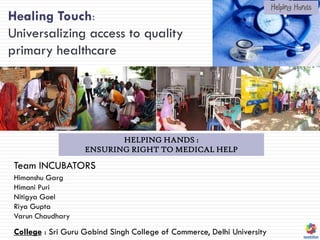
Healing Touch:
Universalizing access to quality
primary healthcare
Team INCUBATORS
Himanshu Garg
Himani Puri
Nitigya Goel
Riya Gupta
Varun Chaudhary
College : Sri Guru Gobind Singh College of Commerce, Delhi University
Helping Hands
HELPING HANDS :
ENSURING RIGHT TO MEDICAL HELP
India accounts for the largest number of maternal deaths in the world.
79% of the children between the age of 6-35 months, and more than
50% of women, are anaemic
Out of the 6,39,729 doctors registered in India, only 67,576 are in the
public sector.
Nearly 67% of the population in India do not have access to essential
medicines.
United Nations calculations show that India’s spending on public health
provision, as a share of GDP is the 18th lowest in the world.
Half of the population still relies on old methods of treatment through
daimaa instead of doctors due to high cost
And what's surprising is that
The situation is arguably getting worse faster than it's getting better.
THE PROBLEM Helping Hands
Whose data will be maintained in registry
Patients / people in
general
Hospitals/clinics Community health
workers/NGOs
Medical colleges Panchayats
What details will be maintained in the registry
• Name
• Age
• Sex
• Contact no.
• Address
• Blood group
• Health
Insurance(if any)
• Medical history
• Registered
name
• Contact
• Location
• Specialisation
• No. of beds
• Timings
• Locality
• No. of
volunteers
• Medical
expertise of
volunteers
• On going
programmes
• Contact details
• Locality
• Specialisation
• No of interns
• Field trips
• Contact
details
• Name of
the village
• Population
of village
How to get registered
• Online through Government web site created specifically for
this purpose
• Via telephones (to reach extreme rural areas of the country)
We will create a Registry
containing Centralised database maintained by the Government
After registration a unique ID will be assigned to every individual for future reference
Proposed Solution Helping Hands
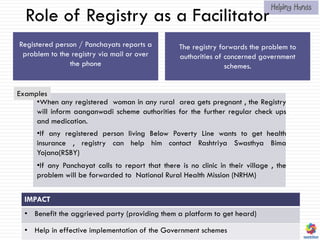
Registered person / Panchayats reports a
problem to the registry via mail or over
the phone
The registry forwards the problem to
authorities of concerned government
schemes.
•When any registered woman in any rural area gets pregnant , the Registry
will inform aanganwadi scheme authorities for the further regular check ups
and medication.
•If any registered person living Below Poverty Line wants to get health
insurance , registry can help him contact Rashtriya Swasthya Bima
Yojana(RSBY)
•If any Panchayat calls to report that there is no clinic in their village , the
problem will be forwarded to National Rural Health Mission (NRHM)
Examples
IMPACT
• Benefit the aggrieved party (providing them a platform to get heard)
• Help in effective implementation of the Government schemes
Helping Hands
Role of Registry as a Facilitator
Helping Hands
Ensuring availability and affordability
of medicines.
 Generic medicines will be supplied to the registered Panchayats and/or
community health workers on credit.
 These medicines will then be made available to the poor after consultancy from
nearest clinics/mobile apps(discussed later).
 Panchayats will sell these medicines at reasonable prices.
 Stock of medicines will be Reimbursed at the end of every month after collecting
the proceeds of previous month’s sale .
 The database will be maintained and updated by the registry .
This will help inIMPACT
• Easy availability of low priced generic medicines.
• Since medicines are supplied on credit, no financial burden on Panchayats as the
payments will be made only after receiving proceeds from patients.
• Medical aid will be within financial reach of every individual
Doctors Forum
IMPACT
• Inexperienced doctors/Dai ammas will get relevant specialised solutions.
• Medical expertise will reach every corner of the country even in remote areas.
• Nationwide Access to medical research and studies.
Development
of an Online
Portal
• The IT team will
develop online forum
just like Yahoo
answers to provide a
platform for rural and
urban area doctors to
interact
Posting/asking
a query
• Any registered doctor
can post a medical
query regarding a
particular patient or
science in general on the
forum
Posting the
solutions
• Experienced doctors
with knowledge in
particular field will
then post answers to
the query.
For extreme rural areas, doctors can call the registry to get the problem updated on forum
and the solution to the problem will be communicated to them through a phone call.
Helping Hands
M-Health
Mobile phone based systems will be developed in order to improve health
surveillance, facilitate referrals and improve overall care.
Application Area Examples
Education & Awareness Disease prevention, health promotion
Point-of-Care Support & Diagnostics Support in diagnostics and clinical care
Disease & Epidemic Outbreak Surveillance Real-time tracking of cases of infectious
diseases
PROJECT AIM APPROACH
Integrated Disease
Surveillance and Response
(eIDSR) system
To improve containment and
eventual prevention of
disease outbreaks
Immediate notification alerts
for pandemic prone diseases
such as dysentery, chicken pox,
rabies and measles in their
area as they arise.
One of the systems that can be developed
Application areas in which M-health can be introduced
With doctor patient ratio as low as 1:1700 in some areas, mobile services will help in extension of
primary health care services.
Helping Hands
Top Management
Department/Policy
makers
Information
Technology
department
Website development
team
(team of 15
professionals)
Mobile app
development team
(team of 15
professionals )
Communication/Call
center
(1 centres per state
working 24*7)
Pharmaceuticals
(Generic medicines)
department
Procurement team
(team of 3 managers
at central level for
policy framework)
Sales and Distribution
team
(team of 5 managers
at central level for
policy framework
4 supervisors managing 5 teams of 5
members each per state
Estimated funding required for 1st year when only 3 states are targeted(MARKET TESTING)
Technological
cost
(IT hardware and
Personnel)
Logistics cost
(state and regional teams of
pharmaceutical dept. )
Communication/call
centres
(hardware and personnel)
Total
(expenses
for 1st year)
Up to 1 crore • Supervisors 20 lakhs per state=60 lakhs
• Teams 10 lakh per team = 1.5 crores
• Total Aprox 2 crores
Call centres max 1 crore
For 3 states total 3 crores 5 crores
(Aprox)
Helping Hands
Organizational Structure needed for
implementation
Execution Timeline
Focused
development in
MP, UP, Bihar-
being the most
underdevelope
d states.
The
benefits of
registry
extended
to whole of
east India
The range of
registry will
extend to
North India
and east India
completely
with opening
of centralized
call centers.
The services
will have
covered more
than 75% of
the country by
now , including
whole of west
India
Whole of India will
be covered and
connected through
various call centers
and the accurate
database will be
maintained.
More than 5 lakhs
villages will be
served
YEAR 1
YEAR 10
YEAR 5
YEAR 4
YEAR 2
Within 10 years of incorporation the registry will
cover whole of India ensuring right to medical
care to over at least 60 crores Indians across both
rural and urban Areas
After recruitments and departmentalisation,
Promotion will be done for the registry through
social media like News channels, Radio and in
Government hospitals and registration process
will begin.
Helping Hands
Networking
• 3,14,000 primary health centers.
• 47,300 hospitals
• 408 Medical colleges
• 60,00,000 people in India and
• Panchayats all across the country
will be brought together
Availability and
affordability of
medicines
• Medicines will be made available in more than 6lac villages.
• Awareness about low priced Generic Medicines at levels
never expected before
Other
advantages
• Creation of Job opportunities (in call centers and IT team)
• Innovative approach using modern techniques like mobile
apps and internet
• Improving skills of doctors in rural areas(through doctor
forums) at negligible costs
• Acts as a complementary scheme to the existing models
IMPACT / Benefits to society
Helping Hands
Potential Challenges Preventive Measures
Inefficiency may creep because of several
levels of bureaucracy.
• Establishing proper authority -
responsibility relationships.
• Conducting timely performance appraisal
Problem of implementation and data main-
enhance due to large scale
(case in point - Adhaar cards)
• Using high security devices
• Maintenance by highly professional IT
technicians.
Indifferent approach of people due lack of
awareness of its advantages.
• Communicating benefits through News
channels, Radios etc.
• Awareness campaigns can be organised
(if need be)
Unavailability of generic medicine retailers. • Inclusion of Panchayats in distribution
network to ensure availability
• Sale of generic medicines in hospitals
may be started
Difficulty in implementation of M-Health
programmes due to lack of internet
connectivity
• Designing offline mobile apps
Helping Hands
Appendix
 HEALTH CARE IN INDIA - VISION 2020 Prospectus by R. Srinivisan
 National Family Health Survey (NFHS) Reports by NRHM
 Supportive Supervision of Frontline Workers and Service Providers:
Consultation Report by UNICEF
 Healthcare in India : Emerging market report 2007 by
PricewaterhouseCoopers
 Annual Report – Ministry of health and Family Welfare
 High level expert group report on universal health coverage for India
 Economic survey 2012
 Census of India
 World bank data bank
References
Helping Hands

INCUBATORS

  • 1.
    Healing Touch: Universalizing accessto quality primary healthcare Team INCUBATORS Himanshu Garg Himani Puri Nitigya Goel Riya Gupta Varun Chaudhary College : Sri Guru Gobind Singh College of Commerce, Delhi University Helping Hands HELPING HANDS : ENSURING RIGHT TO MEDICAL HELP
  • 2.
    India accounts forthe largest number of maternal deaths in the world. 79% of the children between the age of 6-35 months, and more than 50% of women, are anaemic Out of the 6,39,729 doctors registered in India, only 67,576 are in the public sector. Nearly 67% of the population in India do not have access to essential medicines. United Nations calculations show that India’s spending on public health provision, as a share of GDP is the 18th lowest in the world. Half of the population still relies on old methods of treatment through daimaa instead of doctors due to high cost And what's surprising is that The situation is arguably getting worse faster than it's getting better. THE PROBLEM Helping Hands
  • 3.
    Whose data willbe maintained in registry Patients / people in general Hospitals/clinics Community health workers/NGOs Medical colleges Panchayats What details will be maintained in the registry • Name • Age • Sex • Contact no. • Address • Blood group • Health Insurance(if any) • Medical history • Registered name • Contact • Location • Specialisation • No. of beds • Timings • Locality • No. of volunteers • Medical expertise of volunteers • On going programmes • Contact details • Locality • Specialisation • No of interns • Field trips • Contact details • Name of the village • Population of village How to get registered • Online through Government web site created specifically for this purpose • Via telephones (to reach extreme rural areas of the country) We will create a Registry containing Centralised database maintained by the Government After registration a unique ID will be assigned to every individual for future reference Proposed Solution Helping Hands
  • 4.
    Registered person /Panchayats reports a problem to the registry via mail or over the phone The registry forwards the problem to authorities of concerned government schemes. •When any registered woman in any rural area gets pregnant , the Registry will inform aanganwadi scheme authorities for the further regular check ups and medication. •If any registered person living Below Poverty Line wants to get health insurance , registry can help him contact Rashtriya Swasthya Bima Yojana(RSBY) •If any Panchayat calls to report that there is no clinic in their village , the problem will be forwarded to National Rural Health Mission (NRHM) Examples IMPACT • Benefit the aggrieved party (providing them a platform to get heard) • Help in effective implementation of the Government schemes Helping Hands Role of Registry as a Facilitator
  • 5.
    Helping Hands Ensuring availabilityand affordability of medicines.  Generic medicines will be supplied to the registered Panchayats and/or community health workers on credit.  These medicines will then be made available to the poor after consultancy from nearest clinics/mobile apps(discussed later).  Panchayats will sell these medicines at reasonable prices.  Stock of medicines will be Reimbursed at the end of every month after collecting the proceeds of previous month’s sale .  The database will be maintained and updated by the registry . This will help inIMPACT • Easy availability of low priced generic medicines. • Since medicines are supplied on credit, no financial burden on Panchayats as the payments will be made only after receiving proceeds from patients. • Medical aid will be within financial reach of every individual
  • 6.
    Doctors Forum IMPACT • Inexperienceddoctors/Dai ammas will get relevant specialised solutions. • Medical expertise will reach every corner of the country even in remote areas. • Nationwide Access to medical research and studies. Development of an Online Portal • The IT team will develop online forum just like Yahoo answers to provide a platform for rural and urban area doctors to interact Posting/asking a query • Any registered doctor can post a medical query regarding a particular patient or science in general on the forum Posting the solutions • Experienced doctors with knowledge in particular field will then post answers to the query. For extreme rural areas, doctors can call the registry to get the problem updated on forum and the solution to the problem will be communicated to them through a phone call. Helping Hands
  • 7.
    M-Health Mobile phone basedsystems will be developed in order to improve health surveillance, facilitate referrals and improve overall care. Application Area Examples Education & Awareness Disease prevention, health promotion Point-of-Care Support & Diagnostics Support in diagnostics and clinical care Disease & Epidemic Outbreak Surveillance Real-time tracking of cases of infectious diseases PROJECT AIM APPROACH Integrated Disease Surveillance and Response (eIDSR) system To improve containment and eventual prevention of disease outbreaks Immediate notification alerts for pandemic prone diseases such as dysentery, chicken pox, rabies and measles in their area as they arise. One of the systems that can be developed Application areas in which M-health can be introduced With doctor patient ratio as low as 1:1700 in some areas, mobile services will help in extension of primary health care services. Helping Hands
  • 8.
    Top Management Department/Policy makers Information Technology department Website development team (teamof 15 professionals) Mobile app development team (team of 15 professionals ) Communication/Call center (1 centres per state working 24*7) Pharmaceuticals (Generic medicines) department Procurement team (team of 3 managers at central level for policy framework) Sales and Distribution team (team of 5 managers at central level for policy framework 4 supervisors managing 5 teams of 5 members each per state Estimated funding required for 1st year when only 3 states are targeted(MARKET TESTING) Technological cost (IT hardware and Personnel) Logistics cost (state and regional teams of pharmaceutical dept. ) Communication/call centres (hardware and personnel) Total (expenses for 1st year) Up to 1 crore • Supervisors 20 lakhs per state=60 lakhs • Teams 10 lakh per team = 1.5 crores • Total Aprox 2 crores Call centres max 1 crore For 3 states total 3 crores 5 crores (Aprox) Helping Hands Organizational Structure needed for implementation
  • 9.
    Execution Timeline Focused development in MP,UP, Bihar- being the most underdevelope d states. The benefits of registry extended to whole of east India The range of registry will extend to North India and east India completely with opening of centralized call centers. The services will have covered more than 75% of the country by now , including whole of west India Whole of India will be covered and connected through various call centers and the accurate database will be maintained. More than 5 lakhs villages will be served YEAR 1 YEAR 10 YEAR 5 YEAR 4 YEAR 2 Within 10 years of incorporation the registry will cover whole of India ensuring right to medical care to over at least 60 crores Indians across both rural and urban Areas After recruitments and departmentalisation, Promotion will be done for the registry through social media like News channels, Radio and in Government hospitals and registration process will begin. Helping Hands
  • 10.
    Networking • 3,14,000 primaryhealth centers. • 47,300 hospitals • 408 Medical colleges • 60,00,000 people in India and • Panchayats all across the country will be brought together Availability and affordability of medicines • Medicines will be made available in more than 6lac villages. • Awareness about low priced Generic Medicines at levels never expected before Other advantages • Creation of Job opportunities (in call centers and IT team) • Innovative approach using modern techniques like mobile apps and internet • Improving skills of doctors in rural areas(through doctor forums) at negligible costs • Acts as a complementary scheme to the existing models IMPACT / Benefits to society Helping Hands
  • 11.
    Potential Challenges PreventiveMeasures Inefficiency may creep because of several levels of bureaucracy. • Establishing proper authority - responsibility relationships. • Conducting timely performance appraisal Problem of implementation and data main- enhance due to large scale (case in point - Adhaar cards) • Using high security devices • Maintenance by highly professional IT technicians. Indifferent approach of people due lack of awareness of its advantages. • Communicating benefits through News channels, Radios etc. • Awareness campaigns can be organised (if need be) Unavailability of generic medicine retailers. • Inclusion of Panchayats in distribution network to ensure availability • Sale of generic medicines in hospitals may be started Difficulty in implementation of M-Health programmes due to lack of internet connectivity • Designing offline mobile apps Helping Hands
  • 12.
    Appendix  HEALTH CAREIN INDIA - VISION 2020 Prospectus by R. Srinivisan  National Family Health Survey (NFHS) Reports by NRHM  Supportive Supervision of Frontline Workers and Service Providers: Consultation Report by UNICEF  Healthcare in India : Emerging market report 2007 by PricewaterhouseCoopers  Annual Report – Ministry of health and Family Welfare  High level expert group report on universal health coverage for India  Economic survey 2012  Census of India  World bank data bank References Helping Hands