“The Incredible Years
    Parent, programmes:
background and lessons from
           Wales”

       Professor Judy Hutchings
   Centre for Evidence Based Early
    Intervention, Bangor University


                                      1
Essential components of effective parent
                   programmes
   Specific factors (the social learning theory that
    underpins effective child management)

   Common factors (relationship and counselling
    skills that respect parents goals and views and
    seek to help them find solutions)

   Access issues for challenged families
    addressed, transport, meals, creche, time to
    build a relationship with them

                                                    2
Key specific components of effective parenting
 interventions
- new parenting skills must be modelled and rehearsed

- (non-violent) sanctions for negative behaviour and
   relationship building, praise and rewards
-

- home-based practice or ‘homework’
- parenting programmes should emphasise principles rather
  than prescribe techniques
-   must address difficulties in adult relationships or other
    family problems

- interventions work best when delivered early
                                                            33
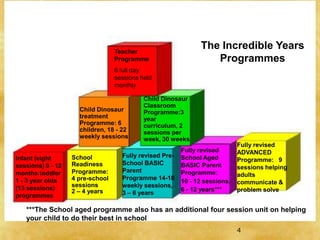
Teacher
                                                               The Incredible Years
                                  Programme                       Programmes
                                  6 full day
                                  sessions held
                                  monthly

                                            Child Dinosaur
                                            Classroom
                     Child Dinosaur         Programme:3
                     treatment              year
                     Programme: 6           curriculum, 2
                     children, 18 - 22      sessions per
                     weekly sessions        week, 30 weeks
                                                                             Fully revised
                                                         Fully revised       ADVANCED
Infant (eight      School           Fully revised Pre-   School Aged         Programme: 9
sessions) 0 - 12   Readiness        School BASIC         BASIC Parent        sessions helping
months toddler     Programme:       Parent               Programme:          adults
1 - 3 year olds    4 pre-school     Programme 14-18
                                                         10 - 12 sessions,   communicate &
(13 sessions)      sessions         weekly sessions,
                   2 – 4 years                           6 - 12 years***     problem solve
programmes                          3 – 6 years

   ***The School aged programme also has an additional four session unit on helping
   your child to do their best in school
                                                                             4
IY Parent Child and Teacher programmes
• Over thirty years of research with high standards
  of evidence and long term follow-up
• Effective as clinical and preventive programmes
• Identified in every systematic review and by the
  US Office of Juvenile Justice and Delinquency
  Prevention as a model “Blueprint” programme for
  violence prevention.
•
• Parenting programme is one of only two
  programmes identified by NICE as effective for the
  treatment of conduct disorder
• Replication of parent programme in
  Canada, Wales, England, Norway, Portugal, Ireland
  , teacher programme in Jamaica and Wales
• Parent programme is equally effective with
  caucasian, african, asian and spanish americans
• Research underway in
  Seattle, Wales, England, Ireland, Norway, Denmark
  , Portugal, Jamaica, etc.,
What does it mean to be a Blueprint for
        Violence Prevention
• US OJJDP funded the Center for Violence
  Prevention, University of Colorado, to identify
  programmes with real evidence for prevention or
  reduction of violence, they needed:
• RCT evidence
• Independent replication
• Long term follow-up
• Replication in service settings
• Tools for fidelity
• Only 11 of the 900 reviewed were identified as
  “Blueprints for Violence Prevention”, 6
                                        including IY
                                                   6
                                                   6
IY tools for effective replication:
• Books and manuals for leaders/therapists
• Standardised training for leaders/therapists
• Supervision/consultation for therapists
• Materials for parents/participants
• An effective accreditation/fidelity assessment
  process (to ensure that people are receiving
  the evidence based programme in the
  evidence based way)
• All essential components from parenting
  research                                     7
Development of the IY
      programmes in the UK
 Mainly parent programme established
 Researched in Oxford (targeted) London
  (CAMHS and universal),Wales and
  Birmingham (targeted early intervention)
 Fourteen mentors approved to deliver local
  training across UK, three trainers
 Westminster Government funded training
  activity through the Pathfinder Early
  Intervention and Family Intervention Projects
                                              8
Wales
 Population 3 million, majority in Sth Wales
 Economically poor, loss of coal and steel
  industries in Welsh Valley communities in
  South Wales
 200,000 children live in poverty* (1/3rd of all
  children aged 0 - 16)
 Significantly lower incomes than England or
  Scotland
 Highest unemployment levels among UK
  countries and rising
*poverty defined as income after housing costs below 60% of the median
income’ for families. This equates to £78/child and £86/adult per week
Child and Family policy
       developments in Wales
 IY parent programme used since 1999
 Early Welsh Sure Start (2000) like England
  funded without direction re: programmes
 2005 Welsh Government (WG) Parenting
  Action Plan for Wales and based on results
  from my Sure Start RCT, WG approved
  funding for IY parent leader training for all 22
  Authorities across Wales
 WG funded leader training since 2006 now in
  the seventh year of funding training, materials
  etc. for IY parenting work across Wales
                                              10
How we developed the strategy
 Annual conferences in North and South
  Wales with research and practice focus
 Publications, annual newsletters and
  academic articles
 Wales wide surveys of leaders and
  programme dissemination
 Responses to Welsh Government policy
  papers on health, education, poverty, etc
 Research programme extended and
  Research Centre created
 Annual reports to Welsh Government
 Managers workshops developed on
  evaluation and fidelity
 Evidence to WG Children and Young
  People’s Committee reviewing the
  Parenting Action Plan
 Contribution to NICE, Westminster
  Government strategy, referenced twice
  in Hansard
 International recognition of the work in
  Wales in Ireland, Portugal, Australia,
  Poland, Denmark, Czech Republic etc.
Things we did
 The leader surveys to identify problems
 Developed workshops for managers on
  evaluation and fidelity
 Obtained further funding to evaluate
  other IY programmes
 Developed a 25 year strategy
 Supported infrastructure development -
  mentor support in three Authorities,
  peer coaches in six Authorities
Welsh Government
        developments
 Monitored the results of our research
 Continued funding parent leader training
 Translated IY parent and teacher books
  into Welsh
 Developed Flying Start (FS) programme
 Commissioned review of suitable
  parenting programmes (IY included)
 Funded research on IY toddler
  programme in FS areas across Wales 14
Other activities
 Developed workshops for managers on
  evaluation and fidelity
 Obtained further funding to evaluate
  other IY programmes
 Developed a 25 year strategy
 Continued to research the programmes
Parenting Programme:
 research completed
 •Welsh Sure Start study: short- and long-term
   outcomes, outcomes for children at risk of
  adhd, mediators and moderators of change,
   maternal depression outcomes, key group
               leader behaviours
 •Pathfinder project: parenting 8 – 13 year olds
                   outcomes
   •Toddler Programme: 1 – 2 yos, outcomes
     •Nursery Staff Programme: outcomes
            •Foster Carer: outcomes
Current Studies
• Assessing whether toddler programme
attendance increases parental language use

• IY School Readiness Programme for parents of
children as they enrol in school delivered by
school staff to build the home-school link
• IY Baby Programme for parents and babies
during their first year of life delivered by health
care staff
Thank you
For further information please visit
        our research website
  www.incredible-years-wales-
       research.bangor.ac.uk
                 or
                Email
    j.hutchings@bangor.ac.uk

Incredible Years

  • 1.
    “The Incredible Years Parent, programmes: background and lessons from Wales” Professor Judy Hutchings Centre for Evidence Based Early Intervention, Bangor University 1
  • 2.
    Essential components ofeffective parent programmes  Specific factors (the social learning theory that underpins effective child management)  Common factors (relationship and counselling skills that respect parents goals and views and seek to help them find solutions)  Access issues for challenged families addressed, transport, meals, creche, time to build a relationship with them 2
  • 3.
    Key specific componentsof effective parenting interventions - new parenting skills must be modelled and rehearsed - (non-violent) sanctions for negative behaviour and relationship building, praise and rewards - - home-based practice or ‘homework’ - parenting programmes should emphasise principles rather than prescribe techniques - must address difficulties in adult relationships or other family problems - interventions work best when delivered early 33
  • 4.
    Teacher The Incredible Years Programme Programmes 6 full day sessions held monthly Child Dinosaur Classroom Child Dinosaur Programme:3 treatment year Programme: 6 curriculum, 2 children, 18 - 22 sessions per weekly sessions week, 30 weeks Fully revised Fully revised ADVANCED Infant (eight School Fully revised Pre- School Aged Programme: 9 sessions) 0 - 12 Readiness School BASIC BASIC Parent sessions helping months toddler Programme: Parent Programme: adults 1 - 3 year olds 4 pre-school Programme 14-18 10 - 12 sessions, communicate & (13 sessions) sessions weekly sessions, 2 – 4 years 6 - 12 years*** problem solve programmes 3 – 6 years ***The School aged programme also has an additional four session unit on helping your child to do their best in school 4
  • 5.
    IY Parent Childand Teacher programmes • Over thirty years of research with high standards of evidence and long term follow-up • Effective as clinical and preventive programmes • Identified in every systematic review and by the US Office of Juvenile Justice and Delinquency Prevention as a model “Blueprint” programme for violence prevention. • • Parenting programme is one of only two programmes identified by NICE as effective for the treatment of conduct disorder • Replication of parent programme in Canada, Wales, England, Norway, Portugal, Ireland , teacher programme in Jamaica and Wales • Parent programme is equally effective with caucasian, african, asian and spanish americans • Research underway in Seattle, Wales, England, Ireland, Norway, Denmark , Portugal, Jamaica, etc.,
  • 6.
    What does itmean to be a Blueprint for Violence Prevention • US OJJDP funded the Center for Violence Prevention, University of Colorado, to identify programmes with real evidence for prevention or reduction of violence, they needed: • RCT evidence • Independent replication • Long term follow-up • Replication in service settings • Tools for fidelity • Only 11 of the 900 reviewed were identified as “Blueprints for Violence Prevention”, 6 including IY 6 6
  • 7.
    IY tools foreffective replication: • Books and manuals for leaders/therapists • Standardised training for leaders/therapists • Supervision/consultation for therapists • Materials for parents/participants • An effective accreditation/fidelity assessment process (to ensure that people are receiving the evidence based programme in the evidence based way) • All essential components from parenting research 7
  • 8.
    Development of theIY programmes in the UK  Mainly parent programme established  Researched in Oxford (targeted) London (CAMHS and universal),Wales and Birmingham (targeted early intervention)  Fourteen mentors approved to deliver local training across UK, three trainers  Westminster Government funded training activity through the Pathfinder Early Intervention and Family Intervention Projects 8
  • 9.
    Wales  Population 3million, majority in Sth Wales  Economically poor, loss of coal and steel industries in Welsh Valley communities in South Wales  200,000 children live in poverty* (1/3rd of all children aged 0 - 16)  Significantly lower incomes than England or Scotland  Highest unemployment levels among UK countries and rising *poverty defined as income after housing costs below 60% of the median income’ for families. This equates to £78/child and £86/adult per week
  • 10.
    Child and Familypolicy developments in Wales  IY parent programme used since 1999  Early Welsh Sure Start (2000) like England funded without direction re: programmes  2005 Welsh Government (WG) Parenting Action Plan for Wales and based on results from my Sure Start RCT, WG approved funding for IY parent leader training for all 22 Authorities across Wales  WG funded leader training since 2006 now in the seventh year of funding training, materials etc. for IY parenting work across Wales 10
  • 11.
    How we developedthe strategy  Annual conferences in North and South Wales with research and practice focus  Publications, annual newsletters and academic articles  Wales wide surveys of leaders and programme dissemination  Responses to Welsh Government policy papers on health, education, poverty, etc  Research programme extended and Research Centre created
  • 12.
     Annual reportsto Welsh Government  Managers workshops developed on evaluation and fidelity  Evidence to WG Children and Young People’s Committee reviewing the Parenting Action Plan  Contribution to NICE, Westminster Government strategy, referenced twice in Hansard  International recognition of the work in Wales in Ireland, Portugal, Australia, Poland, Denmark, Czech Republic etc.
  • 13.
    Things we did The leader surveys to identify problems  Developed workshops for managers on evaluation and fidelity  Obtained further funding to evaluate other IY programmes  Developed a 25 year strategy  Supported infrastructure development - mentor support in three Authorities, peer coaches in six Authorities
  • 14.
    Welsh Government developments  Monitored the results of our research  Continued funding parent leader training  Translated IY parent and teacher books into Welsh  Developed Flying Start (FS) programme  Commissioned review of suitable parenting programmes (IY included)  Funded research on IY toddler programme in FS areas across Wales 14
  • 15.
    Other activities  Developedworkshops for managers on evaluation and fidelity  Obtained further funding to evaluate other IY programmes  Developed a 25 year strategy  Continued to research the programmes
  • 16.
    Parenting Programme: researchcompleted •Welsh Sure Start study: short- and long-term outcomes, outcomes for children at risk of adhd, mediators and moderators of change, maternal depression outcomes, key group leader behaviours •Pathfinder project: parenting 8 – 13 year olds outcomes •Toddler Programme: 1 – 2 yos, outcomes •Nursery Staff Programme: outcomes •Foster Carer: outcomes
  • 17.
    Current Studies • Assessingwhether toddler programme attendance increases parental language use • IY School Readiness Programme for parents of children as they enrol in school delivered by school staff to build the home-school link • IY Baby Programme for parents and babies during their first year of life delivered by health care staff
  • 18.
    Thank you For furtherinformation please visit our research website www.incredible-years-wales- research.bangor.ac.uk or Email j.hutchings@bangor.ac.uk