





HANDLING COMPLEXITY
M A R C E L B R I T S C H E Q U A L E X P E R T S
Digital Consulting, Business Analysis and Product Management Agile Software Delivery
A C A S E A N D O U T L I N E F O R L E A N I N C E P T I O N P H A S E S
L E T M E M A K E
A CASE FOR UP-FRONT ANALYSIS
AND DESIGN
ish
O R B E T T E R
A CASE FORA CASE FOR SOME UP-FRONT THINKING
M O R E P R E C I S E L Y
A CASE FORA CASE FOR LIGHTWEIGHT UP-FRONT
THINKING
P R O J E C T S U C C E S S I S B A S E D O N
SOLID
FOUNDATIONS
Being lean and agile does not mean we can compromise or ignore the
bedrock our projects are build on.
APPRECIATE THY CONTEXT
E V E N E S P E C I A L L Y I N A N A G I L E W O R L D Y O U N E E D T O
O N E K E Y C H A L L E N G E :
P R O J E C T - D O M A I N S A R E
COMPLICATED
& COMPLEX
The biggest challenge when starting something new is making
sense of the complicated or even complex world our endeavour lives
in.
T H E C H A L L E N G E I S T O
U N D E R S T A N D T H E D O M A I N
Where are we?
Where do we want to be?
How do we get there?
B U T
B E F A S T & G E T I T R I G H T
Avoid future impact of missed risks or
opportunities
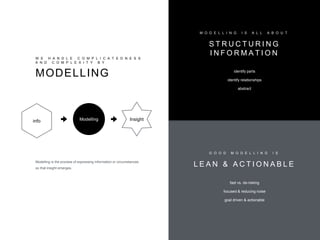
W E H A N D L E C O M P L I C A T E D N E S S
A N D C O M P L E X I T Y B Y
MODELLING
Modelling is the process of expressing information or circumstances
so that insight emerges.
info Modelling
G O O D M O D E L L I N G I S
L E A N & A C T I O N A B L E
fast vs. de-risking
focused & reducing noise
goal driven & actionable
Insight
M O D E L L I N G I S A L L A B O U T
S T R U C T U R I N G
I N F O R M A T I O N
identify parts
identify relationships
abstract
M O R E O F T E N T H A N N O T
B I G - D E S I G N -
U P F R O N T
I S T H E D E V I L
B U T M I S G U I D E D
A G I L E C A N L E A D
U S A S T R A Y
A S A N I N D U S T R Y
W E S U C K A T
A C T I O N A B L E
M O D E L L I N G
B U T W E A R E G E T T I N G B E T T E R
M O D E L L I N G
MAKE NO MISTAKE…
I T ’ S A B O U T B A L A N C E T O B U I L D
S O L I D F O N D A T I O N S
I T ’ S A B O U T F O C U S O N
P U R P O S E
T H E A P P R O P R I A T E M I N I M U M A N D T H A T J U S T I N T I M E
LAZY DOES IT
Note that my ‘lazy’ may not be your ‘lazy’.
RISK BE YOUR MEASURE
S E C U R I T I E S L E N D I N G R E P O R T I N G P L A T F O R M
INVESTMENT BANKING
G R E E N F I E L D
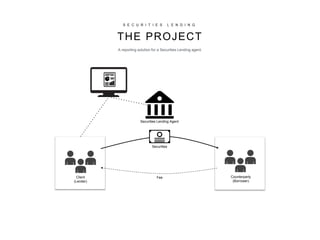
S E C U R I T I E S L E N D I N G
THE PROJECT
A reporting solution for a Securities Lending agent.
Counterparty
(Borrower)
Client
(Lender)
Securities Lending Agent
Securities
Fee
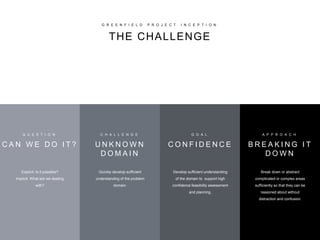
G R E E N F I E L D P R O J E C T I N C E P T I O N
THE CHALLENGE
Q U E S T I O N
C A N W E D O I T ?
Explicit: Is it possible?
Implicit: What are we dealing
with?
C H A L L E N G E
U N K N O W N
D O M A I N
Quickly develop sufficient
understanding of the problem
domain.
G O A L
C O N F I D E N C E
Develop sufficient understanding
of the domain to support high
confidence feasibility assessment
and planning.
A P P R O A C H
B R E A K I N G I T
D O W N
Break down or abstract
complicated or complex areas
sufficiently so that they can be
reasoned about without
distraction and confusion.
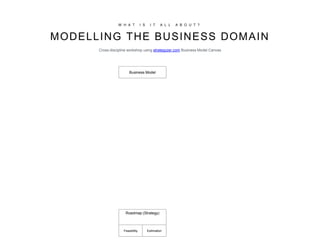
Business Model
Roadmap (Strategy)
Feasibility Estimation
W H A T I S I T A L L A B O U T ?
MODELLING THE BUSINESS DOMAIN
Cross-discipline workshop using strategyzer.com Business Model Canvas
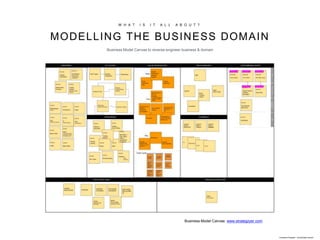
W H A T I S I T A L L A B O U T ?
MODELLING THE BUSINESS DOMAIN
Business Model Canvas to reverse-engineer business & domain
Business Model Canvas: www.strategzyer.com
Indicative Example - not factually correct
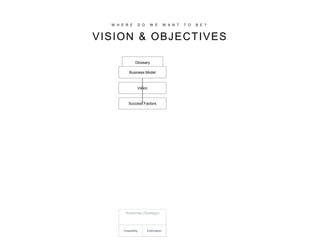
Glossary
W H E R E D O W E W A N T T O B E ?
VISION & OBJECTIVES
Success Factors
Vision
Business Model
Roadmap (Strategy)
Feasibility Estimation
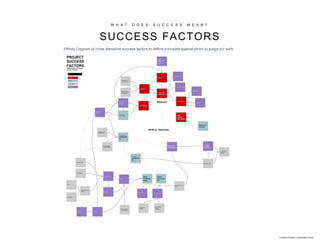
Affinity Diagram of cross-discipline success factors to define principles against which to judge our work
W H A T D O E S S U C C E S S M E A N ?
SUCCESS FACTORS
Indicative Example - not factually correct
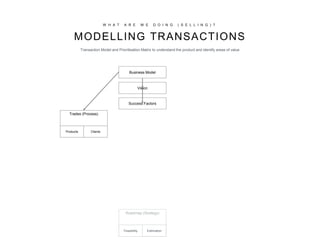
W H A T A R E W E D O I N G ( S E L L I N G ) ?
MODELLING TRANSACTIONS
Trades (Process)
Products Clients
Success Factors
Vision
Business Model
Roadmap (Strategy)
Feasibility Estimation
Transaction Model and Prioritisation Matrix to understand the product and identify areas of value
Counterparty
(Borrower)
Client
(Lender)
Securities Lending Agent
Securities
Collateral
Fee
££
£
£
1
2
3
4
56
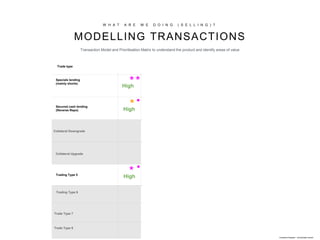
MODELLING TRANSACTIONS
W H A T A R E W E D O I N G ( S E L L I N G ) ?
Transaction Model and Prioritisation Matrix to understand the product and identify areas of value
Indicative Example - not factually correct
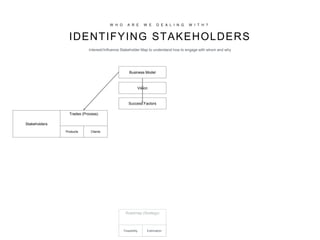
W H O A R E W E D E A L I N G W I T H ?
IDENTIFYING STAKEHOLDERS
Trades (Process)
Products Clients
Success Factors
Vision
Business Model
Stakeholders
Roadmap (Strategy)
Feasibility Estimation
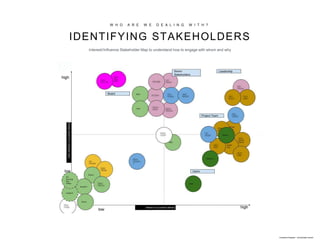
Interest//Influence Stakeholder Map to understand how to engage with whom and why
IDENTIFYING STAKEHOLDERS
Indicative Example - not factually correct
W H O A R E W E D E A L I N G W I T H ?
Interest//Influence Stakeholder Map to understand how to engage with whom and why
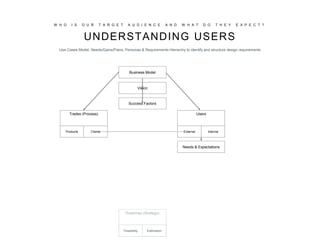
W H O I S O U R T A R G E T A U D I E N C E A N D W H A T D O T H E Y E X P E C T ?
Users
External Internal
Trades (Process)
Products Clients
Needs & Expectations
Success Factors
Vision
Business Model
Roadmap (Strategy)
Feasibility Estimation
UNDERSTANDING USERS
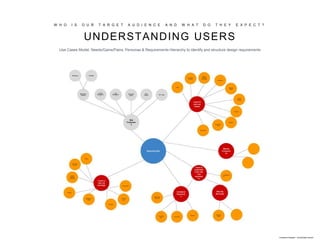
Use Cases Model, Needs/Gains/Pains, Personas & Requirements Hierarchy to identify and structure design requirements
Indicative Example - not factually correct
W H O I S O U R T A R G E T A U D I E N C E A N D W H A T D O T H E Y E X P E C T ?
UNDERSTANDING USERS
Use Cases Model, Needs/Gains/Pains, Personas & Requirements Hierarchy to identify and structure design requirements
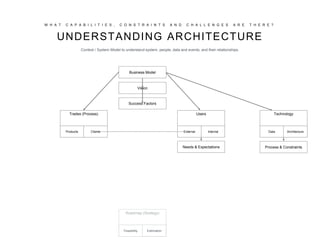
W H A T C A P A B I L I T I E S , C O N S T R A I N T S A N D C H A L L E N G E S A R E T H E R E ?
UNDERSTANDING ARCHITECTURE
Users
External Internal
Trades (Process)
Products Clients
Needs & Expectations
Success Factors
Vision
Business Model
Technology
Data Architecture
Process & Constraints
Roadmap (Strategy)
Feasibility Estimation
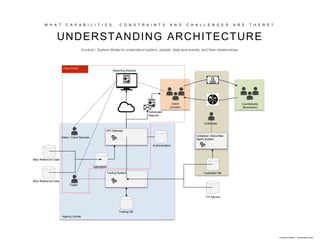
Context / System Model to understand system, people, data and events, and their relationships.
API Gateway
Trading System
Aggregator
Trading DB
Custodian DB
FX Service
Custodian
Sales / Client Services
Trader
Misc Reference Data
Counterparty
(Borrowers)
Client
(Lender)
Authentication
Scheduled
Reports
Reporting Website
Agency Lender
Project Domain
Collateral / Securities
Mgmt System
Misc Reference Data
Indicative Example - not factually correct
W H A T C A P A B I L I T I E S , C O N S T R A I N T S A N D C H A L L E N G E S A R E T H E R E ?
UNDERSTANDING ARCHITECTURE
Context / System Model to understand system, people, data and events, and their relationships.
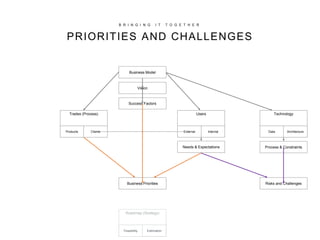
B R I N G I N G I T T O G E T H E R
PRIORITIES AND CHALLENGES
Users
External Internal
Trades (Process)
Products Clients
Needs & Expectations
Business Priorities
Success Factors
Vision
Business Model
Technology
Data Architecture
Process & Constraints
Risks and Challenges
Roadmap (Strategy)
Feasibility Estimation
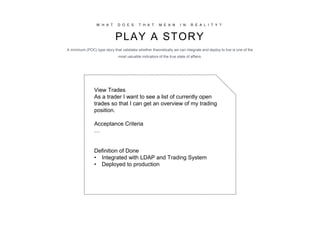
W H A T D O E S T H A T M E A N I N R E A L I T Y ?
PLAY A STORY
A minimum (POC) type story that validates whether theoretically we can integrate and deploy to live is one of the
most valuable indicators of the true state of affairs.
View Trades
As a trader I want to see a list of currently open
trades so that I can get an overview of my trading
position.
Acceptance Criteria
…
Definition of Done
• Integrated with LDAP and Trading System
• Deployed to production
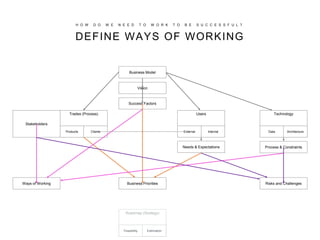
H O W D O W E N E E D T O W O R K T O B E S U C C E S S F U L ?
DEFINE WAYS OF WORKING
Users
External Internal
Trades (Process)
Products Clients
Needs & Expectations
Business Priorities
Success Factors
Vision
Business Model
Ways of Working
Stakeholders
Technology
Data Architecture
Process & Constraints
Risks and Challenges
Roadmap (Strategy)
Feasibility Estimation
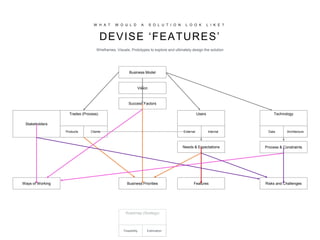
W H A T W O U L D A S O L U T I O N L O O K L I K E ?
Users
External Internal
Trades (Process)
Products Clients
Needs & Expectations
FeaturesBusiness Priorities
Success Factors
Vision
Business Model
Ways of Working
Stakeholders
Technology
Data Architecture
Process & Constraints
Risks and Challenges
Roadmap (Strategy)
Feasibility Estimation
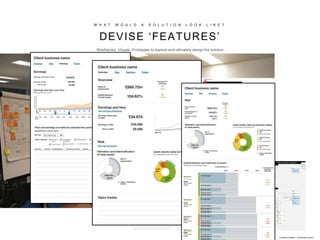
DEVISE ‘FEATURES’
Wireframes, Visuals, Prototypes to explore and ultimately design the solution
Indicative Example - not factually correct
W H A T W O U L D A S O L U T I O N L O O K L I K E ?
DEVISE ‘FEATURES’
Wireframes, Visuals, Prototypes to explore and ultimately design the solution
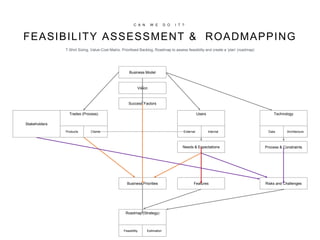
T-Shirt Sizing, Value-Cost Matrix, Prioritised Backlog, Roadmap to assess feasibility and create a ‘plan’ (roadmap)
Users
External Internal
Trades (Process)
Products Clients
Needs & Expectations
FeaturesBusiness Priorities
Success Factors
Vision
Business Model
Stakeholders
Technology
Data Architecture
Process & Constraints
Risks and Challenges
Roadmap (Strategy)
Feasibility Estimation
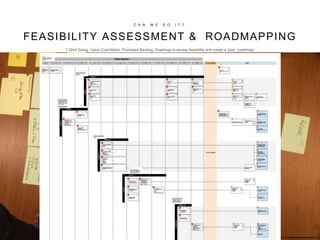
C A N W E D O I T ?
FEASIBILITY ASSESSMENT & ROADMAPPING
Indicative Example - not factually correct
C A N W E D O I T ?
FEASIBILITY ASSESSMENT & ROADMAPPING
T-Shirt Sizing, Value-Cost Matrix, Prioritised Backlog, Roadmap to assess feasibility and create a ‘plan’ (roadmap)
Indicative Example - not factually corr
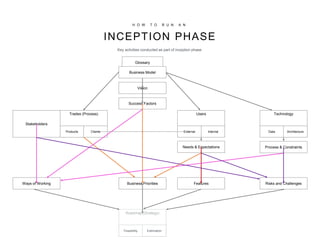
H O W T O R U N A N
INCEPTION PHASE
Key activities conducted as part of inception phase.
Glossary
Users
External Internal
Trades (Process)
Products Clients
Needs & Expectations
FeaturesBusiness Priorities
Success Factors
Vision
Business Model
Ways of Working
Stakeholders
Technology
Data Architecture
Process & Constraints
Risks and Challenges
Roadmap (Strategy)
Feasibility Estimation
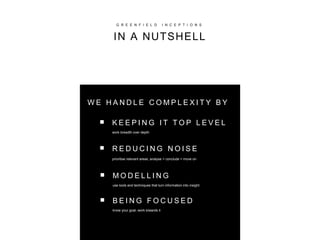
G R E E N F I E L D I N C E P T I O N S
IN A NUTSHELL
■
■
K E E P I N G I T T O P L E V E L
work breadth over depth
R E D U C I N G N O I S E
prioritise relevant areas, analyse > conclude > move on
W E H A N D L E C O M P L E X I T Y B Y
M O D E L L I N G
use tools and techniques that turn information into insight
■
B E I N G F O C U S E D
know your goal, work towards it
■
R E T A I L S U P P L Y C H A I N T O O L I N G
RETAIL
B R O O K F I E L D
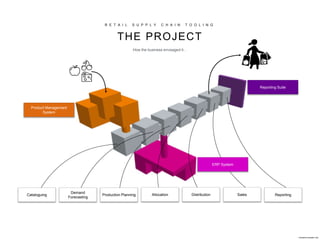
R E T A I L S U P P L Y C H A I N T O O L I N G
THE PROJECT
How the business envisaged it…
Cataloguing
Demand
Forecasting
Production Planning Allocation Distribution Sales Reporting
Product Management
System
ERP System
Reporting Suite
Indicative example only
R E T A I L S U P P L Y C H A I N T O O L I N G
THE PROJECT
What it morphed into…
Indicative example only
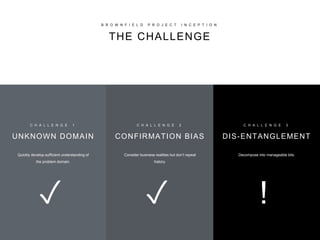
B R O W N F I E L D P R O J E C T I N C E P T I O N
THE CHALLENGE
C H A L L E N G E 1
UNKNOWN DOMAIN
Quickly develop sufficient understanding of
the problem domain.
✓
C H A L L E N G E 2
CONFIRMATION BIAS
Consider business realities but don’t repeat
history.
✓
C H A L L E N G E 3
DIS-ENTANGLEMENT
Decompose into manageable bits.
!
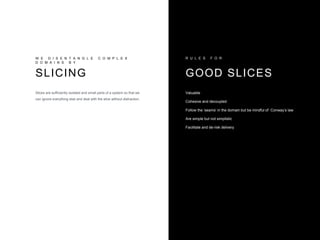
W E D I S E N T A N G L E C O M P L E X
D O M A I N S B Y
SLICING
Slices are sufficiently isolated and small parts of a system so that we
can ignore everything else and deal with the slice without distraction.
Valuable
Cohesive and decoupled
Follow the ‘seams’ in the domain but be mindful of Conway’s law
Are simple but not simplistic
Facilitate and de-risk delivery
R U L E S F O R
GOOD SLICES
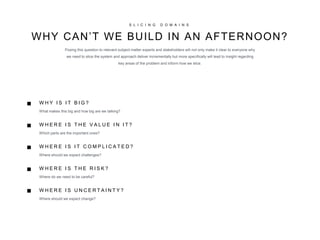
S L I C I N G D O M A I N S
WHY CAN’T WE BUILD IN AN AFTERNOON?
Posing this question to relevant subject matter experts and stakeholders will not only make it clear to everyone why
we need to slice the system and approach deliver incrementally but more specifically will lead to insight regarding
key areas of the problem and inform how we slice.
W H E R E I S U N C E R T A I N T Y ?
Where should we expect change?
■
■
■
W H E R E I S T H E R I S K ?
Where do we need to be careful?
■
W H Y I S I T B I G ?
What makes this big and how big are we talking?
W H E R E I S T H E V A L U E I N I T ?
Which parts are the important ones?
W H E R E I S I T C O M P L I C A T E D ?
Where should we expect challenges?
■
S L I C I N G D O M A I N S
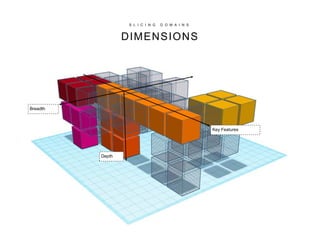
DIMENSIONS
Key Features
Breadth
Depth
S L I C I N G D O M A I N S
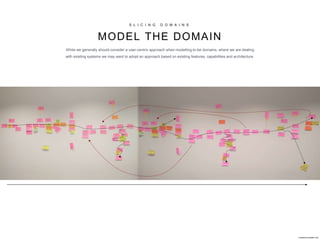
MODEL THE DOMAIN
While we generally should consider a user-centric approach when modelling to-be domains, where we are dealing
with existing systems we may want to adopt an approach based on existing features, capabilities and architecture.
Indicative example only
S L I C I N G D O M A I N S
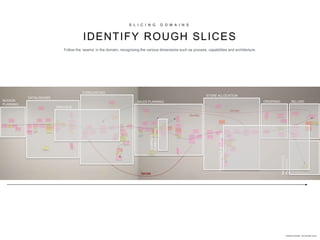
IDENTIFY ROUGH SLICES
Iterate
Iterate
Iterate
CATALOGUING
FORECASTING
STORE ALLOCATION
ORDERINGSEASON
PLANNING
SALES PLANNING SELLING
MARKDOWN
PLANNING
Indicative Example - not factually correct
Follow the ‘seams’ in the domain, recognising the various dimensions such as process, capabilities and architecture.
‘SPECIALS’
COMPLEX
FORECASTING
‘ESSENTIALS’SOURCING
S L I C I N G D O M A I N S
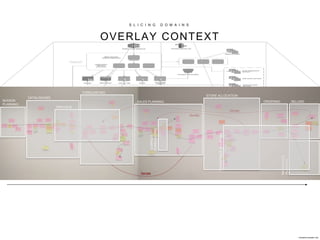
OVERLAY CONTEXT
Indicative example only
Iterate
Iterate
Iterate
CATALOGUING
FORECASTING
STORE ALLOCATION
ORDERINGSEASON
PLANNING
SALES PLANNING SELLING
MARKDOWN
PLANNING
‘SPECIALS’
COMPLEX
FORECASTING
‘ESSENTIALS’SOURCING
S L I C I N G D O M A I N S
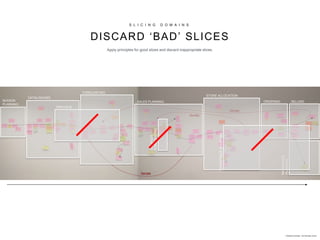
DISCARD ‘BAD’ SLICES
Indicative Example - not factually correct
Apply principles for good slices and discard inappropriate slices.
Iterate
Iterate
Iterate
CATALOGUING
FORECASTING
STORE ALLOCATION
ORDERINGSEASON
PLANNING
SALES PLANNING SELLING
MARKDOWN
PLANNING
‘SPECIALS’
COMPLEX
FORECASTING
‘ESSENTIALS’SOURCING
S L I C I N G D O M A I N S
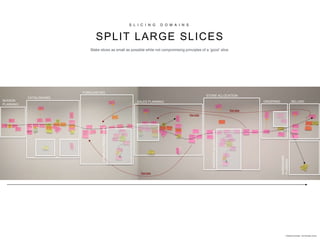
SPLIT LARGE SLICES
Iterate
Iterate
Iterate
CATALOGUING
FORECASTING
STORE ALLOCATION
ORDERINGSEASON
PLANNING
SALES PLANNING SELLING
MARKDOWN
PLANNING
COMPLEXPREDICTION
WEIGHTEDALLOCATION
Indicative Example - not factually correct
Make slices as small as possible while not compromising principles of a ‘good’ slice.
S L I C I N G D O M A I N S
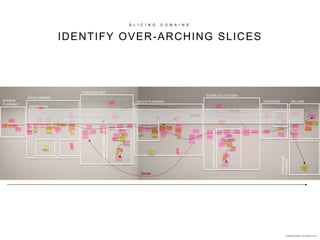
IDENTIFY OVER-ARCHING SLICES
Iterate
Iterate
Iterate
CATALOGUING
FORECASTING
STORE ALLOCATION
ORDERINGSEASON
PLANNING
SALES PLANNING SELLING
MARKDOWN
PLANNING
COMPLEXPREDICTION
WEIGHTEDALLOCATION
Indicative Example - not factually correct
REPORTING
RECONCILLIATION
Iterate
Iterate
Iterate
CATALOGUING
FORECASTING
STORE ALLOCATION
ORDERINGSEASON
PLANNING
SALES PLANNING SELLING
MARKDOWN
PLANNING
COMPLEXPREDICTION
WEIGHTEDALLOCATION
Indicative Example - not factually correct
REPORTING
RECONCILLIATION
S L I C I N G D O M A I N S
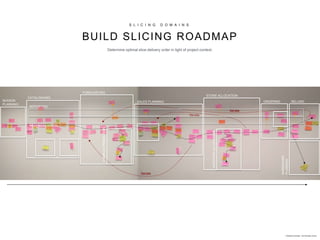
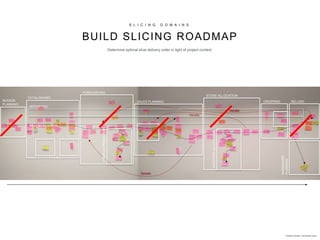
BUILD SLICING ROADMAP
Determine optimal slice-delivery order in light of project context.
S L I C I N G D O M A I N S
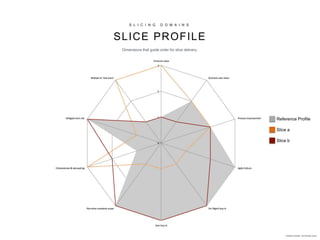
SLICE PROFILE
Indicative Example - not factually correct
Dimensions that guide order for slice delivery.
Slice a
Slice b
Reference Profile
S L I C I N G D O M A I N S
BUILD SLICING ROADMAP
Indicative Example - not factually correct
Iterate
Iterate
Iterate
CATALOGUING
FORECASTING
STORE ALLOCATION
ORDERINGSEASON
PLANNING
SALES PLANNING SELLING
MARKDOWN
PLANNING
COMPLEXPREDICTION
WEIGHTEDALLOCATION
Determine optimal slice-delivery order in light of project context.
REPORTING
RECONCILLIATION
S L I C I N G D O M A I N S
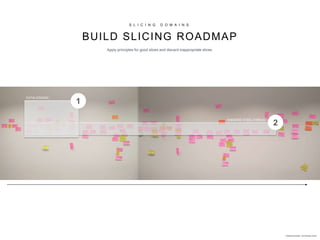
BUILD SLICING ROADMAP
2
1
Indicative Example - not factually correct
Apply principles for good slices and discard inappropriate slices.
CATALOGUING
END2END STEELTHREAD
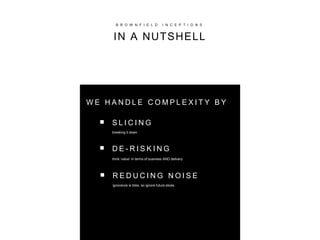
B R O W N F I E L D I N C E P T I O N S
IN A NUTSHELL
■
■
S L I C I N G
breaking it down
D E - R I S K I N G
think ‘value’ in terms of business AND delivery
W E H A N D L E C O M P L E X I T Y B Y
R E D U C I N G N O I S E
ignorance is bliss, so ignore future slices
■
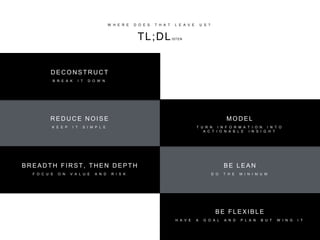
W H E R E D O E S T H A T L E A V E U S ?
TL;DLISTEN
K E E P I T S I M P L E
REDUCE NOISE
F O C U S O N V A L U E A N D R I S K
BR EAD TH FIR ST, TH EN D EPTH
D O T H E M I N I M U M
BE LEAN
T U R N I N F O R M A T I O N I N T O
A C T I O N A B L E I N S I G H T
MODEL
B R E A K I T D O W N
D EC ON STR U C T
H A V E A G O A L A N D P L A N B U T W I N G I T
BE FLEXIBLE
A N D R E A L L Y …
IF YOU ARE NOT SCARED $***LESS
AT SOME POINT YOU ARE DOING IT
WRONG
though if you are constantly scared you are doing it wrong either.
GETTING IN TOUCH
M A R C E L B R I T S C H
Contact: marcel.britsch@beautifulabstraction.com
Web: www.beautifulabstraction.com
Blog: www.thedigitalbusinessanalyst.com
E Q U A L E X P E R T S
L I C E N S E
Digital Consulting, Business Analysis and Product Management
Contact: hello@equalexperts.com
Web: www.equalexperts.com
Agile Software Delivery
This document is made available under a
Creative Commons Attribution-ShareAlike 4.0 International License
THANK YOU
M A R C E L B R I T S C H
Contact: marcel.britsch@beautifulabstraction.com
Web: www.beautifulabstraction.com
Blog: www.thedigitalbusinessanalyst.com
L I C E N S E
Digital Consulting, Business Analysis and Product Management
This document is made available under a
Creative Commons Attribution-ShareAlike 4.0 International License
N O T E
All information may have been changed in the interest of simplicity, illustration or confidentiality and may not represent the actual
state of affairs.

Inception Phases - Handling Complexity

  • 1.
    HANDLING COMPLEXITY M AR C E L B R I T S C H E Q U A L E X P E R T S Digital Consulting, Business Analysis and Product Management Agile Software Delivery A C A S E A N D O U T L I N E F O R L E A N I N C E P T I O N P H A S E S
  • 2.
    L E TM E M A K E A CASE FOR UP-FRONT ANALYSIS AND DESIGN ish
  • 3.
    O R BE T T E R A CASE FORA CASE FOR SOME UP-FRONT THINKING
  • 4.
    M O RE P R E C I S E L Y A CASE FORA CASE FOR LIGHTWEIGHT UP-FRONT THINKING
  • 5.
    P R OJ E C T S U C C E S S I S B A S E D O N SOLID FOUNDATIONS Being lean and agile does not mean we can compromise or ignore the bedrock our projects are build on. APPRECIATE THY CONTEXT E V E N E S P E C I A L L Y I N A N A G I L E W O R L D Y O U N E E D T O
  • 6.
    O N EK E Y C H A L L E N G E : P R O J E C T - D O M A I N S A R E COMPLICATED & COMPLEX The biggest challenge when starting something new is making sense of the complicated or even complex world our endeavour lives in. T H E C H A L L E N G E I S T O U N D E R S T A N D T H E D O M A I N Where are we? Where do we want to be? How do we get there? B U T B E F A S T & G E T I T R I G H T Avoid future impact of missed risks or opportunities
  • 7.
    W E HA N D L E C O M P L I C A T E D N E S S A N D C O M P L E X I T Y B Y MODELLING Modelling is the process of expressing information or circumstances so that insight emerges. info Modelling G O O D M O D E L L I N G I S L E A N & A C T I O N A B L E fast vs. de-risking focused & reducing noise goal driven & actionable Insight M O D E L L I N G I S A L L A B O U T S T R U C T U R I N G I N F O R M A T I O N identify parts identify relationships abstract
  • 8.
    M O RE O F T E N T H A N N O T B I G - D E S I G N - U P F R O N T I S T H E D E V I L B U T M I S G U I D E D A G I L E C A N L E A D U S A S T R A Y A S A N I N D U S T R Y W E S U C K A T A C T I O N A B L E M O D E L L I N G B U T W E A R E G E T T I N G B E T T E R M O D E L L I N G MAKE NO MISTAKE… I T ’ S A B O U T B A L A N C E T O B U I L D S O L I D F O N D A T I O N S I T ’ S A B O U T F O C U S O N P U R P O S E
  • 9.
    T H EA P P R O P R I A T E M I N I M U M A N D T H A T J U S T I N T I M E LAZY DOES IT Note that my ‘lazy’ may not be your ‘lazy’. RISK BE YOUR MEASURE
  • 10.
    S E CU R I T I E S L E N D I N G R E P O R T I N G P L A T F O R M INVESTMENT BANKING G R E E N F I E L D
  • 11.
    S E CU R I T I E S L E N D I N G THE PROJECT A reporting solution for a Securities Lending agent. Counterparty (Borrower) Client (Lender) Securities Lending Agent Securities Fee
  • 12.
    G R EE N F I E L D P R O J E C T I N C E P T I O N THE CHALLENGE Q U E S T I O N C A N W E D O I T ? Explicit: Is it possible? Implicit: What are we dealing with? C H A L L E N G E U N K N O W N D O M A I N Quickly develop sufficient understanding of the problem domain. G O A L C O N F I D E N C E Develop sufficient understanding of the domain to support high confidence feasibility assessment and planning. A P P R O A C H B R E A K I N G I T D O W N Break down or abstract complicated or complex areas sufficiently so that they can be reasoned about without distraction and confusion.
  • 13.
    Business Model Roadmap (Strategy) FeasibilityEstimation W H A T I S I T A L L A B O U T ? MODELLING THE BUSINESS DOMAIN Cross-discipline workshop using strategyzer.com Business Model Canvas
  • 14.
    W H AT I S I T A L L A B O U T ? MODELLING THE BUSINESS DOMAIN Business Model Canvas to reverse-engineer business & domain Business Model Canvas: www.strategzyer.com Indicative Example - not factually correct
  • 15.
    Glossary W H ER E D O W E W A N T T O B E ? VISION & OBJECTIVES Success Factors Vision Business Model Roadmap (Strategy) Feasibility Estimation
  • 16.
    Affinity Diagram ofcross-discipline success factors to define principles against which to judge our work W H A T D O E S S U C C E S S M E A N ? SUCCESS FACTORS Indicative Example - not factually correct
  • 17.
    W H AT A R E W E D O I N G ( S E L L I N G ) ? MODELLING TRANSACTIONS Trades (Process) Products Clients Success Factors Vision Business Model Roadmap (Strategy) Feasibility Estimation Transaction Model and Prioritisation Matrix to understand the product and identify areas of value
  • 18.
    Counterparty (Borrower) Client (Lender) Securities Lending Agent Securities Collateral Fee ££ £ £ 1 2 3 4 56 MODELLINGTRANSACTIONS W H A T A R E W E D O I N G ( S E L L I N G ) ? Transaction Model and Prioritisation Matrix to understand the product and identify areas of value Indicative Example - not factually correct
  • 19.
    W H OA R E W E D E A L I N G W I T H ? IDENTIFYING STAKEHOLDERS Trades (Process) Products Clients Success Factors Vision Business Model Stakeholders Roadmap (Strategy) Feasibility Estimation Interest//Influence Stakeholder Map to understand how to engage with whom and why
  • 20.
    IDENTIFYING STAKEHOLDERS Indicative Example- not factually correct W H O A R E W E D E A L I N G W I T H ? Interest//Influence Stakeholder Map to understand how to engage with whom and why
  • 21.
    W H OI S O U R T A R G E T A U D I E N C E A N D W H A T D O T H E Y E X P E C T ? Users External Internal Trades (Process) Products Clients Needs & Expectations Success Factors Vision Business Model Roadmap (Strategy) Feasibility Estimation UNDERSTANDING USERS Use Cases Model, Needs/Gains/Pains, Personas & Requirements Hierarchy to identify and structure design requirements
  • 22.
    Indicative Example -not factually correct W H O I S O U R T A R G E T A U D I E N C E A N D W H A T D O T H E Y E X P E C T ? UNDERSTANDING USERS Use Cases Model, Needs/Gains/Pains, Personas & Requirements Hierarchy to identify and structure design requirements
  • 23.
    W H AT C A P A B I L I T I E S , C O N S T R A I N T S A N D C H A L L E N G E S A R E T H E R E ? UNDERSTANDING ARCHITECTURE Users External Internal Trades (Process) Products Clients Needs & Expectations Success Factors Vision Business Model Technology Data Architecture Process & Constraints Roadmap (Strategy) Feasibility Estimation Context / System Model to understand system, people, data and events, and their relationships.
  • 24.
    API Gateway Trading System Aggregator TradingDB Custodian DB FX Service Custodian Sales / Client Services Trader Misc Reference Data Counterparty (Borrowers) Client (Lender) Authentication Scheduled Reports Reporting Website Agency Lender Project Domain Collateral / Securities Mgmt System Misc Reference Data Indicative Example - not factually correct W H A T C A P A B I L I T I E S , C O N S T R A I N T S A N D C H A L L E N G E S A R E T H E R E ? UNDERSTANDING ARCHITECTURE Context / System Model to understand system, people, data and events, and their relationships.
  • 25.
    B R IN G I N G I T T O G E T H E R PRIORITIES AND CHALLENGES Users External Internal Trades (Process) Products Clients Needs & Expectations Business Priorities Success Factors Vision Business Model Technology Data Architecture Process & Constraints Risks and Challenges Roadmap (Strategy) Feasibility Estimation
  • 26.
    W H AT D O E S T H A T M E A N I N R E A L I T Y ? PLAY A STORY A minimum (POC) type story that validates whether theoretically we can integrate and deploy to live is one of the most valuable indicators of the true state of affairs. View Trades As a trader I want to see a list of currently open trades so that I can get an overview of my trading position. Acceptance Criteria … Definition of Done • Integrated with LDAP and Trading System • Deployed to production
  • 27.
    H O WD O W E N E E D T O W O R K T O B E S U C C E S S F U L ? DEFINE WAYS OF WORKING Users External Internal Trades (Process) Products Clients Needs & Expectations Business Priorities Success Factors Vision Business Model Ways of Working Stakeholders Technology Data Architecture Process & Constraints Risks and Challenges Roadmap (Strategy) Feasibility Estimation
  • 28.
    W H AT W O U L D A S O L U T I O N L O O K L I K E ? Users External Internal Trades (Process) Products Clients Needs & Expectations FeaturesBusiness Priorities Success Factors Vision Business Model Ways of Working Stakeholders Technology Data Architecture Process & Constraints Risks and Challenges Roadmap (Strategy) Feasibility Estimation DEVISE ‘FEATURES’ Wireframes, Visuals, Prototypes to explore and ultimately design the solution
  • 29.
    Indicative Example -not factually correct W H A T W O U L D A S O L U T I O N L O O K L I K E ? DEVISE ‘FEATURES’ Wireframes, Visuals, Prototypes to explore and ultimately design the solution
  • 30.
    T-Shirt Sizing, Value-CostMatrix, Prioritised Backlog, Roadmap to assess feasibility and create a ‘plan’ (roadmap) Users External Internal Trades (Process) Products Clients Needs & Expectations FeaturesBusiness Priorities Success Factors Vision Business Model Stakeholders Technology Data Architecture Process & Constraints Risks and Challenges Roadmap (Strategy) Feasibility Estimation C A N W E D O I T ? FEASIBILITY ASSESSMENT & ROADMAPPING
  • 31.
    Indicative Example -not factually correct C A N W E D O I T ? FEASIBILITY ASSESSMENT & ROADMAPPING T-Shirt Sizing, Value-Cost Matrix, Prioritised Backlog, Roadmap to assess feasibility and create a ‘plan’ (roadmap) Indicative Example - not factually corr
  • 32.
    H O WT O R U N A N INCEPTION PHASE Key activities conducted as part of inception phase. Glossary Users External Internal Trades (Process) Products Clients Needs & Expectations FeaturesBusiness Priorities Success Factors Vision Business Model Ways of Working Stakeholders Technology Data Architecture Process & Constraints Risks and Challenges Roadmap (Strategy) Feasibility Estimation
  • 33.
    G R EE N F I E L D I N C E P T I O N S IN A NUTSHELL ■ ■ K E E P I N G I T T O P L E V E L work breadth over depth R E D U C I N G N O I S E prioritise relevant areas, analyse > conclude > move on W E H A N D L E C O M P L E X I T Y B Y M O D E L L I N G use tools and techniques that turn information into insight ■ B E I N G F O C U S E D know your goal, work towards it ■
  • 34.
    R E TA I L S U P P L Y C H A I N T O O L I N G RETAIL B R O O K F I E L D
  • 35.
    R E TA I L S U P P L Y C H A I N T O O L I N G THE PROJECT How the business envisaged it… Cataloguing Demand Forecasting Production Planning Allocation Distribution Sales Reporting Product Management System ERP System Reporting Suite Indicative example only
  • 36.
    R E TA I L S U P P L Y C H A I N T O O L I N G THE PROJECT What it morphed into… Indicative example only
  • 37.
    B R OW N F I E L D P R O J E C T I N C E P T I O N THE CHALLENGE C H A L L E N G E 1 UNKNOWN DOMAIN Quickly develop sufficient understanding of the problem domain. ✓ C H A L L E N G E 2 CONFIRMATION BIAS Consider business realities but don’t repeat history. ✓ C H A L L E N G E 3 DIS-ENTANGLEMENT Decompose into manageable bits. !
  • 38.
    W E DI S E N T A N G L E C O M P L E X D O M A I N S B Y SLICING Slices are sufficiently isolated and small parts of a system so that we can ignore everything else and deal with the slice without distraction. Valuable Cohesive and decoupled Follow the ‘seams’ in the domain but be mindful of Conway’s law Are simple but not simplistic Facilitate and de-risk delivery R U L E S F O R GOOD SLICES
  • 39.
    S L IC I N G D O M A I N S WHY CAN’T WE BUILD IN AN AFTERNOON? Posing this question to relevant subject matter experts and stakeholders will not only make it clear to everyone why we need to slice the system and approach deliver incrementally but more specifically will lead to insight regarding key areas of the problem and inform how we slice. W H E R E I S U N C E R T A I N T Y ? Where should we expect change? ■ ■ ■ W H E R E I S T H E R I S K ? Where do we need to be careful? ■ W H Y I S I T B I G ? What makes this big and how big are we talking? W H E R E I S T H E V A L U E I N I T ? Which parts are the important ones? W H E R E I S I T C O M P L I C A T E D ? Where should we expect challenges? ■
  • 40.
    S L IC I N G D O M A I N S DIMENSIONS Key Features Breadth Depth
  • 41.
    S L IC I N G D O M A I N S MODEL THE DOMAIN While we generally should consider a user-centric approach when modelling to-be domains, where we are dealing with existing systems we may want to adopt an approach based on existing features, capabilities and architecture. Indicative example only
  • 42.
    S L IC I N G D O M A I N S IDENTIFY ROUGH SLICES Iterate Iterate Iterate CATALOGUING FORECASTING STORE ALLOCATION ORDERINGSEASON PLANNING SALES PLANNING SELLING MARKDOWN PLANNING Indicative Example - not factually correct Follow the ‘seams’ in the domain, recognising the various dimensions such as process, capabilities and architecture. ‘SPECIALS’ COMPLEX FORECASTING ‘ESSENTIALS’SOURCING
  • 43.
    S L IC I N G D O M A I N S OVERLAY CONTEXT Indicative example only Iterate Iterate Iterate CATALOGUING FORECASTING STORE ALLOCATION ORDERINGSEASON PLANNING SALES PLANNING SELLING MARKDOWN PLANNING ‘SPECIALS’ COMPLEX FORECASTING ‘ESSENTIALS’SOURCING
  • 44.
    S L IC I N G D O M A I N S DISCARD ‘BAD’ SLICES Indicative Example - not factually correct Apply principles for good slices and discard inappropriate slices. Iterate Iterate Iterate CATALOGUING FORECASTING STORE ALLOCATION ORDERINGSEASON PLANNING SALES PLANNING SELLING MARKDOWN PLANNING ‘SPECIALS’ COMPLEX FORECASTING ‘ESSENTIALS’SOURCING
  • 45.
    S L IC I N G D O M A I N S SPLIT LARGE SLICES Iterate Iterate Iterate CATALOGUING FORECASTING STORE ALLOCATION ORDERINGSEASON PLANNING SALES PLANNING SELLING MARKDOWN PLANNING COMPLEXPREDICTION WEIGHTEDALLOCATION Indicative Example - not factually correct Make slices as small as possible while not compromising principles of a ‘good’ slice.
  • 46.
    S L IC I N G D O M A I N S IDENTIFY OVER-ARCHING SLICES Iterate Iterate Iterate CATALOGUING FORECASTING STORE ALLOCATION ORDERINGSEASON PLANNING SALES PLANNING SELLING MARKDOWN PLANNING COMPLEXPREDICTION WEIGHTEDALLOCATION Indicative Example - not factually correct REPORTING RECONCILLIATION
  • 47.
    Iterate Iterate Iterate CATALOGUING FORECASTING STORE ALLOCATION ORDERINGSEASON PLANNING SALES PLANNINGSELLING MARKDOWN PLANNING COMPLEXPREDICTION WEIGHTEDALLOCATION Indicative Example - not factually correct REPORTING RECONCILLIATION S L I C I N G D O M A I N S BUILD SLICING ROADMAP Determine optimal slice-delivery order in light of project context.
  • 48.
    S L IC I N G D O M A I N S SLICE PROFILE Indicative Example - not factually correct Dimensions that guide order for slice delivery. Slice a Slice b Reference Profile
  • 49.
    S L IC I N G D O M A I N S BUILD SLICING ROADMAP Indicative Example - not factually correct Iterate Iterate Iterate CATALOGUING FORECASTING STORE ALLOCATION ORDERINGSEASON PLANNING SALES PLANNING SELLING MARKDOWN PLANNING COMPLEXPREDICTION WEIGHTEDALLOCATION Determine optimal slice-delivery order in light of project context. REPORTING RECONCILLIATION
  • 50.
    S L IC I N G D O M A I N S BUILD SLICING ROADMAP 2 1 Indicative Example - not factually correct Apply principles for good slices and discard inappropriate slices. CATALOGUING END2END STEELTHREAD
  • 51.
    B R OW N F I E L D I N C E P T I O N S IN A NUTSHELL ■ ■ S L I C I N G breaking it down D E - R I S K I N G think ‘value’ in terms of business AND delivery W E H A N D L E C O M P L E X I T Y B Y R E D U C I N G N O I S E ignorance is bliss, so ignore future slices ■
  • 52.
    W H ER E D O E S T H A T L E A V E U S ? TL;DLISTEN K E E P I T S I M P L E REDUCE NOISE F O C U S O N V A L U E A N D R I S K BR EAD TH FIR ST, TH EN D EPTH D O T H E M I N I M U M BE LEAN T U R N I N F O R M A T I O N I N T O A C T I O N A B L E I N S I G H T MODEL B R E A K I T D O W N D EC ON STR U C T H A V E A G O A L A N D P L A N B U T W I N G I T BE FLEXIBLE
  • 53.
    A N DR E A L L Y … IF YOU ARE NOT SCARED $***LESS AT SOME POINT YOU ARE DOING IT WRONG though if you are constantly scared you are doing it wrong either.
  • 54.
    GETTING IN TOUCH MA R C E L B R I T S C H Contact: marcel.britsch@beautifulabstraction.com Web: www.beautifulabstraction.com Blog: www.thedigitalbusinessanalyst.com E Q U A L E X P E R T S L I C E N S E Digital Consulting, Business Analysis and Product Management Contact: hello@equalexperts.com Web: www.equalexperts.com Agile Software Delivery This document is made available under a Creative Commons Attribution-ShareAlike 4.0 International License THANK YOU
  • 55.
    M A RC E L B R I T S C H Contact: marcel.britsch@beautifulabstraction.com Web: www.beautifulabstraction.com Blog: www.thedigitalbusinessanalyst.com L I C E N S E Digital Consulting, Business Analysis and Product Management This document is made available under a Creative Commons Attribution-ShareAlike 4.0 International License N O T E All information may have been changed in the interest of simplicity, illustration or confidentiality and may not represent the actual state of affairs.