Incentivizing and aligning Sustainability
Programs through Benchmarking
2020 IFA Global Stewardship Conference
New York, 5 February 2020
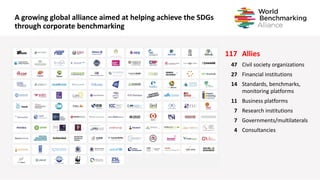
A growing global alliance aimed at helping achieve the SDGs
through corporate benchmarking
117 Allies
47 Civil society organizations
27 Financial institutions
14 Standards, benchmarks,
monitoring platforms
11 Business platforms
7 Research institutions
7 Governments/multilaterals
4 Consultancies
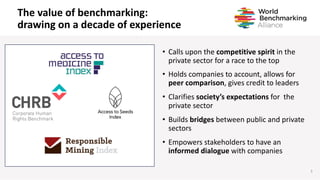
• Calls upon the competitive spirit in the
private sector for a race to the top
• Holds companies to account, allows for
peer comparison, gives credit to leaders
• Clarifies society’s expectations for the
private sector
• Builds bridges between public and private
sectors
• Empowers stakeholders to have an
informed dialogue with companies
The value of benchmarking:
drawing on a decade of experience
3
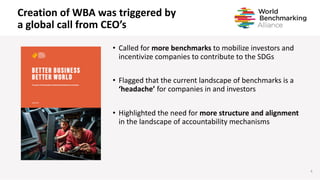
Creation of WBA was triggered by
a global call from CEO’s
4
• Called for more benchmarks to mobilize investors and
incentivize companies to contribute to the SDGs
• Flagged that the current landscape of benchmarks is a
‘headache’ for companies in and investors
• Highlighted the need for more structure and alignment
in the landscape of accountability mechanisms
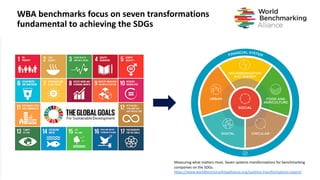
WBA benchmarks focus on seven transformations
fundamental to achieving the SDGs
Measuring what matters most. Seven systems transformations for benchmarking
companies on the SDGs.
https://www.worldbenchmarkingalliance.org/systems-transformations-report/
6
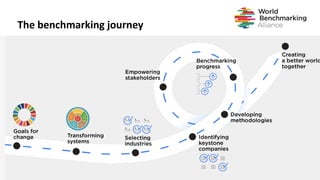
The benchmarking journey
WBA launched the SDG2000 in Davos: the 2000
companies most influential for achieving the SDGs
SDG 2000
• 2000 unique companies
• $43 trillion in revenues
• 74 countries
• 36 industry groups
Food & Agriculture 350
• 350 companies across the value chain
• 12 primary fertilizers companies
• 20+ other with fertilizers in their portfolios
Fertilizer companies in SDG2000
1. CF Industries
2. EuroChem
3. Indian Farmers Fertiliser Cooperative (IFFCO)
4. Israel Chemicals
5. K&S
6. Mosaic
7. Muragappa Group (Coromandel)
8. Nutrien
9. OCP
10. PhosAgro
11. Wengfu Group
12. Yara
https://sdg2000.worldbenchmarkingalliance.org
8
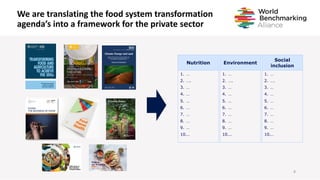
We are translating the food system transformation
agenda’s into a framework for the private sector
Nutrition Environment
Social
inclusion
1. …
2. ….
3. …
4. …
5. …
6. …
7. …
8. …
9. …
10.…
1. …
2. ….
3. …
4. …
5. …
6. …
7. …
8. …
9. …
10...
1. …
2. ….
3. …
4. …
5. …
6. …
7. …
8. …
9. …
10...
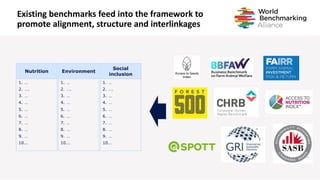
Existing benchmarks feed into the framework to
promote alignment, structure and interlinkages
Nutrition Environment
Social
inclusion
1. …
2. ….
3. …
4. …
5. …
6. …
7. …
8. …
9. …
10.…
1. …
2. ….
3. …
4. …
5. …
6. …
7. …
8. …
9. …
10...
1. …
2. ….
3. …
4. …
5. …
6. …
7. …
8. …
9. …
10...
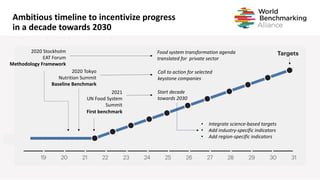
Ambitious timeline to incentivize progress
in a decade towards 2030
19 20 21 22 23 24 25 26 27 28 29 30 31
Baseline
Prep time
1,5 years
Targets
19 20 21 22 23 24 25 26 27 28 29 30 31
Baseline
Prep time
1,5 years
Targets
19 20 21 22 23 24 25 26 27 28 29 30 31
Baseline
Prep time
1,5 years
Targets
19 20 21 22 2
Prep time
1,5 years
19 20 21 22 23 24 25 2
Baseline
Prep time
1,5 years
19 20 21 22 23 24 25 26 27 28 29 3
Baseline
Prep time
1,5 years
Targets
2020 Tokyo
Nutrition Summit
Baseline Benchmark
2021
UN Food System
Summit
First benchmark
19 20 21 22 23 24 25 26 27 28 29 30 31
Baseline
Prep time
1,5 years
Targets
19 20 21 22 23 24 25 26 27 28 29 30 31
Baseline
Prep time
1,5 years
Targets
Start decade
towards 2030
Call to action for selected
keystone companies
2020 Stockholm
EAT Forum
Methodology Framework
Food system transformation agenda
translated for private sector
• Integrate science-based targets
• Add industry-specific indicators
• Add region-specific indicators

Incentivizing and aligning Sustainability Programs through Benchmarking

  • 1.
    Incentivizing and aligningSustainability Programs through Benchmarking 2020 IFA Global Stewardship Conference New York, 5 February 2020
  • 2.
    A growing globalalliance aimed at helping achieve the SDGs through corporate benchmarking 117 Allies 47 Civil society organizations 27 Financial institutions 14 Standards, benchmarks, monitoring platforms 11 Business platforms 7 Research institutions 7 Governments/multilaterals 4 Consultancies
  • 3.
    • Calls uponthe competitive spirit in the private sector for a race to the top • Holds companies to account, allows for peer comparison, gives credit to leaders • Clarifies society’s expectations for the private sector • Builds bridges between public and private sectors • Empowers stakeholders to have an informed dialogue with companies The value of benchmarking: drawing on a decade of experience 3
  • 4.
    Creation of WBAwas triggered by a global call from CEO’s 4 • Called for more benchmarks to mobilize investors and incentivize companies to contribute to the SDGs • Flagged that the current landscape of benchmarks is a ‘headache’ for companies in and investors • Highlighted the need for more structure and alignment in the landscape of accountability mechanisms
  • 5.
    WBA benchmarks focuson seven transformations fundamental to achieving the SDGs Measuring what matters most. Seven systems transformations for benchmarking companies on the SDGs. https://www.worldbenchmarkingalliance.org/systems-transformations-report/
  • 6.
  • 7.
    WBA launched theSDG2000 in Davos: the 2000 companies most influential for achieving the SDGs SDG 2000 • 2000 unique companies • $43 trillion in revenues • 74 countries • 36 industry groups Food & Agriculture 350 • 350 companies across the value chain • 12 primary fertilizers companies • 20+ other with fertilizers in their portfolios Fertilizer companies in SDG2000 1. CF Industries 2. EuroChem 3. Indian Farmers Fertiliser Cooperative (IFFCO) 4. Israel Chemicals 5. K&S 6. Mosaic 7. Muragappa Group (Coromandel) 8. Nutrien 9. OCP 10. PhosAgro 11. Wengfu Group 12. Yara https://sdg2000.worldbenchmarkingalliance.org
  • 8.
    8 We are translatingthe food system transformation agenda’s into a framework for the private sector Nutrition Environment Social inclusion 1. … 2. …. 3. … 4. … 5. … 6. … 7. … 8. … 9. … 10.… 1. … 2. …. 3. … 4. … 5. … 6. … 7. … 8. … 9. … 10... 1. … 2. …. 3. … 4. … 5. … 6. … 7. … 8. … 9. … 10...
  • 9.
    Existing benchmarks feedinto the framework to promote alignment, structure and interlinkages Nutrition Environment Social inclusion 1. … 2. …. 3. … 4. … 5. … 6. … 7. … 8. … 9. … 10.… 1. … 2. …. 3. … 4. … 5. … 6. … 7. … 8. … 9. … 10... 1. … 2. …. 3. … 4. … 5. … 6. … 7. … 8. … 9. … 10...
  • 10.
    Ambitious timeline toincentivize progress in a decade towards 2030 19 20 21 22 23 24 25 26 27 28 29 30 31 Baseline Prep time 1,5 years Targets 19 20 21 22 23 24 25 26 27 28 29 30 31 Baseline Prep time 1,5 years Targets 19 20 21 22 23 24 25 26 27 28 29 30 31 Baseline Prep time 1,5 years Targets 19 20 21 22 2 Prep time 1,5 years 19 20 21 22 23 24 25 2 Baseline Prep time 1,5 years 19 20 21 22 23 24 25 26 27 28 29 3 Baseline Prep time 1,5 years Targets 2020 Tokyo Nutrition Summit Baseline Benchmark 2021 UN Food System Summit First benchmark 19 20 21 22 23 24 25 26 27 28 29 30 31 Baseline Prep time 1,5 years Targets 19 20 21 22 23 24 25 26 27 28 29 30 31 Baseline Prep time 1,5 years Targets Start decade towards 2030 Call to action for selected keystone companies 2020 Stockholm EAT Forum Methodology Framework Food system transformation agenda translated for private sector • Integrate science-based targets • Add industry-specific indicators • Add region-specific indicators