WBA Food & Agriculture Benchmark
Incentivizing food system transformation
Presentation for Aviva – 20 June 2019
A growing global alliance to incentivize business
contribution to the Sustainable Development Goals
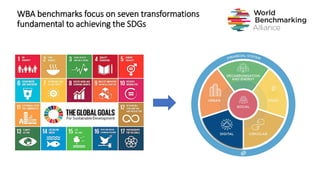
WBA benchmarks focus on seven transformations
fundamental to achieving the SDGs
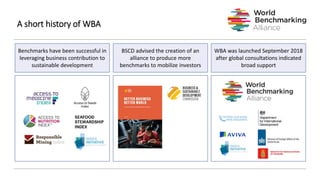
Benchmarks have been successful in
leveraging business contribution to
sustainable development
BSCD advised the creation of an
alliance to produce more
benchmarks to mobilize investors
WBA was launched September 2018
after global consultations indicated
broad support
A short history of WBA
WBA Food & Agriculture Benchmark development taps
into global initiatives on food system transformation
Agenda
Roadmaps
Targets
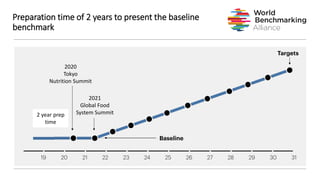
Preparation time of 2 years to present the baseline
benchmark
2020
Tokyo
Nutrition Summit
2021
Global Food
System Summit2 year prep
time
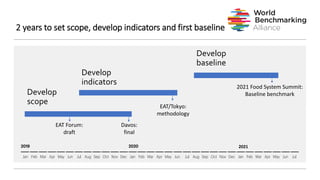
2 years to set scope, develop indicators and first baseline
2021
Develop
scope
Develop
indicators
Develop
baseline
EAT Forum:
draft
Davos:
final
EAT/Tokyo:
methodology
2021 Food System Summit:
Baseline benchmark
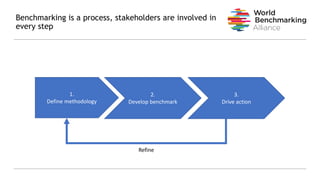
Benchmarking is a process, stakeholders are involved in
every step
1.
Define methodology
2.
Develop benchmark
3.
Drive action
Refine
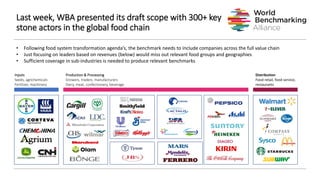
Inputs
Seeds, agrichemicals
Fertilizer, machinery
Production & Processing
Growers, traders, manufacturers
Dairy, meat, confectionery, beverage
Distribution
Food retail, food service,
restaurants
• Following food system transformation agenda’s, the benchmark needs to include companies across the full value chain
• Just focusing on leaders based on revenues (below) would miss out relevant food groups and geographies
• Sufficient coverage in sub-industries is needed to produce relevant benchmarks
Last week, WBA presented its draft scope with 300+ key
stone actors in the global food chain
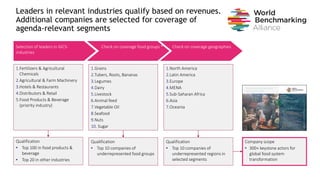
Leaders in relevant industries qualify based on revenues.
Additional companies are selected for coverage of
agenda-relevant segments
1.Fertilizers & Agricultural
Chemicals
2.Agricultural & Farm Machinery
3.Hotels & Restaurants
4.Distributors & Retail
5.Food Products & Beverage
(priority industry)
1.Grains
2.Tubers, Roots, Bananas
3.Legumes
4.Dairy
5.Livestock
6.Animal feed
7.Vegetable Oil
8.Seafood
9.Nuts
10. Sugar
1.North America
2.Latin America
3.Europe
4.MENA
5.Sub-Saharan Africa
6.Asia
7.Oceania
Qualification
• Top 100 in food products &
beverage
• Top 20 in other industries
Qualification
• Top 10 companies of
underrepresented food groups
Qualification
• Top 10 companies of
underrepresented regions in
selected segments
Selection of leaders in GICS-
industries
Check on coverage food groups * Check on coverage geographies
Company scope
• 300+ keystone actors for
global food system
transformation
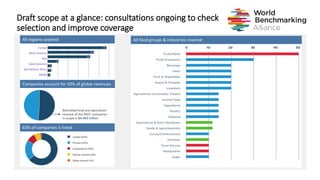
Draft scope at a glance: consultations ongoing to check
selection and improve coverage
Europe
North America
Asia
South America
Sub-Saharan Africa
MENA
All regions covered
Companies account for 50% of global revenues
63% of companies is listed
All food groups & industries covered
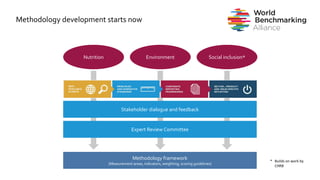
Methodology development starts now
Nutrition Environment Social inclusion*
Methodology framework
(Measurement areas, indicators, weighting, scoring guidelines)
Stakeholder dialogue and feedback
Expert Review Committee
* Builds on work by
CHRB
Consumer
Staples
3010 Food &
Staples
Retailing
301010 Food &
Staples
Retailing
30101020 Food Distributors
Distributors of food products to other companies and not directly to
the consumer.
30101030 Food Retail
Owners and operators of primarily food retail stores.
30101040 Hypermarkets & Super Centers
Owners and operators of hypermarkets and super centers selling food
and a wide-range of consumer staple products. Excludes Food and
Drug Retailers classified in the Food Retail and Drug Retail Sub-
Industries, respectively.
3020 Food,
Beverage &
Tobacco
302010 Beverages 30201010 Brewers
Producers of beer and malt liquors. Includes breweries not classified
in the Restaurants Sub-Industry.
30201020 Distillers & Vintners
Distillers, vintners and producers of alcoholic beverages not classified
in the Brewers Sub-Industry.
30201030 Soft Drinks
Producers of non-alcoholic beverages including mineral waters.
Excludes producers of milk classified in the Packaged Foods Sub-
Industry.
302020 Food
Products
30202010 Agricultural Products
Producers of agricultural products. Includes crop growers, owners of
plantations and companies that produce and process foods but do not
package and market them. Excludes companies classified in the
Forest Products Sub-Industry and those that package and market the
food products classified in the Packaged Foods Sub-Industry.
30202030 Packaged Foods & Meats
Producers of packaged foods including dairy products, fruit juices,
meats, poultry, fish and pet foods.
1.
Fertilizers & Agricultural
Chemicals
2.
Agricultural &
Farm Machinery
3.
Hotels &
Restaurants
4.
Distributors & Retail
5.
Food & Beverage
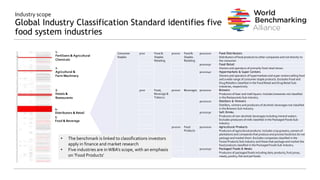
Industry scope
Global Industry Classification Standard identifies five
food system industries
• The benchmark is linked to classifications investors
apply in finance and market research
• Five industries are inWBA’s scope, with an emphasis
on ‘Food Products’
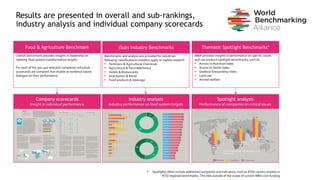
Results are presented in overall and sub-rankings,
industry analysis and individual company scorecards
Investments by global seed companies in the
Global South
Company scorecards
Insight in individual performance
Industry analysis
Industry performance on food system targets
Spotlight analysis
Performance of companies on critical issues
Overall benchmark provides insights in leadership on
meeting food system transformation targets.
For each of the 300-400 selected companies individual
scorecards are compiled that enable an evidence based
dialogue on their performance.
Benchmarks and analysis are provided for industries
following classifications investors apply in market research
• Fertilizers & Agricultural Chemicals
• Agricultural & Farm Machinery
• Hotels & Restaurants
• Distributors & Retail
• Food products & beverage
WBA provides insights in performance on specific issues
and can produce spotlight benchmarks, such as:
• Access to Nutrition Index
• Access to Seeds Index
• Seafood Stewardship Index
• Land use
• Animal welfare
Food & Agriculture Benchmark (Sub) Industry Benchmarks Thematic Spotlight Benchmarks*
* Spotlights often include additional companies and indicators, such as ATNI country studies or
ATSI regional benchmarks. This falls outside of the scope of current WBA core funding

190620 wba fab aviva intro

  • 1.
    WBA Food &Agriculture Benchmark Incentivizing food system transformation Presentation for Aviva – 20 June 2019
  • 2.
    A growing globalalliance to incentivize business contribution to the Sustainable Development Goals
  • 3.
    WBA benchmarks focuson seven transformations fundamental to achieving the SDGs
  • 4.
    Benchmarks have beensuccessful in leveraging business contribution to sustainable development BSCD advised the creation of an alliance to produce more benchmarks to mobilize investors WBA was launched September 2018 after global consultations indicated broad support A short history of WBA
  • 5.
    WBA Food &Agriculture Benchmark development taps into global initiatives on food system transformation Agenda Roadmaps Targets
  • 6.
    Preparation time of2 years to present the baseline benchmark 2020 Tokyo Nutrition Summit 2021 Global Food System Summit2 year prep time
  • 7.
    2 years toset scope, develop indicators and first baseline 2021 Develop scope Develop indicators Develop baseline EAT Forum: draft Davos: final EAT/Tokyo: methodology 2021 Food System Summit: Baseline benchmark
  • 8.
    Benchmarking is aprocess, stakeholders are involved in every step 1. Define methodology 2. Develop benchmark 3. Drive action Refine
  • 9.
    Inputs Seeds, agrichemicals Fertilizer, machinery Production& Processing Growers, traders, manufacturers Dairy, meat, confectionery, beverage Distribution Food retail, food service, restaurants • Following food system transformation agenda’s, the benchmark needs to include companies across the full value chain • Just focusing on leaders based on revenues (below) would miss out relevant food groups and geographies • Sufficient coverage in sub-industries is needed to produce relevant benchmarks Last week, WBA presented its draft scope with 300+ key stone actors in the global food chain
  • 10.
    Leaders in relevantindustries qualify based on revenues. Additional companies are selected for coverage of agenda-relevant segments 1.Fertilizers & Agricultural Chemicals 2.Agricultural & Farm Machinery 3.Hotels & Restaurants 4.Distributors & Retail 5.Food Products & Beverage (priority industry) 1.Grains 2.Tubers, Roots, Bananas 3.Legumes 4.Dairy 5.Livestock 6.Animal feed 7.Vegetable Oil 8.Seafood 9.Nuts 10. Sugar 1.North America 2.Latin America 3.Europe 4.MENA 5.Sub-Saharan Africa 6.Asia 7.Oceania Qualification • Top 100 in food products & beverage • Top 20 in other industries Qualification • Top 10 companies of underrepresented food groups Qualification • Top 10 companies of underrepresented regions in selected segments Selection of leaders in GICS- industries Check on coverage food groups * Check on coverage geographies Company scope • 300+ keystone actors for global food system transformation
  • 11.
    Draft scope ata glance: consultations ongoing to check selection and improve coverage Europe North America Asia South America Sub-Saharan Africa MENA All regions covered Companies account for 50% of global revenues 63% of companies is listed All food groups & industries covered
  • 12.
    Methodology development startsnow Nutrition Environment Social inclusion* Methodology framework (Measurement areas, indicators, weighting, scoring guidelines) Stakeholder dialogue and feedback Expert Review Committee * Builds on work by CHRB
  • 13.
    Consumer Staples 3010 Food & Staples Retailing 301010Food & Staples Retailing 30101020 Food Distributors Distributors of food products to other companies and not directly to the consumer. 30101030 Food Retail Owners and operators of primarily food retail stores. 30101040 Hypermarkets & Super Centers Owners and operators of hypermarkets and super centers selling food and a wide-range of consumer staple products. Excludes Food and Drug Retailers classified in the Food Retail and Drug Retail Sub- Industries, respectively. 3020 Food, Beverage & Tobacco 302010 Beverages 30201010 Brewers Producers of beer and malt liquors. Includes breweries not classified in the Restaurants Sub-Industry. 30201020 Distillers & Vintners Distillers, vintners and producers of alcoholic beverages not classified in the Brewers Sub-Industry. 30201030 Soft Drinks Producers of non-alcoholic beverages including mineral waters. Excludes producers of milk classified in the Packaged Foods Sub- Industry. 302020 Food Products 30202010 Agricultural Products Producers of agricultural products. Includes crop growers, owners of plantations and companies that produce and process foods but do not package and market them. Excludes companies classified in the Forest Products Sub-Industry and those that package and market the food products classified in the Packaged Foods Sub-Industry. 30202030 Packaged Foods & Meats Producers of packaged foods including dairy products, fruit juices, meats, poultry, fish and pet foods. 1. Fertilizers & Agricultural Chemicals 2. Agricultural & Farm Machinery 3. Hotels & Restaurants 4. Distributors & Retail 5. Food & Beverage Industry scope Global Industry Classification Standard identifies five food system industries • The benchmark is linked to classifications investors apply in finance and market research • Five industries are inWBA’s scope, with an emphasis on ‘Food Products’
  • 14.
    Results are presentedin overall and sub-rankings, industry analysis and individual company scorecards Investments by global seed companies in the Global South Company scorecards Insight in individual performance Industry analysis Industry performance on food system targets Spotlight analysis Performance of companies on critical issues Overall benchmark provides insights in leadership on meeting food system transformation targets. For each of the 300-400 selected companies individual scorecards are compiled that enable an evidence based dialogue on their performance. Benchmarks and analysis are provided for industries following classifications investors apply in market research • Fertilizers & Agricultural Chemicals • Agricultural & Farm Machinery • Hotels & Restaurants • Distributors & Retail • Food products & beverage WBA provides insights in performance on specific issues and can produce spotlight benchmarks, such as: • Access to Nutrition Index • Access to Seeds Index • Seafood Stewardship Index • Land use • Animal welfare Food & Agriculture Benchmark (Sub) Industry Benchmarks Thematic Spotlight Benchmarks* * Spotlights often include additional companies and indicators, such as ATNI country studies or ATSI regional benchmarks. This falls outside of the scope of current WBA core funding