WBA Food & Agriculture Benchmark
Supporting global food system transformation
through corporate benchmarking
Mumbai, 7 March 2019
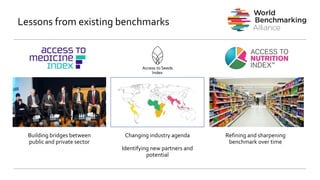
Lessons from existing benchmarks
Building bridges between
public and private sector
Changing industry agenda
Identifying new partners and
potential
Refining and sharpening
benchmark over time
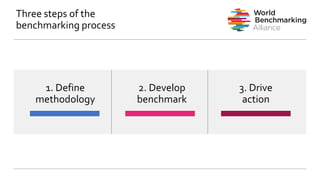
Three steps of the
benchmarking process
1. Define
methodology
2. Develop
benchmark
3. Drive
action
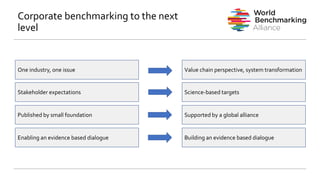
Corporate benchmarking to the next
level
Stakeholder expectations
Published by small foundation
One industry, one issue
Science-based targets
Supported by a global alliance
Value chain perspective, system transformation
Enabling an evidence based dialogue Building an evidence based dialogue
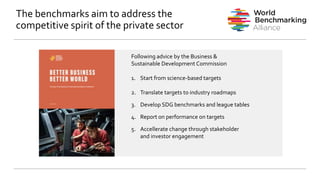
The benchmarks aim to address the
competitive spirit of the private sector
Following advice by the Business &
Sustainable Development Commission
1. Start from science-based targets
2. Translate targets to industry roadmaps
3. Develop SDG benchmarks and league tables
4. Report on performance on targets
5. Accellerate change through stakeholder
and investor engagement
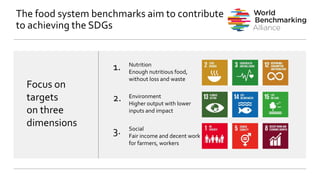
The food system benchmarks aim to contribute
to achieving the SDGs
Nutrition
Enough nutritious food,
without loss and waste
Environment
Higher output with lower
inputs and impact
Social
Fair income and decent work
for farmers, workers
Focus on
targets
on three
dimensions
1.
2.
3.
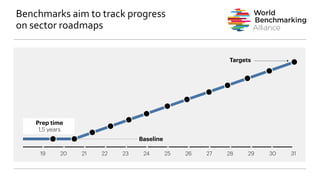
Benchmarks aim to track progress
on sector roadmaps
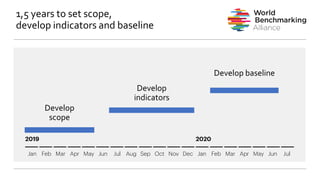
1,5 years to set scope,
develop indicators and baseline
Develop
scope
Develop
indicators
Develop baseline
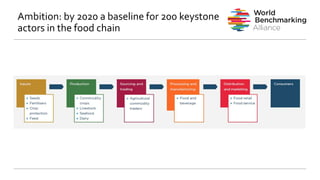
Ambition: by 2020 a baseline for 200 keystone
actors in the food chain
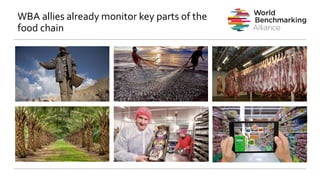
WBA allies already monitor key parts of the
food chain
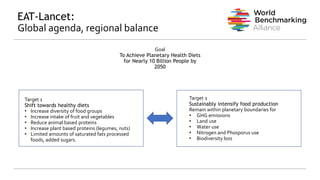
Goal
To Achieve Planetary Health Diets
for Nearly 10 Billion People by
2050
Target 1
Shift towards healthy diets
• Increase diversity of food groups
• Increase intake of fruit and vegetables
• Reduce animal based proteins
• Increase plant based proteins (legumes, nuts)
• Limited amounts of saturated fats processed
foods, added sugars.
Target 2
Sustainably intensify food production
Remain within planetary boundaries for
• GHG emissions
• Land use
• Water use
• Nitrogen and Phosporus use
• Biodiversity loss
EAT-Lancet:
Global agenda, regional balance
WBA Food & Agriculture Benchmark
Supporting global food system transformation
through corporate benchmarking
Mumbai, 7 March 2019
Group1
What are the five biggest challenges for India in moving towards
the EAT Lancet targets in the Environmental Space?’
Group2
What are the five biggest challenges for India in moving towards
the EAT Lancet targets in the Healthy Diet space?’
Group3
‘What are the five biggest challenges for India in moving towards
the EAT Lancet targets in the Social space?’
Question 1
In your groups:
• Introduce yourselves and your interest today
• Debate the question on your chart: express your own view
and encourage others to do the same, listen to difference
• Record the key themes of your conversation on the flip
chart. Ensure all points and views are recorded.
(30mins)
Group 1
How can the private sector help in tackling these challenges in
the healthy diet space?
Group 2
How can the private sector help in tackling these challenges in
the social space?
Group 3
How can the private sector help in tackling these challenges in
the environmental space?
Question 2
In your groups:
• Introduce yourselves and your interest today
• One person who was here for the discussion of the first question
run through the flipchart which summarises the discussion you had
so that everyone can build on that discussion here.
• Debate the question on your chart: express your own view and
encourage others to do the same, listen to difference
• Record the key themes of your conversation on the flip chart.
Ensure all points and views are recorded.
(30mins)
All Groups
Given the challenges that we see and the contribution
companies can make, how can WBA and its benchmark
contribute to this change?
Given that we cannot do everything or monitor all companies:
what should we focus on to create a tipping point?
Question 3
In your new table groups:
• Introduce yourselves
• Debate the 3rd question: express your own view and encourage
others to do the same, listen to difference
• Record the key themes of your conversation on the flipchart. Ensure
all points and views are recorded
• Select a spokesperson to feedback a quick summary to the large group
in the next session in here
(25 mins)

Introduction Mumbai Roundtable

  • 1.
    WBA Food &Agriculture Benchmark Supporting global food system transformation through corporate benchmarking Mumbai, 7 March 2019
  • 2.
    Lessons from existingbenchmarks Building bridges between public and private sector Changing industry agenda Identifying new partners and potential Refining and sharpening benchmark over time
  • 3.
    Three steps ofthe benchmarking process 1. Define methodology 2. Develop benchmark 3. Drive action
  • 4.
    Corporate benchmarking tothe next level Stakeholder expectations Published by small foundation One industry, one issue Science-based targets Supported by a global alliance Value chain perspective, system transformation Enabling an evidence based dialogue Building an evidence based dialogue
  • 5.
    The benchmarks aimto address the competitive spirit of the private sector Following advice by the Business & Sustainable Development Commission 1. Start from science-based targets 2. Translate targets to industry roadmaps 3. Develop SDG benchmarks and league tables 4. Report on performance on targets 5. Accellerate change through stakeholder and investor engagement
  • 6.
    The food systembenchmarks aim to contribute to achieving the SDGs Nutrition Enough nutritious food, without loss and waste Environment Higher output with lower inputs and impact Social Fair income and decent work for farmers, workers Focus on targets on three dimensions 1. 2. 3.
  • 7.
    Benchmarks aim totrack progress on sector roadmaps
  • 8.
    1,5 years toset scope, develop indicators and baseline Develop scope Develop indicators Develop baseline
  • 9.
    Ambition: by 2020a baseline for 200 keystone actors in the food chain
  • 10.
    WBA allies alreadymonitor key parts of the food chain
  • 11.
    Goal To Achieve PlanetaryHealth Diets for Nearly 10 Billion People by 2050 Target 1 Shift towards healthy diets • Increase diversity of food groups • Increase intake of fruit and vegetables • Reduce animal based proteins • Increase plant based proteins (legumes, nuts) • Limited amounts of saturated fats processed foods, added sugars. Target 2 Sustainably intensify food production Remain within planetary boundaries for • GHG emissions • Land use • Water use • Nitrogen and Phosporus use • Biodiversity loss EAT-Lancet: Global agenda, regional balance
  • 12.
    WBA Food &Agriculture Benchmark Supporting global food system transformation through corporate benchmarking Mumbai, 7 March 2019
  • 13.
    Group1 What are thefive biggest challenges for India in moving towards the EAT Lancet targets in the Environmental Space?’ Group2 What are the five biggest challenges for India in moving towards the EAT Lancet targets in the Healthy Diet space?’ Group3 ‘What are the five biggest challenges for India in moving towards the EAT Lancet targets in the Social space?’ Question 1
  • 14.
    In your groups: •Introduce yourselves and your interest today • Debate the question on your chart: express your own view and encourage others to do the same, listen to difference • Record the key themes of your conversation on the flip chart. Ensure all points and views are recorded. (30mins)
  • 15.
    Group 1 How canthe private sector help in tackling these challenges in the healthy diet space? Group 2 How can the private sector help in tackling these challenges in the social space? Group 3 How can the private sector help in tackling these challenges in the environmental space? Question 2
  • 16.
    In your groups: •Introduce yourselves and your interest today • One person who was here for the discussion of the first question run through the flipchart which summarises the discussion you had so that everyone can build on that discussion here. • Debate the question on your chart: express your own view and encourage others to do the same, listen to difference • Record the key themes of your conversation on the flip chart. Ensure all points and views are recorded. (30mins)
  • 17.
    All Groups Given thechallenges that we see and the contribution companies can make, how can WBA and its benchmark contribute to this change? Given that we cannot do everything or monitor all companies: what should we focus on to create a tipping point? Question 3
  • 18.
    In your newtable groups: • Introduce yourselves • Debate the 3rd question: express your own view and encourage others to do the same, listen to difference • Record the key themes of your conversation on the flipchart. Ensure all points and views are recorded • Select a spokesperson to feedback a quick summary to the large group in the next session in here (25 mins)