Translating Strategy into Action: Market-
based Approaches towards more
Sustainable Products
Cristian Barcan, BASF Nutrition & Health
Sarah Lewis, The Sustainability Consortium
Vidar Gundersen, BioMar Group !
3/29/2012
Translating Strategy into Action:
Market-based Approaches towards
more Sustainable Products
YOUR
BRAND
Cristian Barcan
SET – applied sustainability
BASF Nutrition & Health
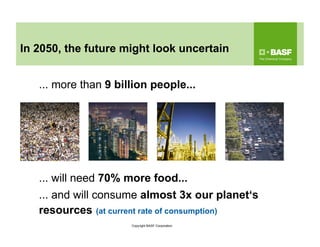
... will need 70% more food...
... more than 9 billion people...
... and will consume almost 3x our planet‘s
resources (at current rate of consumption)
In 2050, the future might look uncertain
Copyright BASF Corporation
Changes need to happen.
We need to learn to produce
more with less
(more sustainable)
3
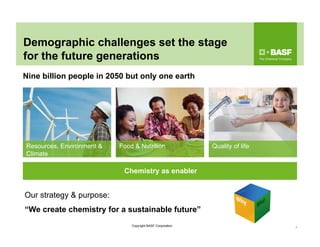
Demographic challenges set the stage
for the future generations
Nine billion people in 2050 but only one earth
Food & Nutrition Quality of life
Chemistry as enabler
Resources, Environment &
Climate
Our strategy & purpose:
“We create chemistry for a sustainable future”
4Copyright BASF Corporation
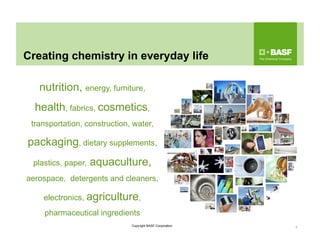
Creating chemistry in everyday life
nutrition, energy, furniture,
health, fabrics, cosmetics,
transportation, construction, water,
packaging, dietary supplements,
plastics, paper, aquaculture,
aerospace, detergents and cleaners,
electronics, agriculture,
pharmaceutical ingredients
5Copyright BASF Corporation
66
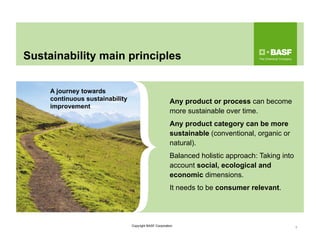
Sustainability main principles
6
A journey towards
continuous sustainability
improvement
!Any product or process can become
more sustainable over time.
!Any product category can be more
sustainable (conventional, organic or
natural).
!Balanced holistic approach: Taking into
account social, ecological and
economic dimensions.
!It needs to be consumer relevant.
Copyright BASF Corporation
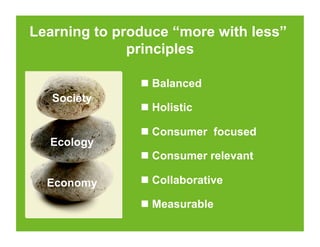
Learning to produce “more with less”
principles
Society
Ecology
Economy
!!Balanced
!!Holistic
!!Consumer focused
!!Consumer relevant
!!Collaborative
!!Measurable
8
We create chemistry
for a sustainable future
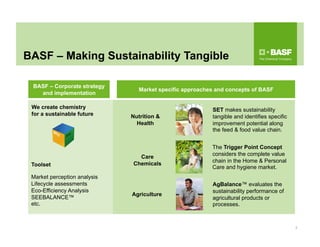
BASF – Corporate strategy
and implementation
Market specific approaches and concepts of BASF
BASF – Making Sustainability Tangible
Nutrition &
Health
Care
Chemicals
The Trigger Point Concept
considers the complete value
chain in the Home & Personal
Care and hygiene market.
SET makes sustainability
tangible and identifies specific
improvement potential along
the feed & food value chain.
Agriculture
AgBalance™ evaluates the
sustainability performance of
agricultural products or
processes.
Toolset
Market perception analysis
Lifecycle assessments
Eco-Efficiency Analysis
SEEBALANCE™
etc.
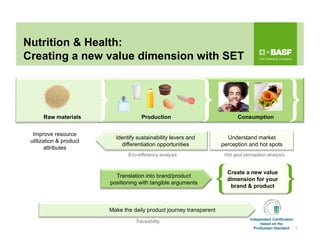
Raw materials Production Consumption
Improve resource
utilization & product
attributes
Identify sustainability levers and
differentiation opportunities
Translation into brand/product
positioning with tangible arguments
Create a new value
dimension for your
brand & product
Eco-efficiency analysis
Understand market
perception and hot spots
Hot spot perception analysis
Make the daily product journey transparent
Traceability
9
Independent Certification
based on the
ProSustain Standard
Nutrition & Health:
Creating a new value dimension with SET
www.basf.com
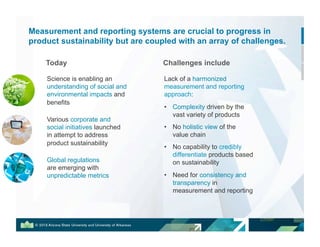
Measurement and reporting systems are crucial to progress in
product sustainability but are coupled with an array of challenges.
Challenges include
Lack of a harmonized
measurement and reporting
approach:
•! Complexity driven by the
vast variety of products
•! No holistic view of the
value chain
•! No capability to credibly
differentiate products based
on sustainability
•! Need for consistency and
transparency in
measurement and reporting
Science is enabling an
understanding of social and
environmental impacts and
benefits
Global regulations
are emerging with
unpredictable metrics
Today
Various corporate and
social initiatives launched
in attempt to address
product sustainability
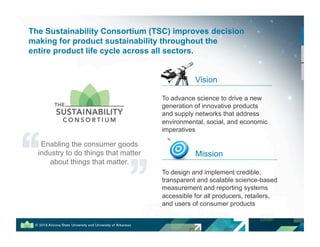
Vision
To advance science to drive a new
generation of innovative products
and supply networks that address
environmental, social, and economic
imperatives
Mission
To design and implement credible,
transparent and scalable science-based
measurement and reporting systems
accessible for all producers, retailers,
and users of consumer products
The Sustainability Consortium (TSC) improves decision
making for product sustainability throughout the
entire product life cycle across all sectors.
Enabling the consumer goods
industry to do things that matter
about things that matter.
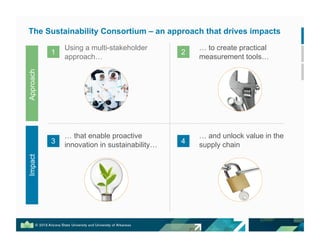
The Sustainability Consortium – an approach that drives impacts
… that enable proactive
innovation in sustainability…
Using a multi-stakeholder
approach…
… to create practical
measurement tools…
… and unlock value in the
supply chain
ApproachImpact
1 2
3 4
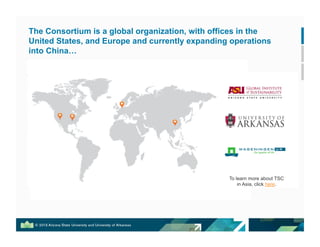
The Consortium is a global organization, with offices in the
United States, and Europe and currently expanding operations
into China…
To learn more about TSC
in Asia, click here.
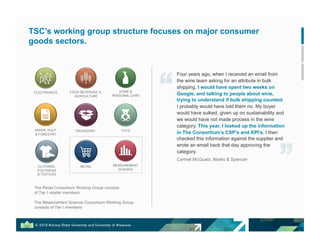
TSC’s working group structure focuses on major consumer
goods sectors.
ELECTRONICS FOOD BEVERAGE &
AGRICULTURE
HOME &
PERSONAL CARE
PAPER, PULP,
& FORESTRY
PACKAGING TOYS
RETAIL MEASUREMENT
SCIENCE
CLOTHING,
FOOTWEAR
& TEXTILES
The Retail Consortium Working Group consists
of Tier I retailer members
The Measurement Science Consortium Working Group
consists of Tier I members
Four years ago, when I received an email from
the wine team asking for an attribute in bulk
shipping, I would have spent two weeks on
Google, and talking to people about wine,
trying to understand if bulk shipping counted.
I probably would have told them no. My buyer
would have sulked, given up on sustainability and
we would have not made process in the wine
category. This year, I looked up the information
in The Consortium’s CSP’s and KPI’s. I then
checked this information against the supplier and
wrote an email back that day approving the
category.
Carmel McQuaid, Marks & Spencer
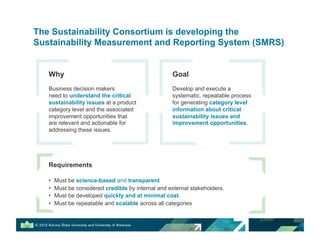
The Sustainability Consortium is developing the
Sustainability Measurement and Reporting System (SMRS)
Goal
Develop and execute a
systematic, repeatable process
for generating category level
information about critical
sustainability issues and
improvement opportunities.
Requirements
•! Must be science-based and transparent
•! Must be considered credible by internal and external stakeholders.
•! Must be developed quickly and at minimal cost.
•! Must be repeatable and scalable across all categories
Why
Business decision makers
need to understand the critical
sustainability issues at a product
category level and the associated
improvement opportunities that
are relevant and actionable for
addressing these issues.
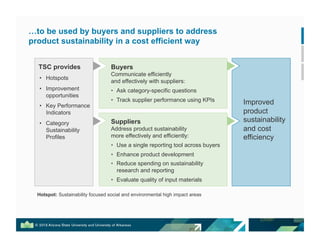
Buyers
Communicate efficiently
and effectively with suppliers:
•! Ask category-specific questions
•! Track supplier performance using KPIs
Suppliers
Address product sustainability
more effectively and efficiently:
•! Use a single reporting tool across buyers
•! Enhance product development
•! Reduce spending on sustainability
research and reporting
•! Evaluate quality of input materials
…to be used by buyers and suppliers to address
product sustainability in a cost efficient way
Improved
product
sustainability
and cost
efficiency
•! Hotspots
•! Improvement
opportunities
•! Key Performance
Indicators
•! Category
Sustainability
Profiles
TSC provides
Hotspot: Sustainability focused social and environmental high impact areas
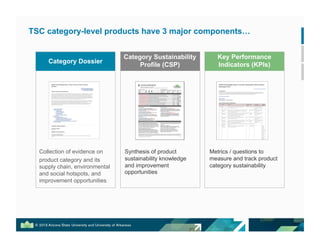
TSC category-level products have 3 major components…
Category Dossier
Collection of evidence on
product category and its
supply chain, environmental
and social hotspots, and
improvement opportunities
Category Sustainability
Profile (CSP)
Synthesis of product
sustainability knowledge
and improvement
opportunities
Key Performance
Indicators (KPIs)
Metrics / questions to
measure and track product
category sustainability
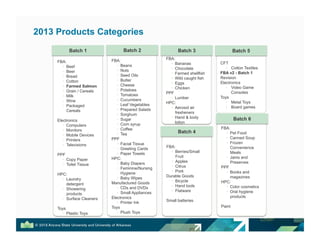
2013 Products Categories
FBA:
•! Beef
•! Beer
•! Bread
•! Cotton
•! Farmed Salmon
•! Grain / Cereals
•! Milk
•! Wine
•! Packaged
Cereals
Electronics
•! Computers
•! Monitors
•! Mobile Devices
•! Printers
•! Televisions
PPF
•! Copy Paper
•! Toilet Tissue
HPC:
•! Laundry
detergent
•! Showering
products
•! Surface Cleaners
Toys
•! Plastic Toys
Batch 1
FBA:
•! Beans
•! Nuts
•! Seed Oils
•! Butter
•! Cheese
•! Potatoes
•! Tomatoes
•! Cucumbers
•! Leaf Vegetables
•! Prepared Salads
•! Sorghum
•! Sugar
•! Corn syrup
•! Coffee
•! Tea
PPF
•! Facial Tissue
•! Greeting Cards
•! Paper Towels
HPC:
•! Baby Diapers
•! Feminine/Nursing
Hygiene
•! Baby Wipes
Manufactured Goods
•! CDs and DVDs
•! Small Appliances
Electronics
•! Printer Ink
Toys
•! Plush Toys
Batch 2
FBA:
•! Bananas
•! Chocolate
•! Farmed shellfish
•! Wild caught fish
•! Eggs
•! Chicken
PPF
•! Lumber
HPC:
•! Aerosol air
fresheners
•! Hand & body
lotion
Batch 3
FBA:
•! Berries/Small
Fruit
•! Apples
•! Citrus
•! Pork
Durable Goods
•! Bicycle
•! Hand tools
•! Flatware
Small batteries
Batch 4
CFT
•! Cotton Textiles
FBA v2 - Batch 1
Revision
Electronics
•! Video Game
Consoles
Toys
•! Metal Toys
•! Board games
Batch 5
FBA:
•! Pet Food
•! Canned Soup
•! Frozen
Convenience
Meals
•! Jams and
Preserves
PPF
•! Books and
magazines
HPC:
•! Color cosmetics
•! Oral hygiene
products
Paint
Batch 6
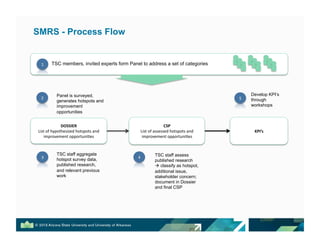
SMRS - Process Flow
TSC members, invited experts form Panel to address a set of categories
!"##$%&'
!"#$%&'%()*&$(+#",+-%(&$#*&$#%./-%
"0*1&2+0+/$%&**&1$3/"4+#%
Panel is surveyed,
generates hotspots and
improvement
opportunities
TSC staff aggregate
hotspot survey data,
published research,
and relevant previous
work
(#)'
!"#$%&'%.##+##+-%(&$#*&$#%./-%
"0*1&2+0+/$%&**&1$3/"4+#%
TSC staff assess
published research
! classify as hotspot,
additional issue,
stakeholder concern;
document in Dossier
and final CSP
Develop KPI’s
through
workshops
*)$+,'
5%
6%
7% 8%
9%
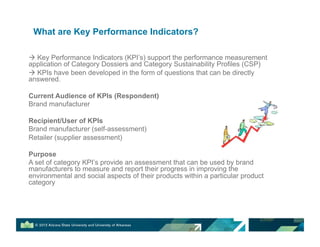
What are Key Performance Indicators?
! Key Performance Indicators (KPI’s) support the performance measurement
application of Category Dossiers and Category Sustainability Profiles (CSP)
! KPIs have been developed in the form of questions that can be directly
answered.
Current Audience of KPIs (Respondent)
Brand manufacturer
Recipient/User of KPIs
Brand manufacturer (self-assessment)
Retailer (supplier assessment)
Purpose
A set of category KPI’s provide an assessment that can be used by brand
manufacturers to measure and report their progress in improving the
environmental and social aspects of their products within a particular product
category
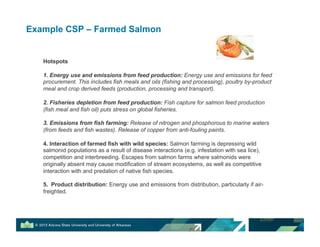
Example CSP – Farmed Salmon
Hotspots
1. Energy use and emissions from feed production: Energy use and emissions for feed
procurement. This includes fish meals and oils (fishing and processing), poultry by-product
meal and crop derived feeds (production, processing and transport).
2. Fisheries depletion from feed production: Fish capture for salmon feed production
(fish meal and fish oil) puts stress on global fisheries.
3. Emissions from fish farming: Release of nitrogen and phosphorous to marine waters
(from feeds and fish wastes). Release of copper from anti-fouling paints.
4. Interaction of farmed fish with wild species: Salmon farming is depressing wild
salmonid populations as a result of disease interactions (e.g. infestation with sea lice),
competition and interbreeding. Escapes from salmon farms where salmonids were
originally absent may cause modification of stream ecosystems, as well as competitive
interaction with and predation of native fish species.
5. Product distribution: Energy use and emissions from distribution, particularly if air-
freighted.
Improvement Opportunities
I. Avoid airplane distribution of product: Frozen and super-cooled fish can be transported by
boat instead of air or by train instead of truck, even over very long distances. Due to the long shelf
life of salmon, this option results in much lower resource use for transportation.
II. Feed substitution and optimization: Substitution of vegetable meals and oils in place of animal-
derived ingredients. Use of least impact-intensive vegetable feeds. Reduce fish derived inputs,
especially fish oil. Lower feed conversion ratios.
III. Avoiding escapes from salmon farms: Measures for reducing escapes include improving
strength and durability of net pens, modifications to harvest equipment, monitoring and contingency
plans. Closed containment of salmon farms, either land-based systems (with effluent treatment) or
marine floating bag systems, are options to reduce escapes. These options represent a trade-off in
lower proximate ecological impacts and higher energy requirements.
IV. Salmon farm siting and management practices: Moving farms away form wild salmon
migration routes; reduce stocking densities; fallowing farms.
V. Use of benchmarking tools: Use a calculation tool or other benchmarking method to catalog
inputs to and outputs from the fabrication of this product. Set targets for reducing inputs and
managing waste using the tool as a guide.
Example CSP- Farmed Salmon
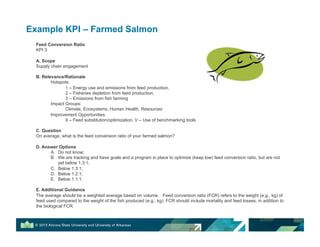
Example KPI – Farmed Salmon
Feed Conversion Ratio
KPI 3
A. Scope
Supply chain engagement
B. Relevance/Rationale
Hotspots:
1 – Energy use and emissions from feed production,
2 – Fisheries depletion from feed production,
3 – Emissions from fish farming
Impact Groups:
Climate, Ecosystems, Human Health, Resources
Improvement Opportunities:
II – Feed substitution/optimization, V – Use of benchmarking tools
C. Question
On average, what is the feed conversion ratio of your farmed salmon?
D. Answer Options
A.! Do not know;
B.! We are tracking and have goals and a program in place to optimize (keep low) feed conversion ratio, but are not
yet below 1.3:1;
C.! Below 1.3:1;
D.! Below 1.2:1;
E.! Below 1.1:1.
E. Additional Guidance
The average should be a weighted average based on volume. Feed conversion ratio (FCR) refers to the weight (e.g., kg) of
feed used compared to the weight of the fish produced (e.g., kg). FCR should include mortality and feed losses, in addition to
the biological FCR.
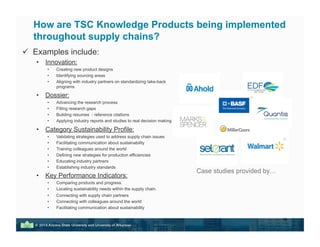
How are TSC Knowledge Products being implemented
throughout supply chains?
15
!! Examples include:
•! Innovation:
•! Creating new product designs
•! Identifying sourcing areas
•! Aligning with industry partners on standardizing take-back
programs
•! Dossier:
•! Advancing the research process
•! Filling research gaps
•! Building resumes - reference citations
•! Applying industry reports and studies to real decision making
•! Category Sustainability Profile:
•! Validating strategies used to address supply chain issues
•! Facilitating communication about sustainability
•! Training colleagues around the world
•! Defining new strategies for production efficiencies
•! Educating industry partners
•! Establishing industry standards
•! Key Performance Indicators:
•! Comparing products and progress.
•! Locating sustainability needs within the supply chain.
•! Connecting with supply chain partners
•! Connecting with colleagues around the world
•! Facilitating communication about sustainability
Case studies provided by…
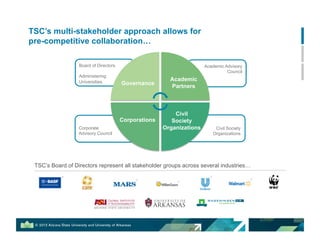
Board of Directors
Administering
Universities
Corporate
Advisory Council
Civil Society
Organizations
Academic Advisory
Council
TSC’s multi-stakeholder approach allows for
pre-competitive collaboration…
TSC’s Board of Directors represent all stakeholder groups across several industries…
Governance
Academic
Partners
Civil
Society
Organizations
Corporations
TSC’s membership represent over $1.5 trillion in revenue…
…and are dedicated leaders in sustainability
Our academic partners are dedicated to science and research
Industry partners contribute to the success of TSC everyday…
www.biomar.com!
Vidar Gundersen!
Sustainability Manager!
BioMar!
www.biomar.com!
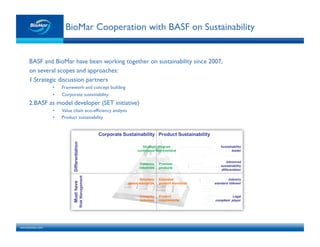
BioMar Cooperation with BASF on Sustainability!
BASF and BioMar have been working together on sustainability since 2007, !
on several scopes and approaches:!
1.!Strategic discussion partners!
•! Framework and concept building!
•! Corporate sustainability!
2.!BASF as model developer (SET initiative)!
•! Value chain eco-efficiency analysis!
•! Product sustainability!
www.biomar.com!
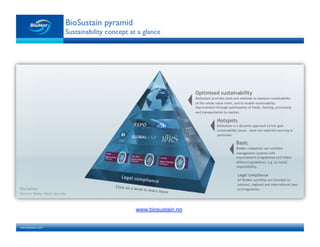
BioSustain pyramid"
Sustainability concept at a glance!
www.biosustain.no
www.biomar.com!
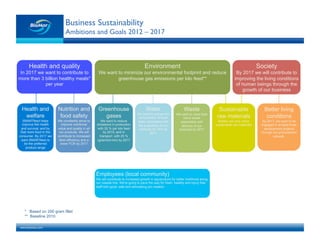
Business Sustainability "
Ambitions and Goals 2012 – 2017!
Health and quality
In 2017 we want to contribute to
more than 3 billion healthy meals*
per year
Society
By 2017 we will contribute to
improving the living conditions
of human beings through the
growth of our business
Environment
We want to minimize our environmental footprint and reduce
greenhouse gas emissions per kilo feed**
Better living
conditions
By 2017, we want to be
engaged in at least three
development projects
through our procurement
network.
Greenhouse
gases
We want to reduce
emissions in production
with 20 % per kilo feed
by 2015, and in
transport with 25 %
(gram/ton-km) by 2017
Sustainable
raw materials
BioMar will only utilize
sustainable raw materials
Waste
We want to more than
halve waste
associated with
delivery of our
products by 2017
Water
We want to reduce the
consumption of fresh
water associated with
the production of our
products by 10% by
2017
Nutrition and
food safety
We constantly strive to
improve nutritional
value and quality in all
our products. We will
contribute to increased
feed efficiency and a
lower FCR by 2017
Health and
welfare
SMARTfeed helps
improve fish health
and survival, and by
that more food to the
consumer. By 2017 we
want SMARTfeed to
be the preferred
product range
Employees (local community)
We will contribute to increased growth in aquaculture for better livelihood along
our coastal line. We're going to pave the way for fresh, healthy and injury free
staff with good, safe and stimulating job creation
* Based on 200 gram fillet
** Baseline 2010
www.biomar.com!
Valuechain
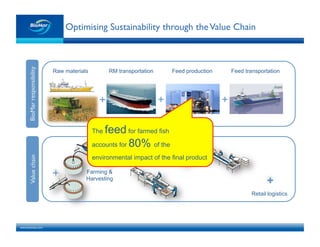
Optimising Sustainability through theValue Chain!
Feed transportation
Farming &
Harvesting
Retail logistics
RM transportationRaw materials Feed production
+ +
+
+
BioMarresponsibility
+
+
+
Slaughtering,
Processing &
Packaging
The feed for farmed fish
accounts for 80% of the
environmental impact of the final product
www.biomar.com!
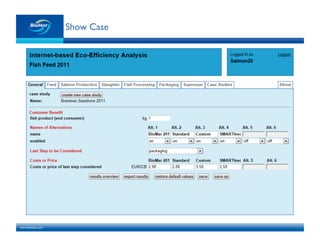
Show Case!
www.biomar.com!
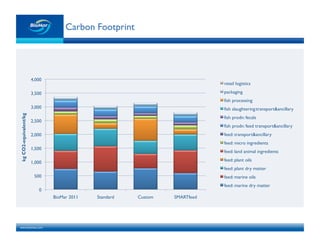
Carbon Footprint!
0
500
1,000
1,500
2,000
2,500
3,000
3,500
4,000
BioMar 2011 Standard Custom SMARTfeed
kgCO2-equivalent/kg
retail logistics
packaging
fish processing
fish slaughtering:transport&ancillary
fish prodn: fecals
fish prodn: feed transport&ancillary
feed: transport&ancillary
feed: micro ingredients
feed: land animal ingredients
feed: plant oils
feed: plant dry matter
feed: marine oils
feed: marine dry matter
www.biomar.com!
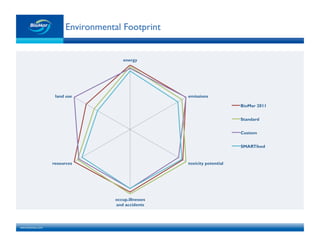
Environmental Footprint!
0.00
energy
emissions
toxicity potential
occup.illnesses
and accidents
resources
land use
BioMar 2011
Standard
Custom
SMARTfeed
www.biomar.com!
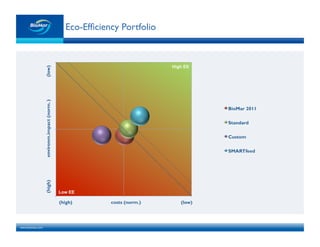
Eco-Efficiency Portfolio!
(high)environm.impact(norm.)(low)
(high) costs (norm.) (low)
BioMar 2011
Standard
Custom
SMARTfeed
High EE
Low EE
www.biomar.com!
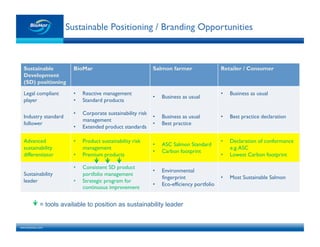
Sustainable Positioning / Branding Opportunities!
Sustainable
Development
(SD) positioning
BioMar Salmon farmer Retailer / Consumer
Legal compliant
player
•! Reactive management
•! Standard products
•! Business as usual
Industry standard
follower
•! Corporate sustainability risk
management
•! Extended product standards
•! Business as usual
•! Best practice
•! Best practice declaration
Advanced
sustainability
differentiator
•! Product sustainability risk
management
•! Premium products
•! ASC Salmon Standard
•! Carbon footprint
•! Declaration of conformance
e.g.ASC
•! Lowest Carbon footprint
Sustainability
leader
•! Consistent SD product
portfolio management
•! Strategic program for
continuous improvement
•! Environmental
fingerprint
•! Eco-efficiency portfolio
•! Most Sustainable Salmon
= tools available to position as sustainability leader
www.biomar.com!
Translating Strategy into Action: Market-based Approaches towards more Sustainable Products

Translating Strategy into Action: Market-based Approaches towards more Sustainable Products

  • 1.
    Translating Strategy intoAction: Market- based Approaches towards more Sustainable Products Cristian Barcan, BASF Nutrition & Health Sarah Lewis, The Sustainability Consortium Vidar Gundersen, BioMar Group !
  • 2.
    3/29/2012 Translating Strategy intoAction: Market-based Approaches towards more Sustainable Products YOUR BRAND Cristian Barcan SET – applied sustainability BASF Nutrition & Health
  • 3.
    ... will need70% more food... ... more than 9 billion people... ... and will consume almost 3x our planet‘s resources (at current rate of consumption) In 2050, the future might look uncertain Copyright BASF Corporation
  • 4.
    Changes need tohappen. We need to learn to produce more with less (more sustainable) 3
  • 5.
    Demographic challenges setthe stage for the future generations Nine billion people in 2050 but only one earth Food & Nutrition Quality of life Chemistry as enabler Resources, Environment & Climate Our strategy & purpose: “We create chemistry for a sustainable future” 4Copyright BASF Corporation
  • 6.
    Creating chemistry ineveryday life nutrition, energy, furniture, health, fabrics, cosmetics, transportation, construction, water, packaging, dietary supplements, plastics, paper, aquaculture, aerospace, detergents and cleaners, electronics, agriculture, pharmaceutical ingredients 5Copyright BASF Corporation
  • 7.
    66 Sustainability main principles 6 Ajourney towards continuous sustainability improvement !Any product or process can become more sustainable over time. !Any product category can be more sustainable (conventional, organic or natural). !Balanced holistic approach: Taking into account social, ecological and economic dimensions. !It needs to be consumer relevant. Copyright BASF Corporation
  • 8.
    Learning to produce“more with less” principles Society Ecology Economy !!Balanced !!Holistic !!Consumer focused !!Consumer relevant !!Collaborative !!Measurable
  • 9.
    8 We create chemistry fora sustainable future BASF – Corporate strategy and implementation Market specific approaches and concepts of BASF BASF – Making Sustainability Tangible Nutrition & Health Care Chemicals The Trigger Point Concept considers the complete value chain in the Home & Personal Care and hygiene market. SET makes sustainability tangible and identifies specific improvement potential along the feed & food value chain. Agriculture AgBalance™ evaluates the sustainability performance of agricultural products or processes. Toolset Market perception analysis Lifecycle assessments Eco-Efficiency Analysis SEEBALANCE™ etc.
  • 10.
    Raw materials ProductionConsumption Improve resource utilization & product attributes Identify sustainability levers and differentiation opportunities Translation into brand/product positioning with tangible arguments Create a new value dimension for your brand & product Eco-efficiency analysis Understand market perception and hot spots Hot spot perception analysis Make the daily product journey transparent Traceability 9 Independent Certification based on the ProSustain Standard Nutrition & Health: Creating a new value dimension with SET
  • 11.
  • 12.
    Measurement and reportingsystems are crucial to progress in product sustainability but are coupled with an array of challenges. Challenges include Lack of a harmonized measurement and reporting approach: •! Complexity driven by the vast variety of products •! No holistic view of the value chain •! No capability to credibly differentiate products based on sustainability •! Need for consistency and transparency in measurement and reporting Science is enabling an understanding of social and environmental impacts and benefits Global regulations are emerging with unpredictable metrics Today Various corporate and social initiatives launched in attempt to address product sustainability
  • 13.
    Vision To advance scienceto drive a new generation of innovative products and supply networks that address environmental, social, and economic imperatives Mission To design and implement credible, transparent and scalable science-based measurement and reporting systems accessible for all producers, retailers, and users of consumer products The Sustainability Consortium (TSC) improves decision making for product sustainability throughout the entire product life cycle across all sectors. Enabling the consumer goods industry to do things that matter about things that matter.
  • 14.
    The Sustainability Consortium– an approach that drives impacts … that enable proactive innovation in sustainability… Using a multi-stakeholder approach… … to create practical measurement tools… … and unlock value in the supply chain ApproachImpact 1 2 3 4
  • 15.
    The Consortium isa global organization, with offices in the United States, and Europe and currently expanding operations into China… To learn more about TSC in Asia, click here.
  • 16.
    TSC’s working groupstructure focuses on major consumer goods sectors. ELECTRONICS FOOD BEVERAGE & AGRICULTURE HOME & PERSONAL CARE PAPER, PULP, & FORESTRY PACKAGING TOYS RETAIL MEASUREMENT SCIENCE CLOTHING, FOOTWEAR & TEXTILES The Retail Consortium Working Group consists of Tier I retailer members The Measurement Science Consortium Working Group consists of Tier I members Four years ago, when I received an email from the wine team asking for an attribute in bulk shipping, I would have spent two weeks on Google, and talking to people about wine, trying to understand if bulk shipping counted. I probably would have told them no. My buyer would have sulked, given up on sustainability and we would have not made process in the wine category. This year, I looked up the information in The Consortium’s CSP’s and KPI’s. I then checked this information against the supplier and wrote an email back that day approving the category. Carmel McQuaid, Marks & Spencer
  • 17.
    The Sustainability Consortiumis developing the Sustainability Measurement and Reporting System (SMRS) Goal Develop and execute a systematic, repeatable process for generating category level information about critical sustainability issues and improvement opportunities. Requirements •! Must be science-based and transparent •! Must be considered credible by internal and external stakeholders. •! Must be developed quickly and at minimal cost. •! Must be repeatable and scalable across all categories Why Business decision makers need to understand the critical sustainability issues at a product category level and the associated improvement opportunities that are relevant and actionable for addressing these issues.
  • 18.
    Buyers Communicate efficiently and effectivelywith suppliers: •! Ask category-specific questions •! Track supplier performance using KPIs Suppliers Address product sustainability more effectively and efficiently: •! Use a single reporting tool across buyers •! Enhance product development •! Reduce spending on sustainability research and reporting •! Evaluate quality of input materials …to be used by buyers and suppliers to address product sustainability in a cost efficient way Improved product sustainability and cost efficiency •! Hotspots •! Improvement opportunities •! Key Performance Indicators •! Category Sustainability Profiles TSC provides Hotspot: Sustainability focused social and environmental high impact areas
  • 19.
    TSC category-level productshave 3 major components… Category Dossier Collection of evidence on product category and its supply chain, environmental and social hotspots, and improvement opportunities Category Sustainability Profile (CSP) Synthesis of product sustainability knowledge and improvement opportunities Key Performance Indicators (KPIs) Metrics / questions to measure and track product category sustainability
  • 20.
    2013 Products Categories FBA: •!Beef •! Beer •! Bread •! Cotton •! Farmed Salmon •! Grain / Cereals •! Milk •! Wine •! Packaged Cereals Electronics •! Computers •! Monitors •! Mobile Devices •! Printers •! Televisions PPF •! Copy Paper •! Toilet Tissue HPC: •! Laundry detergent •! Showering products •! Surface Cleaners Toys •! Plastic Toys Batch 1 FBA: •! Beans •! Nuts •! Seed Oils •! Butter •! Cheese •! Potatoes •! Tomatoes •! Cucumbers •! Leaf Vegetables •! Prepared Salads •! Sorghum •! Sugar •! Corn syrup •! Coffee •! Tea PPF •! Facial Tissue •! Greeting Cards •! Paper Towels HPC: •! Baby Diapers •! Feminine/Nursing Hygiene •! Baby Wipes Manufactured Goods •! CDs and DVDs •! Small Appliances Electronics •! Printer Ink Toys •! Plush Toys Batch 2 FBA: •! Bananas •! Chocolate •! Farmed shellfish •! Wild caught fish •! Eggs •! Chicken PPF •! Lumber HPC: •! Aerosol air fresheners •! Hand & body lotion Batch 3 FBA: •! Berries/Small Fruit •! Apples •! Citrus •! Pork Durable Goods •! Bicycle •! Hand tools •! Flatware Small batteries Batch 4 CFT •! Cotton Textiles FBA v2 - Batch 1 Revision Electronics •! Video Game Consoles Toys •! Metal Toys •! Board games Batch 5 FBA: •! Pet Food •! Canned Soup •! Frozen Convenience Meals •! Jams and Preserves PPF •! Books and magazines HPC: •! Color cosmetics •! Oral hygiene products Paint Batch 6
  • 21.
    SMRS - ProcessFlow TSC members, invited experts form Panel to address a set of categories !"##$%&' !"#$%&'%()*&$(+#",+-%(&$#*&$#%./-% "0*1&2+0+/$%&**&1$3/"4+#% Panel is surveyed, generates hotspots and improvement opportunities TSC staff aggregate hotspot survey data, published research, and relevant previous work (#)' !"#$%&'%.##+##+-%(&$#*&$#%./-% "0*1&2+0+/$%&**&1$3/"4+#% TSC staff assess published research ! classify as hotspot, additional issue, stakeholder concern; document in Dossier and final CSP Develop KPI’s through workshops *)$+,' 5% 6% 7% 8% 9%
  • 22.
    What are KeyPerformance Indicators? ! Key Performance Indicators (KPI’s) support the performance measurement application of Category Dossiers and Category Sustainability Profiles (CSP) ! KPIs have been developed in the form of questions that can be directly answered. Current Audience of KPIs (Respondent) Brand manufacturer Recipient/User of KPIs Brand manufacturer (self-assessment) Retailer (supplier assessment) Purpose A set of category KPI’s provide an assessment that can be used by brand manufacturers to measure and report their progress in improving the environmental and social aspects of their products within a particular product category
  • 23.
    Example CSP –Farmed Salmon Hotspots 1. Energy use and emissions from feed production: Energy use and emissions for feed procurement. This includes fish meals and oils (fishing and processing), poultry by-product meal and crop derived feeds (production, processing and transport). 2. Fisheries depletion from feed production: Fish capture for salmon feed production (fish meal and fish oil) puts stress on global fisheries. 3. Emissions from fish farming: Release of nitrogen and phosphorous to marine waters (from feeds and fish wastes). Release of copper from anti-fouling paints. 4. Interaction of farmed fish with wild species: Salmon farming is depressing wild salmonid populations as a result of disease interactions (e.g. infestation with sea lice), competition and interbreeding. Escapes from salmon farms where salmonids were originally absent may cause modification of stream ecosystems, as well as competitive interaction with and predation of native fish species. 5. Product distribution: Energy use and emissions from distribution, particularly if air- freighted.
  • 24.
    Improvement Opportunities I. Avoidairplane distribution of product: Frozen and super-cooled fish can be transported by boat instead of air or by train instead of truck, even over very long distances. Due to the long shelf life of salmon, this option results in much lower resource use for transportation. II. Feed substitution and optimization: Substitution of vegetable meals and oils in place of animal- derived ingredients. Use of least impact-intensive vegetable feeds. Reduce fish derived inputs, especially fish oil. Lower feed conversion ratios. III. Avoiding escapes from salmon farms: Measures for reducing escapes include improving strength and durability of net pens, modifications to harvest equipment, monitoring and contingency plans. Closed containment of salmon farms, either land-based systems (with effluent treatment) or marine floating bag systems, are options to reduce escapes. These options represent a trade-off in lower proximate ecological impacts and higher energy requirements. IV. Salmon farm siting and management practices: Moving farms away form wild salmon migration routes; reduce stocking densities; fallowing farms. V. Use of benchmarking tools: Use a calculation tool or other benchmarking method to catalog inputs to and outputs from the fabrication of this product. Set targets for reducing inputs and managing waste using the tool as a guide. Example CSP- Farmed Salmon
  • 25.
    Example KPI –Farmed Salmon Feed Conversion Ratio KPI 3 A. Scope Supply chain engagement B. Relevance/Rationale Hotspots: 1 – Energy use and emissions from feed production, 2 – Fisheries depletion from feed production, 3 – Emissions from fish farming Impact Groups: Climate, Ecosystems, Human Health, Resources Improvement Opportunities: II – Feed substitution/optimization, V – Use of benchmarking tools C. Question On average, what is the feed conversion ratio of your farmed salmon? D. Answer Options A.! Do not know; B.! We are tracking and have goals and a program in place to optimize (keep low) feed conversion ratio, but are not yet below 1.3:1; C.! Below 1.3:1; D.! Below 1.2:1; E.! Below 1.1:1. E. Additional Guidance The average should be a weighted average based on volume. Feed conversion ratio (FCR) refers to the weight (e.g., kg) of feed used compared to the weight of the fish produced (e.g., kg). FCR should include mortality and feed losses, in addition to the biological FCR.
  • 26.
    How are TSCKnowledge Products being implemented throughout supply chains? 15 !! Examples include: •! Innovation: •! Creating new product designs •! Identifying sourcing areas •! Aligning with industry partners on standardizing take-back programs •! Dossier: •! Advancing the research process •! Filling research gaps •! Building resumes - reference citations •! Applying industry reports and studies to real decision making •! Category Sustainability Profile: •! Validating strategies used to address supply chain issues •! Facilitating communication about sustainability •! Training colleagues around the world •! Defining new strategies for production efficiencies •! Educating industry partners •! Establishing industry standards •! Key Performance Indicators: •! Comparing products and progress. •! Locating sustainability needs within the supply chain. •! Connecting with supply chain partners •! Connecting with colleagues around the world •! Facilitating communication about sustainability Case studies provided by…
  • 28.
    Board of Directors Administering Universities Corporate AdvisoryCouncil Civil Society Organizations Academic Advisory Council TSC’s multi-stakeholder approach allows for pre-competitive collaboration… TSC’s Board of Directors represent all stakeholder groups across several industries… Governance Academic Partners Civil Society Organizations Corporations
  • 29.
    TSC’s membership representover $1.5 trillion in revenue…
  • 30.
    …and are dedicatedleaders in sustainability
  • 31.
    Our academic partnersare dedicated to science and research Industry partners contribute to the success of TSC everyday…
  • 32.
  • 33.
    www.biomar.com! BioMar Cooperation withBASF on Sustainability! BASF and BioMar have been working together on sustainability since 2007, ! on several scopes and approaches:! 1.!Strategic discussion partners! •! Framework and concept building! •! Corporate sustainability! 2.!BASF as model developer (SET initiative)! •! Value chain eco-efficiency analysis! •! Product sustainability!
  • 34.
  • 35.
    www.biomar.com! Business Sustainability " Ambitionsand Goals 2012 – 2017! Health and quality In 2017 we want to contribute to more than 3 billion healthy meals* per year Society By 2017 we will contribute to improving the living conditions of human beings through the growth of our business Environment We want to minimize our environmental footprint and reduce greenhouse gas emissions per kilo feed** Better living conditions By 2017, we want to be engaged in at least three development projects through our procurement network. Greenhouse gases We want to reduce emissions in production with 20 % per kilo feed by 2015, and in transport with 25 % (gram/ton-km) by 2017 Sustainable raw materials BioMar will only utilize sustainable raw materials Waste We want to more than halve waste associated with delivery of our products by 2017 Water We want to reduce the consumption of fresh water associated with the production of our products by 10% by 2017 Nutrition and food safety We constantly strive to improve nutritional value and quality in all our products. We will contribute to increased feed efficiency and a lower FCR by 2017 Health and welfare SMARTfeed helps improve fish health and survival, and by that more food to the consumer. By 2017 we want SMARTfeed to be the preferred product range Employees (local community) We will contribute to increased growth in aquaculture for better livelihood along our coastal line. We're going to pave the way for fresh, healthy and injury free staff with good, safe and stimulating job creation * Based on 200 gram fillet ** Baseline 2010
  • 36.
    www.biomar.com! Valuechain Optimising Sustainability throughtheValue Chain! Feed transportation Farming & Harvesting Retail logistics RM transportationRaw materials Feed production + + + + BioMarresponsibility + + + Slaughtering, Processing & Packaging The feed for farmed fish accounts for 80% of the environmental impact of the final product
  • 37.
  • 38.
    www.biomar.com! Carbon Footprint! 0 500 1,000 1,500 2,000 2,500 3,000 3,500 4,000 BioMar 2011Standard Custom SMARTfeed kgCO2-equivalent/kg retail logistics packaging fish processing fish slaughtering:transport&ancillary fish prodn: fecals fish prodn: feed transport&ancillary feed: transport&ancillary feed: micro ingredients feed: land animal ingredients feed: plant oils feed: plant dry matter feed: marine oils feed: marine dry matter
  • 39.
  • 40.
    www.biomar.com! Eco-Efficiency Portfolio! (high)environm.impact(norm.)(low) (high) costs(norm.) (low) BioMar 2011 Standard Custom SMARTfeed High EE Low EE
  • 41.
    www.biomar.com! Sustainable Positioning /Branding Opportunities! Sustainable Development (SD) positioning BioMar Salmon farmer Retailer / Consumer Legal compliant player •! Reactive management •! Standard products •! Business as usual •! Business as usual Industry standard follower •! Corporate sustainability risk management •! Extended product standards •! Business as usual •! Best practice •! Best practice declaration Advanced sustainability differentiator •! Product sustainability risk management •! Premium products •! ASC Salmon Standard •! Carbon footprint •! Declaration of conformance e.g.ASC •! Lowest Carbon footprint Sustainability leader •! Consistent SD product portfolio management •! Strategic program for continuous improvement •! Environmental fingerprint •! Eco-efficiency portfolio •! Most Sustainable Salmon = tools available to position as sustainability leader
  • 42.