IN THE BEGINNING….
CLASS THREE OF THREE
Our Lady of the Presentation Parish
Mary Pat Storms
June 20, 2013
Today’s Overview
1

• Leviticus

2

• Numbers

3

• Deuteronomy
LEVITICUS
Leviticus
Be holy as God is holy.
Laws related to sacrifice,
priests and religious
feasts.
Some notes about Leviticus





Moses is considered “author”
Events likely occurred 1445-1444 BC
Response to the Sinai covenant
God has taken Israel out of Egypt; he is
now taking the slavery to sin out of them.
 Israel is God’s treasured possession,
kingdom of priests, holy nation (Ex 19:5-6)
 Combination of meat, bread and drink
constitutes a sacred meal, a feast
Three themes of Leviticus
God is Holy
 To be holy like God is to be a people “set
apart” from the world
Dealing with Sin
 Atonement for Sin requires sacrifice:
repentant, obedient to God, perfect (spotless)
Worshipping God
 Worship is about a relationship with God in
every area of our lives, including the ways we
interact with others.
Leviticus
• Ritual of Sacrifices (1:1–7:38)
– Instructions for the Israelites (1:1–5:26)
– Instructions for the Priests (6:1–7:38)

•
•
•
•

Ceremony of Ordination (8:1–10:20)
Laws Regarding Ritual Purity (11:1–16:34)
Holiness Laws (17:1–26:46)
Redemption of Offerings (27:1–34)
Grain Offerings
• 2: 1* a When anyone brings a grain offering to the
LORD, the offering must consist of bran flour. The
offerer shall pour oil on it and put frankincenseb
over it, 2and bring it to Aaron’s sons, the priests. A
priest shall take a handful of the bran flour and oil,
together with all the frankincense, and shall burn it
on the altar as a token of the offering,* a sweetsmelling oblation to the LORD.c 3The rest of the
grain offering belongs to Aaron and his sons,d a
most holye portion from the oblations to the LORD.
Some prohibitions
19: 26Do not eat anything with the blood still in it.r Do not
recite charms or practice soothsaying.* s 27Do not clip
your hair at the temples, nor spoil the edges of your
beard. 28Do not lacerate your bodies for the dead, and do
not tattoo yourselves.* t I am the LORD.
• 29You shall not degrade your daughter by making a
prostitute of her;u otherwise the land will prostitute
itself and become full of lewdness. 30Keep my sabbaths,
and reverence my sanctuary.v I am the LORD.
• 31Do not turn to ghosts or consult spirits, by which you
will be defiled.w I, the LORD, am your God.
Holy Days
• Holy Days.* 1The LORD said to Moses: 2Speak to the
Israelites and tell them: The following are the festivalsa of
the LORD, which you shall declare holy days. These are my
festivals:
• 3For six days work may be done; but the seventh day is a
sabbath of complete rest,* a declared holy day; you shall do
no work. It is the LORD’s sabbath wherever you dwell.b
• Passover, Pentecost, New Year’s Day, the Day of Atonement,
the Feast of Booths, Shabbat
The Sabbatical Year
• 25: 1The LORD said to Moses on Mount Sinai: 2* Speak to
the Israelites and tell them: When you enter the land that I
am giving you, let the land, too, keep a sabbath for the LORD.
3For six years you may sow your field, and for six years prune
your vineyard, gathering in their produce.a 4But during the
seventh year the land shall have a sabbath of complete rest,
a sabbath for the LORD,b when you may neither sow your
field nor prune your vineyard. 5The aftergrowth of your
harvest you shall not reap, nor shall you pick the grapes of
your untrimmed vines. It shall be a year of rest for the land.
NUMBERS
Numbers

More laws; wanderings in
the desert on the way to
Promised Land. Repeated
unfaithfulness increases
period of wandering.
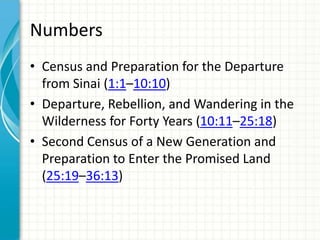
Numbers
• Census and Preparation for the Departure
from Sinai (1:1–10:10)
• Departure, Rebellion, and Wandering in the
Wilderness for Forty Years (10:11–25:18)
• Second Census of a New Generation and
Preparation to Enter the Promised Land
(25:19–36:13)
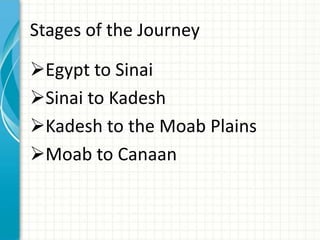
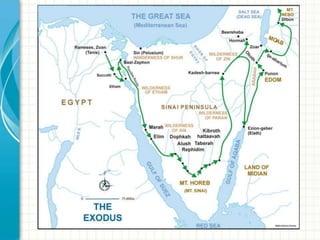
Stages of the Journey
Egypt to Sinai
Sinai to Kadesh
Kadesh to the Moab Plains
Moab to Canaan
Some notes about Numbers
• There are two censuses taken, both in
preparation for entering the Promised Land
• Spies are sent out in preparation for entering
Canaan. The first set of 12 spies come back and
– with the exception of Caleb and Joshua –
convince the people NOT to enter.
• The LORD punishes the people for their doubt by
making them wander the desert for 40 years…2
generations. The first generation will die before
entering the promised land.
Numbers
• The second census, taken 40 years later, is
geared toward organizing an army.
• Joshua and Caleb, who did trust God, are the
only remaining spies. They will lead the
tribes in taking back the Promised Land.
More notes about Numbers
• The MENORAH is made in this book.
• NAZIRITES: people who are holy to God like
prophets – do not partake of grape products,
cut hair or shave, or touch a corpse. John the
Baptist was a Nazirite (and Samson)
• LEVITES (Aaron and his sons) do not have
territory because they are the priests. The
entire community shares in the task of
tending to the needs of the priests.
More notes about Numbers
• There is an ordering of the tribes in the camp
and as they travel and a drawing of lots for
placement
• A question of inheritance is resolved when
some daughters of the tribe of Manassah ask
to inherit when they have no
brothers…women may inherit, but need to
marry within their tribe so that the property
stays with the tribe.
Miriam
• Miriam questions Moses’ authority; Miriam is
punished with a skin disease and banished
from the camp. When Moses begs the
LORD’s forgiveness on his sister’s behalf, God
relents and changes the punishment to seven
days. The camp stays in place until Miriam’s
time of banishment is complete.
• Miriam’s death is recorded in the Book of
Numbers.
Other events…
• Aaron’s death is recorded in this book; his
son, Eleazar, becomes the head priest.
• The people are stricken with snakes for their
sinfulness; Moses makes a bronze serpent
and when they look on it, they are healed.
• Balaam and his donkey.
The Priestly Blessing
6:22The LORD said to Moses: 23Speak to Aaron
and his sons and tell them: This is how you shall
bless the Israelites. Say to them:
24The LORD bless you and keep you!
25The LORD let his face shine upon you, and be
gracious to you!
26The LORD look upon you kindly and give you
peace!*
DEUTERONOMY
Deuteronomy
The “second law.” Moses
farewell at the borders of
the Promised Land.
Deuteronomy: Three Discourses
• First Address (1:1–4:43) Review of History
• Second Address (4:44–28:69)
– The Lord’s Covenant with Israel (4:44–11:32)
– The Deuteronomic Code (12:1–28:69)

• Third Address (29:1–33:29) Blessing and
Farewell
• The Death of Moses (34:1–12)
Deuteronomy
• In many ways, Deuteronomy is a preface to
the Historical books: Joshua, Judges, Samuel
and Kings.
• Deuteronomy is quoted frequently in the
New Testament
Deuteronomy’s messages
•
•
•
•
•
•

Obey God and you will be rewarded;
Disobey God, and you will be punished.
Life must be totally dedicated to God.
We must do more than the minimum.
Reiteration of the 10 Commandments
Much evidence of the J author - earthiness
Deuteronomy’s messages
• Worship should be centralized (later, in
Jerusalem.)
• Warnings about kings who have many wives,
money and horses.
• War is not about total destruction; rules
about war and peace.
The Shema
• Hear, O Israel, the Lord is our
God, the Lord alone and you
must love the Lord with all your
heart, and mind and soul.
Deuteronomy’s messages
• The notion of a 10 percent tithe
• The Jubilee Year – the 7th year is one
to forgive debts.
Moses’ farewell and death
• Joshua is commissioned to lead the people
into the Promised Land.
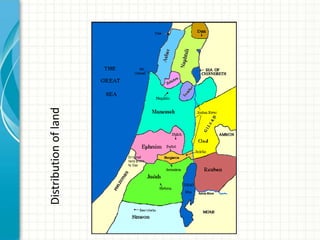
• Reuben and Gad will fight for the Promised
Land, but will settle the eastern side of the
River Jordan.
• Song of Moses
• Viewing of Canaan
• Final blessing of the tribes
• Death on Mount Nebo
Distribution of land
10 Themes of the Torah
•
•
•
•
•
•
•
•
•

God created a world that is GOOD
God has blessed humans; they are GOOD
Humans tend to sin
But, God loves them anyway and shows mercy
God keeps his promises
The covenant binds humans and God
The Law is an expression of this covenant
Worship is praise; praise is thanksgiving.
We live in community because God wants us to do so;
The Community is essential to survival.
• God directs all of history.
Lessons from the Torah
•
•
•
•
•
•

Obey God and you will be blessed.
Disobey God and you will be punished.
Totally dedicate yourself to God.
Sin requires atonement.
God works through women, the lowly, the imperfect.
Because of their relationship with God, people
become better people and are able to achieve great
things in God’s name.
• Working through ordinary people, God’s plan is
revealed.
QUESTIONS?

In the beginning part iii

  • 1.
    IN THE BEGINNING…. CLASSTHREE OF THREE Our Lady of the Presentation Parish Mary Pat Storms June 20, 2013
  • 2.
  • 3.
  • 4.
    Leviticus Be holy asGod is holy. Laws related to sacrifice, priests and religious feasts.
  • 5.
    Some notes aboutLeviticus     Moses is considered “author” Events likely occurred 1445-1444 BC Response to the Sinai covenant God has taken Israel out of Egypt; he is now taking the slavery to sin out of them.  Israel is God’s treasured possession, kingdom of priests, holy nation (Ex 19:5-6)  Combination of meat, bread and drink constitutes a sacred meal, a feast
  • 6.
    Three themes ofLeviticus God is Holy  To be holy like God is to be a people “set apart” from the world Dealing with Sin  Atonement for Sin requires sacrifice: repentant, obedient to God, perfect (spotless) Worshipping God  Worship is about a relationship with God in every area of our lives, including the ways we interact with others.
  • 7.
    Leviticus • Ritual ofSacrifices (1:1–7:38) – Instructions for the Israelites (1:1–5:26) – Instructions for the Priests (6:1–7:38) • • • • Ceremony of Ordination (8:1–10:20) Laws Regarding Ritual Purity (11:1–16:34) Holiness Laws (17:1–26:46) Redemption of Offerings (27:1–34)
  • 8.
    Grain Offerings • 2:1* a When anyone brings a grain offering to the LORD, the offering must consist of bran flour. The offerer shall pour oil on it and put frankincenseb over it, 2and bring it to Aaron’s sons, the priests. A priest shall take a handful of the bran flour and oil, together with all the frankincense, and shall burn it on the altar as a token of the offering,* a sweetsmelling oblation to the LORD.c 3The rest of the grain offering belongs to Aaron and his sons,d a most holye portion from the oblations to the LORD.
  • 9.
    Some prohibitions 19: 26Donot eat anything with the blood still in it.r Do not recite charms or practice soothsaying.* s 27Do not clip your hair at the temples, nor spoil the edges of your beard. 28Do not lacerate your bodies for the dead, and do not tattoo yourselves.* t I am the LORD. • 29You shall not degrade your daughter by making a prostitute of her;u otherwise the land will prostitute itself and become full of lewdness. 30Keep my sabbaths, and reverence my sanctuary.v I am the LORD. • 31Do not turn to ghosts or consult spirits, by which you will be defiled.w I, the LORD, am your God.
  • 10.
    Holy Days • HolyDays.* 1The LORD said to Moses: 2Speak to the Israelites and tell them: The following are the festivalsa of the LORD, which you shall declare holy days. These are my festivals: • 3For six days work may be done; but the seventh day is a sabbath of complete rest,* a declared holy day; you shall do no work. It is the LORD’s sabbath wherever you dwell.b • Passover, Pentecost, New Year’s Day, the Day of Atonement, the Feast of Booths, Shabbat
  • 11.
    The Sabbatical Year •25: 1The LORD said to Moses on Mount Sinai: 2* Speak to the Israelites and tell them: When you enter the land that I am giving you, let the land, too, keep a sabbath for the LORD. 3For six years you may sow your field, and for six years prune your vineyard, gathering in their produce.a 4But during the seventh year the land shall have a sabbath of complete rest, a sabbath for the LORD,b when you may neither sow your field nor prune your vineyard. 5The aftergrowth of your harvest you shall not reap, nor shall you pick the grapes of your untrimmed vines. It shall be a year of rest for the land.
  • 12.
  • 13.
    Numbers More laws; wanderingsin the desert on the way to Promised Land. Repeated unfaithfulness increases period of wandering.
  • 14.
    Numbers • Census andPreparation for the Departure from Sinai (1:1–10:10) • Departure, Rebellion, and Wandering in the Wilderness for Forty Years (10:11–25:18) • Second Census of a New Generation and Preparation to Enter the Promised Land (25:19–36:13)
  • 15.
    Stages of theJourney Egypt to Sinai Sinai to Kadesh Kadesh to the Moab Plains Moab to Canaan
  • 17.
    Some notes aboutNumbers • There are two censuses taken, both in preparation for entering the Promised Land • Spies are sent out in preparation for entering Canaan. The first set of 12 spies come back and – with the exception of Caleb and Joshua – convince the people NOT to enter. • The LORD punishes the people for their doubt by making them wander the desert for 40 years…2 generations. The first generation will die before entering the promised land.
  • 18.
    Numbers • The secondcensus, taken 40 years later, is geared toward organizing an army. • Joshua and Caleb, who did trust God, are the only remaining spies. They will lead the tribes in taking back the Promised Land.
  • 19.
    More notes aboutNumbers • The MENORAH is made in this book. • NAZIRITES: people who are holy to God like prophets – do not partake of grape products, cut hair or shave, or touch a corpse. John the Baptist was a Nazirite (and Samson) • LEVITES (Aaron and his sons) do not have territory because they are the priests. The entire community shares in the task of tending to the needs of the priests.
  • 20.
    More notes aboutNumbers • There is an ordering of the tribes in the camp and as they travel and a drawing of lots for placement • A question of inheritance is resolved when some daughters of the tribe of Manassah ask to inherit when they have no brothers…women may inherit, but need to marry within their tribe so that the property stays with the tribe.
  • 21.
    Miriam • Miriam questionsMoses’ authority; Miriam is punished with a skin disease and banished from the camp. When Moses begs the LORD’s forgiveness on his sister’s behalf, God relents and changes the punishment to seven days. The camp stays in place until Miriam’s time of banishment is complete. • Miriam’s death is recorded in the Book of Numbers.
  • 22.
    Other events… • Aaron’sdeath is recorded in this book; his son, Eleazar, becomes the head priest. • The people are stricken with snakes for their sinfulness; Moses makes a bronze serpent and when they look on it, they are healed. • Balaam and his donkey.
  • 23.
    The Priestly Blessing 6:22TheLORD said to Moses: 23Speak to Aaron and his sons and tell them: This is how you shall bless the Israelites. Say to them: 24The LORD bless you and keep you! 25The LORD let his face shine upon you, and be gracious to you! 26The LORD look upon you kindly and give you peace!*
  • 24.
  • 25.
    Deuteronomy The “second law.”Moses farewell at the borders of the Promised Land.
  • 26.
    Deuteronomy: Three Discourses •First Address (1:1–4:43) Review of History • Second Address (4:44–28:69) – The Lord’s Covenant with Israel (4:44–11:32) – The Deuteronomic Code (12:1–28:69) • Third Address (29:1–33:29) Blessing and Farewell • The Death of Moses (34:1–12)
  • 27.
    Deuteronomy • In manyways, Deuteronomy is a preface to the Historical books: Joshua, Judges, Samuel and Kings. • Deuteronomy is quoted frequently in the New Testament
  • 28.
    Deuteronomy’s messages • • • • • • Obey Godand you will be rewarded; Disobey God, and you will be punished. Life must be totally dedicated to God. We must do more than the minimum. Reiteration of the 10 Commandments Much evidence of the J author - earthiness
  • 29.
    Deuteronomy’s messages • Worshipshould be centralized (later, in Jerusalem.) • Warnings about kings who have many wives, money and horses. • War is not about total destruction; rules about war and peace.
  • 30.
    The Shema • Hear,O Israel, the Lord is our God, the Lord alone and you must love the Lord with all your heart, and mind and soul.
  • 31.
    Deuteronomy’s messages • Thenotion of a 10 percent tithe • The Jubilee Year – the 7th year is one to forgive debts.
  • 32.
    Moses’ farewell anddeath • Joshua is commissioned to lead the people into the Promised Land. • Reuben and Gad will fight for the Promised Land, but will settle the eastern side of the River Jordan. • Song of Moses • Viewing of Canaan • Final blessing of the tribes • Death on Mount Nebo
  • 33.
  • 34.
    10 Themes ofthe Torah • • • • • • • • • God created a world that is GOOD God has blessed humans; they are GOOD Humans tend to sin But, God loves them anyway and shows mercy God keeps his promises The covenant binds humans and God The Law is an expression of this covenant Worship is praise; praise is thanksgiving. We live in community because God wants us to do so; The Community is essential to survival. • God directs all of history.
  • 35.
    Lessons from theTorah • • • • • • Obey God and you will be blessed. Disobey God and you will be punished. Totally dedicate yourself to God. Sin requires atonement. God works through women, the lowly, the imperfect. Because of their relationship with God, people become better people and are able to achieve great things in God’s name. • Working through ordinary people, God’s plan is revealed.
  • 36.

Editor's Notes

  • #2 This template can be used as a starter file for presenting training materials in a group setting.SectionsRight-click on a slide to add sections. Sections can help to organize your slides or facilitate collaboration between multiple authors.NotesUse the Notes section for delivery notes or to provide additional details for the audience. View these notes in Presentation View during your presentation. Keep in mind the font size (important for accessibility, visibility, videotaping, and online production)Coordinated colors Pay particular attention to the graphs, charts, and text boxes. Consider that attendees will print in black and white or grayscale. Run a test print to make sure your colors work when printed in pure black and white and grayscale.Graphics, tables, and graphsKeep it simple: If possible, use consistent, non-distracting styles and colors.Label all graphs and tables.
  • #3 This is another option for an Overview slide.
  • #5 This is another option for an Overview slides using transitions.
  • #6 This is another option for an Overview slides using transitions.
  • #7 This is another option for an Overview slides using transitions.
  • #14 This is another option for an Overview slides using transitions.
  • #26 This is another option for an Overview slides using transitions.
  • #35 Summarize presentation content by restating the important points from the lessons.What do you want the audience to remember when they leave your presentation?Save your presentation to a video for easy distribution (To create a video, click the File tab, and then click Share.  Under File Types, click Create a Video.)