Old Testament
Core Seminar
Class 7
“Numbers”
Old Testament Overview
1
Introduction
2
Theme: Past Promises will prevail in spite of present problems
• Numbers comes after Exodus when the Israelites leave Egypt.
• They’ve just received the Ten Commandments at Sinai and built
the Tabernacle.
• Here we see the people pack up camp from the foot of Mount
Sinai and move toward the land of Canaan, the fertile land just
east of the Mediterranean Sea.
• The route is only 200 miles, but it takes 40 years!
• Breaking the chapters up geographically, we see chapters
• 1-10 are about packing up at Sinai,
• 11-12 about the journey to Kadesh where the people rebel,
• 13-19 explain the wanderings in the wilderness,
• 20-21 describe the journey to the plains of Moab. Finally,
• 22-36, we’ll see that Israel is camped on the eastern bank of the Jordan
River, looking across the river at the Promised Land.
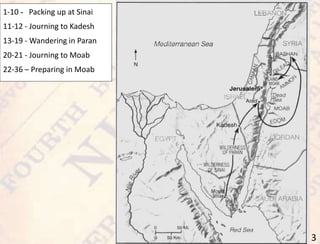
1-10 - Packing up at Sinai
11-12 - Journing to Kadesh
13-19 - Wandering in Paran
20-21 - Journing to Moab
22-36 – Preparing in Moab
3
4
• Numbers is not just about finding a place to live.
• It fits into the bigger far bigger question of how God’s promises
to Abraham will be fulfilled from Genesis. He promises …
1 His people will have a place. “All the land that you see I will give
you” (13v15).
2 His people, the offspring of Abraham, will be numerous “a great
nation” (12v2), “like the dust of the earth” (13v16) “as stars in
the sky” (15v4).
3 He will be with them … His presence. Genesis 15v1: Abraham is
not to be afraid about God’s promises because God is his
“strength and shield”.
4 Through the Israelites, all nations will be blessed. “I will bless
those who bless you, and curse those who curse you, and all
people will be blessed through you” (12v3).
• In Numbers we see the first time since creation the possibility of
all four promises coming true as part of the Redemptive plan!
5
• This plan of redemption is a long process.
• It’s a very long time between God’s initiation of that plan (in
Genesis 3) and the actual arrival of the New Heavens and the
New Earth (Revelation 21).
• That which kept them out of the land is exactly the same thing
that would keep anyone today out of the New Heavens and the
New Earth… Unbelief.
• There are two thematic ideas in Numbers.
• The present problems - the unbelief, rebellion, and
disobedience of the people.
• Past promises – the faithfulness, patience, and grace of
Yahweh.
• Which is going to win? God’s promises or disobedience, distrust
and unbelief?”
• The answer is the theme: Past promises will prevail in spite
of present problems
6
Numbers can be divided into three parts:
1. Chapters 1-10 – God preparing his people for the fulfilment of
his promises.
2. Chapters 11-16 – God punishing his people for their great
unbelief and incredible lack of trust in his promises being
fulfilled.
3. Chapters 17-36 – God’s patience with his people … His
promises will be fulfilled in spite of everything that has taken
place.
Chapters 1-10: God’s Preparation
Preserves His Promises
7
• God’s people are still at the foot of Mount Sinai, ready to break
camp.
• What was the mood of the people?
• They’d received the laws, they were in covenant with Yahweh
who now dwells them, and now they going up to Canaan!
• What was the first promise?
• A great nation!
• Chapter 1 contains the census of fighting men. - “603,550 men
able to go to war”.
• Chapters 23-4 count the priests at 8580.
• Once the preparation is complete God’s people are on the
move.
8
• Between the census (chapters 1-4) and setting out (chapter 10),
God’s people are being primed for the fullness of his presence.
• People cannot draw near to God unless they are clean.
• The tabernacle represented God’s presence with his people and
the priest’s service identified these people as belonging to God.
– Chapters 5 and 6 the camp is cleansed.
– Chapter 7, the tabernacle is consecrated.
– Chapter 8, the priests are inducted into their roles.
• Chapters 9 and 10, God’s presence when His people move.
• “Now on the day that the tabernacle was raised up, the cloud covered the
tabernacle, the tent of the Testimony; from evening until morning it was above the
tabernacle like the appearance of fire. So it was always: the cloud covered it by
day, and the appearance of fire by night. Whenever the cloud was taken up from
above the tabernacle, after that the children of Israel would journey; and in the
place where the cloud settled, there the children of Israel would pitch their tents.
At the command of the LORD the children of Israel would journey, and at the
command of the LORD they would camp; as long as the cloud stayed above the
tabernacle they remained encamped.” (9:15-18)
9
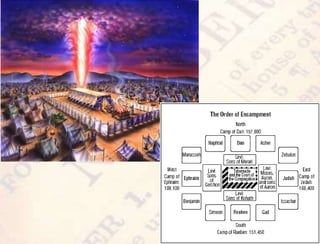
• The camp is designed so that the tabernacle is always right in
the middle as a reminder that Yahweh is dwelling with them.
• Does that make you envious?
• Do you wish you were there to see the fire? To KNOW God was
with me.
• Read 1 Corinthians 13:12
• They got to see God in the cloud and in the fire but we will get
to see Him “face to face”.
• We also have His word in our hands and His sprit in us!
• There is also the third part of the blessing (to all nations).
• At the end of this section Moses’ Father-in-law, Hobab, a
Midianite, a foreigner, to join them “… for the LORD has
promised good things to Israel.” 10:29
• Even if it is with just one man – we see God preparing to bless
the nations as the first non-Israelite is integrated in.
10
Chapters 11-16: God’s Punishment
Preserves His Promises
11
• “Complain” appears in nearly every one of the next 6 chapters.
• 11:1 they complain about their hardships.
• 11:13 they complain about their food.
• 12:1 Miriam & Aaron, Moses’ brother & sister “talk against him”
• In chapter 13 is the worst transgression, it’s here God’s people
show that they do not trust that God will give them the land.
• Yahweh instructs Moses to send spies into the land.
• “Then they told him, and said: “We went to the land where you sent
us. It truly flows with milk and honey, and this is its fruit.
Nevertheless the people who dwell in the land are strong; the cities
are fortified and very large; moreover we saw the descendants of
Anak there. The Amalekites dwell in the land of the South; the
Hittites, the Jebusites, and the Amorites dwell in the mountains; and
the Canaanites dwell by the sea and along the banks of the Jordan.””
12
• Read 10:30 – Caleb’s reply, words of faith and trust in God.
• Read 10:31-32 – the majority report … words of disbelief.
• Chapter 14 records the mutiny and even a desire to return into
slavery!
• Reflect on the roots of their sin (and often our own sin).
• See connection between their dissatisfaction and their sin.
• Complaining reveals an underlying spiritual state.
– They’ve been miraculously rescued from Egypt without having to fight a
single battle.
– The people are given supernatural food they don’t have to work for.
– They have a faithful leader and God’s law and His presence.
• They’re so blessed – how inappropriate their to complain!
• Is that not us too?
• Such sinful dissatisfaction tells us more about our souls than
our circumstances. Beware of discontentment.
13
• Complaints about hardships – God sends fire
• Complaints about food – God sends a plague
• Mariam’s complaint about leadership – God sends leprosy
• Total lack of trust in God’s promises – Read Numbers 14:10-12
– Like the golden calf incident – God is ready to blot them out!
– Like Christ does for us Moses intercedes.
• Total lack of trust in God’s promises – “No one who has treated
me with contempt will ever see it.” (14:23 NIV)
• Is God keeping His promise?
• Back in Exodus God declared they would only be blessed if they
kept his covenant and obeyed, and if they did not then they
would be cursed.
• God is keeping his promise – the judgment promise this time.
• What about the Abrahamic promise – read 14:31.
• There is still hope! The promises still stand!
14
Hebrews 3:12-19 Beware, brethren, lest there be in any of you an
evil heart of unbelief in departing from the living God; but exhort
one another daily, while it is called "Today," lest any of you be
hardened through the deceitfulness of sin. For we have become
partakers of Christ if we hold the beginning of our confidence
steadfast to the end, while it is said: "Today, if you will hear His
voice, Do not harden your hearts as in the rebellion." Failure of
the Wilderness Wanderers For who, having heard, rebelled?
Indeed, was it not all who came out of Egypt, led by Moses? Now
with whom was He angry forty years? Was it not with those who
sinned, whose corpses fell in the wilderness? And to whom did He
swear that they would not enter His rest, but to those who did not
obey? So we see that they could not enter in because of unbelief.
• A warning that we can be exposed to much grace, and teaching
of the LORD, and still fall away because we lack faith.
• God is still with them but the promise of a place will wait until
the next generation.
Chapters 17-36: God’s Patience
Preserves His Promises
15
• You’d think that God’s punishment would to stop the grumbling!
• God’s people continue in their sin and disbelief.
• In 17:13 they misrepresent what God says. “Anyone who comes
near the tabernacle of the LORD will die!”. Wrong!
• In chapter 20, Moses isn’t immune – in a fit of anger he strikes a
rock rather than speaking to it as God instructed.
– The result - the same punishment as they got.
• In 21, they speak against God and Moses saying “Why have you
brought us up out of Egypt to die in the desert? There is no
bread! There is no water! And we detest this miserable food!”
– So God sends poisonous snakes!
• They repent and Moses intercedes for them … again.
Conclusion
16
• The message of Numbers is:
– God prepares his people for the fulfillment of his promises,
– but the people are punished because they do not believe his promises.
– Nevertheless God’s patience sees that his promises will prevail and will
come to pass.
• We face similar problems today.
– We question whether God’s promises will come to pass.
– We wonder if God will use us to build up of his people/church.
– We question the reality of heaven when we are in the midst of earthly
weariness.
– We forget that God is with us.
• It is then that we must hold on to the certainty of God’s
promises … as in Numbers, they will always prevail.
17
• So how did looking at a bronze snake heal them?
• It’s the same obedience and trust/faith we are called to use for
our salvation.
• This is a type of Christ – read John 3:14-15
• God’s promises continue to prevail in the midst of the
problems.
• The rest of Numbers shows forth God’s gracious patience.
• People: Chapters 22-24’s narration of the “Balaam event”
shows the people prospering and growing in size (601,730!).
• Place: Chapter 27 introduces Joshua who will lead them into
the Promised Land.
• Presence: Chapter 29 - God is still with them at the feast of
trumpets.
• Blessing/Cursing to the nations: Chapter 21 – the Canaanites
and Amorites are destroyed. Chapters 22-24 the Moabites lose
their land and 31 details the vengeance on the Midianites.

Session 07 Old Testament Overview - Numbers

  • 1.
    Old Testament Core Seminar Class7 “Numbers” Old Testament Overview 1
  • 2.
    Introduction 2 Theme: Past Promiseswill prevail in spite of present problems • Numbers comes after Exodus when the Israelites leave Egypt. • They’ve just received the Ten Commandments at Sinai and built the Tabernacle. • Here we see the people pack up camp from the foot of Mount Sinai and move toward the land of Canaan, the fertile land just east of the Mediterranean Sea. • The route is only 200 miles, but it takes 40 years! • Breaking the chapters up geographically, we see chapters • 1-10 are about packing up at Sinai, • 11-12 about the journey to Kadesh where the people rebel, • 13-19 explain the wanderings in the wilderness, • 20-21 describe the journey to the plains of Moab. Finally, • 22-36, we’ll see that Israel is camped on the eastern bank of the Jordan River, looking across the river at the Promised Land.
  • 3.
    1-10 - Packingup at Sinai 11-12 - Journing to Kadesh 13-19 - Wandering in Paran 20-21 - Journing to Moab 22-36 – Preparing in Moab 3
  • 4.
    4 • Numbers isnot just about finding a place to live. • It fits into the bigger far bigger question of how God’s promises to Abraham will be fulfilled from Genesis. He promises … 1 His people will have a place. “All the land that you see I will give you” (13v15). 2 His people, the offspring of Abraham, will be numerous “a great nation” (12v2), “like the dust of the earth” (13v16) “as stars in the sky” (15v4). 3 He will be with them … His presence. Genesis 15v1: Abraham is not to be afraid about God’s promises because God is his “strength and shield”. 4 Through the Israelites, all nations will be blessed. “I will bless those who bless you, and curse those who curse you, and all people will be blessed through you” (12v3). • In Numbers we see the first time since creation the possibility of all four promises coming true as part of the Redemptive plan!
  • 5.
    5 • This planof redemption is a long process. • It’s a very long time between God’s initiation of that plan (in Genesis 3) and the actual arrival of the New Heavens and the New Earth (Revelation 21). • That which kept them out of the land is exactly the same thing that would keep anyone today out of the New Heavens and the New Earth… Unbelief. • There are two thematic ideas in Numbers. • The present problems - the unbelief, rebellion, and disobedience of the people. • Past promises – the faithfulness, patience, and grace of Yahweh. • Which is going to win? God’s promises or disobedience, distrust and unbelief?” • The answer is the theme: Past promises will prevail in spite of present problems
  • 6.
    6 Numbers can bedivided into three parts: 1. Chapters 1-10 – God preparing his people for the fulfilment of his promises. 2. Chapters 11-16 – God punishing his people for their great unbelief and incredible lack of trust in his promises being fulfilled. 3. Chapters 17-36 – God’s patience with his people … His promises will be fulfilled in spite of everything that has taken place.
  • 7.
    Chapters 1-10: God’sPreparation Preserves His Promises 7 • God’s people are still at the foot of Mount Sinai, ready to break camp. • What was the mood of the people? • They’d received the laws, they were in covenant with Yahweh who now dwells them, and now they going up to Canaan! • What was the first promise? • A great nation! • Chapter 1 contains the census of fighting men. - “603,550 men able to go to war”. • Chapters 23-4 count the priests at 8580. • Once the preparation is complete God’s people are on the move.
  • 8.
    8 • Between thecensus (chapters 1-4) and setting out (chapter 10), God’s people are being primed for the fullness of his presence. • People cannot draw near to God unless they are clean. • The tabernacle represented God’s presence with his people and the priest’s service identified these people as belonging to God. – Chapters 5 and 6 the camp is cleansed. – Chapter 7, the tabernacle is consecrated. – Chapter 8, the priests are inducted into their roles. • Chapters 9 and 10, God’s presence when His people move. • “Now on the day that the tabernacle was raised up, the cloud covered the tabernacle, the tent of the Testimony; from evening until morning it was above the tabernacle like the appearance of fire. So it was always: the cloud covered it by day, and the appearance of fire by night. Whenever the cloud was taken up from above the tabernacle, after that the children of Israel would journey; and in the place where the cloud settled, there the children of Israel would pitch their tents. At the command of the LORD the children of Israel would journey, and at the command of the LORD they would camp; as long as the cloud stayed above the tabernacle they remained encamped.” (9:15-18)
  • 9.
    9 • The campis designed so that the tabernacle is always right in the middle as a reminder that Yahweh is dwelling with them. • Does that make you envious? • Do you wish you were there to see the fire? To KNOW God was with me. • Read 1 Corinthians 13:12 • They got to see God in the cloud and in the fire but we will get to see Him “face to face”. • We also have His word in our hands and His sprit in us! • There is also the third part of the blessing (to all nations). • At the end of this section Moses’ Father-in-law, Hobab, a Midianite, a foreigner, to join them “… for the LORD has promised good things to Israel.” 10:29 • Even if it is with just one man – we see God preparing to bless the nations as the first non-Israelite is integrated in.
  • 10.
  • 11.
    Chapters 11-16: God’sPunishment Preserves His Promises 11 • “Complain” appears in nearly every one of the next 6 chapters. • 11:1 they complain about their hardships. • 11:13 they complain about their food. • 12:1 Miriam & Aaron, Moses’ brother & sister “talk against him” • In chapter 13 is the worst transgression, it’s here God’s people show that they do not trust that God will give them the land. • Yahweh instructs Moses to send spies into the land. • “Then they told him, and said: “We went to the land where you sent us. It truly flows with milk and honey, and this is its fruit. Nevertheless the people who dwell in the land are strong; the cities are fortified and very large; moreover we saw the descendants of Anak there. The Amalekites dwell in the land of the South; the Hittites, the Jebusites, and the Amorites dwell in the mountains; and the Canaanites dwell by the sea and along the banks of the Jordan.””
  • 12.
    12 • Read 10:30– Caleb’s reply, words of faith and trust in God. • Read 10:31-32 – the majority report … words of disbelief. • Chapter 14 records the mutiny and even a desire to return into slavery! • Reflect on the roots of their sin (and often our own sin). • See connection between their dissatisfaction and their sin. • Complaining reveals an underlying spiritual state. – They’ve been miraculously rescued from Egypt without having to fight a single battle. – The people are given supernatural food they don’t have to work for. – They have a faithful leader and God’s law and His presence. • They’re so blessed – how inappropriate their to complain! • Is that not us too? • Such sinful dissatisfaction tells us more about our souls than our circumstances. Beware of discontentment.
  • 13.
    13 • Complaints abouthardships – God sends fire • Complaints about food – God sends a plague • Mariam’s complaint about leadership – God sends leprosy • Total lack of trust in God’s promises – Read Numbers 14:10-12 – Like the golden calf incident – God is ready to blot them out! – Like Christ does for us Moses intercedes. • Total lack of trust in God’s promises – “No one who has treated me with contempt will ever see it.” (14:23 NIV) • Is God keeping His promise? • Back in Exodus God declared they would only be blessed if they kept his covenant and obeyed, and if they did not then they would be cursed. • God is keeping his promise – the judgment promise this time. • What about the Abrahamic promise – read 14:31. • There is still hope! The promises still stand!
  • 14.
    14 Hebrews 3:12-19 Beware,brethren, lest there be in any of you an evil heart of unbelief in departing from the living God; but exhort one another daily, while it is called "Today," lest any of you be hardened through the deceitfulness of sin. For we have become partakers of Christ if we hold the beginning of our confidence steadfast to the end, while it is said: "Today, if you will hear His voice, Do not harden your hearts as in the rebellion." Failure of the Wilderness Wanderers For who, having heard, rebelled? Indeed, was it not all who came out of Egypt, led by Moses? Now with whom was He angry forty years? Was it not with those who sinned, whose corpses fell in the wilderness? And to whom did He swear that they would not enter His rest, but to those who did not obey? So we see that they could not enter in because of unbelief. • A warning that we can be exposed to much grace, and teaching of the LORD, and still fall away because we lack faith. • God is still with them but the promise of a place will wait until the next generation.
  • 15.
    Chapters 17-36: God’sPatience Preserves His Promises 15 • You’d think that God’s punishment would to stop the grumbling! • God’s people continue in their sin and disbelief. • In 17:13 they misrepresent what God says. “Anyone who comes near the tabernacle of the LORD will die!”. Wrong! • In chapter 20, Moses isn’t immune – in a fit of anger he strikes a rock rather than speaking to it as God instructed. – The result - the same punishment as they got. • In 21, they speak against God and Moses saying “Why have you brought us up out of Egypt to die in the desert? There is no bread! There is no water! And we detest this miserable food!” – So God sends poisonous snakes! • They repent and Moses intercedes for them … again.
  • 16.
    Conclusion 16 • The messageof Numbers is: – God prepares his people for the fulfillment of his promises, – but the people are punished because they do not believe his promises. – Nevertheless God’s patience sees that his promises will prevail and will come to pass. • We face similar problems today. – We question whether God’s promises will come to pass. – We wonder if God will use us to build up of his people/church. – We question the reality of heaven when we are in the midst of earthly weariness. – We forget that God is with us. • It is then that we must hold on to the certainty of God’s promises … as in Numbers, they will always prevail.
  • 17.
    17 • So howdid looking at a bronze snake heal them? • It’s the same obedience and trust/faith we are called to use for our salvation. • This is a type of Christ – read John 3:14-15 • God’s promises continue to prevail in the midst of the problems. • The rest of Numbers shows forth God’s gracious patience. • People: Chapters 22-24’s narration of the “Balaam event” shows the people prospering and growing in size (601,730!). • Place: Chapter 27 introduces Joshua who will lead them into the Promised Land. • Presence: Chapter 29 - God is still with them at the feast of trumpets. • Blessing/Cursing to the nations: Chapter 21 – the Canaanites and Amorites are destroyed. Chapters 22-24 the Moabites lose their land and 31 details the vengeance on the Midianites.