Minor Prophets I
Amos, Hosea, Micah
Amos, Hosea, Micah
• Active in the 8th century BC
• Focus is on sins of their own people
– Social Sin
– Cultic Sin (Idolatry, religious abuses)

• Contemporaries of Isaiah
– Hosea is in the northern kingdom
– Micah is in the southern kingdom
– Amos is from the south, but working in
the north
Hosea
• Images of marital infidelity are tied
to Israel’s disloyalty
– Unfaithful wife who becomes a
prostitute

• Hosea’s personal experience with his
wife, Gomer, is a metaphor for God’s
relationship with Israel
– Unfaithful wife who becomes a
prostitute
Hosea
• Part I: Hosea’s faithless wife
– Chapters 1-3

• Part II: Collection of prophetic
speeches
– Condemns Israel’s behavior
– Predicts God’s punishment
– Express Hope for renewal
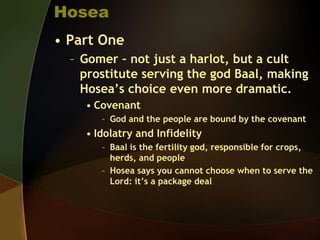
Hosea
• Part One
– Gomer – not just a harlot, but a cult
prostitute serving the god Baal, making
Hosea’s choice even more dramatic.
• Covenant
– God and the people are bound by the covenant

• Idolatry and Infidelity
– Baal is the fertility god, responsible for crops,
herds, and people
– Hosea says you cannot choose when to serve the
Lord: it’s a package deal
Hosea
• Part One
• Understanding God
– God is all that best about human nature

• Land and Desert
– The land is filled with milk and honey;
worshipping Baal will lead to a desert
– In the desert, though, God may court his people
and renew the covenant
Hosea’s children
• Jezreel
– Jehu had royal family executed and
heads sent to Jezreel. God will punish
Jehu and destroy his family ruling in
Israel

• Lo-ruhama (unpitied)
– God no longer pities Israel

• Lo-ammi (not my people)
– Yahweh will not consider Israel his
people any longer
Hosea 11:1-4
•
•
•
•
•
•
•
•
•
•
•
•
•
•

When Israel was a child I loved him,a
out of Egypt* I called my son.b
2The more I called them,
the farther they went from me,
Sacrificing to the Baals
and burning incense to idols.
3Yet it was I who taught Ephraim to walk,
who took them in my arms;c
but they did not know that I cared for them.
4I drew them with human cords,
with bands of love;*
I fostered them like those
who raise an infant to their cheeks;
I bent down to feed them.d

How do
these
images
apply to
our world?
Hosea
• One way of knowing God is
through human experience.
How is God like a faithful
spouse, a loving parent, a
friend seeking a lasting
relationship?
• God’s judgment and
punishment is always
directed toward restoring
relationship.
Amos
• Priest of Bethel
• Shepherd, “dresser of sycamores”
• Religion requires more than ritual
observances; it requires a moral life.
• Harsh critic of Israelite society; 25
years after Amos, Samaria falls to
Assyria.
• Prophet of Doom
Amos
• Concern for justice is passionate
– Demands in all areas of life:
political, economic, judicial
– The fall of Israel is inevitable
because of corruption and injustice.

• Structure of two sentence
pronouncements of sins,
judgment
Amos
• Independent; southerner who
proclaims in the north
• Does not rely on priests or kings
for support
• Prophecies against the king make
the priests nervous
• Independence leads to blunt and
somewhat offensive style
– Cows of Bashan (4:1) to refer to
women of Samaria
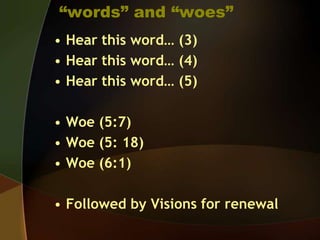
“words” and “woes”
• Hear this word… (3)
• Hear this word… (4)
• Hear this word… (5)
• Woe (5:7)
• Woe (5: 18)
• Woe (6:1)
• Followed by Visions for renewal
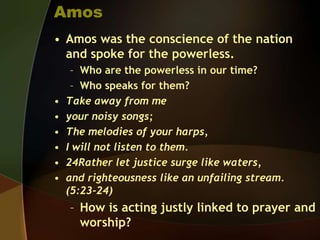
Amos
• Amos was the conscience of the nation
and spoke for the powerless.

•
•
•
•
•
•

– Who are the powerless in our time?
– Who speaks for them?
Take away from me
your noisy songs;
The melodies of your harps,
I will not listen to them.
24Rather let justice surge like waters,
and righteousness like an unfailing stream.
(5:23-24)

– How is acting justly linked to prayer and
worship?
Micah
• Anthology of short speeches
– Judgment speeches
– Salvation speeches

• Concern about the impending
Assyrian invasion and social justice
– Accuses ruling elite of corruption
– Impatience with false prophets
Micah
• Similar to Jeremiah in tone and in
terms of acceptance
• He was a poor peasant –
farmer/shepherd class

• Impending Judgment
– God is coming to judge
– The rich have taken from the poor; the
Assyrians will take from the rich
– Virtue requires justice and facing
reality
Micah
• Uses the Hebrew word hesed for
covenant, which refers to the
steadfast love that binds two parties
together.

• Punishment is deserved, but Micah
still mourns for his people.
• Zion is a plowed field
Micah
• Prophecies of Restoration
– Probably added after Babylonian exile
– Hope after destruction
– Prophecy for Bethlehem

• Indictment of Israel
– Israel’s failure to respond to God’s
faithfulness
– True religion is based on acting justly,
walking humbly, loving tenderly
Micah
• Concluding Indictment and
Prayer
– Only solution to the corruption of
the society is repentance and
reliance on the Lord
– God will forgive a repentant people
and restore them to favor.
Micah
• Prophets who point out the
problems in society are not
popular.
– What true prophets do we have in
our time?
– What “professional” prophets in
our time mislead people in our
time?
Micah
• But you, Bethlehem-Ephrathah
least among the clans of Judah,
From you shall come forth for me
one who is to be ruler in Israel;
Whose origin is from of old,
from ancient times.
• What does this section from Micah
mean for you? Why is it significant
that Jesus will come from Bethlehem?

Minor prophets i

  • 1.
  • 2.
    Amos, Hosea, Micah •Active in the 8th century BC • Focus is on sins of their own people – Social Sin – Cultic Sin (Idolatry, religious abuses) • Contemporaries of Isaiah – Hosea is in the northern kingdom – Micah is in the southern kingdom – Amos is from the south, but working in the north
  • 3.
    Hosea • Images ofmarital infidelity are tied to Israel’s disloyalty – Unfaithful wife who becomes a prostitute • Hosea’s personal experience with his wife, Gomer, is a metaphor for God’s relationship with Israel – Unfaithful wife who becomes a prostitute
  • 4.
    Hosea • Part I:Hosea’s faithless wife – Chapters 1-3 • Part II: Collection of prophetic speeches – Condemns Israel’s behavior – Predicts God’s punishment – Express Hope for renewal
  • 5.
    Hosea • Part One –Gomer – not just a harlot, but a cult prostitute serving the god Baal, making Hosea’s choice even more dramatic. • Covenant – God and the people are bound by the covenant • Idolatry and Infidelity – Baal is the fertility god, responsible for crops, herds, and people – Hosea says you cannot choose when to serve the Lord: it’s a package deal
  • 6.
    Hosea • Part One •Understanding God – God is all that best about human nature • Land and Desert – The land is filled with milk and honey; worshipping Baal will lead to a desert – In the desert, though, God may court his people and renew the covenant
  • 7.
    Hosea’s children • Jezreel –Jehu had royal family executed and heads sent to Jezreel. God will punish Jehu and destroy his family ruling in Israel • Lo-ruhama (unpitied) – God no longer pities Israel • Lo-ammi (not my people) – Yahweh will not consider Israel his people any longer
  • 8.
    Hosea 11:1-4 • • • • • • • • • • • • • • When Israelwas a child I loved him,a out of Egypt* I called my son.b 2The more I called them, the farther they went from me, Sacrificing to the Baals and burning incense to idols. 3Yet it was I who taught Ephraim to walk, who took them in my arms;c but they did not know that I cared for them. 4I drew them with human cords, with bands of love;* I fostered them like those who raise an infant to their cheeks; I bent down to feed them.d How do these images apply to our world?
  • 9.
    Hosea • One wayof knowing God is through human experience. How is God like a faithful spouse, a loving parent, a friend seeking a lasting relationship? • God’s judgment and punishment is always directed toward restoring relationship.
  • 10.
    Amos • Priest ofBethel • Shepherd, “dresser of sycamores” • Religion requires more than ritual observances; it requires a moral life. • Harsh critic of Israelite society; 25 years after Amos, Samaria falls to Assyria. • Prophet of Doom
  • 11.
    Amos • Concern forjustice is passionate – Demands in all areas of life: political, economic, judicial – The fall of Israel is inevitable because of corruption and injustice. • Structure of two sentence pronouncements of sins, judgment
  • 12.
    Amos • Independent; southernerwho proclaims in the north • Does not rely on priests or kings for support • Prophecies against the king make the priests nervous • Independence leads to blunt and somewhat offensive style – Cows of Bashan (4:1) to refer to women of Samaria
  • 13.
    “words” and “woes” •Hear this word… (3) • Hear this word… (4) • Hear this word… (5) • Woe (5:7) • Woe (5: 18) • Woe (6:1) • Followed by Visions for renewal
  • 14.
    Amos • Amos wasthe conscience of the nation and spoke for the powerless. • • • • • • – Who are the powerless in our time? – Who speaks for them? Take away from me your noisy songs; The melodies of your harps, I will not listen to them. 24Rather let justice surge like waters, and righteousness like an unfailing stream. (5:23-24) – How is acting justly linked to prayer and worship?
  • 15.
    Micah • Anthology ofshort speeches – Judgment speeches – Salvation speeches • Concern about the impending Assyrian invasion and social justice – Accuses ruling elite of corruption – Impatience with false prophets
  • 16.
    Micah • Similar toJeremiah in tone and in terms of acceptance • He was a poor peasant – farmer/shepherd class • Impending Judgment – God is coming to judge – The rich have taken from the poor; the Assyrians will take from the rich – Virtue requires justice and facing reality
  • 17.
    Micah • Uses theHebrew word hesed for covenant, which refers to the steadfast love that binds two parties together. • Punishment is deserved, but Micah still mourns for his people. • Zion is a plowed field
  • 18.
    Micah • Prophecies ofRestoration – Probably added after Babylonian exile – Hope after destruction – Prophecy for Bethlehem • Indictment of Israel – Israel’s failure to respond to God’s faithfulness – True religion is based on acting justly, walking humbly, loving tenderly
  • 19.
    Micah • Concluding Indictmentand Prayer – Only solution to the corruption of the society is repentance and reliance on the Lord – God will forgive a repentant people and restore them to favor.
  • 20.
    Micah • Prophets whopoint out the problems in society are not popular. – What true prophets do we have in our time? – What “professional” prophets in our time mislead people in our time?
  • 21.
    Micah • But you,Bethlehem-Ephrathah least among the clans of Judah, From you shall come forth for me one who is to be ruler in Israel; Whose origin is from of old, from ancient times. • What does this section from Micah mean for you? Why is it significant that Jesus will come from Bethlehem?