



Object Recognition and Real-Time
                               Tracking in Microscopy Imaging


 Object Recognition and Real-Time Tracking in Microscopy
                         Imaging

                              Jan Wedekind

                       30th Aug – 1st Sep 2006


                  MMVL         http://www.shu.ac.uk/research/meri/mmvl/
                  MiCRoN       http://wwwipr.ira.uka.de/~micron/
                  Mimas        http://sourceforge.net/projects/mimas/
                  MediaWiki    http://vision.eng.shu.ac.uk/mediawiki/

People: J. Wedekind, M. Boissenin, B.P. Amavasai, F. Caparrelli, J. Travis
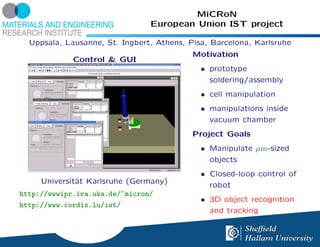
MiCRoN
                                European Union IST project

  Uppsala, Lausanne, St. Ingbert, Athens, Pisa, Barcelona, Karlsruhe
                                           Motivation
             Control & GUI
                                             • prototype
                                               soldering/assembly
                                             • cell manipulation
                                             • manipulations inside
                                               vacuum chamber
                                           Project Goals
                                             • Manipulate µm-sized
                                               objects
                                             • Closed-loop control of
     Universit¨t Karlsruhe (Germany)
              a
                                               robot
http://wwwipr.ira.uka.de/~micron/
                                             • 3D object recognition
http://www.cordis.lu/ist/
                                               and tracking
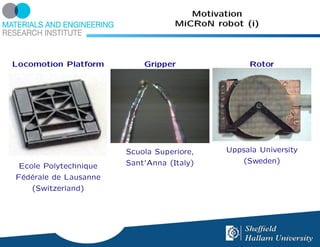
Motivation
                                   MiCRoN robot (i)


Locomotion Platform        Gripper               Rotor


                       Scuola Superiore,    Uppsala University
                       Sant’Anna (Italy)       (Sweden)
 Ecole Polytechnique
F´d´rale de Lausanne
 e e
    (Switzerland)
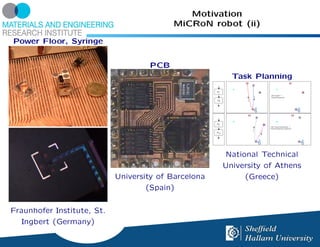
Motivation
                                          MiCRoN robot (ii)

Power Floor, Syringe


                                    PCB
                                                        Task Planning


                                                      National Technical
                                                      University of Athens
                            University of Barcelona        (Greece)
                                    (Spain)


Fraunhofer Institute, St.
   Ingbert (Germany)
Motivation
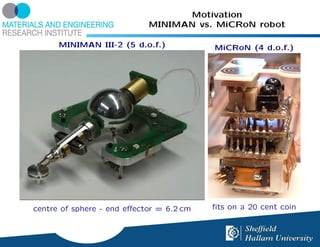
                            MINIMAN vs. MiCRoN robot

      MINIMAN III-2 (5 d.o.f.)            MiCRoN (4 d.o.f.)


centre of sphere - end effector = 6.2 cm   fits on a 20 cent coin
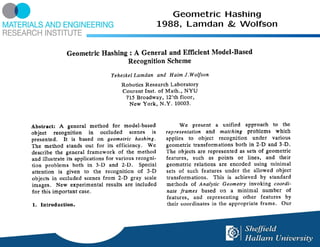
Geometric Hashing
1988, Lamdan & Wolfson
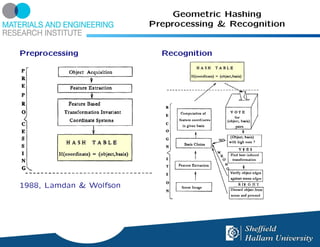
Geometric Hashing
                         Preprocessing & Recognition


Preprocessing              Recognition


1988, Lamdan & Wolfson
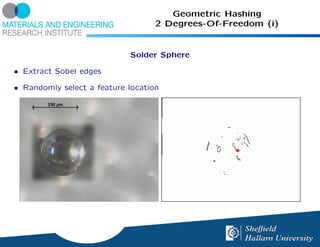
Geometric Hashing
                                   2 Degrees-Of-Freedom (i)


                            Solder Sphere

• Extract Sobel edges

• Randomly select a feature location
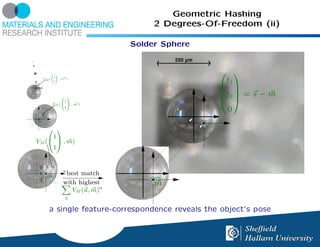
Geometric Hashing
                                        2 Degrees-Of-Freedom (ii)

                                   Solder Sphere


             0 1
              1
                                                         
0 0 1
         VM (@ A , m )
              1                                          t1
3
1
 m                                                       
                 0 1
                                                        t2  = s − m
                  1
                                                         
             VM (@ A , m )
                  1
                                                         0
 2 1 4
 0
 0
   m

                                                  s
      1
 VM (  , m)
      1


        0 5 5
        1
          m        ”best match
        3
                   with highest         m
                      VM (u, m)”
                    u

            a single feature-correspondence reveals the object’s pose
Geometric Hashing
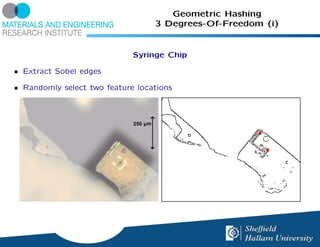
                                  3 Degrees-Of-Freedom (i)


                             Syringe Chip

• Extract Sobel edges

• Randomly select two feature locations
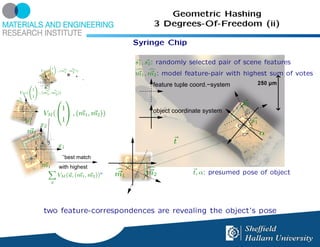
Geometric Hashing
                                                          3 Degrees-Of-Freedom (ii)

                                                    Syringe Chip

                0 1
                                                    s1 , s2 : randomly selected pair of scene features
                 1
            VM (@ A , (m1 , m2 ))
           m2
                 1                                  m1 , m2 : model feature-pair with highest sum of votes
             0 1 0
             2
     0 1     1
            m1
                                                         feature tuple coord.−system
      1
 VM (@ A , (m1 , m2 ))
      1
m2               
                                                                                       s2
  3 2 1
  0
                 1                                       object coordinate system
  1         VM (  , (m1 , m2 ))
    m1           1                                                                          s1
           x2
     m2                                                                                          α
          1 4 5                                                 t
          3
                         x1
          4               ’’best match
            m1           with highest
                         VM (u, (m1 , m2 ))”   m1      m2              t, α: presumed pose of object
                     u


             two feature-correspondences are revealing the object’s pose
Bounded Hough Transform
2001/2004, Greenspan, Shang &
         Jasiobedzki
Bounded Hough Transform
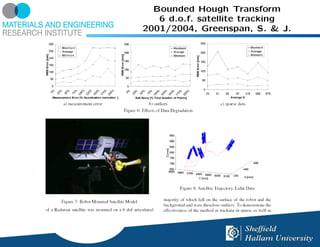
   6 d.o.f. satellite tracking
2001/2004, Greenspan, S. & J.
Bounded Hough Transform
                2 Degrees-Of-Freedom


 Accumulate Votes
                                  t2


                                         t1
model features
scene features
local region
Bounded Hough Transform
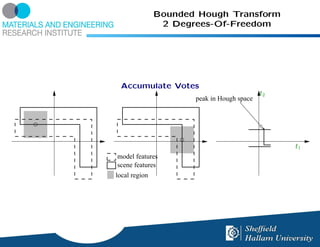
                2 Degrees-Of-Freedom


 Accumulate Votes
                                            t2
                      peak in Hough space


                                                 t1
model features
scene features
local region
Bounded Hough Transform
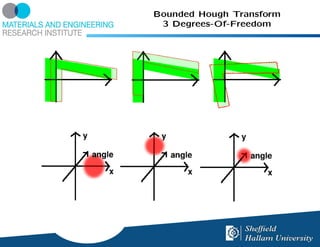
 3 Degrees-Of-Freedom
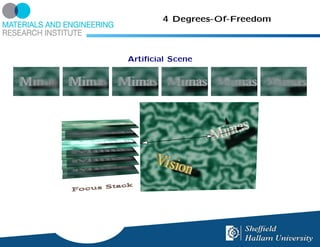
4 Degrees-Of-Freedom


Artificial Scene
Implementation
          Software Architecture

Application Layers
Implementation
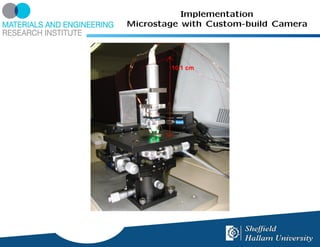
Microstage with Custom-build Camera
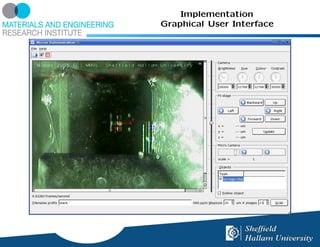
Implementation
Graphical User Interface
Pushing Sugar
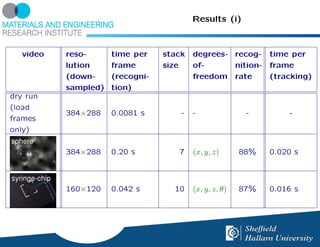
Results (i)


   video   reso-      time per    stack   degrees- recog- time per
           lution     frame       size    of-      nition- frame
           (down-     (recogni-           freedom rate     (tracking)
           sampled)   tion)
dry run
(load
           384×288    0.0081 s        -   -               -        -
frames
only)

           384×288    0.20 s         7    (x, y, z)      88%   0.020 s


           160×120    0.042 s       10    (x, y, z, θ)   87%   0.016 s
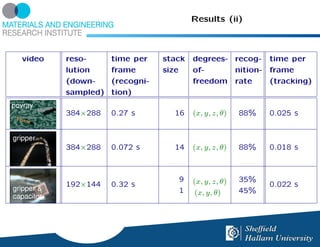
Results (ii)


video   reso-      time per    stack   degrees- recog- time per
        lution     frame       size    of-      nition- frame
        (down-     (recogni-           freedom rate     (tracking)
        sampled)   tion)

        384×288    0.27 s        16    (x, y, z, θ)   88%   0.025 s


        384×288    0.072 s       14    (x, y, z, θ)   88%   0.018 s


                                  9    (x, y, z, θ)   35%
        192×144    0.32 s                                   0.022 s
                                  1     (x, y, θ)     45%
Conclusion


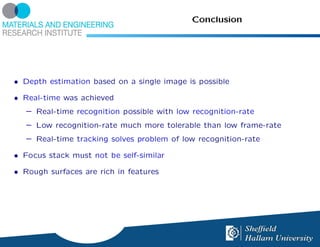
• Depth estimation based on a single image is possible

• Real-time was achieved
   – Real-time recognition possible with low recognition-rate
   – Low recognition-rate much more tolerable than low frame-rate
   – Real-time tracking solves problem of low recognition-rate

• Focus stack must not be self-similar

• Rough surfaces are rich in features
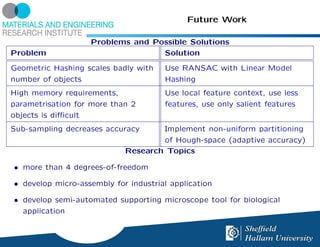
Future Work

                   Problems and Possible Solutions
Problem                           Solution
Geometric Hashing scales badly with   Use RANSAC with Linear Model
number of objects                     Hashing
High memory requirements,             Use local feature context, use less
parametrisation for more than 2       features, use only salient features
objects is difficult
Sub-sampling decreases accuracy     Implement non-uniform partitioning
                                    of Hough-space (adaptive accuracy)
                            Research Topics

• more than 4 degrees-of-freedom

• develop micro-assembly for industrial application

• develop semi-automated supporting microscope tool for biological
  application
Homepage


MMVL official website                 MMVL MediaWiki


www.shu.ac.uk/research/meri/mmvl/   vision.eng.shu.ac.uk/mediawiki/

       Open source MiCRoN vision software + test data
       Open source Mimas real-time computer vision library

Object Recognition and Real-Time Tracking in Microscope Imaging - IMVIP 2006

  • 1.
    Object Recognition andReal-Time Tracking in Microscopy Imaging Object Recognition and Real-Time Tracking in Microscopy Imaging Jan Wedekind 30th Aug – 1st Sep 2006 MMVL http://www.shu.ac.uk/research/meri/mmvl/ MiCRoN http://wwwipr.ira.uka.de/~micron/ Mimas http://sourceforge.net/projects/mimas/ MediaWiki http://vision.eng.shu.ac.uk/mediawiki/ People: J. Wedekind, M. Boissenin, B.P. Amavasai, F. Caparrelli, J. Travis
  • 2.
    MiCRoN European Union IST project Uppsala, Lausanne, St. Ingbert, Athens, Pisa, Barcelona, Karlsruhe Motivation Control & GUI • prototype soldering/assembly • cell manipulation • manipulations inside vacuum chamber Project Goals • Manipulate µm-sized objects • Closed-loop control of Universit¨t Karlsruhe (Germany) a robot http://wwwipr.ira.uka.de/~micron/ • 3D object recognition http://www.cordis.lu/ist/ and tracking
  • 3.
    Motivation MiCRoN robot (i) Locomotion Platform Gripper Rotor Scuola Superiore, Uppsala University Sant’Anna (Italy) (Sweden) Ecole Polytechnique F´d´rale de Lausanne e e (Switzerland)
  • 4.
    Motivation MiCRoN robot (ii) Power Floor, Syringe PCB Task Planning National Technical University of Athens University of Barcelona (Greece) (Spain) Fraunhofer Institute, St. Ingbert (Germany)
  • 5.
    Motivation MINIMAN vs. MiCRoN robot MINIMAN III-2 (5 d.o.f.) MiCRoN (4 d.o.f.) centre of sphere - end effector = 6.2 cm fits on a 20 cent coin
  • 6.
  • 7.
    Geometric Hashing Preprocessing & Recognition Preprocessing Recognition 1988, Lamdan & Wolfson
  • 8.
    Geometric Hashing 2 Degrees-Of-Freedom (i) Solder Sphere • Extract Sobel edges • Randomly select a feature location
  • 9.
    Geometric Hashing 2 Degrees-Of-Freedom (ii) Solder Sphere 0 1 1   0 0 1 VM (@ A , m ) 1 t1 3 1 m   0 1 t2  = s − m 1   VM (@ A , m ) 1 0 2 1 4 0 0 m   s 1 VM (  , m) 1 0 5 5 1 m ”best match 3 with highest m VM (u, m)” u a single feature-correspondence reveals the object’s pose
  • 10.
    Geometric Hashing 3 Degrees-Of-Freedom (i) Syringe Chip • Extract Sobel edges • Randomly select two feature locations
  • 11.
    Geometric Hashing 3 Degrees-Of-Freedom (ii) Syringe Chip 0 1 s1 , s2 : randomly selected pair of scene features 1 VM (@ A , (m1 , m2 )) m2 1 m1 , m2 : model feature-pair with highest sum of votes 0 1 0 2 0 1 1 m1 feature tuple coord.−system 1 VM (@ A , (m1 , m2 )) 1 m2   s2 3 2 1 0 1 object coordinate system 1 VM (  , (m1 , m2 )) m1 1 s1 x2 m2 α 1 4 5 t 3 x1 4 ’’best match m1 with highest VM (u, (m1 , m2 ))” m1 m2 t, α: presumed pose of object u two feature-correspondences are revealing the object’s pose
  • 12.
    Bounded Hough Transform 2001/2004,Greenspan, Shang & Jasiobedzki
  • 13.
    Bounded Hough Transform 6 d.o.f. satellite tracking 2001/2004, Greenspan, S. & J.
  • 14.
    Bounded Hough Transform 2 Degrees-Of-Freedom Accumulate Votes t2 t1 model features scene features local region
  • 15.
    Bounded Hough Transform 2 Degrees-Of-Freedom Accumulate Votes t2 peak in Hough space t1 model features scene features local region
  • 16.
    Bounded Hough Transform 3 Degrees-Of-Freedom
  • 17.
  • 18.
    Implementation Software Architecture Application Layers
  • 19.
  • 20.
  • 21.
  • 22.
    Results (i) video reso- time per stack degrees- recog- time per lution frame size of- nition- frame (down- (recogni- freedom rate (tracking) sampled) tion) dry run (load 384×288 0.0081 s - - - - frames only) 384×288 0.20 s 7 (x, y, z) 88% 0.020 s 160×120 0.042 s 10 (x, y, z, θ) 87% 0.016 s
  • 23.
    Results (ii) video reso- time per stack degrees- recog- time per lution frame size of- nition- frame (down- (recogni- freedom rate (tracking) sampled) tion) 384×288 0.27 s 16 (x, y, z, θ) 88% 0.025 s 384×288 0.072 s 14 (x, y, z, θ) 88% 0.018 s 9 (x, y, z, θ) 35% 192×144 0.32 s 0.022 s 1 (x, y, θ) 45%
  • 24.
    Conclusion • Depth estimationbased on a single image is possible • Real-time was achieved – Real-time recognition possible with low recognition-rate – Low recognition-rate much more tolerable than low frame-rate – Real-time tracking solves problem of low recognition-rate • Focus stack must not be self-similar • Rough surfaces are rich in features
  • 25.
    Future Work Problems and Possible Solutions Problem Solution Geometric Hashing scales badly with Use RANSAC with Linear Model number of objects Hashing High memory requirements, Use local feature context, use less parametrisation for more than 2 features, use only salient features objects is difficult Sub-sampling decreases accuracy Implement non-uniform partitioning of Hough-space (adaptive accuracy) Research Topics • more than 4 degrees-of-freedom • develop micro-assembly for industrial application • develop semi-automated supporting microscope tool for biological application
  • 26.
    Homepage MMVL official website MMVL MediaWiki www.shu.ac.uk/research/meri/mmvl/ vision.eng.shu.ac.uk/mediawiki/ Open source MiCRoN vision software + test data Open source Mimas real-time computer vision library