Week 5


융합리서치
방법론 + 실습 (Theory & Practice)
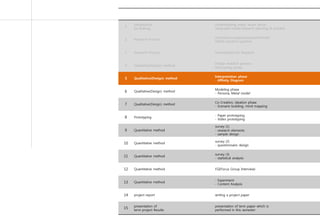
Introduction                 understanding major issues about
1    Ice Braking                  integrated media research planning & practice

                                  Overview(concept/purpose/methods)
2    Research Process
                                  Define research question


3    Research Process             Secondary(Desk) Research


                                  Design research process
4    Qualitative(Design) method
                                  Discovering phase

                                  Interpretation phase
5    Qualitative(Design) method
                                  - Affinity Diagram

                                  Modeling phase
6    Qualitative(Design) method
                                  - Persona, Metal model

                                  Co-Creation, ideation phase
7    Qualitative(Design) method
                                  - Scenario building, mind mapping

                                  - Paper prototyping
8    Prototyping
                                  - Video prototyping

                                  survey (1)
9    Quantitative method          - research elements
                                  - sample design

                                  survey (2)
10   Quantitative method
                                  - questionnaire design

                                  survey (3)
11   Quantitative method
                                  - statistical analysis


12   Quantitative method          FGI(Focus Group Interview)


                                  - Experiment
13   Quantitative method
                                  - Content Analysis


14   project report               writing a project paper


     presentation of              presentation of term paper which is
15   term project Results         performed in this semester
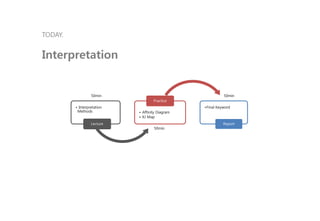
TODAY.


Interpretation


                  50min                                    50min
                 50min              Practice
                                                         50min
         • Interpretation                        •Final Keyword
          Methods           • Affinity Diagram
                            • KJ Map
                  Lecture                                  Report
                                    50min
                                   100min
HaNd Held Media


1
                                           KGIT 2011 Spring Semester | JYLEE


Mapping Technology
Identifying criteria,
Developing Strategic frameworks,
Specifying and Scoping out of details.
Turning complex data into insights


                                                 HHM.jylee6977.com/tc
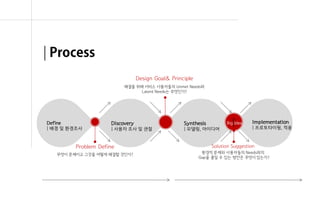
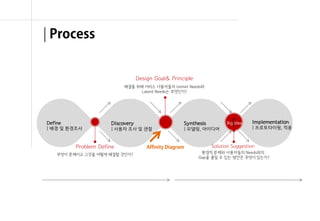
| Process
                                 Design Goal& Principle
                          해결을 위해 서비스 사용자들의 Unmet Needs와
                                Latent Needs는 무엇인가?


Define
| 배경 및 환경조사
                     Discovery
                     | 사용자 조사 및 관찰
                                                   Synthesis
                                                   | 모델링, 아이디어
                                                                       !
                                                                     Big Idea      Implementation
                                                                                   | 프로토타이핑, 적용


         Problem Define                                        Solution Suggestion
   무엇이 문제이고 그것을 어떻게 해결할 것인가?                               환경적 문제와 사용자들의 Needs와의
                                                          Gap을 줄일 수 있는 방안은 무엇이 있는가?


                                                                           융합리서치 방법론 & 실습 | WEEK 5 : Interpretation
| Mapping Methodologies

 Giving strategic direction
Identifying criteria, developing
Strategic frameworks, specifying and
Scoping out of details. Turning complex data
into insights

Requirements
Information about context, client, service provider, constraints and market place

Considerations
Mapping is always based on information. The strategy and direction is only
as good as the facts they are based on.


                                                                                    융합리서치 방법론 & 실습 | WEEK 5 : Interpretation
| Process


                                 Design Goal& Principle
                          해결을 위해 서비스 사용자들의 Unmet Needs와
                                Latent Needs는 무엇인가?


Define
| 배경 및 환경조사
                     Discovery
                     | 사용자 조사 및 관찰
                                                    Synthesis
                                                    | 모델링, 아이디어
                                                                        !
                                                                      Big Idea      Implementation
                                                                                    | 프로토타이핑, 적용


         Problem Define              Affinity Diagram           Solution Suggestion
   무엇이 문제이고 그것을 어떻게 해결할 것인가?                               환경적 문제와 사용자들의 Needs와의
                                                          Gap을 줄일 수 있는 방안은 무엇이 있는가?


                                                                            융합리서치 방법론 & 실습 | WEEK 5 : Interpretation
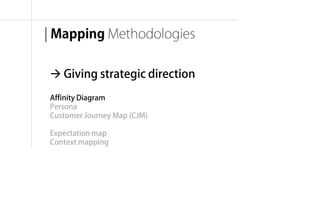
| Mapping Methodologies


 Giving strategic direction
Affinity Diagram
Persona
Customer Journey Map (CJM)

Expectation map
Context mapping


                               융합리서치 방법론 & 실습 | WEEK 5 : Interpretation
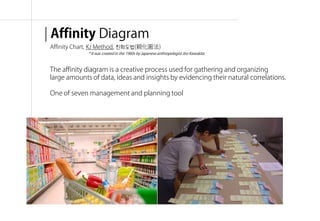
| Affinity Diagram
Affinity Chart, KJ Method, 친화도법(親化圖法)
             * It was created in the 1960s by Japanese anthropologist Jiro Kawakita.


The affinity diagram is a creative process used for gathering and organizing
large amounts of data, ideas and insights by evidencing their natural correlations.

One of seven management and planning tool


                                                                                       융합리서치 방법론 & 실습 | WEEK 5 : Interpretation
| Affinity Diagram
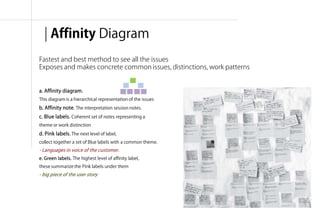
Fastest and best method to see all the issues
Exposes and makes concrete common issues, distinctions, work patterns


a. Affinity diagram.
This diagram is a hierarchical representation of the issues
b. Affinity note. The interpretation session notes.
c. Blue labels. Coherent set of notes representing a
theme or work distinction
d. Pink labels. The next level of label,
collect together a set of Blue labels with a common theme.
- Languages in voice of the customer.
e. Green labels. The highest level of affinity label,
these summarize the Pink labels under them
- big piece of the user story


                                                                융합리서치 방법론 & 실습 | WEEK 5 : Interpretation
| Affinity Diagram


                     융합리서치 방법론 & 실습 | WEEK 5 : Interpretation
| Affinity Diagram

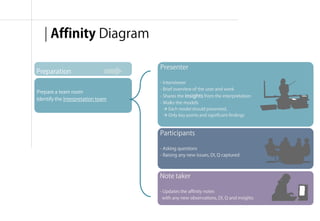
                                   Presenter
Preparation
                                   - Interviewer
                                   - Brief overview of the user and work
Prepare a team room
                                   - Shares the insights from the interpretation
Identify the interpretation team
                                   - Walks the models
                                      Each model should presented,
                                      Only key points and significant findings


                                   Participants

                                   - Asking questions
                                   - Raising any new issues, DI, Q captured


                                   Note taker

                                   - Updates the affinity notes
                                     with any new observations, DI, Q and insights


                                                                           융합리서치 방법론 & 실습 | WEEK 5 : Interpretation
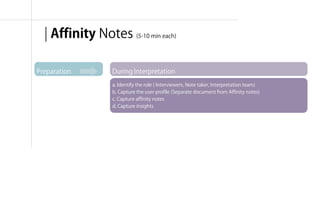
| Affinity Notes (5-10 min each)

Preparation       During Interpretation
                  a. Identify the role ( Interviewers, Note taker, Interpretation team)
                  b. Capture the user profile (Separate document from Affinity notes)
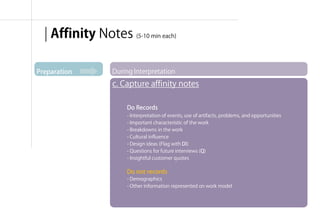
                  c. Capture affinity notes
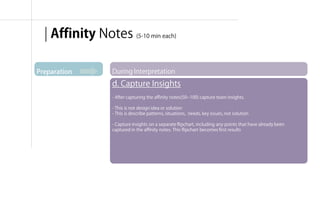
                  d. Capture insights


                                                                            융합리서치 방법론 & 실습 | WEEK 5 : Interpretation
| Affinity Notes (5-10 min each)

Preparation       During Interpretation
                  c. Capture affinity notes

                      Do Records
                      - Interpretation of events, use of artifacts, problems, and opportunities
                      - Important characteristic of the work
                      - Breakdowns in the work
                      - Cultural influence
                      - Design ideas (Flag with DI)
                      - Questions for future interviews (Q)
                      - Insightful customer quotes

                      Do not records
                      - Demographics
                      - Other information represented on work model


                                                                         융합리서치 방법론 & 실습 | WEEK 5 : Interpretation
| Affinity Notes (5-10 min each)

Preparation       During Interpretation
                  d. Capture Insights
                  - After capturing the affinity notes(50~100) capture team insights.

                  - This is not design idea or solution
                  - This is describe patterns, situations, needs, key issues, not solution

                  - Capture insights on a separate flipchart, including any points that have already been
                  captured in the affinity notes. This flipchart becomes first results


                                                                                   융합리서치 방법론 & 실습 | WEEK 5 : Interpretation
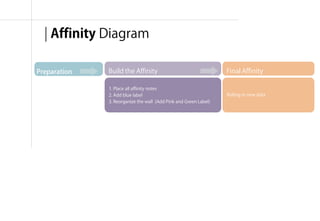
| Affinity Diagram

Preparation   Build the Affinity                                  Final Affinity

              1. Place all affinity notes
              2. Add blue label                                   Rolling in new data
              3. Reorganize the wall (Add Pink and Green Label)


                                                                      융합리서치 방법론 & 실습 | WEEK 5 : Interpretation
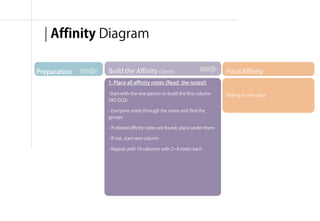
| Affinity Diagram

Preparation   Build the Affinity (10min)                                Final Affinity
              1. Place all affinity notes (Read the notes!)

              -Start with the one person to build the first column      Rolling in new data
              (NO DI,Q)

              - Everyone reads through the notes and find the
              groups

              - If related affinity notes are found, place under them

              - If not, start new column

              - Repeat until 10 columns with 2~4 notes each


                                                                            융합리서치 방법론 & 실습 | WEEK 5 : Interpretation
| Affinity Diagram

Preparation   Build the Affinity (5min)                           Final Affinity
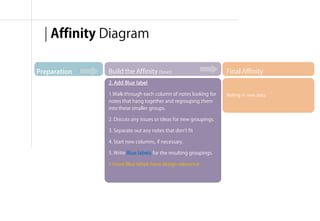
              2. Add Blue label

              1.Walk through each column of notes looking for     Rolling in new data
              notes that hang together and regrouping them
              into these smaller groups.

              2. Discuss any issues or ideas for new groupings.

              3. Separate out any notes that don’t fit

              4. Start new columns, if necessary.

              5. Write Blue labels for the resulting groupings.

              !! Good Blue labels have design relevance


                                                                      융합리서치 방법론 & 실습 | WEEK 5 : Interpretation
| Affinity Diagram

Preparation   Build the Affinity (10min)                           Final Affinity
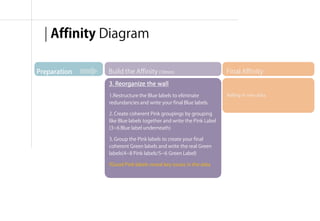
              3. Reorganize the wall

              1.Restructure the Blue labels to eliminate           Rolling in new data
              redundancies and write your final Blue labels.

              2. Create coherent Pink groupings by grouping
              like Blue labels together and write the Pink Label
              (3~6 Blue label underneath)

              3. Group the Pink labels to create your final
              coherent Green labels and write the real Green
              labels(4~8 Pink labels/5~6 Green Label)

              !!Good Pink labels reveal key issues in the data


                                                                       융합리서치 방법론 & 실습 | WEEK 5 : Interpretation
| Affinity Diagram

Preparation   Build the Affinity           Final Affinity
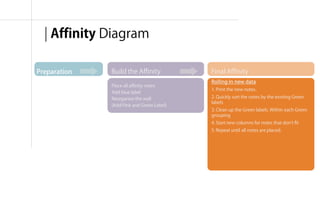
                                           Rolling in new data
              Place all affinity notes
                                           1. Print the new notes.
              Add blue label
              Reorganize the wall          2. Quickly sort the notes by the existing Green
                                           labels
              (Add Pink and Green Label)
                                           3. Clean up the Green labels. Within each Green
                                           grouping
                                           4. Start new columns for notes that don’t fit
                                           5. Repeat until all notes are placed.


                                                        융합리서치 방법론 & 실습 | WEEK 5 : Interpretation
| Affinity Diagram

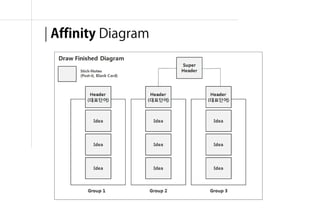
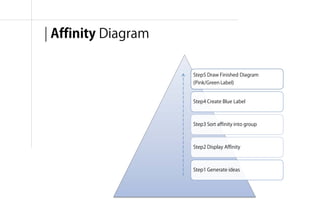
                     Step5 Draw Finished Diagram
                     (Pink/Green Label)


                     Step4 Create Blue Label


                     Step3 Sort affinity into group


                     Step2 Display Affinity


                     Step1 Generate ideas


                                          융합리서치 방법론 & 실습 | WEEK 5 : Interpretation
HaNd Held Media
                        KGIT 2011 Spring Semester | JYLEE


For Next 50 min
>> Affinity Diagram


                              HHM.jylee6977.com/tc
HaNd Held Media
                                   KGIT 2011 Spring Semester | JYLEE


Do your research!
>> Next Week :
PERSONA | Bring Magazines/Photos


                                         HHM.jylee6977.com/tc
HaNd Held Media
        KGIT 2011 Spring Semester | JYLEE


Q&A
              HHM.jylee6977.com/tc

[Imr]week5

  • 1.
    Week 5 융합리서치 방법론 +실습 (Theory & Practice)
  • 2.
    Introduction understanding major issues about 1 Ice Braking integrated media research planning & practice Overview(concept/purpose/methods) 2 Research Process Define research question 3 Research Process Secondary(Desk) Research Design research process 4 Qualitative(Design) method Discovering phase Interpretation phase 5 Qualitative(Design) method - Affinity Diagram Modeling phase 6 Qualitative(Design) method - Persona, Metal model Co-Creation, ideation phase 7 Qualitative(Design) method - Scenario building, mind mapping - Paper prototyping 8 Prototyping - Video prototyping survey (1) 9 Quantitative method - research elements - sample design survey (2) 10 Quantitative method - questionnaire design survey (3) 11 Quantitative method - statistical analysis 12 Quantitative method FGI(Focus Group Interview) - Experiment 13 Quantitative method - Content Analysis 14 project report writing a project paper presentation of presentation of term paper which is 15 term project Results performed in this semester
  • 3.
    TODAY. Interpretation 50min 50min 50min Practice 50min • Interpretation •Final Keyword Methods • Affinity Diagram • KJ Map Lecture Report 50min 100min
  • 4.
    HaNd Held Media 1 KGIT 2011 Spring Semester | JYLEE Mapping Technology Identifying criteria, Developing Strategic frameworks, Specifying and Scoping out of details. Turning complex data into insights HHM.jylee6977.com/tc
  • 5.
    | Process Design Goal& Principle 해결을 위해 서비스 사용자들의 Unmet Needs와 Latent Needs는 무엇인가? Define | 배경 및 환경조사 Discovery | 사용자 조사 및 관찰 Synthesis | 모델링, 아이디어 ! Big Idea Implementation | 프로토타이핑, 적용 Problem Define Solution Suggestion 무엇이 문제이고 그것을 어떻게 해결할 것인가? 환경적 문제와 사용자들의 Needs와의 Gap을 줄일 수 있는 방안은 무엇이 있는가? 융합리서치 방법론 & 실습 | WEEK 5 : Interpretation
  • 6.
    | Mapping Methodologies Giving strategic direction Identifying criteria, developing Strategic frameworks, specifying and Scoping out of details. Turning complex data into insights Requirements Information about context, client, service provider, constraints and market place Considerations Mapping is always based on information. The strategy and direction is only as good as the facts they are based on. 융합리서치 방법론 & 실습 | WEEK 5 : Interpretation
  • 7.
    | Process Design Goal& Principle 해결을 위해 서비스 사용자들의 Unmet Needs와 Latent Needs는 무엇인가? Define | 배경 및 환경조사 Discovery | 사용자 조사 및 관찰 Synthesis | 모델링, 아이디어 ! Big Idea Implementation | 프로토타이핑, 적용 Problem Define Affinity Diagram Solution Suggestion 무엇이 문제이고 그것을 어떻게 해결할 것인가? 환경적 문제와 사용자들의 Needs와의 Gap을 줄일 수 있는 방안은 무엇이 있는가? 융합리서치 방법론 & 실습 | WEEK 5 : Interpretation
  • 8.
    | Mapping Methodologies Giving strategic direction Affinity Diagram Persona Customer Journey Map (CJM) Expectation map Context mapping 융합리서치 방법론 & 실습 | WEEK 5 : Interpretation
  • 9.
    | Affinity Diagram AffinityChart, KJ Method, 친화도법(親化圖法) * It was created in the 1960s by Japanese anthropologist Jiro Kawakita. The affinity diagram is a creative process used for gathering and organizing large amounts of data, ideas and insights by evidencing their natural correlations. One of seven management and planning tool 융합리서치 방법론 & 실습 | WEEK 5 : Interpretation
  • 10.
    | Affinity Diagram Fastestand best method to see all the issues Exposes and makes concrete common issues, distinctions, work patterns a. Affinity diagram. This diagram is a hierarchical representation of the issues b. Affinity note. The interpretation session notes. c. Blue labels. Coherent set of notes representing a theme or work distinction d. Pink labels. The next level of label, collect together a set of Blue labels with a common theme. - Languages in voice of the customer. e. Green labels. The highest level of affinity label, these summarize the Pink labels under them - big piece of the user story 융합리서치 방법론 & 실습 | WEEK 5 : Interpretation
  • 11.
    | Affinity Diagram 융합리서치 방법론 & 실습 | WEEK 5 : Interpretation
  • 12.
    | Affinity Diagram Presenter Preparation - Interviewer - Brief overview of the user and work Prepare a team room - Shares the insights from the interpretation Identify the interpretation team - Walks the models  Each model should presented,  Only key points and significant findings Participants - Asking questions - Raising any new issues, DI, Q captured Note taker - Updates the affinity notes with any new observations, DI, Q and insights 융합리서치 방법론 & 실습 | WEEK 5 : Interpretation
  • 13.
    | Affinity Notes(5-10 min each) Preparation During Interpretation a. Identify the role ( Interviewers, Note taker, Interpretation team) b. Capture the user profile (Separate document from Affinity notes) c. Capture affinity notes d. Capture insights 융합리서치 방법론 & 실습 | WEEK 5 : Interpretation
  • 14.
    | Affinity Notes(5-10 min each) Preparation During Interpretation c. Capture affinity notes Do Records - Interpretation of events, use of artifacts, problems, and opportunities - Important characteristic of the work - Breakdowns in the work - Cultural influence - Design ideas (Flag with DI) - Questions for future interviews (Q) - Insightful customer quotes Do not records - Demographics - Other information represented on work model 융합리서치 방법론 & 실습 | WEEK 5 : Interpretation
  • 15.
    | Affinity Notes(5-10 min each) Preparation During Interpretation d. Capture Insights - After capturing the affinity notes(50~100) capture team insights. - This is not design idea or solution - This is describe patterns, situations, needs, key issues, not solution - Capture insights on a separate flipchart, including any points that have already been captured in the affinity notes. This flipchart becomes first results 융합리서치 방법론 & 실습 | WEEK 5 : Interpretation
  • 16.
    | Affinity Diagram Preparation Build the Affinity Final Affinity 1. Place all affinity notes 2. Add blue label Rolling in new data 3. Reorganize the wall (Add Pink and Green Label) 융합리서치 방법론 & 실습 | WEEK 5 : Interpretation
  • 17.
    | Affinity Diagram Preparation Build the Affinity (10min) Final Affinity 1. Place all affinity notes (Read the notes!) -Start with the one person to build the first column Rolling in new data (NO DI,Q) - Everyone reads through the notes and find the groups - If related affinity notes are found, place under them - If not, start new column - Repeat until 10 columns with 2~4 notes each 융합리서치 방법론 & 실습 | WEEK 5 : Interpretation
  • 18.
    | Affinity Diagram Preparation Build the Affinity (5min) Final Affinity 2. Add Blue label 1.Walk through each column of notes looking for Rolling in new data notes that hang together and regrouping them into these smaller groups. 2. Discuss any issues or ideas for new groupings. 3. Separate out any notes that don’t fit 4. Start new columns, if necessary. 5. Write Blue labels for the resulting groupings. !! Good Blue labels have design relevance 융합리서치 방법론 & 실습 | WEEK 5 : Interpretation
  • 19.
    | Affinity Diagram Preparation Build the Affinity (10min) Final Affinity 3. Reorganize the wall 1.Restructure the Blue labels to eliminate Rolling in new data redundancies and write your final Blue labels. 2. Create coherent Pink groupings by grouping like Blue labels together and write the Pink Label (3~6 Blue label underneath) 3. Group the Pink labels to create your final coherent Green labels and write the real Green labels(4~8 Pink labels/5~6 Green Label) !!Good Pink labels reveal key issues in the data 융합리서치 방법론 & 실습 | WEEK 5 : Interpretation
  • 20.
    | Affinity Diagram Preparation Build the Affinity Final Affinity Rolling in new data Place all affinity notes 1. Print the new notes. Add blue label Reorganize the wall 2. Quickly sort the notes by the existing Green labels (Add Pink and Green Label) 3. Clean up the Green labels. Within each Green grouping 4. Start new columns for notes that don’t fit 5. Repeat until all notes are placed. 융합리서치 방법론 & 실습 | WEEK 5 : Interpretation
  • 21.
    | Affinity Diagram Step5 Draw Finished Diagram (Pink/Green Label) Step4 Create Blue Label Step3 Sort affinity into group Step2 Display Affinity Step1 Generate ideas 융합리서치 방법론 & 실습 | WEEK 5 : Interpretation
  • 22.
    HaNd Held Media KGIT 2011 Spring Semester | JYLEE For Next 50 min >> Affinity Diagram HHM.jylee6977.com/tc
  • 23.
    HaNd Held Media KGIT 2011 Spring Semester | JYLEE Do your research! >> Next Week : PERSONA | Bring Magazines/Photos HHM.jylee6977.com/tc
  • 24.
    HaNd Held Media KGIT 2011 Spring Semester | JYLEE Q&A HHM.jylee6977.com/tc