
The Parliament
Does turning ideas into law
sustain community standards?
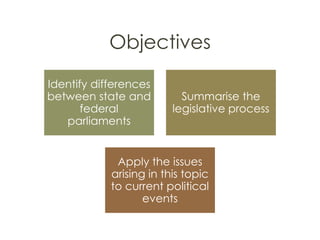
Objectives
Identify differences
between state and
federal
parliaments
Summarise the
legislative process
Apply the issues
arising in this topic
to current political
events
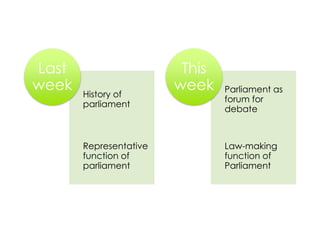
History of
parliament
Representative
function of
parliament
Last
week Parliament as
forum for
debate
Law-making
function of
Parliament
This
week
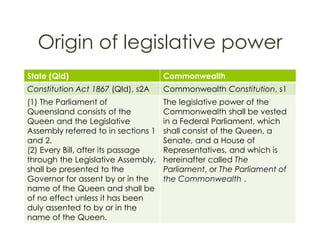
Origin of legislative power
State (Qld) Commonwealth
Constitution Act 1867 (Qld), s2A Commonwealth Constitution, s1
(1) The Parliament of
Queensland consists of the
Queen and the Legislative
Assembly referred to in sections 1
and 2.
(2) Every Bill, after its passage
through the Legislative Assembly,
shall be presented to the
Governor for assent by or in the
name of the Queen and shall be
of no effect unless it has been
duly assented to by or in the
name of the Queen.
The legislative power of the
Commonwealth shall be vested
in a Federal Parliament, which
shall consist of the Queen, a
Senate, and a House of
Representatives, and which is
hereinafter called The
Parliament, or The Parliament of
the Commonwealth .
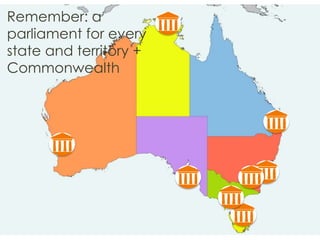
Remember: a
parliament for every
state and territory +
Commonwealth
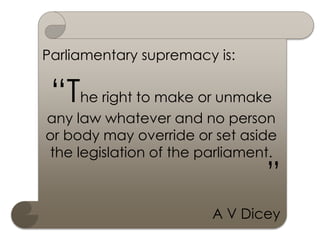
Parliamentary supremacy is:
“The right to make or unmake
any law whatever and no person
or body may override or set aside
the legislation of the parliament.
”
A V Dicey
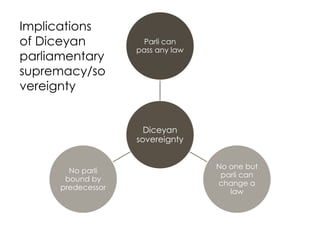
Diceyan
sovereignty
Parli can
pass any law
No one but
parli can
change a
law
No parli
bound by
predecessor
Implications
of Diceyan
parliamentary
supremacy/so
vereignty
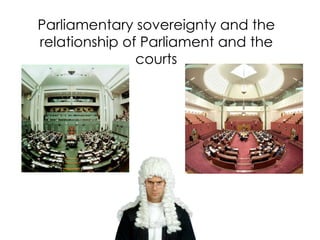
Parliamentary sovereignty and the
relationship of Parliament and the
courts
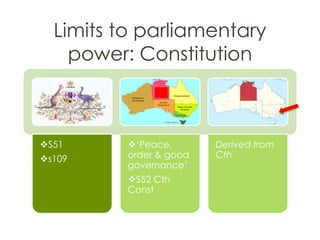
Limits to parliamentary
power: Constitution
S51
s109
‘Peace,
order & good
governance’
S52 Cth
Const
Derived from
Cth
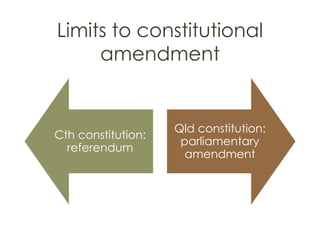
Limits to constitutional
amendment
Cth constitution:
referendum
Qld constitution:
parliamentary
amendment
Note entrenched
provisions in Qld
Constitution
http://www.arkive.org/mole/talpa-europaea/image-A20355.html
And the double
entrenchment
provisions
http://ashfieldallotments.co.uk/index.php/double-digging/
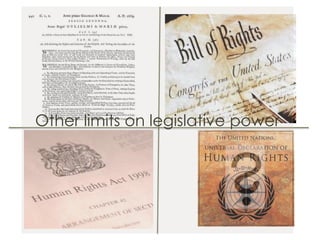
Other limits on legislative power
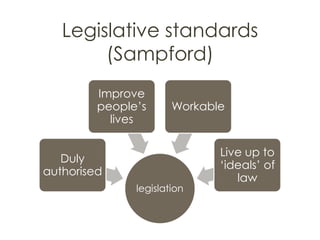
Legislative standards
(Sampford)
legislation
Duly
authorised
Improve
people’s
lives
Workable
Live up to
‘ideals’ of
law
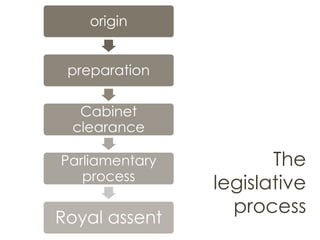
The
legislative
process
origin
preparation
Cabinet
clearance
Parliamentary
process
Royal assent
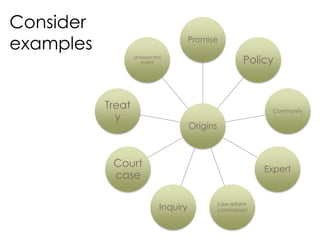
Origins
Promise
Policy
Community
Expert
Law reform
commissionInquiry
Court
case
Treat
y
Unexpected
event
Consider
examples
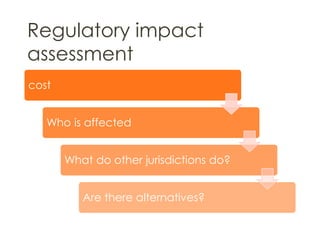
Regulatory impact
assessment
cost
Who is affected
What do other jurisdictions do?
Are there alternatives?
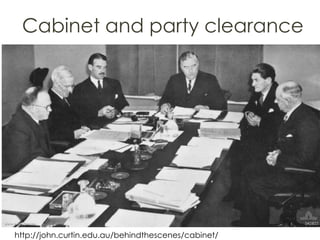
Cabinet and party clearance
http://john.curtin.edu.au/behindthescenes/cabinet/
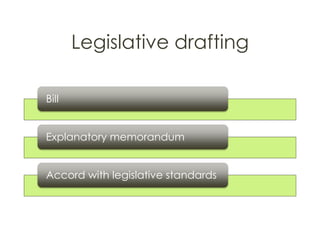
Legislative drafting
Bill
Explanatory memorandum
Accord with legislative standards
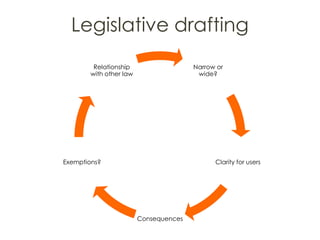
Legislative drafting
Narrow or
wide?
Clarity for users
Consequences
Exemptions?
Relationship
with other law
How hard can
it be?
drafting
legislation
Draft a statutory provision to
address this issue:
What is ‘stealing’?
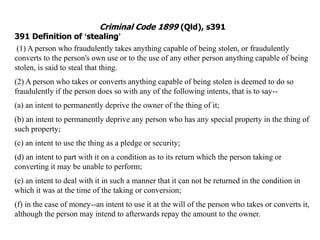
Criminal Code 1899 (Qld), s391
391 Definition of ‘stealing’
(1) A person who fraudulently takes anything capable of being stolen, or fraudulently
converts to the person's own use or to the use of any other person anything capable of being
stolen, is said to steal that thing.
(2) A person who takes or converts anything capable of being stolen is deemed to do so
fraudulently if the person does so with any of the following intents, that is to say--
(a) an intent to permanently deprive the owner of the thing of it;
(b) an intent to permanently deprive any person who has any special property in the thing of
such property;
(c) an intent to use the thing as a pledge or security;
(d) an intent to part with it on a condition as to its return which the person taking or
converting it may be unable to perform;
(e) an intent to deal with it in such a manner that it can not be returned in the condition in
which it was at the time of the taking or conversion;
(f) in the case of money--an intent to use it at the will of the person who takes or converts it,
although the person may intend to afterwards repay the amount to the owner.
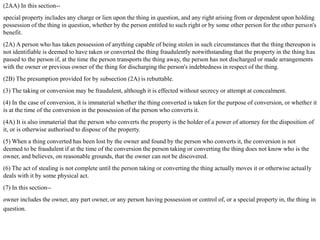
(2AA) In this section--
special property includes any charge or lien upon the thing in question, and any right arising from or dependent upon holding
possession of the thing in question, whether by the person entitled to such right or by some other person for the other person's
benefit.
(2A) A person who has taken possession of anything capable of being stolen in such circumstances that the thing thereupon is
not identifiable is deemed to have taken or converted the thing fraudulently notwithstanding that the property in the thing has
passed to the person if, at the time the person transports the thing away, the person has not discharged or made arrangements
with the owner or previous owner of the thing for discharging the person's indebtedness in respect of the thing.
(2B) The presumption provided for by subsection (2A) is rebuttable.
(3) The taking or conversion may be fraudulent, although it is effected without secrecy or attempt at concealment.
(4) In the case of conversion, it is immaterial whether the thing converted is taken for the purpose of conversion, or whether it
is at the time of the conversion in the possession of the person who converts it.
(4A) It is also immaterial that the person who converts the property is the holder of a power of attorney for the disposition of
it, or is otherwise authorised to dispose of the property.
(5) When a thing converted has been lost by the owner and found by the person who converts it, the conversion is not
deemed to be fraudulent if at the time of the conversion the person taking or converting the thing does not know who is the
owner, and believes, on reasonable grounds, that the owner can not be discovered.
(6) The act of stealing is not complete until the person taking or converting the thing actually moves it or otherwise actually
deals with it by some physical act.
(7) In this section--
owner includes the owner, any part owner, or any person having possession or control of, or a special property in, the thing in
question.
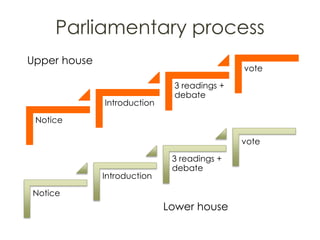
Parliamentary process
Notice
Introduction
3 readings +
debate
vote
Notice
Introduction
3 readings +
debate
vote
Lower house
Upper house
Deadlocks
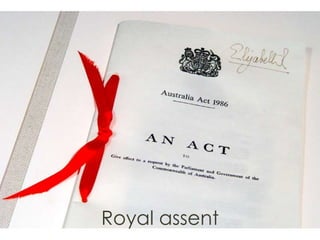
Royal assent
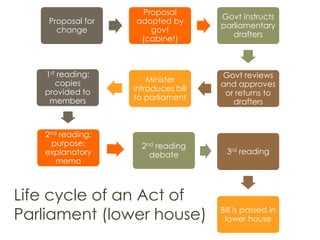
Proposal for
change
Proposal
adopted by
govt
(cabinet)
Govt instructs
parliamentary
drafters
Govt reviews
and approves
or returns to
drafters
Minister
introduces bill
to parliament
1st reading:
copies
provided to
members
2nd reading:
purpose;
explanatory
memo
2nd reading
debate 3rd reading
Bill is passed in
lower house
Life cycle of an Act of
Parliament (lower house)
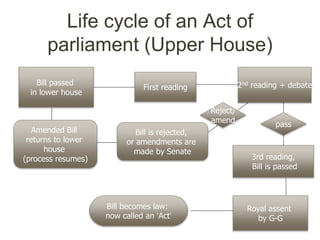
Life cycle of an Act of
parliament (Upper House)
Bill passed
in lower house
First reading
3rd reading,
Bill is passed
Royal assent
by G-G
Bill is rejected,
or amendments are
made by Senate
Amended Bill
returns to lower
house
(process resumes)
Reject/
amend
2nd reading + debate
pass
Bill becomes law:
now called an ‘Act’
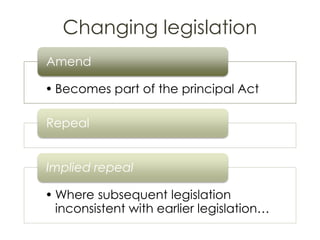
Changing legislation
• Becomes part of the principal Act
Amend
Repeal
• Where subsequent legislation
inconsistent with earlier legislation…
Implied repeal
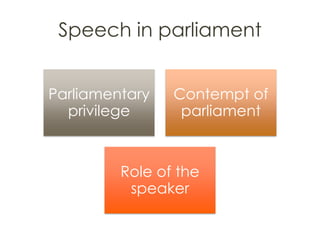
Speech in parliament
Parliamentary
privilege
Contempt of
parliament
Role of the
speaker
Think about the legislative
process…
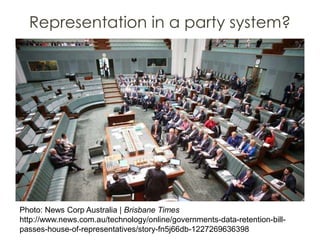
Representation in a party system?
Photo: News Corp Australia | Brisbane Times
http://www.news.com.au/technology/online/governments-data-retention-bill-
passes-house-of-representatives/story-fn5j66db-1227269636398
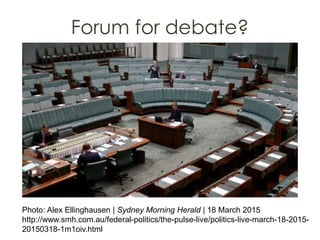
Forum for debate?
Photo: Alex Ellinghausen | Sydney Morning Herald | 18 March 2015
http://www.smh.com.au/federal-politics/the-pulse-live/politics-live-march-18-2015-
20150318-1m1oiv.html
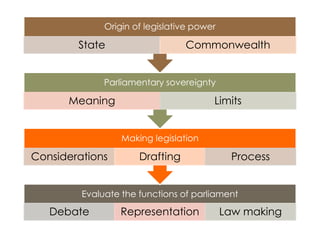
Evaluate the functions of parliament
Debate Representation Law making
Making legislation
Considerations Drafting Process
Parliamentary sovereignty
Meaning Limits
Origin of legislative power
State Commonwealth

The Parliament: Its Law-making Function

  • 1.
    The Parliament Does turningideas into law sustain community standards?
  • 2.
    Objectives Identify differences between stateand federal parliaments Summarise the legislative process Apply the issues arising in this topic to current political events
  • 3.
    History of parliament Representative function of parliament Last weekParliament as forum for debate Law-making function of Parliament This week
  • 4.
    Origin of legislativepower State (Qld) Commonwealth Constitution Act 1867 (Qld), s2A Commonwealth Constitution, s1 (1) The Parliament of Queensland consists of the Queen and the Legislative Assembly referred to in sections 1 and 2. (2) Every Bill, after its passage through the Legislative Assembly, shall be presented to the Governor for assent by or in the name of the Queen and shall be of no effect unless it has been duly assented to by or in the name of the Queen. The legislative power of the Commonwealth shall be vested in a Federal Parliament, which shall consist of the Queen, a Senate, and a House of Representatives, and which is hereinafter called The Parliament, or The Parliament of the Commonwealth .
  • 5.
    Remember: a parliament forevery state and territory + Commonwealth
  • 6.
    Parliamentary supremacy is: “Theright to make or unmake any law whatever and no person or body may override or set aside the legislation of the parliament. ” A V Dicey
  • 7.
    Diceyan sovereignty Parli can pass anylaw No one but parli can change a law No parli bound by predecessor Implications of Diceyan parliamentary supremacy/so vereignty
  • 8.
    Parliamentary sovereignty andthe relationship of Parliament and the courts
  • 9.
    Limits to parliamentary power:Constitution S51 s109 ‘Peace, order & good governance’ S52 Cth Const Derived from Cth
  • 10.
    Limits to constitutional amendment Cthconstitution: referendum Qld constitution: parliamentary amendment
  • 11.
    Note entrenched provisions inQld Constitution http://www.arkive.org/mole/talpa-europaea/image-A20355.html
  • 12.
  • 13.
    Other limits onlegislative power
  • 14.
  • 15.
  • 16.
  • 17.
    Regulatory impact assessment cost Who isaffected What do other jurisdictions do? Are there alternatives?
  • 18.
    Cabinet and partyclearance http://john.curtin.edu.au/behindthescenes/cabinet/
  • 19.
  • 20.
    Legislative drafting Narrow or wide? Clarityfor users Consequences Exemptions? Relationship with other law
  • 21.
    How hard can itbe? drafting legislation
  • 22.
    Draft a statutoryprovision to address this issue: What is ‘stealing’?
  • 23.
    Criminal Code 1899(Qld), s391 391 Definition of ‘stealing’ (1) A person who fraudulently takes anything capable of being stolen, or fraudulently converts to the person's own use or to the use of any other person anything capable of being stolen, is said to steal that thing. (2) A person who takes or converts anything capable of being stolen is deemed to do so fraudulently if the person does so with any of the following intents, that is to say-- (a) an intent to permanently deprive the owner of the thing of it; (b) an intent to permanently deprive any person who has any special property in the thing of such property; (c) an intent to use the thing as a pledge or security; (d) an intent to part with it on a condition as to its return which the person taking or converting it may be unable to perform; (e) an intent to deal with it in such a manner that it can not be returned in the condition in which it was at the time of the taking or conversion; (f) in the case of money--an intent to use it at the will of the person who takes or converts it, although the person may intend to afterwards repay the amount to the owner.
  • 24.
    (2AA) In thissection-- special property includes any charge or lien upon the thing in question, and any right arising from or dependent upon holding possession of the thing in question, whether by the person entitled to such right or by some other person for the other person's benefit. (2A) A person who has taken possession of anything capable of being stolen in such circumstances that the thing thereupon is not identifiable is deemed to have taken or converted the thing fraudulently notwithstanding that the property in the thing has passed to the person if, at the time the person transports the thing away, the person has not discharged or made arrangements with the owner or previous owner of the thing for discharging the person's indebtedness in respect of the thing. (2B) The presumption provided for by subsection (2A) is rebuttable. (3) The taking or conversion may be fraudulent, although it is effected without secrecy or attempt at concealment. (4) In the case of conversion, it is immaterial whether the thing converted is taken for the purpose of conversion, or whether it is at the time of the conversion in the possession of the person who converts it. (4A) It is also immaterial that the person who converts the property is the holder of a power of attorney for the disposition of it, or is otherwise authorised to dispose of the property. (5) When a thing converted has been lost by the owner and found by the person who converts it, the conversion is not deemed to be fraudulent if at the time of the conversion the person taking or converting the thing does not know who is the owner, and believes, on reasonable grounds, that the owner can not be discovered. (6) The act of stealing is not complete until the person taking or converting the thing actually moves it or otherwise actually deals with it by some physical act. (7) In this section-- owner includes the owner, any part owner, or any person having possession or control of, or a special property in, the thing in question.
  • 25.
    Parliamentary process Notice Introduction 3 readings+ debate vote Notice Introduction 3 readings + debate vote Lower house Upper house
  • 26.
  • 27.
  • 28.
    Proposal for change Proposal adopted by govt (cabinet) Govtinstructs parliamentary drafters Govt reviews and approves or returns to drafters Minister introduces bill to parliament 1st reading: copies provided to members 2nd reading: purpose; explanatory memo 2nd reading debate 3rd reading Bill is passed in lower house Life cycle of an Act of Parliament (lower house)
  • 29.
    Life cycle ofan Act of parliament (Upper House) Bill passed in lower house First reading 3rd reading, Bill is passed Royal assent by G-G Bill is rejected, or amendments are made by Senate Amended Bill returns to lower house (process resumes) Reject/ amend 2nd reading + debate pass Bill becomes law: now called an ‘Act’
  • 30.
    Changing legislation • Becomespart of the principal Act Amend Repeal • Where subsequent legislation inconsistent with earlier legislation… Implied repeal
  • 31.
  • 32.
    Think about thelegislative process…
  • 33.
    Representation in aparty system? Photo: News Corp Australia | Brisbane Times http://www.news.com.au/technology/online/governments-data-retention-bill- passes-house-of-representatives/story-fn5j66db-1227269636398
  • 34.
    Forum for debate? Photo:Alex Ellinghausen | Sydney Morning Herald | 18 March 2015 http://www.smh.com.au/federal-politics/the-pulse-live/politics-live-march-18-2015- 20150318-1m1oiv.html
  • 35.
    Evaluate the functionsof parliament Debate Representation Law making Making legislation Considerations Drafting Process Parliamentary sovereignty Meaning Limits Origin of legislative power State Commonwealth