Noakhali Science And Technology University
Course Tittle
Marine Natural Products
Couse code
OCN4103
Assignment on:
Important Marine Natural Products(MNP)
Azad Uddin Sojib
Enroll: ASH1718010M
Dept. Of Oceanography
Noakhali Science And Technology University
Table of contents
1. Prologue
2. Marine natural products
3. Important marine natural products
4. Castoff marine natural products
5. Categories of drug molecules of marine organisms
6. Anti-inflammatory drugs/ Agents
7. Antimicrobial Agents
8. Anti-viral agents & Anti-fungal agents
9. Anti-bacterial and anti-parasitic agents
10. Cardiovascular compounds
11. references
The Marine resources are today widely studied because of massive reasons. One of the reason is as
the oceans cover more than 70% of the world surface and among 36 known living phyla, 34 of them are
found in marine ambience with more than 300000+ known species of fauna and flora.
The concerns of finding drug from ocean/sea had started from 1970s. For instance, about 300 patents on
bioactive marine natural product have been issued between 1969 and 1999. So far, more than 10,000
compounds have been isolated from marine organism.
a marine natural product is a compound or substance that produced by a living organism. They
may be extracted from the marine organism or micro - organism fermentation.
In that respect any biological molecule is a natural product, but in general the term is reserved
for secondary metabolites (carotinoids, phytosterines, saponines, phenolic compounds,
alkaloids, glycosinates, terpenes etc).
prologue
Marine natural product:
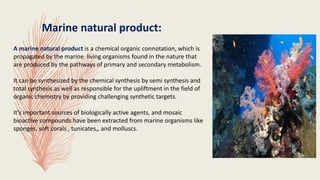
A marine natural product is a chemical organic connotation, which is
propagated by the marine living organisms found in the nature that
are produced by the pathways of primary and secondary metabolism.
It can be synthesized by the chemical synthesis by semi synthesis and
total synthesis as well as responsible for the upliftment in the field of
organic chemistry by providing challenging synthetic targets.
It’s important sources of biologically active agents, and mosaic
bioactive compounds have been extracted from marine organisms like
sponges, soft corals , tunicates,, and molluscs.
Important marine natural product(MNP)
Some of the tremendous marine natural products are display in here;
• Africanene, • Caco-spongiolide B, • Palinurine A and B
• Lamellarin α-20-sulfate • Papuamides A–D • Polycitone A
• Glycosaminoglycan • Sulfated β-galactan • Bengazole , bengamide
• Oceanapiside • Spongistatin I • Tanikolide
• Theopederins F–J • Loloatins A–D • Myticin
• Psammaplin A • Valinomycin • Staurosporine
• Anthopleurins. • Laminine. • Spongosine
Chemical patter of MNP:
Castoff/used of marine natural product:
Marine natural products are used for treatment of sundry malady
such as;
 Anti viral drugs
 Anti inflammatory drugs
 Anti bacterial drugs
 Anti helminthetic drugs
 Anti parasitic drugs
 Anti fungal drugs
 Anti cancer drugs
 Cardio-vascular drugs
Categories of drug molecules of marine organisms
The enormous quantum of newer and potent drug molecule derived from the wide
spectrum of marine organism across the world may be judiciously and logically classified
based on their specific pharmacologic actions as stated below;
I. Anti-biotic substances
II. Cardiovascular active drugs
III. Anti-inflammatory and antispasmodic agents
IV. Marine toxins
V. Anti-neoplastic Agents
VI. Miscellaneous pharmacologically active substance
Anti-inflammatory agents
Marine organisms have shown the presence of novel. A series of bio-indol derivatives isolated from
marine cyanobacterium Rivularia firma has shown potential antiinflammatory activity in the models
of carrageenan-induced rat paw oedema. In another study, the butanolide derivatives obtained from
Euplexaura flava have demonstrated a significant antiinflammatory effect in a low dose of 100 ug/ml.
BIO-INDOL
 Biosource – It is obtained from marine cyanobacterium Rivularia firma
 Chemical compound – Bio Indol derivative
 Use – Anti-inflammatory agent
BUTANOLIDE
 Biosource - It is obtained from marine Euplexaura flava
 Chemical compound – Butanolide derivative
 Use – Anti-inflammatory agent
Caco-spongionolide B
 A novel sesterterpene inhibitor of human synovial phospholipase A2 isolated from the
sponge Fasciospongia cavernosa
 It irreversibly inhibited both secretory PLA2 in vitro and group II secretory PLA2 in vivo .
Palinurine A & B
 Isolated from the marine sponge Ircinia echinata .
 Palinurin inhibited TXB2 & Oxide radicals .
 Palinurine A and B were relatively ineffective inhibitors of both TXB2 and Oxide radicals .
Antimicrobial drugs/Agents
A large variety of antimicrobial agents are produced by number of marine organisms, such as
sponges, algae, gorgonian corals, annelids, etc., and many of them are active against gram +ve
and gram –ve microorganisms, protozoal and fungal strains.
Antimicrobial drugs substances have been isolated, characterized and studied extensively over
the past three decades particularly from the vast domain of marine organism. A few examples
are, brown and red algae.
1. ZONAROL
 Biological source: zonarol and iso- zonarol are both obtained from dictyopteris zonaroides (brown algae).
 Chemistry - Flavonoid
 USES: Zonarol is used as Antimicrobial.
2.PREPACIFENOL
 Biological source: it is obtained from laurenica filformis, the two different species of algae.
3.EUNICIN
 Biological source: Eunicin is obtained from Eunicia mammosa the Gorgonian corals
 Chemistry – Diterpene
 USES :Anti-microbial agent
4. Tetrabromo-2-Heptanone
 BioSource: It is obtained from another species of Bonnemaisonia hemifera. (Red algae)
 Chemistry – Bromophenol compound
 Use - Antimicrobial
5. 2-CYANO-4,5-DIBROMOPYRROLE
 It is perhaps one of the rarest examples of a chemical entity isolated from a marine organism which
contains a cyano(-CN) function group.
Anti-virals
1. Lamellarin α-20-sulfate 2. Papuamides A–D 3. Polycitone A
4. Glycosaminoglycan 5. Sulfated β-galactan
Papuamides A - D :
 Papuamides A, B, C & D were isolated from the sponges Theonella mirabilis & Theonella swinhoei .
 Papuamides A & B inhibited the infection of human T-lymphoblastoid cells by HIV-1 in vitro.
Glucosaminoglycan :
 Synthesis of sulfated derivatives of a glycosaminoglycan isolated from the marine bacterium
Pseudomonas sp. & act against two strains of influenza virus types A & but not B .
Polycitone A :
 Polycitone A isolated from the ascidian Polyctor sp., is a potent inhibitor of the reverse transcriptase
of HIV & both C and B retroviruses, as well as a general inhibitor of cellular DNA polymerases.
 As polycitone A is a general inhibitor of DNA polymerases it cannot serve as an anti-HIV drug but
structural modifications of polycitone A could lead towards the rational design of new derivatives with
anti-HIV reverse transcriptase activity.
Anti-fungals
1. Bengazole & bengamide 2. Oceanapiside
3. Spongistatin I 4. Tanikolide
a)Bengazole & Bengamide:
 The bengazole derivatives & a new bengamide obtained from the sponge Pachastrissa sp .
 The bengazole derivatives were observed to be active against Candida albicans .
b) Oceanapiside
 Oceanapiside, from the sponge Oceanapia phillipensis, demonstrated antifungal activity against the
fluconazole-resistant yeast Candida glabrata.
 Oceanapiside inhibit fungal cell growth by oxidases .
 ex: Oceanapiside A an inhibitor of sphingolipid biosynthesis.
c)Spongistatin :
 Spongistatin isolated from the sponge Hyrtios erecta demonstrated potent microtubule-severing activity
 Mechanism of action of was significantly differerent from all other antimicrotubule agents .
d) Tanikolide :
 Tanikolide was isolated from the marine cyanobacterium Lyngbia majuscula .
 Tanikolide targets through reverse chemical genetic and proteomic approaches,which has been
target based screening for SRIT2 inhibitors
Antiparasitic agents:
a)Valinomycin
b)Staurosporine
a) Valinomycin :
 It was a Dodecadepsi peptide antibiotic .
 It was obtained from the cells of several streptomyces strains , among which s. tsusimaensis and
s.fulvissimus.
 It was recently reported to be the most potent agent against severe acute respiratory syndrome corona
virus .
b) Valinomycin
 It is a natural product originally isolated in 1977 from the bacterium streptomyces staurosporeus.
 It was discovered to have biological activities ranging from anti fungal to anti hyper tensive .
Cardiovascular compounds
a) Anthopleurins.
b) Laminine.
c) Spongosine
a) Anthopleurins :
 These are a group of peptides obtaines from “coelenterates”. Anthopleura xanthogrammica gives
type A & type B .as well as Anthopleura elegantissima gives type C .
 Anthopleurins AP- A shows strong positive ionotropic action and also produces cardiotonic effect in
consious dag.
b.Spongosine
 Chemically it is a nucleoside, methoxy derivative of adenosine . It is found in the extract of carrabean
sponge crypotethia crypta .
 It reduces both the rate & force of contraction of heart.
REFERENCES
1. D.S. Bhakuni,Central Drug Research Institute,Lucknow, India. D.S. Rawat
Department of Chemistry, University of Delhi, Delhi, India. Bioactive Marine Natural
Products.
2. Narsinh I.Thakur. Archana. N & Werner E.G. Miller; Marine natural products in drug
discovery.
3.
4. Wen-Chi Wei , Ping-Jyun Sung , Chang-Yih Duh , Bo-Wei Chen , Jyh- Horng Sheu ,
and Ning-Sun Yang , Marine drugs; Anti inflammatory activity of natural products;
ISSN 1660-339 N.
5. EL-Amraoui, B.J.F Biard, M.J.U riz, S.Rafai & A.Fassouane 2010. Antifungal & anti
bacterial activity. Journal mycologic medicale .
6. Mayer, A.M.S ,A.D.Rodriguez; R.G.S Berlinck & M.T.Hamann . 2009.Marine
compounds with antibacterial,anti inflammatory,anti protozoal,antiviral
,cardiovascular agents.Biochima et biophysica acta 1790 : 283-308

Important marine natural products

  • 1.
    Noakhali Science AndTechnology University Course Tittle Marine Natural Products Couse code OCN4103 Assignment on: Important Marine Natural Products(MNP) Azad Uddin Sojib Enroll: ASH1718010M Dept. Of Oceanography Noakhali Science And Technology University
  • 2.
    Table of contents 1.Prologue 2. Marine natural products 3. Important marine natural products 4. Castoff marine natural products 5. Categories of drug molecules of marine organisms 6. Anti-inflammatory drugs/ Agents 7. Antimicrobial Agents 8. Anti-viral agents & Anti-fungal agents 9. Anti-bacterial and anti-parasitic agents 10. Cardiovascular compounds 11. references
  • 3.
    The Marine resourcesare today widely studied because of massive reasons. One of the reason is as the oceans cover more than 70% of the world surface and among 36 known living phyla, 34 of them are found in marine ambience with more than 300000+ known species of fauna and flora. The concerns of finding drug from ocean/sea had started from 1970s. For instance, about 300 patents on bioactive marine natural product have been issued between 1969 and 1999. So far, more than 10,000 compounds have been isolated from marine organism. a marine natural product is a compound or substance that produced by a living organism. They may be extracted from the marine organism or micro - organism fermentation. In that respect any biological molecule is a natural product, but in general the term is reserved for secondary metabolites (carotinoids, phytosterines, saponines, phenolic compounds, alkaloids, glycosinates, terpenes etc). prologue
  • 4.
    Marine natural product: Amarine natural product is a chemical organic connotation, which is propagated by the marine living organisms found in the nature that are produced by the pathways of primary and secondary metabolism. It can be synthesized by the chemical synthesis by semi synthesis and total synthesis as well as responsible for the upliftment in the field of organic chemistry by providing challenging synthetic targets. It’s important sources of biologically active agents, and mosaic bioactive compounds have been extracted from marine organisms like sponges, soft corals , tunicates,, and molluscs.
  • 5.
    Important marine naturalproduct(MNP) Some of the tremendous marine natural products are display in here; • Africanene, • Caco-spongiolide B, • Palinurine A and B • Lamellarin α-20-sulfate • Papuamides A–D • Polycitone A • Glycosaminoglycan • Sulfated β-galactan • Bengazole , bengamide • Oceanapiside • Spongistatin I • Tanikolide • Theopederins F–J • Loloatins A–D • Myticin • Psammaplin A • Valinomycin • Staurosporine • Anthopleurins. • Laminine. • Spongosine
  • 6.
  • 7.
    Castoff/used of marinenatural product: Marine natural products are used for treatment of sundry malady such as;  Anti viral drugs  Anti inflammatory drugs  Anti bacterial drugs  Anti helminthetic drugs  Anti parasitic drugs  Anti fungal drugs  Anti cancer drugs  Cardio-vascular drugs
  • 8.
    Categories of drugmolecules of marine organisms The enormous quantum of newer and potent drug molecule derived from the wide spectrum of marine organism across the world may be judiciously and logically classified based on their specific pharmacologic actions as stated below; I. Anti-biotic substances II. Cardiovascular active drugs III. Anti-inflammatory and antispasmodic agents IV. Marine toxins V. Anti-neoplastic Agents VI. Miscellaneous pharmacologically active substance
  • 9.
    Anti-inflammatory agents Marine organismshave shown the presence of novel. A series of bio-indol derivatives isolated from marine cyanobacterium Rivularia firma has shown potential antiinflammatory activity in the models of carrageenan-induced rat paw oedema. In another study, the butanolide derivatives obtained from Euplexaura flava have demonstrated a significant antiinflammatory effect in a low dose of 100 ug/ml. BIO-INDOL  Biosource – It is obtained from marine cyanobacterium Rivularia firma  Chemical compound – Bio Indol derivative  Use – Anti-inflammatory agent BUTANOLIDE  Biosource - It is obtained from marine Euplexaura flava  Chemical compound – Butanolide derivative  Use – Anti-inflammatory agent
  • 10.
    Caco-spongionolide B  Anovel sesterterpene inhibitor of human synovial phospholipase A2 isolated from the sponge Fasciospongia cavernosa  It irreversibly inhibited both secretory PLA2 in vitro and group II secretory PLA2 in vivo . Palinurine A & B  Isolated from the marine sponge Ircinia echinata .  Palinurin inhibited TXB2 & Oxide radicals .  Palinurine A and B were relatively ineffective inhibitors of both TXB2 and Oxide radicals . Antimicrobial drugs/Agents A large variety of antimicrobial agents are produced by number of marine organisms, such as sponges, algae, gorgonian corals, annelids, etc., and many of them are active against gram +ve and gram –ve microorganisms, protozoal and fungal strains. Antimicrobial drugs substances have been isolated, characterized and studied extensively over the past three decades particularly from the vast domain of marine organism. A few examples are, brown and red algae.
  • 11.
    1. ZONAROL  Biologicalsource: zonarol and iso- zonarol are both obtained from dictyopteris zonaroides (brown algae).  Chemistry - Flavonoid  USES: Zonarol is used as Antimicrobial. 2.PREPACIFENOL  Biological source: it is obtained from laurenica filformis, the two different species of algae. 3.EUNICIN  Biological source: Eunicin is obtained from Eunicia mammosa the Gorgonian corals  Chemistry – Diterpene  USES :Anti-microbial agent 4. Tetrabromo-2-Heptanone  BioSource: It is obtained from another species of Bonnemaisonia hemifera. (Red algae)  Chemistry – Bromophenol compound  Use - Antimicrobial 5. 2-CYANO-4,5-DIBROMOPYRROLE  It is perhaps one of the rarest examples of a chemical entity isolated from a marine organism which contains a cyano(-CN) function group.
  • 12.
    Anti-virals 1. Lamellarin α-20-sulfate2. Papuamides A–D 3. Polycitone A 4. Glycosaminoglycan 5. Sulfated β-galactan Papuamides A - D :  Papuamides A, B, C & D were isolated from the sponges Theonella mirabilis & Theonella swinhoei .  Papuamides A & B inhibited the infection of human T-lymphoblastoid cells by HIV-1 in vitro. Glucosaminoglycan :  Synthesis of sulfated derivatives of a glycosaminoglycan isolated from the marine bacterium Pseudomonas sp. & act against two strains of influenza virus types A & but not B . Polycitone A :  Polycitone A isolated from the ascidian Polyctor sp., is a potent inhibitor of the reverse transcriptase of HIV & both C and B retroviruses, as well as a general inhibitor of cellular DNA polymerases.  As polycitone A is a general inhibitor of DNA polymerases it cannot serve as an anti-HIV drug but structural modifications of polycitone A could lead towards the rational design of new derivatives with anti-HIV reverse transcriptase activity.
  • 13.
    Anti-fungals 1. Bengazole &bengamide 2. Oceanapiside 3. Spongistatin I 4. Tanikolide a)Bengazole & Bengamide:  The bengazole derivatives & a new bengamide obtained from the sponge Pachastrissa sp .  The bengazole derivatives were observed to be active against Candida albicans . b) Oceanapiside  Oceanapiside, from the sponge Oceanapia phillipensis, demonstrated antifungal activity against the fluconazole-resistant yeast Candida glabrata.  Oceanapiside inhibit fungal cell growth by oxidases .  ex: Oceanapiside A an inhibitor of sphingolipid biosynthesis. c)Spongistatin :  Spongistatin isolated from the sponge Hyrtios erecta demonstrated potent microtubule-severing activity  Mechanism of action of was significantly differerent from all other antimicrotubule agents .
  • 14.
    d) Tanikolide : Tanikolide was isolated from the marine cyanobacterium Lyngbia majuscula .  Tanikolide targets through reverse chemical genetic and proteomic approaches,which has been target based screening for SRIT2 inhibitors Antiparasitic agents: a)Valinomycin b)Staurosporine a) Valinomycin :  It was a Dodecadepsi peptide antibiotic .  It was obtained from the cells of several streptomyces strains , among which s. tsusimaensis and s.fulvissimus.  It was recently reported to be the most potent agent against severe acute respiratory syndrome corona virus . b) Valinomycin  It is a natural product originally isolated in 1977 from the bacterium streptomyces staurosporeus.  It was discovered to have biological activities ranging from anti fungal to anti hyper tensive .
  • 15.
    Cardiovascular compounds a) Anthopleurins. b)Laminine. c) Spongosine a) Anthopleurins :  These are a group of peptides obtaines from “coelenterates”. Anthopleura xanthogrammica gives type A & type B .as well as Anthopleura elegantissima gives type C .  Anthopleurins AP- A shows strong positive ionotropic action and also produces cardiotonic effect in consious dag. b.Spongosine  Chemically it is a nucleoside, methoxy derivative of adenosine . It is found in the extract of carrabean sponge crypotethia crypta .  It reduces both the rate & force of contraction of heart.
  • 16.
    REFERENCES 1. D.S. Bhakuni,CentralDrug Research Institute,Lucknow, India. D.S. Rawat Department of Chemistry, University of Delhi, Delhi, India. Bioactive Marine Natural Products. 2. Narsinh I.Thakur. Archana. N & Werner E.G. Miller; Marine natural products in drug discovery. 3. 4. Wen-Chi Wei , Ping-Jyun Sung , Chang-Yih Duh , Bo-Wei Chen , Jyh- Horng Sheu , and Ning-Sun Yang , Marine drugs; Anti inflammatory activity of natural products; ISSN 1660-339 N. 5. EL-Amraoui, B.J.F Biard, M.J.U riz, S.Rafai & A.Fassouane 2010. Antifungal & anti bacterial activity. Journal mycologic medicale . 6. Mayer, A.M.S ,A.D.Rodriguez; R.G.S Berlinck & M.T.Hamann . 2009.Marine compounds with antibacterial,anti inflammatory,anti protozoal,antiviral ,cardiovascular agents.Biochima et biophysica acta 1790 : 283-308