IMPORTANCE OF PLANT BASED
DIET AND EVIL EFFECTS OF
MEAT CONSUMPTION
S.DHIVYA (CB.EN.U4ECE11115)
G.SRI VIHITHA (CB.EN.U4ECE11118)
N.TULASI HAAR (CB.EN.U4ECE11135)
S.PAVITHRA (CB.EN.U4ECE11142)
J.SRINIDHI (CB.EN.U4ECE11153)
AMRITA VISHWA VIDYAPEETAM
What is
non-vegetarian ???
This is what we think…
A non-vegetarian diet is one which
includes beef, chicken, mutton, fish.
What it actually is???
ļ‚›Blood
ļ‚›Muscles
ļ‚›Tendons
ļ‚›Flesh
ļ‚›Vein
ļ‚›Hen periods
What makes one to eat
non-veg????
ļ‚›Habit
ļ‚›Tradition
ļ‚›Convenience
ļ‚›Taste
Meat eating
What’s the logic?!
ļ‚›We all love animals, why do we call some
ā€œpetsā€ and others ā€œdinnerā€?
~K.D.Lang
ļ‚›If u put a baby in a crib with an apple and a
rabbit, if it eats the rabbit and plays with
the apple I’ll buy you a new car
~Harvey Diamond
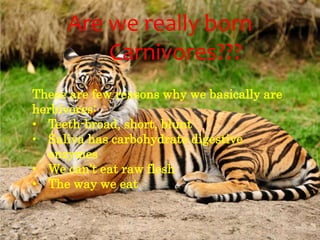
Are we really born
Carnivores???
These are few reasons why we basically are
herbivores:
• Teeth-broad, short, blunt
• Saliva has carbohydrate digestive
enzymes
• We can’t eat raw flesh
• The way we eat
MISCONCEPTION!!!
People think consuming non-
vegetarian which is of high protein
is good for health but its actually
not!
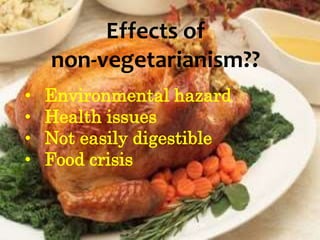
Effects of
non-vegetarianism??
• Environmental hazard
• Health issues
• Not easily digestible
• Food crisis
Effects of livestock on
environment
ļ‚›Eating meat is the very leading cause of
global warming which is one of the
main causes of the unprecedented ice
melts in the arctic and Antarctic.
ļ‚›Some of the environmental effects that
have been associated with meat
production are pollution through fossil
fuel usage, water and land pollution.
Biodiversity
ļ‚›Livestock take up 30% of the lands surface
which was once habitat of wildlife.
ļ‚›Tropical forests hold half of the worlds species
which are becoming extinct at an alarming rate
due to deforestation for meat production.
ļ‚›53% of global fish meal production is used by
the livestock sector for feed , seriously affecting
the worlds fish population.
Water Pollution
ļ‚›Livestock production is the largest sectorial
source of water pollutant.
ļ‚›Animal waste contribute to large oceanic
ā€œdead zonesā€ in coastal areas.
ļ‚› Degradation of coral reefs
ļ‚›Animal agriculture is the source of more
than a third of water pollution from
pesticides and half of water pollution from
antibiotics.
ļ‚›Aquaculture(basically, the factory farming of
fish in under water enclosures)also makes a
large contribution to water pollution.
Intensive fish farming maximise production
efficiency and creates tons of untreated fecal
waste that pollutes and de-oxygenates aquatic
habitants
Air Pollution
ļ‚›Livestock are responsible for almost
two-thirds of anthropogenic ammonia
emissions, which contribute
significantly to acid rain and
acidification of eco system.
ļ‚›Animal agriculture is responsible for
more than half of humanity’s total
greenhouse gas emission. It includes
37% of anthropogenic methane .
Land Pollution
ļ‚›Most food produced for animals is
grown using a combination of untreated
animal waste and synthetic fertilizers,
both of which contain excessive
amounts of nitrogen ,phosphorous and
heavy metals pollutes the soil,
degrading its water retention ability
and fertility over time.
Major cause of deforestation
ļ‚›70% of Amazon deforestation is to clear
land for pasture and livestock feed
crops.
ļ‚›Deforestation is responsible for 20% -
25% of global warming as it increases
green house gas emissions due to the
release of CO2 stored in trees.
ļ‚›Deforestation destroy livelihoods : over
1.5 billion people depend upon the
forests for fuel wood , medicinal plants
or food.
Food Crisis
ļ‚›A total of 925 million people don’t
have enough to eat which is more
than the population of US,
Canada, and the European Union
combined.
ļ‚›This year 2.6 million children will
die of malnutrition.
ļ‚› Every 12 seconds a child dies
from a hunger related disease that
is 7100 children a day.
• It takes upto 13 pounds of grain to produce 1
pound of meat. If people were to eat grain itself,
an entire village will be fed instead of one family.
• Using an acre to raise cattle for slaughter gives
people only 20 pounds of meat. But if the same
amount of land would grow 365 pounds of
protein rich soya beans with which 17 times
more people could be saved from starvation.
• At present the average American receives
27% of their calories from animal
products. If every one on earth ate this
way 3.2 billion people would have food to
eat and 3.7 billion people would starve.
• If this doubles, 1.5 billion would have food
to eat and 5.4 billion would starve.
ļ‚›It takes more than 11 times as much
fossil fuel to make one calorie of animal
protein as it does to make one calorie of
plant protein
ļ‚›Over 30% of global grains(including
wheat and maize) and 90% of soya are
used to feed farm animals, of which the
majority are in factory farms.
ļ‚›Converting plant protein into animal
products is wasteful. It takes 20 kilos of
feed to produce 1 kilo of edible beef, 7.5
kilos of feed for a kilo of edible pork and
4.5 kilos for a kilo of edible chicken.
ļ‚›Over 30% of global grains(including
wheat and maize) and 90% of soya are
used to feed farm animals, of which the
majority are in factory forms.
ļ‚›If global demand for animal products
continues to escalate, ever-increasing
amounts of precious grains, and water
to irrigate those crops, would be needed
to fatten up ever-increasing numbers of
factory farmed animals.
ļ‚›Such a system is clearly unsustainable
for animals, people and the planet.
Health issues
CONSEQUENCES OF EATING TOO
MUCH MEAT:
ļ‚›Studies show that people who eat too
much meat are 20% more likely to
develop cancer.
ļ‚›Consumption of chicken and fish is also
linked to colon cancer.
ļ‚›Meat also contains lots of saturated fat and
cholesterol which can lead to heart disease.
ļ‚›Kidneys work to remove excess protein from
your body so eating too much protein can
stress them out leading to kidney damage and
even contributing to renal failure in some
cases.
Processed meats have high levels of
sodium and nitrates.
• Sodium can raise blood pressure and
therefore the risk of stroke and heart
disease.
• Nitrates may damage blood vessels and
are associated with insulin response
Bacterial Diseases!!!
ļ‚›Swine flu
ļ‚›Bird flu
ļ‚›Blue tongue disease
ļ‚›Mad cow disease
ļ‚›Salmonellosis
ļ‚›E-coli infection
ļ‚›Avian-flu
Meat free diet advantages
ļ‚›Stops 70% of deforestation.
ļ‚›Uses two-third less fossil fuels.
ļ‚›Reduces pollution from untreated
animal waste.
ļ‚›Maintains cleaner air.
ļ‚›Saves up to 4.5 tons of emissions per
household per year.
ļ‚›Stops 80% of global warming.
Culture
Does Indian culture support eating
meat???
Each culture has few practices and
beliefs i.e.
In India we believe in AHIMSA and also
in KARMA which makes it clear that it
doesn’t support killing animals.
ļ‚›Eating meat will drive one away from
god, make oneself sick and will make
one tamasik.
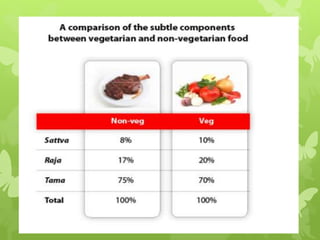
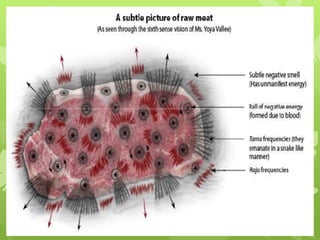
ļ‚›Tama component in non vegetarian food
is greater than vegetarian food and so it
indirectly affects one’s progress in
spiritual life.
Spiritual
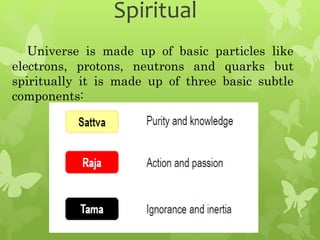
Universe is made up of basic particles like
electrons, protons, neutrons and quarks but
spiritually it is made up of three basic subtle
components:
• These three are intangible and not visible to the
human eyes but can be seen only through sixth
sense.
• Every being let it be a living or a non-living is
composed of these three components and their
composition changes with their activities.
• Food we eat plays a very important role in our
progress in spiritual life
Future outlook
ļ‚›Consumption is expected to double by 2050,
hence emissions & other ā€œcostsā€ as well.
ļ‚›Plans to reduce emissions through: reducing
methane productions by using feed additives
and vaccines. But-adding more chemicals to the
environment is not a sustainable solution.
What’s The
Solution???
We have only one
planet only one chance.
It’s future depends on
each of us.
And there is ONE thing
We all can do:
Be Veg,Go Green!
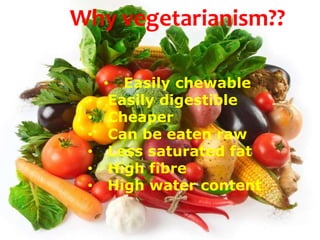
• Easily chewable
• Easily digestible
• Cheaper
• Can be eaten raw
• Less saturated fat
• High fibre
• High water content
Why vegetarianism??
5 Reasons to eat a plant
based diet!!!
ļ‚› Its good for health
ļ‚› Its easy to loose weight
ļ‚› Its good for the environment
ļ‚› Its saves money
ļ‚› You are not supporting animal cruelty
Any movement toward more plants and
less
meat is a big step in the right direction!!!
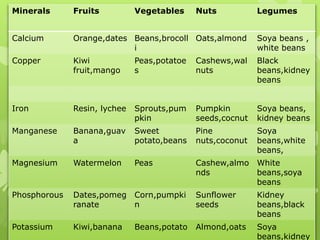
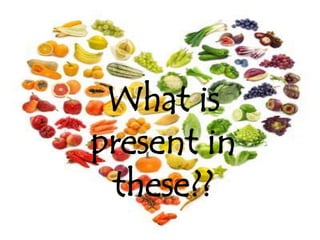
What is
present in
these??
Minerals Fruits Vegetables Nuts Legumes
Calcium Orange,dates Beans,brocoll
i
Oats,almond Soya beans ,
white beans
Copper Kiwi
fruit,mango
Peas,potatoe
s
Cashews,wal
nuts
Black
beans,kidney
beans
Iron Resin, lychee Sprouts,pum
pkin
Pumpkin
seeds,cocnut
Soya beans,
kidney beans
Manganese Banana,guav
a
Sweet
potato,beans
Pine
nuts,coconut
Soya
beans,white
beans,
Magnesium Watermelon Peas Cashew,almo
nds
White
beans,soya
beans
Phosphorous Dates,pomeg
ranate
Corn,pumpki
n
Sunflower
seeds
Kidney
beans,black
beans
Potassium Kiwi,banana Beans,potato Almond,oats Soya
beans,kidney
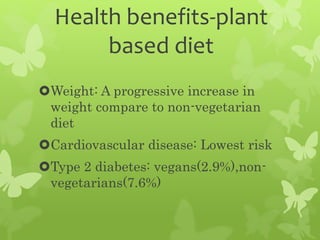
Health benefits-plant
based diet
ļ‚›Weight: A progressive increase in
weight compare to non-vegetarian
diet
ļ‚›Cardiovascular disease: Lowest risk
ļ‚›Type 2 diabetes: vegans(2.9%),non-
vegetarians(7.6%)
ļ‚›Cancer : vegetarians had an 8%
reduction in risk
ļ‚›Longevity: death rates rise across
dietary groups, from vegans to non-
vegetarian.
ļ‚›Healthy behaviours: watch television,
sleep more ,and consume more fruits,
vegetables, and low-glycemic foods and
less saturated fats
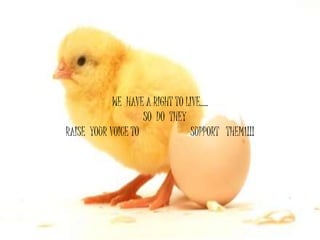
WE HAVE A RIGHT TO LIVE….
SO DO THEY
RAISE YOUR VOICE TO SUPPORT THEM1!!!
REFERENCES
ļ‚› http://features.peta2.com/making -the-
connection/world-hunger.aspx
ļ‚› www.ciwf.org.uk/news/factory_farming/the_food
_crisis_and_too_much_meat.aspx
ļ‚› www.foodfactoflife.org.uk
ļ‚› http://www.clear.org/schools/students/ages-17-
18/natural-world/benefits-vegetarian.aspx
ļ‚› www.livestrong.com

IMPORTANCE OF PLANT BASED DITE

  • 1.
    IMPORTANCE OF PLANTBASED DIET AND EVIL EFFECTS OF MEAT CONSUMPTION S.DHIVYA (CB.EN.U4ECE11115) G.SRI VIHITHA (CB.EN.U4ECE11118) N.TULASI HAAR (CB.EN.U4ECE11135) S.PAVITHRA (CB.EN.U4ECE11142) J.SRINIDHI (CB.EN.U4ECE11153) AMRITA VISHWA VIDYAPEETAM
  • 2.
    What is non-vegetarian ??? Thisis what we think… A non-vegetarian diet is one which includes beef, chicken, mutton, fish.
  • 3.
    What it actuallyis??? ļ‚›Blood ļ‚›Muscles ļ‚›Tendons ļ‚›Flesh ļ‚›Vein ļ‚›Hen periods
  • 4.
    What makes oneto eat non-veg???? ļ‚›Habit ļ‚›Tradition ļ‚›Convenience ļ‚›Taste
  • 5.
    Meat eating What’s thelogic?! ļ‚›We all love animals, why do we call some ā€œpetsā€ and others ā€œdinnerā€? ~K.D.Lang ļ‚›If u put a baby in a crib with an apple and a rabbit, if it eats the rabbit and plays with the apple I’ll buy you a new car ~Harvey Diamond
  • 6.
    Are we reallyborn Carnivores??? These are few reasons why we basically are herbivores: • Teeth-broad, short, blunt • Saliva has carbohydrate digestive enzymes • We can’t eat raw flesh • The way we eat
  • 7.
    MISCONCEPTION!!! People think consumingnon- vegetarian which is of high protein is good for health but its actually not!
  • 8.
    Effects of non-vegetarianism?? • Environmentalhazard • Health issues • Not easily digestible • Food crisis
  • 9.
    Effects of livestockon environment ļ‚›Eating meat is the very leading cause of global warming which is one of the main causes of the unprecedented ice melts in the arctic and Antarctic. ļ‚›Some of the environmental effects that have been associated with meat production are pollution through fossil fuel usage, water and land pollution.
  • 10.
    Biodiversity ļ‚›Livestock take up30% of the lands surface which was once habitat of wildlife. ļ‚›Tropical forests hold half of the worlds species which are becoming extinct at an alarming rate due to deforestation for meat production. ļ‚›53% of global fish meal production is used by the livestock sector for feed , seriously affecting the worlds fish population.
  • 11.
    Water Pollution ļ‚›Livestock productionis the largest sectorial source of water pollutant. ļ‚›Animal waste contribute to large oceanic ā€œdead zonesā€ in coastal areas. ļ‚› Degradation of coral reefs ļ‚›Animal agriculture is the source of more than a third of water pollution from pesticides and half of water pollution from antibiotics.
  • 12.
    ļ‚›Aquaculture(basically, the factoryfarming of fish in under water enclosures)also makes a large contribution to water pollution. Intensive fish farming maximise production efficiency and creates tons of untreated fecal waste that pollutes and de-oxygenates aquatic habitants
  • 13.
    Air Pollution ļ‚›Livestock areresponsible for almost two-thirds of anthropogenic ammonia emissions, which contribute significantly to acid rain and acidification of eco system. ļ‚›Animal agriculture is responsible for more than half of humanity’s total greenhouse gas emission. It includes 37% of anthropogenic methane .
  • 14.
    Land Pollution ļ‚›Most foodproduced for animals is grown using a combination of untreated animal waste and synthetic fertilizers, both of which contain excessive amounts of nitrogen ,phosphorous and heavy metals pollutes the soil, degrading its water retention ability and fertility over time.
  • 15.
    Major cause ofdeforestation ļ‚›70% of Amazon deforestation is to clear land for pasture and livestock feed crops. ļ‚›Deforestation is responsible for 20% - 25% of global warming as it increases green house gas emissions due to the release of CO2 stored in trees. ļ‚›Deforestation destroy livelihoods : over 1.5 billion people depend upon the forests for fuel wood , medicinal plants or food.
  • 16.
    Food Crisis ļ‚›A totalof 925 million people don’t have enough to eat which is more than the population of US, Canada, and the European Union combined. ļ‚›This year 2.6 million children will die of malnutrition. ļ‚› Every 12 seconds a child dies from a hunger related disease that is 7100 children a day.
  • 17.
    • It takesupto 13 pounds of grain to produce 1 pound of meat. If people were to eat grain itself, an entire village will be fed instead of one family. • Using an acre to raise cattle for slaughter gives people only 20 pounds of meat. But if the same amount of land would grow 365 pounds of protein rich soya beans with which 17 times more people could be saved from starvation.
  • 18.
    • At presentthe average American receives 27% of their calories from animal products. If every one on earth ate this way 3.2 billion people would have food to eat and 3.7 billion people would starve. • If this doubles, 1.5 billion would have food to eat and 5.4 billion would starve.
  • 19.
    ļ‚›It takes morethan 11 times as much fossil fuel to make one calorie of animal protein as it does to make one calorie of plant protein ļ‚›Over 30% of global grains(including wheat and maize) and 90% of soya are used to feed farm animals, of which the majority are in factory farms.
  • 20.
    ļ‚›Converting plant proteininto animal products is wasteful. It takes 20 kilos of feed to produce 1 kilo of edible beef, 7.5 kilos of feed for a kilo of edible pork and 4.5 kilos for a kilo of edible chicken. ļ‚›Over 30% of global grains(including wheat and maize) and 90% of soya are used to feed farm animals, of which the majority are in factory forms.
  • 21.
    ļ‚›If global demandfor animal products continues to escalate, ever-increasing amounts of precious grains, and water to irrigate those crops, would be needed to fatten up ever-increasing numbers of factory farmed animals. ļ‚›Such a system is clearly unsustainable for animals, people and the planet.
  • 22.
    Health issues CONSEQUENCES OFEATING TOO MUCH MEAT: ļ‚›Studies show that people who eat too much meat are 20% more likely to develop cancer. ļ‚›Consumption of chicken and fish is also linked to colon cancer.
  • 23.
    ļ‚›Meat also containslots of saturated fat and cholesterol which can lead to heart disease. ļ‚›Kidneys work to remove excess protein from your body so eating too much protein can stress them out leading to kidney damage and even contributing to renal failure in some cases.
  • 24.
    Processed meats havehigh levels of sodium and nitrates. • Sodium can raise blood pressure and therefore the risk of stroke and heart disease. • Nitrates may damage blood vessels and are associated with insulin response
  • 25.
    Bacterial Diseases!!! ļ‚›Swine flu ļ‚›Birdflu ļ‚›Blue tongue disease ļ‚›Mad cow disease ļ‚›Salmonellosis ļ‚›E-coli infection ļ‚›Avian-flu
  • 26.
    Meat free dietadvantages ļ‚›Stops 70% of deforestation. ļ‚›Uses two-third less fossil fuels. ļ‚›Reduces pollution from untreated animal waste. ļ‚›Maintains cleaner air. ļ‚›Saves up to 4.5 tons of emissions per household per year. ļ‚›Stops 80% of global warming.
  • 27.
    Culture Does Indian culturesupport eating meat??? Each culture has few practices and beliefs i.e. In India we believe in AHIMSA and also in KARMA which makes it clear that it doesn’t support killing animals.
  • 28.
    ļ‚›Eating meat willdrive one away from god, make oneself sick and will make one tamasik. ļ‚›Tama component in non vegetarian food is greater than vegetarian food and so it indirectly affects one’s progress in spiritual life.
  • 29.
    Spiritual Universe is madeup of basic particles like electrons, protons, neutrons and quarks but spiritually it is made up of three basic subtle components:
  • 30.
    • These threeare intangible and not visible to the human eyes but can be seen only through sixth sense. • Every being let it be a living or a non-living is composed of these three components and their composition changes with their activities. • Food we eat plays a very important role in our progress in spiritual life
  • 33.
    Future outlook ļ‚›Consumption isexpected to double by 2050, hence emissions & other ā€œcostsā€ as well. ļ‚›Plans to reduce emissions through: reducing methane productions by using feed additives and vaccines. But-adding more chemicals to the environment is not a sustainable solution.
  • 34.
  • 35.
    We have onlyone planet only one chance. It’s future depends on each of us. And there is ONE thing We all can do: Be Veg,Go Green!
  • 36.
    • Easily chewable •Easily digestible • Cheaper • Can be eaten raw • Less saturated fat • High fibre • High water content Why vegetarianism??
  • 37.
    5 Reasons toeat a plant based diet!!! ļ‚› Its good for health ļ‚› Its easy to loose weight ļ‚› Its good for the environment ļ‚› Its saves money ļ‚› You are not supporting animal cruelty Any movement toward more plants and less meat is a big step in the right direction!!!
  • 38.
  • 39.
    Minerals Fruits VegetablesNuts Legumes Calcium Orange,dates Beans,brocoll i Oats,almond Soya beans , white beans Copper Kiwi fruit,mango Peas,potatoe s Cashews,wal nuts Black beans,kidney beans Iron Resin, lychee Sprouts,pum pkin Pumpkin seeds,cocnut Soya beans, kidney beans Manganese Banana,guav a Sweet potato,beans Pine nuts,coconut Soya beans,white beans, Magnesium Watermelon Peas Cashew,almo nds White beans,soya beans Phosphorous Dates,pomeg ranate Corn,pumpki n Sunflower seeds Kidney beans,black beans Potassium Kiwi,banana Beans,potato Almond,oats Soya beans,kidney
  • 42.
    Health benefits-plant based diet ļ‚›Weight:A progressive increase in weight compare to non-vegetarian diet ļ‚›Cardiovascular disease: Lowest risk ļ‚›Type 2 diabetes: vegans(2.9%),non- vegetarians(7.6%)
  • 43.
    ļ‚›Cancer : vegetarianshad an 8% reduction in risk ļ‚›Longevity: death rates rise across dietary groups, from vegans to non- vegetarian. ļ‚›Healthy behaviours: watch television, sleep more ,and consume more fruits, vegetables, and low-glycemic foods and less saturated fats
  • 44.
    WE HAVE ARIGHT TO LIVE…. SO DO THEY RAISE YOUR VOICE TO SUPPORT THEM1!!!
  • 45.
    REFERENCES ļ‚› http://features.peta2.com/making -the- connection/world-hunger.aspx ļ‚›www.ciwf.org.uk/news/factory_farming/the_food _crisis_and_too_much_meat.aspx ļ‚› www.foodfactoflife.org.uk ļ‚› http://www.clear.org/schools/students/ages-17- 18/natural-world/benefits-vegetarian.aspx ļ‚› www.livestrong.com