Importance of Creating
Strategy for Your
OrganizationBY
Angela Ihunweze(Mrs)
+234 080 33 28 03 53
Table of contents
 What exactly is strategy?
 Fundamentals of strategy
 Strategy at Different Levels of a
Business
 The impact of strategy in the
organization
 Key Stakeholders and Participants in the
Strategic Process
 Key Stakeholders and Participants in the
Strategic Process part 2
 Exercise for you
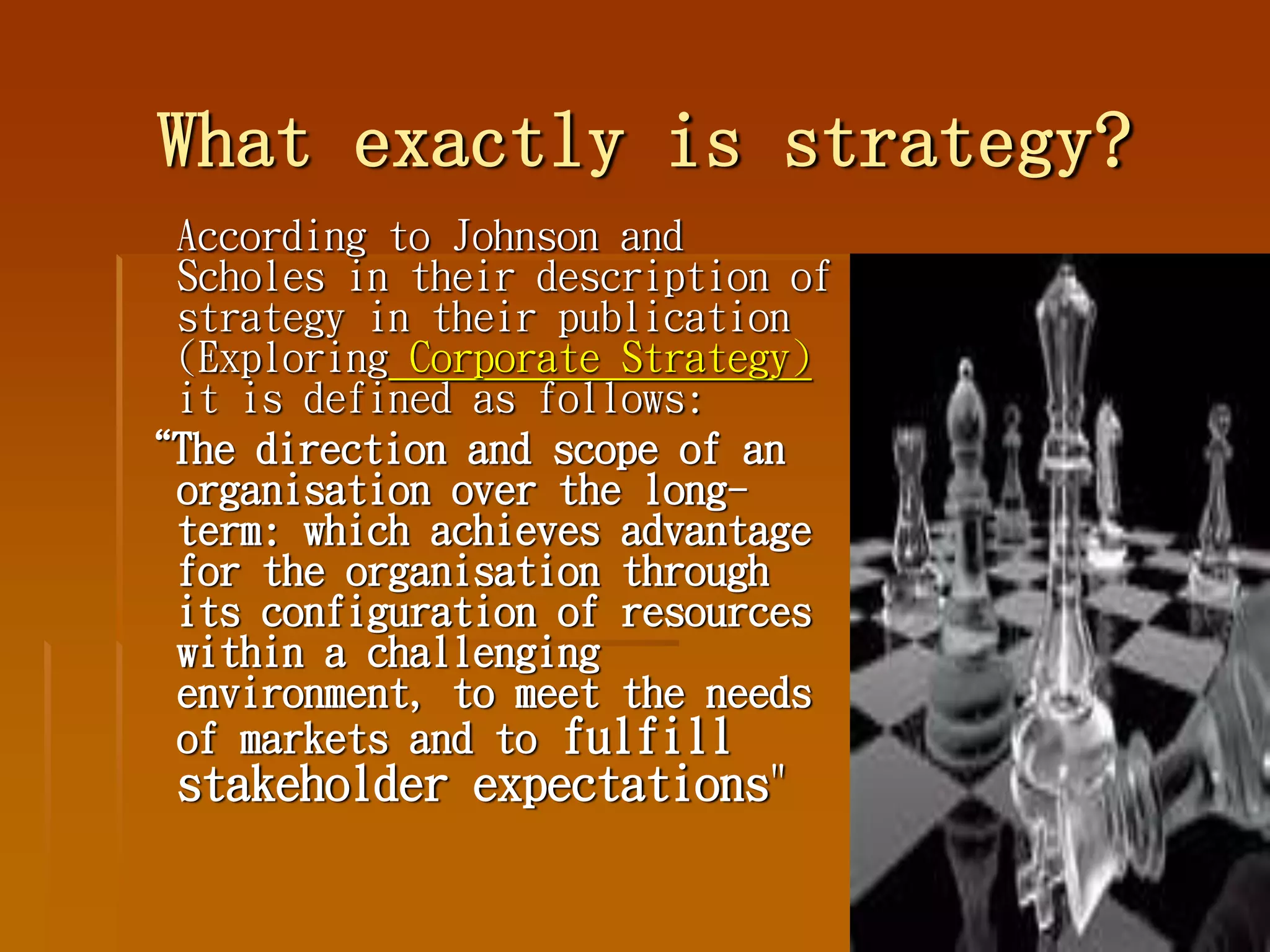
What exactly is strategy?
According to Johnson and
Scholes in their description of
strategy in their publication
(Exploring Corporate Strategy)
it is defined as follows:
“The direction and scope of an
organisation over the long-
term: which achieves advantage
for the organisation through
its configuration of resources
within a challenging
environment, to meet the needs
of markets and to fulfill
stakeholder expectations"
Fundamentals of strategy
Strategy addresses the following fundamentals:
 Where is the business trying to get to in the long-term
(direction)
 Which markets should the business compete in and what kind
of activities are involved in such markets? (markets;
scope)
 How can the business perform better than the competition
in those markets? (advantage)?
 What resources (skills, assets, finance, relationships,
technical competence, facilities) are required in order to
be able to compete? (resources)?
 What external, environmental factors affect the
businesses' ability to compete? (environment)?
 What are the values and expectations of those who have
power in and around the business? (stakeholders)
Strategy at Different Levels of a Business
Strategies exist at several levels in any
organization - ranging from the overall
business (or group of businesses) through to
individuals working in it.
 Corporate Strategy - is concerned with the
overall purpose and scope of the business to
meet stakeholder expectations. This is a
crucial level since it is heavily influenced by
investors in the business and acts to guide
strategic decision-making throughout the
business. Corporate strategy is often stated
explicitly in a "mission statement".
 Business Unit Strategy - is concerned more with
how a business competes successfully in a
particular market. It concerns strategic
decisions about choice of products, meeting
needs of customers, gaining advantage over
competitors, exploiting or creating new
opportunities etc.
 Operational Strategy - is concerned with how
each part of the business is organized to
deliver the corporate and business-unit level
strategic direction. Operational strategy
therefore focuses on issues of resources,
processes, people etc.
The impact of strategy in the organization
 leads to action
 builds a shared vision that is values-based
 is an inclusive, participatory process in
which board and staff take on a shared
ownership
 accepts accountability to the community
 is externally focused and sensitive to the
organization's environment
 is based on quality data
 requires an openness to questioning the
status quo
 is a key part of effective management.
Key Stakeholders and Participants in the
Strategic Process
Strategic planning phase
Who should be involved?
 Planning the process; The
management team of the
project or organization.
 Understanding the context;
All staff and Board
members: Administrative
staff should be involved
if it is important for
them to understand the
organization's issues and
problems.
Key Stakeholders and
Participants in the Strategic
Process part 2
 Vision, values and mission discussion; All staff and Board
members. It is very important to involve all staff, including
administrative staff in this discussion as it is likely to
provide a set of
operating principles – in other words, to
make it clear why people who work in
the project or organization are expected to work and behave
in a certain way.
 Review of strengths and weaknesses opportunities and threats;
Programme or professional staff for the whole of this
process; include administrative staff in the discussions
around internal strengths and weaknesses. Discussion of
strategic options and
goals. Professional staff and Board members.
 Organizational structure; The management team with input from
the rest of the staff
Exercise for you
What is your contribution
in creating strategy
---------------------------
--------------------------
--------------------------
--------------------------
--------------------------
--------------------------
------------------------
Send it to me
angelaitambo74@yahoo.com

Importance of creating strategy for your organization

  • 1.
    Importance of Creating Strategyfor Your OrganizationBY Angela Ihunweze(Mrs) +234 080 33 28 03 53
  • 2.
    Table of contents What exactly is strategy?  Fundamentals of strategy  Strategy at Different Levels of a Business  The impact of strategy in the organization  Key Stakeholders and Participants in the Strategic Process  Key Stakeholders and Participants in the Strategic Process part 2  Exercise for you
  • 3.
    What exactly isstrategy? According to Johnson and Scholes in their description of strategy in their publication (Exploring Corporate Strategy) it is defined as follows: “The direction and scope of an organisation over the long- term: which achieves advantage for the organisation through its configuration of resources within a challenging environment, to meet the needs of markets and to fulfill stakeholder expectations"
  • 4.
    Fundamentals of strategy Strategyaddresses the following fundamentals:  Where is the business trying to get to in the long-term (direction)  Which markets should the business compete in and what kind of activities are involved in such markets? (markets; scope)  How can the business perform better than the competition in those markets? (advantage)?  What resources (skills, assets, finance, relationships, technical competence, facilities) are required in order to be able to compete? (resources)?  What external, environmental factors affect the businesses' ability to compete? (environment)?  What are the values and expectations of those who have power in and around the business? (stakeholders)
  • 5.
    Strategy at DifferentLevels of a Business Strategies exist at several levels in any organization - ranging from the overall business (or group of businesses) through to individuals working in it.  Corporate Strategy - is concerned with the overall purpose and scope of the business to meet stakeholder expectations. This is a crucial level since it is heavily influenced by investors in the business and acts to guide strategic decision-making throughout the business. Corporate strategy is often stated explicitly in a "mission statement".  Business Unit Strategy - is concerned more with how a business competes successfully in a particular market. It concerns strategic decisions about choice of products, meeting needs of customers, gaining advantage over competitors, exploiting or creating new opportunities etc.  Operational Strategy - is concerned with how each part of the business is organized to deliver the corporate and business-unit level strategic direction. Operational strategy therefore focuses on issues of resources, processes, people etc.
  • 6.
    The impact ofstrategy in the organization  leads to action  builds a shared vision that is values-based  is an inclusive, participatory process in which board and staff take on a shared ownership  accepts accountability to the community  is externally focused and sensitive to the organization's environment  is based on quality data  requires an openness to questioning the status quo  is a key part of effective management.
  • 7.
    Key Stakeholders andParticipants in the Strategic Process Strategic planning phase Who should be involved?  Planning the process; The management team of the project or organization.  Understanding the context; All staff and Board members: Administrative staff should be involved if it is important for them to understand the organization's issues and problems.
  • 8.
    Key Stakeholders and Participantsin the Strategic Process part 2  Vision, values and mission discussion; All staff and Board members. It is very important to involve all staff, including administrative staff in this discussion as it is likely to provide a set of operating principles – in other words, to make it clear why people who work in the project or organization are expected to work and behave in a certain way.  Review of strengths and weaknesses opportunities and threats; Programme or professional staff for the whole of this process; include administrative staff in the discussions around internal strengths and weaknesses. Discussion of strategic options and goals. Professional staff and Board members.  Organizational structure; The management team with input from the rest of the staff
  • 9.
    Exercise for you Whatis your contribution in creating strategy --------------------------- -------------------------- -------------------------- -------------------------- -------------------------- -------------------------- ------------------------ Send it to me angelaitambo74@yahoo.com