IMPORT
 An import is a product or service produced abroad and
purchased in your home country.
 Imported goods or services are attractive when domestic
industries cannot produce similar goods and services cheaply or
efficiently.
 Free trade agreements and tariff schedules often dictate
which goods and materials are less expensive to import.
 Economists and policy analysts disagree on the positive and
negative impacts of imports.
IMPORT
 Countries are most likely to import goods or services that
their domestic industries cannot produce as efficiently or cheaply
as the exporting country.
 Countries may also import raw materials or commodities that are
not available within their borders.
 For example, many countries import oil because they cannot
produce it domestically or cannot produce enough to meet demand.
THE BASICS OF AN IMPORT
 Being the world’s fifth-most populous country, Pakistan is
forced to import an immense quantity of resources to sustain its
population.
 Since the country’s own resources consist of agriculture and
raw materials, it has to rely on imports to fulfill other needs.
IMPORTANCE OF IMPORT
 Mineral Fuels and Oils
These imports make up 27 percent of the country’s total imports, amounting to
approximately $19.3 billion in the year 2021.
 Electrical Equipment
Currently, electrical equipment is one of the major imports of Pakistan,
amounting to 8.2 percent of the total imports.
 Machinery
Machinery imports have an approximate value of $5.88 billion, a considerable
amount out of the total imports.
In total, these imports amount to 8.1 percent of the country’s total imports.
MAJOR IMPORTS OF PAKISTAN
 Iron and Steel
The total value of these imports amounts to roughly $4.59 billion,
with major trading partners being China, Japan, Vietnam, Iran, and
Germany. Therefore, almost 6.3 percent of the country’s total
imports comprise iron and steel.
 Pharmaceutical Products
Currently, pharmaceuticals make up almost 5.2 percent of total
imports, valued at around $3.78 billion in the year 2021.
 Animal and Vegetable Oils
In the previous fiscal year, animal and vegetable oil imports made
up 4.9 percent of the country’s overall imports, with an approximate
valuation of $3.60 billion.
 Plastics
In 2021, plastics made up almost 4.1 percent of the country’s total imports,
valued at approximately $3.01 billion.
 Organic Chemicals
Out of the country’s total imports in 2021, organic chemicals amounted to
almost 4.1 percent. These imports were valued at around $3 billion.
 Import Tariffs
Pakistan uses the Harmonized System to classify goods.
Customs duties are levied on ad-valorem basis. Other than customs duty,
the government charges 17.0 percent sales tax on the duty paid value of a
variety of goods produced in or imported into the country.
Customs duty and other charges are payable in Pakistani rupees.
Imports into Pakistan can be made using any of the following modes:
 Letter of credit
 Registered contract
 Documentary collection
 Open account
 Advance payment
MODES OF PAYMENT FOR IMPORTS
 Karachi Port & Harbour
Karachi, Sindh Province
 Gwadar Port
Gwadar, Balochistan Province
 Port Muhammad Bin Qasim
Bin Qasim, Malir District, Sindh Province
 Mohammad Ali Jinnah Naval Base
Ormara, Balochistan Province
EIGHT MAJOR PORTS IN PAKISTAN
 Keti Bander Port
Thatta District, Sindh Province
 Port of Ormara
Gwadar District, Balochistan Province
 Port of Pasni
Pasni, Gwadar District, Balochistan Province
 Port of Jiwani
Jiwani, Gwadar District, Balochistan Province
Imports of goods and services represent the value of all goods and other
market services received from the rest of the world. They include the
value of merchandise, freight, insurance, transport, travel, royalties,
license fees, and other services, such as communication, construction,
financial, information, business, personal, and government services. They
exclude compensation of employees and investment income (formerly
called factor services) and transfer payments. Data are in current U.S.
dollars.
Pakistan imports for 2021 was $69.04B, a 31.94% increase from 2020.
Pakistan Imports - Historical Data
Year Billions of US $ % of GDP
2021 $69.04B 19.93%
2020 $52.33B 17.42%
2019 $62.62B 19.51%
2018 $67.82B 19.04%
2017 $58.51B 17.25%
2016 $50.07B 15.96%
2015 $46.13B 17.05%
2014 $45.59B 18.66%
2013 $46.37B 20.06%
2012 $45.79B 20.41%
2011 $40.52B 18.97%
Pakistan Imports - Historical Data
Year Billions of US $ % of GDP
2010 $34.29B 19.35%
2009 $33.09B 19.68%
2008 $39.48B 23.21%
2007 $30.14B 19.78%
2006 $29.58B 21.55%
2005 $21.42B 17.84%
2004 $14.34B 13.30%
2003 $13.42B 14.63%
2002 $11.07B 13.86%
2001 $11.36B 14.29%
2000 $10.86B 13.24%
EXPORT
An export in international trade is a good produced in one
country that is sold into another country or a service
provided in one country for a national or resident of another
country
Importance of Export
Exports are incredibly important to modern economies because
they offer people and firms many more markets for their goods.
One of the core functions of diplomacy and foreign policy
between governments is to foster economic trade,
encouraging exports and imports for the benefit of all trading
parties As components of both domestic and global
economies, a country's exports can have far-reaching effects
on businesses and consumers all around the world.
 Here are some reasons why exports are important
Benefits for domestic businesses
Benefits for domestic economy
• Stabilize the value of their currency
• Lower the value of their currency
• Maintain liquidity
• Control inflation
• Pay debts
Effects on international relations
 Benefits for domestic businesses
Diversify business investment and spread out economic risk
Expending business by entering into international market
Reduce per unit cost
Spread out economic risk
Domestic business can acquire new market and increase
their profit
Gaining new knowledge and experience
 Benefits for domestic Economy
Stimulates economics activities and create jobs
Business opportunity thrives in country
Raise standard of living
Increase foreign exchange reserve
Foreign reserve can be used in following ways
o Stabilize currency
o maintain liquidity
o Lower the value of their currency
o pay debts
o Control inflation
 Effects on international relations
 Exports and trade agreements can impact its diplomatic
relations with foreign countries
 More trade with a country shows strong relationships
 results in increased efficiency but also allows countries to
participate in a global economy
 Encouraging the opportunity for foreign direct investment
 Providing employment and enabling consumers to enjoy a
greater variety of goods
MAJOR EXPORT OF PAKISTAN
Following are the major export of Pakistan
 Miscellaneous textiles, worn clothing US$5.5 billion (19.1% of total exports)
 Knit or crochet clothing, accessories US$4.5 billion (15.6%)
 Cotton, Rice, Wheat $4.8 billion (17.8%)
 Clothing, accessories (not knit) $3.4 billion (11.8%)
 Cereals $2.3 billion (7.8%)
 Copper $818.3 million (2.8%)
 Leather/animal gut articles $697.6 million (2.4%)
 Fruits, nuts $492.9 million (1.7%)
 Salt, Sulphur, stone, cement $484.7 million (1.7%)
 Optical, technical, medical apparatus $437 million (1.5%)
 Export tariff
An export tariff is a tax placed on a good that is exported from a
country. Governments use tariffs to create economic barriers to
trade. Tariffs raise the overall prices of goods, limiting their
production and sale. An export tariff specifically increases the cost
to sell domestic goods overseas.
Tariff Rate for export in Pakistan is 8.67%
Modes of Payment for Export
Registered Contract
Open Account (O/A)
Documentary Collections
Letter of Credit (L/C)
Cash in Advance
 Pakistan
Export –
Historical
Data for
20 years
Pakistan Exports - Historical Data
Year Billions of US $ % of GDP
2021 $34.57B 9.98%
2020 $27.94B 9.30%
2019 $30.14B 9.39%
2018 $30.56B 8.58%
2017 $27.89B 8.22%
2016 $27.40B 8.74%
2015 $28.69B 10.60%
2014 $29.92B 12.24%
2013 $30.70B 13.28%
2012 $27.82B 12.40%
2011 $29.83B 13.97%
2010 $23.95B 13.52%
2009 $20.84B 12.40%
2008 $21.06B 12.38%
2007 $20.14B 13.21%
2006 $19.40B 14.13%
2005 $17.18B 14.31%
2004 $15.35B 14.24%
2003 $13.92B 15.17%
2002 $11.01B 13.78%
2001 $10.60B 13.34%
2000 $9.94B 12.12%
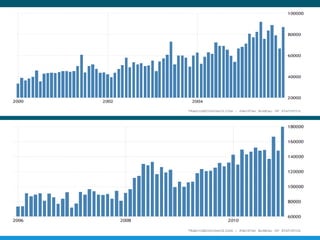
 Graphical representation
 Monthly
export
report for
last four
years with
% change
 Group-wise analysis of
exports
METHOD TO INCREASE EXPORT
 Entrepreneurship and Workforce Development.
 Improve the productivity and technological content of domestic goods
 provide incentives to nurturing innovation,
 making Pakistani products globally competitive
 innovative thinking and out-of-the-box solutions
 Withdraw custom duty/sale tax
 More Products Diversity
 Empowering SMEs
 Simplifying regulations
 Reference
https://www.investopedia.com/terms/e/export.asp#:~:text=Exports%20are%20incre
dibly%20important%20to,benefit%20of%20all%20trading%20parties.
https://www.worldstopexports.com/pakistans-top-10-exports/
<a href='https://www.macrotrends.net/countries/PAK/pakistan/tariff-rates'>Pakistan
Tariff Rates 1995-2022</a>. www.macrotrends.net. Retrieved 2022-12-08.
<a href='https://www.macrotrends.net/countries/PAK/pakistan/exports'>Pakistan
Exports 1960-2022</a>. www.macrotrends.net. Retrieved 2022-12-09.
https://www.pbc.org.pk/research/selected-trade-and-manufacturing-data-for-
pakistan-a-brief_analysis-2/
Source
World bank
Pakistan Bureau of Statistics
Pakistan Business council
Forbes Global 2000 rankings, The World’s Biggest Public Companies
Wikipedia, Pakistan
 Current Account
Deficit
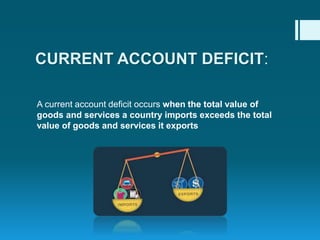
CURRENT ACCOUNT DEFICIT:
A current account deficit occurs when the total value of
goods and services a country imports exceeds the total
value of goods and services it exports
KEY POINTS:
 A current account deficit indicates that a country is importing
more than it is exporting.
Emerging economies often run surpluses, and developed
countries tend to run deficits.
A current account deficit is not always detrimental to a
nation's economy—external debt may be used to finance
lucrative investments
COMPONENTS:
 TRADE DEFICIT.
 NET INCOME.
 DIRECT REMITTANCE AND INVESTMENT INCOME.
CAUSES:
Overvalued exchange rate
Higher inflation
Economic growth
Recession in other country
Borrowing money
Decline in export sectors
EFFECTS:
Economic growth
Weakening of demand
Rise in value of foreign assets
Setting of inflation
Lower standards of living
IMPORTANCE:
Neither good nor bad.
Likely to be unsustainable and lead to harmful result when
persistently large, fuels consumptions rather than investment,
occurs alongside excessive domestic credit growth, follows
an overvalued exchange rate or accompanies.
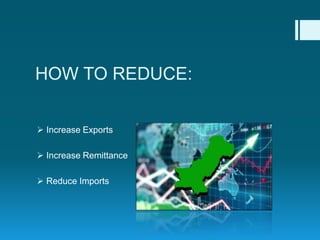
HOW TO REDUCE:
 Increase Exports
 Increase Remittance
 Reduce Imports
…
The quality, quantity and innovation of exports of Pakistan is
very low. We should uplift our domestic sector and work on
Artificial Intelligence to uplift Foreign Exchange Reserves.
(PTI’s Government initiated Presidential Initiative for AI and
Computing)
CALCULATION:
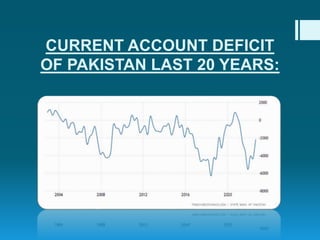
CURRENT ACCOUNT DEFICIT
OF PAKISTAN LAST 20 YEARS:

Import Export of Pakistan

  • 1.
  • 2.
     An importis a product or service produced abroad and purchased in your home country.  Imported goods or services are attractive when domestic industries cannot produce similar goods and services cheaply or efficiently.  Free trade agreements and tariff schedules often dictate which goods and materials are less expensive to import.  Economists and policy analysts disagree on the positive and negative impacts of imports. IMPORT
  • 3.
     Countries aremost likely to import goods or services that their domestic industries cannot produce as efficiently or cheaply as the exporting country.  Countries may also import raw materials or commodities that are not available within their borders.  For example, many countries import oil because they cannot produce it domestically or cannot produce enough to meet demand. THE BASICS OF AN IMPORT
  • 4.
     Being theworld’s fifth-most populous country, Pakistan is forced to import an immense quantity of resources to sustain its population.  Since the country’s own resources consist of agriculture and raw materials, it has to rely on imports to fulfill other needs. IMPORTANCE OF IMPORT
  • 5.
     Mineral Fuelsand Oils These imports make up 27 percent of the country’s total imports, amounting to approximately $19.3 billion in the year 2021.  Electrical Equipment Currently, electrical equipment is one of the major imports of Pakistan, amounting to 8.2 percent of the total imports.  Machinery Machinery imports have an approximate value of $5.88 billion, a considerable amount out of the total imports. In total, these imports amount to 8.1 percent of the country’s total imports. MAJOR IMPORTS OF PAKISTAN
  • 6.
     Iron andSteel The total value of these imports amounts to roughly $4.59 billion, with major trading partners being China, Japan, Vietnam, Iran, and Germany. Therefore, almost 6.3 percent of the country’s total imports comprise iron and steel.  Pharmaceutical Products Currently, pharmaceuticals make up almost 5.2 percent of total imports, valued at around $3.78 billion in the year 2021.  Animal and Vegetable Oils In the previous fiscal year, animal and vegetable oil imports made up 4.9 percent of the country’s overall imports, with an approximate valuation of $3.60 billion.
  • 7.
     Plastics In 2021,plastics made up almost 4.1 percent of the country’s total imports, valued at approximately $3.01 billion.  Organic Chemicals Out of the country’s total imports in 2021, organic chemicals amounted to almost 4.1 percent. These imports were valued at around $3 billion.  Import Tariffs Pakistan uses the Harmonized System to classify goods. Customs duties are levied on ad-valorem basis. Other than customs duty, the government charges 17.0 percent sales tax on the duty paid value of a variety of goods produced in or imported into the country. Customs duty and other charges are payable in Pakistani rupees.
  • 8.
    Imports into Pakistancan be made using any of the following modes:  Letter of credit  Registered contract  Documentary collection  Open account  Advance payment MODES OF PAYMENT FOR IMPORTS
  • 9.
     Karachi Port& Harbour Karachi, Sindh Province  Gwadar Port Gwadar, Balochistan Province  Port Muhammad Bin Qasim Bin Qasim, Malir District, Sindh Province  Mohammad Ali Jinnah Naval Base Ormara, Balochistan Province EIGHT MAJOR PORTS IN PAKISTAN
  • 10.
     Keti BanderPort Thatta District, Sindh Province  Port of Ormara Gwadar District, Balochistan Province  Port of Pasni Pasni, Gwadar District, Balochistan Province  Port of Jiwani Jiwani, Gwadar District, Balochistan Province
  • 11.
    Imports of goodsand services represent the value of all goods and other market services received from the rest of the world. They include the value of merchandise, freight, insurance, transport, travel, royalties, license fees, and other services, such as communication, construction, financial, information, business, personal, and government services. They exclude compensation of employees and investment income (formerly called factor services) and transfer payments. Data are in current U.S. dollars. Pakistan imports for 2021 was $69.04B, a 31.94% increase from 2020.
  • 12.
    Pakistan Imports -Historical Data Year Billions of US $ % of GDP 2021 $69.04B 19.93% 2020 $52.33B 17.42% 2019 $62.62B 19.51% 2018 $67.82B 19.04% 2017 $58.51B 17.25% 2016 $50.07B 15.96% 2015 $46.13B 17.05% 2014 $45.59B 18.66% 2013 $46.37B 20.06% 2012 $45.79B 20.41% 2011 $40.52B 18.97%
  • 13.
    Pakistan Imports -Historical Data Year Billions of US $ % of GDP 2010 $34.29B 19.35% 2009 $33.09B 19.68% 2008 $39.48B 23.21% 2007 $30.14B 19.78% 2006 $29.58B 21.55% 2005 $21.42B 17.84% 2004 $14.34B 13.30% 2003 $13.42B 14.63% 2002 $11.07B 13.86% 2001 $11.36B 14.29% 2000 $10.86B 13.24%
  • 14.
    EXPORT An export ininternational trade is a good produced in one country that is sold into another country or a service provided in one country for a national or resident of another country
  • 15.
    Importance of Export Exportsare incredibly important to modern economies because they offer people and firms many more markets for their goods. One of the core functions of diplomacy and foreign policy between governments is to foster economic trade, encouraging exports and imports for the benefit of all trading parties As components of both domestic and global economies, a country's exports can have far-reaching effects on businesses and consumers all around the world.
  • 16.
     Here aresome reasons why exports are important Benefits for domestic businesses Benefits for domestic economy • Stabilize the value of their currency • Lower the value of their currency • Maintain liquidity • Control inflation • Pay debts Effects on international relations
  • 17.
     Benefits fordomestic businesses Diversify business investment and spread out economic risk Expending business by entering into international market Reduce per unit cost Spread out economic risk Domestic business can acquire new market and increase their profit Gaining new knowledge and experience
  • 18.
     Benefits fordomestic Economy Stimulates economics activities and create jobs Business opportunity thrives in country Raise standard of living Increase foreign exchange reserve Foreign reserve can be used in following ways o Stabilize currency o maintain liquidity o Lower the value of their currency o pay debts o Control inflation
  • 19.
     Effects oninternational relations  Exports and trade agreements can impact its diplomatic relations with foreign countries  More trade with a country shows strong relationships  results in increased efficiency but also allows countries to participate in a global economy  Encouraging the opportunity for foreign direct investment  Providing employment and enabling consumers to enjoy a greater variety of goods
  • 20.
    MAJOR EXPORT OFPAKISTAN Following are the major export of Pakistan  Miscellaneous textiles, worn clothing US$5.5 billion (19.1% of total exports)  Knit or crochet clothing, accessories US$4.5 billion (15.6%)  Cotton, Rice, Wheat $4.8 billion (17.8%)  Clothing, accessories (not knit) $3.4 billion (11.8%)  Cereals $2.3 billion (7.8%)  Copper $818.3 million (2.8%)  Leather/animal gut articles $697.6 million (2.4%)  Fruits, nuts $492.9 million (1.7%)  Salt, Sulphur, stone, cement $484.7 million (1.7%)  Optical, technical, medical apparatus $437 million (1.5%)
  • 21.
     Export tariff Anexport tariff is a tax placed on a good that is exported from a country. Governments use tariffs to create economic barriers to trade. Tariffs raise the overall prices of goods, limiting their production and sale. An export tariff specifically increases the cost to sell domestic goods overseas. Tariff Rate for export in Pakistan is 8.67% Modes of Payment for Export Registered Contract Open Account (O/A) Documentary Collections Letter of Credit (L/C) Cash in Advance
  • 22.
     Pakistan Export – Historical Datafor 20 years Pakistan Exports - Historical Data Year Billions of US $ % of GDP 2021 $34.57B 9.98% 2020 $27.94B 9.30% 2019 $30.14B 9.39% 2018 $30.56B 8.58% 2017 $27.89B 8.22% 2016 $27.40B 8.74% 2015 $28.69B 10.60% 2014 $29.92B 12.24% 2013 $30.70B 13.28% 2012 $27.82B 12.40% 2011 $29.83B 13.97% 2010 $23.95B 13.52% 2009 $20.84B 12.40% 2008 $21.06B 12.38% 2007 $20.14B 13.21% 2006 $19.40B 14.13% 2005 $17.18B 14.31% 2004 $15.35B 14.24% 2003 $13.92B 15.17% 2002 $11.01B 13.78% 2001 $10.60B 13.34% 2000 $9.94B 12.12%
  • 23.
  • 26.
     Monthly export report for lastfour years with % change
  • 27.
  • 28.
    METHOD TO INCREASEEXPORT  Entrepreneurship and Workforce Development.  Improve the productivity and technological content of domestic goods  provide incentives to nurturing innovation,  making Pakistani products globally competitive  innovative thinking and out-of-the-box solutions  Withdraw custom duty/sale tax  More Products Diversity  Empowering SMEs  Simplifying regulations
  • 29.
     Reference https://www.investopedia.com/terms/e/export.asp#:~:text=Exports%20are%20incre dibly%20important%20to,benefit%20of%20all%20trading%20parties. https://www.worldstopexports.com/pakistans-top-10-exports/ <a href='https://www.macrotrends.net/countries/PAK/pakistan/tariff-rates'>Pakistan TariffRates 1995-2022</a>. www.macrotrends.net. Retrieved 2022-12-08. <a href='https://www.macrotrends.net/countries/PAK/pakistan/exports'>Pakistan Exports 1960-2022</a>. www.macrotrends.net. Retrieved 2022-12-09. https://www.pbc.org.pk/research/selected-trade-and-manufacturing-data-for- pakistan-a-brief_analysis-2/ Source World bank Pakistan Bureau of Statistics Pakistan Business council Forbes Global 2000 rankings, The World’s Biggest Public Companies Wikipedia, Pakistan
  • 30.
  • 31.
    CURRENT ACCOUNT DEFICIT: Acurrent account deficit occurs when the total value of goods and services a country imports exceeds the total value of goods and services it exports
  • 32.
    KEY POINTS:  Acurrent account deficit indicates that a country is importing more than it is exporting. Emerging economies often run surpluses, and developed countries tend to run deficits. A current account deficit is not always detrimental to a nation's economy—external debt may be used to finance lucrative investments
  • 33.
    COMPONENTS:  TRADE DEFICIT. NET INCOME.  DIRECT REMITTANCE AND INVESTMENT INCOME.
  • 34.
    CAUSES: Overvalued exchange rate Higherinflation Economic growth Recession in other country Borrowing money Decline in export sectors
  • 35.
    EFFECTS: Economic growth Weakening ofdemand Rise in value of foreign assets Setting of inflation Lower standards of living
  • 36.
    IMPORTANCE: Neither good norbad. Likely to be unsustainable and lead to harmful result when persistently large, fuels consumptions rather than investment, occurs alongside excessive domestic credit growth, follows an overvalued exchange rate or accompanies.
  • 37.
    HOW TO REDUCE: Increase Exports  Increase Remittance  Reduce Imports
  • 38.
    … The quality, quantityand innovation of exports of Pakistan is very low. We should uplift our domestic sector and work on Artificial Intelligence to uplift Foreign Exchange Reserves. (PTI’s Government initiated Presidential Initiative for AI and Computing)
  • 39.
  • 40.
    CURRENT ACCOUNT DEFICIT OFPAKISTAN LAST 20 YEARS: