IEEE GLOBECOM 2010

Yang Hong, Changcheng Huang, and James Yan
Department of Systems and Computer Engineering, 
Carleton University, Ottawa, Canada
Wh t i SIP?
What is SIP?
 Session Initiation Protocol
 protocol that establishes,

Internet

manages (multimedia)
sessions [RFC 3261]
 used for VoIP presence &
VoIP,
video conference

Proxy
Server

Proxy
Server

 SIP consists of two basic

elements
l
t
 UA (User Agent) and P-Server
(Proxy Server)

 About 1000 companies produce

SIP products
 Microsoft’s Windows
Messenger (≥4 7) i l d SIP
M
(≥4.7) includes

UA

UA

Simplified SIP Network Configuration

2
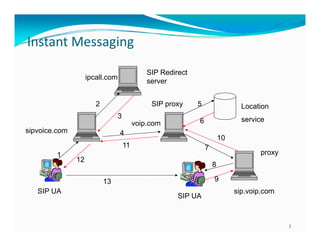
Instant Messaging
Instant Messaging
SIP Redirect
server

ipcall.com
ipcall com

SIP proxy

2
3
sipvoice.com

voip.com

5

4

10
7

12

proxy
8
9

13
SIP UA

service

6

11
1

Location

SIP UA

sip.voip.com

3
IMS SIP Server Overload – A 
f
h ll
Performance Management Challenge
 3GPP has adopted SIP
 as the basis of IMS architecture

 Problem: Server(s) cannot complete

the processing of requests under
overload conditions

 Multiple causes: Insufficient
p

capacity, Component Failures,
Unexpected traffic surges, DOS
attacks [RFC 5390]

 Impact: Performance degradation,

drop in throughput, revenue loss,
network collapse
Simplified
Si lifi d IMS C t l L
Control Layer O
Overview
i
4
Why Worry About SIP Message Retransmission?
Why Worry About SIP Message Retransmission?
built in
 Retransmission built-in to maintain SIP reliability
against message loss
 Loss is detected as long delay in acknowledgment
 Surge in user demand can cause SIP server

overload and long delay to acknowledge SIP
messages
 Long dela s ma trigger more retransmissions and a
delays may

positive feedback exacerbating server overload

5
Contributions of This Paper
 Using control-theoretic approach to
 model an overloaded downstream server and its
upstream server as a feedback control system
 Proposing Redundant Retransmission Ratio Control

(RRRC) algorithm (a PI rate control algorithm) to
 mitigate the overload
 achieve satisfactory target redundant message ratio


by controlling retransmission rate

 Performing OPNET simulations under two typical

overload scenarios to
 Validate RRRC (implicit SIP overload control) algorithm
6
Outline
 SIP Retransmission Mechanism Overview
 Related Work on SIP Overload Control
 Queuing Dynamics of Overloaded Server
 Control-Theoretic Design for Overload Control Based
g

on Redundant Retransmission Ratio
 Performance Evaluation to Validate RRRC SIP

Overload Control Algorithm
 Conclusions
7
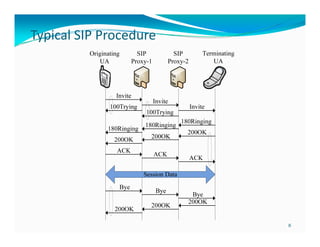
Typical SIP Procedure

8
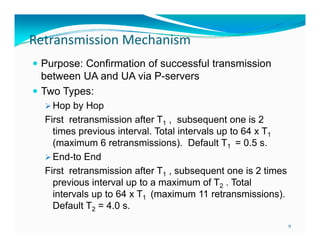
Retransmission Mechanism
 Purpose: Confirmation of successful transmission

between UA and UA via P-servers
 Two Types:
 Hop by Hop

First retransmission after T1 , subsequent one is 2
times previous interval. Total intervals up to 64 x T1
(maximum 6 retransmissions). Default T1 = 0.5 s.
(
)
f
 End-to End
First retransmission after T1 , subsequent one is 2 times
previous interval up to a maximum of T2 . Total
intervals up to 64 x T1 (maximum 11 retransmissions).
Default T2 = 4.0 s.
9
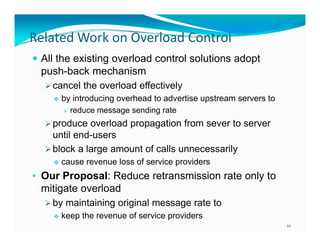
Related Work on Overload Control
 All the existing overload control solutions adopt

push-back mechanism
 cancel the overload effectively


by introducing overhead to advertise upstream servers to
 reduce message sending rate
d
di
t

 produce overload propagation from sever to server

until end-users
 block a large amount of calls unnecessarily


cause revenue loss of service providers

• Our Proposal: Reduce retransmission rate only to

mitigate overload
 by maintaining original message rate to


keep the revenue of service providers
10
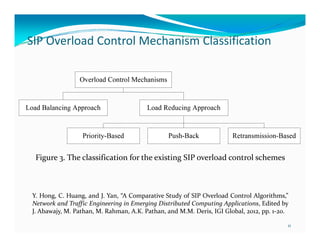
SIP Overload Control Mechanism Classification

Figure 3. The classification for the existing SIP overload control schemes

Y. Hong, C. Huang, and J. Yan, “A Comparative Study of SIP Overload Control Algorithms,”
Network and T ffi E i
N
k d Traffic Engineering i E
i in Emerging Di ib d C
i Distributed Computing A li i
i Applications, Edi d b
Edited by
J. Abawajy, M. Pathan, M. Rahman, A.K. Pathan, and M.M. Deris, IGI Global, 2012, pp. 1‐20.
11
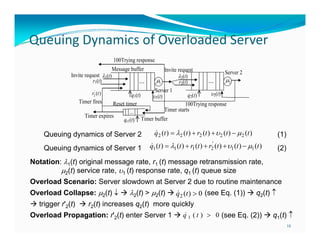
Queuing Dynamics of Overloaded Server
Q
g y
 

100Trying response
Invite request 1(t)
r1(t)
r2' (t )  
Timer fires

Message buffer

q1(t)
Reset timer

Timer expires



qr1(t)

Invite request
Server 2
2(t)
2  
1  

r2(t)
Server 1
2(t)
q2(t)
1(t)
100Trying response
Timer starts
Ti

Timer buffer

Queuing dynamics of Server 2
Queuing dynamics of Server 1


q 2 (t )  2 (t )  r2 (t )   2 (t )   2 (t )


q1 (t )  1 (t )  r1 (t )  r2' (t )  1 (t )  1 (t )

(1)
(2)

Notation: 1(t) original message rate, r1 (t) message retransmission rate,
2(t) service rate 1 (t) response rate q1 (t) queue size
rate,
rate,
Overload Scenario: Server slowdown at Server 2 due to routine maintenance
Overload Collapse: 2(t)   2(t) > 2(t)  q 2 (t )  0 (see Eq. (1))  q2(t) 

ti
trigger r''2(t)  r2(t) i
increases q2(t) more quickly
i kl

Overload Propagation: r'2(t) enter Server 1  q 1 ( t )  0 (see Eq. (2))  q1(t) 
12
Feedback Overload Control System 
 

g
g
y
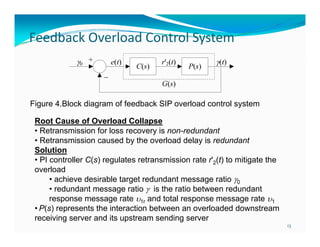
Figure 4.Block diagram of feedback SIP overload control system
Root Cause of Overload Collapse
• Retransmission for loss recovery is non-redundant
• Retransmission caused by the overload delay is redundant
Solution
• PI controller C(s) regulates retransmission rate r'2(t) to mitigate the
overload
• achieve desirable target redundant message ratio 0
• redundant message ratio  is the ratio between redundant
espo se essage ate
a d total espo se essage ate
response message rate 1r and tota response message rate 1
• P(s) represents the interaction between an overloaded downstream
receiving server and its upstream sending server
13
Overload Controller Design 
g
Redundant message ratio (t)=1r(t)/1(t) r'2(t)/1(t)
PI controller regulates retransmission rate r'2(t)
r
t

'
r2 (t)  KPe(t )  KI 0 e()d
t

 KP ( 0   (t ))  KI 0 ( 0   ())d
Control plant P(s)=(s)/r'2(s)=[r'2(s)e-s/1]/r'2(s)=e-s/1
PI controller C(s)=KP+KI/s
Open-loop overload control system G(s)=C(s)P(s)=(KP+KI/s)e-s/1
Positive phase margin m of G(s) can guarantee control system stability
PI controller gains can be obtained based on phase margin m

KP 

1
2

KI 

1 (3 / 4   m )
2
14
SIP Overload Control Algorithm (RRRC)
SIP Overload Control Algorithm (RRRC)
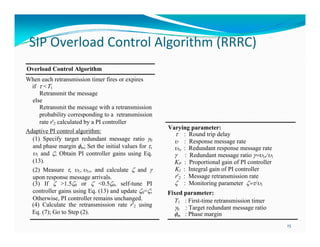
Overload Control Algorithm
When each retransmission timer fires or expires
if < 1
Retransmit the message
else
Retransmit the message with a retransmission
probability corresponding to a retransmission
rate r'2 calculated by a PI controller
Adaptive PI control algorithm:
(1) Specify target redundant message ratio
and phase margin m; Set the initial values for ,
and ; Obtain PI controller gains using Eq.
(13).
(2) Measure ,
and
r and calculate
upon response message arrivals.
>1.5
or
<0.5 , self-tune PI
(3) If
controller gains using Eq. (13) and update = ;
g
Otherwise, PI controller remains unchanged.
(4) Calculate the retransmission rate r'2 using
Eq. (7); Go to Step (2).

Varying parameter:
: Round trip delay
: Response message rate
1r : Redundant response message rate
: Redundant message ratio
1r/ 1
KP : Proportional gain of PI controller
KI : Integral gain of PI controller
r'2 : Message retransmission rate
: Monitoring parameter
/ 1
Fixed parameter:
T1 : First-time retransmission timer
: Target redundant message ratio
m : Phase margin
15
Scenario to Validate Overload Control Algorithm
Scenario to Validate Overload Control Algorithm
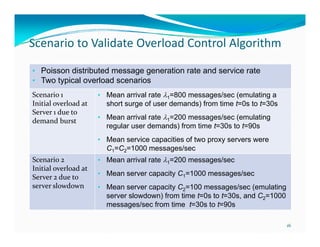
• Poisson distributed message generation rate and service rate
• Two typical overload scenarios
Scenario 1
Initial overload at 
Server 1 due to 
demand burst

• Mean arrival rate 1=800 messages/sec (emulating a

short surge of user demands) from time t=0s to t=30s

• Mean arrival rate 1=200 messages/sec (emulating

regular user demands) from time t=30s to t=90s

• Mean service capacities of two proxy servers were

C1=C2=1000 messages/sec
Scenario 2
Initial overload at 
Server 2 due to 
server slowdown

• Mean arrival rate 1=200 messages/sec
• Mean server capacity C1=1000 messages/sec
• Mean server capacity C2=100 messages/sec (emulating

server slowdown) from time t=0s to t=30s, and C2=1000
messages/sec from time t=30s to t=90s

16
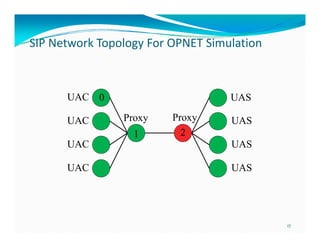
SIP Network Topology For OPNET Simulation
SIP Network Topology For OPNET Simulation

17
Simulation Results of Scenario 1
Simulation Results of Scenario 1
4

x 10

NOLC q1

7

OLC q1
6

o

5
4
3
2
1
0

10

20

30

40

50

60

70

80

90

Time (sec)

Queue size q1 (messages) of Server 1
versus time

OLC qo

8000

6000
10
4000

2000

0

0

20
NOLC qo

0

10

20

30

40

50

60

70

80

OLC Queue size qo (messag
ges)

10000

NOLC Queue size q (messag
e
ges)

Queue siz q1 (messages
ze
s)

8

0
90

Time (sec)

Queue size qo (messages) of an originating
server versus time

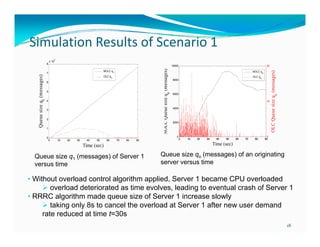
• Without overload control algorithm applied, Server 1 became CPU overloaded
 overload deteriorated as time evolves, leading to eventual crash of Server 1
• RRRC algorithm made queue size of Server 1 increase slowly
 taking only 8s to cancel the overload at Server 1 after new user demand
rate reduced at time t=30s
18
Simulation Results of Scenario 2
Simulation Results of Scenario 2
4

x 10

OLC q1

4

1

3

2

10
2

1

0

10

20

30

40

50

60

70

80

0
90

Time (sec)
( )

Queue size q1 (messages) of Server 1
versus time

x 10

1.8

Queue size q2 (messages
s
s)

NOLC q1

0

4

20

OLC Queu size q (messa
ue
ages)

1

NOLC Que size q (mess
eue
sages)

5

NOLC q2

1.6

OLC q2

1.4
1.2
1
0.8
0.6
0.4
0.2
0

0

10

20

30

40

50

60

70

80

90

Time (sec)

Queue size q2 (messages) of Server 2
versus time

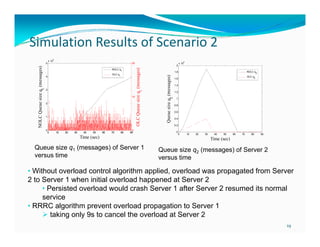
• Without overload control algorithm applied overload was propagated from Server
applied,
2 to Server 1 when initial overload happened at Server 2
• Persisted overload would crash Server 1 after Server 2 resumed its normal
service
• RRRC algorithm prevent overload propagation to Server 1
 taking only 9s to cancel the overload at Server 2
19
Conclusions
 Applying control-theoretic approach to model SIP

overload problem as a feedback control problem
D
Developing R d d t R t
l i Redundant Retransmission R ti C t l
i i Ratio Control
(RRRC) algorithm (a PI rate control algorithm) to mitigate
the overload by
 controlling retransmission rate
 achieving desirable target redundant message ratio

 Simulation results demonstrate that RRRC (implicit SIP

overload control) algorithm can
 prevent the overload propagation
 cancel the overload effectively

 Our solution does NOT require modification in the SIP

header and time consuming standardization process
time-consuming
 can be freely implemented in any SIP servers of different carriers
20
Remarks (1)
 OPNET simulation code for 3 implicit SIP overload control algorithms

(RRRC, RTDC, and RTQC) published by IEEE Globecom 2010/ICC 2011
available for non-commercial research use upon request
 RRRC algorithm (proposed by this IEEE Globecom 2010 paper) has been

quickly adopted by The Central Weather Bureau of Taiwan for their early
earthquake warning system
 “A Effi i t Earthquake Early W
“An Efficient E th
k E l Warning M
i Message D li
Delivery Al ith U i an i
Algorithm Using
in

Time Control-Theoretic Approach,” Ubiquitous Intelligence and Computing,
Lecture Notes in Computer Science, 6905, Springer, Berlin, Heidelberg, 2011, pp.
161-173.

http://www.springerlink.com/content/b6252x2k613rv211/?MUD=MP
http://www.ipv6.org.tw/docu/elearning8_2011/1010004798p_3-7.pdf
 S
Short review and comments on RRRC (
C (implicit S overload control)
SIP
)

algorithm: "Local SIP Overload Control", Proceedings of WWIC, June 2013.
http://link.springer.com/chapter/10.1007%2F978-3-642-38401-1_16#
http://c3lab.poliba.it/images/2/2a/SipOverload_WWIC13.pdf
http://c3lab poliba it/images/2/2a/SipOverload WWIC13 pdf
21
Remarks (2)
 Journal version discusses how to apply RTDC algorithm to mitigate SIP

overload for both SIP over UDP and SIP over TCP (with TLS)
 “Applying control theoretic approach to mitigate SIP overload,”
y
( )
Telecommunication Systems, 54(4), 2013, pp. 387-404. Available at
http://www.researchgate.net/publication/257667871_Applying_control_theoretic
_approach_to_mitigate_SIP_overload
 Survey on SIP overload control algorithms: “A Comparative Study of SIP
y
g
p
y

Overload Control Algorithms,” Network and Traffic Engineering in Emerging
Distributed Computing Applications, IGI Global, 2012, pp. 1-20.
http://www.igi-global.com/chapter/comparative-study-sip-overloadcontrol/67496
t l/67496
http://www.researchgate.net/publication/231609451_A_Comparative_Study_of
_SIP_Overload_Control_Algorithms
 Discussion on control system design can be found in the answers to the

ResearchGate question “What are trends in control theory and its
applications in physical systems (from a research point of view)? ”
https://www.researchgate.net/post/What_are_trends_in_control_theory_and_its
https://www researchgate net/post/What are trends in control theory and its
_applications_in_physical_systems_from_a_research_point_of_view2
22

Mitigating SIP Overload Using a Control-Theoretic Approach

  • 1.
  • 2.
    Wh t iSIP? What is SIP?  Session Initiation Protocol  protocol that establishes, Internet manages (multimedia) sessions [RFC 3261]  used for VoIP presence & VoIP, video conference Proxy Server Proxy Server  SIP consists of two basic elements l t  UA (User Agent) and P-Server (Proxy Server)  About 1000 companies produce SIP products  Microsoft’s Windows Messenger (≥4 7) i l d SIP M (≥4.7) includes UA UA Simplified SIP Network Configuration 2
  • 3.
    Instant Messaging Instant Messaging SIP Redirect server ipcall.com ipcallcom SIP proxy 2 3 sipvoice.com voip.com 5 4 10 7 12 proxy 8 9 13 SIP UA service 6 11 1 Location SIP UA sip.voip.com 3
  • 4.
    IMS SIP Server Overload – A  f h ll Performance Management Challenge 3GPP has adopted SIP  as the basis of IMS architecture  Problem: Server(s) cannot complete the processing of requests under overload conditions  Multiple causes: Insufficient p capacity, Component Failures, Unexpected traffic surges, DOS attacks [RFC 5390]  Impact: Performance degradation, drop in throughput, revenue loss, network collapse Simplified Si lifi d IMS C t l L Control Layer O Overview i 4
  • 5.
    Why Worry AboutSIP Message Retransmission? Why Worry About SIP Message Retransmission? built in  Retransmission built-in to maintain SIP reliability against message loss  Loss is detected as long delay in acknowledgment  Surge in user demand can cause SIP server overload and long delay to acknowledge SIP messages  Long dela s ma trigger more retransmissions and a delays may positive feedback exacerbating server overload 5
  • 6.
    Contributions of This Paper  Using control-theoreticapproach to  model an overloaded downstream server and its upstream server as a feedback control system  Proposing Redundant Retransmission Ratio Control (RRRC) algorithm (a PI rate control algorithm) to  mitigate the overload  achieve satisfactory target redundant message ratio  by controlling retransmission rate  Performing OPNET simulations under two typical overload scenarios to  Validate RRRC (implicit SIP overload control) algorithm 6
  • 7.
    Outline  SIP RetransmissionMechanism Overview  Related Work on SIP Overload Control  Queuing Dynamics of Overloaded Server  Control-Theoretic Design for Overload Control Based g on Redundant Retransmission Ratio  Performance Evaluation to Validate RRRC SIP Overload Control Algorithm  Conclusions 7
  • 8.
  • 9.
    Retransmission Mechanism  Purpose: Confirmationof successful transmission between UA and UA via P-servers  Two Types:  Hop by Hop First retransmission after T1 , subsequent one is 2 times previous interval. Total intervals up to 64 x T1 (maximum 6 retransmissions). Default T1 = 0.5 s. ( ) f  End-to End First retransmission after T1 , subsequent one is 2 times previous interval up to a maximum of T2 . Total intervals up to 64 x T1 (maximum 11 retransmissions). Default T2 = 4.0 s. 9
  • 10.
    Related Work on Overload Control  All theexisting overload control solutions adopt push-back mechanism  cancel the overload effectively  by introducing overhead to advertise upstream servers to  reduce message sending rate d di t  produce overload propagation from sever to server until end-users  block a large amount of calls unnecessarily  cause revenue loss of service providers • Our Proposal: Reduce retransmission rate only to mitigate overload  by maintaining original message rate to  keep the revenue of service providers 10
  • 11.
    SIP Overload Control Mechanism Classification Figure 3. The classification for the existing SIP overload control schemes Y. Hong, C.Huang, and J. Yan, “A Comparative Study of SIP Overload Control Algorithms,” Network and T ffi E i N k d Traffic Engineering i E i in Emerging Di ib d C i Distributed Computing A li i i Applications, Edi d b Edited by J. Abawajy, M. Pathan, M. Rahman, A.K. Pathan, and M.M. Deris, IGI Global, 2012, pp. 1‐20. 11
  • 12.
    Queuing Dynamics of Overloaded Server Q g y   100Trying response Inviterequest 1(t) r1(t) r2' (t )   Timer fires Message buffer  q1(t) Reset timer Timer expires  qr1(t) Invite request Server 2 2(t) 2   1    r2(t) Server 1 2(t) q2(t) 1(t) 100Trying response Timer starts Ti Timer buffer Queuing dynamics of Server 2 Queuing dynamics of Server 1  q 2 (t )  2 (t )  r2 (t )   2 (t )   2 (t )  q1 (t )  1 (t )  r1 (t )  r2' (t )  1 (t )  1 (t ) (1) (2) Notation: 1(t) original message rate, r1 (t) message retransmission rate, 2(t) service rate 1 (t) response rate q1 (t) queue size rate, rate, Overload Scenario: Server slowdown at Server 2 due to routine maintenance Overload Collapse: 2(t)   2(t) > 2(t)  q 2 (t )  0 (see Eq. (1))  q2(t)   ti trigger r''2(t)  r2(t) i increases q2(t) more quickly i kl  Overload Propagation: r'2(t) enter Server 1  q 1 ( t )  0 (see Eq. (2))  q1(t)  12
  • 13.
    Feedback Overload Control System    g g y Figure 4.Block diagramof feedback SIP overload control system Root Cause of Overload Collapse • Retransmission for loss recovery is non-redundant • Retransmission caused by the overload delay is redundant Solution • PI controller C(s) regulates retransmission rate r'2(t) to mitigate the overload • achieve desirable target redundant message ratio 0 • redundant message ratio  is the ratio between redundant espo se essage ate a d total espo se essage ate response message rate 1r and tota response message rate 1 • P(s) represents the interaction between an overloaded downstream receiving server and its upstream sending server 13
  • 14.
    Overload Controller Design  g Redundant message ratio(t)=1r(t)/1(t) r'2(t)/1(t) PI controller regulates retransmission rate r'2(t) r t ' r2 (t)  KPe(t )  KI 0 e()d t  KP ( 0   (t ))  KI 0 ( 0   ())d Control plant P(s)=(s)/r'2(s)=[r'2(s)e-s/1]/r'2(s)=e-s/1 PI controller C(s)=KP+KI/s Open-loop overload control system G(s)=C(s)P(s)=(KP+KI/s)e-s/1 Positive phase margin m of G(s) can guarantee control system stability PI controller gains can be obtained based on phase margin m KP  1 2 KI  1 (3 / 4   m ) 2 14
  • 15.
    SIP Overload ControlAlgorithm (RRRC) SIP Overload Control Algorithm (RRRC) Overload Control Algorithm When each retransmission timer fires or expires if < 1 Retransmit the message else Retransmit the message with a retransmission probability corresponding to a retransmission rate r'2 calculated by a PI controller Adaptive PI control algorithm: (1) Specify target redundant message ratio and phase margin m; Set the initial values for , and ; Obtain PI controller gains using Eq. (13). (2) Measure , and r and calculate upon response message arrivals. >1.5 or <0.5 , self-tune PI (3) If controller gains using Eq. (13) and update = ; g Otherwise, PI controller remains unchanged. (4) Calculate the retransmission rate r'2 using Eq. (7); Go to Step (2). Varying parameter: : Round trip delay : Response message rate 1r : Redundant response message rate : Redundant message ratio 1r/ 1 KP : Proportional gain of PI controller KI : Integral gain of PI controller r'2 : Message retransmission rate : Monitoring parameter / 1 Fixed parameter: T1 : First-time retransmission timer : Target redundant message ratio m : Phase margin 15
  • 16.
    Scenario to ValidateOverload Control Algorithm Scenario to Validate Overload Control Algorithm • Poisson distributed message generation rate and service rate • Two typical overload scenarios Scenario 1 Initial overload at  Server 1 due to  demand burst • Mean arrival rate 1=800 messages/sec (emulating a short surge of user demands) from time t=0s to t=30s • Mean arrival rate 1=200 messages/sec (emulating regular user demands) from time t=30s to t=90s • Mean service capacities of two proxy servers were C1=C2=1000 messages/sec Scenario 2 Initial overload at  Server 2 due to  server slowdown • Mean arrival rate 1=200 messages/sec • Mean server capacity C1=1000 messages/sec • Mean server capacity C2=100 messages/sec (emulating server slowdown) from time t=0s to t=30s, and C2=1000 messages/sec from time t=30s to t=90s 16
  • 17.
    SIP Network TopologyFor OPNET Simulation SIP Network Topology For OPNET Simulation 17
  • 18.
    Simulation Results ofScenario 1 Simulation Results of Scenario 1 4 x 10 NOLC q1 7 OLC q1 6 o 5 4 3 2 1 0 10 20 30 40 50 60 70 80 90 Time (sec) Queue size q1 (messages) of Server 1 versus time OLC qo 8000 6000 10 4000 2000 0 0 20 NOLC qo 0 10 20 30 40 50 60 70 80 OLC Queue size qo (messag ges) 10000 NOLC Queue size q (messag e ges) Queue siz q1 (messages ze s) 8 0 90 Time (sec) Queue size qo (messages) of an originating server versus time • Without overload control algorithm applied, Server 1 became CPU overloaded  overload deteriorated as time evolves, leading to eventual crash of Server 1 • RRRC algorithm made queue size of Server 1 increase slowly  taking only 8s to cancel the overload at Server 1 after new user demand rate reduced at time t=30s 18
  • 19.
    Simulation Results ofScenario 2 Simulation Results of Scenario 2 4 x 10 OLC q1 4 1 3 2 10 2 1 0 10 20 30 40 50 60 70 80 0 90 Time (sec) ( ) Queue size q1 (messages) of Server 1 versus time x 10 1.8 Queue size q2 (messages s s) NOLC q1 0 4 20 OLC Queu size q (messa ue ages) 1 NOLC Que size q (mess eue sages) 5 NOLC q2 1.6 OLC q2 1.4 1.2 1 0.8 0.6 0.4 0.2 0 0 10 20 30 40 50 60 70 80 90 Time (sec) Queue size q2 (messages) of Server 2 versus time • Without overload control algorithm applied overload was propagated from Server applied, 2 to Server 1 when initial overload happened at Server 2 • Persisted overload would crash Server 1 after Server 2 resumed its normal service • RRRC algorithm prevent overload propagation to Server 1  taking only 9s to cancel the overload at Server 2 19
  • 20.
    Conclusions  Applying control-theoreticapproach to model SIP overload problem as a feedback control problem D Developing R d d t R t l i Redundant Retransmission R ti C t l i i Ratio Control (RRRC) algorithm (a PI rate control algorithm) to mitigate the overload by  controlling retransmission rate  achieving desirable target redundant message ratio  Simulation results demonstrate that RRRC (implicit SIP overload control) algorithm can  prevent the overload propagation  cancel the overload effectively  Our solution does NOT require modification in the SIP header and time consuming standardization process time-consuming  can be freely implemented in any SIP servers of different carriers 20
  • 21.
    Remarks (1)  OPNET simulationcode for 3 implicit SIP overload control algorithms (RRRC, RTDC, and RTQC) published by IEEE Globecom 2010/ICC 2011 available for non-commercial research use upon request  RRRC algorithm (proposed by this IEEE Globecom 2010 paper) has been quickly adopted by The Central Weather Bureau of Taiwan for their early earthquake warning system  “A Effi i t Earthquake Early W “An Efficient E th k E l Warning M i Message D li Delivery Al ith U i an i Algorithm Using in Time Control-Theoretic Approach,” Ubiquitous Intelligence and Computing, Lecture Notes in Computer Science, 6905, Springer, Berlin, Heidelberg, 2011, pp. 161-173. http://www.springerlink.com/content/b6252x2k613rv211/?MUD=MP http://www.ipv6.org.tw/docu/elearning8_2011/1010004798p_3-7.pdf  S Short review and comments on RRRC ( C (implicit S overload control) SIP ) algorithm: "Local SIP Overload Control", Proceedings of WWIC, June 2013. http://link.springer.com/chapter/10.1007%2F978-3-642-38401-1_16# http://c3lab.poliba.it/images/2/2a/SipOverload_WWIC13.pdf http://c3lab poliba it/images/2/2a/SipOverload WWIC13 pdf 21
  • 22.
    Remarks (2)  Journal versiondiscusses how to apply RTDC algorithm to mitigate SIP overload for both SIP over UDP and SIP over TCP (with TLS)  “Applying control theoretic approach to mitigate SIP overload,” y ( ) Telecommunication Systems, 54(4), 2013, pp. 387-404. Available at http://www.researchgate.net/publication/257667871_Applying_control_theoretic _approach_to_mitigate_SIP_overload  Survey on SIP overload control algorithms: “A Comparative Study of SIP y g p y Overload Control Algorithms,” Network and Traffic Engineering in Emerging Distributed Computing Applications, IGI Global, 2012, pp. 1-20. http://www.igi-global.com/chapter/comparative-study-sip-overloadcontrol/67496 t l/67496 http://www.researchgate.net/publication/231609451_A_Comparative_Study_of _SIP_Overload_Control_Algorithms  Discussion on control system design can be found in the answers to the ResearchGate question “What are trends in control theory and its applications in physical systems (from a research point of view)? ” https://www.researchgate.net/post/What_are_trends_in_control_theory_and_its https://www researchgate net/post/What are trends in control theory and its _applications_in_physical_systems_from_a_research_point_of_view2 22