COM+ is an evolution of Microsoft Component Object Model (COM) and Microsoft Transaction Server (MTS). COM+ builds on and extends applications written using COM, MTS, and other COM-based technologies.
AGENDA
• Goals andrequirements
• Semantics and programming model
• Topology
• Architecture
• Installation and Admin issues
• Availability
• How does this relate to Valence/Convoy?
3.
GOALS
• Improved scalability
•Increased application throughput by adding servers
• Improved availability
• Applications can tolerate server failure
• Server failures are transparent to clients
• Compose with clustering and WLBS
• Complimentary technologies
SEMANTICS
• Granularity isat the class level
• User explicitly marks class to be
load balanced
• Load Balancing at:
• Object creation time
• JIT activation time at a future release
• Load Balancing engine associated with class
• Default: response time engine
6.
PROGRAMMING MODEL
• CreatingLoad-Balance’able components
• Design for short lived instances
• Explicitly manage state
• Store in DB across creation boundaries
• No node affinity
• Component shouldn’t assume creation on a specific node
• E.g., don’t depend on a specific file on a particular node
7.
CLIENT PROGRAMMING MODEL
•Client applications
• Create and release references to objects
• Short lived server components
• Load balancing happens on creation boundary in COM+ 1.0 (and not JIT)
8.
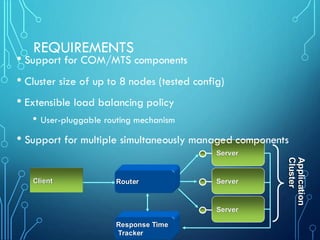
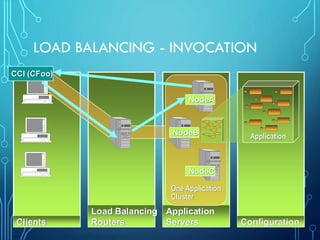
Clients
Load Balancing
Routers
Application
Servers Configuration
OneApplication
Cluster
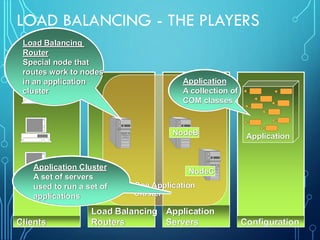
LOAD BALANCING - THE PLAYERS
NodeB
NodeA
NodeC
Application
Application Cluster
A set of servers
used to run a set of
applications
Application Cluster
A set of servers
used to run a set of
applications
Application
A collection of
COM classes
Application
A collection of
COM classes
Load Balancing
Router
Special node that
routes work to nodes
in an application
cluster
Load Balancing
Router
Special node that
routes work to nodes
in an application
cluster
9.
Clients
Load Balancing
Routers
Application
Servers Configuration
OneApplication
Cluster
NodeB
NodeA
NodeC
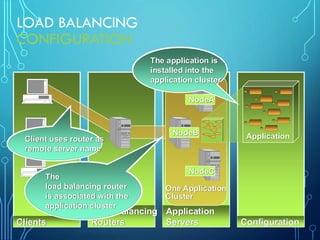
The
load balancing router
is associated with the
application cluster
The
load balancing router
is associated with the
application cluster
Application
The application is
installed into the
application cluster
The application is
installed into the
application cluster
Client uses router as
remote server name
Client uses router as
remote server name
LOAD BALANCING
CONFIGURATION
TOPOLOGY
• Applications are:
•Collections of COM classes
• Installed on application clusters
• An application cluster
• Is a collection of servers
• Is associated with one load balancing component router
12.
TOPOLOGY
• Clients
• Setcreation requests to be forwarded to the load balancing router
machine
• Load balancing component router maintains information about the
servers
• Component Routers accommodate transient and permanent
failures in application servers
13.
APPLICATIONS AND INSTALLATION
•Can be load balanced [YES/NO]
• Default - NO
• If the application is load balanced
• The client side package will have the RemoteServerName entry points to
the load balancing router machine
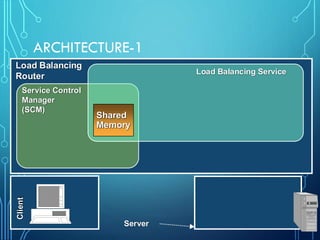
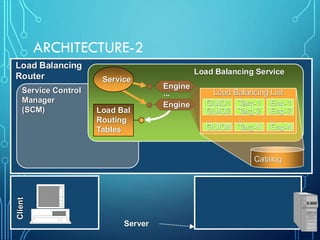
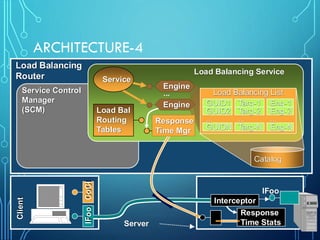
ARCHITECTURE-4
Load Balancing Service
Catalog
...
LoadBal
Routing
Tables
Service
Load Balancing List
... ...
GUID1
GUID2
GUIDN
Targ-1
Targ-2
Targ-N
Eng-1
Eng-2
Eng-N
...
Engine
IFoo
CoCI
Client
Server
Load Balancing
Router
Service Control
Manager
(SCM) Load Bal
Routing
Tables
IFoo
Interceptor
Response
Time Stats
Response
Time Mgr
Engine
18.
ROUTER STARTUP
• Spinoff supervisor
• Initialize and load the catalog
• Obtain servers in application cluster
• Obtain classes and associated servers
• Create shared memory table
• Create and initialize load balancing engine(s); the engine:
• Creates worker threads
• Creates a remote instance of a response time server
19.
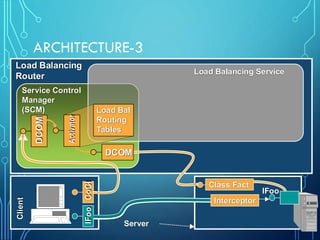
CREATING AN INSTANCE
•Client request forwarded to
router SCM
• Router SCM calls activator
• Activator reads shared memory and determines server to
use
• MachineName is updated and activator delegates
• Emergency recovery is initiated if failures are
encountered
20.
HANDLING SERVER DOWN
•Activator marks server as down and triggers target down on
engine
• Engine responsible to replace with new target (or NULL if cluster
down)
• Analyzers and load balancing engines
• Responsible for declaring a server to be up again
• Assume that the server is down until a remote creation of the response time
server succeeds
• Unhandled: scheduled downtimes
21.
ROUTER AVAILABILITY
• Routeris single point of failure
• Can be configured as a Cluster (MSCS) resource
• Node failure results in router service being instantiated on second
node
22.
HOW THIS RELATESTO…
• Valence/Convoy (WLBS)
• Complimentary
• Use COM+ Load Balancing for fine grained dynamic control of applications
• Compose
• Can be used together for a highly scalable configuration
• Same programming model
• No node affinity; careful
state management
23.
SUMMARY
• Load Balancingfor
COM/MTS components
• Cluster size of up to 8 nodes
• Designed for extensibility
• High availability architecture
• Support for multiple simultaneously managed components
24.
CALL TO ACTION
•Build your server applications to be scalable using COM+ Load
Balancing
• Careful design and choice of mechanisms
• Explicit design with component state
• Build client applications to use scalable server applications
• Create, use and release server objects
• Retry on failure

![APPLICATIONS AND INSTALLATION
• Can be load balanced [YES/NO]
• Default - NO
• If the application is load balanced
• The client side package will have the RemoteServerName entry points to
the load balancing router machine](https://image.slidesharecdn.com/comloadbalancing-250312031552-e6d1f744/85/Implementing-Load-Balancing-in-COM-Applications-13-320.jpg)





![[@IndeedEng] Boxcar: A self-balancing distributed services protocol](https://cdn.slidesharecdn.com/ss_thumbnails/indeedeng-boxcar-131104105304-phpapp02-thumbnail.jpg?width=640&height=640&fit=bounds)


![5G Explained! A High Level Overview [Introduction]](https://cdn.slidesharecdn.com/ss_thumbnails/5gexplainedahighleveloverview-260119165306-cc137a3e-thumbnail.jpg?width=640&height=640&fit=bounds)

