Server Load Balancing1st ed Edition Tony Bourke
pdf download
https://ebookfinal.com/download/server-load-balancing-1st-ed-
edition-tony-bourke/
Explore and download more ebooks or textbooks
at ebookfinal.com
2.
Here are somerecommended products for you. Click the link to
download, or explore more at ebookfinal
Windows Server 2003 Clustering Load Balancing 1st Edition
Robert Shimonski
https://ebookfinal.com/download/windows-server-2003-clustering-load-
balancing-1st-edition-robert-shimonski/
NGINX Cookbook Advanced Recipes for High Performance Load
Balancing 3rd Edition Derek Dejonghe
https://ebookfinal.com/download/nginx-cookbook-advanced-recipes-for-
high-performance-load-balancing-3rd-edition-derek-dejonghe/
Websphere J2ee Application Development for the IBM Server
Iseries Server 1st ed Edition Ibm Redbooks
https://ebookfinal.com/download/websphere-j2ee-application-
development-for-the-ibm-server-iseries-server-1st-ed-edition-ibm-
redbooks/
Professional Team Foundation Server 2010 1st Edition Ed
Blankenship
https://ebookfinal.com/download/professional-team-foundation-
server-2010-1st-edition-ed-blankenship/
3.
Dictionary of ContemporarySlang 3Rev Ed Edition Tony
Thorne
https://ebookfinal.com/download/dictionary-of-contemporary-slang-3rev-
ed-edition-tony-thorne/
Lecture Notes Respiratory Medicine 9th Edition Stephen J.
Bourke
https://ebookfinal.com/download/lecture-notes-respiratory-
medicine-9th-edition-stephen-j-bourke/
DNS on Windows Server 2003 3rd ed Edition Cricket Liu
https://ebookfinal.com/download/dns-on-windows-server-2003-3rd-ed-
edition-cricket-liu/
Gas turbine handbook principles and practices 3rd ed
Edition Tony Giampaolo
https://ebookfinal.com/download/gas-turbine-handbook-principles-and-
practices-3rd-ed-edition-tony-giampaolo/
The Story of Pain From Prayer to Painkillers 1st Edition
Joanna Bourke
https://ebookfinal.com/download/the-story-of-pain-from-prayer-to-
painkillers-1st-edition-joanna-bourke/
5.
Server Load Balancing1st ed Edition Tony Bourke
Digital Instant Download
Author(s): Tony Bourke
ISBN(s): 9780596000509, 0596000502
Edition: 1st ed
File Details: PDF, 3.12 MB
Year: 2001
Language: english
6.
Server Load Balancing
TonyBourke
O'REILLY'
Beijing • Cambridge • Farnham • Koln • Paris • Sebastopol • Taipei • Tokyo
Table of Contents
Prefaceix
I. Concepts and Theories ofServer Load Balancing 1
1. Introduction to Server Load Balancing 3
In the Beginning 4
Evolution 7
Other Technologies 8
2. Concepts ofServer Load Balancing 13
Networking Basics 13
Server Load Balancers 15
Redundancy 16
Provider Infrastructure 22
3. Anatomy ofa Server Load Balancer 24
A Day in the Life of a Packet 25
Direct Server Return 27
Other SLB Methods 29
Under the Hood 30
4. Performance Metrics ....32
Connections Per Second 32
Total Concurrent Connections 33
Throughput 33
Traffic Profiles 34
The Wall . . 36
Table of Contents
AdministrationNetwork 117
Additional Features 118
10. F5's BIG-IP 119
Getting Started 119
Flat-Based SLB 125
NAT-BasedSLB 126
Redundancy 127
11. Foundry Serverlron Series 129
Command Line Interface (CLI) 130
Flat-Based SLB 133
NAT-BasedSLB 135
Redundancy 136
TV. Appendixes 139
A. Quick Command Guide 141
B. Direct Server Return Configuration 151
C. Sample Configurations 157
Index 167
11.
Preface
This book ismeant to be a resource for anyone involved in the design, produc-
tion, overseeing, or troubleshooting of a site that employs server load balancing
(SLB). Managers and other high-level people can use this book to improve their
understanding of the overall technology. Engineers and site architects can use this
book to give insight into their designs and implementations of SLB. Technicians
can use this book to help configure and troubleshoot SLB implementations, as well
as other in-the-trenches work.
This book came about because of the almost nonexistent resources for SLB that
exist today. Most of the information and resources for an SLB implementation
come from the vendor of the particular product that you use or are looking to use.
Through my own trials and tribulations, I realized that there was a need for a
third-party resource—one that was unbiased and had the users' interests at heart.
While most or all of the vendors have good intentions in reference to what they
tell you, they can still be clouded by the bottom line of their own sales figures.
Because SLB is relatively new, there is a lack of standardized terminology for con-
cepts associated with the technology. Because of this lack of standardization, this
book adopts a particular vocabulary that, though similar, does not match the
vocabulary you may have adopted with a particular vendor. This was deliberately
done to provide an even, unbiased basis for the discussion of SLB and its termi-
nology.
This book includes a section devoted to configuring four of the SLB vendors.
Those vendors are (in alphabetical order) Alteon WebSystems (http://www.
alteonwebsystems.com); Cisco Systems, Inc., which includes their CSS-11000 (for-
merly known as Arrowpoint) line of products (http://www.cisco.com); F5 Net-
works, Inc., makers of BIG-IP (http://www.f5.com); and Foundry Networks, Inc.
(http://www.foundrynetworks.com). These are not the only vendors in the SLB
ix
12.
x Preface
industry; thisbook would be well over a thousand pages if it were to cover all the
vendors. These vendors represent the market leaders and the more popular among
the lot. Though one section of this book is dedicated to these vendors, the other
two can still provide a valuable resource no matter which SLB vendor you choose.
There is more than one way to skin a cat, as the old adage goes, and that is partic-
ularly true of the networking world. The methods shown in this book are tried-
and-true implementations that I have worked with and have helped to develop
over the few years SLB has been around. My ways aren't the only ways, nor are
they necessarily the best ways, but they've served me well, and I hope they serve
you, too.
This book assumes that the reader is relatively familiar with the basic, day-to-day
workings of the IP suite of protocols, Ethernet (regular, Fast, or Gigabit), and the
Internet in general. There are many great books that delve into the magic and
inner workings of these subjects, if the need should arise. However, to under-
stand load balancing, it is not necessary to know the byte length of an Ethernet
frame header.
Overview
This book is divided into three parts. Part I concentrates on the theories and con-
cepts of Server Load Balancing. Part II concentrates on the implementation and
network topology of load balancers. Part III is a configuration guide to four signifi-
cant load-balancing products on the market.
Part I: Concepts and Theories
ofServerLoadBalancing
Chapter 1, Introduction to Server Load Balancing, glosses over the world of Server
Load Balancing as a whole.
Chapter 2, Concepts ofServer Load Balancing, delves into the concepts and termi-
nology associated with Server Load Balancing. Since every vendor has its own
jargon for essentially the same concepts, it's important to have a basic vocabulary
for comparing one product and its features to another.
Chapter 3, Anatomy of a Server Load Balancer, goes into the networking process
of Server Load Balancing. This chapter reviews the life of a packet as it travels
from the user to the load balancer, from the load balancer to the server, from the
server to the load balancer, and from the load balancer back to the user.
Chapter 4, Performance Metrics, discusses the various metrics associated with load-
balancingperformance.
13.
Preface xi
Part II:Practice and Implementation
of Server Load Balancing
Chapter 5, Introduction to Architecture, goes into the actual guts of load-balancing
devices and reviews the different paths that companies have taken in designing
load-balancer hardware.
Chapter 6, Flat-Based SLB Network Architecture, delves into the flat-based network
architecture, where the VIPs and real servers are on the same subnet. Flat-based is
the most simple way of implementing a load-balanced network.
Chapter 7, NAT-Based SLB Network Architecture, deals with NAT-based SLB imple-
mentations, where the VIPs and real servers are on separate subnets. NAT-based
SLB is more complicated, but can offer some advantages over the flat-based net-
work, depending on your site's requirements.
Part III: Configuring Server Load Balancers
Chapter 8, Alteon WebSystems, presents two separate guides to configuring an
Alteon load balancer for both scenarios laid out in Chapters 6 and 7.
Chapter 9, Cisco's CSS (Formerly ArrowPoint) Configuration Guide, presents two
separate guides to configuring Cisco's CSS switches for both scenarios laid out in
Chapters 6 and 7.
Chapter 10, F5's BIG-IP, presents two separate guides to configuring an F5 BIG-IP
for both scenarios laid out in Chapters 6 and 7.
Chapter 11, Foundry Serverlron Series, presents two separate guides to config-
uring a Foundry Serverlron for both scenarios laid out in Chapters 6 and 7.
Appendix A, Quick Command Guide, is a quick reference to commonly per-
formed administration tasks involving the load balancers featured in this book.
Appendix B, Direct Server Return Configuration, provides configuration examples
for the setup of Direct Server Return (DSR).
Appendix C, Sample Configurations, is a quick reference to a multitude of pos-
sible load-balancing configurations and implementations. The illustrations in
Appendix C are vendor-neutral.
This book was written using Microsoft Word and Visio. It was written during
2000-01 in New York City, usually in the wee hours of the night, and usually
fueled by vegan chocolate chips and soy burgers.
14.
Preface
Resources
Again, there isa multitude of resources available to people who are implementing
or are planning to implement load balancers. Trade publications such as Network
World (for which I have written and with which I have had a great experience)
and InfoWorld do pieces on load balancing and the industry. The vendors are
good resources to go to, but of course, they will be a little biased towards their
products.
I run a mailing list for the discussion of load balancing, which can be found at
http://vegan.net/lb. There are other resources linked to that site, including http://
vegan.net/MRTG, which shows how to configure the freeware graphing program
MRTG for use with load balancers and their metrics. MRTG, which can be found at
http://ee-staff.ethz.ch/~oetlker/webtools/mrtg/mrtg.html is an absolutely marvelous
tool written by Tobias Oetiker and Dave Rand. Never underestimate the power of
pretty pictures.
Conventions Used in This Book
Throughout this book, I have used the following typographic conventions:
Constant width
Used to indicate a language construct such as a language statement, a con-
stant, or an expression. Lines of code also appear in constant width
Constant width bold
Used to indicate user input
Italic
Used to indicate commands, file extensions, filenames, directory or folder
names, and functions
Constant width italic
Used to indicate variables in examples
This icon designates a note, -which is an important aside to the
nearby text.
This icon designates a warning relating to the nearby text.
15.
Preface xiii
How toContact Us
Please address comments and questions concerning this book to the publisher:
O'Reilly & Associates, Inc.
101 Morris St.
Sebastopol, CA 95472
(800) 998-9938 (in the U.S. or Canada)
(707) 829-0515 (international/local)
(707) 829-0104 (fax)
We have a web page for this book, where we list errata or any additional informa-
tion. You can access this page at:
http://www. oreilly. com/catalog/serverload
To ask technical questions or comment on the book, send email to:
bookquestions@oreilly. com
For more information about our books, conferences, software, Resource Centers,
and the O'Reilly Network, see our web site at:
http://www.oreilly.com
Acknowledgments
First off, I'd like to thank the vendors for their help. Their support teams have
helped me when I needed clarification on a concept or a feature, as well as
helping to ensure that their products were accurately represented.
At Cisco, I'd like to thank Dion Heraghty, Jim Davies, Kate Pence, and Jason La
Carrubba from the ArrowPoint group; at F5, Rob Gilde, Ron Kim, and Dan Matte;
at Alteon, Jimmy Wong, the incorrigible David Callisch, John Taylor, Andrew
Hejnar, and Lori Hopkins; at Foundry, Chandra Kopparapu, Srini Ramadurai, and
Jerry Folta. I'd also like to thank Mark Hoover for giving me additional insight into
the industry.
Of course, I'd also like to thank my parents, Steve and Mary, for ensuring that I
learned how to read and write (who knew that would pay off?); my sister Kristen,
who kept bugging me to hurry up and finish the book; my former boss, Chris
Coluzzi, the best boss I've ever had, who initially helped and encouraged me to
write a book; and my coworkers at SiteSmith, Inc., my current employer, namely
Treb Ryan, for supporting me in my speaking and writing endeavors.
I'd also like to thank my editor, Jim Sumser, who helped me through my first
book, as well as my technical reviewer, Andy Neely, who made sure this book
16.
xiv Preface
was onthe level. And of course, my publisher, O'Reilly, the industry leader for
many reasons—the way they handle their authors is definitely one of them.
Introduction to Server
LoadBalancing
While Server Load Balancing (SLB) could mean many things, for the purpose of
this book it is defined as a process and technology that distributes site traffic
among several servers using a network-based device. This device intercepts traffic
destined for a site and redirects that traffic to various servers. The load-balancing
process is completely transparent to the end user. There are often dozens or even
hundreds of servers operating behind a single URL. In Figure 1-1, we see the sim-
plest representation of SLB.
Figure 1-1. SLB simplified
1
19.
Chapter 1: Introductionto Server Load Balancing
A load balancer performs the following functions:
• Intercepts network-based traffic (such as web traffic) destined for a site.
• Splits the traffic into individual requests and decides which servers receive
individual requests.
• Maintains a watch on the available servers, ensuring that they are responding
to traffic. If they are not, they are taken out of rotation.
• Provides redundancy by employing more than one unit in a fail-over scenario.
• Offers content-aware distribution, by doing things such as reading URLs, inter-
cepting cookies, and XML parsing.
In the Beginning
In its infancy, the Internet was mostly the playground of academia with very little
general consumer use. Even when the Internet first started catching on around
1995 and personal use ballooned, web sites still weren't used much for commerce
and, thus, were not "mission critical." A single server could easily handle the pro-
cessing requirements of even one of the most popular sites of the day and, since
there wasn't much commerce going on, it wasn't too big of a deal if the site went
down. But as more and more businesses recognized the power and potential the
Internet could offer, that started to change. People came up with clever ways to
handle redundancy and scaling issues as they arose.
Bigger and Faster
When faced with a server pushed to its limits, one of the first instincts of a system
administrator is to somehow beef it up. Adding more RAM, upgrading the pro-
cessor, or adding more processors were all typical options. However, those mea-
sures could only scale so far. At some point, you'll max out the scalability of either
a hardware platform or the operating system on which it runs. Also, beefing up a
server requires taking the server down, and downtime is a concern that server
upgrades don't address. Even the most redundant of server systems is still vulner-
able to outages.
DNS-BasedLoadBalancing
Before SLB was a technology or a viable product, site administrators would (and
sometimes still do) employ a load-balancing process known as DNS round robin.
DNS round robin uses a function of DNS that allows more than one IP address to
associate with a hostname. Every DNS entry has what is known as an A record,
which maps a hostname (such as www.vegan.net) to an IP address (such as
20.
In theBeginning
208.185.43.202). Usuallyonly one IP address is given for a hostname. Under ISO's
DNS server, BIND 8, this is what the DNS entry for www.vegan.net would look
like:
www.vegan.net. IN 208.185.43.202
With DNS round robin, it is possible to give multiple IP addresses to a hostname,
distributing traffic more or less evenly to the listed IP addresses. For instance, let's
say you had three web servers with IP addresses of 208.185.43.202, 208.185.43.203,
and 208.185.43.204 that we wanted to share the load for the site www.vegan.net.
The configuration in the DNS server for the three IP addresses would look like
this:
www.vegan.net. IN
IN
IN
A
A
A
208.185.43.202
208.185.43.203
208.185.43.204
You can check the effect using a DNS utility known as nslookup, which would
show the following for www.vegan.net:
[zorak]# nslookup www.vegan.net
Server: ns1.vegan.net
Address: 198.143.25.15
Name: www.vegan.net
Addresses: 208.185.43.202, 208.185.43.203, 208.185.43.204
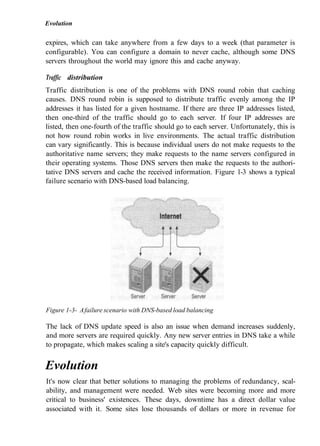
The end result is that the traffic destined for www.vegan.net is distributed between
the three IP addresses listed, as shown in Figure 1-2.
Figure 1-2. Traffic distribution by DNS-based load balancing
21.
Chapter 1: Introductionto Server Load Balancing
This seems like a pretty simple way to distribute traffic among servers, so why
bother spending the money and time implementing SLB at all? The reason is that
DNS round robin has several limitations, including unpredictable load distribution,
caching issues, and a lack of fault-tolerance measures. An understanding of how
DNS works will help to explain the problems of DNS-based load balancing.
DNS 101
DNS associates IP addresses with hostnames so that we don't have to memorize
numbers; instead, we memorize domain names. A computer needs to know the IP
address, however. To perform that translation, every computer connected to the
Internet, whether it be a server or a dialup user's home machine, has one or more
DNS servers configured. When a user types the URL of a hostname into his
browser, for instance, the operating system sends a query to the configured DNS
server requesting the IP address of that hostname. The DNS server doesn't usually
have that information (unless it is cached, which is something we'll discuss later),
so the domain name server looks up the domain name with one of the root
servers. The root servers do not have the IP address information either, but they
know who does, and report that to the user's DNS server. (Servers with the appro-
priate DNS information are known as the authoritative DNS servers. There are usu-
ally at least two listed for a domain, and you can find out what they are by using
the whois utility supplied by most Unix distributions, or through several domain-
registration web sites.) The query goes out to the authoritative name server, the IP
address is reported back, and in a matter of seconds the web site appears on the
user's screen. The entire process works like this:
1. The user types the URL into the browser.
2. The OS makes a DNS request to the configured DNS server.
3. The DNS server sees if it has that IP address cached. If not, it makes a query
to the root servers to see what DNS servers have the information.
4. The root servers reply back with an authoritative DNS server for the requested
hostname.
5. The DNS server makes a query to the authoritative DNS server and receives a
response.
Caching issues
Many of the limitations of DNS round robin are caused by DNS caching. To pre-
vent DNS servers from being hammered with requests, and to keep bandwidth uti-
lization low, DNS servers employ quite a bit of DNS caching. Since DNS
information typically changes very little, this is fine for normal functions. When a
DNS server goes out and gets a DNS entry, it caches that entry until the entry
22.
Evolution
expires, which cantake anywhere from a few days to a week (that parameter is
configurable). You can configure a domain to never cache, although some DNS
servers throughout the world may ignore this and cache anyway.
Traffic distribution
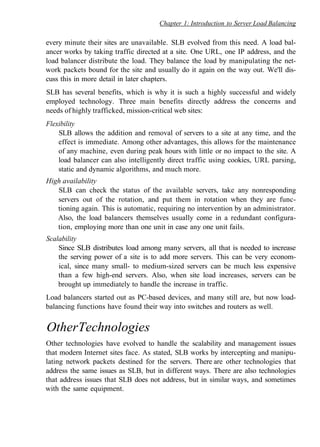
Traffic distribution is one of the problems with DNS round robin that caching
causes. DNS round robin is supposed to distribute traffic evenly among the IP
addresses it has listed for a given hostname. If there are three IP addresses listed,
then one-third of the traffic should go to each server. If four IP addresses are
listed, then one-fourth of the traffic should go to each server. Unfortunately, this is
not how round robin works in live environments. The actual traffic distribution
can vary significantly. This is because individual users do not make requests to the
authoritative name servers; they make requests to the name servers configured in
their operating systems. Those DNS servers then make the requests to the authori-
tative DNS servers and cache the received information. Figure 1-3 shows a typical
failure scenario with DNS-based load balancing.
Figure 1-3- Afailure scenario with DNS-based load balancing
The lack of DNS update speed is also an issue when demand increases suddenly,
and more servers are required quickly. Any new server entries in DNS take a while
to propagate, which makes scaling a site's capacity quickly difficult.
Evolution
It's now clear that better solutions to managing the problems of redundancy, scal-
ability, and management were needed. Web sites were becoming more and more
critical to business' existences. These days, downtime has a direct dollar value
associated with it. Some sites lose thousands of dollars or more in revenue for
23.
Chapter 1: Introductionto Server Load Balancing
every minute their sites are unavailable. SLB evolved from this need. A load bal-
ancer works by taking traffic directed at a site. One URL, one IP address, and the
load balancer distribute the load. They balance the load by manipulating the net-
work packets bound for the site and usually do it again on the way out. We'll dis-
cuss this in more detail in later chapters.
SLB has several benefits, which is why it is such a highly successful and widely
employed technology. Three main benefits directly address the concerns and
needs of highly trafficked, mission-critical web sites:
Flexibility
SLB allows the addition and removal of servers to a site at any time, and the
effect is immediate. Among other advantages, this allows for the maintenance
of any machine, even during peak hours with little or no impact to the site. A
load balancer can also intelligently direct traffic using cookies, URL parsing,
static and dynamic algorithms, and much more.
High availability
SLB can check the status of the available servers, take any nonresponding
servers out of the rotation, and put them in rotation when they are func-
tioning again. This is automatic, requiring no intervention by an administrator.
Also, the load balancers themselves usually come in a redundant configura-
tion, employing more than one unit in case any one unit fails.
Scalability
Since SLB distributes load among many servers, all that is needed to increase
the serving power of a site is to add more servers. This can be very econom-
ical, since many small- to medium-sized servers can be much less expensive
than a few high-end servers. Also, when site load increases, servers can be
brought up immediately to handle the increase in traffic.
Load balancers started out as PC-based devices, and many still are, but now load-
balancing functions have found their way into switches and routers as well.
OtherTechnologies
Other technologies have evolved to handle the scalability and management issues
that modern Internet sites face. As stated, SLB works by intercepting and manipu-
lating network packets destined for the servers. There are other technologies that
address the same issues as SLB, but in different ways. There are also technologies
that address issues that SLB does not address, but in similar ways, and sometimes
with the same equipment.
24.
Other Technologies
Firewall LoadBalancing
Firewall Load Balancing (FWLB) has been developed to overcome some of the
limitations of firewall technologies. Most firewalls are CPU-based, such as a SPARC
machine or an x86-based machine. Because of the processor limitations involved,
the amount of throughput a firewall can handle is often limited. Processor speed,
packet size, configuration, and several other metrics are all determining factors for
what a firewall can do, but generally, they tend to max out at around 70 to 80
Mbps (Megabits per second) of throughput. Like SLB, FWLB allows for the imple-
mentation of several firewalls sharing the load in a manner similar to SLB. Because
of the nature of the traffic, however, the configuration and technology are dif-
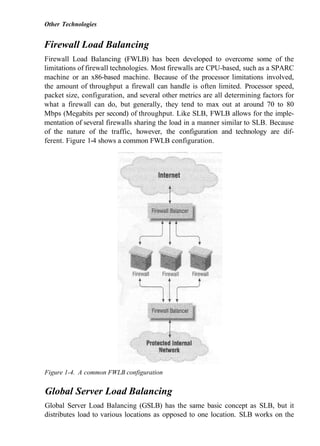
ferent. Figure 1-4 shows a common FWLB configuration.
Figure 1-4. A common FWLB configuration
Global Server Load Balancing
Global Server Load Balancing (GSLB) has the same basic concept as SLB, but it
distributes load to various locations as opposed to one location. SLB works on the
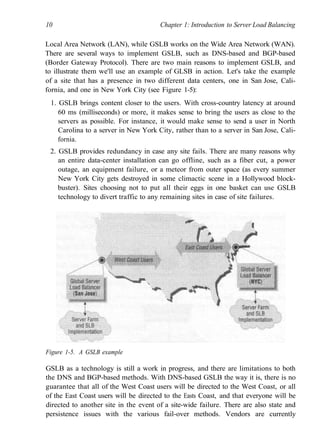
25.
10 Chapter 1:Introduction to Server Load Balancing
Local Area Network (LAN), while GSLB works on the Wide Area Network (WAN).
There are several ways to implement GSLB, such as DNS-based and BGP-based
(Border Gateway Protocol). There are two main reasons to implement GSLB, and
to illustrate them we'll use an example of GLSB in action. Let's take the example
of a site that has a presence in two different data centers, one in San Jose, Cali-
fornia, and one in New York City (see Figure 1-5):
1. GSLB brings content closer to the users. With cross-country latency at around
60 ms (milliseconds) or more, it makes sense to bring the users as close to the
servers as possible. For instance, it would make sense to send a user in North
Carolina to a server in New York City, rather than to a server in San Jose, Cali-
fornia.
2. GSLB provides redundancy in case any site fails. There are many reasons why
an entire data-center installation can go offline, such as a fiber cut, a power
outage, an equipment failure, or a meteor from outer space (as every summer
New York City gets destroyed in some climactic scene in a Hollywood block-
buster). Sites choosing not to put all their eggs in one basket can use GSLB
technology to divert traffic to any remaining sites in case of site failures.
Figure 1-5. A GSLB example
GSLB as a technology is still a work in progress, and there are limitations to both
the DNS and BGP-based methods. With DNS-based GSLB the way it is, there is no
guarantee that all of the West Coast users will be directed to the West Coast, or all
of the East Coast users will be directed to the Easts Coast, and that everyone will be
directed to another site in the event of a site-wide failure. There are also state and
persistence issues with the various fail-over methods. Vendors are currently
Norwich, March 26,1762.
SUSAN NASMITH and JAMES KEITH,
Proprietors of the
NORWICH MACHINE,
Give Notice
that their Machine will set out from the Maid's Head Inn, in St
Simon's Parish, in Norwich, on Monday, the 5th day of April
next, at half-past eleven in the forenoon, and on the Wednesday
and Friday in the same week, at the same time; and to be
continued in like Manner, on those Days weekly, for the carrying
four inside Passengers, at Twenty-five Shillings each, and
outside at Twelve Shillings and Sixpence each. The inside
Passengers to be allowed twenty pound Weight, and all above
to be paid for at three half-pence per pound; and to be in
London on the Tuesday, Thursday and Saturday Evenings
weekly.
N.B.—A Machine will set out on the same days, at the same
time, from the Green Dragon, in Bishopsgate Street, London, for
Norwich.
In the following year, the "Widow Nasmith" and James Keith
advertised that they had built large and commodious machines, to
carry six inside, and reduced the fares to twenty shillings and ten
shillings respectively; but they had apparently not succeeded in
performing the journey in less time than a day and a half, for no
mention is made of speed being accelerated. But a remarkable
feature in that announcement is the extraordinary cheapness of the
fares, little over twopence and a penny a mile for inside and outside
passengers, at a time when prices on other roads ruled from twenty-
28.
five to fiftyper cent. higher. This tells a tale of competition; but
Time, the thief, has robbed us of all knowledge of those competitors.
A year later the London and Ipswich Post Coaches were advertised
to set out every week-day, and to perform the 69¼ miles in ten
hours, an average pace of almost 7 miles an hour; a marvellous turn
of speed for that age. As to whether those Post Coaches ever did
cover that distance in ten hours, we may reasonably express a
doubt; but there was the promise, and 011 the strength of it the
proprietors charged threepence a mile. As will be seen by the
advertisement, these coaches carried no outside passengers:—
Ipswich, August 17th, 1764.
THE LONDON AND IPSWICH POST COACHES
Set out on Monday, the 27th of August, at seven o'clock in the
morning from the Black Bull, in Bishopsgate, London, and at the
same time from the Great White Horse, in Ipswich, and continue
every day (Sunday excepted), to be at the above places the
same evening at five o'clock; each passenger to pay threepence
per mile, and to be allowed eighteen pounds luggage; all above
to pay one penny per pound, and so in proportion. The coaches,
hung upon steel springs, are very easy, large and commodious,
carry six inside but no outside passengers whatever; but have
great conveniences for parcels or game (to keep them from the
weather), which will be delivered at London and Ipswich the
same night.
As these coaches are sent out for the ease and expedition of
gentlemen and ladies travelling, the proprietors humbly hope for
their encouragement, and are determined to spare no pains to
render it as agreeable as they can.
Performed (if God permits) by—
29.
Pet. Sheldon, atthe Bull, Bishopsgate Street,
London.
Thomas Archer, at the White Hart, Brentwood.
Charles Kerry, at the Black Boy, Chelmsford.
Geo. Reynolds, at the Three Cups, Colchester; and
Chas. Harris, at the Great White Horse, Ipswich.
N.B.—The proprietors will not be answerable for any money,
plate, jewels, or writings, unless entered and paid for as such.
The reader will perhaps have observed that this advertisement
especially mentions a convenience for carrying game, and, as a
matter of fact, game and oysters were prominent from an early
period in the history of Norwich Road conveyances, and, by the
middle of the eighteenth century, the Norfolk and Suffolk coaches
had already earned quite a distinctive character in two seasons of
the year, Michaelmas and Christmas. East Anglia has always
abounded in game, and its broad heaths and extensive commons
have been the breeding-grounds of innumerable geese and turkeys
whose careers have ended on London dinner-tables. In those two
seasons it was often difficult to secure a seat on or in any of the
"up" coaches from Norwich or Ipswich, for while every available inch
of space on the mails was occupied by festoons of dead birds
consigned by country cousins to friends in town, the whole of a
stage-coach was frequently chartered for the purpose of despatching
heavy consignments of these noble poultry to the London market.
Christmas provided extraordinary sights along the Norfolk Road, in
the swaying coaches, with parcels and geese and turkeys mountains
high on the roof; with barrels of Colchester natives in the boot, and
hampers swinging heavily between the axle-trees on a shelf called
"the cellar"; while from every rail or projection to which they could
be either safely or hazardously tied depended other turkeys or
braces of fowls, booked at the last moment before starting. It was
something in those days to be a turkey or a goose, before whose
importance the claims of human passengers faded; but it was a
30.
fleeting elevation whichthe philosophic did not envy, thinking that
here indeed the poet was justified in his sounding line—
"The paths of glory lead but to the grave."
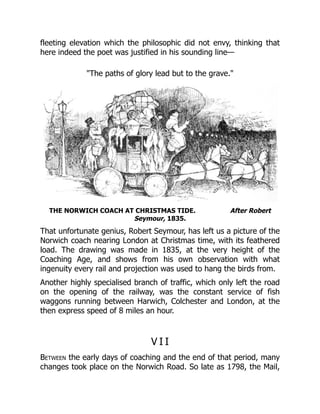
THE NORWICH COACH AT CHRISTMAS TIDE. After Robert
Seymour, 1835.
That unfortunate genius, Robert Seymour, has left us a picture of the
Norwich coach nearing London at Christmas time, with its feathered
load. The drawing was made in 1835, at the very height of the
Coaching Age, and shows from his own observation with what
ingenuity every rail and projection was used to hang the birds from.
Another highly specialised branch of traffic, which only left the road
on the opening of the railway, was the constant service of fish
waggons running between Harwich, Colchester and London, at the
then express speed of 8 miles an hour.
V I I
Between the early days of coaching and the end of that period, many
changes took place on the Norwich Road. So late as 1798, the Mail,
31.
the "Expedition," andthe "Post Coach" were the only coaches to
Norwich, supplemented by three road waggons; two of them doing
the journey twice a week, the third setting out weekly. Later came
the "Norwich Times," "Gurney's Original Day Coach," the
"Phænomenon," as it was originally spelt; the "Magnet," the Ipswich
"Shannon," and the Ipswich "Blue." With the object of serving as
many places as possible, and, incidentally, securing heavier
bookings, the "Times" and Gurney's coaches took a somewhat
circuitous route, leaving the direct road at Chelmsford, and going
through Braintree, Halstead, Sudbury, Long Melford and Bury St
Edmunds, rejoining the Norwich Road at Scole.
But the lord of the road was the Mail Coach, beside which the stages
were very commonplace affairs.
The first mail-coach that ever ran the road between London and
Norwich started in March 1785, and the service was from the
beginning continued daily. Before that time the mails had been
carried by post-boys, who began in 1741 to go six days a week
instead of three, as they formerly had done.
Mail-coaches are entirely things of the past, for the modern coaching
revival has only brought back the smart stages and drags of the last
years of the Coaching Age. The mails were expensive and exclusive
affairs, constructed to carry only nine persons; four inside and five
out, including coachman and guard. For the higher fares passengers
paid they had not always the satisfaction of travelling faster than on
the stages; but perhaps there was some dignity attaching to a seat
on the mail which was lacking on ordinary coaches. And certainly
they were surrounded by pomp and circumstance. The guard wore a
scarlet coat and went armed with pistol, sword and blunderbuss;
not, of course, for the protection of the passengers, but for the safe-
guarding of His Majesty's mails. And everything gave place, as a
matter of right and not merely courtesy, to the mail. Surly pikemen
swung open their gates and asked no toll, for it was one of the
privileges of the mail to go toll-free, and the highwaymen, if they
walked in the ways of caution, left the gorgeous conveyance
32.
severely alone, reservingtheir best attentions for the plebeian
stages. It was a much more serious thing to rob the mail than an
ordinary coach, for a conviction was more certain to end in death,
judges having hints from the Government how undesirable it was
that mails should be ransacked and the robbers live. The rewards
usually offered by the Post-office, too, were tempting to those who
could inform if they would. £200 was the sum generally to be had
for this service, together with the £40 reward by Act of Parliament
for the apprehension of a highwayman; and if the mail was robbed
within five miles of London, another £100. Courage, recklessness,
and desperation—whichever we like to call it—often nerved the
night-hawks to brave even so heavy a handicap as this, as this very
road bears witness, in the daring robbery of the Ipswich Mail in
1822, when notes to the value of no less than £31,198 were stolen.
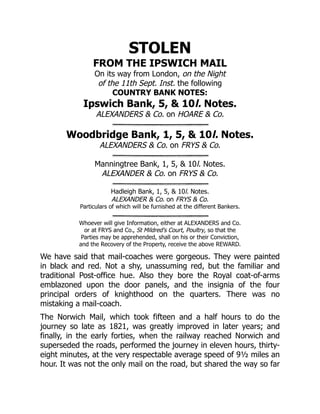
In addition to the usual rewards, a sum of £1000 was offered by the
losing firms of bankers, as shown in the accompanying old handbill,
but without avail. This sum was afterwards increased to £5000, and
a notification given that, in order to prevent the notes being
changed, the ink on all new ones had been altered from black to
red. But the robbers had the impudence to ask £6000 for the return
of the notes. They had already passed £3000 worth, and naively
said, in the negotiations they opened up, that the trouble they had
taken and the risks they had run did not make it worth while to
accept a smaller "reward." The bankers, however, would not spring
another thousand, for by that time everyone was too shy of an
"Ipswich black note," and it was extremely unlikely that any more
could be passed. Negotiations were broken off; but a month later
notes to the value of £28,000 were returned. The thieves were never
traced, and although the bulk of their booty was useless to them,
made the very substantial haul of over £3000 by their lawless
enterprise.
£1000 Reward.
33.
STOLEN
FROM THE IPSWICHMAIL
On its way from London, on the Night
of the 11th Sept. Inst. the following
COUNTRY BANK NOTES:
Ipswich Bank, 5, & 10l. Notes.
ALEXANDERS & Co. on HOARE & Co.
Woodbridge Bank, 1, 5, & 10l. Notes.
ALEXANDERS & Co. on FRYS & Co.
Manningtree Bank, 1, 5, & 10l. Notes.
ALEXANDER & Co. on FRYS & Co.
Hadleigh Bank, 1, 5, & 10l. Notes.
ALEXANDER & Co. on FRYS & Co.
Particulars of which will be furnished at the different Bankers.
Whoever will give Information, either at ALEXANDERS and Co.
or at FRYS and Co., St Mildred's Court, Poultry, so that the
Parties may be apprehended, shall on his or their Conviction,
and the Recovery of the Property, receive the above REWARD.
We have said that mail-coaches were gorgeous. They were painted
in black and red. Not a shy, unassuming red, but the familiar and
traditional Post-office hue. Also they bore the Royal coat-of-arms
emblazoned upon the door panels, and the insignia of the four
principal orders of knighthood on the quarters. There was no
mistaking a mail-coach.
The Norwich Mail, which took fifteen and a half hours to do the
journey so late as 1821, was greatly improved in later years; and
finally, in the early forties, when the railway reached Norwich and
superseded the roads, performed the journey in eleven hours, thirty-
eight minutes, at the very respectable average speed of 9½ miles an
hour. It was not the only mail on the road, but shared the way so far
34.
as Ipswich withthe Ipswich and Yarmouth Mail. This coach was
unfortunate on two occasions between 1835 and 1839. On
September 28th in the first year, when the coachman was climbing
on to his box in the yard of the "Swan with Two Necks," the horses
started away on their own accord, tumbling the coachman off and
knocking down the helper who had been holding their heads.
Dashing into Cheapside, they flung themselves against the back of
the Poole Mail with such force that the coachman of that mail was
also thrown off. He was taken unconscious to the hospital.
Continuing their furious rush, the horses of the Ipswich Mail at
length ran the pole of the coach between the iron railings of a
house, and so were stopped.
The second happening, in 1839, was somewhat similar. The mail had
arrived at Colchester, and the coachman, throwing down the reins,
got off the box. No one was at the horses' heads, and they started
away and galloped down the High Street, until the near leader fell
and broke his neck, stopping the team.
It was by the Ipswich and Yarmouth Mail that David Copperfield
journeyed down to Yarmouth on his second visit to Mr Peggotty. In
the ordinary course of things, he would have reached Ipswich at
3·12 a.m. But on this occasion the weather was a potent factor in
causing delay. He occupied the box seat, and remarked upon the
look of the sky to the coachman while yet on the first stage out of
London.
"Don't you think that a very remarkable sky?" he asked; "I don't
remember to have seen one like it."
"Nor I—not equal to it," said the coachman. "That's mist, sir. There'll
be mischief done at sea, I expect, before long."
The description of this stormy sky is very fine, and seems to have
been drawn from observation; just as true and as effective in its way
as Old Crome's billowy cloudscapes, in his Mousehold Heath, or as
any of Constable's rain-surcharged Suffolk scenes.
35.
"It was amurky confusion—here and there blotted with a colour like
the colour of the smoke from damp fuel—of flying clouds tossed up
into most remarkable heaps, suggesting greater heights in the
clouds than there were depths below them to the bottom of the
deepest hollows in the earth, through which the wild moon seemed
to plunge headlong, as if, in a dread disturbance of the laws of
nature, she had lost her way and were frightened. There had been a
wind all day; and it was rising then, with an extraordinary great
sound. In another hour it had much increased, and the sky was
more overcast, and it blew hard.
"But as the night advanced, the clouds closing in and densely
overspreading the whole sky, then very dark, it came on to blow
harder and harder. It still increased, until our horses could scarcely
face the wind. Many times in the dark part of the night (it was then
late in September, when the nights were not short) the leaders
turned about, or came to a dead stop; and we were often in serious
apprehension that the coach would be blown over. Sweeping gusts
of rain came up before this storm, like showers of steel; and at those
times, when there was any shelter of trees or lee-walls to be got, we
were fain to stop, in a sheer impossibility of continuing the
struggle.... We came to Ipswich very late, having had to fight every
inch of ground since we were ten miles out of London; and found a
cluster of people in the market-place, who had risen from their beds
in the night, fearful of falling chimneys. Some of these, congregating
about the inn-yard while we changed horses, told us of great sheets
of lead having been ripped off a high church tower and flung into a
bye-street, which they then blocked up."
At Ipswich the Yarmouth coaches left the Norwich Road, and so the
further adventures of David Copperfield do not in this place concern
us.
V I I I
36.
Here, as onthe other roads, the early advent of the Motor Car, in
1826, caused much commotion. The steam coaches of that period
never achieved any success on this route, but caricatures of what
might be expected were plentiful, and pictures of the Colchester
"Dreadful Vengeance," the Norwich "Buster," and other fanciful
conveyances, in the act of exploding and distributing their
passengers in little pieces over a wide stretch of country, were
popular. The railway itself came in for much abuse, and misguided
and fanatical coach proprietors wasted their substance in pitiful
attempts to compete with it. Among these was Israel Alexander, that
Jewish hero of the Brighton Road in the early forties, who, although
a first-class whip, was perhaps chiefly associated with the many
upsettings of the Brighton "Quicksilver." He fell out with his noble
friends on that highway, and, coming to the Norwich Road, ran a
well-appointed coach to Colchester for a little while, until even the
Eastern Counties Railway, then the slowest on earth, made the pace
too quick for him. His turn-out was given the extraordinary name of
the "Duke of Beaufort's Retaliator," and might have continued much
longer to carry those who were prejudiced against railways, had it
not met with so many accidents.
One who was contemporary with the coaching age has ingeniously
divided coaching accidents into three classes:—1. Accidents to the
coach; 2. Accidents to the horses; 3. Accidents to the harness. The
most common kind of mishap to the coach was, he says, the
breaking of an axle. This was not, as a rule, due to any faulty
construction of that most essential feature of a public conveyance,
but to the overloading either of passengers or goods, to which
coaches were continually subject. The sudden snapping of an axle at
a high speed or on a down grade produced a tremendous crash
which generally shot coachman, guard and "outsides" in all
directions. Happy those who, in such a case, were received into the
thorny arms of a quickset hedge or the soft embraces of a mud-
heap.
Another kind of mishap, not always accidental, was that of a wheel
coming off; an incident often caused in early times, before the
37.
introduction of patentaxle-boxes, by the mischievous removal of the
lynch-pin by some unscrupulous rascal in the employ of the rival
coach proprietor.
The sudden snapping of a skid-chain while descending a hill,
resulting in the coach running on to the horses and a general
overthrow, in which horses' legs and passengers heads came into
unwonted contact, was perhaps as uncomfortable a kind of disaster
as could be imagined. Overloading, too, sometimes had the effect of
rendering a coach top-heavy, when a slight lack of caution in running
round curves would upset it.
Accidents to the horses were:—casting a shoe, involving lameness,
and perhaps a fall; tripping and stumbling on loose stones and
rolling over; slipping up in frosty weather; and kicking over the
traces or the splinter-bar.
Accidents to the harness usually happened to the traces, which
commonly snapped under an uneven strain. To cobble them up with
twine, and so complete a stage, was a common practice. In such
cases, the thoughts of passengers during the remaining miles were,
like those of the poet, "too deep for words." Most nerve-shaking of
all these varied and untoward happenings, however, was the
breaking of the reins. Rotted by age, by the sun's heat and the
winter's frosts, they would "come away" in the coachman's hands at
that worst of moments;—when he was holding in his horses
downhill. In that contingency, says our ancient, who, in the modern
slang phrase, has "been there," it was the approved thing to say
your prayers first and then take a flying leap (result, a broken neck,
or fractured leg: the bone protruding over the top of the Blucher).
"Then shrieked the timid and stood"—or, rather, sat—"still the
brave;" who had this consolation, that if they fared no better than
those who jumped, the odds were that they fared no worse.
To be dragged at hurricane pace by four runaway horses (for in such
a case they generally did so run) with the broken reins trailing
helplessly after them, was to acquire the knowledge of an inner
38.
meaning in theword "terror." In escapades of this kind the "insides"
were in the most unenviable situation; for the "outsides," including
coachman and guard, took the better, if unheroic, part of crawling
over the roof and slipping down the back of the coach into the road.
The wisdom of their doing so would, in most cases, be proved a few
seconds later by the sound of a distant crash as the coach hurtled
against some roadside tree and dissolved into matchwork, while the
"insides" were stuck as full of splinters as a "fretful porcupine" of
quills.
The "human boy" was as much the terror of the old coachman as he
is of the modern cyclist. The sight of a boy with a hoop reduced him
to a state of purple indignation or of quivering anxiety, according to
temperament. Many an one of our great-grandfathers, attired in the
odd costume of boys in that period, and trundling a hoop along the
road, has felt the lash of the coachman's whip. The following little
story will show us why.
"When a very little boy," says one of our forebears, "I once upset a
four-horse coach by losing control over my hoop, which, to my
consternation, bowled among the legs of the team. I shall never
forget the horror with which I for an instant saw the spirited horses
floundering about with that hateful hoop among them, or heard the
execrations of the coachman and the shouts of the passengers.
Abandoning the wretched plaything to its fate, I took to my heels
down a bye-lane, the portentous crash that followed only
accelerating my speed."
Coach proprietors were favourite targets for Fate's worst shafts.
They were a hard-working, much-enduring class of men; up early
and to bed late, retiring in good circumstances and rising perhaps
ruined through some unforeseen accident. They were "common
carriers" in law, and bound under many Acts of Parliament to deliver
goods uninjured at their destination. As carriers of passengers, it is
true, they were only required to exercise all "due care and diligence"
for the safety of their customers, and were exempt from liability in
case of mishaps through the "act of God" or the unforeseen; but the
39.
observance of dueprecautions and a daily inspection of the coach
had to be proved in case of injury to passengers, or in default they
were held liable for damages.
Thus, the carelessness of any one of his many servants might mean
a very serious thing to a coach proprietor. In those days the old
Anglo-Saxon Law of Deodand was not only in existence, but in a
very nourishing and aggressive condition. Indeed, coaching had
practically rescued it from neglect. It was a law which, in cases of
fatal injuries, empowered the coroner's jury to levy a fine, which
might vary from sixpence to a thousand pounds, upon the object
that caused the mischief.
The very multiplicity of tribunals before whom the personally
unoffending coach proprietor was liable to be haled was in itself
terrifying. There was the already-mentioned coroners jury; the jury
on the criminal side in trials at the Assizes for manslaughter, and the
other "twelve good men and true" who assessed damages in the
Sheriff's Court.
How even the most well-meaning of men might thus suffer is
evident in the case of a proprietor who was cast in damages from
excess of caution. For additional security, and in order to protect it
from road grit, he had a part of an axle incased in wood. One day
this axle broke and a serious accident happened, resulting in an
action against him for damages. He lost the day; the judge ruling
that, although no proof of a defective axle was adduced, a flaw
might have existed which a proper daily examination would have
detected had the extra precaution for safety not been adopted.
I X
What Aldgate might now have been had the original intention of the
Eastern Counties directorate to place their terminus there been
successful, we need not stop to inquire. But, as a good deal has
already been said on the subject of coaches and coaching, it will be
40.
of interest tolearn what were the views of the projectors of the
Eastern Counties Railway. With their original prospectus was issued a
map of the proposed railway from London to Norwich and Yarmouth,
by which it appears that, instead of going to the left of the road
from London, as far as Seven Kings and Chadwell Heath, it was
originally intended to construct the line on the right of the road so
far. Between Romford and Chelmsford the line has been made
practically as first proposed, but onwards, from Chelmsford to
Lexden, it is again on the other side of the highway; and, north of
Colchester, goes wide of the original plan all the way to Norwich.
In many ways this document is very much of a curiosity at this time,
as also are the hopes and aspirations of the directors at the first
General Meeting of the company. The chairman, for instance,
confidently anticipated dividends of 22 per cent., upon which one of
the confiding shareholders replied that the report was most
satisfactory and the prospects held out by no means overcharged.
"If this understanding," said he, "fails in producing the dividend of
22 per cent., calculated upon in the report, then, I must say, human
calculations and expectation can no longer be depended upon." O!
most excellent man. But better is to come.
"Should I live to see the completion of this and similar
undertakings," he resumed, "I do believe I shall live to see misery
almost banished from the earth. From the love I bear my species, I
trust that I may not be too sanguine, and that I may yet witness the
happy end that I have pictured to myself." His was, you think, the
faith that might have moved mountains; but it did not produce that
promised 22 per cent., nor, although we now have many thousands
more miles of railway than he ever dreamed of, has the millennium
yet arrived. Even the most far-seeing have not yet discovered any
heralds of its approach. Let us drop the tribute of a tear to the
sorrows of this excellent person, whose love of his species and
touching anticipation of 22 per cent. dividends were so beautifully
blended, and so cruelly disappointed.
41.
For some yearssmall (very small) dividends were paid. Hudson, the
"Railway King," paid them out of capital. "It made things pleasant,"
he said, when charged with such financially immoral practices. Alas!
poor Hudson, you lived before your time, and went to another world
before such "dishonest" doings as yours were sanctified in principle
by Acts of Parliament which authorise payments of dividends out of
capital in the case of railways under construction.
In 1848 the Eastern Counties Railway was in Chancery, and its very
locomotives and carriages were seized for debt; while for years
afterwards its name was a synonym for delay. The satirists of that
period were as busy with the Eastern Counties as those of our own
time are with the South-Eastern Railway. Every journey has an end;
"even the Eastern Counties' trains come in at last," said Thackeray,
very charitably.
In 1862 it was amalgamated with several minor undertakings, and
re-named the "Great Eastern Railway"; "great in nothing but the
name," as the spiteful said.
When matters were at their worst, the Lord Cranborne of that time
was invited to accept the position of chairman and to help extricate
the company from its difficulties. He accepted the post in January
1868 and held it until December 1871. In April 1868 he had
succeeded to the title of Marquis of Salisbury. Thus the statesman
and prime minister of later years was once a great figure in the
railway world. His financial abilities helped to put the Great Eastern
line on a firm basis, and when he left it the railway was already
greatly improved in every respect. To-day, instead of being a
"shocking example," it is a model to be copied by other lines.
X
Although the last of the old coaches was long ago broken up, and the
Norwich Road is no longer lively with mail and stage travellers, it
has, in common with several other roads out of London, witnessed a
42.
wholly unexpected revival,in the shape of the Parcel Mail service
between London and Ipswich. When the Parcel Post came into being
on the 1st August 1883, it was speedily discovered by the General
Post-office authorities that in paying, according to contract, 55 per
cent. of the gross receipts to the railway companies for the mere
carriage of parcels, they were paying too much. Accordingly, a
system of Parcel Mail coaches was established on several of the old
roads, commencing with the London to Brighton Parcel Mail, in June
1887. A London and Chelmsford four-horse mail was soon added,
and this was shortly afterwards extended to Colchester, and thence
to Ipswich by cart. This curious enterprise of the Post-office was
immediately successful, and it has ever since been found to effect a
large saving over the railway charges. Nor is time lost in delivery.
The down mail leaves London at a quarter to ten o'clock every night
and the parcels arrive at Colchester and Ipswich in time for the first
delivery the next morning; while the country parcels come up to
London by an equally early hour. The way in which the service is
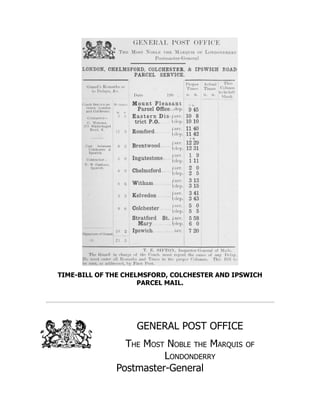
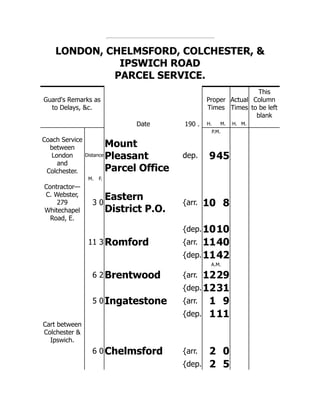
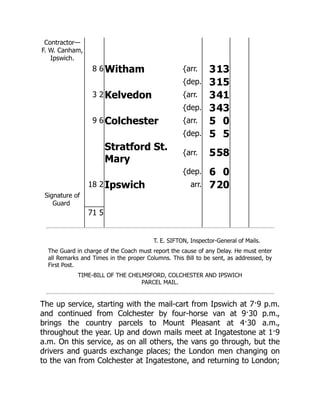
worked will be gathered from the accompanying official way-sheet of
the down mails.
43.
TIME-BILL OF THECHELMSFORD, COLCHESTER AND IPSWICH
PARCEL MAIL.
GENERAL POST OFFICE
The Most Noble the Marquis of
Londonderry
Postmaster-General
44.
LONDON, CHELMSFORD, COLCHESTER,&
IPSWICH ROAD
PARCEL SERVICE.
Guard's Remarks as
to Delays, &c.
Proper
Times
Actual
Times
This
Column
to be left
blank
Date 190 . H. M. H. M.
P.M.
Coach Service
between
London
and
Colchester.
Distance
Mount
Pleasant
Parcel Office
dep. 945
M. F.
Contractor—
C. Webster,
279
Whitechapel
Road, E.
3 0
Eastern
District P.O.
{arr. 10 8
{dep.1010
11 3 Romford {arr. 1140
{dep.1142
A.M.
6 2 Brentwood {arr. 1229
{dep.1231
5 0 Ingatestone {arr. 1 9
{dep. 111
Cart between
Colchester &
Ipswich.
6 0 Chelmsford {arr. 2 0
{dep. 2 5
45.
Contractor—
F. W. Canham,
Ipswich.
86 Witham {arr. 313
{dep. 315
3 2 Kelvedon {arr. 341
{dep. 343
9 6 Colchester {arr. 5 0
{dep. 5 5
Stratford St.
Mary
{arr. 558
{dep. 6 0
18 2 Ipswich arr. 720
Signature of
Guard
71 5
T. E. SIFTON, Inspector-General of Mails.
The Guard in charge of the Coach must report the cause of any Delay. He must enter
all Remarks and Times in the proper Columns. This Bill to be sent, as addressed, by
First Post.
TIME-BILL OF THE CHELMSFORD, COLCHESTER AND IPSWICH
PARCEL MAIL.
The up service, starting with the mail-cart from Ipswich at 7·9 p.m.
and continued from Colchester by four-horse van at 9·30 p.m.,
brings the country parcels to Mount Pleasant at 4·30 a.m.,
throughout the year. Up and down mails meet at Ingatestone at 1·9
a.m. On this service, as on all others, the vans go through, but the
drivers and guards exchange places; the London men changing on
to the van from Colchester at Ingatestone, and returning to London;
46.
the Colchester mentaking over the down van and similarly returning
whence they came.
It is a curious and unexpected revival of old methods, but an entirely
successful one. No highwayman has ever attempted to "hold up" the
Parcel Mail, for the last of that trade has for generations mouldered
in his grave; but should any amateurs essay to complete this revival
of old coaching days by waylaying the mail, the guards would be
found well armed. Their virgin steel and untried pistols have for
years been carried without any excuse for using them; but there
need be no doubt that, were the occasion to arrive, they would
defend their parcels—the pounds of country butter, the eggs, and
wild flowers, or the miscellaneous consignment from London—with
their hearts' blood. There are more romantic things in the world to
die for than postal parcels of eggs, cheese and butter, but the
ennobling word Duty might glorify such a sacrifice for the sake of a
pound's weight of "best fresh," or a dozen of "new laid."
But although the possibility of attack is remote, a spice of danger
and romance savours the conduct of the parcel mails.
The up Colchester Parcel Mail had a mishap on the night of October
11, 1890, when, owing to the prevailing fog, it was driven into a
ditch near Margaretting. Happily, both coachman and guard escaped
injury, the heavy vehicle resting against the hedge. The coachman,
mounting one of his team, and hurrying back to Chelmsford,
succeeded in overtaking the down coach, which, returning to the
scene of the accident, unloaded and transferred the parcels, and
continued to London, leaving the down mail to be forwarded with
local help. It eventually arrived at Colchester four hours late.
X I
Coaching days, old and new, having now been disposed of, we might
set off down the road at once, were it not that our steps are at once
arrested by the sight of the "Red Lion" Inn, at the corner of
47.
Whitechapel Road andLeman Street, which, together with the "Old
Red Lion," adjoining, stands on a site made historic by Dick Turpin's
lurid career.
It was in the yard of the old house that Turpin shot Matthew King in
1737. He had stolen a fine horse belonging to a Mr Major, near the
"Green Man," Epping, and had been traced by means of the animal
to the inn, where he was found by the Bow Street runners in
company with Matthew and Robert King, birds of like feather with
himself. The landlord endeavoured to arrest King, who fired at him
without effect, calling to Turpin, "Dick! shoot him, or we are taken,
by God!"
Turpin had his usual extensive armoury on his person—three brace
of pistols and a carbine slung across his back. He fired, and shot
Matthew King, whether by accident or design is not known. King first
exclaimed, "Dick! you have shot me; make off," but is said
afterwards to have cursed him as he went, for a coward. King died a
week later of his wounds, Turpin fleeing to a deserted mansion in
Essex, and thence to a cave in Epping Forest. It is usually said that it
was the more famous Tom King who met so dramatic an end, but
original authorities give Matthew; and certainly we find a Tom King,
highwayman, decorously executed at Tyburn eighteen years later.
48.
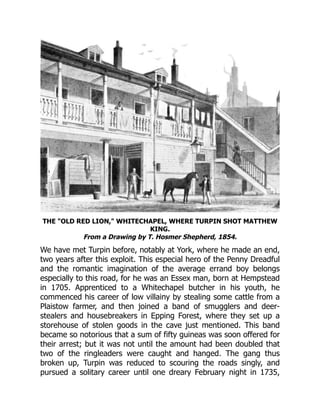
THE "OLD REDLION," WHITECHAPEL, WHERE TURPIN SHOT MATTHEW
KING.
From a Drawing by T. Hosmer Shepherd, 1854.
We have met Turpin before, notably at York, where he made an end,
two years after this exploit. This especial hero of the Penny Dreadful
and the romantic imagination of the average errand boy belongs
especially to this road, for he was an Essex man, born at Hempstead
in 1705. Apprenticed to a Whitechapel butcher in his youth, he
commenced his career of low villainy by stealing some cattle from a
Plaistow farmer, and then joined a band of smugglers and deer-
stealers and housebreakers in Epping Forest, where they set up a
storehouse of stolen goods in the cave just mentioned. This band
became so notorious that a sum of fifty guineas was soon offered for
their arrest; but it was not until the amount had been doubled that
two of the ringleaders were caught and hanged. The gang thus
broken up, Turpin was reduced to scouring the roads singly, and
pursued a solitary career until one dreary February night in 1735,
49.
while patrolling theCambridge Road, he saw a horseman
approaching through the mist. At the time-honoured demand, "Your
money or your life!" the stranger simply laughed.
"What!" said he, "should dog eat dog? We are of a like trade."
Thus Turpin and Tom King met, and struck up a partnership. If only
one quarter of the deeds assigned to Turpin were true, his would be
a very gallant, as well as phenomenally busy, figure on the roads of
England. Although by no means a mythical person, the stories told
of him nearly all belong to the regions of romance, and his true
history shows him to have had few redeeming qualities. Many of the
old knights of the road were courageous, and hand in hand with
their courage went a humour not seldom kindly; but Turpin was a
bloodthirsty ruffian whose courage is not an established fact, and
whose humour, like the "tender mercies of the wicked," was cruel,
not to say ferocious. It is quite hopeless to attempt to finally destroy
the great Turpin myth after this lapse of time: Harrison Ainsworth's
romance has enjoyed too great and too long a popularity for that;
but let the attempt here be made to paint him as the cowardly
ruffian he was.
Whitechapel, quite apart from memories of Turpin, owns an
unenviable repute, and its very name is a synonym for villainy. Its
bad savour, however, goes back no greater distance in time than the
first half of the eighteenth century, for until that period it was not
built upon, and indeed "Whitechapel Common" was spoken of so
late as 1761, maps proving the old church to have been quite rural
at that date. Originally a chapel-of-ease to the great mother-parish
of Stepney, the district was erected into a separate parish so far
back as the fourteenth century and the original "white chapel"—
doubtless so called from its mediæval coats of whitewash—made a
church. But old names cling, and although it has been a church for
over six hundred years, it has not been able to confer its more
dignified title upon the parish itself. Thus the name of Whitechapel is
doubly misleading nowadays, for it is no longer a chapelry and its
stately church is in red brick; so that there is some force in the
50.
argument for re-christeningthe borough and dignifying it by a
revival of the old name of Eastminster, owned by that not very
fortunate Abbey of St Mary Grace, founded by Edward the Third in
1348, which formerly stood on the site of the Royal Mint.
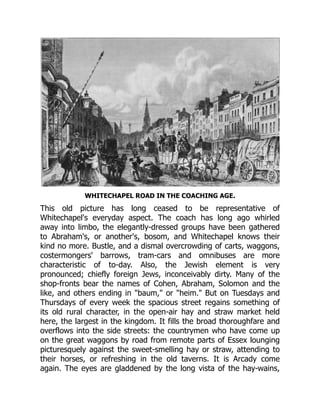
WHITECHAPEL OLD CHURCH.
St Mary's, Whitechapel, is a beautiful church, built in 1877, burnt
August 20, 1880, and since restored. It replaced the ugly old
building, which was "taken down for the simple reason that it would
not stand up." The ancient wrangling over its full title of St Mary
Matfelon is not yet done, and rash would be he who voted for any
particular one among the rival derivatives of the name. Matfelon,
holds one school, was the name of a forgotten benefactor, whose
particular benefactions are not stated. Who, then, would found,
since benefits are thus forgot? "Mariæ, matri et filio," an ancient
dedication, say others; while yet different parties find its source in a
Syriac word meaning "mother of a son" = the Virgin Mary. Perhaps
the most entertaining legend, however, is that which tells how it
51.
originated in thekilling of a murderer, in 1429, by the women of
Whitechapel. "Between Estren and Witsontyd, a fals Breton mordred
a wydewe in here bed, the which find hym for almasse withought
Algate, in the suburbes of London, and bar away alle that sche
hadde, and afterwards he toke socour of Holy Chirche in Suthwark;
but at the last he took the crosse and forswore the kynge's land;
and as he went hys waye, it happyd hym to come be the same place
where he had don that cursed dede, and women of the same parysh
comen out with stones and canell dong, and ther maden an ende of
hym in the hyghe strete." These things seem quite in keeping with
Whitechapel's evil fame.
The old church, as it stood until well into the nineteenth century, is
shown opposite this page, with one of the old road-waggons
crawling past. In another view of the same date the High Street
itself is seen, its long perspective fully bearing out the old
description of spaciousness. At the same time, it is seen to be empty
enough to resemble the street of a provincial town. The houses are
exceedingly old, the road paved with knobbly stones, and the shop
windows artfully constructed with the apparent object of obstructing
instead of admitting the light. Very few of these old shop-fronts are
now left, but a good specimen is that of a bell-founding firm at No.
34 Whitechapel Road.
52.
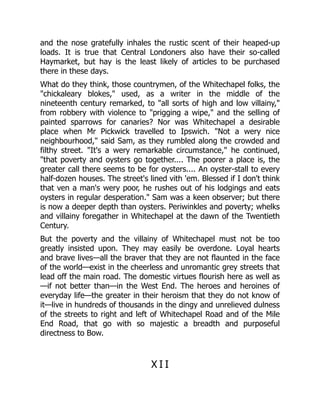
WHITECHAPEL ROAD INTHE COACHING AGE.
This old picture has long ceased to be representative of
Whitechapel's everyday aspect. The coach has long ago whirled
away into limbo, the elegantly-dressed groups have been gathered
to Abraham's, or another's, bosom, and Whitechapel knows their
kind no more. Bustle, and a dismal overcrowding of carts, waggons,
costermongers' barrows, tram-cars and omnibuses are more
characteristic of to-day. Also, the Jewish element is very
pronounced; chiefly foreign Jews, inconceivably dirty. Many of the
shop-fronts bear the names of Cohen, Abraham, Solomon and the
like, and others ending in "baum," or "heim." But on Tuesdays and
Thursdays of every week the spacious street regains something of
its old rural character, in the open-air hay and straw market held
here, the largest in the kingdom. It fills the broad thoroughfare and
overflows into the side streets: the countrymen who have come up
on the great waggons by road from remote parts of Essex lounging
picturesquely against the sweet-smelling hay or straw, attending to
their horses, or refreshing in the old taverns. It is Arcady come
again. The eyes are gladdened by the long vista of the hay-wains,
53.
and the nosegratefully inhales the rustic scent of their heaped-up
loads. It is true that Central Londoners also have their so-called
Haymarket, but hay is the least likely of articles to be purchased
there in these days.
What do they think, those countrymen, of the Whitechapel folks, the
"chickaleary blokes," used, as a writer in the middle of the
nineteenth century remarked, to "all sorts of high and low villainy,"
from robbery with violence to "prigging a wipe," and the selling of
painted sparrows for canaries? Nor was Whitechapel a desirable
place when Mr Pickwick travelled to Ipswich. "Not a wery nice
neighbourhood," said Sam, as they rumbled along the crowded and
filthy street. "It's a wery remarkable circumstance," he continued,
"that poverty and oysters go together.... The poorer a place is, the
greater call there seems to be for oysters.... An oyster-stall to every
half-dozen houses. The street's lined vith 'em. Blessed if I don't think
that ven a man's wery poor, he rushes out of his lodgings and eats
oysters in regular desperation." Sam was a keen observer; but there
is now a deeper depth than oysters. Periwinkles and poverty; whelks
and villainy foregather in Whitechapel at the dawn of the Twentieth
Century.
But the poverty and the villainy of Whitechapel must not be too
greatly insisted upon. They may easily be overdone. Loyal hearts
and brave lives—all the braver that they are not flaunted in the face
of the world—exist in the cheerless and unromantic grey streets that
lead off the main road. The domestic virtues flourish here as well as
—if not better than—in the West End. The heroes and heroines of
everyday life—the greater in their heroism that they do not know of
it—live in hundreds of thousands in the dingy and unrelieved dulness
of the streets to right and left of Whitechapel Road and of the Mile
End Road, that go with so majestic a breadth and purposeful
directness to Bow.
X I I
54.
Let the Londonerwho has never been "down East," and so is given
to speaking contemptuously of it, take a journey down the
Whitechapel and Mile End Roads, and see with what an astonishing
width, both in respect of roadway and foot-pavements, those noble
thoroughfares are endowed. The London he has already known
owns no streets so wide, save only in the isolated and unimportant
instance of Langham Place; while, although it cannot be said that,
taken individually, the houses of the great East-End thoroughfares
are at all picturesque, yet there is a certain interesting quality in the
roads as a whole, lacking elsewhere. This, doubtless, is partly
explained by the strangeness of the East-ender's garb, and partly by
the many Jewish and other foreigners who throng the pavements.
A strangely-named public-house—the "Grave Maurice"—is one of the
landmarks of the Whitechapel Road. Many have set themselves the
task of finding the origin of that sign and its meaning; but their
efforts have been baulked by the very multiplicity of historic
Maurices, grave or otherwise. The sign may originally have been the
"Graf Maurice," Prince Maurice of Bohemia, brother of the better-
known Prince Rupert, the dashing cavalier, but a difficulty arises
from the fact that there was another "Graf Maurice" at the same
time, in the person of the equally well-known Prince Maurice of
Nassau, who died of grief when the Spanish overran Holland and
besieged Breda. Nor does the uncertainty end here, for Dekker uses
the expression "grave maurice" in one of his plays, written at least
thirty years before the time of those princes, in a passage which
reads as though it were the usual nickname at that period for an
officer.
Beyond the house owning this perplexing sign we come to the
beginning of the Mile End Road, one mile, as its name implies, from
Aldgate, and for long the site of a turnpike-gate, only removed with
the close of the Coaching Age. Rowlandson has left us an excellent
view of Mile End Turnpike as it was in his time; with isolated blocks
of houses, groups of rustic cottages and a background of trees, to
show how rural were the surroundings towards the close of the
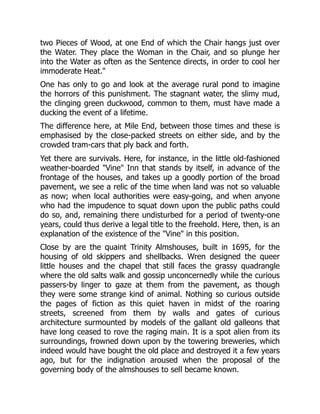
eighteenth century; while maps of that period mark the road
55.
onwards, bordered byfields, with "Ducking Pond Row" standing
solitary and the ducking-pond itself close behind, where the scolds
and shrews of that age were soused.
The Ducking-Pond as an institution is as obsolete as the rack, the
thumb-screw, and other ingenious devices of the "good old times";
but most towns a hundred years ago still kept a cucking or ducking-
stool; while, if they had no official pond for the purpose, any dirty
pool would serve, and the dirtier it were the better it was esteemed.
MILE END TURNPIKE, 1813. After Rowlandson.
"The Way of punishing scolding Women is pleasant enough," says an
old traveller. "They fasten an Arm Chair to the End of two Beams,
twelve or fifteen Foot long, and parallel to each other: so that these
two Pieces of Wood, with their two Ends embrace the Chair, which
hangs between them on a sort of Axel; by which Means it plays
freely, and always remains in the natural horizontal Position in which
a Chair should be, that a Person may sit conveniently in it, whether
you raise it or let it down. They set up a Post upon the Bank of a
Pond or River, and over this Post they lay, almost in Equilibrio, the
56.
two Pieces ofWood, at one End of which the Chair hangs just over
the Water. They place the Woman in the Chair, and so plunge her
into the Water as often as the Sentence directs, in order to cool her
immoderate Heat."
One has only to go and look at the average rural pond to imagine
the horrors of this punishment. The stagnant water, the slimy mud,
the clinging green duckwood, common to them, must have made a
ducking the event of a lifetime.
The difference here, at Mile End, between those times and these is
emphasised by the close-packed streets on either side, and by the
crowded tram-cars that ply back and forth.
Yet there are survivals. Here, for instance, in the little old-fashioned
weather-boarded "Vine" Inn that stands by itself, in advance of the
frontage of the houses, and takes up a goodly portion of the broad
pavement, we see a relic of the time when land was not so valuable
as now; when local authorities were easy-going, and when anyone
who had the impudence to squat down upon the public paths could
do so, and, remaining there undisturbed for a period of twenty-one
years, could thus derive a legal title to the freehold. Here, then, is an
explanation of the existence of the "Vine" in this position.
Close by are the quaint Trinity Almshouses, built in 1695, for the
housing of old skippers and shellbacks. Wren designed the queer
little houses and the chapel that still faces the grassy quadrangle
where the old salts walk and gossip unconcernedly while the curious
passers-by linger to gaze at them from the pavement, as though
they were some strange kind of animal. Nothing so curious outside
the pages of fiction as this quiet haven in midst of the roaring
streets, screened from them by walls and gates of curious
architecture surmounted by models of the gallant old galleons that
have long ceased to rove the raging main. It is a spot alien from its
surroundings, frowned down upon by the towering breweries, which
indeed would have bought the old place and destroyed it a few years
ago, but for the indignation aroused when the proposal of the
governing body of the almshouses to sell became known.
57.
There is nothingelse to detain the explorer on his way into Essex.
The People's Palace, it is true, is a remarkable place, the result of Sir
Walter Besant's dream of a resort for those of the East who would
get culture and find recreation, but it is a dream realised as an
architectural nightmare, and is a very terrible example of what is
done to this unhappy quarter in the names of Art and Philanthropy.
X I I I
At last, by this broadest of broad roads, we come to Stratford-le-
Bow and its parish church. In these hurried times, and for some
centuries past, the old hyphenated place-name has been dropped,
and as "Bow" alone it is familiar to all East-enders. The place is
nowadays chiefly associated with Bryant & May and matches, but
there yet remain many old Queen Anne, and even earlier, mansions
by the roadside, telling of days long before "patent safeties" were
thought of, and when flint and steel and timber were the sole means
of obtaining a light.
"Bow," says the Ambulator of 1774, "is a village a little to the east of
Mile End, inhabited by many whitsters and scarlet dyers. Here has
been set up a large manufactory of porcelain, little inferior to that of
Chelsea." That description is now somewhat out of date. The
manufactory of porcelain has long disappeared and Bow china is
scarce, and treasured accordingly. Whitsters—that is to say,
bleachers of linen—and scarlet dyers, also, are to seek.
Bow Church confronts the eastward-bound traveller in bold and
rugged fashion; its time-worn tower standing midway of the road
and challenging, as it were, the crossing of the little River Lea, just
beyond, to Stratford and into Essex. Church and churchyard split the
road up into two channels and thus destroy its width, which it never
afterwards regains until the suburbs are passed and the open
country reached. A modern touch here is the bronze statue of
Gladstone, in advance of the church, facing westwards in
declamatory attitude from its granite pedestal, and erected in his
58.
lifetime; recalling thefervent hero-worshipping days of the "People's
William." The outstretched hand is oddly crooked. Few be them that
see statues raised to themselves, unless indeed they be made of
finer clay than most mortals, kings and princes, and the like. Of
recent years this bronze Gladstone has, in our vulgar way, been
made to preside, as it were, over an underground public
convenience, from whose too obtrusive midst he rises, absurdly
eloquent.
BOW.
Just how Stratford-le-Bow received its name is an interesting piece
of history. Both here and at the neighbouring Old Ford the Lea was
anciently crossed by a paved stone ford of Roman construction,
continuing the highway into Essex; but when that river's many
channels, swollen by winter's rains, rolled in freshets toward the
Thames, the low-lying lands of what we now call Hackney and West
Ham marshes were for long distances converted into a sluggish lake.
For months together the approaches to the Lea were lost in floods,
59.
Welcome to ourwebsite – the ideal destination for book lovers and
knowledge seekers. With a mission to inspire endlessly, we offer a
vast collection of books, ranging from classic literary works to
specialized publications, self-development books, and children's
literature. Each book is a new journey of discovery, expanding
knowledge and enriching the soul of the reade
Our website is not just a platform for buying books, but a bridge
connecting readers to the timeless values of culture and wisdom. With
an elegant, user-friendly interface and an intelligent search system,
we are committed to providing a quick and convenient shopping
experience. Additionally, our special promotions and home delivery
services ensure that you save time and fully enjoy the joy of reading.
Let us accompany you on the journey of exploring knowledge and
personal growth!
ebookfinal.com






![Server Load Balancing
by Tony Bourke
Copyright © 2001 O'Reilly & Associates, Inc. All rights reserved.
Printed in the United States of America.
Published by O'Reilly & Associates, Inc., 101 Morris Street, Sebastopol, CA 95472.
Editor: Jim Sumser
Production Editor: Matt Hutchinson
Cover Designer: Emma Colby
Printing History:
August 2001: First Edition.
Nutshell Handbook, the Nutshell Handbook logo, and the O'Reilly logo are registered
trademarks of O'Reilly & Associates, Inc. Alteon WebOS, Foundry Serverlron, Cisco WebNS,
Cisco CSS, F5 Network's BIG-IP, and Arrowpoint are registered trademarks. Many of the
designations used by manufacturers and sellers to distinguish their products are claimed as
trademarks. Where those designations appear in this book, and O'Reilly & Associates, Inc. was
aware of a trademark claim, the designations have been printed in caps or initial caps. The
association between the image of a jacana and the topic of server load balancing is a
trademark of O'Reilly & Associates, Inc.
While every precaution has been taken in the preparation of this book, the publisher assumes
no responsibility for errors or omissions, or for damages resulting from the use of the
information contained herein.
ISBN: 0-596-00050-2
[M]](https://image.slidesharecdn.com/17326-250411142248-06fabc63/85/Server-Load-Balancing-1st-ed-Edition-Tony-Bourke-7-320.jpg)
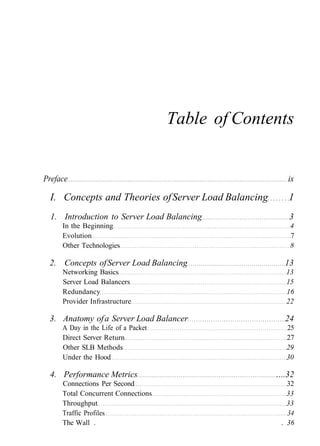
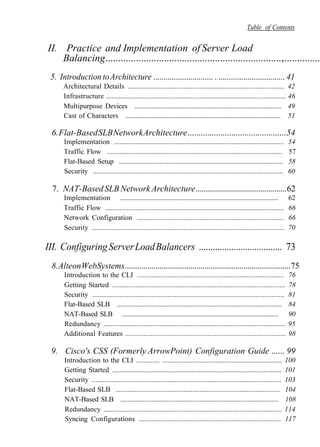
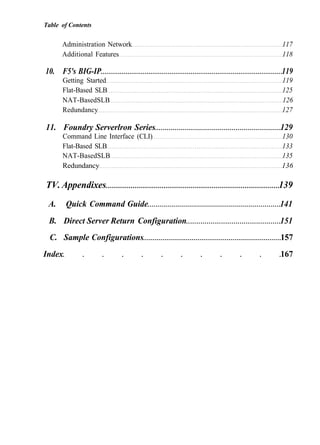

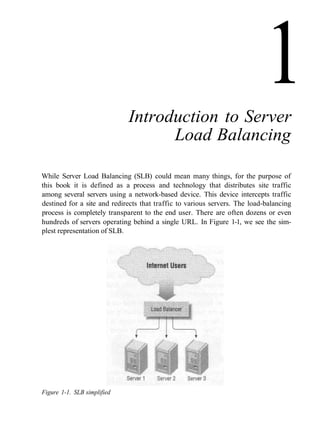
![In theBeginning
208.185.43.202). Usually only one IP address is given for a hostname. Under ISO's
DNS server, BIND 8, this is what the DNS entry for www.vegan.net would look
like:
www.vegan.net. IN 208.185.43.202
With DNS round robin, it is possible to give multiple IP addresses to a hostname,
distributing traffic more or less evenly to the listed IP addresses. For instance, let's
say you had three web servers with IP addresses of 208.185.43.202, 208.185.43.203,
and 208.185.43.204 that we wanted to share the load for the site www.vegan.net.
The configuration in the DNS server for the three IP addresses would look like
this:
www.vegan.net. IN
IN
IN
A
A
A
208.185.43.202
208.185.43.203
208.185.43.204
You can check the effect using a DNS utility known as nslookup, which would
show the following for www.vegan.net:
[zorak]# nslookup www.vegan.net
Server: ns1.vegan.net
Address: 198.143.25.15
Name: www.vegan.net
Addresses: 208.185.43.202, 208.185.43.203, 208.185.43.204
The end result is that the traffic destined for www.vegan.net is distributed between
the three IP addresses listed, as shown in Figure 1-2.
Figure 1-2. Traffic distribution by DNS-based load balancing](https://image.slidesharecdn.com/17326-250411142248-06fabc63/85/Server-Load-Balancing-1st-ed-Edition-Tony-Bourke-20-320.jpg)