Authorization in Micro Services world
ISTIO and Open Policy Agent
Sitaraman Lakshminarayanan
About Me
• Sitaraman Lakshminarayanan
• Work: Security Architect at Pure Storage
• Books : Author Oracle Web Services Manager,
Co-Author ASP.NET Security
• Twitter @Lsitaraman
Definitions
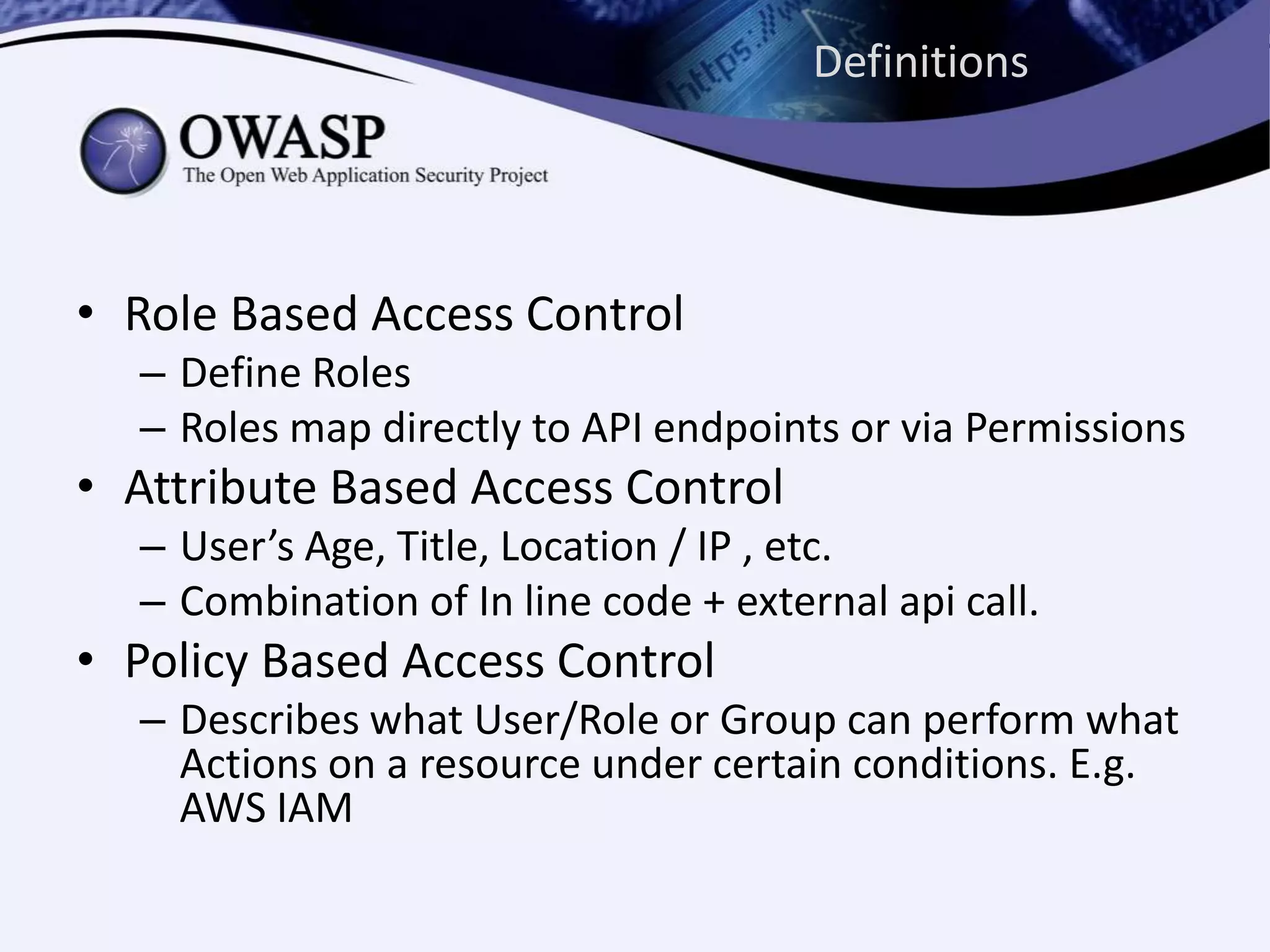
• Role Based Access Control
– Define Roles
– Roles map directly to API endpoints or via Permissions
• Attribute Based Access Control
– User’s Age, Title, Location / IP , etc.
– Combination of In line code + external api call.
• Policy Based Access Control
– Describes what User/Role or Group can perform what
Actions on a resource under certain conditions. E.g.
AWS IAM
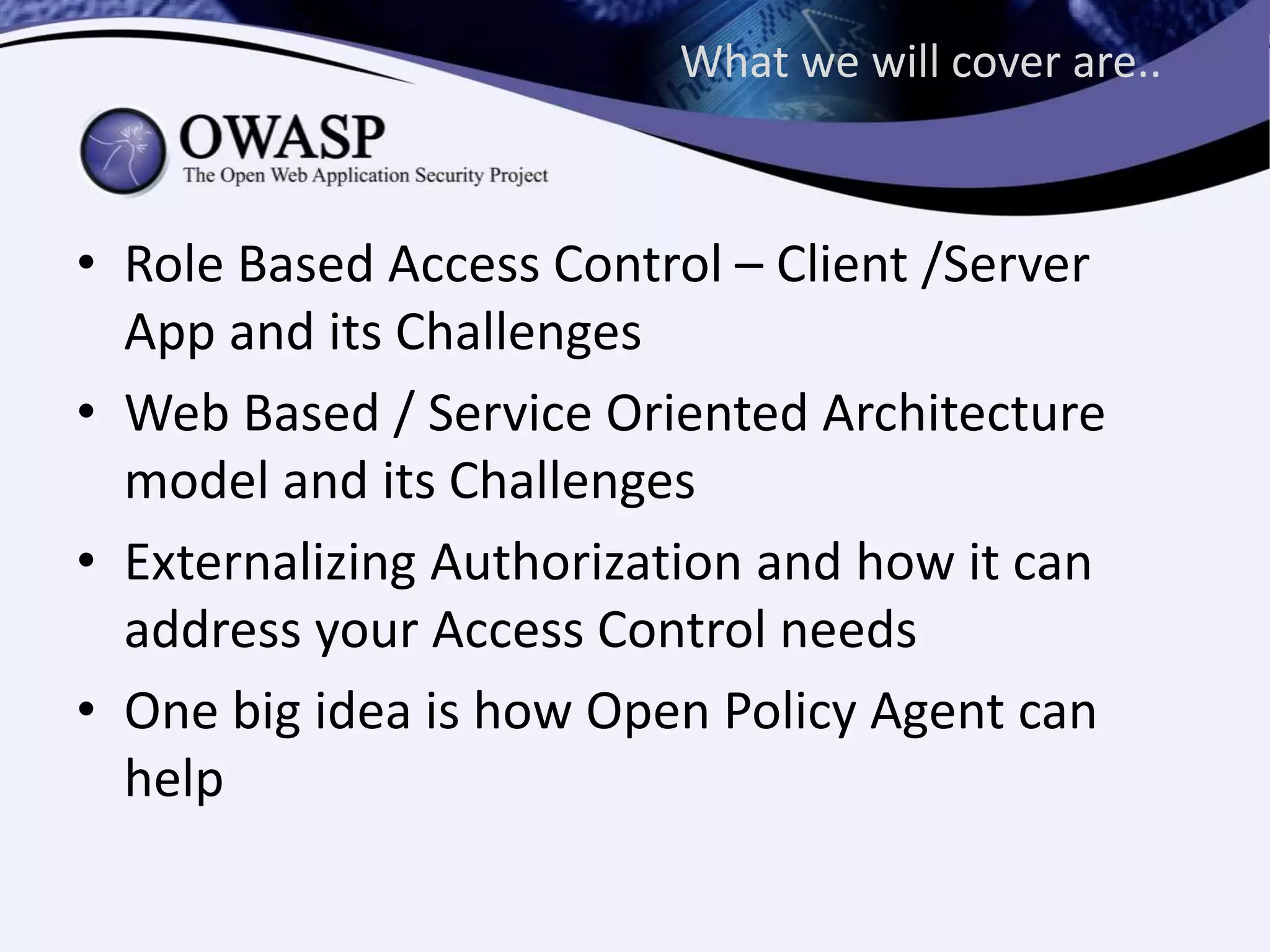
What we will cover are..
• Role Based Access Control – Client /Server
App and its Challenges
• Web Based / Service Oriented Architecture
model and its Challenges
• Externalizing Authorization and how it can
address your Access Control needs
• One big idea is how Open Policy Agent can
help
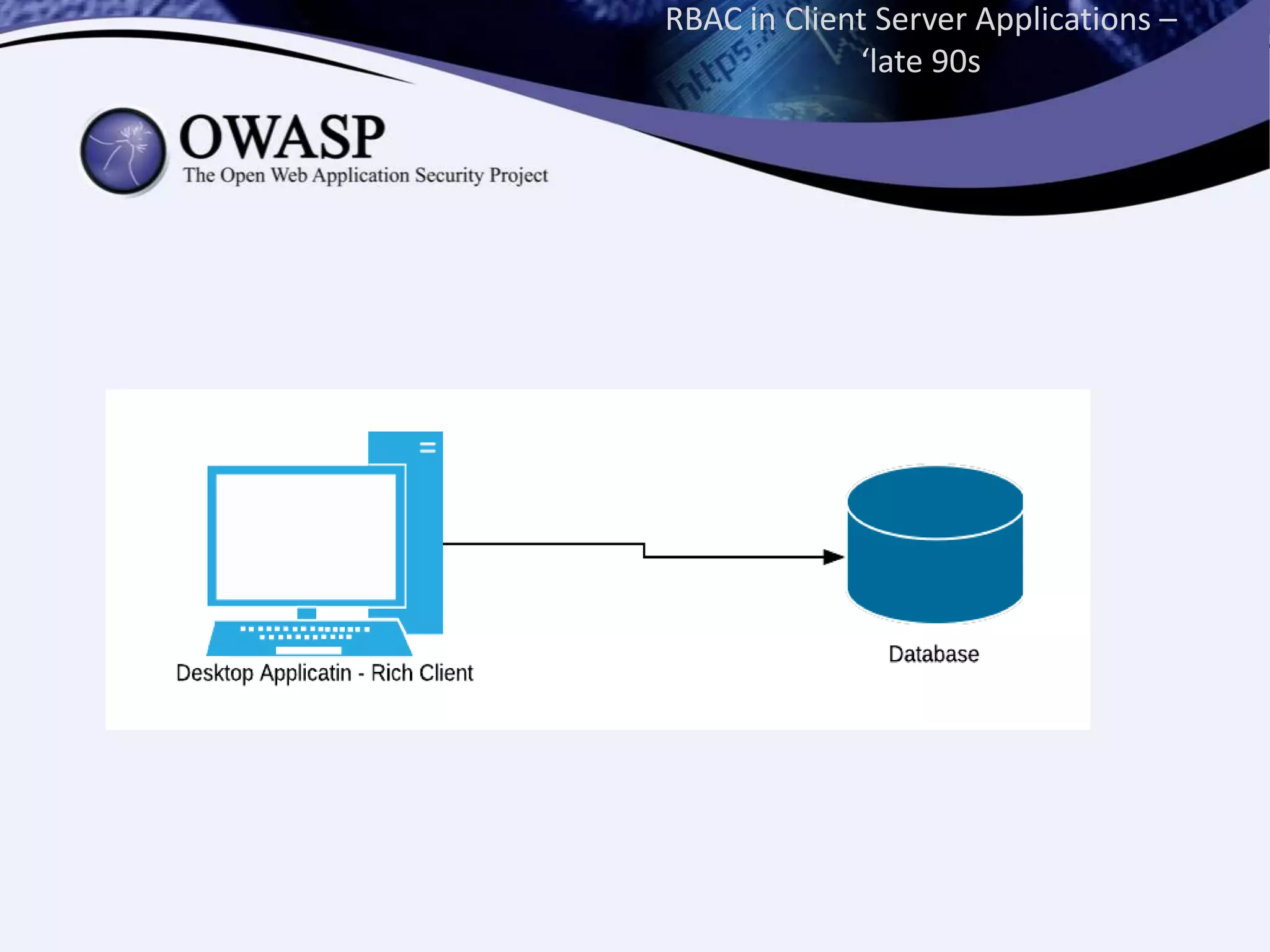
RBAC in Client Server Applications –
‘late 90s
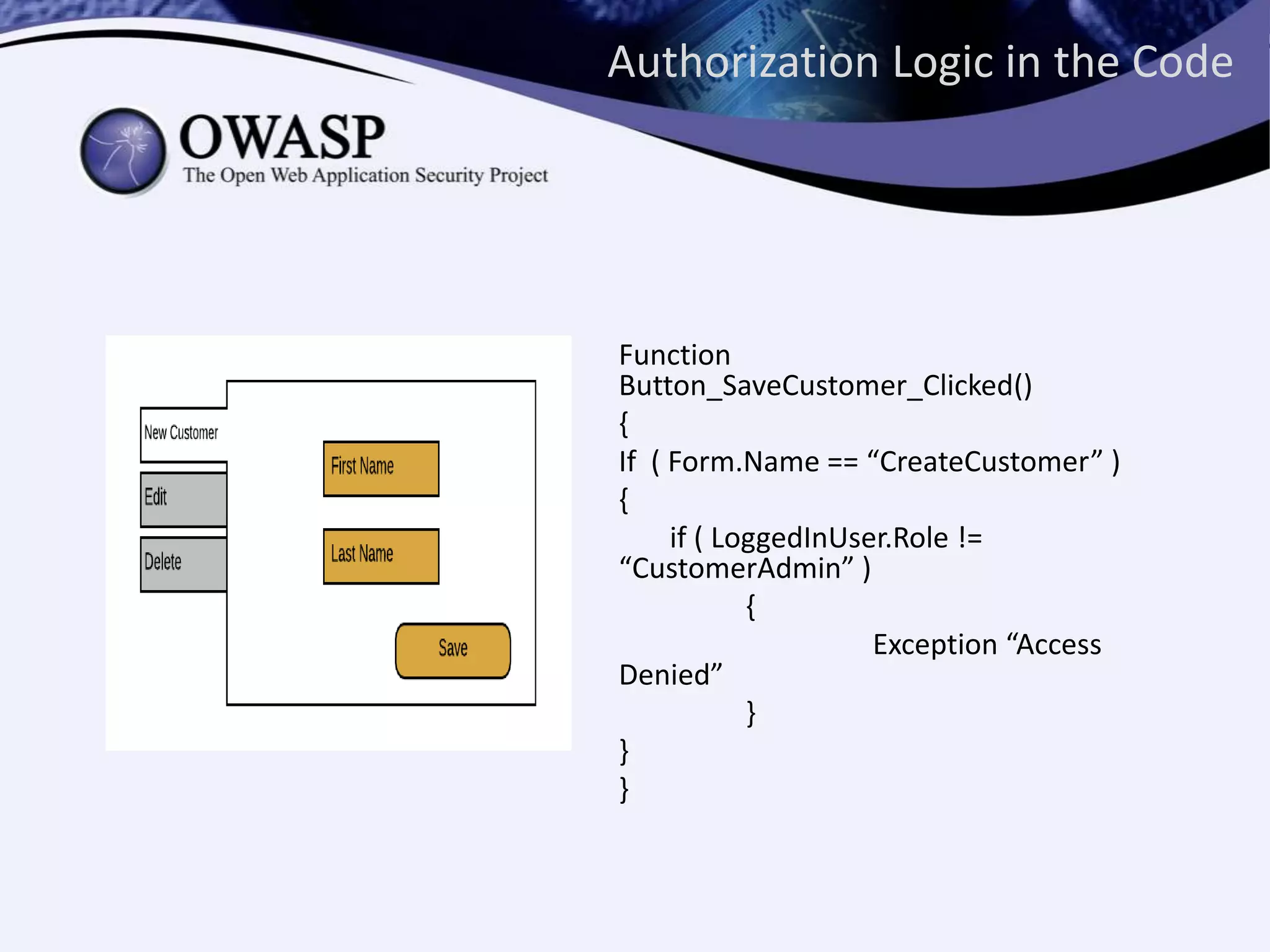
Authorization Logic in the Code
Function
Button_SaveCustomer_Clicked()
{
If ( Form.Name == “CreateCustomer” )
{
if ( LoggedInUser.Role !=
“CustomerAdmin” )
{
Exception “Access
Denied”
}
}
}
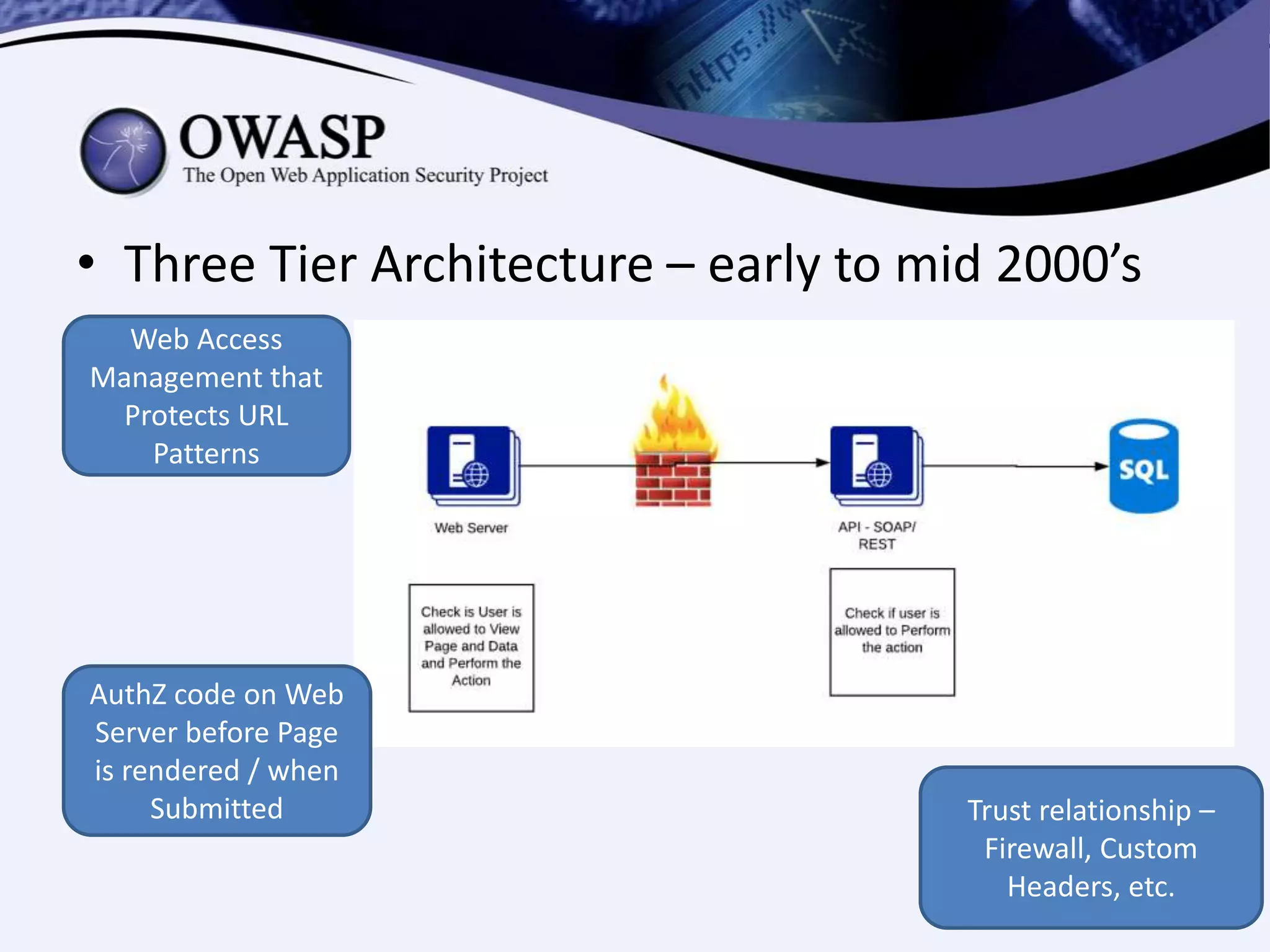
• Three Tier Architecture – early to mid 2000’s
AuthZ code on Web
Server before Page
is rendered / when
Submitted Trust relationship –
Firewall, Custom
Headers, etc.
Web Access
Management that
Protects URL
Patterns
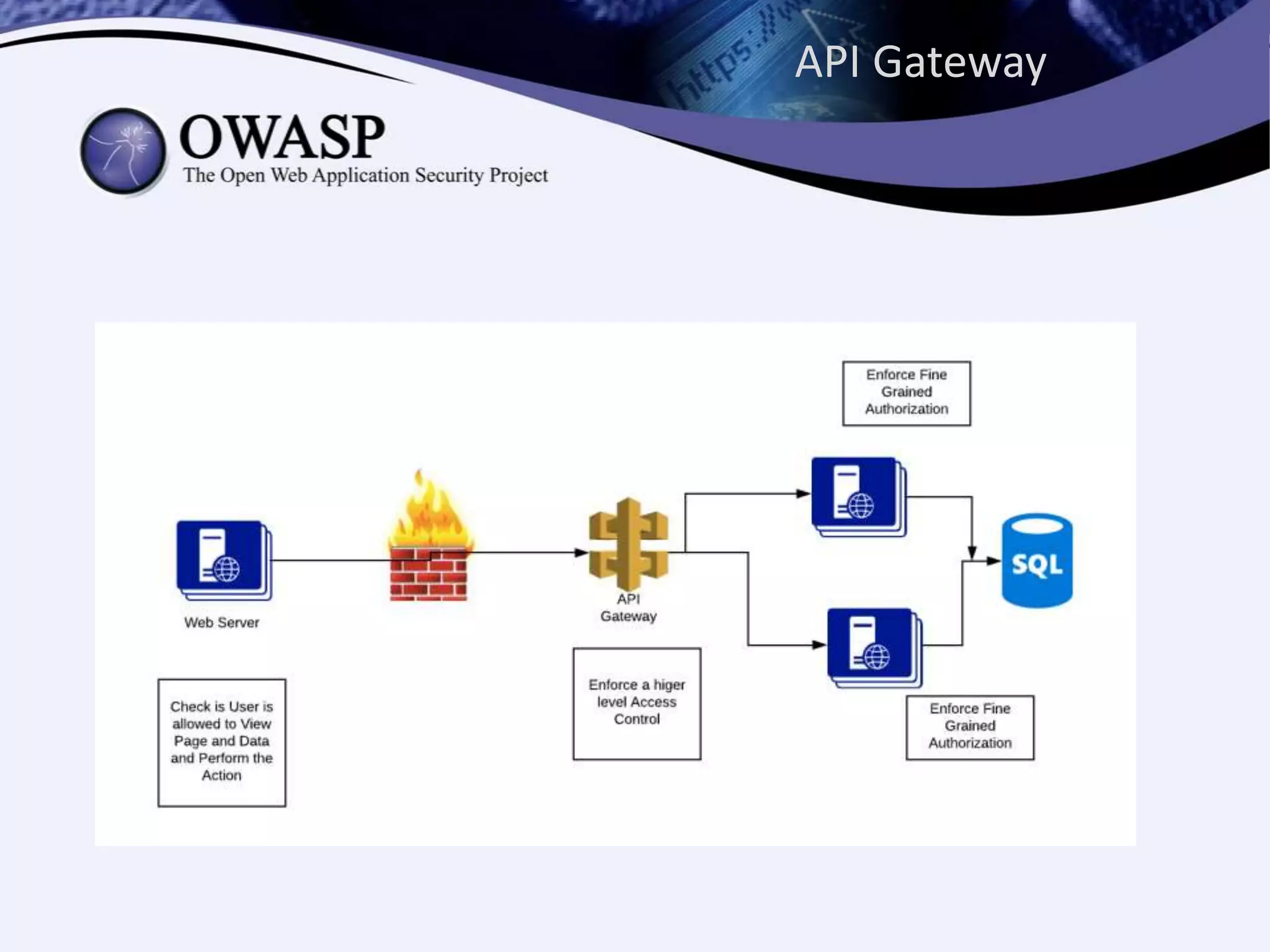
API Gateway
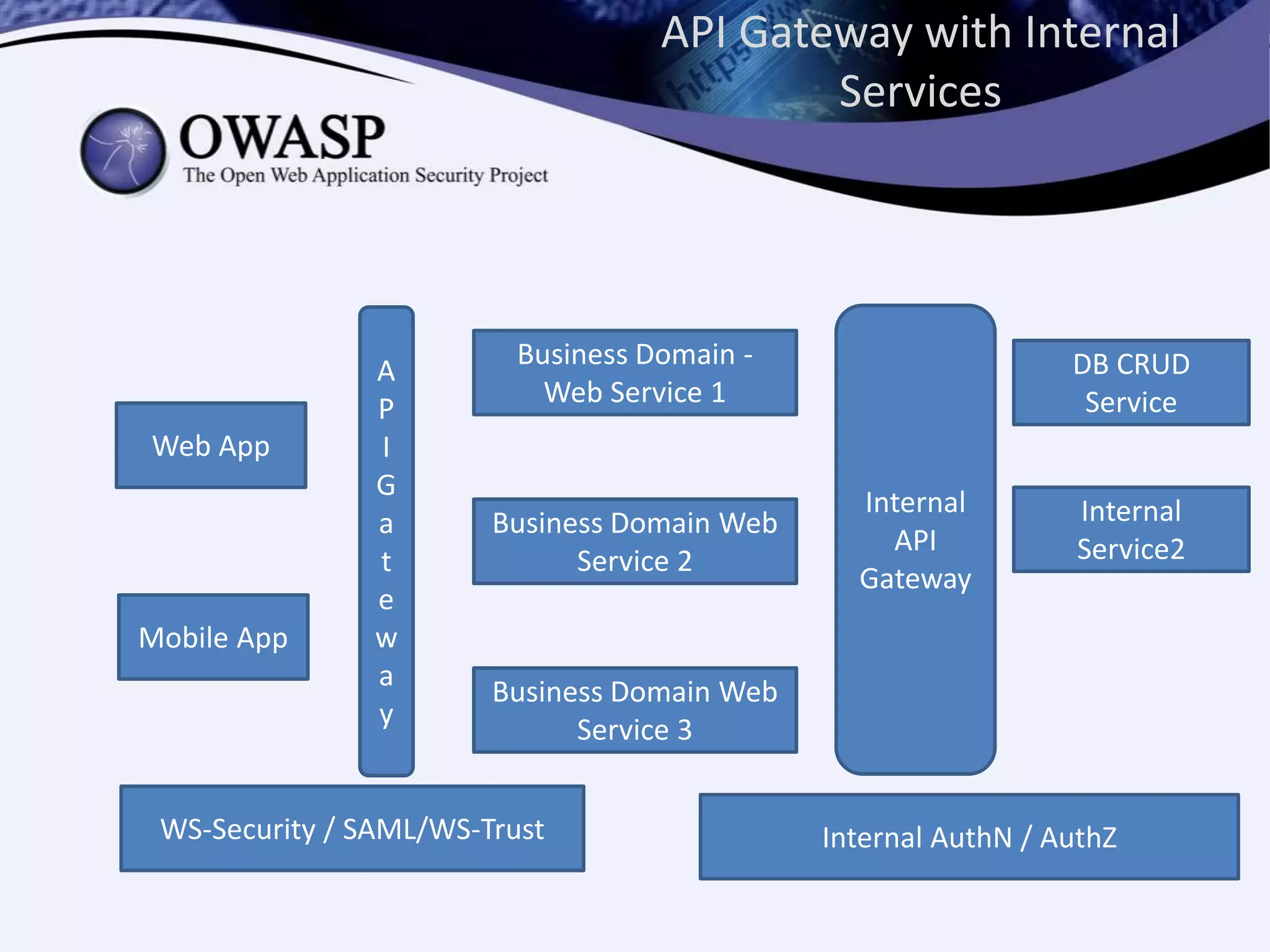
API Gateway with Internal
Services
A
P
I
G
a
t
e
w
a
y
Business Domain -
Web Service 1
Business Domain Web
Service 2
Business Domain Web
Service 3
Internal
API
Gateway
DB CRUD
Service
Internal
Service2
Web App
Mobile App
WS-Security / SAML/WS-Trust Internal AuthN / AuthZ
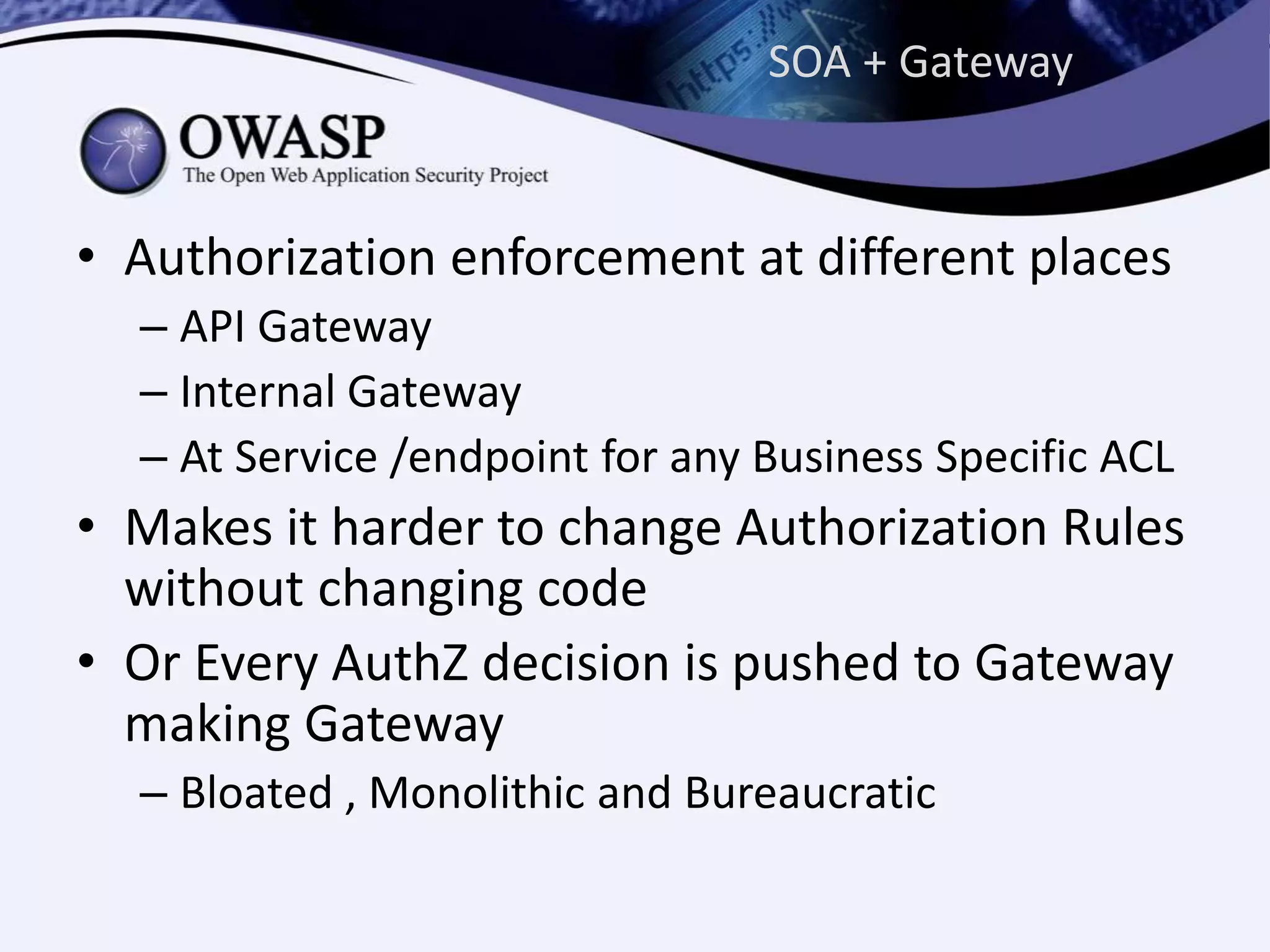
SOA + Gateway
• Authorization enforcement at different places
– API Gateway
– Internal Gateway
– At Service /endpoint for any Business Specific ACL
• Makes it harder to change Authorization Rules
without changing code
• Or Every AuthZ decision is pushed to Gateway
making Gateway
– Bloated , Monolithic and Bureaucratic
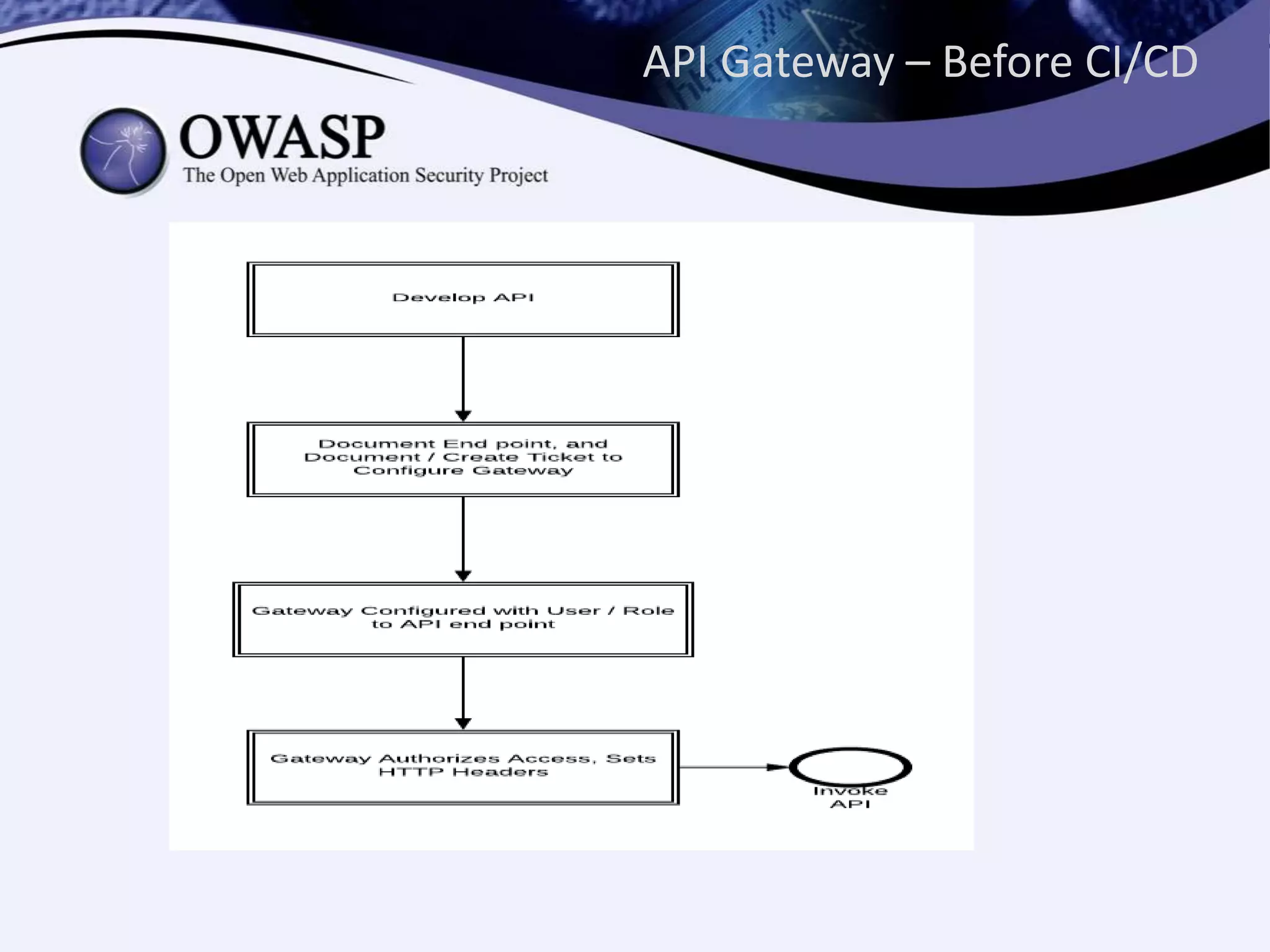
API Gateway – Before CI/CD
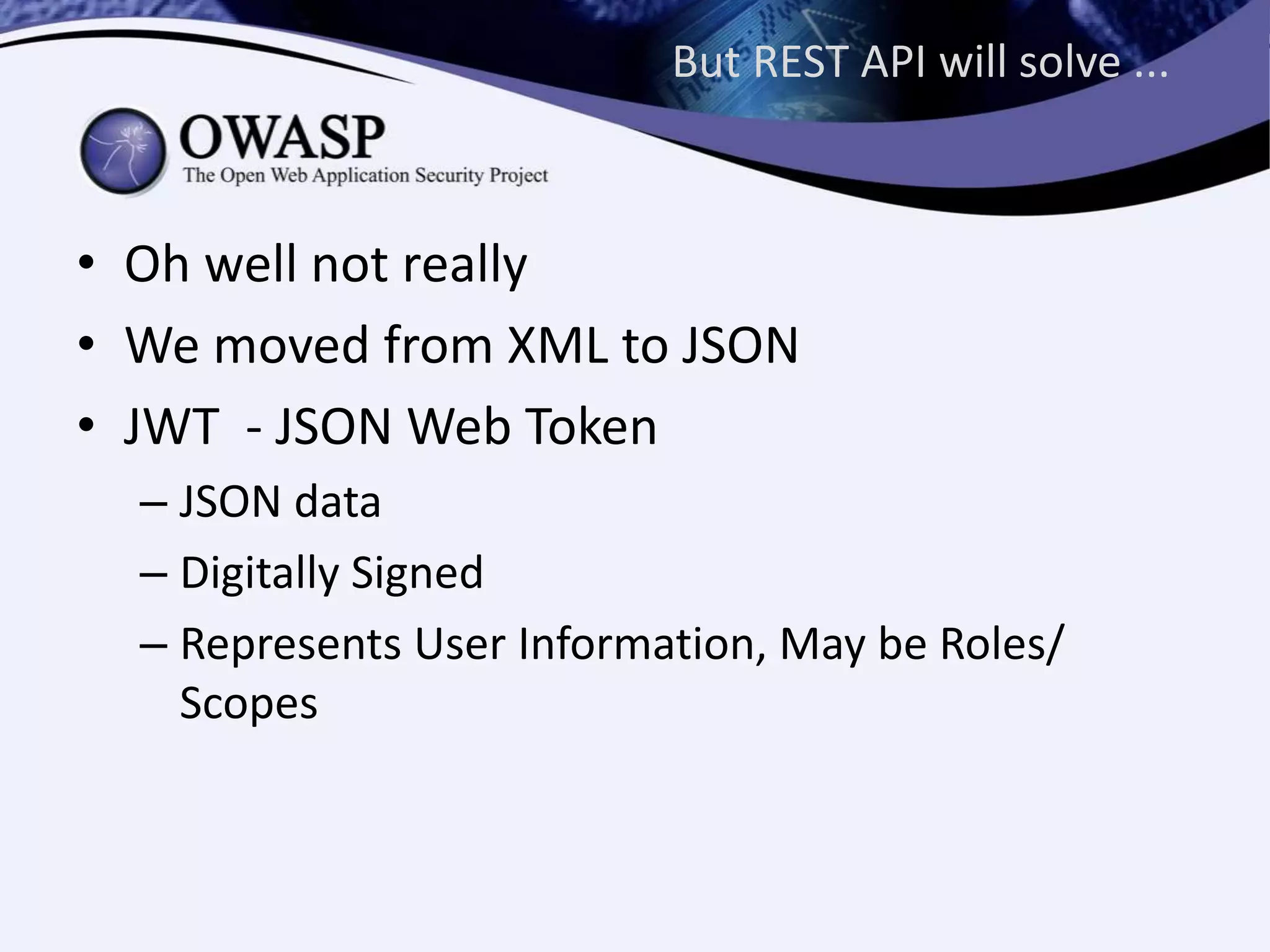
But REST API will solve ...
• Oh well not really
• We moved from XML to JSON
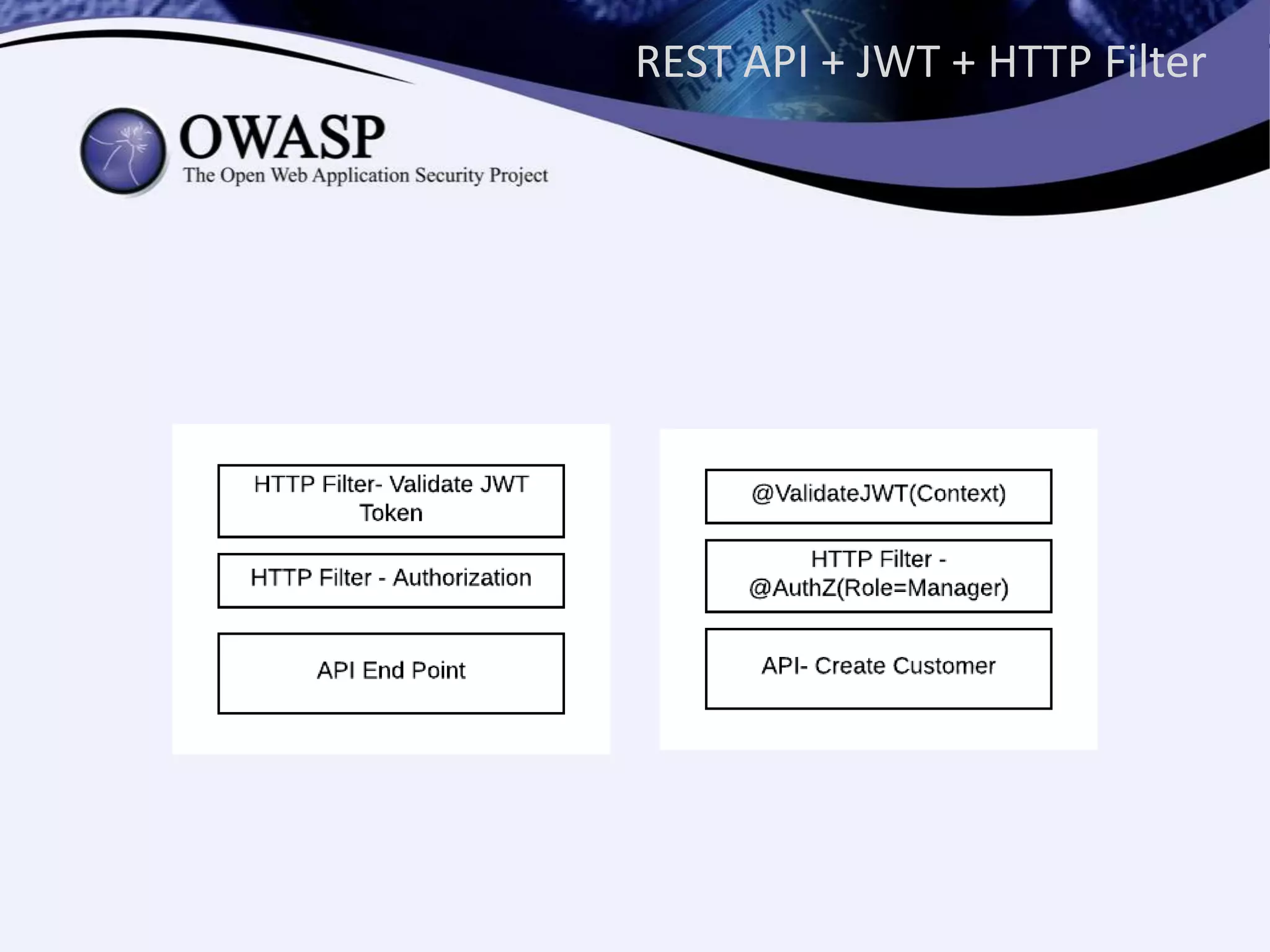
• JWT - JSON Web Token
– JSON data
– Digitally Signed
– Represents User Information, May be Roles/
Scopes
REST API + JWT + HTTP Filter
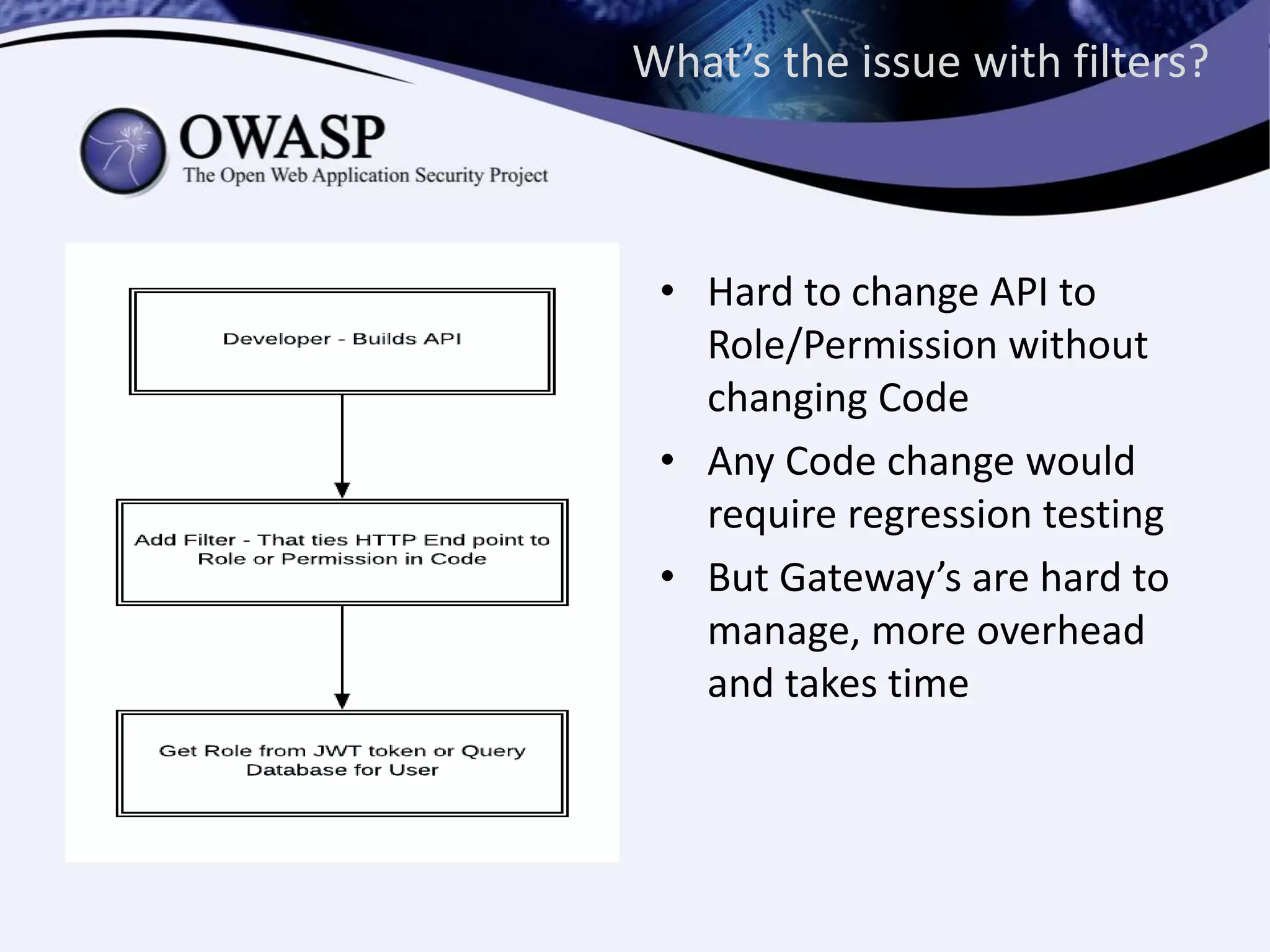
What’s the issue with filters?
• Hard to change API to
Role/Permission without
changing Code
• Any Code change would
require regression testing
• But Gateway’s are hard to
manage, more overhead
and takes time
How do we move forward?
• Externalize Authorization from Code
– Not Just Gateway that acts as Check Point
– Making it developer friendly and easy to develop,
deploy and change policies.
• Externalizing Authorization from code is not
new
– API Gateway was one such solution
– Extensible Access Control Markup Language
(XACML) standard was supposed to address this.
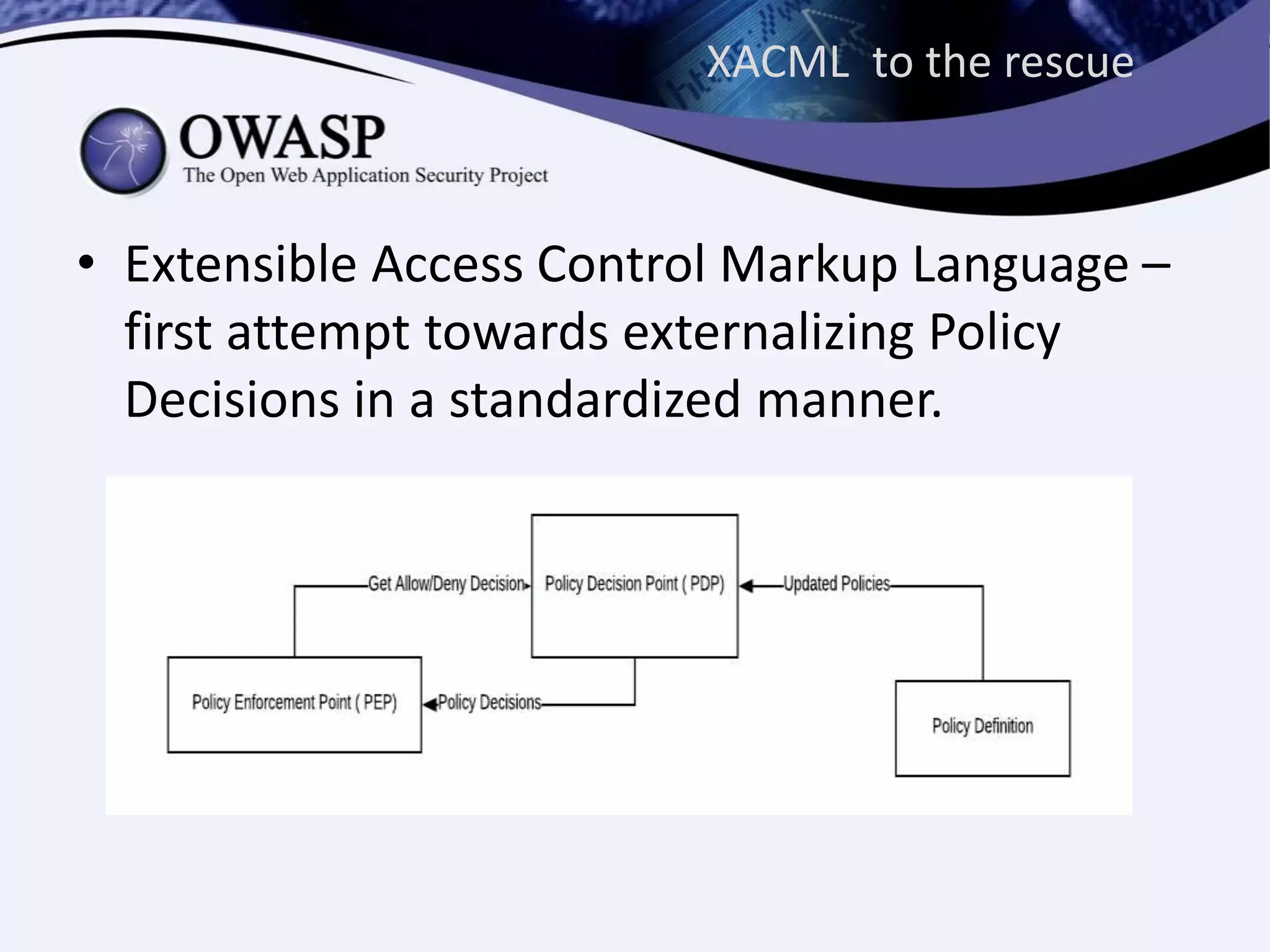
XACML to the rescue
• Extensible Access Control Markup Language –
first attempt towards externalizing Policy
Decisions in a standardized manner.
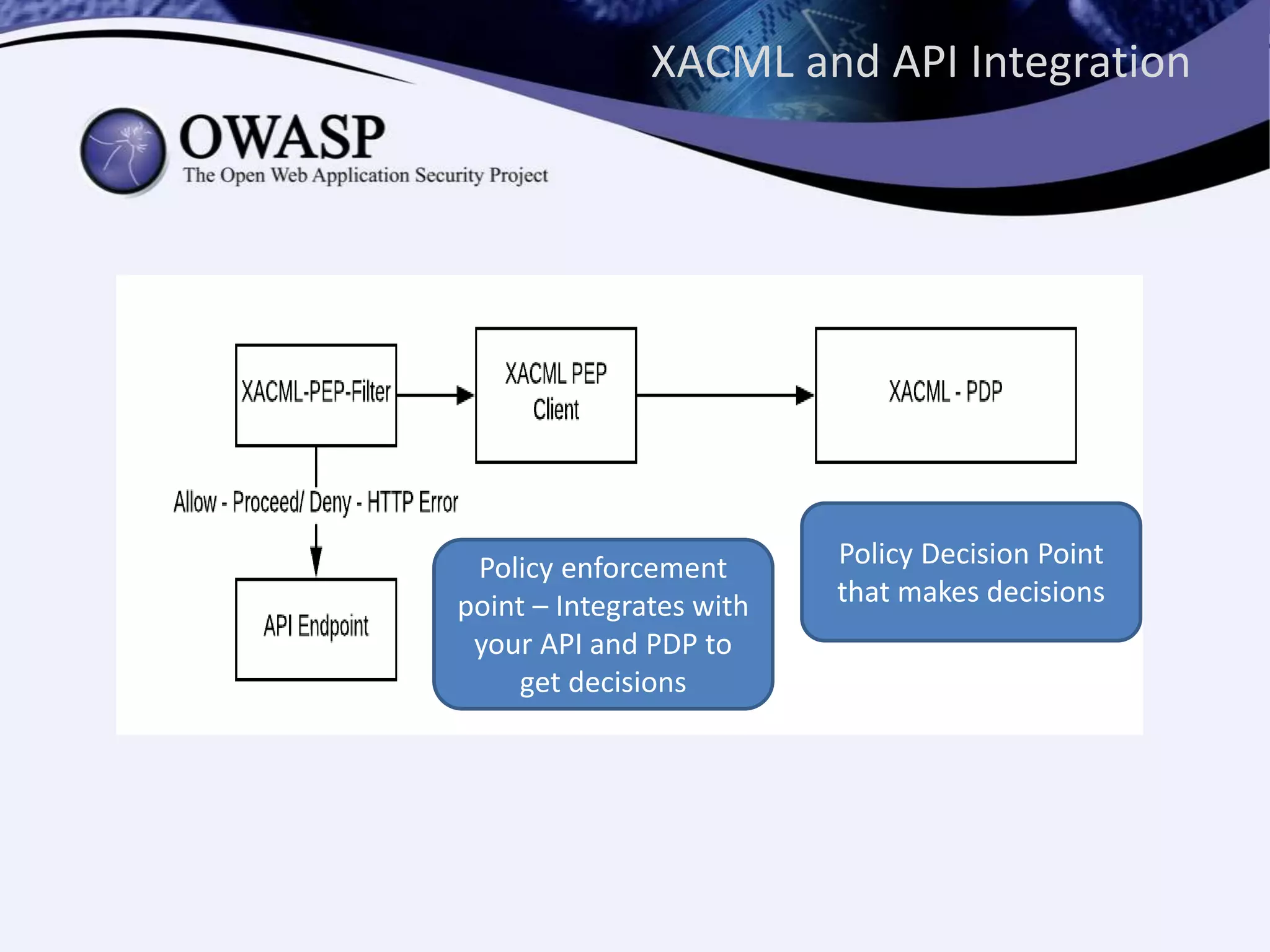
XACML and API Integration
Policy Decision Point
that makes decisions
Policy enforcement
point – Integrates with
your API and PDP to
get decisions
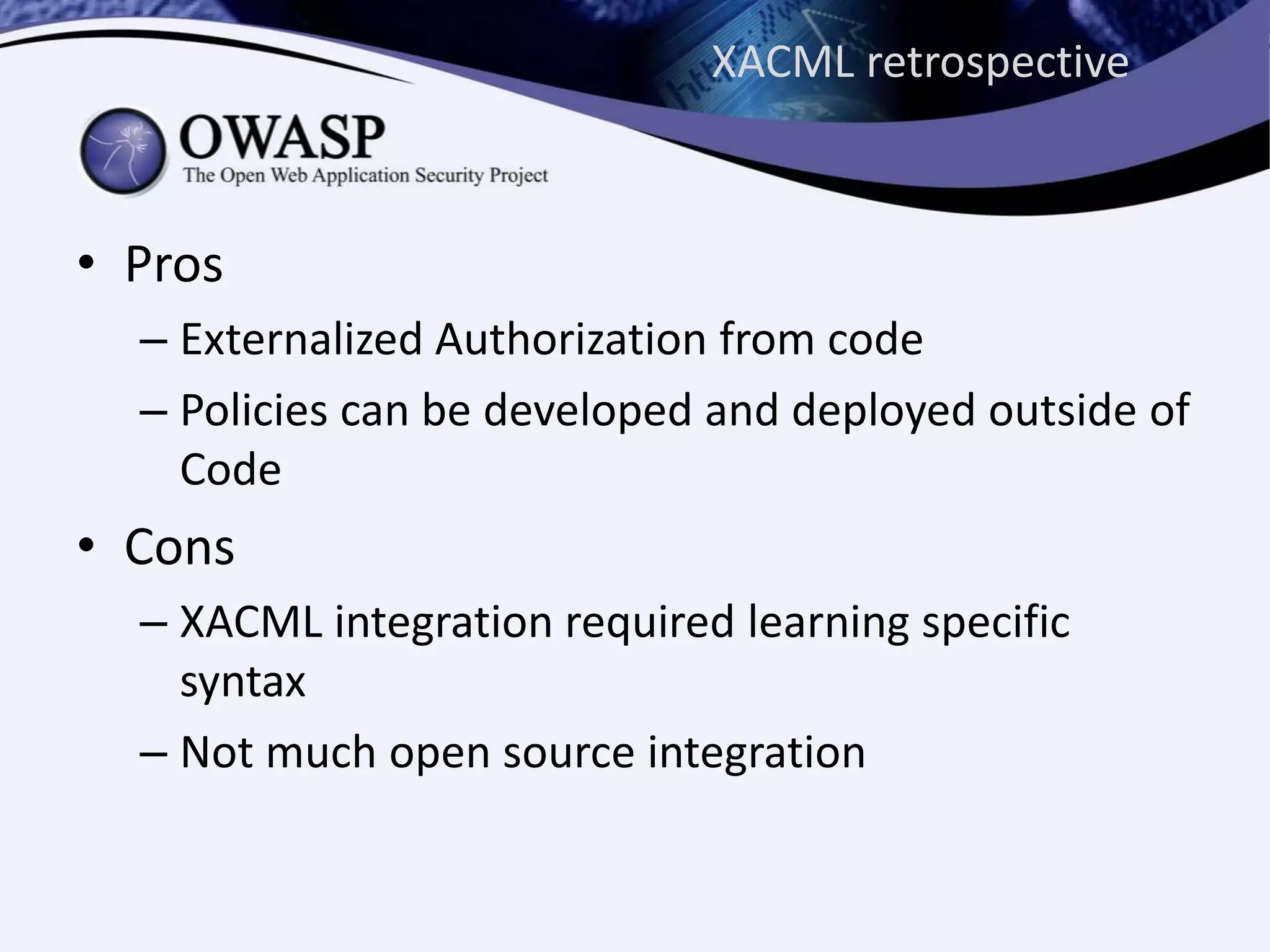
XACML retrospective
• Pros
– Externalized Authorization from code
– Policies can be developed and deployed outside of
Code
• Cons
– XACML integration required learning specific
syntax
– Not much open source integration
XACML Replacement – Build
your own AuthZ API
• Build your own Authorization API
• Integrations between AuthZ API and
App/Service are proprietary
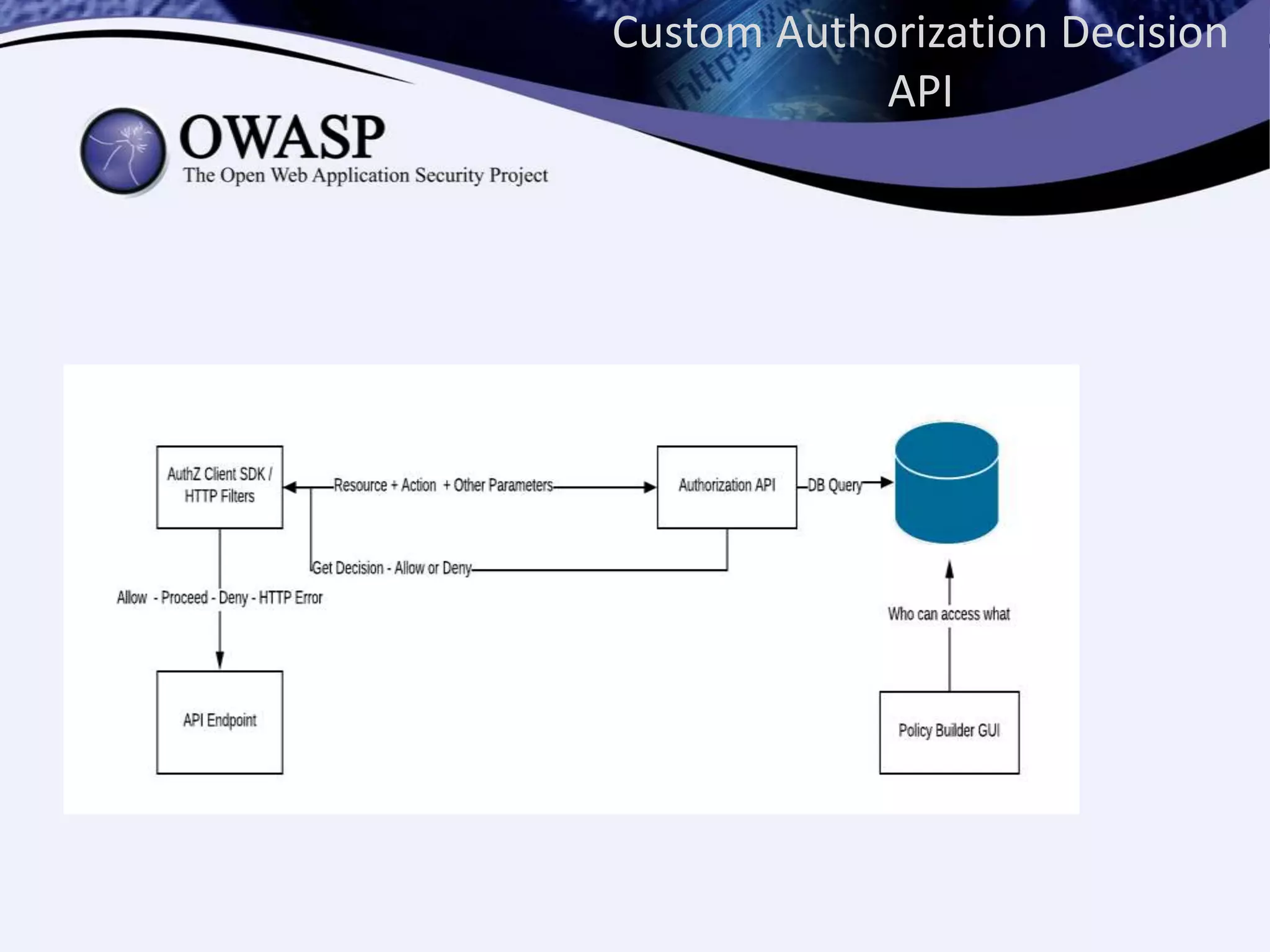
Custom Authorization Decision
API
When you build your own
AuthZ API
• You own everything
– Contract between Client and Authorization API /
Policy Decision Point
– Build SDK for languages within your enterprise
– Train every developer on your own API and
Integration, no community to source information
from
– Suddenly you are asking yourself – Am I Building
Feature X? or Am I a Security product?
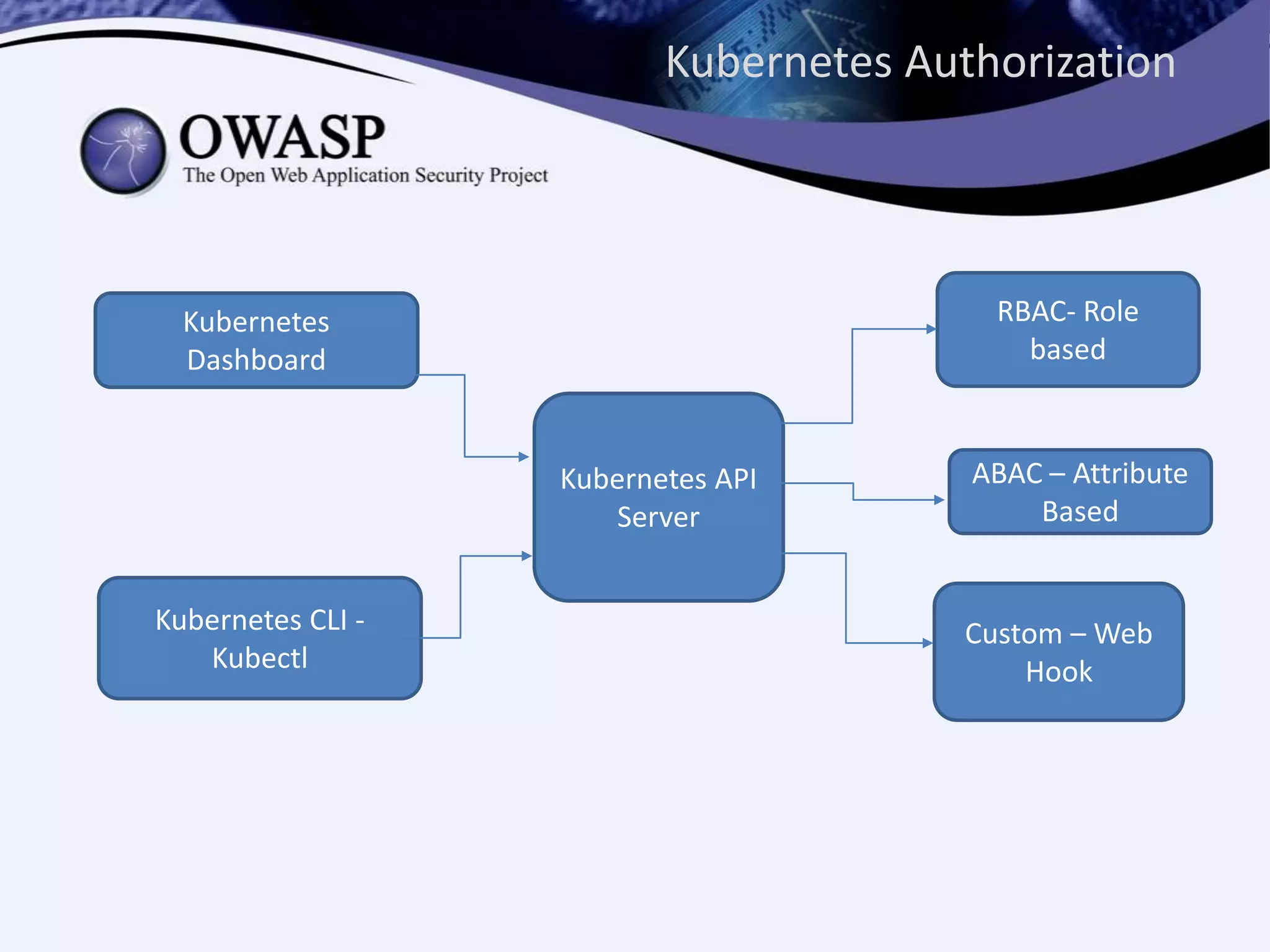
Kubernetes Authorization
Kubernetes API
Server
Kubernetes
Dashboard
Kubernetes CLI -
Kubectl
RBAC- Role
based
Custom – Web
Hook
ABAC – Attribute
Based
Kubernetes Web Hook
Authorization
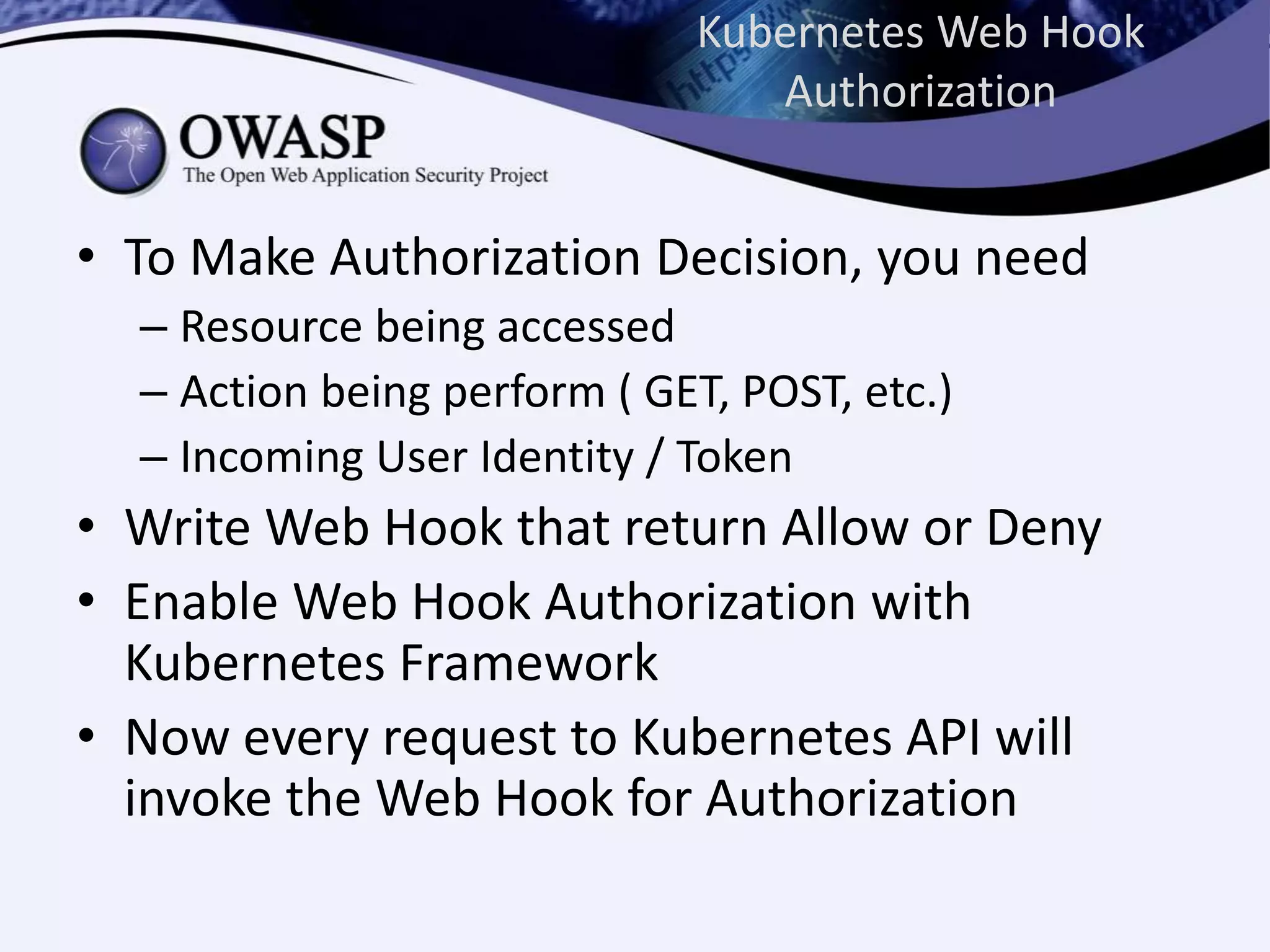
• To Make Authorization Decision, you need
– Resource being accessed
– Action being perform ( GET, POST, etc.)
– Incoming User Identity / Token
• Write Web Hook that return Allow or Deny
• Enable Web Hook Authorization with
Kubernetes Framework
• Now every request to Kubernetes API will
invoke the Web Hook for Authorization
Example Web Hook AuthZ in
K8
{ "apiVersion":
"authorization.k8s.io/v1beta1",
"kind": "SubjectAccessReview",
"spec":
{ "resourceAttributes":
{ "namespace":
"kittensandponies",
"verb": "get",
"group":
"unicorn.example.org",
"resource":
"pods"
},
"user": "jane",
"group": [ "group1",
"group2" ]
}}
K8 API Version, so you can
make decision based on
Version of K8 API Server
Kind –
SubjectAccessReview
Describes type of Object.
Provides flexibility to add
any other review later.
ResourceAttributes – tells
everything you need to know.
What namespace being
accessed, whether its HTTP
get or post , user identity and
Group information ( can
come from JWT Token from
your SSO System, etc.)
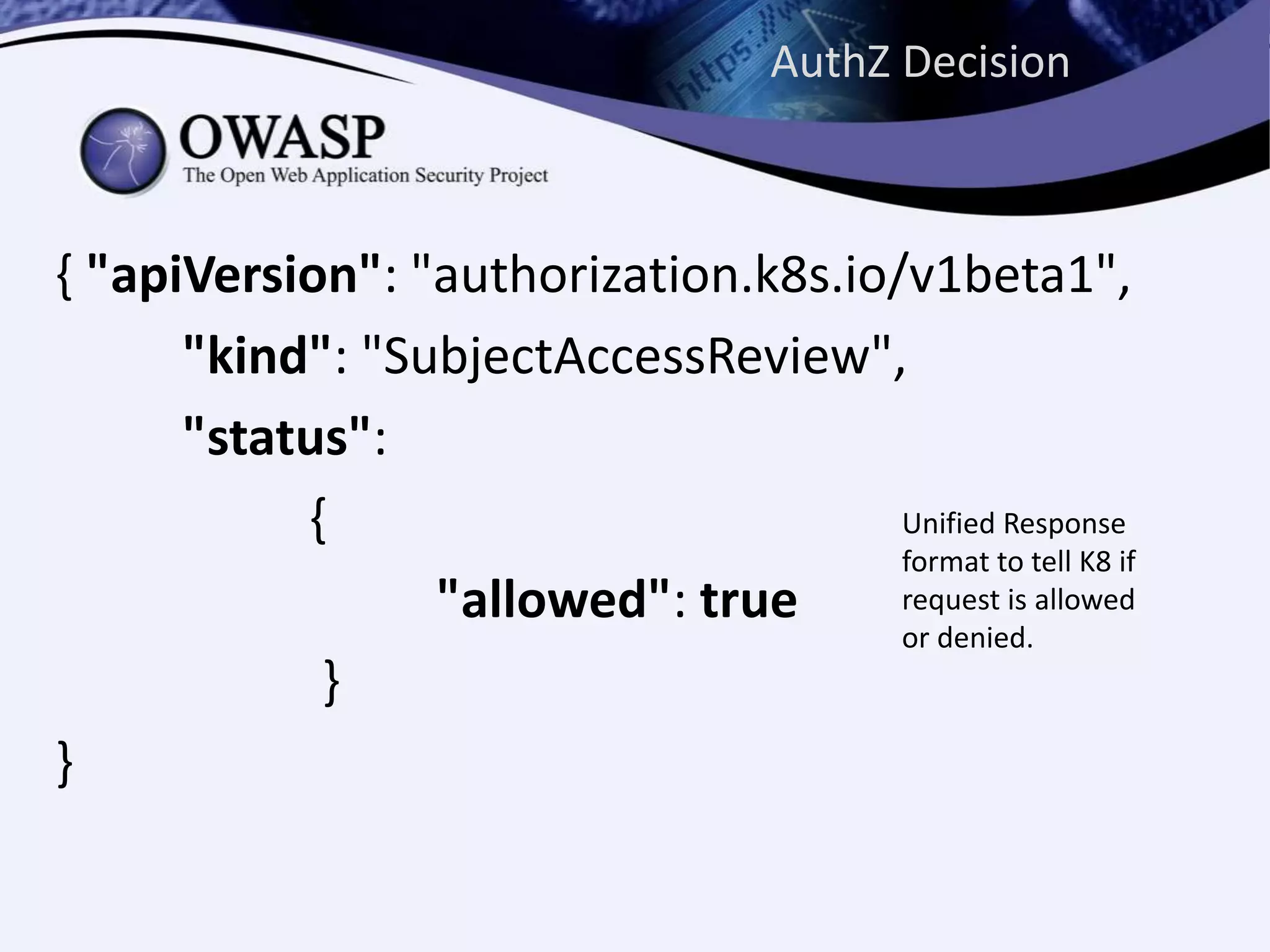
AuthZ Decision
{ "apiVersion": "authorization.k8s.io/v1beta1",
"kind": "SubjectAccessReview",
"status":
{
"allowed": true
}
}
Unified Response
format to tell K8 if
request is allowed
or denied.
Why I love K8 AuthZ model
• You let customers manage their own Risk. You
provide the framework.
• No one size fits all RBAC model
• Its designed with API First approach – so
everything is a Resource.
• Externalized Authorization through Web Hook
let you manage the Risk, implement Policy and
Process around your deployment.
What about Services deployed
on K8
• Micro Services have gained huge adoption and
its much easier with Kubernetes.
• But you still have to manage Authorization for
your Business Services.
• ISTIO brings together faster deployment and
Gateway approach for Services.
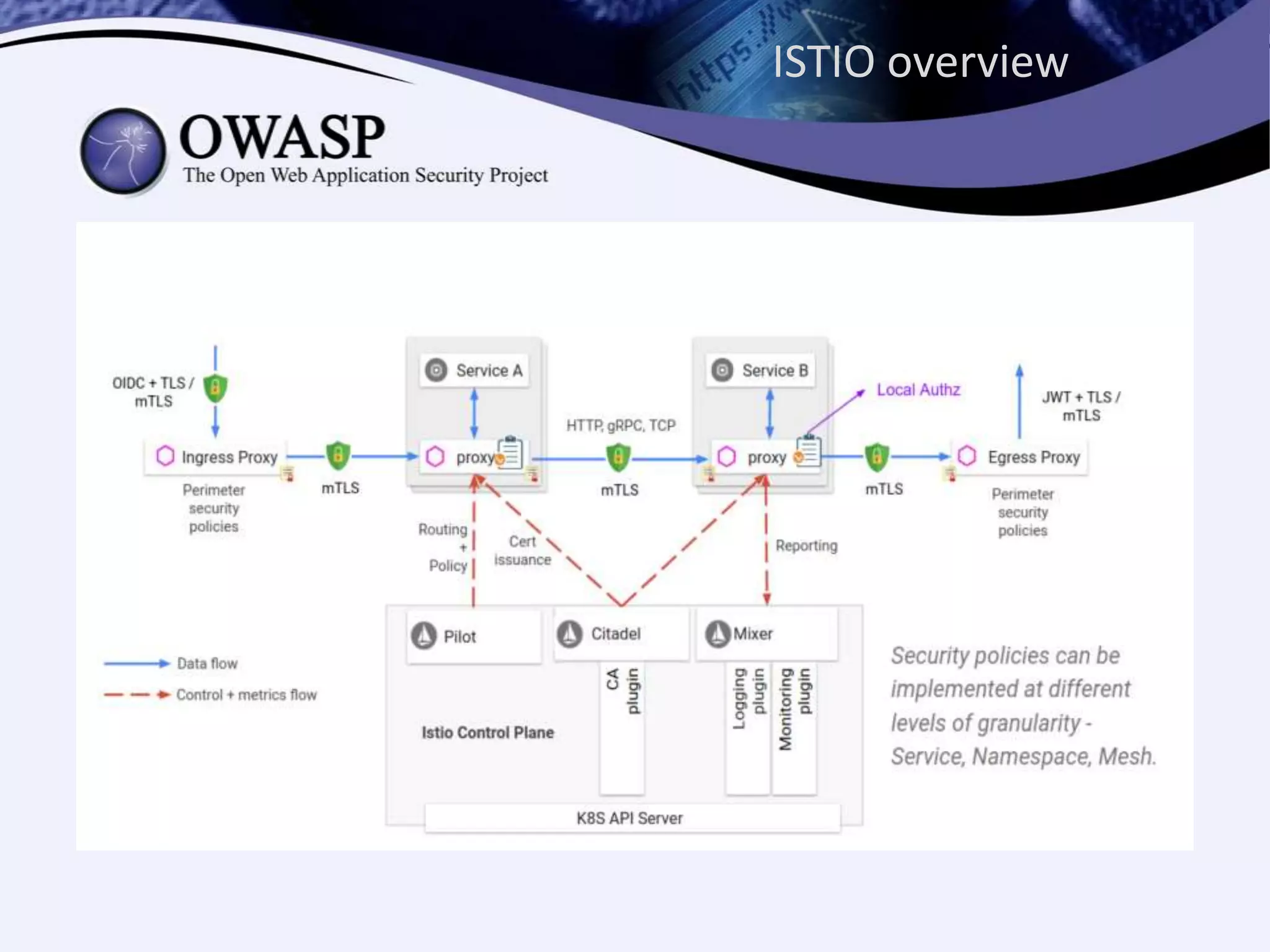
ISTIO overview
ISTIO Things to know
• Without going into ISTIO jargons… ISTIO makes it
easy to
– Enforce Authorization
– Logging
– Collect Telemetry
– Quotas
– Deploys Envoy Proxy as SideCar
• In other words, ISTIO is light weight proxy in front
of your API Services
• ISTIO components are at Ingress and Egress layer
ISTIO Authorization
apiVersion: "rbac.istio.io/v1alpha1"
kind: ServiceRole
metadata:
name: tester
namespace: default
spec:
rules:
- services: ["test-*"]
methods: ["*"]
- services:
["bookstore.default.svc.cluster.local"
]
paths: ["*/reviews"]
methods: ["GET"]
Authorization now
moved from Code /
Gateway config to
YAML .. We all love
Yet another.. 
Fine Grained ACL gets
challenging.
This is external to
code but still requires
re-deployment.
ISTIO Service to Service
Deploying ISTIO completely
hides the complexity of
Service Discovery and
Service Invocation
mTLS, Protocol Translation,
etc.
But what about
Authorization?- YAML file

Externalizing AuthZ in Micro Services World
• Let’s agree to a standard of communicating
– Resource ( end point being invoked)
– Operations / Actions being performed
– Identity of Caller
– Payload
• You can use your own proprietary, or Platform
Specific or use Open Policy Agent
Open Policy Agent
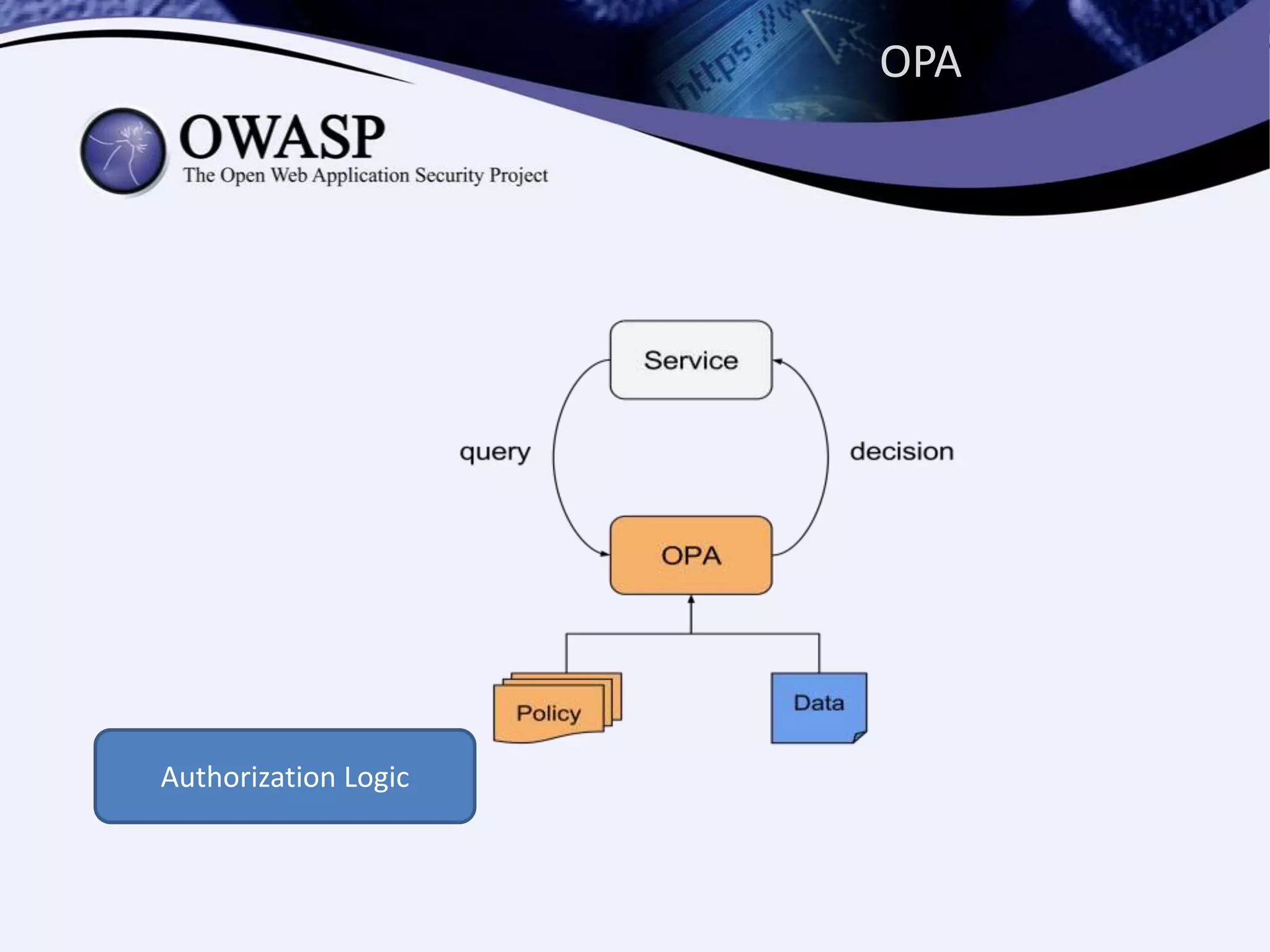
• It’s a Policy Engine
• Available as RESTful API with JSON and HTTP ,
so no new integration patterns.
• Data can be static or Dynamic that can be
used to make the decision
• Policies are written in declarative language
Rego
• Policies are updated in OPA via /v1/policies
API endpoint
OPA
Authorization Logic
OPA-Rego and Policies
• OPA uses its native query language Rego
• Policy decisions are written in Rego
• Policies are defined inside Module.
– Each Module should have one Package name
– Zero or more statements
– Zero or more Rules
OPA Policy Walkthrough
Package Name
Rule Name
Compares Input – If method is
GET, Path is finance and
Username , if everything is true it
returns True.
Input is keyword. Assign Input as
http_api variable
package httpapi.authz
subordinates = {"alice": [], "charlie": [],
"bob": ["alice"], "betty": ["charlie"]} Static Data
import input as http_api
allow {
http_api.method = "GET"
http_api.path = ["finance",
"salary", username]
username = http_api.user }
How is OPA Policy invoked?
input_dict =
{ # create input to hand to OPA "input":
{ "user": api_user_from_jwt,
"path": “finance”,
"method": “GET”
}
}
rsp =
requests.post("http://example.com/v1/data/htt
papi/authz", data=json.dumps(input_dict))
if rsp.json()["allow"]
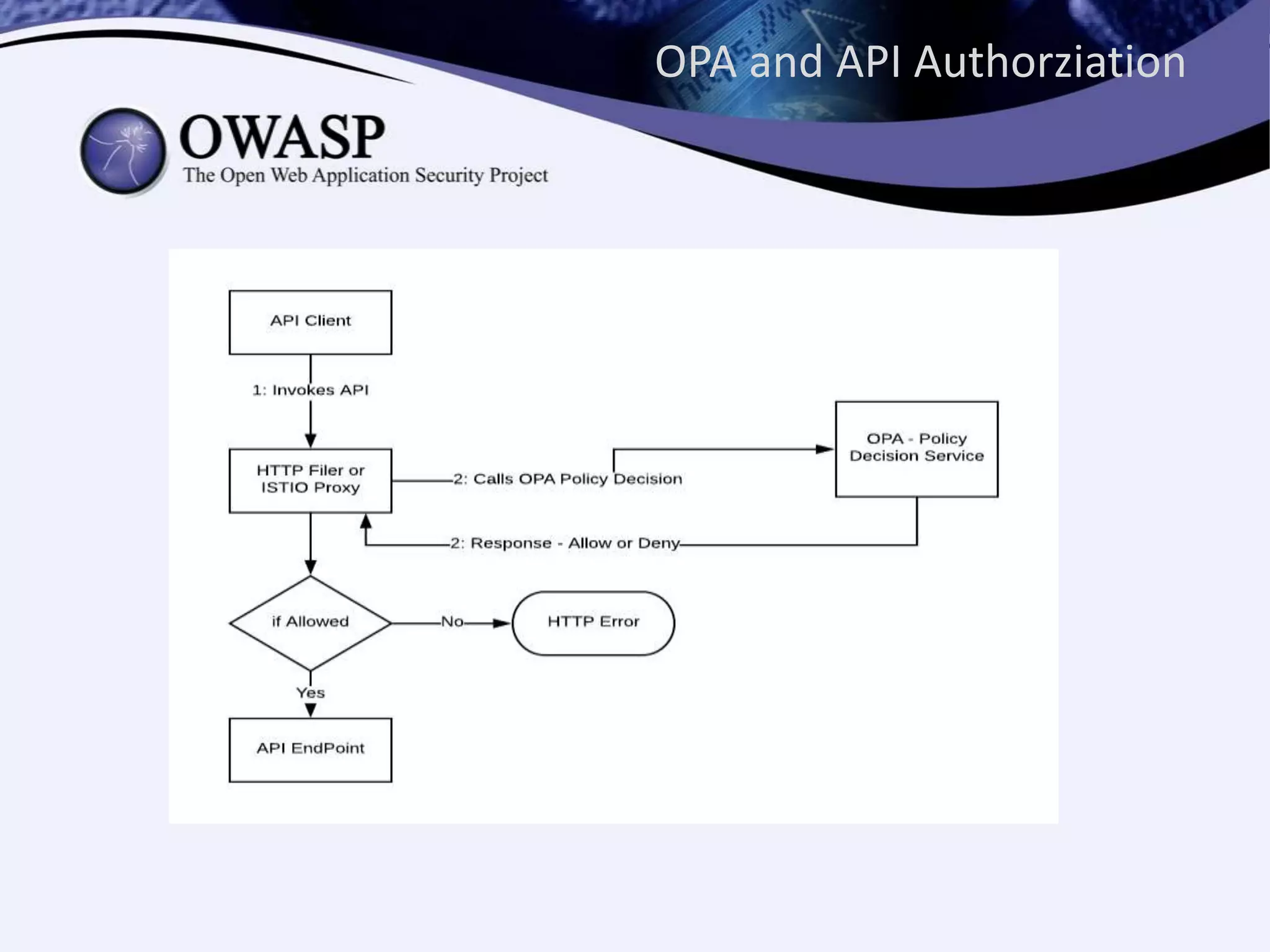
Gather Input.
HTTP Filter that gathers all
the data such as User ,
Method, URL Path, etc.
Make a Call to OPA - POST
v1/data/{PolicyName} and
supply the Input, get a
decision back as JSON
JSON is returned with
allow:True or can be any
specific data
OPA and API Authorziation
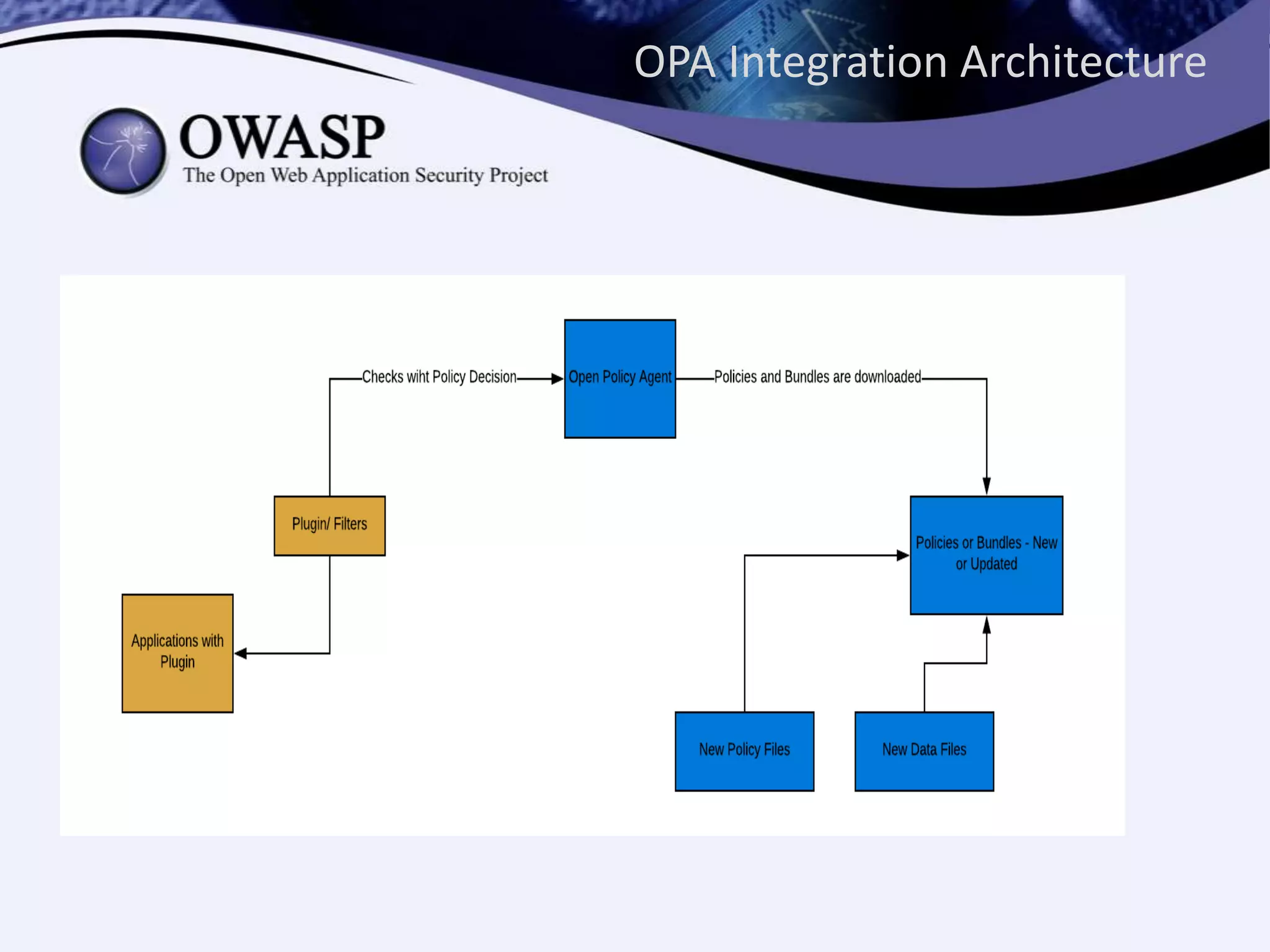
OPA Integration Architecture
OPA - Benefits
• You can update the Policy without changing
Code
• Policy definition can be left to development
teams to implement, but just outside of the
core Business API
• It can be used beyond REST API – Anywhere
there can be a Plugin, OPA can be integrated
as Plugin.
Micro Services, ISTIO and OPA
• API’s are deployed in Kubernetes
• ISTIO runs as Side Car
• OPA Plugin for ISTIO makes Policy Decision
Queries against OPA
Key Takeaways
• Externalize Authorization from code
• OPA provides easy way to write Policies and
Integrate via API
• REST API integration with Policy Decision makes it
easier to adapt across Platforms – Java, Node,
Python, etc.
• Policies and Data can be made available as
Bundle.
• Policy Change does not require re deployment of
code.
Questions?
• Thanks to K8 and OPA Community
• Various Authors who blogged about OPA
Thank You

Externalizing Authorization in Micro Services world

  • 1.
    Authorization in MicroServices world ISTIO and Open Policy Agent Sitaraman Lakshminarayanan
  • 2.
    About Me • SitaramanLakshminarayanan • Work: Security Architect at Pure Storage • Books : Author Oracle Web Services Manager, Co-Author ASP.NET Security • Twitter @Lsitaraman
  • 3.
    Definitions • Role BasedAccess Control – Define Roles – Roles map directly to API endpoints or via Permissions • Attribute Based Access Control – User’s Age, Title, Location / IP , etc. – Combination of In line code + external api call. • Policy Based Access Control – Describes what User/Role or Group can perform what Actions on a resource under certain conditions. E.g. AWS IAM
  • 4.
    What we willcover are.. • Role Based Access Control – Client /Server App and its Challenges • Web Based / Service Oriented Architecture model and its Challenges • Externalizing Authorization and how it can address your Access Control needs • One big idea is how Open Policy Agent can help
  • 5.
    RBAC in ClientServer Applications – ‘late 90s
  • 6.
    Authorization Logic inthe Code Function Button_SaveCustomer_Clicked() { If ( Form.Name == “CreateCustomer” ) { if ( LoggedInUser.Role != “CustomerAdmin” ) { Exception “Access Denied” } } }
  • 7.
    • Three TierArchitecture – early to mid 2000’s AuthZ code on Web Server before Page is rendered / when Submitted Trust relationship – Firewall, Custom Headers, etc. Web Access Management that Protects URL Patterns
  • 8.
  • 9.
    API Gateway withInternal Services A P I G a t e w a y Business Domain - Web Service 1 Business Domain Web Service 2 Business Domain Web Service 3 Internal API Gateway DB CRUD Service Internal Service2 Web App Mobile App WS-Security / SAML/WS-Trust Internal AuthN / AuthZ
  • 10.
    SOA + Gateway •Authorization enforcement at different places – API Gateway – Internal Gateway – At Service /endpoint for any Business Specific ACL • Makes it harder to change Authorization Rules without changing code • Or Every AuthZ decision is pushed to Gateway making Gateway – Bloated , Monolithic and Bureaucratic
  • 11.
    API Gateway –Before CI/CD
  • 12.
    But REST APIwill solve ... • Oh well not really • We moved from XML to JSON • JWT - JSON Web Token – JSON data – Digitally Signed – Represents User Information, May be Roles/ Scopes
  • 13.
    REST API +JWT + HTTP Filter
  • 14.
    What’s the issuewith filters? • Hard to change API to Role/Permission without changing Code • Any Code change would require regression testing • But Gateway’s are hard to manage, more overhead and takes time
  • 15.
    How do wemove forward? • Externalize Authorization from Code – Not Just Gateway that acts as Check Point – Making it developer friendly and easy to develop, deploy and change policies. • Externalizing Authorization from code is not new – API Gateway was one such solution – Extensible Access Control Markup Language (XACML) standard was supposed to address this.
  • 16.
    XACML to therescue • Extensible Access Control Markup Language – first attempt towards externalizing Policy Decisions in a standardized manner.
  • 17.
    XACML and APIIntegration Policy Decision Point that makes decisions Policy enforcement point – Integrates with your API and PDP to get decisions
  • 18.
    XACML retrospective • Pros –Externalized Authorization from code – Policies can be developed and deployed outside of Code • Cons – XACML integration required learning specific syntax – Not much open source integration
  • 19.
    XACML Replacement –Build your own AuthZ API • Build your own Authorization API • Integrations between AuthZ API and App/Service are proprietary
  • 20.
  • 21.
    When you buildyour own AuthZ API • You own everything – Contract between Client and Authorization API / Policy Decision Point – Build SDK for languages within your enterprise – Train every developer on your own API and Integration, no community to source information from – Suddenly you are asking yourself – Am I Building Feature X? or Am I a Security product?
  • 22.
    Kubernetes Authorization Kubernetes API Server Kubernetes Dashboard KubernetesCLI - Kubectl RBAC- Role based Custom – Web Hook ABAC – Attribute Based
  • 23.
    Kubernetes Web Hook Authorization •To Make Authorization Decision, you need – Resource being accessed – Action being perform ( GET, POST, etc.) – Incoming User Identity / Token • Write Web Hook that return Allow or Deny • Enable Web Hook Authorization with Kubernetes Framework • Now every request to Kubernetes API will invoke the Web Hook for Authorization
  • 24.
    Example Web HookAuthZ in K8 { "apiVersion": "authorization.k8s.io/v1beta1", "kind": "SubjectAccessReview", "spec": { "resourceAttributes": { "namespace": "kittensandponies", "verb": "get", "group": "unicorn.example.org", "resource": "pods" }, "user": "jane", "group": [ "group1", "group2" ] }} K8 API Version, so you can make decision based on Version of K8 API Server Kind – SubjectAccessReview Describes type of Object. Provides flexibility to add any other review later. ResourceAttributes – tells everything you need to know. What namespace being accessed, whether its HTTP get or post , user identity and Group information ( can come from JWT Token from your SSO System, etc.)
  • 25.
    AuthZ Decision { "apiVersion":"authorization.k8s.io/v1beta1", "kind": "SubjectAccessReview", "status": { "allowed": true } } Unified Response format to tell K8 if request is allowed or denied.
  • 26.
    Why I loveK8 AuthZ model • You let customers manage their own Risk. You provide the framework. • No one size fits all RBAC model • Its designed with API First approach – so everything is a Resource. • Externalized Authorization through Web Hook let you manage the Risk, implement Policy and Process around your deployment.
  • 27.
    What about Servicesdeployed on K8 • Micro Services have gained huge adoption and its much easier with Kubernetes. • But you still have to manage Authorization for your Business Services. • ISTIO brings together faster deployment and Gateway approach for Services.
  • 28.
  • 29.
    ISTIO Things toknow • Without going into ISTIO jargons… ISTIO makes it easy to – Enforce Authorization – Logging – Collect Telemetry – Quotas – Deploys Envoy Proxy as SideCar • In other words, ISTIO is light weight proxy in front of your API Services • ISTIO components are at Ingress and Egress layer
  • 30.
    ISTIO Authorization apiVersion: "rbac.istio.io/v1alpha1" kind:ServiceRole metadata: name: tester namespace: default spec: rules: - services: ["test-*"] methods: ["*"] - services: ["bookstore.default.svc.cluster.local" ] paths: ["*/reviews"] methods: ["GET"] Authorization now moved from Code / Gateway config to YAML .. We all love Yet another..  Fine Grained ACL gets challenging. This is external to code but still requires re-deployment.
  • 31.
    ISTIO Service toService Deploying ISTIO completely hides the complexity of Service Discovery and Service Invocation mTLS, Protocol Translation, etc. But what about Authorization?- YAML file 
  • 32.
    Externalizing AuthZ inMicro Services World • Let’s agree to a standard of communicating – Resource ( end point being invoked) – Operations / Actions being performed – Identity of Caller – Payload • You can use your own proprietary, or Platform Specific or use Open Policy Agent
  • 33.
    Open Policy Agent •It’s a Policy Engine • Available as RESTful API with JSON and HTTP , so no new integration patterns. • Data can be static or Dynamic that can be used to make the decision • Policies are written in declarative language Rego • Policies are updated in OPA via /v1/policies API endpoint
  • 34.
  • 35.
    OPA-Rego and Policies •OPA uses its native query language Rego • Policy decisions are written in Rego • Policies are defined inside Module. – Each Module should have one Package name – Zero or more statements – Zero or more Rules
  • 36.
    OPA Policy Walkthrough PackageName Rule Name Compares Input – If method is GET, Path is finance and Username , if everything is true it returns True. Input is keyword. Assign Input as http_api variable package httpapi.authz subordinates = {"alice": [], "charlie": [], "bob": ["alice"], "betty": ["charlie"]} Static Data import input as http_api allow { http_api.method = "GET" http_api.path = ["finance", "salary", username] username = http_api.user }
  • 37.
    How is OPAPolicy invoked? input_dict = { # create input to hand to OPA "input": { "user": api_user_from_jwt, "path": “finance”, "method": “GET” } } rsp = requests.post("http://example.com/v1/data/htt papi/authz", data=json.dumps(input_dict)) if rsp.json()["allow"] Gather Input. HTTP Filter that gathers all the data such as User , Method, URL Path, etc. Make a Call to OPA - POST v1/data/{PolicyName} and supply the Input, get a decision back as JSON JSON is returned with allow:True or can be any specific data
  • 38.
    OPA and APIAuthorziation
  • 39.
  • 40.
    OPA - Benefits •You can update the Policy without changing Code • Policy definition can be left to development teams to implement, but just outside of the core Business API • It can be used beyond REST API – Anywhere there can be a Plugin, OPA can be integrated as Plugin.
  • 41.
    Micro Services, ISTIOand OPA • API’s are deployed in Kubernetes • ISTIO runs as Side Car • OPA Plugin for ISTIO makes Policy Decision Queries against OPA
  • 42.
    Key Takeaways • ExternalizeAuthorization from code • OPA provides easy way to write Policies and Integrate via API • REST API integration with Policy Decision makes it easier to adapt across Platforms – Java, Node, Python, etc. • Policies and Data can be made available as Bundle. • Policy Change does not require re deployment of code.
  • 43.
    Questions? • Thanks toK8 and OPA Community • Various Authors who blogged about OPA Thank You