Istio’s Mixer:
Policy Enforcement with Custom Adapters
Limin Wang, Software Engineer, Google
Torin Sandall, Software Engineer, Styra
Outline
● Istio and policy (how to enforce your custom
policy in Istio)
● Integrate Open Policy Agent to Istio
(demo)
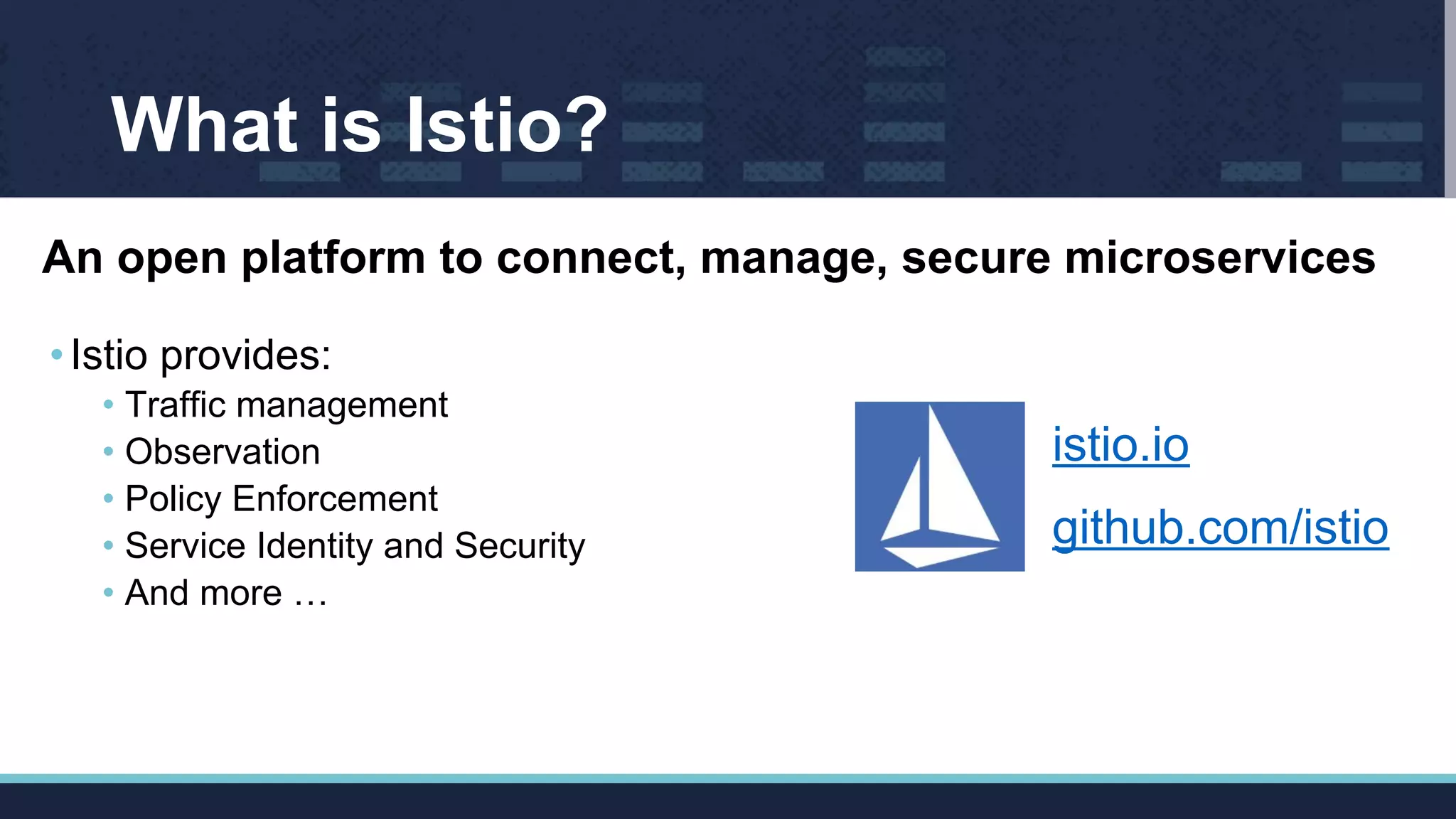
What is Istio?
An open platform to connect, manage, secure microservices
•Istio provides:
• Traffic management
• Observation
• Policy Enforcement
• Service Identity and Security
• And more …
istio.io
github.com/istio
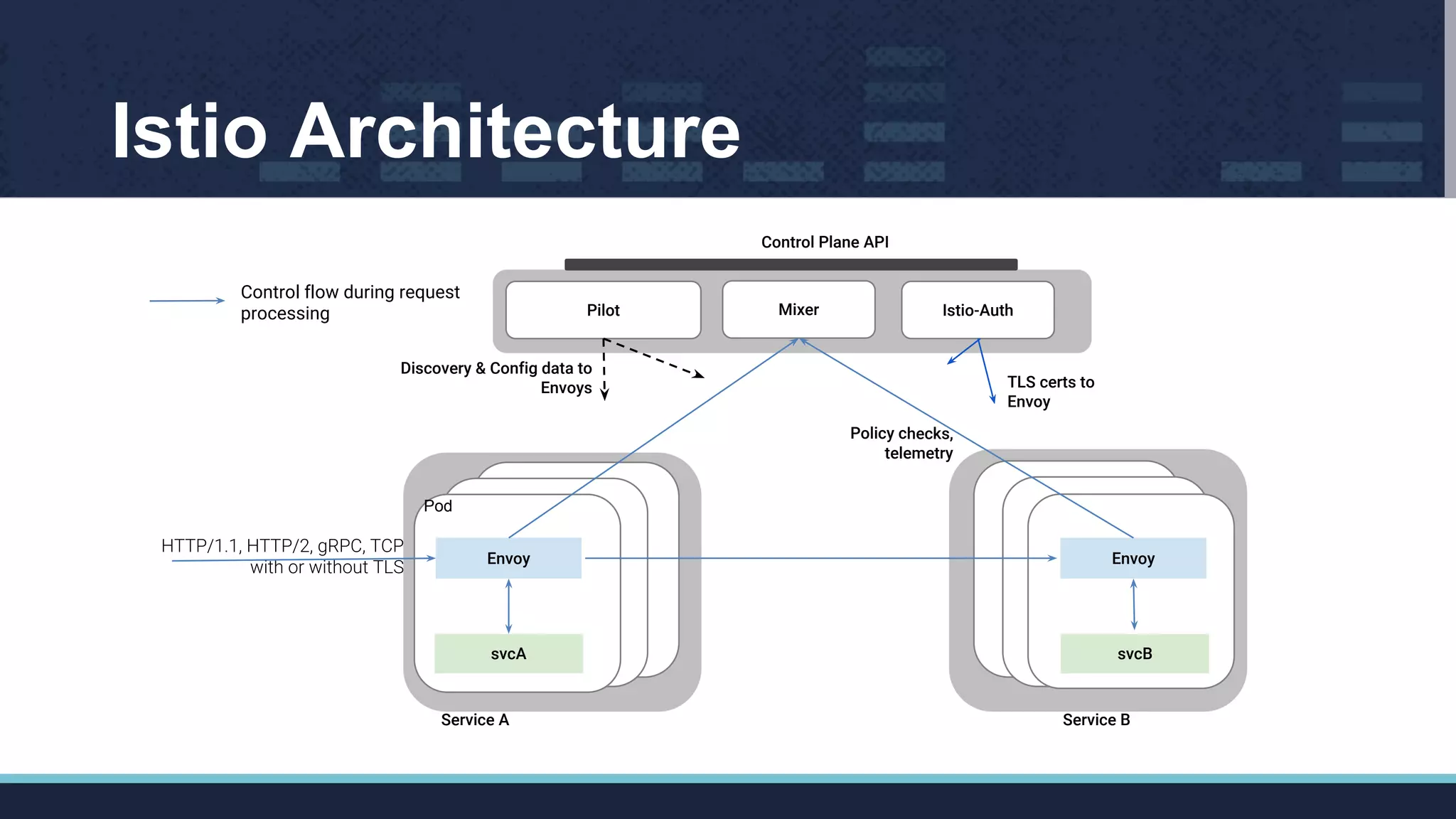
Istio Architecture
HTTP/1.1, HTTP/2, gRPC, TCP
with or without TLS
svcA
Envoy
Pod
Service A
svcB
Envoy
Service B
Pilot
Control Plane API
Mixer
Discovery & Config data to
Envoys
Policy checks,
telemetry
Control flow during request
processing Istio-Auth
TLS certs to
Envoy
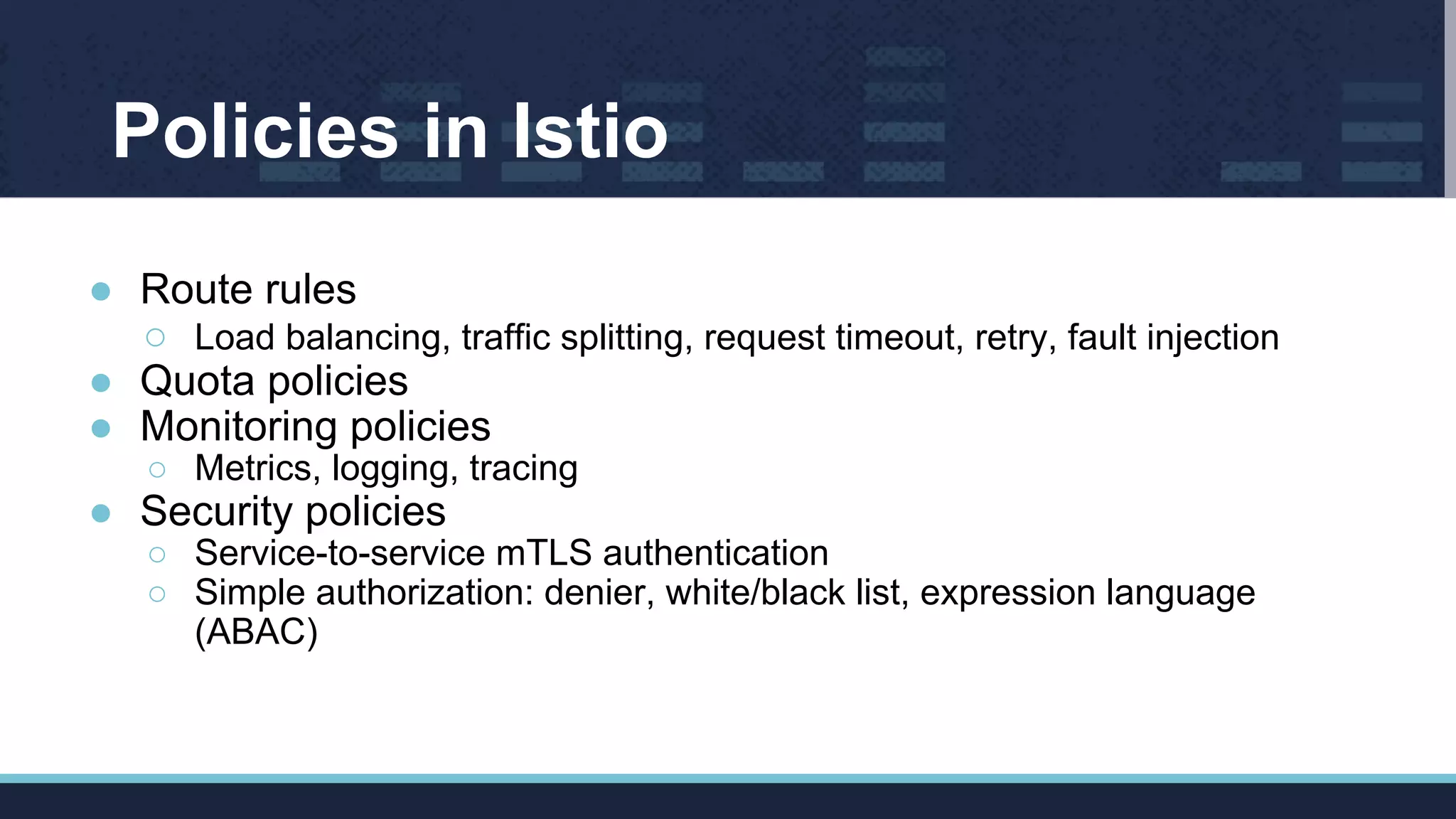
Policies in Istio
● Route rules
○ Load balancing, traffic splitting, request timeout, retry, fault injection
● Quota policies
● Monitoring policies
○ Metrics, logging, tracing
● Security policies
○ Service-to-service mTLS authentication
○ Simple authorization: denier, white/black list, expression language
(ABAC)
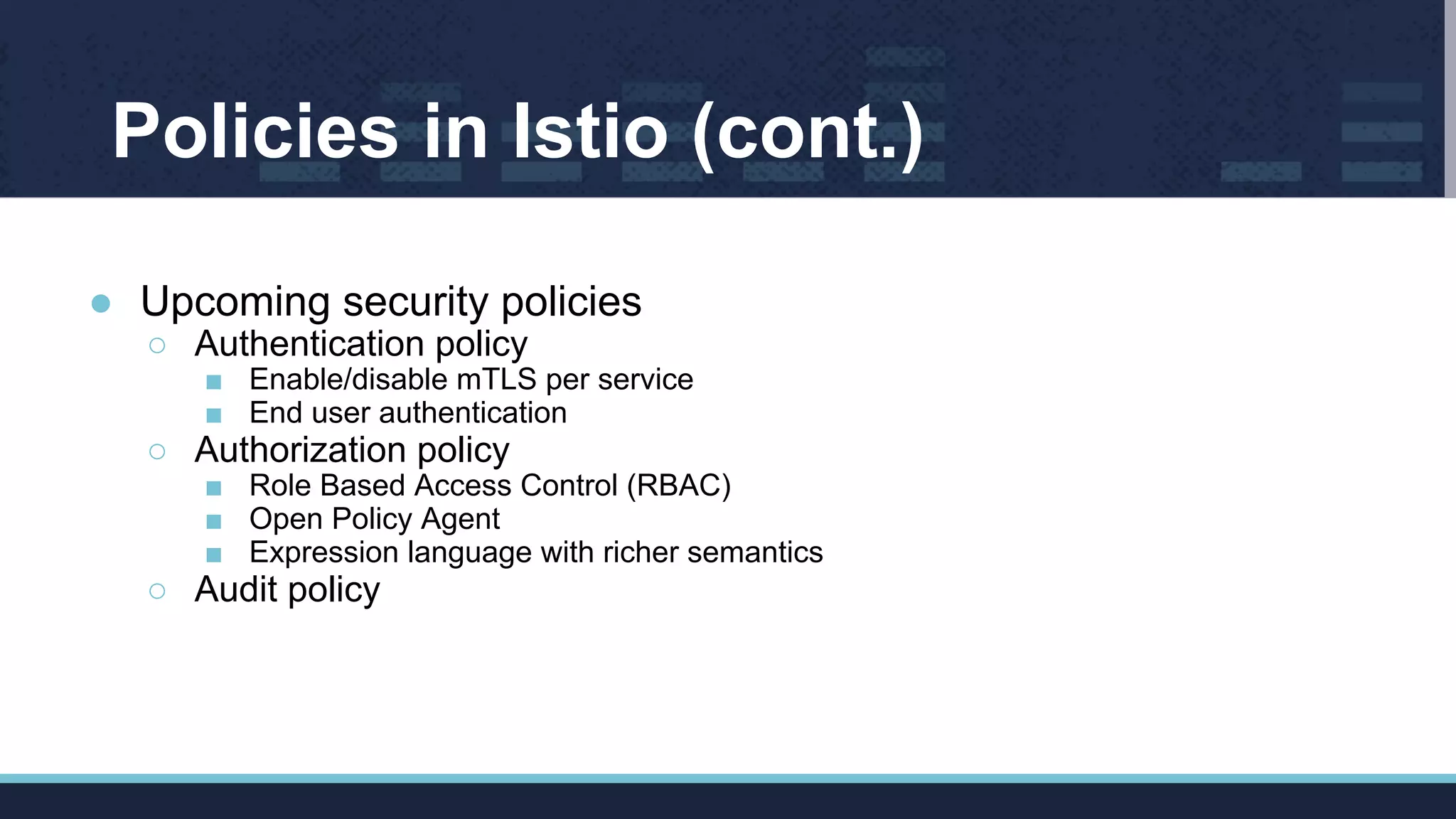
Policies in Istio (cont.)
● Upcoming security policies
○ Authentication policy
■ Enable/disable mTLS per service
■ End user authentication
○ Authorization policy
■ Role Based Access Control (RBAC)
■ Open Policy Agent
■ Expression language with richer semantics
○ Audit policy
Example Policy (RBAC)
kind: ServiceRole
apiVersion: config.istio.io/v1alpha2
metadata:
name: review-product-viewer
namespace: default
spec:
rules:
- services: [“reviews”]
methods: [“GET”, “HEAD”]
- services: [“products”]
paths: [“/books”, “/books/*”]
methods: [“GET”, “HEAD”]
kind: ServiceRoleBinding
apiVersion: config.istio.io/v1alpha2
metadata:
name: example-role-binding
namespace: default
spec:
subjects:
- name: “istio-ingress-service-account”
roleRef:
kind: ServiceRole
name: review-product-viewer
More information on Istio RBAC Design Doc.
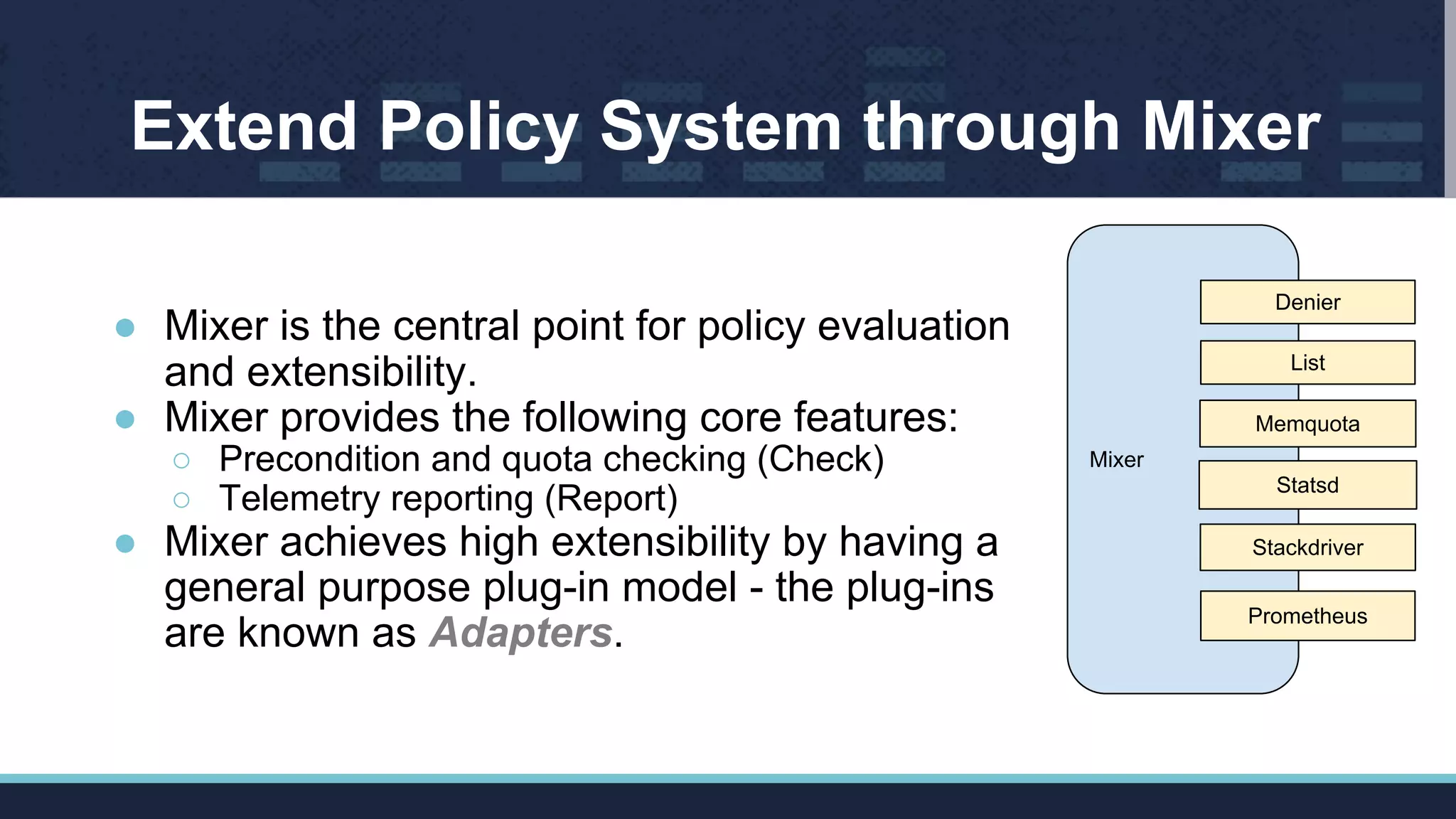
Extend Policy System through Mixer
● Mixer is the central point for policy evaluation
and extensibility.
● Mixer provides the following core features:
○ Precondition and quota checking (Check)
○ Telemetry reporting (Report)
● Mixer achieves high extensibility by having a
general purpose plug-in model - the plug-ins
are known as Adapters.
Mixer
List
Memquota
Statsd
Stackdriver
Prometheus
Denier
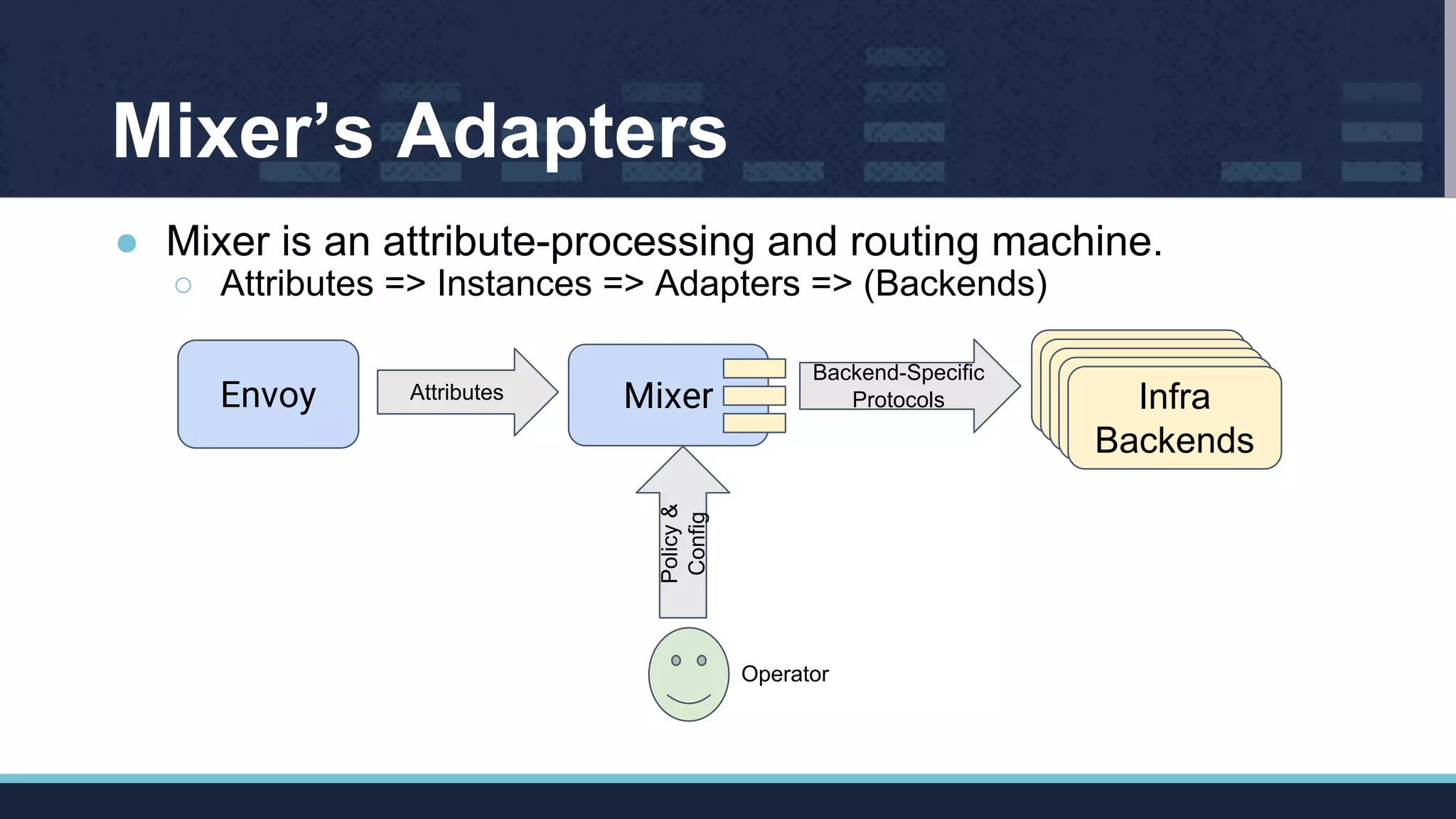
Mixer’s Adapters
● Mixer is an attribute-processing and routing machine.
○ Attributes => Instances => Adapters => (Backends)
Envoy Mixer
Infra
Backends
Infra
Backends
Infra
Backends
Infra
Backends
Infra
Backends
Attributes
Backend-Specific
Protocols
Policy&
Config
Operator
How to Provide a Custom Adapter
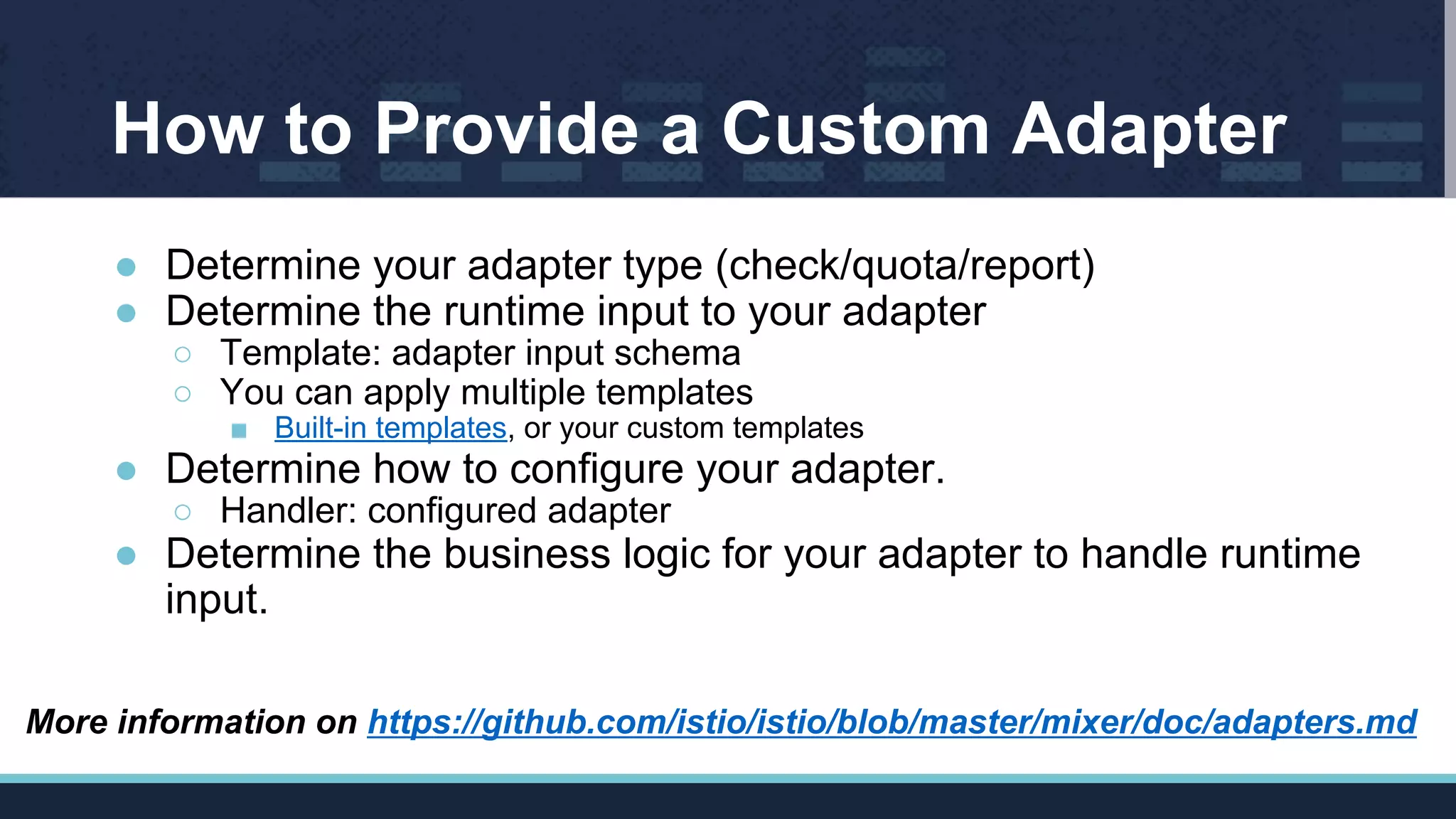
● Determine your adapter type (check/quota/report)
● Determine the runtime input to your adapter
○ Template: adapter input schema
○ You can apply multiple templates
■ Built-in templates, or your custom templates
● Determine how to configure your adapter.
○ Handler: configured adapter
● Determine the business logic for your adapter to handle runtime
input.
More information on https://github.com/istio/istio/blob/master/mixer/doc/adapters.md
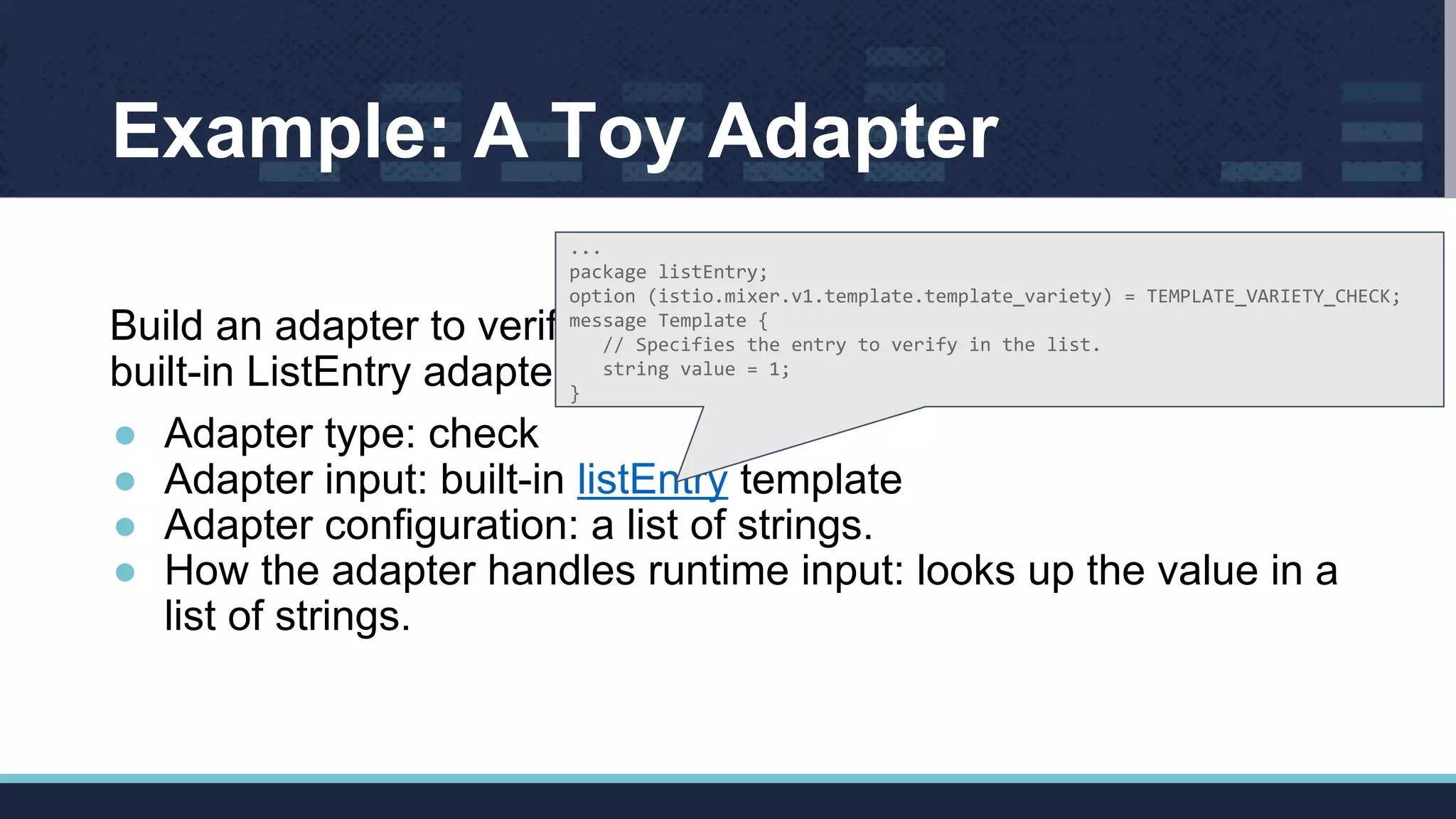
Example: A Toy Adapter
Build an adapter to verify a string is present in a list (simplified
built-in ListEntry adapter).
● Adapter type: check
● Adapter input: built-in listEntry template
● Adapter configuration: a list of strings.
● How the adapter handles runtime input: looks up the value in a
list of strings.
...
package listEntry;
option (istio.mixer.v1.template.template_variety) = TEMPLATE_VARIETY_CHECK;
message Template {
// Specifies the entry to verify in the list.
string value = 1;
}
Steps to Build a Custom Adapter
Step 1. Write basic adapter skeleton code (online tutorial or build-in
adapters)
...
func GetInfo() adapter.Info {
return adapter.Info{
Name: "listChecker",
Description: "Checks whether a string is in the list",
SupportedTemplates: []string{
listentry.TemplateName,
},
NewBuilder: func() adapter.HandlerBuilder { return &builder{} },
DefaultConfig: &config.Params{},
}
}
Steps to Build a Custom Adapter
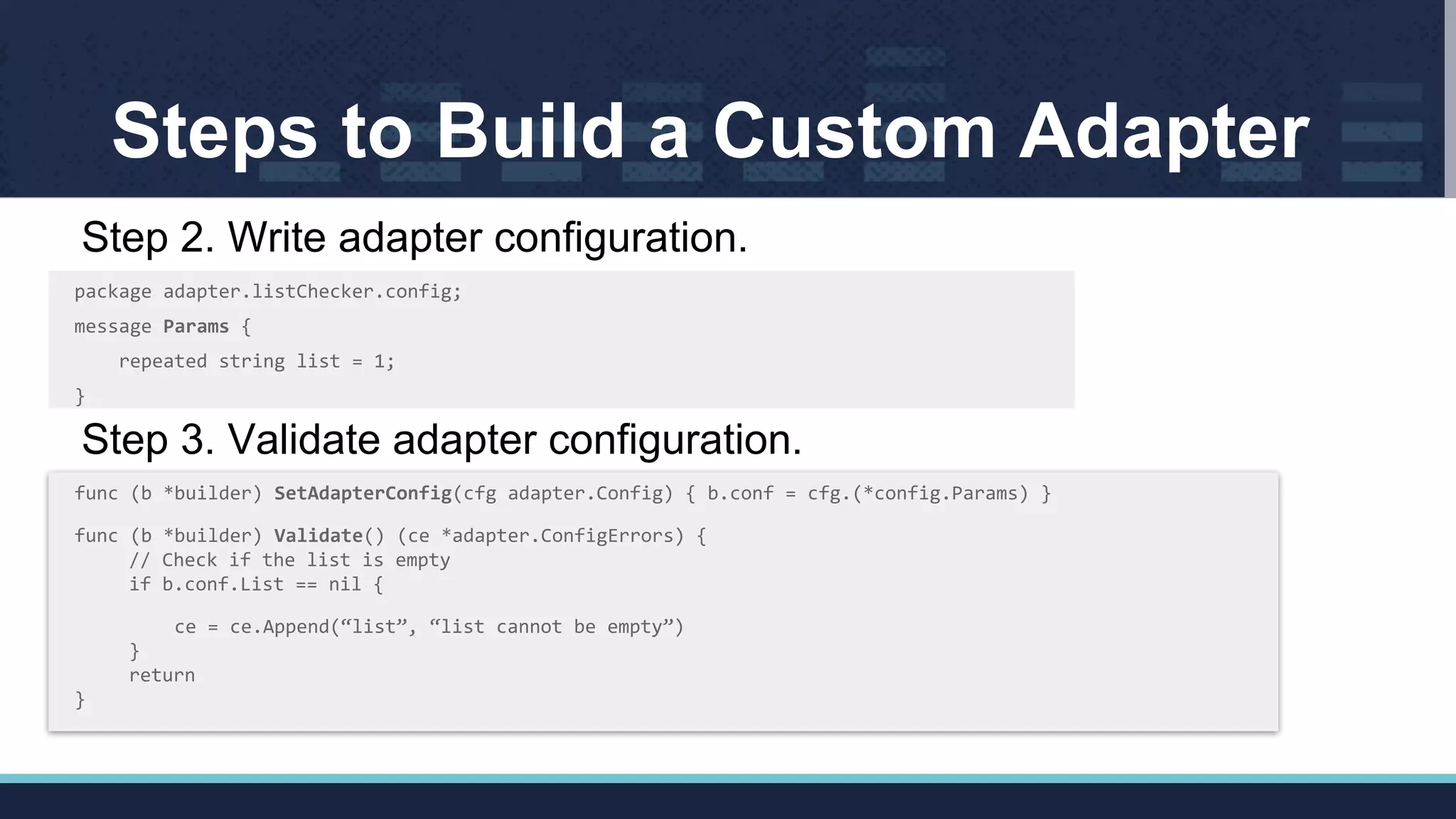
Step 2. Write adapter configuration.
package adapter.listChecker.config;
message Params {
repeated string list = 1;
}
Step 3. Validate adapter configuration.
func (b *builder) SetAdapterConfig(cfg adapter.Config) { b.conf = cfg.(*config.Params) }
func (b *builder) Validate() (ce *adapter.ConfigErrors) {
// Check if the list is empty
if b.conf.List == nil {
ce = ce.Append(“list”, “list cannot be empty”)
}
return
}
Steps to Build a Custom Adapter
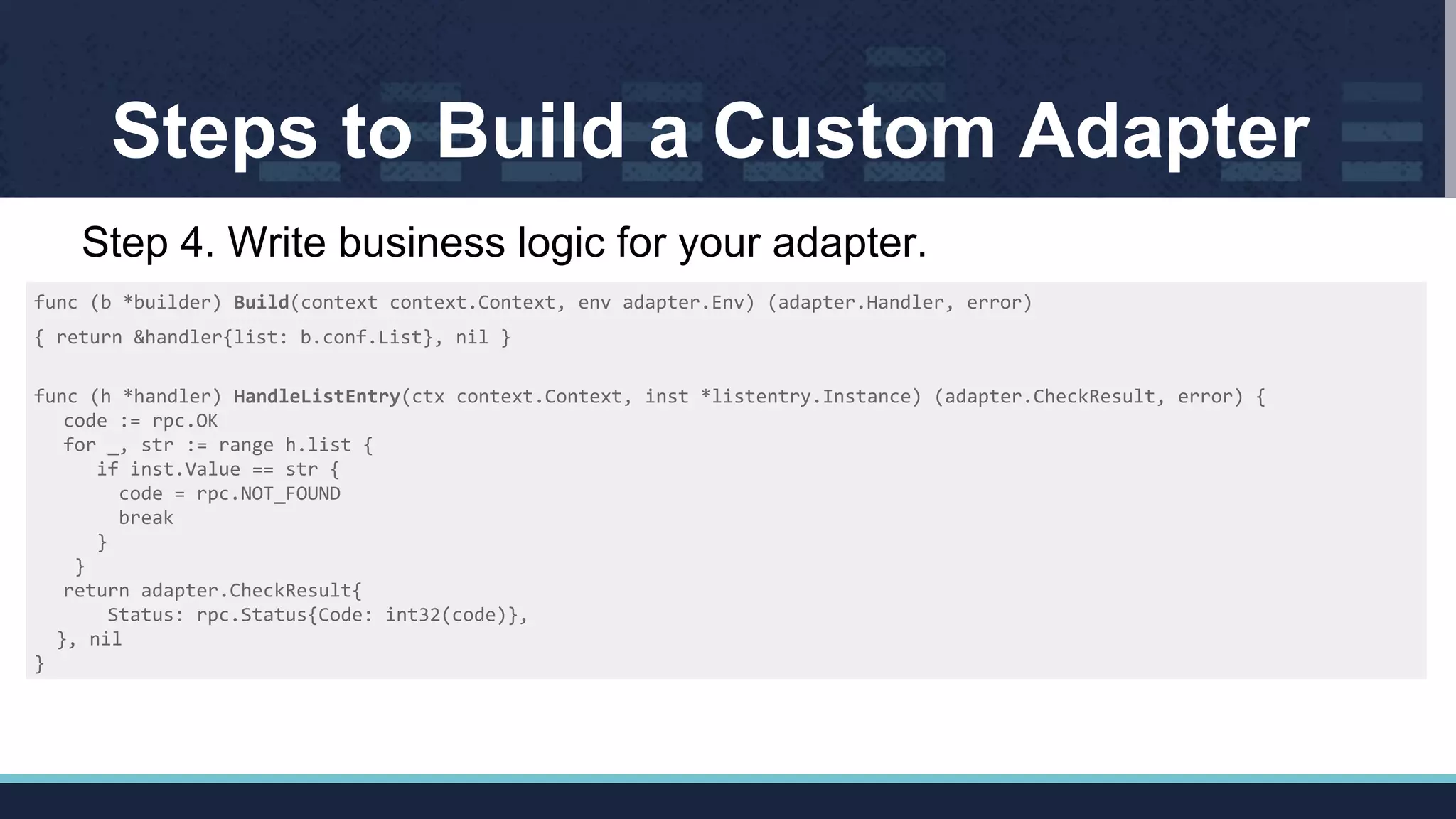
func (b *builder) Build(context context.Context, env adapter.Env) (adapter.Handler, error)
{ return &handler{list: b.conf.List}, nil }
func (h *handler) HandleListEntry(ctx context.Context, inst *listentry.Instance) (adapter.CheckResult, error) {
code := rpc.OK
for _, str := range h.list {
if inst.Value == str {
code = rpc.NOT_FOUND
break
}
}
return adapter.CheckResult{
Status: rpc.Status{Code: int32(code)},
}, nil
}
Step 4. Write business logic for your adapter.
Configure Policy Using Custom Adapter
apiVersion: “config.istio.io/v1alpha2”
kind: listentry
metadata:
name: srcVersion
spec:
value: source.labels[“version”]
1. Create an instance of listentry template.
apiVersion: “config.istio.io/v1alpha2”
kind: listChecker
metadata:
name: versionChecker
spec:
list: [“v1”, “v2”]
2. Create a handler of listChecker adapter.
apiVersion: “config.istio.io/v1alpha2”
kind: rule
metadata:
name: checkVersion
spec:
match: destination.labels[“app”] == “ratings”
actions:
- handler: versionChecker.listChecker
instances:
- srcVersion.listentry
3. Create a checkVersion policy
istioctl create -f *.yaml
4. Apply the policy!
+
● Overview: Open Policy Agent
● OPA Adapter
● Demo
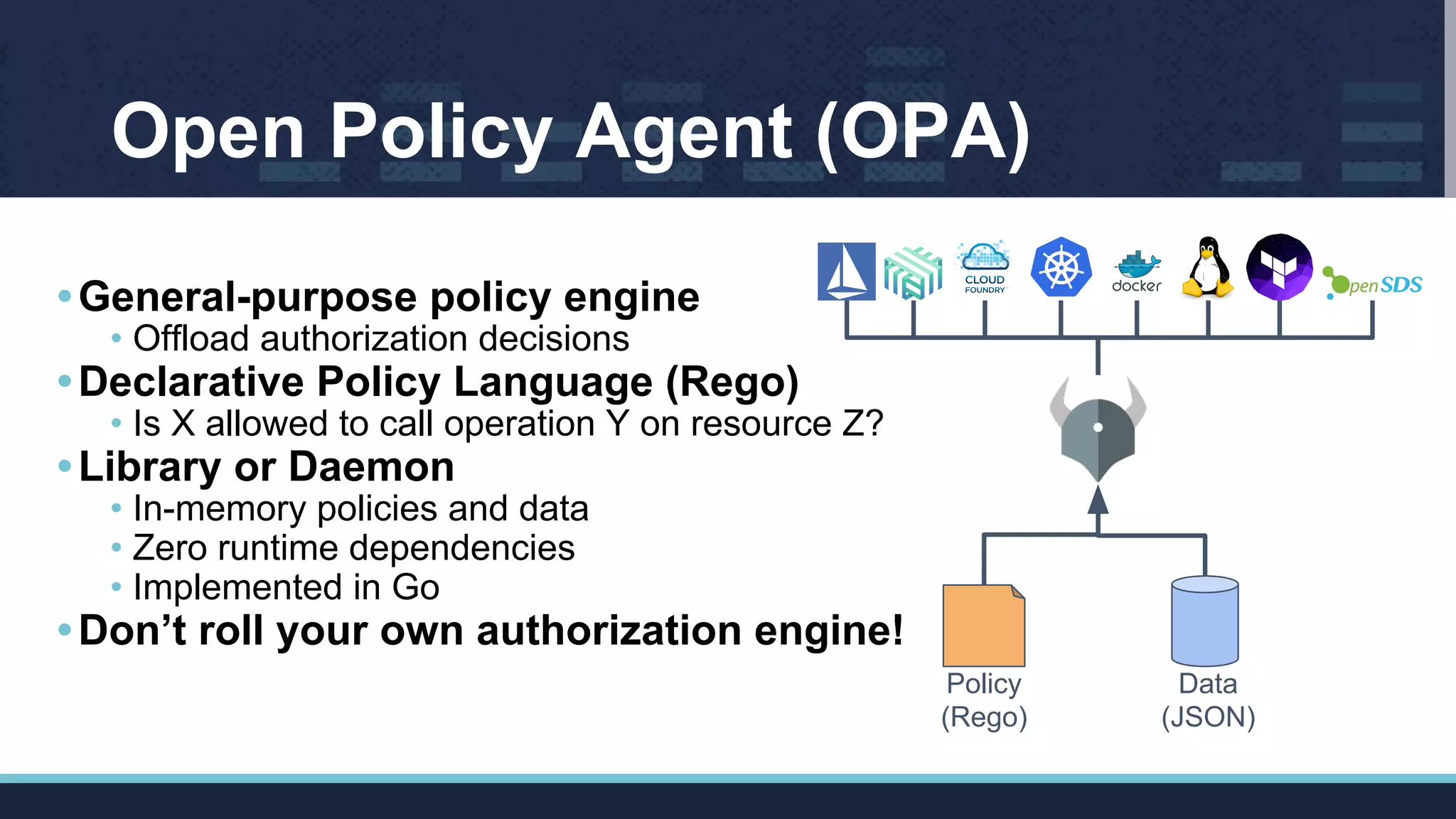
•General-purpose policy engine
• Offload authorization decisions
•Declarative Policy Language (Rego)
• Is X allowed to call operation Y on resource Z?
•Library or Daemon
• In-memory policies and data
• Zero runtime dependencies
• Implemented in Go
•Don’t roll your own authorization engine!
Policy
(Rego)
Data
(JSON)
Open Policy Agent (OPA)
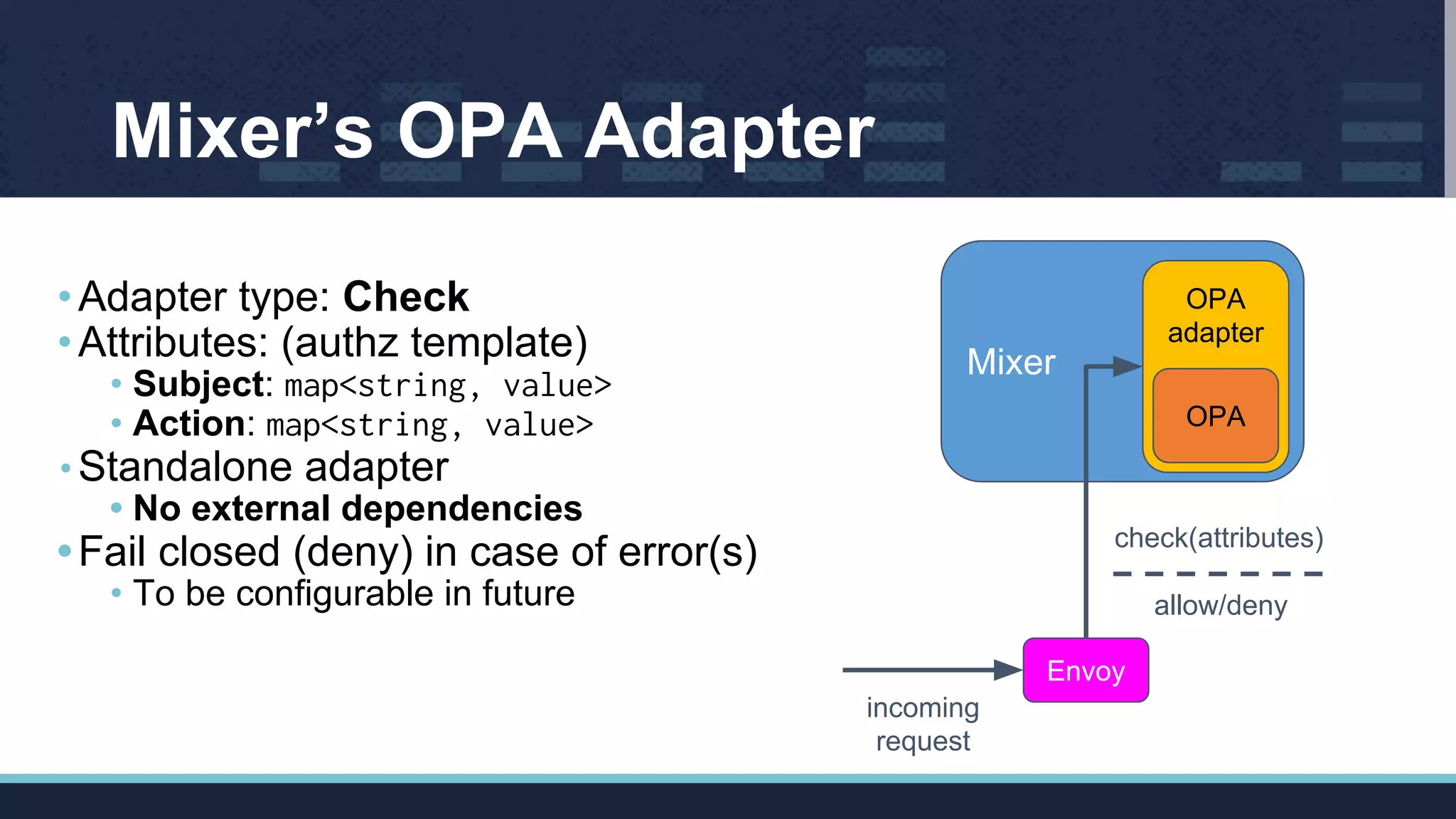
•Adapter type: Check
•Attributes: (authz template)
• Subject: map<string, value>
• Action: map<string, value>
• Standalone adapter
• No external dependencies
•Fail closed (deny) in case of error(s)
• To be configurable in future
Envoy
Mixer
check(attributes)
OPA
adapter
OPA
incoming
request
allow/deny
Mixer’s OPA Adapter
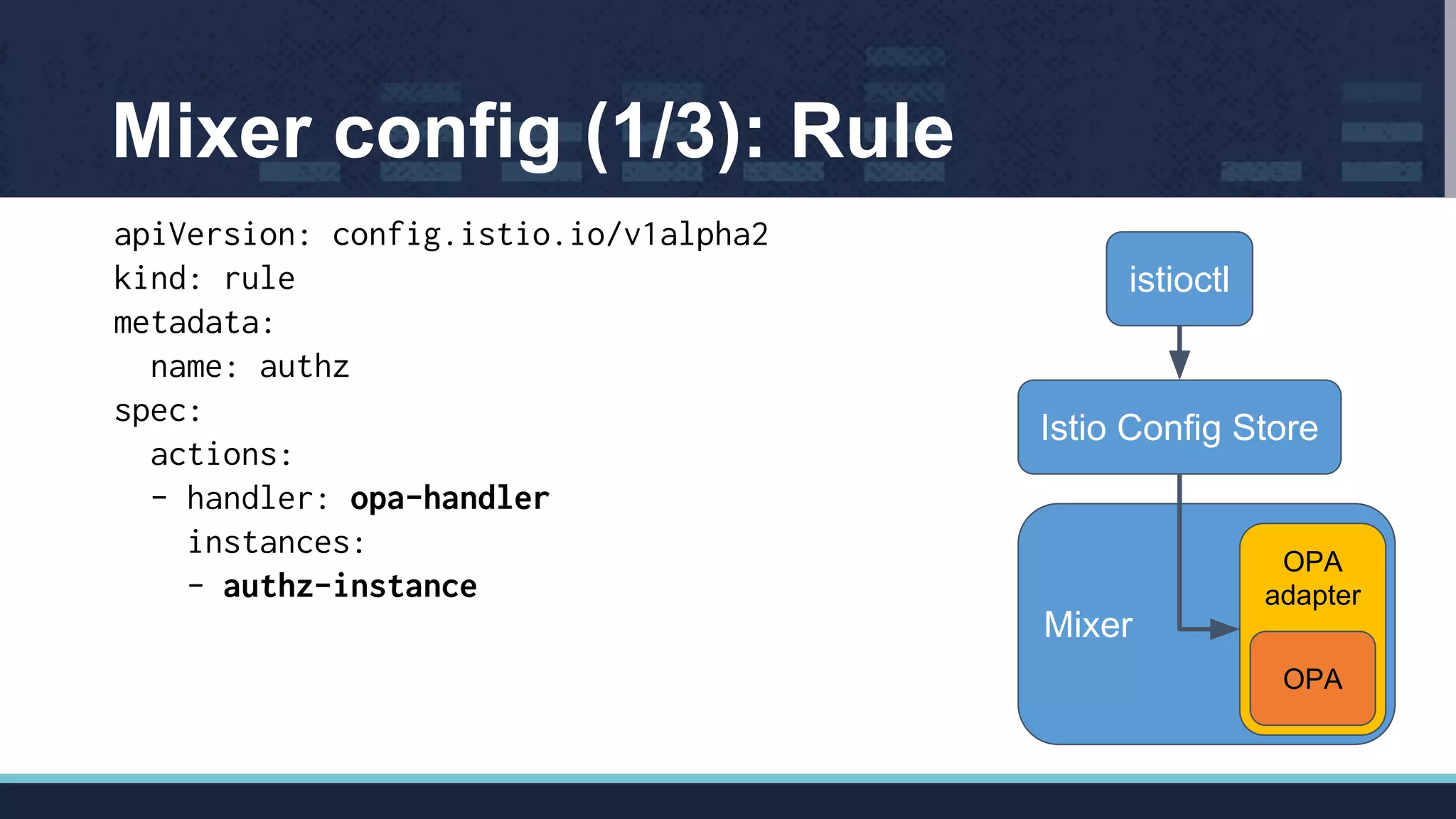
apiVersion: config.istio.io/v1alpha2
kind: rule
metadata:
name: authz
spec:
actions:
- handler: opa-handler
instances:
- authz-instance
Mixer config (1/3): Rule
Mixer
OPA
adapter
OPA
Istio Config Store
istioctl
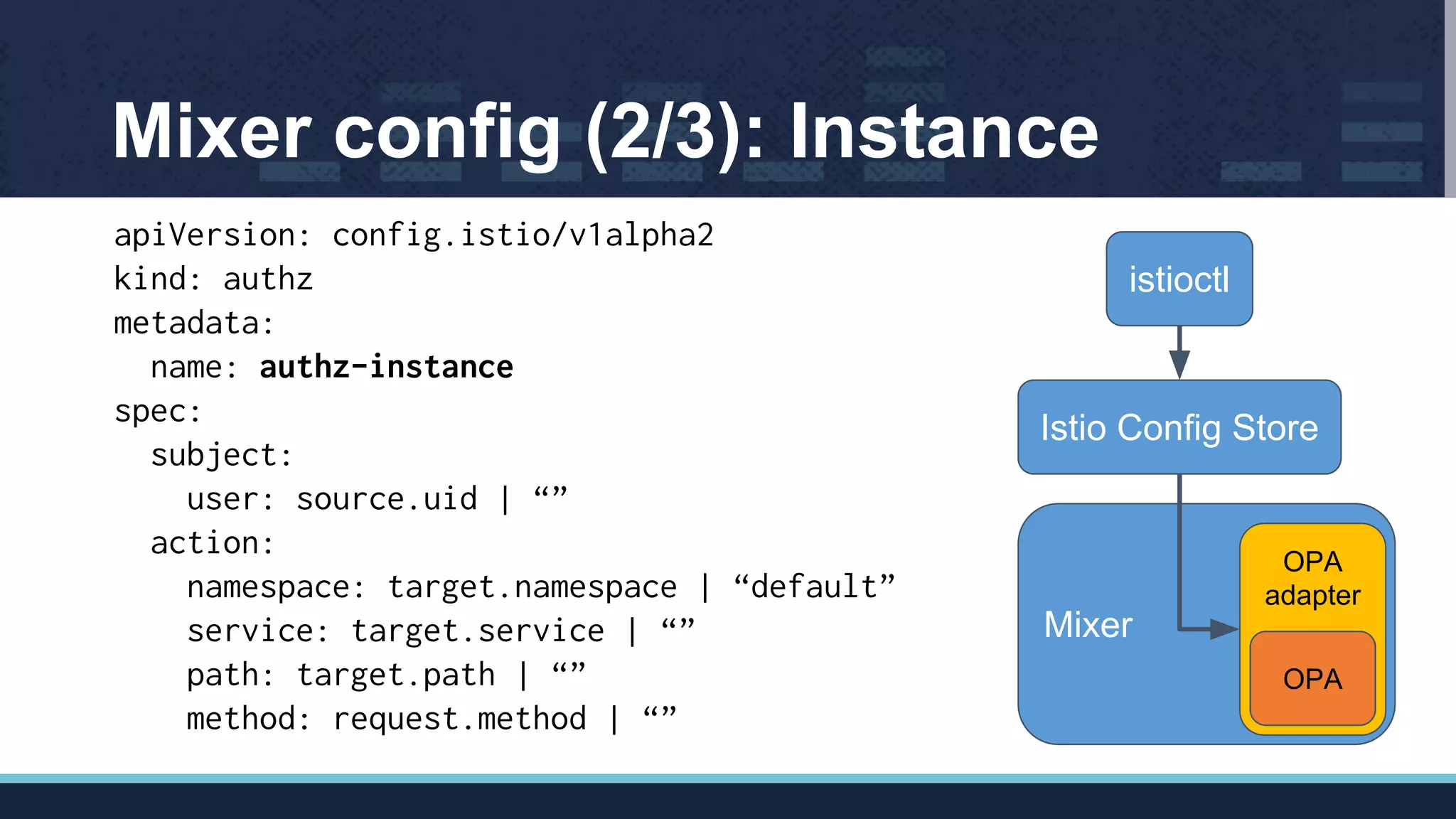
apiVersion: config.istio/v1alpha2
kind: authz
metadata:
name: authz-instance
spec:
subject:
user: source.uid | “”
action:
namespace: target.namespace | “default”
service: target.service | “”
path: target.path | “”
method: request.method | “”
Mixer config (2/3): Instance
Mixer
OPA
adapter
OPA
Istio Config Store
istioctl
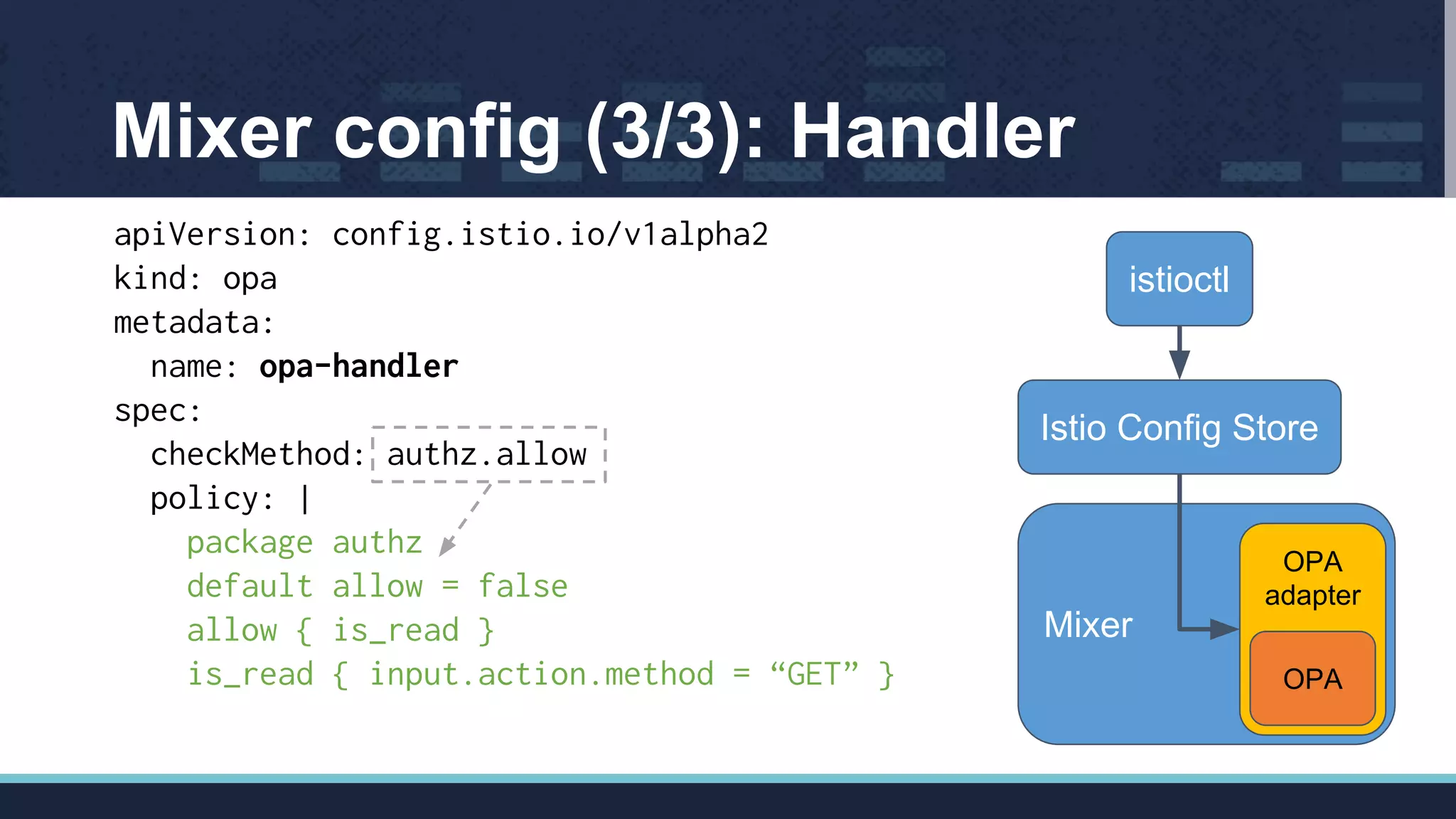
apiVersion: config.istio.io/v1alpha2
kind: opa
metadata:
name: opa-handler
spec:
checkMethod: authz.allow
policy: |
package authz
default allow = false
allow { is_read }
is_read { input.action.method = “GET” }
Mixer config (3/3): Handler
Mixer
OPA
adapter
OPA
Istio Config Store
istioctl
Demo
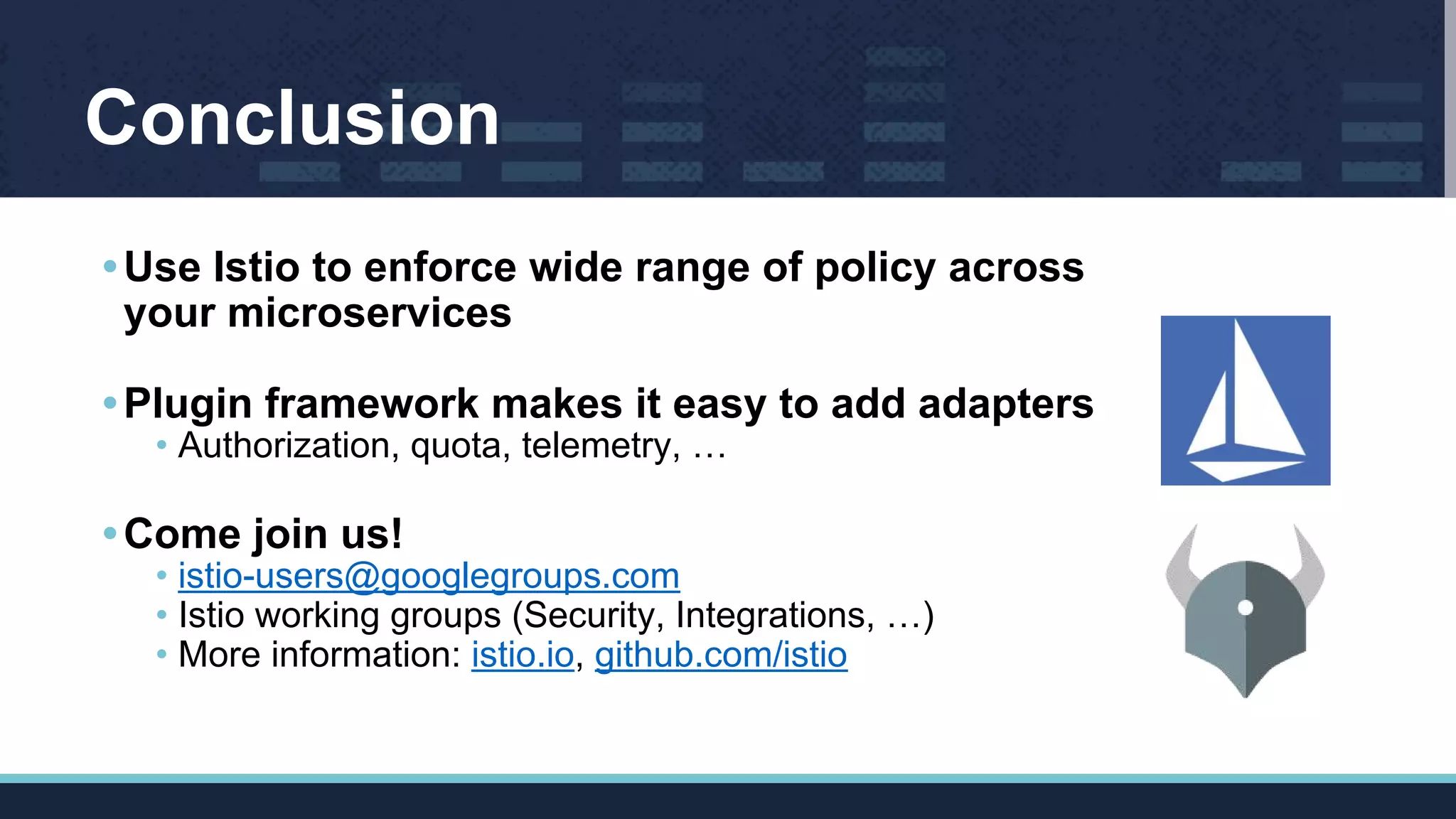
Conclusion
•Use Istio to enforce wide range of policy across
your microservices
•Plugin framework makes it easy to add adapters
• Authorization, quota, telemetry, …
•Come join us!
• istio-users@googlegroups.com
• Istio working groups (Security, Integrations, …)
• More information: istio.io, github.com/istio
Questions?

Istio's mixer policy enforcement with custom adapters (cloud nativecon 17)

  • 1.
    Istio’s Mixer: Policy Enforcementwith Custom Adapters Limin Wang, Software Engineer, Google Torin Sandall, Software Engineer, Styra
  • 2.
    Outline ● Istio andpolicy (how to enforce your custom policy in Istio) ● Integrate Open Policy Agent to Istio (demo)
  • 3.
    What is Istio? Anopen platform to connect, manage, secure microservices •Istio provides: • Traffic management • Observation • Policy Enforcement • Service Identity and Security • And more … istio.io github.com/istio
  • 4.
    Istio Architecture HTTP/1.1, HTTP/2,gRPC, TCP with or without TLS svcA Envoy Pod Service A svcB Envoy Service B Pilot Control Plane API Mixer Discovery & Config data to Envoys Policy checks, telemetry Control flow during request processing Istio-Auth TLS certs to Envoy
  • 5.
    Policies in Istio ●Route rules ○ Load balancing, traffic splitting, request timeout, retry, fault injection ● Quota policies ● Monitoring policies ○ Metrics, logging, tracing ● Security policies ○ Service-to-service mTLS authentication ○ Simple authorization: denier, white/black list, expression language (ABAC)
  • 6.
    Policies in Istio(cont.) ● Upcoming security policies ○ Authentication policy ■ Enable/disable mTLS per service ■ End user authentication ○ Authorization policy ■ Role Based Access Control (RBAC) ■ Open Policy Agent ■ Expression language with richer semantics ○ Audit policy
  • 7.
    Example Policy (RBAC) kind:ServiceRole apiVersion: config.istio.io/v1alpha2 metadata: name: review-product-viewer namespace: default spec: rules: - services: [“reviews”] methods: [“GET”, “HEAD”] - services: [“products”] paths: [“/books”, “/books/*”] methods: [“GET”, “HEAD”] kind: ServiceRoleBinding apiVersion: config.istio.io/v1alpha2 metadata: name: example-role-binding namespace: default spec: subjects: - name: “istio-ingress-service-account” roleRef: kind: ServiceRole name: review-product-viewer More information on Istio RBAC Design Doc.
  • 8.
    Extend Policy Systemthrough Mixer ● Mixer is the central point for policy evaluation and extensibility. ● Mixer provides the following core features: ○ Precondition and quota checking (Check) ○ Telemetry reporting (Report) ● Mixer achieves high extensibility by having a general purpose plug-in model - the plug-ins are known as Adapters. Mixer List Memquota Statsd Stackdriver Prometheus Denier
  • 9.
    Mixer’s Adapters ● Mixeris an attribute-processing and routing machine. ○ Attributes => Instances => Adapters => (Backends) Envoy Mixer Infra Backends Infra Backends Infra Backends Infra Backends Infra Backends Attributes Backend-Specific Protocols Policy& Config Operator
  • 10.
    How to Providea Custom Adapter ● Determine your adapter type (check/quota/report) ● Determine the runtime input to your adapter ○ Template: adapter input schema ○ You can apply multiple templates ■ Built-in templates, or your custom templates ● Determine how to configure your adapter. ○ Handler: configured adapter ● Determine the business logic for your adapter to handle runtime input. More information on https://github.com/istio/istio/blob/master/mixer/doc/adapters.md
  • 11.
    Example: A ToyAdapter Build an adapter to verify a string is present in a list (simplified built-in ListEntry adapter). ● Adapter type: check ● Adapter input: built-in listEntry template ● Adapter configuration: a list of strings. ● How the adapter handles runtime input: looks up the value in a list of strings. ... package listEntry; option (istio.mixer.v1.template.template_variety) = TEMPLATE_VARIETY_CHECK; message Template { // Specifies the entry to verify in the list. string value = 1; }
  • 12.
    Steps to Builda Custom Adapter Step 1. Write basic adapter skeleton code (online tutorial or build-in adapters) ... func GetInfo() adapter.Info { return adapter.Info{ Name: "listChecker", Description: "Checks whether a string is in the list", SupportedTemplates: []string{ listentry.TemplateName, }, NewBuilder: func() adapter.HandlerBuilder { return &builder{} }, DefaultConfig: &config.Params{}, } }
  • 13.
    Steps to Builda Custom Adapter Step 2. Write adapter configuration. package adapter.listChecker.config; message Params { repeated string list = 1; } Step 3. Validate adapter configuration. func (b *builder) SetAdapterConfig(cfg adapter.Config) { b.conf = cfg.(*config.Params) } func (b *builder) Validate() (ce *adapter.ConfigErrors) { // Check if the list is empty if b.conf.List == nil { ce = ce.Append(“list”, “list cannot be empty”) } return }
  • 14.
    Steps to Builda Custom Adapter func (b *builder) Build(context context.Context, env adapter.Env) (adapter.Handler, error) { return &handler{list: b.conf.List}, nil } func (h *handler) HandleListEntry(ctx context.Context, inst *listentry.Instance) (adapter.CheckResult, error) { code := rpc.OK for _, str := range h.list { if inst.Value == str { code = rpc.NOT_FOUND break } } return adapter.CheckResult{ Status: rpc.Status{Code: int32(code)}, }, nil } Step 4. Write business logic for your adapter.
  • 15.
    Configure Policy UsingCustom Adapter apiVersion: “config.istio.io/v1alpha2” kind: listentry metadata: name: srcVersion spec: value: source.labels[“version”] 1. Create an instance of listentry template. apiVersion: “config.istio.io/v1alpha2” kind: listChecker metadata: name: versionChecker spec: list: [“v1”, “v2”] 2. Create a handler of listChecker adapter. apiVersion: “config.istio.io/v1alpha2” kind: rule metadata: name: checkVersion spec: match: destination.labels[“app”] == “ratings” actions: - handler: versionChecker.listChecker instances: - srcVersion.listentry 3. Create a checkVersion policy istioctl create -f *.yaml 4. Apply the policy!
  • 16.
    + ● Overview: OpenPolicy Agent ● OPA Adapter ● Demo
  • 17.
    •General-purpose policy engine •Offload authorization decisions •Declarative Policy Language (Rego) • Is X allowed to call operation Y on resource Z? •Library or Daemon • In-memory policies and data • Zero runtime dependencies • Implemented in Go •Don’t roll your own authorization engine! Policy (Rego) Data (JSON) Open Policy Agent (OPA)
  • 18.
    •Adapter type: Check •Attributes:(authz template) • Subject: map<string, value> • Action: map<string, value> • Standalone adapter • No external dependencies •Fail closed (deny) in case of error(s) • To be configurable in future Envoy Mixer check(attributes) OPA adapter OPA incoming request allow/deny Mixer’s OPA Adapter
  • 19.
    apiVersion: config.istio.io/v1alpha2 kind: rule metadata: name:authz spec: actions: - handler: opa-handler instances: - authz-instance Mixer config (1/3): Rule Mixer OPA adapter OPA Istio Config Store istioctl
  • 20.
    apiVersion: config.istio/v1alpha2 kind: authz metadata: name:authz-instance spec: subject: user: source.uid | “” action: namespace: target.namespace | “default” service: target.service | “” path: target.path | “” method: request.method | “” Mixer config (2/3): Instance Mixer OPA adapter OPA Istio Config Store istioctl
  • 21.
    apiVersion: config.istio.io/v1alpha2 kind: opa metadata: name:opa-handler spec: checkMethod: authz.allow policy: | package authz default allow = false allow { is_read } is_read { input.action.method = “GET” } Mixer config (3/3): Handler Mixer OPA adapter OPA Istio Config Store istioctl
  • 22.
  • 23.
    Conclusion •Use Istio toenforce wide range of policy across your microservices •Plugin framework makes it easy to add adapters • Authorization, quota, telemetry, … •Come join us! • istio-users@googlegroups.com • Istio working groups (Security, Integrations, …) • More information: istio.io, github.com/istio
  • 24.