By : Shubhangi suri
B.tech student
Biotechnology
SMVD University
CONTENTS
1.What are implants.
a. Characteristics of implants
b. Interaction of implant and host
c. Groups of implants based on application
d. Two main categories of implants
2.Orthopaedic implants
a. Materials used
b. Types/examples
c. Orthopaedic screws
d. Bone plates
e. Interlocking nails/rods
3.Dental implants
a. Reasons of using
b. Conditions
c. Benefits
d. Types
e. Disadvantages /risks
4. Conclusion
5. References
WHAT AREIMPLANTS
• A thing inserted in the body, especially a piece of
tissue, prosthetic device, or other object in the
body.
• Medical device manufactured to replace a
missing biological structure, support a damaged
biological structure, or enhance an existing
biological structure . i.e. for therapeutic,
diagnostic, experimental or prosthetic processes.
• Implanted either partially or completely.
CHARACTERISTICSOF IMPLANTS
• Man-made devices.
• Biocompatible and Biosafe.
• Different from transplant, which is a biomedical tissue.
• Implants surface in contact with body might be made
of a biomedical material such as titanium, silicone,
or apatite depending on function.
• Sometimes electronic, such as artificial
pacemaker and cochlear implants.
• Some are bioactive, such as subcutaneous drug
delivery devices.
INTERACTIONOF IMPLANTANDHOST
GROUPSOF IMPLANTS BASED ONAPPLICATIONS
• Sensory and neurological
 Treatment - visual impairments, hearing loss issues,
epilepsy, Parkinson's disease and treatment-resistant depression.
 Examples - intraocular lens, cochlear implant, neurostimulator etc.
• Cardiovascular
 Treatment- heart failure, cardiac arrhythmia, valvular heart
disease etc.
 Examples - artificial heart, artificial heart valve, cardiac
pacemaker, coronary stent etc.
• Orthopaedic
 Treatment- bone fractures, osteoarthritis, chronic pain etc.
 Examples - pins, rods, screws, and plates.
GROUPSOF IMPLANTSBASED ONAPPLICATIONS
Contd..
• Contraception
 Treatment- non-pathological forms of menorrhagia, prevent unintended
pregnancy.
 Examples – copper and hormone-based IUDs.
• Cosmetic
 Treatment- mastectomy, correcting disfigurement, buttock & chin
augmentation.
 Examples - the breast implant, nose prosthesis, ocular prosthesis etc.
• Other organs and systems
 Treatment-gastroesophageal reflux disease, respiratory failure, sleep
apnoea, urinary and fecal incontinence, and erectile dysfunction.
• Examples- implantable gastric stimulator, diaphragmatic/phrenic nerve
stimulator, neurostimulator, penile prosthesis, plantable pills or drug-
eluting stents.
TWO MAINCATEGORIESOF IMPLANTS
Orthopaedic
implants
Dental
implants
ORTHOPAEDICIMPLANTS
• Medical device manufactured to either assist or
replace damaged or troubled bones and joints.
• Internal fixation - an operation that involves the
surgical implementation of bone implants.
• Characteristics depends on material properties
and structural properties.
• Key factor for bone healing is interfragmentary
movement that determines-
Tissue strain.
Cellular reaction in the fracture healing zone.
MATERIALS USED FOR ORTHOPAEDIC IMPLANTS
• METALS
Stainless steel, cobalt-chromium alloys, titanium
alloys.
• POLYMERS
Ultrahigh molecular weight polyethylene
(UHMWPE), and polymethyl methacrylate
(PMMA).
• Ductility and corrosion resistance are
important factor taken care for fractures.
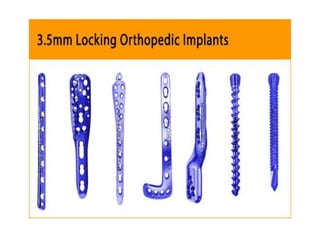
TYPES / EXAMPLES
Three main types
Nails/
Rods
Bone
plates
screws
ORTHOPAEDICSCREWS
• Most commonly used devices for bone fracture
fixation.
• Can be standalone fixators or in conjunction with
other orthopaedic hardware devices, particularly
plates.
• Retain stability of most screw-plate fixation
devices.
• Effect on the long term bone-screw interaction is
largely unknown.
• Supply necessary interfragmentary compression
ORTHOPAEDICSCREWSContd...
• Principle- Conversion of torque forces to
compression forces across a fracture.
• Disadvantages/ Failure
Screw loosening.
Bone loss.
BONEPLATES
• Also called tension band and is placed across
the fracture on the tension (or convex) side of
the bone.
• At this position converted into compressive
forces.
• Offer the benefits of anatomic reduction of
the fracture with open techniques.
• Stability for early function of muscle-tendon
units and joints.
BONE PLATESContd...
• Principle - Must be applied to the tension side of
the bone, so that the bone itself will receive the
compressive forces.
• Disadvantages/Failure
If applied to the compression (or concave) side of
the bone, it is very likely to bend, fatigue, and fail.
risk of bone refracture after their removal
osteoporosis beneath a plate
 plate irritation
 immunologic reaction (rare case)
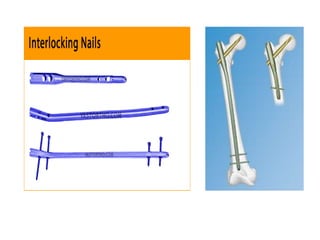
INTERLOCKINGNAILS(RODS)
• Medullary nail technique for fracture fixation.
• Longitudinally slotted tube that is inserted
into a long bone under pre-stress.
• Can be implanted through a small incision and
without considerable surgical exposure.
• Principle - The radial stress caused by the
insertion of nail leads to friction between nail
and bone that secures the relative movement
between the two nailed fragments.
INTERLOCKINGNAILS(RODS)Contd...
• Disadvantages/Failures
frictional forces are limited.
limited just to simple midshaft diaphyseal
fractures
damage to the medullary circulation
possibilities of embolism
complications from misapplication.
DENTAL IMPLANTS
• Metal posts or frames that are surgically positioned
into the jawbone beneath gums.
• Fuses, or integrates with natural bone.
• Artificial replacements for dental roots.
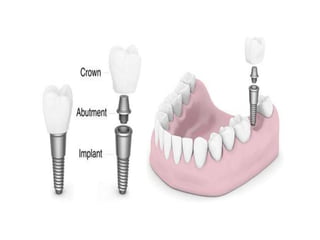
• Three components: the post( screw), abutment, and
restoration(crown).
• Osseointegration.
• Serve as a complete tooth replacement.
• Usually manufactured from titanium or titanium alloys.
Other materials are stainless steel, Co-Cr-Mb alloys,
ceramics, polymers such as PTFE.
REASONSOF USINGDENTALIMPLANTS
• Stop teeth from shifting into the empty space.
• Conserve jawbone.
• Implant-supported dentures prevent
complications.
• Preserve physical facial appearance.
CONDITIONSFOR USING DENTAL IMPLANTS
Dental implants may be used when a person-
• Has one or more missing teeth
• Has a jawbone that's reached full growth
• Has adequate bone to secure the implants or are
able to have a bone graft
• Has healthy oral tissues
• Doesn't have health conditions that will affect
bone healing
• Is unable or unwilling to wear dentures
• Want to improve speech
TYPESOF DENTAL IMPLANT
DISADVANTAGES/RISKS
• High cost.
• Time consuming process.
• Surgical and hence prone to complications and risks.
Risks include:
 Infection at the implant site
 Injury or damage to surrounding structures, such as
other teeth or blood vessels
 Nerve damage, which can cause pain, numbness or
tingling in natural teeth, gums, lips or chin
 Sinus problems.
DISADVANTAGES/RISKSContd...
• After the procedure risks include:
Swelling of your gums and face
Bruising of your skin and gums
Pain at the implant site
Minor bleeding
CONCLUSION
• Implantation is boon for restoration of damaged
body part.
• Implantation is improved and stable method
mainly serve as long term or even permanent
solution.
• In dental implants, problems are rare, though,
and when they do occur they're usually minor
and easily treated.
• Under ideal conditions, implants initiate the
desired host response.
REFERENCES
• www.implantodent.ro
• www.slideshare.net
• www.colgate.com
• www.mayoclinic.org
• www.researchgate.net
• www.orthobullets.com
• www.tjdentalcenter.com
• www.rxlist.com
• www.dynamicdentalinc.com
• www.dental.net
• www.zapmeta.ws
• en.wikipedia.org
THANK YOU

Implants (biomaterials)

  • 1.
    By : Shubhangisuri B.tech student Biotechnology SMVD University
  • 2.
    CONTENTS 1.What are implants. a.Characteristics of implants b. Interaction of implant and host c. Groups of implants based on application d. Two main categories of implants 2.Orthopaedic implants a. Materials used b. Types/examples c. Orthopaedic screws d. Bone plates e. Interlocking nails/rods 3.Dental implants a. Reasons of using b. Conditions c. Benefits d. Types e. Disadvantages /risks 4. Conclusion 5. References
  • 3.
    WHAT AREIMPLANTS • Athing inserted in the body, especially a piece of tissue, prosthetic device, or other object in the body. • Medical device manufactured to replace a missing biological structure, support a damaged biological structure, or enhance an existing biological structure . i.e. for therapeutic, diagnostic, experimental or prosthetic processes. • Implanted either partially or completely.
  • 4.
    CHARACTERISTICSOF IMPLANTS • Man-madedevices. • Biocompatible and Biosafe. • Different from transplant, which is a biomedical tissue. • Implants surface in contact with body might be made of a biomedical material such as titanium, silicone, or apatite depending on function. • Sometimes electronic, such as artificial pacemaker and cochlear implants. • Some are bioactive, such as subcutaneous drug delivery devices.
  • 5.
  • 6.
    GROUPSOF IMPLANTS BASEDONAPPLICATIONS • Sensory and neurological  Treatment - visual impairments, hearing loss issues, epilepsy, Parkinson's disease and treatment-resistant depression.  Examples - intraocular lens, cochlear implant, neurostimulator etc. • Cardiovascular  Treatment- heart failure, cardiac arrhythmia, valvular heart disease etc.  Examples - artificial heart, artificial heart valve, cardiac pacemaker, coronary stent etc. • Orthopaedic  Treatment- bone fractures, osteoarthritis, chronic pain etc.  Examples - pins, rods, screws, and plates.
  • 7.
    GROUPSOF IMPLANTSBASED ONAPPLICATIONS Contd.. •Contraception  Treatment- non-pathological forms of menorrhagia, prevent unintended pregnancy.  Examples – copper and hormone-based IUDs. • Cosmetic  Treatment- mastectomy, correcting disfigurement, buttock & chin augmentation.  Examples - the breast implant, nose prosthesis, ocular prosthesis etc. • Other organs and systems  Treatment-gastroesophageal reflux disease, respiratory failure, sleep apnoea, urinary and fecal incontinence, and erectile dysfunction. • Examples- implantable gastric stimulator, diaphragmatic/phrenic nerve stimulator, neurostimulator, penile prosthesis, plantable pills or drug- eluting stents.
  • 8.
  • 9.
    ORTHOPAEDICIMPLANTS • Medical devicemanufactured to either assist or replace damaged or troubled bones and joints. • Internal fixation - an operation that involves the surgical implementation of bone implants. • Characteristics depends on material properties and structural properties. • Key factor for bone healing is interfragmentary movement that determines- Tissue strain. Cellular reaction in the fracture healing zone.
  • 11.
    MATERIALS USED FORORTHOPAEDIC IMPLANTS • METALS Stainless steel, cobalt-chromium alloys, titanium alloys. • POLYMERS Ultrahigh molecular weight polyethylene (UHMWPE), and polymethyl methacrylate (PMMA). • Ductility and corrosion resistance are important factor taken care for fractures.
  • 12.
    TYPES / EXAMPLES Threemain types Nails/ Rods Bone plates screws
  • 13.
    ORTHOPAEDICSCREWS • Most commonlyused devices for bone fracture fixation. • Can be standalone fixators or in conjunction with other orthopaedic hardware devices, particularly plates. • Retain stability of most screw-plate fixation devices. • Effect on the long term bone-screw interaction is largely unknown. • Supply necessary interfragmentary compression
  • 15.
    ORTHOPAEDICSCREWSContd... • Principle- Conversionof torque forces to compression forces across a fracture. • Disadvantages/ Failure Screw loosening. Bone loss.
  • 16.
    BONEPLATES • Also calledtension band and is placed across the fracture on the tension (or convex) side of the bone. • At this position converted into compressive forces. • Offer the benefits of anatomic reduction of the fracture with open techniques. • Stability for early function of muscle-tendon units and joints.
  • 18.
    BONE PLATESContd... • Principle- Must be applied to the tension side of the bone, so that the bone itself will receive the compressive forces. • Disadvantages/Failure If applied to the compression (or concave) side of the bone, it is very likely to bend, fatigue, and fail. risk of bone refracture after their removal osteoporosis beneath a plate  plate irritation  immunologic reaction (rare case)
  • 20.
    INTERLOCKINGNAILS(RODS) • Medullary nailtechnique for fracture fixation. • Longitudinally slotted tube that is inserted into a long bone under pre-stress. • Can be implanted through a small incision and without considerable surgical exposure. • Principle - The radial stress caused by the insertion of nail leads to friction between nail and bone that secures the relative movement between the two nailed fragments.
  • 22.
    INTERLOCKINGNAILS(RODS)Contd... • Disadvantages/Failures frictional forcesare limited. limited just to simple midshaft diaphyseal fractures damage to the medullary circulation possibilities of embolism complications from misapplication.
  • 23.
    DENTAL IMPLANTS • Metalposts or frames that are surgically positioned into the jawbone beneath gums. • Fuses, or integrates with natural bone. • Artificial replacements for dental roots. • Three components: the post( screw), abutment, and restoration(crown). • Osseointegration. • Serve as a complete tooth replacement. • Usually manufactured from titanium or titanium alloys. Other materials are stainless steel, Co-Cr-Mb alloys, ceramics, polymers such as PTFE.
  • 25.
    REASONSOF USINGDENTALIMPLANTS • Stopteeth from shifting into the empty space. • Conserve jawbone. • Implant-supported dentures prevent complications. • Preserve physical facial appearance.
  • 27.
    CONDITIONSFOR USING DENTALIMPLANTS Dental implants may be used when a person- • Has one or more missing teeth • Has a jawbone that's reached full growth • Has adequate bone to secure the implants or are able to have a bone graft • Has healthy oral tissues • Doesn't have health conditions that will affect bone healing • Is unable or unwilling to wear dentures • Want to improve speech
  • 29.
  • 30.
    DISADVANTAGES/RISKS • High cost. •Time consuming process. • Surgical and hence prone to complications and risks. Risks include:  Infection at the implant site  Injury or damage to surrounding structures, such as other teeth or blood vessels  Nerve damage, which can cause pain, numbness or tingling in natural teeth, gums, lips or chin  Sinus problems.
  • 31.
    DISADVANTAGES/RISKSContd... • After theprocedure risks include: Swelling of your gums and face Bruising of your skin and gums Pain at the implant site Minor bleeding
  • 32.
    CONCLUSION • Implantation isboon for restoration of damaged body part. • Implantation is improved and stable method mainly serve as long term or even permanent solution. • In dental implants, problems are rare, though, and when they do occur they're usually minor and easily treated. • Under ideal conditions, implants initiate the desired host response.
  • 33.
    REFERENCES • www.implantodent.ro • www.slideshare.net •www.colgate.com • www.mayoclinic.org • www.researchgate.net • www.orthobullets.com • www.tjdentalcenter.com • www.rxlist.com • www.dynamicdentalinc.com • www.dental.net • www.zapmeta.ws • en.wikipedia.org
  • 34.