 VIABILITY OF “ALL ON 4” TECHNIQUE IN
MAXILLA & MANDIBLE WITH ATROPHIC
POSTERIOR BONE
Presented by: Guided By: Dr AJAZ AHMAD SHAH
 Dr Mohd Younis Prof and Head OMFS, GDC,
Srinagar
Co Guided By: Dr SHAHID
HASSAN
Assistant Prof. Department of OMFS
Co Guided By: Dr. Shujah Hussain
Consultant Department of OMFS
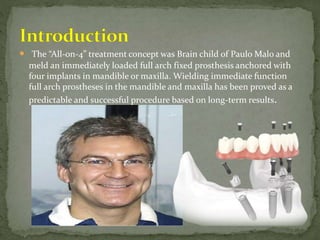
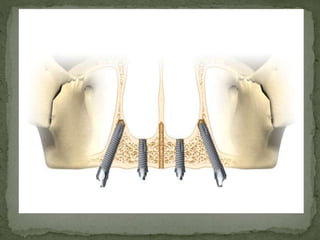
 The “All-on-4” treatment concept was Brain child of Paulo Malo and
meld an immediately loaded full arch fixed prosthesis anchored with
four implants in mandible or maxilla. Wielding immediate function
full arch prostheses in the mandible and maxilla has been proved as a
predictable and successful procedure based on long-term results.
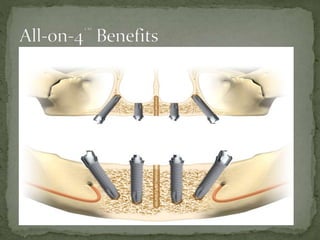
 The “All-on-4” concept utilises:
• Two tilted posterior implants.
• Two axially orientated implants in the anterior region
 implants conventionally have been placed axially, along the
long axis of the tooth to transmit forces axially down the
implant.
 In the completely edentulous jaw, more often there is
insufficient vertical bone height because of bone
resorption in the posterior regions.
 This can be due to bone resorption after extraction and the
immediacy of the inferior alveolar nerve in the mandible
and the maxillary sinus in the maxilla.
 Previously, there was a necessity for bone grafting to
augment the bone in posterior regions to build vertical
height for adequate implant length, adding notable
time and cost to the procedures.
Benefits of Angled posterior implants:
• Help avoid relevant anatomical structures and
can be anchored in better quality anterior bone
• Offer improved support of the prosthesis by
reducing cantilevers
• Reduce the need for bone grafting by
maximizing the use of available bone
Final restoration:
• Full-arch restoration with only 4 implants
• Fixed and removable final prosthetic solutions
Efficient Treatment Flow:
• Immediately loaded for shorter treatment times
and improved patient satisfaction
 Ethical clearance - Institutional review board of
Govt. Dental College, Srinagar.
 Informed/ Written consent will be obtained
 This study is proposed to include 10 patients with
complete edentulous arches visiting the department of
Oral & Maxillofacial Surgery “Govt. Dental College,
Srinagar.” And Hospital.
 Inclusion criteria:
 Need for complete rehabilitation of complete maxilla
or mandible or both
 ASA –I, ASA-II, ASA-III
 Sufficient bone for 4 implants atleast 10 mm in length
 Acceptable oral hygiene
 1. Previous history of head and neck irradiation
 2. Patient not willing to be part of study
 Surgical procedures will be performed under local anaesthesia
(2%lignocaine with 1:80,000 adrenaline). Antibiotics to be given 1
hour prior to.
 In edentulous arches, incisions will made on the alveolar crest, from
the first molar on the contralateral side with bilateral incisions.
 Periosteal reflection on lingual and buccal surfaces will carried out,
crestal shaving of bone will be carried out in cases of crestal
irregularities
 The most posterior implants are placed tilted distally at an angle
about 30 to 35 degrees relative to occlusal plane. The tilted implant
placement is assisted by a special guide.
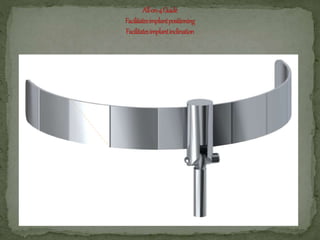
 The guide is placed into a 2 mm osteotomy made at the midline of
the jaw
 Implant insertion follows standard procedures. Usually the osseous
receptor sites are under prepared in order to obtain a torque of more
than 30 NCM for the final seating of the implant. The implant neck
will be positioned at bone level, with bicortical anchorage whenever
possible.
7 mm
7 mm
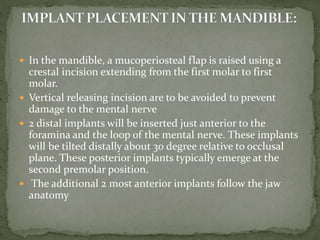
 In the mandible, a mucoperiosteal flap is raised using a
crestal incision extending from the first molar to first
molar.
 Vertical releasing incision are to be avoided to prevent
damage to the mental nerve
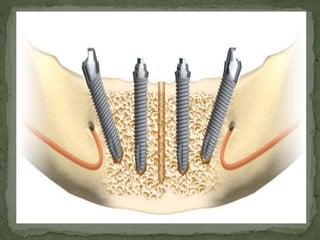
 2 distal implants will be inserted just anterior to the
foramina and the loop of the mental nerve. These implants
will be tilted distally about 30 degree relative to occlusal
plane. These posterior implants typically emerge at the
second premolar position.
 The additional 2 most anterior implants follow the jaw
anatomy
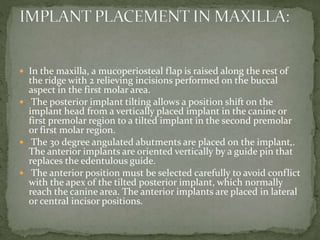
 In the maxilla, a mucoperiosteal flap is raised along the rest of
the ridge with 2 relieving incisions performed on the buccal
aspect in the first molar area.
 The posterior implant tilting allows a position shift on the
implant head from a vertically placed implant in the canine or
first premolar region to a tilted implant in the second premolar
or first molar region.
 The 30 degree angulated abutments are placed on the implant,.
The anterior implants are oriented vertically by a guide pin that
replaces the edentulous guide.
 The anterior position must be selected carefully to avoid conflict
with the apex of the tilted posterior implant, which normally
reach the canine area. The anterior implants are placed in lateral
or central incisor positions.
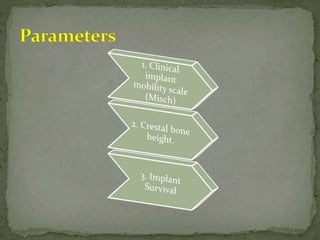
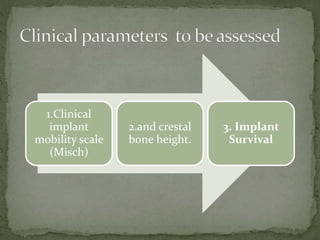
1.Clinical
implant
mobility scale
(Misch)
2.and crestal
bone height.
3. Implant
Survival
 1.Clinical implant mobility scale (Misch): The
Misch mobility scale will be used to assess implant
mobility by means of two rigid instruments.
 The scale is as follows:
 0 = absence of clinical mobility under a 500-g load in
any direction;
 1 = slight detectable horizontal movement;
 2 = moderate visible horizontal mobility up to 0.5 mm;
 3 = severe horizontal movement >0.5 mm;
 4 = visible moderate to severe horizontal and any
visible vertical movement.
 2. 2. Crestal bone height :The marginal bone levels,
to be evaluated on periapical or panoramic
radiographs, to be registered at the last follow-up visit
within the study time.
 3. Implant Survival
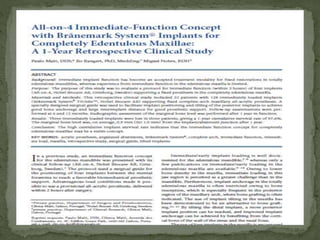
 Paulo Malo, Bo Rangert, Miguel Nobre; in 2003 conducted a clinical study
including 44 patients with 176 immediately loaded implants, placed in the
anterior region, supporting fixed complete – arch mandibular prosthesis in
acrylic. 5 immediately loaded implants failed in 5 patients before the 6th
month follow up, giving a cumulative survival rates of 96.7 and 98.2% for
development and routine groups. The prosthesis survival rate was 100% and the
average bone resorption was low.3

 Paulo Maló, Bo Rangert, Miguel Nobre, in 2005 described a study to evaluate a
protocol for immediate function (within 3 hours) of four implants(All-on-4,
Nobel Biocare AB, Göteborg, Sweden) supporting a fixed prosthesis in the
completely edentulous maxilla. retrospective clinical study included 32
patients with 128 immediately loaded implants supporting fixed complete-arch
maxillary all-acrylic prostheses. A specially designed surgical guide was used to
facilitate implant positioning and tilting of the posterior implants to achieve
good bone anchorage and large interimplant distance for good prosthetic
support. Follow-up examinations were performed at 6 and 12 months.
Radiographic assessment of the marginal bone level was performed after 1 year
in function. Three immediately loaded implants were lost in three
patients,giving a 1-year cumulative survival rate of 97.6%.The marginal bone
level was, on average, 0.9 mm (SD 1.0 mm) from the implant/abutment
junction after 1 year.4
 Paulo Maló, Miguel de AraújoNobre, Ulrika Petersson, StinaWigren, in
2006 described a study to retrospectively evaluate the clinical performance of a
novel implant design in the rehabilitation of completely edentulous jaws and in
combination with an immediate function protocol. Forty-six consecutive
patients received 189 study implants (NobelSpeedyTM concept implant, Nobel
Biocare AB, Göteborg, Sweden) supporting 53 full-arch all-acrylic prostheses
(44 maxilla, 9 mandible). The majority (66%) of the reconstructions were
supported by four implants, of which the two posterior implants were tilted.
All patients were followed for a minimum of 1 year. Radiographic assessment of
the marginal bone level was performed. Two implants were lost in two patients,
rendering a 1-year cumulative clinical survival rate of 98.9%. The marginal
bone level was, on average, situated 1.2 ± 0.7 mm below the implant-abutment
interface after 1 year of loading. Good soft tissue health and overall esthetic
outcome was reported.5
 Leonard Krekmanow, Mikael Kahn, Bo Rangret, Hakan
Lindstrom; in 2000 came up with a new technique of posterior
Implant Placement by angulating the maxillary posteriors to 30-35
degree, mandibular posteriors to 25-35 degree. 47 patients were treated
with tilted implants. They were followed for 40 months (mandible) and
53 months (maxilla). Paresthesias of the mental nerve was observed on
4 sides during first 2-3 weeks after implant placement.
 This new technique had benefits of decreased Mental nerve
paresthesis.6
 Patrick. K. Chu; in 2010 described a case report where he has placed “All-on-
4” system of Implants in a 65 year old male patient partially edentulous in both
maxilla and mandible with advanced periodontitis and excessive mobility of
the remaining teeth. Dentures were pre made and holes were drilled according
to the surgical guide and were immediately given just after the treatment.7
 1. Maló P, Rangert B, Nobre M. “All‐on‐Four” immediate‐function concept with
Brånemark System® implants for completely edentulous mandibles:
aretrospective clinical study. CLIN IMPLANT DENT R. 2003 Mar;5:2-9
 2. Maló P, Rangert B, Nobre M. All‐on‐4 immediate‐function concept with
Brånemark System® implants for completely edentulous maxillae: a 1‐year
retrospective clinical study. CLIN IMPLANT DENT R. 2005 Jun;7:s88-94.
 3. Maló P, De AraújoNobre M, Petersson U, Wigren S. A pilot study of complete
edentulous rehabilitation with immediate function using a new implant
design: case series. CLIN IMPLANT DENT R. 2006 Dec;8(4):223-32.
 4. Leonard Krekmanov DS, Kahn M, Rangert B, Eng M, Lindström H. Tilting of
posterior mandibular and maxillary implants for improved prosthesis support.
Int J Oral Maxillofac Implants. 2000 May;15(3).
 5. Patrick.K.Chu. A case study: The All- on- 4 Treatment Concept
usingBiohorizons Tapered Internal Implants. Clin Oral Implants Res. Fall 2010;
Vol1 No 3.
ALL ON 4.pptx
ALL ON 4.pptx

ALL ON 4.pptx

  • 1.
     VIABILITY OF“ALL ON 4” TECHNIQUE IN MAXILLA & MANDIBLE WITH ATROPHIC POSTERIOR BONE Presented by: Guided By: Dr AJAZ AHMAD SHAH  Dr Mohd Younis Prof and Head OMFS, GDC, Srinagar Co Guided By: Dr SHAHID HASSAN Assistant Prof. Department of OMFS Co Guided By: Dr. Shujah Hussain Consultant Department of OMFS
  • 2.
     The “All-on-4”treatment concept was Brain child of Paulo Malo and meld an immediately loaded full arch fixed prosthesis anchored with four implants in mandible or maxilla. Wielding immediate function full arch prostheses in the mandible and maxilla has been proved as a predictable and successful procedure based on long-term results.
  • 3.
     The “All-on-4”concept utilises: • Two tilted posterior implants. • Two axially orientated implants in the anterior region  implants conventionally have been placed axially, along the long axis of the tooth to transmit forces axially down the implant.  In the completely edentulous jaw, more often there is insufficient vertical bone height because of bone resorption in the posterior regions.  This can be due to bone resorption after extraction and the immediacy of the inferior alveolar nerve in the mandible and the maxillary sinus in the maxilla.
  • 4.
     Previously, therewas a necessity for bone grafting to augment the bone in posterior regions to build vertical height for adequate implant length, adding notable time and cost to the procedures.
  • 6.
    Benefits of Angledposterior implants: • Help avoid relevant anatomical structures and can be anchored in better quality anterior bone • Offer improved support of the prosthesis by reducing cantilevers • Reduce the need for bone grafting by maximizing the use of available bone Final restoration: • Full-arch restoration with only 4 implants • Fixed and removable final prosthetic solutions Efficient Treatment Flow: • Immediately loaded for shorter treatment times and improved patient satisfaction
  • 9.
     Ethical clearance- Institutional review board of Govt. Dental College, Srinagar.  Informed/ Written consent will be obtained
  • 10.
     This studyis proposed to include 10 patients with complete edentulous arches visiting the department of Oral & Maxillofacial Surgery “Govt. Dental College, Srinagar.” And Hospital.
  • 11.
     Inclusion criteria: Need for complete rehabilitation of complete maxilla or mandible or both  ASA –I, ASA-II, ASA-III  Sufficient bone for 4 implants atleast 10 mm in length  Acceptable oral hygiene
  • 12.
     1. Previoushistory of head and neck irradiation  2. Patient not willing to be part of study
  • 14.
     Surgical procedureswill be performed under local anaesthesia (2%lignocaine with 1:80,000 adrenaline). Antibiotics to be given 1 hour prior to.  In edentulous arches, incisions will made on the alveolar crest, from the first molar on the contralateral side with bilateral incisions.  Periosteal reflection on lingual and buccal surfaces will carried out, crestal shaving of bone will be carried out in cases of crestal irregularities  The most posterior implants are placed tilted distally at an angle about 30 to 35 degrees relative to occlusal plane. The tilted implant placement is assisted by a special guide.  The guide is placed into a 2 mm osteotomy made at the midline of the jaw  Implant insertion follows standard procedures. Usually the osseous receptor sites are under prepared in order to obtain a torque of more than 30 NCM for the final seating of the implant. The implant neck will be positioned at bone level, with bicortical anchorage whenever possible.
  • 15.
  • 16.
     In themandible, a mucoperiosteal flap is raised using a crestal incision extending from the first molar to first molar.  Vertical releasing incision are to be avoided to prevent damage to the mental nerve  2 distal implants will be inserted just anterior to the foramina and the loop of the mental nerve. These implants will be tilted distally about 30 degree relative to occlusal plane. These posterior implants typically emerge at the second premolar position.  The additional 2 most anterior implants follow the jaw anatomy
  • 18.
     In themaxilla, a mucoperiosteal flap is raised along the rest of the ridge with 2 relieving incisions performed on the buccal aspect in the first molar area.  The posterior implant tilting allows a position shift on the implant head from a vertically placed implant in the canine or first premolar region to a tilted implant in the second premolar or first molar region.  The 30 degree angulated abutments are placed on the implant,. The anterior implants are oriented vertically by a guide pin that replaces the edentulous guide.  The anterior position must be selected carefully to avoid conflict with the apex of the tilted posterior implant, which normally reach the canine area. The anterior implants are placed in lateral or central incisor positions.
  • 20.
  • 21.
     1.Clinical implantmobility scale (Misch): The Misch mobility scale will be used to assess implant mobility by means of two rigid instruments.  The scale is as follows:  0 = absence of clinical mobility under a 500-g load in any direction;  1 = slight detectable horizontal movement;  2 = moderate visible horizontal mobility up to 0.5 mm;  3 = severe horizontal movement >0.5 mm;  4 = visible moderate to severe horizontal and any visible vertical movement.
  • 22.
     2. 2.Crestal bone height :The marginal bone levels, to be evaluated on periapical or panoramic radiographs, to be registered at the last follow-up visit within the study time.  3. Implant Survival
  • 23.
     Paulo Malo,Bo Rangert, Miguel Nobre; in 2003 conducted a clinical study including 44 patients with 176 immediately loaded implants, placed in the anterior region, supporting fixed complete – arch mandibular prosthesis in acrylic. 5 immediately loaded implants failed in 5 patients before the 6th month follow up, giving a cumulative survival rates of 96.7 and 98.2% for development and routine groups. The prosthesis survival rate was 100% and the average bone resorption was low.3   Paulo Maló, Bo Rangert, Miguel Nobre, in 2005 described a study to evaluate a protocol for immediate function (within 3 hours) of four implants(All-on-4, Nobel Biocare AB, Göteborg, Sweden) supporting a fixed prosthesis in the completely edentulous maxilla. retrospective clinical study included 32 patients with 128 immediately loaded implants supporting fixed complete-arch maxillary all-acrylic prostheses. A specially designed surgical guide was used to facilitate implant positioning and tilting of the posterior implants to achieve good bone anchorage and large interimplant distance for good prosthetic support. Follow-up examinations were performed at 6 and 12 months. Radiographic assessment of the marginal bone level was performed after 1 year in function. Three immediately loaded implants were lost in three patients,giving a 1-year cumulative survival rate of 97.6%.The marginal bone level was, on average, 0.9 mm (SD 1.0 mm) from the implant/abutment junction after 1 year.4
  • 24.
     Paulo Maló,Miguel de AraújoNobre, Ulrika Petersson, StinaWigren, in 2006 described a study to retrospectively evaluate the clinical performance of a novel implant design in the rehabilitation of completely edentulous jaws and in combination with an immediate function protocol. Forty-six consecutive patients received 189 study implants (NobelSpeedyTM concept implant, Nobel Biocare AB, Göteborg, Sweden) supporting 53 full-arch all-acrylic prostheses (44 maxilla, 9 mandible). The majority (66%) of the reconstructions were supported by four implants, of which the two posterior implants were tilted. All patients were followed for a minimum of 1 year. Radiographic assessment of the marginal bone level was performed. Two implants were lost in two patients, rendering a 1-year cumulative clinical survival rate of 98.9%. The marginal bone level was, on average, situated 1.2 ± 0.7 mm below the implant-abutment interface after 1 year of loading. Good soft tissue health and overall esthetic outcome was reported.5
  • 25.
     Leonard Krekmanow,Mikael Kahn, Bo Rangret, Hakan Lindstrom; in 2000 came up with a new technique of posterior Implant Placement by angulating the maxillary posteriors to 30-35 degree, mandibular posteriors to 25-35 degree. 47 patients were treated with tilted implants. They were followed for 40 months (mandible) and 53 months (maxilla). Paresthesias of the mental nerve was observed on 4 sides during first 2-3 weeks after implant placement.  This new technique had benefits of decreased Mental nerve paresthesis.6  Patrick. K. Chu; in 2010 described a case report where he has placed “All-on- 4” system of Implants in a 65 year old male patient partially edentulous in both maxilla and mandible with advanced periodontitis and excessive mobility of the remaining teeth. Dentures were pre made and holes were drilled according to the surgical guide and were immediately given just after the treatment.7
  • 26.
     1. MalóP, Rangert B, Nobre M. “All‐on‐Four” immediate‐function concept with Brånemark System® implants for completely edentulous mandibles: aretrospective clinical study. CLIN IMPLANT DENT R. 2003 Mar;5:2-9  2. Maló P, Rangert B, Nobre M. All‐on‐4 immediate‐function concept with Brånemark System® implants for completely edentulous maxillae: a 1‐year retrospective clinical study. CLIN IMPLANT DENT R. 2005 Jun;7:s88-94.  3. Maló P, De AraújoNobre M, Petersson U, Wigren S. A pilot study of complete edentulous rehabilitation with immediate function using a new implant design: case series. CLIN IMPLANT DENT R. 2006 Dec;8(4):223-32.  4. Leonard Krekmanov DS, Kahn M, Rangert B, Eng M, Lindström H. Tilting of posterior mandibular and maxillary implants for improved prosthesis support. Int J Oral Maxillofac Implants. 2000 May;15(3).  5. Patrick.K.Chu. A case study: The All- on- 4 Treatment Concept usingBiohorizons Tapered Internal Implants. Clin Oral Implants Res. Fall 2010; Vol1 No 3.