MOC, Quality of Care and
Your EMR
Donna M. D’Alessandro, M.D., FAAP
Professor of Pediatrics
University of Iowa
Available at Slide Share
Please sit at
table that is the
closest to QI
project you are
doing or thinking
about doing
Disclosures and Disclaimers
 “I have no relevant financial relationships with the
manufacturer(s) of any commercial product(s) and/or
provider(s) of commercial services discussed in this CME
activity.”
 I know a little bit about each– so before you do
something, please recheck with the appropriate group
to make sure doing the activity will get you what you
want/need
Overview
 Mini Lecture
 MOC
 EMR
 QI
 Start Planning your Project
 Write an AIMS statement
 Write a measure
 Process flow for ideas
 Handouts
 Quality Improvement Project Planner
 Resources
 URL for Handout
Objectives
 Learn about MOC and EMRs and how they can be used to develop quality
improvement programs
 I hope to show you that
 MOC – can be integrated into maintaining your professional competency
 EMRs – are continually advancing tools for us to use in our practice
 QI – is a continuous process to improve the care you provide
 Together they form a stalwart trio to help us provide the best care
possible so “Every Child, Gets the Right Care Every time” - AAP
Alphabet Soup
 ABP – American Board of Pediatrics, “The Board”
 AAP – American Academy of Pediatrics, “The Academy”
 CME – Continuing Medical Education
 CMS – Center for Medicare and Medicaid Services
 MOC – Maintenance of Certification
 QI – Quality Improvement
 EMR/EHR – Electronic Medical Records or Electronic Health Records
 MU – Meaningful Use
Maintenance of Certification (MOC)
 What is MOC?
 Program of activities to “maintain” professional
competency
 There is no expiration date as long as the physician is
enrolled in the program
 ABP is requiring MOC to maintain board certification
 Potentially state boards, hospitals and insurance companies could
require board certification, therefore indirectly requiring MOC
Basic Plan of MOC
 4 parts like Puzzle Pieces, not chronologically ordered
 Part 1 Professional Standing and Licensure: unrestricted license
to practice
 Part 2 Life-long Learning Self Assessment: participating in
knowledge self assessment tools
 Part 3 Cognitive Expertise: passing a secure examination
 Part 4 Performance in Practice: participating in quality
improvement projects
Basic Plan of MOC
 5-year cycle with 100 points for activities
 40 points each Part 2 and Part 4
 20 points either Part 2 or Part 4
 Part 3 – one test every 10 years (every 2 cycles)
Actually Doing MOC
 Check the ABP website to see your personal requirements –
www.abp.org
 If you don’t understand contact the ABP
 Website has lists of activities that qualify for each part
 All activities
 Have a expiration date
 Have a different MOC point value
 May be free or have an additional cost in addition to the ABP’s MOC
fee
 May or may not award CME
Part 4 Pathways- Join Other Groups
 Project sponsor
 Originates and manages a single activity
 Ex: Insurance company, organization
 Portfolio sponsors
 Originate and manage multiple activities or projects
 Ex. AAP, Institutions
 Important – the sponsor applies to the ABP for the MOC and attests
to your fulfillment of the MOC requirements
 AAP offers projects through their portfolio
 QuINN Network (Quality Improvement and Innovations Network)
 Chapter Quality Network
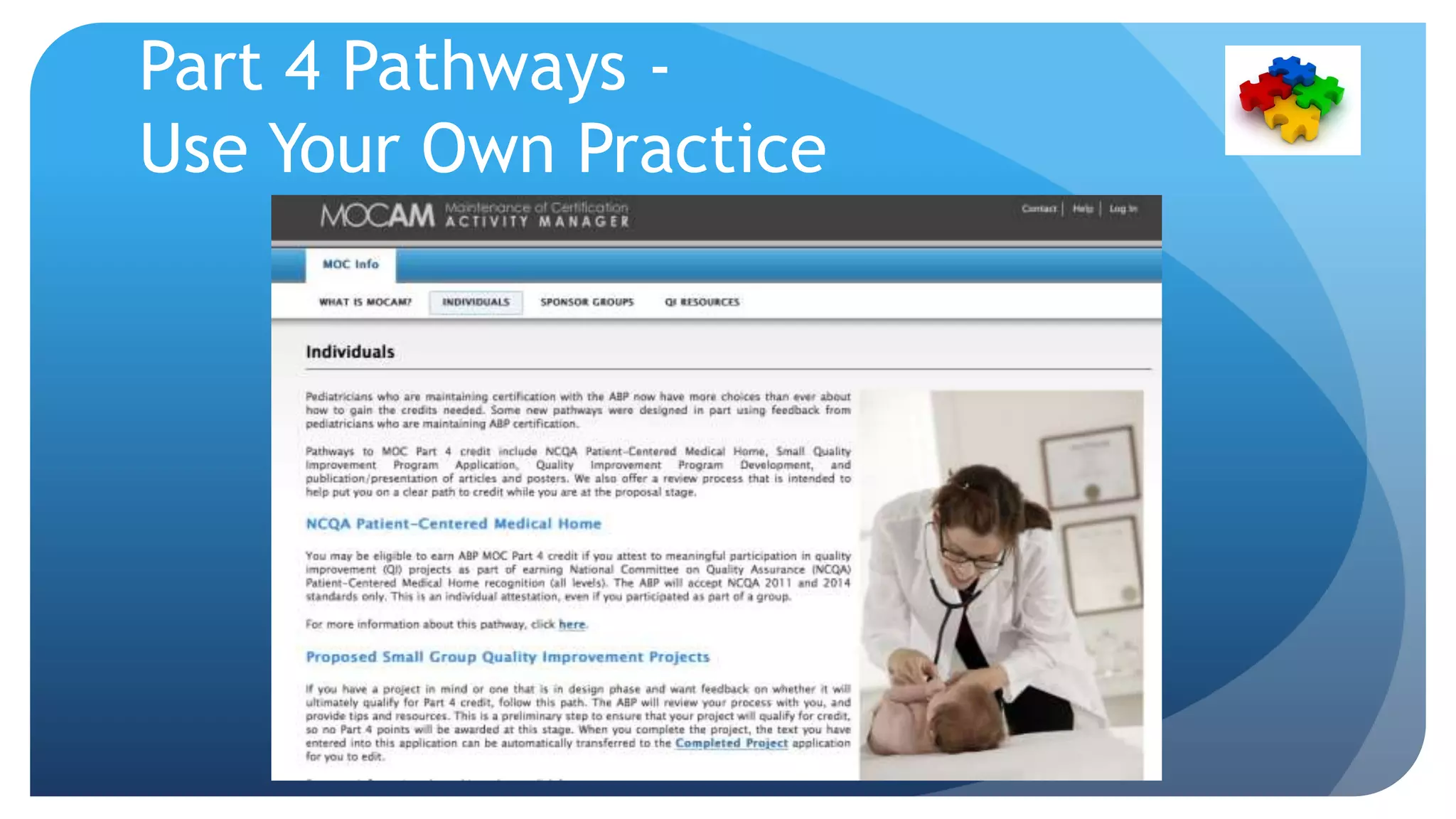
Part 4 Pathways -
Use Your Own Practice
 National Center on Quality Assurance Patient Centered Medical Home
projects
 It is considered an individual activity even if you participated as a group
(40 MOC points, $0)
 Proposed Small Group QI Projects (1-10 physicians, 0 MOC points, $0
for group)
 ABP will review the process, provide tips and resources. This helps to
ensure that your finished project will qualify for credit, but it is NOT the
actual application for MOC credit.
 Completed Small Group QI Projects – finished projects apply for credit
(1-10 physicians, 25 MOC points, $75 for entire group)
 Important – you must apply to the ABP directly and attest that you have
fulfilled the MOC requirements
Part 4 Pathways -
Use Your Own Practice
Part 4 Pathways - Other
 QI Program Development – you are a
leader of QI projects at an institution or
organization (40 MOC points, $150)
 QI Posters or Platform presentations at
national scientific meetings (20 MOC points, $75)
 QI Articles – for authors (25 MOC points, $75)
Electronic Medical Records (EMRs)
 Computers that store health information that then
health care personnel (and patient/family) can access
and utilize to provide care, and hopefully improve
health
EMRs are Not New
 Depending on how you want to define an EMR, first ones go back to late 60s or
earlier
 EMRs have improved documentation and availability = improved communication
 Holy grail is integration – getting computers to talk to each other – still have
problems but better tools and policies continue to improve integration
 Policies and standards are set by CMS for :
 “Certified” EHRs
 For “meaningful use” of the EHRs
 Reporting quality measures
 Create an incentive system for providers to acquire, use and report using EHRs
Meaningful Use (MU)
 Goal: to promote the spread of EMRs to improve health
care in the US, Improve quality, safety, efficiency, and
reduce health disparities
 Engage patients and families
 Improve care coordination, and population and public
health
 Maintain privacy and security of patient health information
MU
 Has criteria that defines
 Eligible professionals
 Eligible hospitals
 MU was developed as a progressive, staged program:
 Stage 1: Data Capturing and Sharing (began 2011)
 Stage 2: Advance Clinical Processes (began 2014)
 Stage 3: Improved Health Outcomes (begins 2018)
MU Stage 2
 Must use a certified EMR-
certified using specific
standards
 Standardizes reporting time
periods – basically continuous
90 day period during the
calendar year
 Reporting times – 1 year
 Report on 1 set of objectives
 Protect Patient Health
Information
 Clinical Decision Support
 Computerized Provider Order
Entry
 Electronic Prescribing
 Health Information Exchange
 Patient Specific Education
 Medication Reconciliation
 Patient Electronic Access
 Secure Electronic Messaging
 Public Health Reporting (EPs only)
 CMS regulations - https://www.cms.gov/Regulations-and-
Guidance/Legislation/EHRIncentivePrograms/Downloads/2015_NeedtoKnowEP.pdf
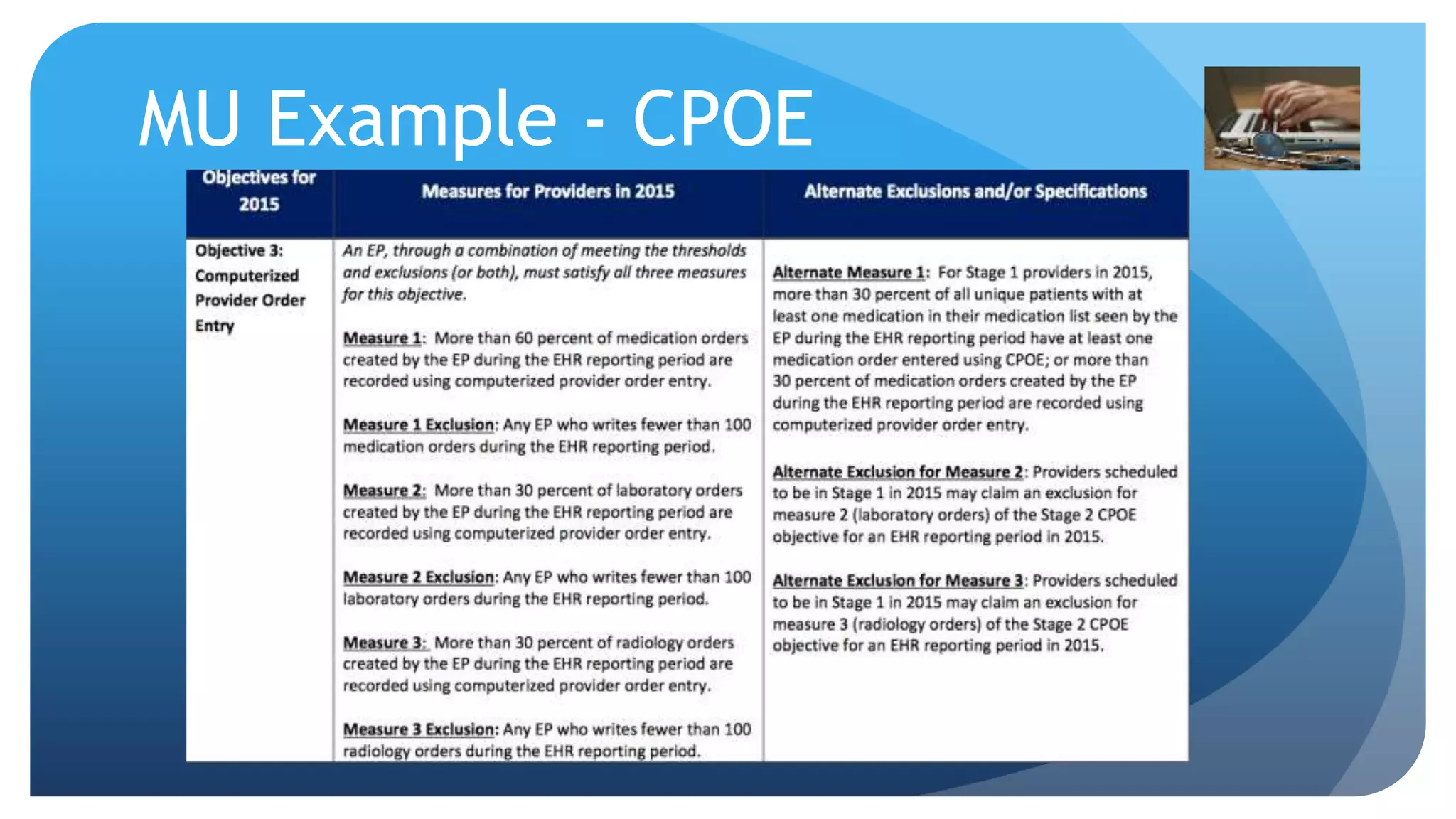
MU Example - CPOE
MU Example – Secure Messaging
 Secure Electronic Messaging
Quality Improvement (QI)
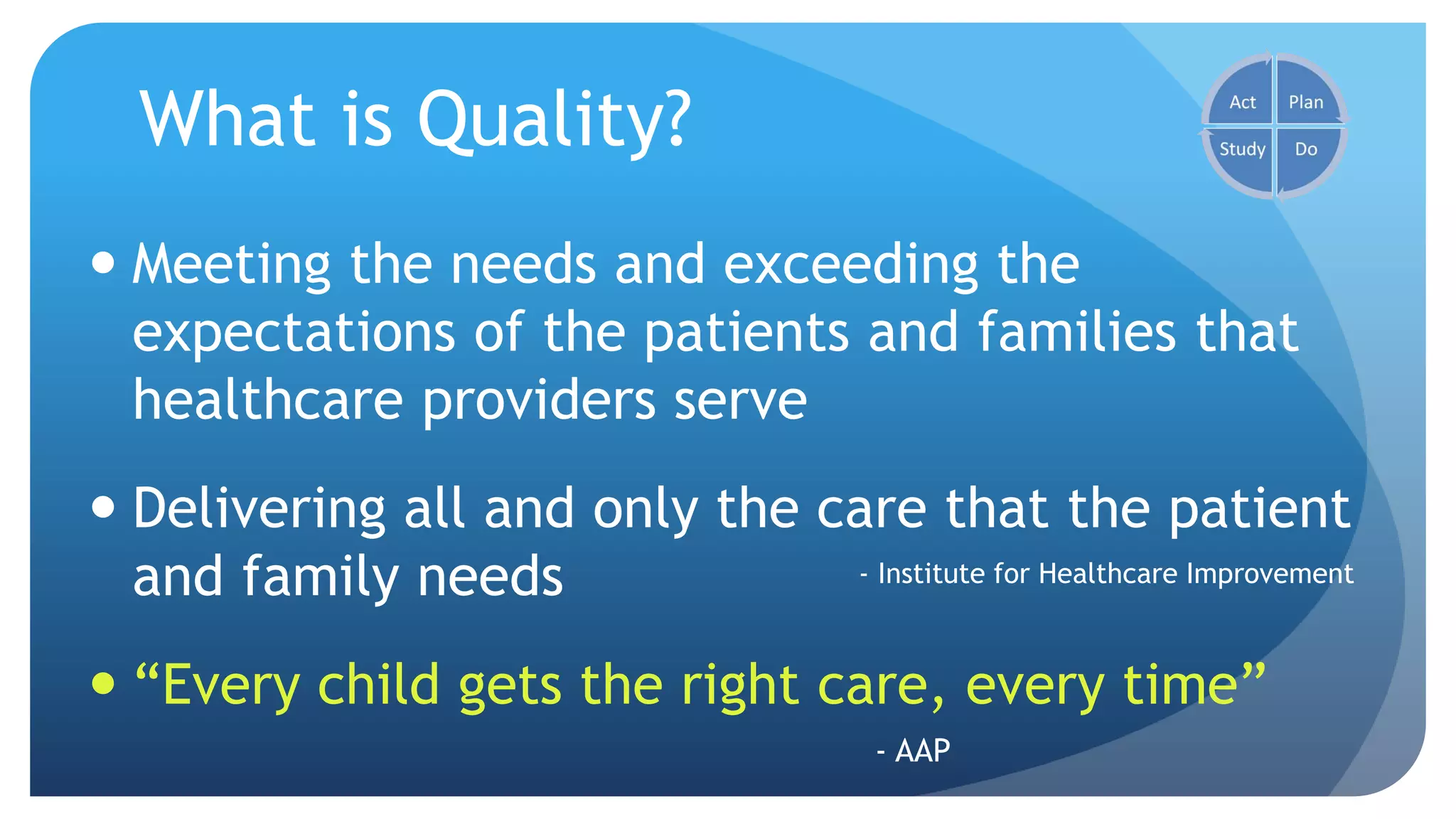
What is Quality?
 Meeting the needs and exceeding the
expectations of the patients and families that
healthcare providers serve
 Delivering all and only the care that the patient
and family needs
 “Every child gets the right care, every time”
- Institute for Healthcare Improvement
- AAP
Improving Quality
 Requires change – every system is designed
perfectly to achieve exactly the results its gets
 Needs to be kept simple
 If you don’t, you destroy productivity and
unintended consequences results in too big a
disruption
Delivering Care and Making Changes
Structure
Processes
and People* Outcomes of Care
Inputs Steps Outputs
•Patients
•Equipment
•Supplies
•Environment
•Training
•Physician orders
•Nursing care
•Ancillary staff
•Coordination
•Business practice
•Physiologic
parameters
•Functional status
•Satisfaction
•Cost
*Has the greatest chance to improve care,
also the closest to the care - Modified from Institute for
Healthcare Improvement
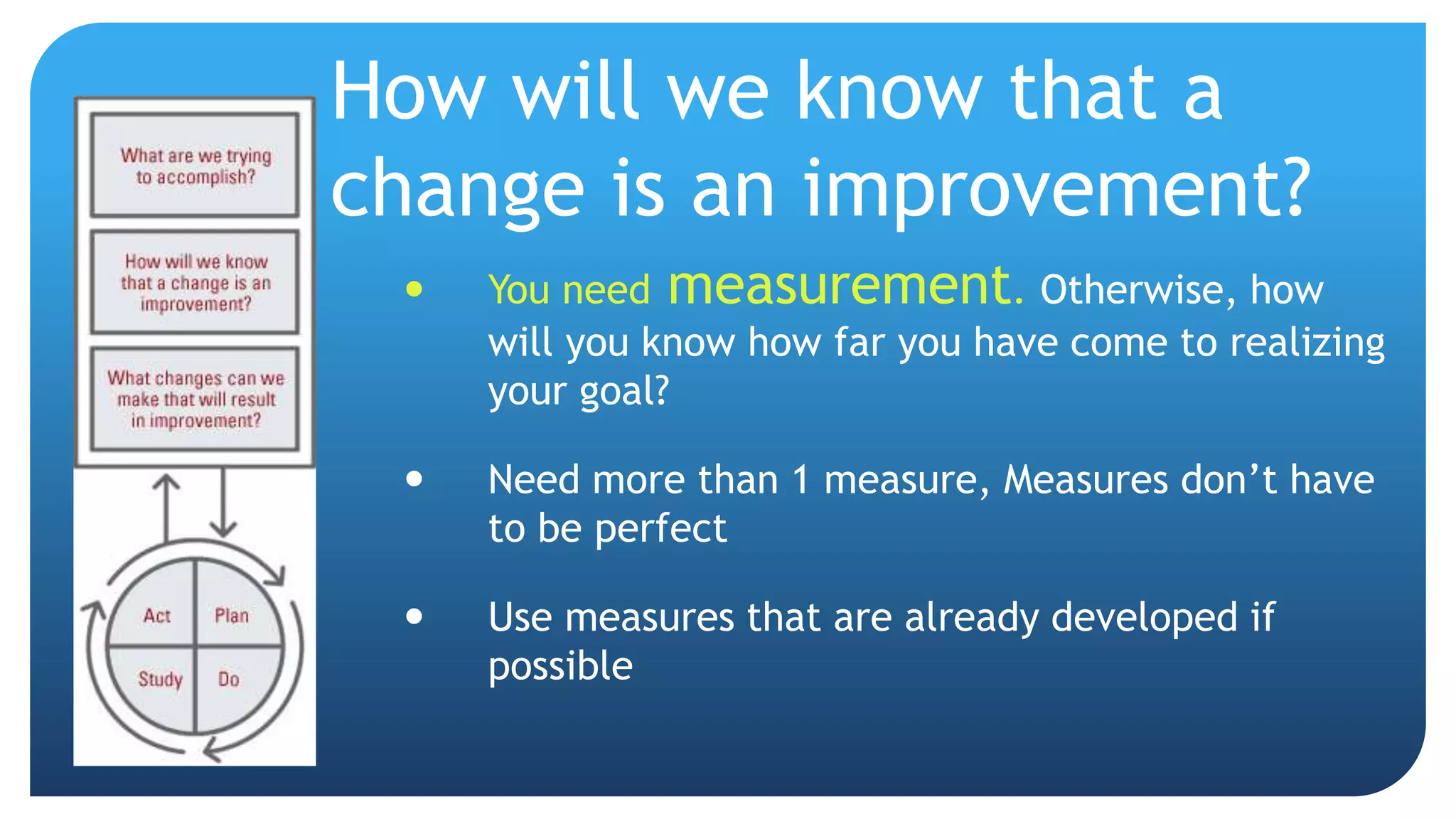
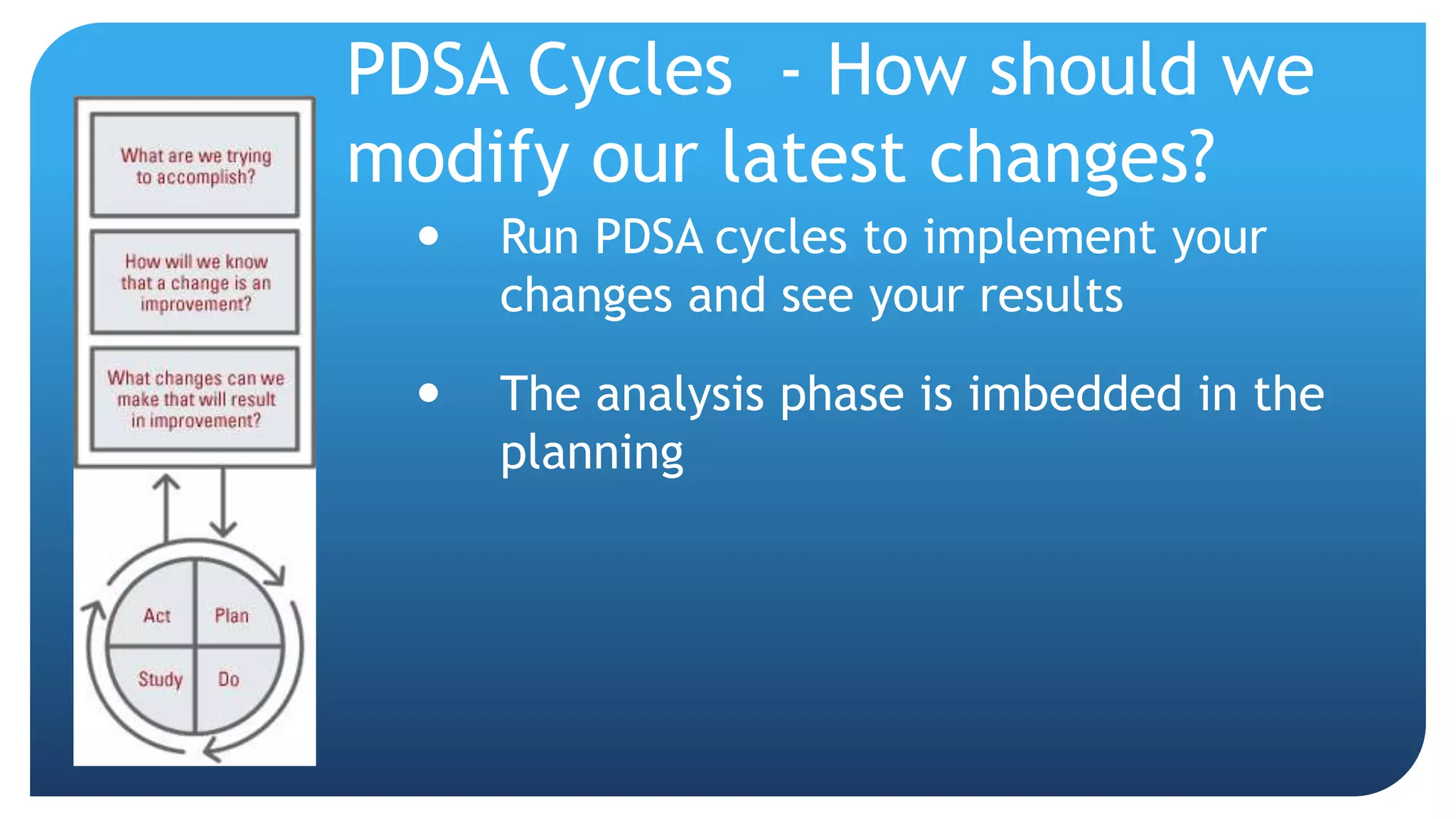
What are we trying to accomplish? (AIM)
How will we know that a change is an
improvement? (Measurement)
What changes will we make that will results in
an improvement? (Ideas)
Plan: How should we modify our latest changes?
- Institute for Healthcare Improvement
Planning Steps for the Change
What Are We Trying to
Accomplish?
 Need an AIM statement that is SMART
 Specific
 Measureable
 Achievable
 Relevant and reliable
 Time limited
 Example: “Increase the screening rates for
dental caries in 5-year olds within 6 months”
 May have more than 1 goal, so discuss options
with the team and chose one goal to work on
 Nee
How will we know that a
change is an improvement?
 You need measurement. Otherwise, how
will you know how far you have come to realizing
your goal?
 Need more than 1 measure, Measures don’t have
to be perfect
 Use measures that are already developed if
possible
How will we know that a
change is an improvement?
How will we know that a
change is an improvement?
 Select changes that are the most likely to improve
outcomes
 Recognize that not all changes improve outcomes –
“Just because you can, doesn’t mean you should”
and conversely, “Just because you think you can’t,
doesn’t mean you shouldn’t try.”
 Example: “Changing the EMR to include discrete
structured data to improve reporting”
How will we know that a
change is an improvement?
 You will need to
 Pilot test – determine your baseline
 Collect data
 Evaluate the data and compare it– overtime, to
benchmarks, to end aim
 Evaluate regularly not just at the end
Measurement– Run Charts
- Minnesota Department of Health
PDSA Cycles - How should we
modify our latest changes?
 Run PDSA cycles to implement your
changes and see your results
 The analysis phase is imbedded in the
planning
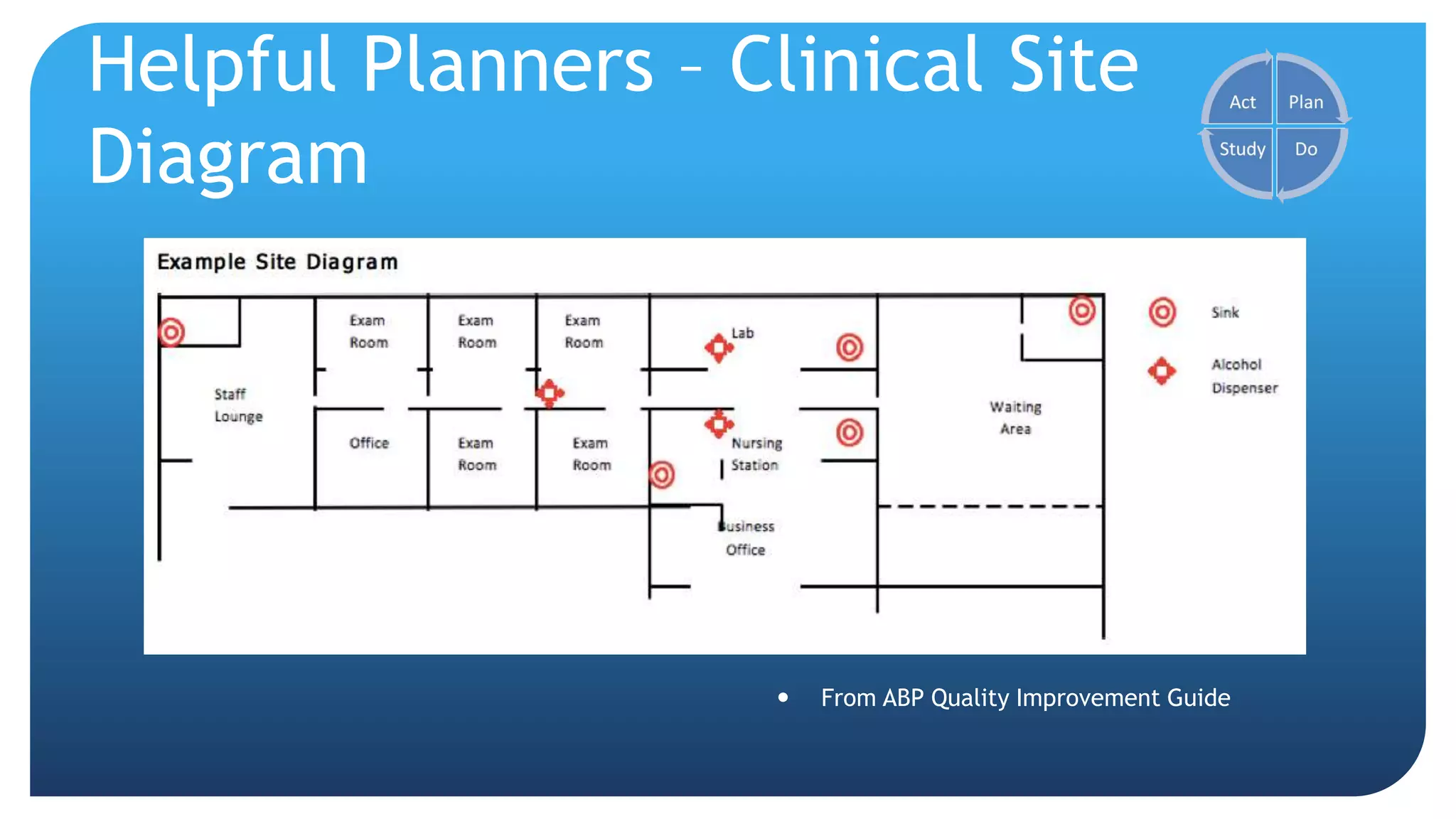
Helpful Planners – Clinical Site
Diagram
 From ABP Quality Improvement Guide
Helpful Planners – Key Drivers
 From ABP Quality Improvement Guide
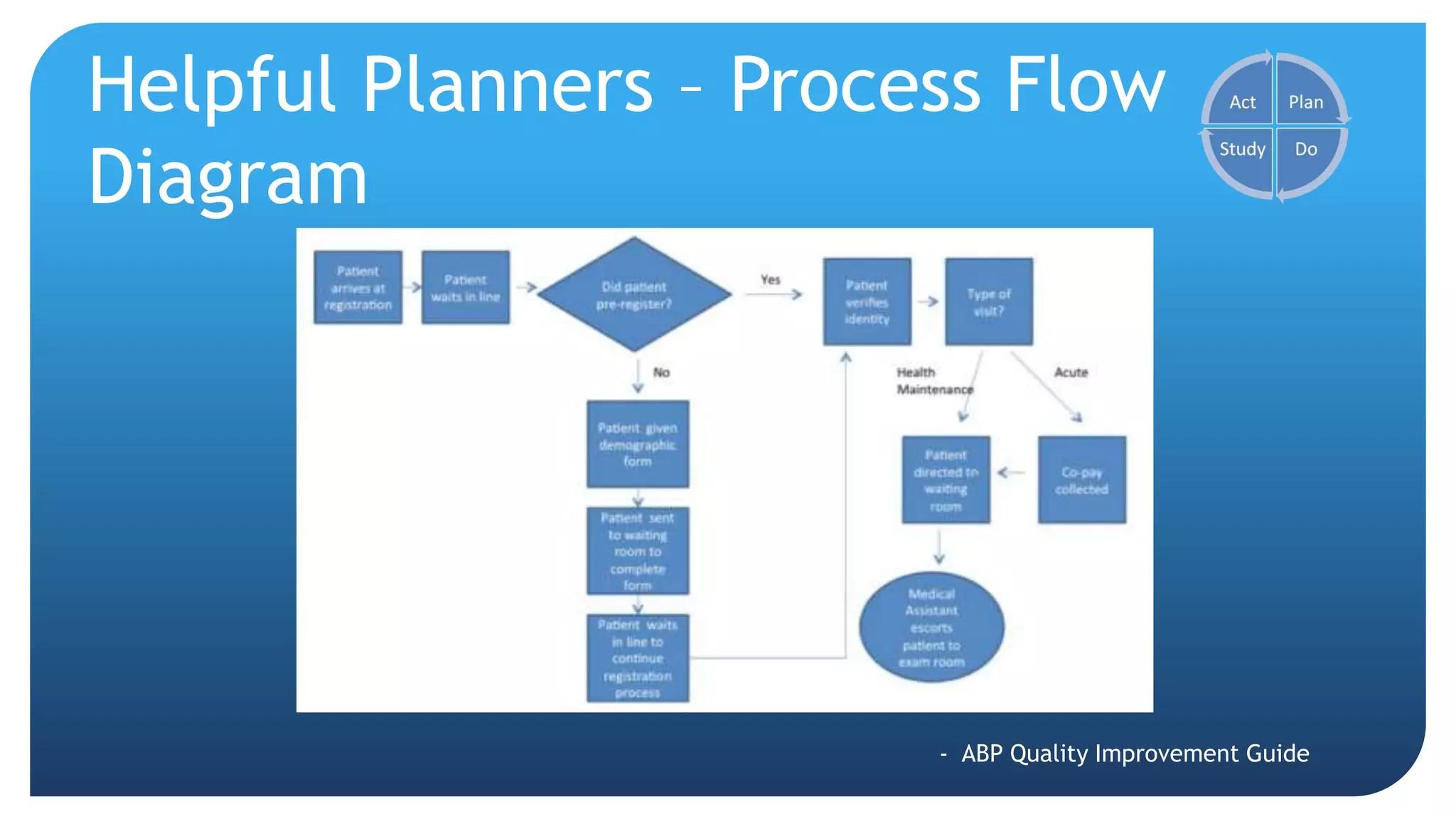
Helpful Planners – Process Flow
Diagram
 -From AB
- ABP Quality Improvement Guide
End of Part 1 – Mini Lecture
Any Questions?
Part 2. Planning Your Project
 Quality Improvement Project Planner- Introduction
 Write an AIM Statement
 Write a Measure
 Process Flow
 URL for Project Planner
Quality Improvement Project
Planner
 URL for Project Planner
 “It’s long”
 Yes it is long – but hopefully all or most of the important questions
will be there to think about, discuss and make thoughtful decisions
about so the project runs well
 “Do I really have to do fill out it out or have to fill out everything?”
 Of course not, but you might want to so you have record of the
decisions you made and why
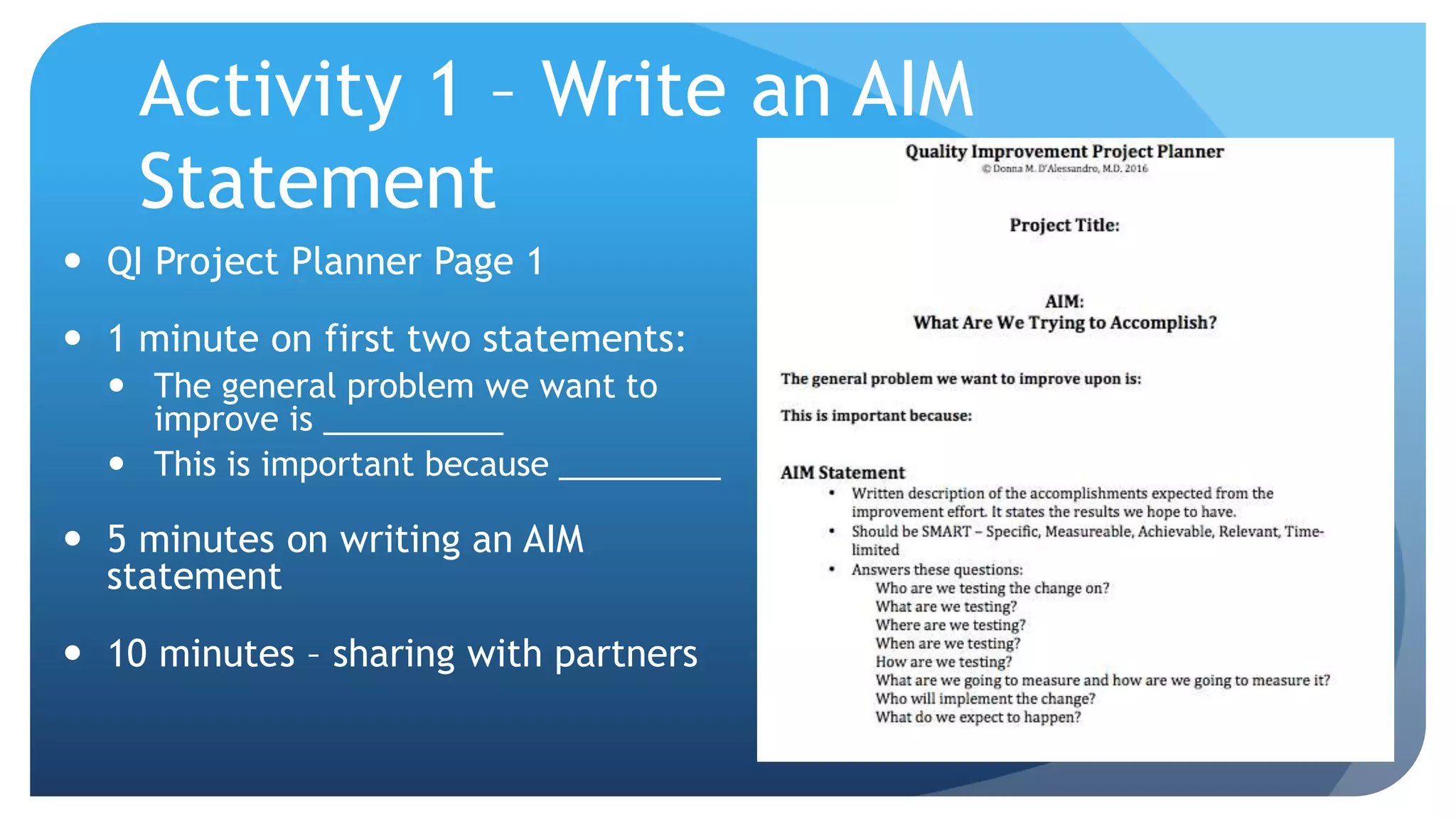
Activity 1 – Write an AIM
Statement
 QI Project Planner Page 1
 1 minute on first two statements:
 The general problem we want to
improve is __________
 This is important because _________
 5 minutes on writing an AIM
statement
 10 minutes – sharing with partners
AIM Statement Iteration
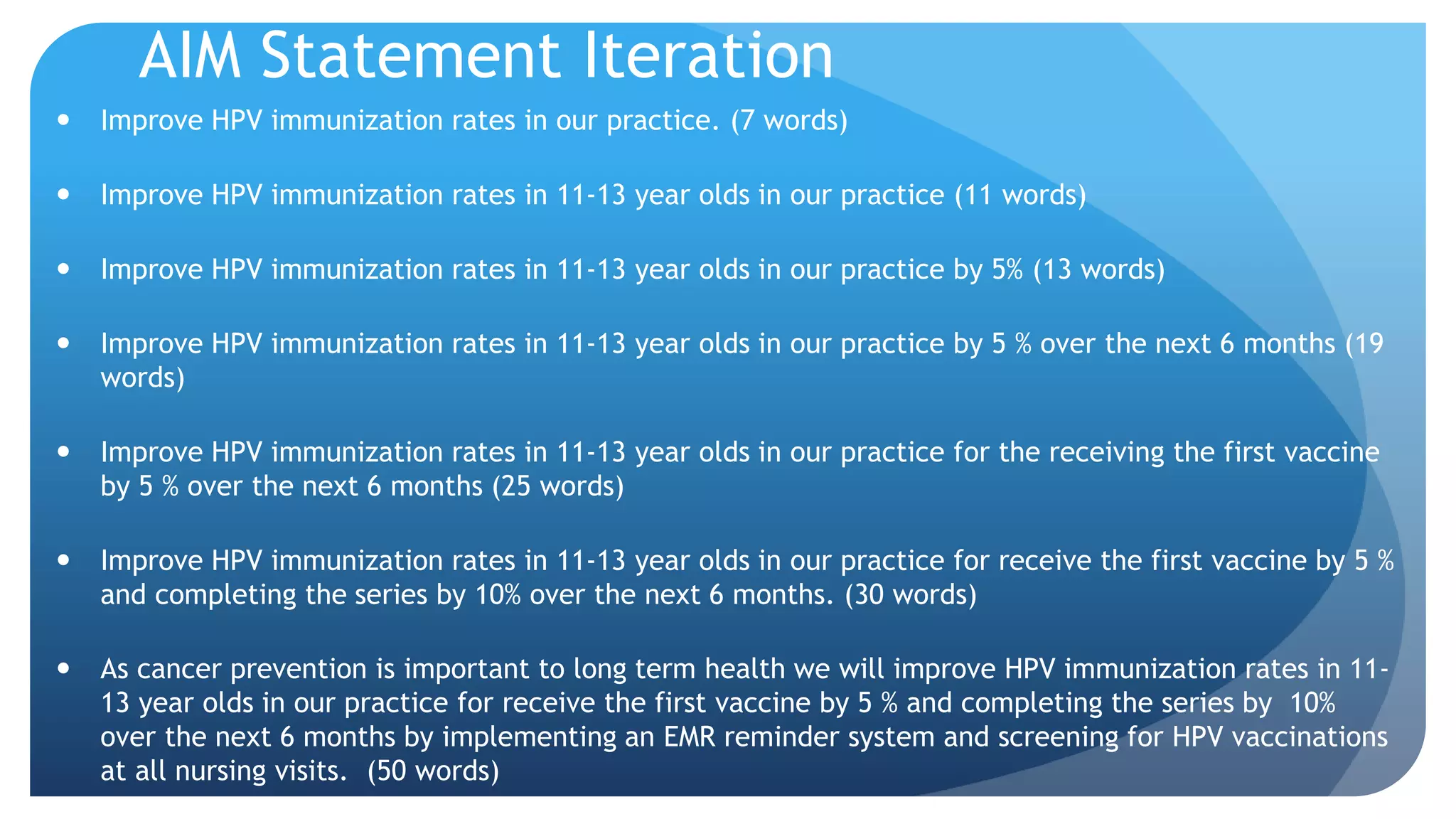
 Improve HPV immunization rates in our practice. (7 words)
 Improve HPV immunization rates in 11-13 year olds in our practice (11 words)
 Improve HPV immunization rates in 11-13 year olds in our practice by 5% (13 words)
 Improve HPV immunization rates in 11-13 year olds in our practice by 5 % over the next 6 months (19
words)
 Improve HPV immunization rates in 11-13 year olds in our practice for the receiving the first vaccine
by 5 % over the next 6 months (25 words)
 Improve HPV immunization rates in 11-13 year olds in our practice for receive the first vaccine by 5 %
and completing the series by 10% over the next 6 months. (30 words)
 As cancer prevention is important to long term health we will improve HPV immunization rates in 11-
13 year olds in our practice for receive the first vaccine by 5 % and completing the series by 10%
over the next 6 months by implementing an EMR reminder system and screening for HPV vaccinations
at all nursing visits. (50 words)
Activity 2 – Write a Measure
 QI Project Planner Page 2
 5-8 minutes
 Write the measure in words
 Determine the numerator/denominator and exclusion criteria
 5-8 minutes – sharing at the table
Activity 2 – Write a Measure
Discussion
 Examples
 What was difficult?
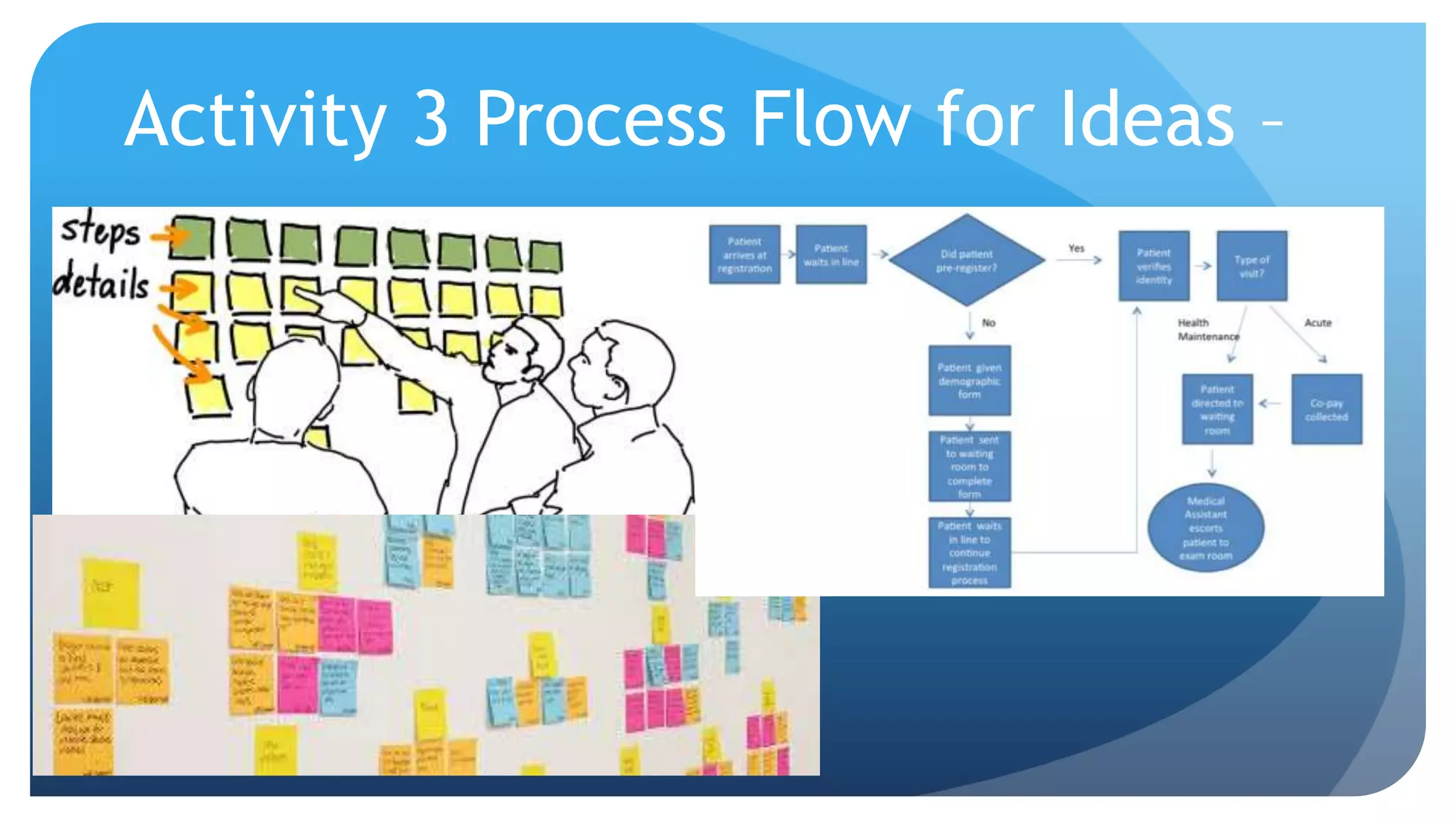
Activity 3 – Idea Process Flow
 Need to plan what actual changes you want to make and how
you are going to do them
 8 minutes, sticky notes and back of your handout.
 Think about one part of the system that will need to change
 Write down each step on a sticky note
 Order the sticky notes so it shows the process that will need to be
performed each time, every time
 8 minutes – share with partner
Activity 3 Process Flow for Ideas –
Other planning
 Team members – page 4
 One person (rarely) can make the changes necessary. It is a system of
processes and personnel that is delivering care
 Team – can be small or large, with everyone involved in some way
 It is the actual people doing the work, not a representative for
others
 Resources – page 5
 Timeline – page 7
Thank you for coming
This presentation is available at:
Slide share
Handouts are available at:
AAP NCE Conference website

Maintenance of Certification, Quality Improvement and Your EMR

  • 1.
    MOC, Quality ofCare and Your EMR Donna M. D’Alessandro, M.D., FAAP Professor of Pediatrics University of Iowa Available at Slide Share
  • 2.
    Please sit at tablethat is the closest to QI project you are doing or thinking about doing
  • 3.
    Disclosures and Disclaimers “I have no relevant financial relationships with the manufacturer(s) of any commercial product(s) and/or provider(s) of commercial services discussed in this CME activity.”  I know a little bit about each– so before you do something, please recheck with the appropriate group to make sure doing the activity will get you what you want/need
  • 4.
    Overview  Mini Lecture MOC  EMR  QI  Start Planning your Project  Write an AIMS statement  Write a measure  Process flow for ideas  Handouts  Quality Improvement Project Planner  Resources  URL for Handout
  • 5.
    Objectives  Learn aboutMOC and EMRs and how they can be used to develop quality improvement programs  I hope to show you that  MOC – can be integrated into maintaining your professional competency  EMRs – are continually advancing tools for us to use in our practice  QI – is a continuous process to improve the care you provide  Together they form a stalwart trio to help us provide the best care possible so “Every Child, Gets the Right Care Every time” - AAP
  • 6.
    Alphabet Soup  ABP– American Board of Pediatrics, “The Board”  AAP – American Academy of Pediatrics, “The Academy”  CME – Continuing Medical Education  CMS – Center for Medicare and Medicaid Services  MOC – Maintenance of Certification  QI – Quality Improvement  EMR/EHR – Electronic Medical Records or Electronic Health Records  MU – Meaningful Use
  • 7.
    Maintenance of Certification(MOC)  What is MOC?  Program of activities to “maintain” professional competency  There is no expiration date as long as the physician is enrolled in the program  ABP is requiring MOC to maintain board certification  Potentially state boards, hospitals and insurance companies could require board certification, therefore indirectly requiring MOC
  • 8.
    Basic Plan ofMOC  4 parts like Puzzle Pieces, not chronologically ordered  Part 1 Professional Standing and Licensure: unrestricted license to practice  Part 2 Life-long Learning Self Assessment: participating in knowledge self assessment tools  Part 3 Cognitive Expertise: passing a secure examination  Part 4 Performance in Practice: participating in quality improvement projects
  • 9.
    Basic Plan ofMOC  5-year cycle with 100 points for activities  40 points each Part 2 and Part 4  20 points either Part 2 or Part 4  Part 3 – one test every 10 years (every 2 cycles)
  • 10.
    Actually Doing MOC Check the ABP website to see your personal requirements – www.abp.org  If you don’t understand contact the ABP  Website has lists of activities that qualify for each part  All activities  Have a expiration date  Have a different MOC point value  May be free or have an additional cost in addition to the ABP’s MOC fee  May or may not award CME
  • 11.
    Part 4 Pathways-Join Other Groups  Project sponsor  Originates and manages a single activity  Ex: Insurance company, organization  Portfolio sponsors  Originate and manage multiple activities or projects  Ex. AAP, Institutions  Important – the sponsor applies to the ABP for the MOC and attests to your fulfillment of the MOC requirements  AAP offers projects through their portfolio  QuINN Network (Quality Improvement and Innovations Network)  Chapter Quality Network
  • 12.
    Part 4 Pathways- Use Your Own Practice  National Center on Quality Assurance Patient Centered Medical Home projects  It is considered an individual activity even if you participated as a group (40 MOC points, $0)  Proposed Small Group QI Projects (1-10 physicians, 0 MOC points, $0 for group)  ABP will review the process, provide tips and resources. This helps to ensure that your finished project will qualify for credit, but it is NOT the actual application for MOC credit.  Completed Small Group QI Projects – finished projects apply for credit (1-10 physicians, 25 MOC points, $75 for entire group)  Important – you must apply to the ABP directly and attest that you have fulfilled the MOC requirements
  • 13.
    Part 4 Pathways- Use Your Own Practice
  • 14.
    Part 4 Pathways- Other  QI Program Development – you are a leader of QI projects at an institution or organization (40 MOC points, $150)  QI Posters or Platform presentations at national scientific meetings (20 MOC points, $75)  QI Articles – for authors (25 MOC points, $75)
  • 15.
    Electronic Medical Records(EMRs)  Computers that store health information that then health care personnel (and patient/family) can access and utilize to provide care, and hopefully improve health
  • 16.
    EMRs are NotNew  Depending on how you want to define an EMR, first ones go back to late 60s or earlier  EMRs have improved documentation and availability = improved communication  Holy grail is integration – getting computers to talk to each other – still have problems but better tools and policies continue to improve integration  Policies and standards are set by CMS for :  “Certified” EHRs  For “meaningful use” of the EHRs  Reporting quality measures  Create an incentive system for providers to acquire, use and report using EHRs
  • 17.
    Meaningful Use (MU) Goal: to promote the spread of EMRs to improve health care in the US, Improve quality, safety, efficiency, and reduce health disparities  Engage patients and families  Improve care coordination, and population and public health  Maintain privacy and security of patient health information
  • 18.
    MU  Has criteriathat defines  Eligible professionals  Eligible hospitals  MU was developed as a progressive, staged program:  Stage 1: Data Capturing and Sharing (began 2011)  Stage 2: Advance Clinical Processes (began 2014)  Stage 3: Improved Health Outcomes (begins 2018)
  • 19.
    MU Stage 2 Must use a certified EMR- certified using specific standards  Standardizes reporting time periods – basically continuous 90 day period during the calendar year  Reporting times – 1 year  Report on 1 set of objectives  Protect Patient Health Information  Clinical Decision Support  Computerized Provider Order Entry  Electronic Prescribing  Health Information Exchange  Patient Specific Education  Medication Reconciliation  Patient Electronic Access  Secure Electronic Messaging  Public Health Reporting (EPs only)  CMS regulations - https://www.cms.gov/Regulations-and- Guidance/Legislation/EHRIncentivePrograms/Downloads/2015_NeedtoKnowEP.pdf
  • 20.
  • 21.
    MU Example –Secure Messaging  Secure Electronic Messaging
  • 22.
  • 23.
    What is Quality? Meeting the needs and exceeding the expectations of the patients and families that healthcare providers serve  Delivering all and only the care that the patient and family needs  “Every child gets the right care, every time” - Institute for Healthcare Improvement - AAP
  • 24.
    Improving Quality  Requireschange – every system is designed perfectly to achieve exactly the results its gets  Needs to be kept simple  If you don’t, you destroy productivity and unintended consequences results in too big a disruption
  • 25.
    Delivering Care andMaking Changes Structure Processes and People* Outcomes of Care Inputs Steps Outputs •Patients •Equipment •Supplies •Environment •Training •Physician orders •Nursing care •Ancillary staff •Coordination •Business practice •Physiologic parameters •Functional status •Satisfaction •Cost *Has the greatest chance to improve care, also the closest to the care - Modified from Institute for Healthcare Improvement
  • 26.
    What are wetrying to accomplish? (AIM) How will we know that a change is an improvement? (Measurement) What changes will we make that will results in an improvement? (Ideas) Plan: How should we modify our latest changes? - Institute for Healthcare Improvement Planning Steps for the Change
  • 27.
    What Are WeTrying to Accomplish?  Need an AIM statement that is SMART  Specific  Measureable  Achievable  Relevant and reliable  Time limited  Example: “Increase the screening rates for dental caries in 5-year olds within 6 months”  May have more than 1 goal, so discuss options with the team and chose one goal to work on  Nee
  • 28.
    How will weknow that a change is an improvement?  You need measurement. Otherwise, how will you know how far you have come to realizing your goal?  Need more than 1 measure, Measures don’t have to be perfect  Use measures that are already developed if possible
  • 29.
    How will weknow that a change is an improvement?
  • 30.
    How will weknow that a change is an improvement?  Select changes that are the most likely to improve outcomes  Recognize that not all changes improve outcomes – “Just because you can, doesn’t mean you should” and conversely, “Just because you think you can’t, doesn’t mean you shouldn’t try.”  Example: “Changing the EMR to include discrete structured data to improve reporting”
  • 31.
    How will weknow that a change is an improvement?  You will need to  Pilot test – determine your baseline  Collect data  Evaluate the data and compare it– overtime, to benchmarks, to end aim  Evaluate regularly not just at the end
  • 32.
    Measurement– Run Charts -Minnesota Department of Health
  • 33.
    PDSA Cycles -How should we modify our latest changes?  Run PDSA cycles to implement your changes and see your results  The analysis phase is imbedded in the planning
  • 34.
    Helpful Planners –Clinical Site Diagram  From ABP Quality Improvement Guide
  • 35.
    Helpful Planners –Key Drivers  From ABP Quality Improvement Guide
  • 36.
    Helpful Planners –Process Flow Diagram  -From AB - ABP Quality Improvement Guide
  • 37.
    End of Part1 – Mini Lecture Any Questions?
  • 38.
    Part 2. PlanningYour Project  Quality Improvement Project Planner- Introduction  Write an AIM Statement  Write a Measure  Process Flow  URL for Project Planner
  • 39.
    Quality Improvement Project Planner URL for Project Planner  “It’s long”  Yes it is long – but hopefully all or most of the important questions will be there to think about, discuss and make thoughtful decisions about so the project runs well  “Do I really have to do fill out it out or have to fill out everything?”  Of course not, but you might want to so you have record of the decisions you made and why
  • 40.
    Activity 1 –Write an AIM Statement  QI Project Planner Page 1  1 minute on first two statements:  The general problem we want to improve is __________  This is important because _________  5 minutes on writing an AIM statement  10 minutes – sharing with partners
  • 41.
    AIM Statement Iteration Improve HPV immunization rates in our practice. (7 words)  Improve HPV immunization rates in 11-13 year olds in our practice (11 words)  Improve HPV immunization rates in 11-13 year olds in our practice by 5% (13 words)  Improve HPV immunization rates in 11-13 year olds in our practice by 5 % over the next 6 months (19 words)  Improve HPV immunization rates in 11-13 year olds in our practice for the receiving the first vaccine by 5 % over the next 6 months (25 words)  Improve HPV immunization rates in 11-13 year olds in our practice for receive the first vaccine by 5 % and completing the series by 10% over the next 6 months. (30 words)  As cancer prevention is important to long term health we will improve HPV immunization rates in 11- 13 year olds in our practice for receive the first vaccine by 5 % and completing the series by 10% over the next 6 months by implementing an EMR reminder system and screening for HPV vaccinations at all nursing visits. (50 words)
  • 42.
    Activity 2 –Write a Measure  QI Project Planner Page 2  5-8 minutes  Write the measure in words  Determine the numerator/denominator and exclusion criteria  5-8 minutes – sharing at the table
  • 43.
    Activity 2 –Write a Measure
  • 44.
    Activity 2 –Write a Measure Discussion  Examples  What was difficult?
  • 45.
    Activity 3 –Idea Process Flow  Need to plan what actual changes you want to make and how you are going to do them  8 minutes, sticky notes and back of your handout.  Think about one part of the system that will need to change  Write down each step on a sticky note  Order the sticky notes so it shows the process that will need to be performed each time, every time  8 minutes – share with partner
  • 46.
    Activity 3 ProcessFlow for Ideas –
  • 47.
    Other planning  Teammembers – page 4  One person (rarely) can make the changes necessary. It is a system of processes and personnel that is delivering care  Team – can be small or large, with everyone involved in some way  It is the actual people doing the work, not a representative for others  Resources – page 5  Timeline – page 7
  • 48.
    Thank you forcoming This presentation is available at: Slide share Handouts are available at: AAP NCE Conference website