Immunomodulators
Introduction
• Potentially hostile world - array
of infectious agents
• Proverbial double edged sword.
Definition
Helps in regulation of the immune system
Indications
 Treatment of autoimmune diseases
 Recurrent diseases
 In case of organ transplant.
 Immunodeficiency disorders(AIDS)
 Chronic infectious diseases.
 Cancer particularly disorder involving the lymphatic
system
Classification of Immunomodulators
Immunosuppressants
Immunostimulants
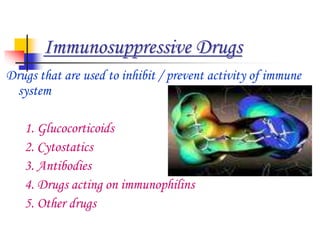
Immunosuppressive Drugs
Drugs that are used to inhibit / prevent activity of immune
system
1. Glucocorticoids
2. Cytostatics
3. Antibodies
4. Drugs acting on immunophilins
5. Other drugs
1. Glucocorticoids
Supress various allergic, inflammatory & autoimmune diseases
Mechanism of action:
Immunosuppressive action
 Suppress cell mediated immunity
 Suppress the humoral immunity
Antinflammatory action
Corticosteroids in oral diseases
 Topical
 Intralesional
 Systemic
Topical corticosteroids
Steroid Dosage every 6 hrs
Hydrocorticosone
hemisuccinate pellets
2.5 mg dissolve in
mouth close to ulcers
Triamcinolone
acetonide in carmellose
gelatin paste
Apply to lesion
More potent
Betamethasone
phosphate tablets
0.5 mg use as
mouthwash
Topical corticosteroids
Beclomethasone spray 1 puff 100 g
Budesonide spray 1 puff 100 g
Flucinolone spray Apply to lesion
Flucinonide cream gel or
ointment
Apply to lesion
Highly potent
Clobetasol cream Apply to lesion 5mg
Intralesional corticosteroids
Prednisolone sodium phospahte Up to 22 mg
Methylprednisolone acetate 4-80mg
Triamcinolone acetonide 2-3 mg
Triamcinolone hexaacetonide Up to 5mg
Systemic corticosteroids
Drug Dose
Prednisolone
40-80 mg orally daily in
divided doses
taper to 10 mg
Cytostatics
 Cytostatics inhibit cell divison –
T & B cell
Alkylating agents
Nitrogen mustards (Cyclophoshamide)
Mechanism of action:
1. Elimination of T regulatory cells(CD4+ CD25+)
2. Induction of T cell growth factors - Type I IFNs
Antimetabolites
Antimetabolites interfere with the synthesis of nucleic
acids
Methotrexate:
Inhibit metabolism of FA
Prevent synthesis of THF
Inhibition of T- cell activation
Azathioprine
Both cell- mediated & humoral immunity
Antibodies
Antibodies are used as a quick and potent
Immunosuppression
2 types:
1.Polyclonal antibodies
2 .Monoclonal antibodies
Antibodies
Polyclonal antibodies
Inhibit T lymphocytes & their lysis ,
Followed by removal of reticuloendothelial
cells from the circulation
Monoclonal antibodies
directed towards defined antigens
Drugs acting on Immunophilins
Cyclosporin
Bind M cytosolic protein -cyclophilin
Complex -inhibits calcineurin, which induces
transcription IL-2
Tacrolimus
Inhibits maturation, activation
Binds cytosolic proteins (Macrophilins I)
blocks calcineurin
Inhibits activated T cells, IL-2, 4, 5
IL-8 Receptors
Sirolimus
Sirolimus acts synergistically - cyclosporine
Inhibits T lympohocyte kinases & phosphatases
Prevent - G1 to S phase
B cell differentiation to plasma cells
Decreases IgM, IgG, IgA
Other drugs
Interferons
 IFN-β suppresses Th1 cytokines
 Monocyte activation
Thalidomide
 Immunomodulatory
 Anti-inflammatory
 Anti-angiogenic
 Modulates CD4+ and CD8+
Immunostimulators
DEFINITION:
Stimulate IMMUNE SYSTEM by
inducing activation/increasing
activity of any of its components
2 categories (Immunostimulators)
A. Specific Immunostimulators
 Provide antigenic specificity in Immune Response
E.g. vaccines
B. Non specific Immunostimulators
 Act irrespective of antigenic specificity to
augment Immune Response E. g. adjuvant
Levamisole
 Restore depressed immune function
 Stimulate formation of antibodies to various
antigens
 Enhance T-cell responses
 Potentiate monocyte and macrophage
 Normalize CD4+ cell/CD8+ cell ratio
Indications In Oral Diseases
Corticosteroids
 RAS
 Bullous pemphigoid
 Mucous membrane pemphigoid
 Linear Ig A disease
 Oral Lichen Planus
Indications In Oral Diseases
Cyclophoshamide
Dosage:1-2.5 mg/kg/day
 Pemphigus Vulgaris
 Mucous Membrane Pemphigoid
Indications In Oral Diseases
Methotrexate
5-12.5 mg/week
 Oral Erosive Lichen Planus
 Pemphigus -100mg/day
 Bullous pemphigoid
Indications In Oral Diseases
Azathioprine
Dosage : 0.5-2.5 mg/kg/daily
 Pemphigoid
 Pemphigus
 Major Apthous Stomatitis
 Adjunct to prednisone
 Severe Erosive Lichen Planus
 Erythema Multiforme
Indications In Oral Diseases
Cyclosporin:
 Pemphigus - 5 -8mg/kg/day
 Bullous Pemphigoid
 Lichen Planus
 Behcets synd (1-2mg/kg/day)
Indications In Oral Diseases
Tacrolimus
0. 03%-0. 1% ointment
 Lichen Planus
 GVHD
 Cutaneous Lupus Erythematosus
Indications In Oral Diseases
Interferons
 Leukoplakia: IFN 6 MU/day3 times,4 wks
 OSMF: intra lesional injection of 50mg/0.25ml
twice a wk, for 8 wk
Indications In Oral Diseases
Thalidomide
100 - 300 mg/day
 Persistent / continuous Erthema Multiforme
 Severe RAS
Indications In Oral Diseases
Levamisole
50 mg t.i.d, 3days
,
 RAS
 Herpes Simplex Virus
Vaccines
Prophylactic
Caries vaccine
 To prevent, protect - tooth decay.
Therapeutic
 Autoimmune diseases
 Cancer
Adverse effects of immunomodulators
Glucocorticoids
 Osteoporosis
 Predisposition to infection
 Peptic ulcer
 Hyperglycemia
 Hypertension
 Edema
 Euphoria & psychosis
Adverse effects of immunomodulators
Cytostatics
 Anemia
 Neutropenia
 Dermatitis
 Non Hodgkin’s Lymphoma
 Squamous cell carcinoma
Drugs acting on Immunophilins
 Decreases kidney function
 Increases infection risk
 Mild tremor
 Swollen gums
 Peripheral tingling
 Hypertrichosis
Other drugs
 Influenza like illness
 Bone marrow suppression
 Hepatitis
Immunostimulator
 Nausea, vomiting,diarrhea
 Alopecia
 Neutropenia
Special considerations
 Patients should be free from other aliments
 Blood tests should be performed frequently
 Contraindicated in pregnancy
CONCLUSION
Wealth of knowledge about concepts of modern
immunology has led to development of specifically
targeted treatment
Central to 21st century medicine, steroid sparing drugs
Classed as investigational drugs, requires the
clinician to weigh the benefits against risks
IMMUNOMODULATORS.ppt

IMMUNOMODULATORS.ppt