Anticoagulants
• Anticoagulants, also known as blood thinners
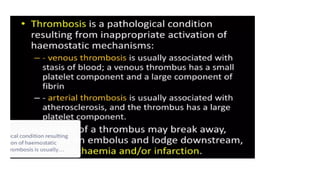
• Anticoagulants, are medications that prevent formation of blood
clots, thereby prevent serious complications like heart attack or stroke
WARFARIN
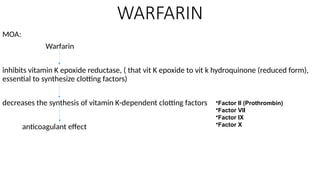
MOA:
Warfarin
inhibits vitamin K epoxide reductase, ( that vit K epoxide to vit k hydroquinone (reduced form),
essential to synthesize clotting factors)
decreases the synthesis of vitamin K-dependent clotting factors
anticoagulant effect
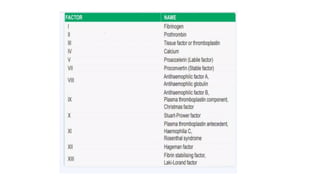
•Factor II (Prothrombin)
•Factor VII
•Factor IX
•Factor X
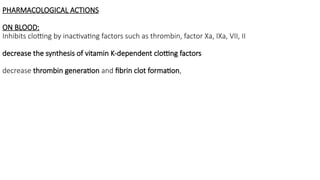
PHARMACOLOGICAL ACTIONS
ON BLOOD:
Inhibits clotting by inactivating factors such as thrombin, factor Xa, IXa, VII, II
decrease the synthesis of vitamin K-dependent clotting factors
decrease thrombin generation and fibrin clot formation,
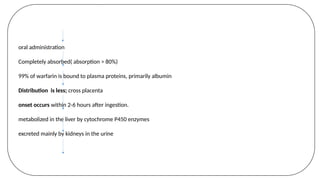
oral administration
Completely absorbed( absorption > 80%)
99% of warfarin is bound to plasma proteins, primarily albumin
Distribution is less; cross placenta
onset occurs within 2-6 hours after ingestion.
metabolized in the liver by cytochrome P450 enzymes
excreted mainly by kidneys in the urine
USES:
Prevention of Venous Thromboembolism (VTE)
Deep Vein Thrombosis (DVT):.
Pulmonary Embolism (PE):
Prosthetic Heart Valves: Patients with mechanical heart valves are at increased risk of clot
formation
prevent recurrent MI heart attacks.
risk of recurrent strokes
manage and prevent thrombotic events.
patients with increased risk of blood clots, such as certain genetic disorders.
ADVERSE EFFECTS
Bleeding: Nosebleeds, gum Bleeding, Bruising,Heavy menstrual periods, Blood in urine or stools
Allergic Reactions: Some individuals may experience allergic reactions, such as rash, itching, or
swelling
GIT: nausea, stomach pain, loss of appetite
CONTRAINDICATIONS
1) Pregnancy and Breastfeeding:
2) Severe Bleeding Disorders: Patients with significant bleeding disorders
1) Recent Major Surgery: Patients who have undergone major surgery within the last 72 hours.
2) Severe Liver Disease: liver disease can affect warfarin metabolism and increase the risk of bleeding.
3) Hypersensitivity: Known hypersensitivity to warfarin, such as skin necrosis or priapism.
Low Platelet Count: A platelet count less than 50 x 10^9/cu.mm (significant thrombocytopenia)
TREATMENT OF POISONING
Stop warfarin, assess INR and bleeding,
treat with vitamin K
Fresh blood transfusion or platelets in managing serious cases.
HEPARIN
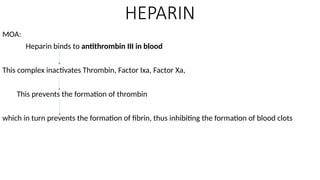
MOA:
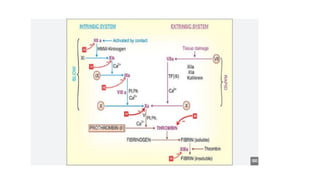
Heparin binds to antithrombin III in blood
This complex inactivates Thrombin, Factor Ixa, Factor Xa,
This prevents the formation of thrombin
which in turn prevents the formation of fibrin, thus inhibiting the formation of blood clots
PHARMACOLOGICAL ACTIONS
ON BLOOD:
Inhibits clotting by inactivating factors such as thrombin, factor Xa, IXa,
ON PLATELETS
Mild inhibition of platelet activation and aggregation.
ON LIPIDS
Mild decrease in serum triglycerides by activating lipoprotein lipase.
ANTIINLAMMATORY
Inhibit platelet adhesion to endothelial cells
Administered parenterally i.v or s.c (70% absorbtion)
highly bound to plasma proteins, (antithrombin III and lipoproteins)
Distribution is less; Do not cross BBB or placenta
onset of action is Immediate (minutes); duration is 1-2 hrs
SC 20-60 minutes duration is 8 to 12 hours
metabolized in the liver by heparinase
excreted mainly by kidneys in the urine
has narrow therapeutic index; follow non linear kinetics in absorption ans
elimination; regular monitoring to ensure the therapeutic levels and bleeding risk
USES:
deep vein thrombosis (DVT),
pulmonary embolism (PE),
Arteriosclerosis
stroke prevention.
ACUTE MI
Kidney dialysis
blood transfusions
ADVERSE EFFECTS
Bleeding
Thrombocytopenia
Osteoporosis
Hypersensitivity Reactions
Anemia
Alopecia
CONTRAINDICATIONS
severe bleeding
thromboembolic disorders
Thrombocytopenia
Severe Renal or Hepatic Insufficiency
TREATMENT OF OVERDOSE
1) discontinuing heparin and
2) administering protamine sulfate to reverse its anticoagulant effect. (i.v 1 mg for 1000 units of
heparin)
3) Close monitoring of coagulation parameters and
4) supportive care (such as blood products) are essential components of managing overdose,
especially in severe cases.
LOW M.WT HEPARINS:
ex: Enoxaparin (Lovenox):
Dalteparin (Fragmin):
Tinzaparin (Innohep):
Ardeparin
reviparin
MOA:
•LMWHs bind to antithrombin III (ATIII),
•inhibition factor Xa, with a smaller effect on thrombin inhibition.
•Selective inhibition of factor Xa
•leads to a reduction in thrombin generation,
•preventing the formation of fibrin clots.
•LMWH offers advantages like
•once-daily dosing,
•lower bleeding risks, and
• lower incidence of HIT (heparin induced thrombocytopenia), making it the preferred choice for many patients
•Predictable Anticoagulant Response: LMWHs have a more predictable anticoagulant response,
which means they don't require frequent monitoring of blood levels.
•Ease of Use: LMWHs can be administered subcutaneously, allowing for easier outpatient treatment
and self-administration.
•Lower Risk of Heparin-Induced Thrombocytopenia (HIT): LMWHs have a lower risk of causing HIT,
a serious immune reaction that can lead to thrombosis.
•Longer Half-Life: LMWHs have a longer half-life,
which means they can be given less frequently (usually once or twice daily) compared to UFH, which requires continuous
•Reduced Bleeding Complications: Studies have shown that LMWHs are
associated with a lower risk of major bleeding complications compared to UFH.
•Better Efficacy in Certain Conditions: more effective in reducing the incidence of
symptomatic recurrent venous thromboembolism, major hemorrhage
Coagulant drugs, also known as hemostatic agents
Coagulant drugs are substances used to promote blood clotting by enhancing the body's natural
clotting mechanisms, either by increasing the production of clotting factors, Activating platelets, or
preventing the breakdown of blood clots
The classification typically includes:
1. Vitamin K and Vitamin K Analogues
•Vitamin K1 (Phytonadione): Essential for the synthesis of clotting factors II, VII, IX, and X.
It is used to treat or prevent bleeding due to vitamin K deficiency, often induced by anticoagulant therapy
(e.g., warfarin).
•Vitamin K2: Less commonly used in practice but can play a role in coagulation.
2. Clotting Factor Concentrates
These are prepared from human plasma or recombinant DNA technology and contain specific clotting
factors to treat bleeding disorders such as hemophilia.
•Factor VIII Concentrates: Used in hemophilia A.
•Factor IX Concentrates: Used in hemophilia B.
•Activated Factor VII: For use in patients with severe bleeding disorders or in cases of major trauma.
3. Fibrin enhancers
These agents prevent the breakdown of fibrin clots, thereby promoting clot stability and reducing
bleeding.
•Tranexamic Acid: Used in conditions like trauma, post-surgical bleeding, and heavy menstrual bleeding.
•Aminocaproic Acid: Similar to tranexamic acid, used for similar bleeding disorders.
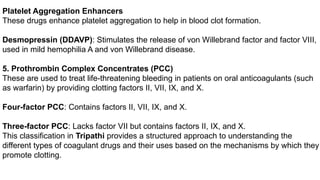
Platelet Aggregation Enhancers
These drugs enhance platelet aggregation to help in blood clot formation.
Desmopressin (DDAVP): Stimulates the release of von Willebrand factor and factor VIII,
used in mild hemophilia A and von Willebrand disease.
5. Prothrombin Complex Concentrates (PCC)
These are used to treat life-threatening bleeding in patients on oral anticoagulants (such
as warfarin) by providing clotting factors II, VII, IX, and X.
Four-factor PCC: Contains factors II, VII, IX, and X.
Three-factor PCC: Lacks factor VII but contains factors II, IX, and X.
This classification in Tripathi provides a structured approach to understanding the
different types of coagulant drugs and their uses based on the mechanisms by which they
promote clotting.
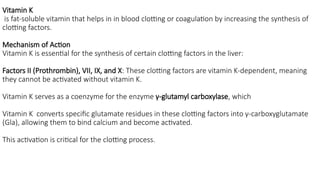
Vitamin K
is fat-soluble vitamin that helps in in blood clotting or coagulation by increasing the synthesis of
clotting factors.
Mechanism of Action
Vitamin K is essential for the synthesis of certain clotting factors in the liver:
Factors II (Prothrombin), VII, IX, and X: These clotting factors are vitamin K-dependent, meaning
they cannot be activated without vitamin K.
Vitamin K serves as a coenzyme for the enzyme Îł-glutamyl carboxylase, which
Vitamin K converts specific glutamate residues in these clotting factors into Îł-carboxyglutamate
(Gla), allowing them to bind calcium and become activated.
This activation is critical for the clotting process.
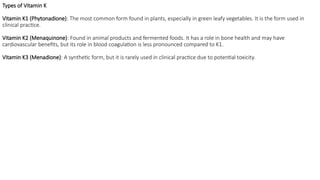
Types of Vitamin K
Vitamin K1 (Phytonadione): The most common form found in plants, especially in green leafy vegetables. It is the form used in
clinical practice.
Vitamin K2 (Menaquinone): Found in animal products and fermented foods. It has a role in bone health and may have
cardiovascular benefits, but its role in blood coagulation is less pronounced compared to K1.
Vitamin K3 (Menadione): A synthetic form, but it is rarely used in clinical practice due to potential toxicity.
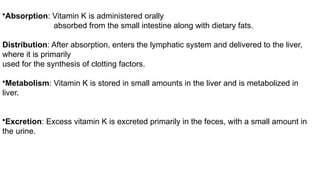
•Absorption: Vitamin K is administered orally
absorbed from the small intestine along with dietary fats.
Distribution: After absorption, enters the lymphatic system and delivered to the liver,
where it is primarily
used for the synthesis of clotting factors.
•Metabolism: Vitamin K is stored in small amounts in the liver and is metabolized in
liver.
•Excretion: Excess vitamin K is excreted primarily in the feces, with a small amount in
the urine.
Vitamin K Deficiency:
Vitamin K deficiency can lead to excessive bleeding and bleeding disorders, such as hemorrhagic
disease of the newborn, which is common in infants born without sufficient vitamin K stores.
USES:
1. Dietery vitamin k deficiency
2. Anticoagulant Reversal: If a patient on warfarin experiences excessive bleeding or requires
urgent surgery, vitamin K is administered to restore normal clotting.
3. Malabsorption syndromes
4. Liver diseases
5. New borns: deficiency of clotting factors
Adverse Effects
Overdose: Vitamin K toxicity is rare because it is water-soluble and excess amounts are typically excreted.
Excessive administration of vitamin K (especially IV form) can lead to:
Hypersensitivity reactions: Including anaphylaxis (if given rapidly via IV).
Hemolytic anemia: Rarely, large doses of synthetic vitamin K (menadione) may cause hemolysis.
Warfarin Interference: If vitamin K is administered to reverse warfarin, there can be a risk of causing a rebound increase in
clotting, potentially leading to thrombosis