NOIDA INSTITUTE OF ENGINEERING AND TECHNOLOGY
(PHARMACY INSTITUTE)
TOPIC- IMMUNOMODULATORS SCREENING MEDOLES
SUBMITTED BY :- SUBMITTED TO :-
MANISH KUSHWAH DR. SAUMYA DAS
M. PHARM ( PHARMACOLOGY) ASSOCIATE PROFESSOR
1ST SEMESTER NIET (PHARMACY INSTITUTE)
INTRODUCTION
• These are a chemical agent that modifies the immune response or the functioning
of the immune system ( as the stimulation of antibody formation or the inhibition
of WBC activity).
• These are the agents that modulate the immune system by suppress or stimulate
the immune response.
• These are divided into two parts that are:
1. Immunosuppressants
2. Immunostimulants
SCREENING METHODS OF IMMUNOMODULATOR
• IN VITRO method
• IN VIVO method
IN VITRO METHODS
• Inhibition of histamin release from mast cell
• Mitogen induced lymphocyte proliferation
• Inhibition of T cell Proliferation
• PFC ( Plaque Forming Colony ) Test
• Inhibition of Dihydro-Orotate Dehydrogenase
• Binding to Sphingosine 1- Phosphate receptor
IN VIVO METHODS
• Acute Systemic Anaphylaxis in Rats
• Delayed Type Hypersensitivity
• Spontaneous Autoimmune Disease in Animals
• Arthus Type Immediate Hypersensitivity
• Passive cutaneous anaphylaxis
• Anti-Anaphylactic Activity ( Schultz-Dale Reaction)
• Reversed Passive Arthus Reaction
• Adjuvants Arthritis in Rats
INVITRO METHODS
INHIBITION OF HISTAMIN RELEASE FROM MAST CELL
PURPOSE AND RATIONALE
• Hypersensitivity reactions can be elicited by various factors: either
immunologically induced i. e. allergic reaction to natural or synthetic compounds
mediated by IgE .
• Or non-immunologically induced i. e. activation of mediator release from cell
through direct contact, without the induction of, or the mediation through
immune responses.
• An important preformed mediator of allergic reaction found in these cell is
histamine which release from mast cell.
PROCEDURE
• Preparation of Mast cell Suspension
1. Wistar rats are decapitated and exsanguinated.
2. Fifty (50) ml of Hank’s balanced salt solution (HBBS) are injected into the
peritoneal cavity and following massage of the body , the abdominal wall is
opened.
3. The fluid containing peritoneal cell is collected in a centrifuge tube and
centrifuged at 2000 rpm.
4. The cells are resuspended in HBBS.
5. Then the cell suspension is brought to a final conc. Of 105 mast cell /100µL
CONT…..
Test Compound Administration and Induction of Histamine Release
1. 1ml test drug is added to the mast cell suspension (105 cells/100ml) and the
mixture is incubated at 37°c for 15 min.
2. The cell are made up a volume of 3 ml with HBBS , an equal volume of calcium-
ionophore (10-6 g/ml) compound or specific allergen is added.
3. The suspension is incubated at 37°c for 30 min followed by centrifugation at
2500 rpm.
CONT……
Determination of Histamine Release
1. The total sample is transferred to an autosampler vial, and the histamine
concentration is determined by a fluorescence detector (using excitation and
emission wave lengths of 350 and 450nm respectively).
EVALUATION
1. Percentage histamine release can be expressed by the following formula :
sample hist. rel. – spontaneous hist. rel. * 100
100% hist. rel. – spontaneous hist. rel.
2. Spontaneous histamine release-contains only mast cells.
MODIFICATION OF THIS METHOD
• Johnston et.al (1978) studied the inc. superoxide anion production by
immunologically activated and chemically elicited macrophages.
MITOGEN INDUCED LYMPHOCYTE PROLIFERATION
Purpose and Rationale
1. Cultured lymphocytes can be stimulated to a proliferative response and to DNA
synthesis by various mitogens.
2. Immunomodulating properties can be detected either by pretreatment of the
animals in vivo or by adding the test drug to the cultured lymphocytes.
CONT…….
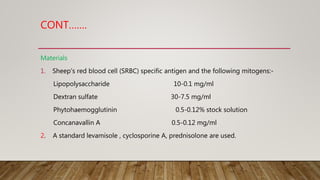
Materials
1. Sheep's red blood cell (SRBC) specific antigen and the following mitogens:-
Lipopolysaccharide 10-0.1 mg/ml
Dextran sulfate 30-7.5 mg/ml
Phytohaemogglutinin 0.5-0.12% stock solution
Concanavallin A 0.5-0.12 mg/ml
2. A standard levamisole , cyclosporine A, prednisolone are used.
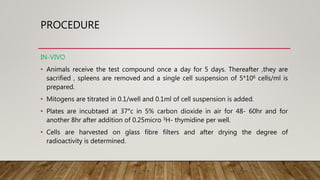
PROCEDURE
IN-VIVO
• Animals receive the test compound once a day for 5 days. Thereafter ,they are
sacrified , spleens are removed and a single cell suspension of 5*106 cells/ml is
prepared.
• Mitogens are titrated in 0.1/well and 0.1ml of cell suspension is added.
• Plates are incubtaed at 37°c in 5% carbon dioxide in air for 48- 60hr and for
another 8hr after addition of 0.25micro 3H- thymidine per well.
• Cells are harvested on glass fibre filters and after drying the degree of
radioactivity is determined.
CONT…….
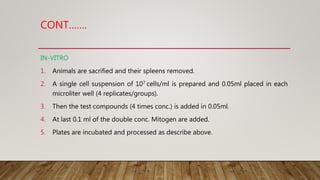
IN-VITRO
1. Animals are sacrified and their spleens removed.
2. A single cell suspension of 107 cells/ml is prepared and 0.05ml placed in each
microliter well (4 replicates/groups).
3. Then the test compounds (4 times conc.) is added in 0.05ml.
4. At last 0.1 ml of the double conc. Mitogen are added.
5. Plates are incubated and processed as describe above.
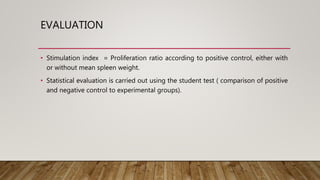
EVALUATION
• Stimulation index = Proliferation ratio according to positive control, either with
or without mean spleen weight.
• Statistical evaluation is carried out using the student test ( comparison of positive
and negative control to experimental groups).
IN VIVO METHODS
ACUTE SYSTEMIC ANAPHYLAXIS IN RATS
PURPOSE AND RATIONALE
1. Rats are immunized with ovalbumin and Bordetella pertussis suspension as
adjuvant.
2. After 11 days the animals are challenged by intervenous injection of ovalbumin.
3. The shock symptom can be inhibited by corticoids and intravenous disodium
cromoglycate.
ANIMAL
1. Female Sprague-Dawley rats weighing 120g
PROCEDURE
• Female Sprague-Dawley rats weighing 120g are immunized by i.m. injection of
10mg/kg highly purified ovalbumin.
• Simultaneously I ml Bordetella pertusis suspension (2*1010 organisms) is injected
intraperitoneally.
• IgE antibodies are induced and attached to the surface of mast cells and
basophilic granulocytes
• Eleven days later the animals are challenged by intravenous injection of 25mg/kg
highly purified ovalbumin
CONT……
• This results in formation of antigen- antibody complexes on the surface of mast
cells and basophilic granulocytes in blood and in all organs with immediate
release of various mediators of anaphylaxis, such as histamine, serotonin,
prostaglandins; in shock symptoms.
• Corticosteroids ,e.g.- dexamethasone 1-10mg/kg subcutaneous are given, 18hr
prior to challenge, or 30mg/kg disodium cromoglycate i.v. before injection of
ovalbumin.
EVALUATION
• The shock symptoms are scored and mortality counted. Results- after treatment
are compared with untreated controls.
• Pretreatment with corticosteroids disodium or cromoglycate can inhibit death
and ameliorate shock symptoms.
• Stastical calculation is performed using the X2 test.
MODIFICATION
• Desensitization by repeated ‘ microshocks ‘ of constant strength in given pigs has
been reported by Herxheimer(1952)
• Acute systemic anaphylaxis experiments have also been performed in given pigs
& mice. In guinea pigs anaphlactic bronchospasm can be measured with Konzett
and Rossler method.
DELAYED TYPE HYPERSENSITIVITY
PURPOSE AND RATIONALE
• Delayed type hypersensitivity is a reaction of cell mediated immunity and
becomes visible only after 16-24 hrs.
• The same method as for testing immediate type hypersensitivity can be used.
ANIMAL
• Albino Wister rat weighing 150 gm
PROCEDURE
• Rats are sensitized in the same way by i.m. administration of 0.5ml ovalbumin
suspension 7 days prior to start the experiment as described for testing
immediate type of hypersensitivity.
• They are challenged by injection of 0.1ml of 0.04% solution of highly purified
ovalbumin in the left hind paw
• Footpad thickness is measured immediately and 24hr after ovalbumin
administration.
MODIFICATION
• Mizukoshi et.al. (1994) injected female CDFI mice intradermally with a suspension
of 2+108 sheep red blood cells/ 50µl into the left foot pad
• A second booster of the same dose was given to the right foot pad on day 4
• Thickness of the foot pads was measured on the following day and the difference
in the thickness between the right & left pads was taken as the degree of
swelling.
REFERENCES
• https://www.slideshare.net/DeepakKumar2053/assignment-on-preclinical-
screening-of-immunomodulators
• https://www.slideshare.net/shahfahad77777/screening-models-for-
immunomodulator
• https://www.ncbi.nlm.nih.gov/pmc/articles/PMC4724932/
• https://www.nature.com/articles/s41598-019-41171-8
THANK YOU

Immunodulators Screening methods

  • 1.
    NOIDA INSTITUTE OFENGINEERING AND TECHNOLOGY (PHARMACY INSTITUTE) TOPIC- IMMUNOMODULATORS SCREENING MEDOLES SUBMITTED BY :- SUBMITTED TO :- MANISH KUSHWAH DR. SAUMYA DAS M. PHARM ( PHARMACOLOGY) ASSOCIATE PROFESSOR 1ST SEMESTER NIET (PHARMACY INSTITUTE)
  • 2.
    INTRODUCTION • These area chemical agent that modifies the immune response or the functioning of the immune system ( as the stimulation of antibody formation or the inhibition of WBC activity). • These are the agents that modulate the immune system by suppress or stimulate the immune response. • These are divided into two parts that are: 1. Immunosuppressants 2. Immunostimulants
  • 3.
    SCREENING METHODS OFIMMUNOMODULATOR • IN VITRO method • IN VIVO method
  • 4.
    IN VITRO METHODS •Inhibition of histamin release from mast cell • Mitogen induced lymphocyte proliferation • Inhibition of T cell Proliferation • PFC ( Plaque Forming Colony ) Test • Inhibition of Dihydro-Orotate Dehydrogenase • Binding to Sphingosine 1- Phosphate receptor
  • 5.
    IN VIVO METHODS •Acute Systemic Anaphylaxis in Rats • Delayed Type Hypersensitivity • Spontaneous Autoimmune Disease in Animals • Arthus Type Immediate Hypersensitivity • Passive cutaneous anaphylaxis • Anti-Anaphylactic Activity ( Schultz-Dale Reaction) • Reversed Passive Arthus Reaction • Adjuvants Arthritis in Rats
  • 6.
  • 7.
    INHIBITION OF HISTAMINRELEASE FROM MAST CELL PURPOSE AND RATIONALE • Hypersensitivity reactions can be elicited by various factors: either immunologically induced i. e. allergic reaction to natural or synthetic compounds mediated by IgE . • Or non-immunologically induced i. e. activation of mediator release from cell through direct contact, without the induction of, or the mediation through immune responses. • An important preformed mediator of allergic reaction found in these cell is histamine which release from mast cell.
  • 8.
    PROCEDURE • Preparation ofMast cell Suspension 1. Wistar rats are decapitated and exsanguinated. 2. Fifty (50) ml of Hank’s balanced salt solution (HBBS) are injected into the peritoneal cavity and following massage of the body , the abdominal wall is opened. 3. The fluid containing peritoneal cell is collected in a centrifuge tube and centrifuged at 2000 rpm. 4. The cells are resuspended in HBBS. 5. Then the cell suspension is brought to a final conc. Of 105 mast cell /100µL
  • 9.
    CONT….. Test Compound Administrationand Induction of Histamine Release 1. 1ml test drug is added to the mast cell suspension (105 cells/100ml) and the mixture is incubated at 37°c for 15 min. 2. The cell are made up a volume of 3 ml with HBBS , an equal volume of calcium- ionophore (10-6 g/ml) compound or specific allergen is added. 3. The suspension is incubated at 37°c for 30 min followed by centrifugation at 2500 rpm.
  • 10.
    CONT…… Determination of HistamineRelease 1. The total sample is transferred to an autosampler vial, and the histamine concentration is determined by a fluorescence detector (using excitation and emission wave lengths of 350 and 450nm respectively).
  • 11.
    EVALUATION 1. Percentage histaminerelease can be expressed by the following formula : sample hist. rel. – spontaneous hist. rel. * 100 100% hist. rel. – spontaneous hist. rel. 2. Spontaneous histamine release-contains only mast cells.
  • 12.
    MODIFICATION OF THISMETHOD • Johnston et.al (1978) studied the inc. superoxide anion production by immunologically activated and chemically elicited macrophages.
  • 13.
    MITOGEN INDUCED LYMPHOCYTEPROLIFERATION Purpose and Rationale 1. Cultured lymphocytes can be stimulated to a proliferative response and to DNA synthesis by various mitogens. 2. Immunomodulating properties can be detected either by pretreatment of the animals in vivo or by adding the test drug to the cultured lymphocytes.
  • 14.
    CONT……. Materials 1. Sheep's redblood cell (SRBC) specific antigen and the following mitogens:- Lipopolysaccharide 10-0.1 mg/ml Dextran sulfate 30-7.5 mg/ml Phytohaemogglutinin 0.5-0.12% stock solution Concanavallin A 0.5-0.12 mg/ml 2. A standard levamisole , cyclosporine A, prednisolone are used.
  • 15.
    PROCEDURE IN-VIVO • Animals receivethe test compound once a day for 5 days. Thereafter ,they are sacrified , spleens are removed and a single cell suspension of 5*106 cells/ml is prepared. • Mitogens are titrated in 0.1/well and 0.1ml of cell suspension is added. • Plates are incubtaed at 37°c in 5% carbon dioxide in air for 48- 60hr and for another 8hr after addition of 0.25micro 3H- thymidine per well. • Cells are harvested on glass fibre filters and after drying the degree of radioactivity is determined.
  • 16.
    CONT……. IN-VITRO 1. Animals aresacrified and their spleens removed. 2. A single cell suspension of 107 cells/ml is prepared and 0.05ml placed in each microliter well (4 replicates/groups). 3. Then the test compounds (4 times conc.) is added in 0.05ml. 4. At last 0.1 ml of the double conc. Mitogen are added. 5. Plates are incubated and processed as describe above.
  • 17.
    EVALUATION • Stimulation index= Proliferation ratio according to positive control, either with or without mean spleen weight. • Statistical evaluation is carried out using the student test ( comparison of positive and negative control to experimental groups).
  • 18.
  • 19.
    ACUTE SYSTEMIC ANAPHYLAXISIN RATS PURPOSE AND RATIONALE 1. Rats are immunized with ovalbumin and Bordetella pertussis suspension as adjuvant. 2. After 11 days the animals are challenged by intervenous injection of ovalbumin. 3. The shock symptom can be inhibited by corticoids and intravenous disodium cromoglycate. ANIMAL 1. Female Sprague-Dawley rats weighing 120g
  • 20.
    PROCEDURE • Female Sprague-Dawleyrats weighing 120g are immunized by i.m. injection of 10mg/kg highly purified ovalbumin. • Simultaneously I ml Bordetella pertusis suspension (2*1010 organisms) is injected intraperitoneally. • IgE antibodies are induced and attached to the surface of mast cells and basophilic granulocytes • Eleven days later the animals are challenged by intravenous injection of 25mg/kg highly purified ovalbumin
  • 21.
    CONT…… • This resultsin formation of antigen- antibody complexes on the surface of mast cells and basophilic granulocytes in blood and in all organs with immediate release of various mediators of anaphylaxis, such as histamine, serotonin, prostaglandins; in shock symptoms. • Corticosteroids ,e.g.- dexamethasone 1-10mg/kg subcutaneous are given, 18hr prior to challenge, or 30mg/kg disodium cromoglycate i.v. before injection of ovalbumin.
  • 22.
    EVALUATION • The shocksymptoms are scored and mortality counted. Results- after treatment are compared with untreated controls. • Pretreatment with corticosteroids disodium or cromoglycate can inhibit death and ameliorate shock symptoms. • Stastical calculation is performed using the X2 test.
  • 23.
    MODIFICATION • Desensitization byrepeated ‘ microshocks ‘ of constant strength in given pigs has been reported by Herxheimer(1952) • Acute systemic anaphylaxis experiments have also been performed in given pigs & mice. In guinea pigs anaphlactic bronchospasm can be measured with Konzett and Rossler method.
  • 24.
    DELAYED TYPE HYPERSENSITIVITY PURPOSEAND RATIONALE • Delayed type hypersensitivity is a reaction of cell mediated immunity and becomes visible only after 16-24 hrs. • The same method as for testing immediate type hypersensitivity can be used. ANIMAL • Albino Wister rat weighing 150 gm
  • 25.
    PROCEDURE • Rats aresensitized in the same way by i.m. administration of 0.5ml ovalbumin suspension 7 days prior to start the experiment as described for testing immediate type of hypersensitivity. • They are challenged by injection of 0.1ml of 0.04% solution of highly purified ovalbumin in the left hind paw • Footpad thickness is measured immediately and 24hr after ovalbumin administration.
  • 26.
    MODIFICATION • Mizukoshi et.al.(1994) injected female CDFI mice intradermally with a suspension of 2+108 sheep red blood cells/ 50µl into the left foot pad • A second booster of the same dose was given to the right foot pad on day 4 • Thickness of the foot pads was measured on the following day and the difference in the thickness between the right & left pads was taken as the degree of swelling.
  • 27.
  • 28.