Immunoassay techniques
Prof Dr Naael H Ali
College of Medicine
University of Basrah
Basrah, Iraq.
Naael.ali@uobasrah.edu.iq
Introduction
 Immune assay:- is a bioanalytical method in which the
quantification of analyte depends on the reaction of an
antigen and antibody .
 Due to the use of antibodies and purified antigens ,
immune assay is very sensitive and specific.
 Immunoassay can be qualitative, quantitative, or semi-
quantitative .
Basic concepts
Ag- Ab bounding is due to specifically bound interaction; electrostatic,
hydrogen bound, hydrophobic and Van derWaals.
The antibodies used in immunoassay must have higher affinity for the antigen
Which means the strength of bound energy of interaction of a single Ab binding
site with corresponding epitope of the Ag.
 Avidity means stability of the Ag-Ab complex and the overall binding
strength of immune complex.
 used antibodies can be monoclonal Ab or polyclonal Ab.
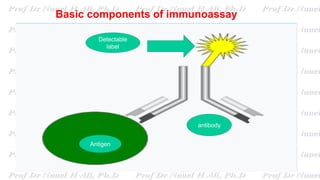
Basic components of immunoassay
Antigen
antibody
Detectable
label
Immunoassay Labels
Acts as detectors in immunoassays
 Enzymes like peroxidase often used as color changes by
spectrophotometers
 fluorescent (Fluorescein) that emit lightdetected by phototube
(fluorometers)
 Radioisotopes (gamma rays)
 Chemiluminescent (luminol or acridium esters).
Techniques of immunoassay
ELISA: enzyme linked immunosorbent assay
RI: radio immunoassay
FIA: fluorescent immunoassay
CLIA: Chemiluminescence immunoassay
IHC: Immunohistochemistry
Lateral flow immunoassay
Flowcytometry
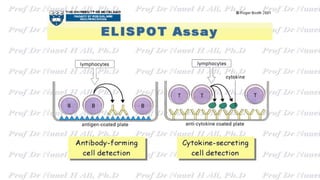
ELISPOT
ELISA
Principle
-The basic principle of an ELISA is use of enzyme to detect Ag-
Ab binding .
-Enzyme convert the colorless substrate (chromogen) to
colored product.
Enzymes occur naturally andcatalyze biochemical reactions.
Cheap
Readily available
Have a long shelf life
Easily adaptable to automation.
Automation relatively inexpensive.
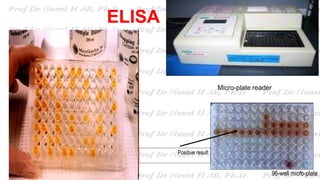
ELISA
8
Micro-plate reader
96-well micro-plate
Positive result
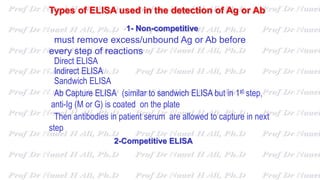
1- Non-competitive
must remove excess/unbound Ag or Ab before
every step of reactions
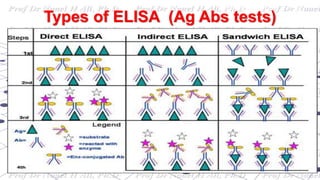
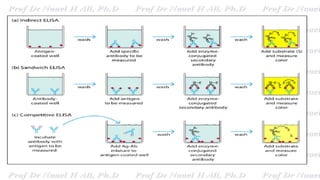
Direct ELISA
Indirect ELISA
Sandwich ELISA
Ab Capture ELISA (similar to sandwich ELISA but in 1st step,
anti-Ig (M or G) is coated on the plate
Then antibodies in patient serum are allowed to capture in next
step
Types of ELISA used in the detection of Ag or Ab
2-Competitive ELISA
Labeling technique
Types of ELISA (Ag Abs tests)
Application of ELISA
* Determine the concentration of serum antibody in a virus test.
* During a disease outbreak.
• Evaluate the spread of the disease, e.g. during recent COVID-19 outbreak,
• rapid testing kits are being used to determine presence of antibodies in the blood
sample
• Analysis of hormones, vitamins, metabolites, diagnostic markers
e.g. FSH, T3, T4, Glucagon, Insulin, Testosterone, vitamin B12, prostaglandins.
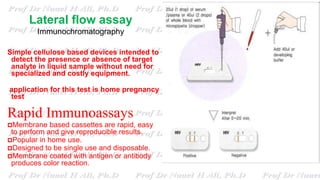
Lateral flow assay
Immunochromatography
Simple cellulose based devices intended to
detect the presence or absence of target
analyte in liquid sample without need for
specialized and costly equipment.
application for this test is home pregnancy
test
Rapid Immunoassays
Membrane based cassettes are rapid, easy
to perform and give reproducible results.
Popular in home use.
Designed to be single use and disposable.
Membrane coated with antigen or antibody
produces color reaction.
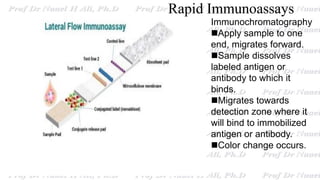
Immunochromatography
Apply sample to one
end, migrates forward.
Sample dissolves
labeled antigen or
antibody to which it
binds.
Migrates towards
detection zone where it
will bind to immobilized
antigen or antibody.
Color change occurs.
Rapid Immunoassays
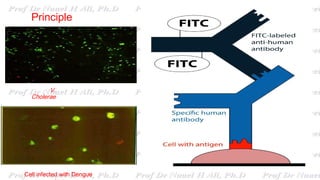
Immunofluorescence IFAT
•Fluorescence is the property of absorbing light rays of one particular wavelength and emitting
rays with a different wave length.
•Dyes that are commonly used include:
Fluorescein, an organic dye that is the most widely used label for immunofluorescence
procedures, absorbs blue light (490 nm) and emits an intense yellow-green fluorescence (517
nm).
Phycoerythrin is an efficient absorber of light (~30-fold greater than fluorescein) and a
brilliant emitter of red fluorescence, stimulating its wide use as a label for
immunofluorescence.
Principle
Cell infected with Dengue
V.
Cholerae
Anti-ds DNA antibodies in SLE
Breast cancer-HER2 positive
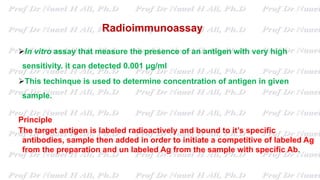
Radioimmunoassay
In vitro assay that measure the presence of an antigen with very high
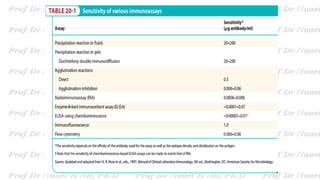
sensitivity. it can detected 0.001 μg/ml
This techinque is used to determine concentration of antigen in given
sample.
Principle
The target antigen is labeled radioactively and bound to it’s specific
antibodies, sample then added in order to initiate a competitive of labeled Ag
from the preparation and un labeled Ag from the sample with specific Ab.
APPLICATION OF RIA
•RIA is used in the
assay of drug like
amphetamine,barbitura
tes,digitoxin,morphine
etc.
•In analysis of vitamine
like riboflavin,folic acid.
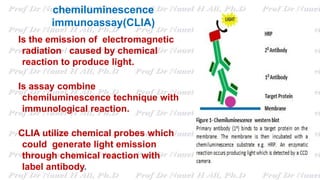
chemiluminescence
immunoassay(CLIA)
Is the emission of electromagnetic
radiation caused by chemical
reaction to produce light.
Is assay combine
chemiluminescence technique with
immunological reaction.
CLIA utilize chemical probes which
could generate light emission
through chemical reaction with
label antibody.
Chemiluminescence application
 traditionally been used to study the nature of the oxidative
bactericidal mechanisms of neutrophils and monocytes
 Study intrinsic defects and cell activation. During the last ten
years, Chemiluminescence has been applied in toxicological
and pharmacological tests (e.g. after exposure to antibiotic or
immunomodulators agents, such as adjuvants and cytotoxic
drugs
Immunoassay  technique 23.pdf

Immunoassay technique 23.pdf

  • 1.
    Immunoassay techniques Prof DrNaael H Ali College of Medicine University of Basrah Basrah, Iraq. Naael.ali@uobasrah.edu.iq
  • 2.
    Introduction  Immune assay:-is a bioanalytical method in which the quantification of analyte depends on the reaction of an antigen and antibody .  Due to the use of antibodies and purified antigens , immune assay is very sensitive and specific.  Immunoassay can be qualitative, quantitative, or semi- quantitative .
  • 3.
    Basic concepts Ag- Abbounding is due to specifically bound interaction; electrostatic, hydrogen bound, hydrophobic and Van derWaals. The antibodies used in immunoassay must have higher affinity for the antigen Which means the strength of bound energy of interaction of a single Ab binding site with corresponding epitope of the Ag.  Avidity means stability of the Ag-Ab complex and the overall binding strength of immune complex.  used antibodies can be monoclonal Ab or polyclonal Ab.
  • 4.
    Basic components ofimmunoassay Antigen antibody Detectable label
  • 5.
    Immunoassay Labels Acts asdetectors in immunoassays  Enzymes like peroxidase often used as color changes by spectrophotometers  fluorescent (Fluorescein) that emit lightdetected by phototube (fluorometers)  Radioisotopes (gamma rays)  Chemiluminescent (luminol or acridium esters).
  • 6.
    Techniques of immunoassay ELISA:enzyme linked immunosorbent assay RI: radio immunoassay FIA: fluorescent immunoassay CLIA: Chemiluminescence immunoassay IHC: Immunohistochemistry Lateral flow immunoassay Flowcytometry ELISPOT
  • 7.
    ELISA Principle -The basic principleof an ELISA is use of enzyme to detect Ag- Ab binding . -Enzyme convert the colorless substrate (chromogen) to colored product. Enzymes occur naturally andcatalyze biochemical reactions. Cheap Readily available Have a long shelf life Easily adaptable to automation. Automation relatively inexpensive.
  • 8.
  • 9.
    1- Non-competitive must removeexcess/unbound Ag or Ab before every step of reactions Direct ELISA Indirect ELISA Sandwich ELISA Ab Capture ELISA (similar to sandwich ELISA but in 1st step, anti-Ig (M or G) is coated on the plate Then antibodies in patient serum are allowed to capture in next step Types of ELISA used in the detection of Ag or Ab 2-Competitive ELISA
  • 10.
    Labeling technique Types ofELISA (Ag Abs tests)
  • 12.
    Application of ELISA *Determine the concentration of serum antibody in a virus test. * During a disease outbreak. • Evaluate the spread of the disease, e.g. during recent COVID-19 outbreak, • rapid testing kits are being used to determine presence of antibodies in the blood sample • Analysis of hormones, vitamins, metabolites, diagnostic markers e.g. FSH, T3, T4, Glucagon, Insulin, Testosterone, vitamin B12, prostaglandins.
  • 13.
    Lateral flow assay Immunochromatography Simplecellulose based devices intended to detect the presence or absence of target analyte in liquid sample without need for specialized and costly equipment. application for this test is home pregnancy test Rapid Immunoassays Membrane based cassettes are rapid, easy to perform and give reproducible results. Popular in home use. Designed to be single use and disposable. Membrane coated with antigen or antibody produces color reaction.
  • 14.
    Immunochromatography Apply sample toone end, migrates forward. Sample dissolves labeled antigen or antibody to which it binds. Migrates towards detection zone where it will bind to immobilized antigen or antibody. Color change occurs. Rapid Immunoassays
  • 15.
    Immunofluorescence IFAT •Fluorescence isthe property of absorbing light rays of one particular wavelength and emitting rays with a different wave length. •Dyes that are commonly used include: Fluorescein, an organic dye that is the most widely used label for immunofluorescence procedures, absorbs blue light (490 nm) and emits an intense yellow-green fluorescence (517 nm). Phycoerythrin is an efficient absorber of light (~30-fold greater than fluorescein) and a brilliant emitter of red fluorescence, stimulating its wide use as a label for immunofluorescence.
  • 16.
    Principle Cell infected withDengue V. Cholerae
  • 17.
    Anti-ds DNA antibodiesin SLE Breast cancer-HER2 positive
  • 18.
    Radioimmunoassay In vitro assaythat measure the presence of an antigen with very high sensitivity. it can detected 0.001 μg/ml This techinque is used to determine concentration of antigen in given sample. Principle The target antigen is labeled radioactively and bound to it’s specific antibodies, sample then added in order to initiate a competitive of labeled Ag from the preparation and un labeled Ag from the sample with specific Ab.
  • 19.
    APPLICATION OF RIA •RIAis used in the assay of drug like amphetamine,barbitura tes,digitoxin,morphine etc. •In analysis of vitamine like riboflavin,folic acid.
  • 21.
    chemiluminescence immunoassay(CLIA) Is the emissionof electromagnetic radiation caused by chemical reaction to produce light. Is assay combine chemiluminescence technique with immunological reaction. CLIA utilize chemical probes which could generate light emission through chemical reaction with label antibody.
  • 22.
    Chemiluminescence application  traditionallybeen used to study the nature of the oxidative bactericidal mechanisms of neutrophils and monocytes  Study intrinsic defects and cell activation. During the last ten years, Chemiluminescence has been applied in toxicological and pharmacological tests (e.g. after exposure to antibiotic or immunomodulators agents, such as adjuvants and cytotoxic drugs