Immunization Summit -2010

Rotavirus vaccines
Is a road map needed for
introduction to the EPI in
Sri Lanka ?
Dr. Pushpa Ranjan Wijesinghe, MD
Consultant Epidemiologist
Consensus statement
Immunization summit-2007
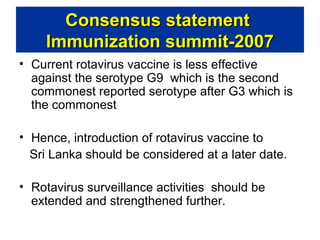
• Current rotavirus vaccine is less effective
against the serotype G9 which is the second
commonest reported serotype after G3 which is
the commonest
• Hence, introduction of rotavirus vaccine to
Sri Lanka should be considered at a later date.
• Rotavirus surveillance activities should be
extended and strengthened further.
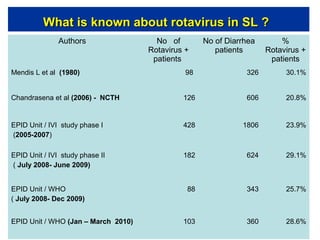
What is known about rotavirus in SL ?
Authors

No of
Rotavirus +
patients

No of Diarrhea
patients

%
Rotavirus +
patients

Mendis L et al (1980)

98

326

30.1%

Chandrasena et al (2006) - NCTH

126

606

20.8%

EPID Unit / IVI study phase I
(2005-2007)

428

1806

23.9%

EPID Unit / IVI study phase II
( July 2008- June 2009)

182

624

29.1%

88

343

25.7%

103

360

28.6%

EPID Unit / WHO
( July 2008- Dec 2009)
EPID Unit / WHO (Jan – March 2010)
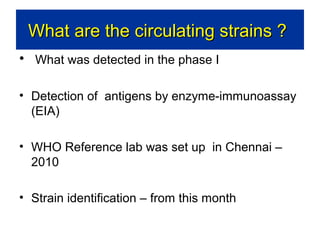
What are the circulating strains ?
• What was detected in the phase I
• Detection of antigens by enzyme-immunoassay
(EIA)
• WHO Reference lab was set up in Chennai –
2010
• Strain identification – from this month
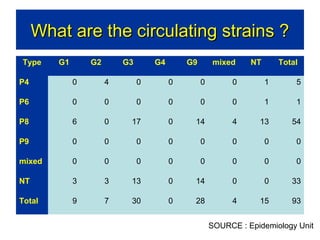
What are the circulating strains ?
Type

G1

G2

G3

G4

G9

mixed

NT

Total

P4

0

4

0

0

0

0

1

5

P6

0

0

0

0

0

0

1

1

P8

6

0

17

0

14

4

13

54

P9

0

0

0

0

0

0

0

0

mixed

0

0

0

0

0

0

0

0

NT

3

3

13

0

14

0

0

33

Total

9

7

30

0

28

4

15

93

SOURCE : Epidemiology Unit
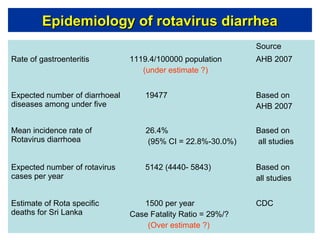
Epidemiology of rotavirus diarrhea
Source
Rate of gastroenteritis

1119.4/100000 population
(under estimate ?)

AHB 2007

Expected number of diarrhoeal
diseases among under five

19477

Based on
AHB 2007

Mean incidence rate of
Rotavirus diarrhoea

26.4%
(95% CI = 22.8%-30.0%)

Based on
all studies

Expected number of rotavirus
cases per year

5142 (4440- 5843)

Based on
all studies

Estimate of Rota specific
deaths for Sri Lanka

1500 per year
Case Fatality Ratio = 29%/?
(Over estimate ?)

CDC
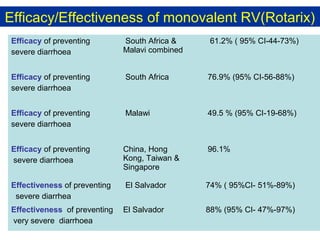
Efficacy/Effectiveness of monovalent RV(Rotarix)
Efficacy of preventing
severe diarrhoea

South Africa &
Malavi combined

61.2% ( 95% CI-44-73%)

Efficacy of preventing
severe diarrhoea

South Africa

76.9% (95% CI-56-88%)

Efficacy of preventing
severe diarrhoea

Malawi

49.5 % (95% CI-19-68%)

Efficacy of preventing
severe diarrhoea

China, Hong
Kong, Taiwan &
Singapore

96.1%

Effectiveness of preventing
severe diarrhea

El Salvador

74% ( 95%CI- 51%-89%)

Effectiveness of preventing
very severe diarrhoea

El Salvador

88% (95% CI- 47%-97%)
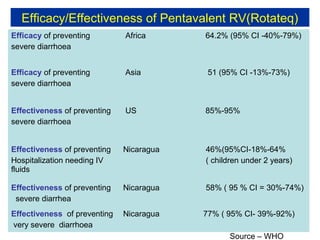
Efficacy/Effectiveness of Pentavalent RV(Rotateq)
Efficacy of preventing
severe diarrhoea

Africa

64.2% (95% CI -40%-79%)

Efficacy of preventing
severe diarrhoea

Asia

51 (95% CI -13%-73%)

Effectiveness of preventing
severe diarrhoea

US

85%-95%

Effectiveness of preventing
Hospitalization needing IV
fluids

Nicaragua

46%(95%CI-18%-64%
( children under 2 years)

Effectiveness of preventing
severe diarrhea

Nicaragua

58% ( 95 % CI = 30%-74%)

Effectiveness of preventing
very severe diarrhoea

Nicaragua

77% ( 95% CI- 39%-92%)
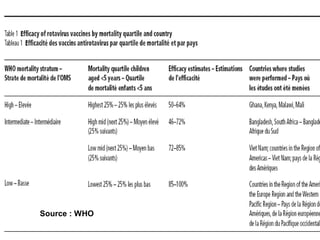
Source – WHO
Source : WHO
Are these vaccines safe ?
• Recommendations of GACVS
– Vaccines are safe
– Risk of intussusception ruled out with confidence
– No data to support increased risk of intussusception
when administered outside the age range
• 6–15 weeks for the first dose
• 32 weeks for the second dose

– No interference with OPV and other EPI vaccines
– OPV inhibit the response of the first dose of Rota
vaccines
– No change in clinical status of
• HIV infected children
• Children born to HIV infected mothers.
Update on rotavirus vaccines

• FDA recommendations – USA

• Addition of Severe Combined Immunodeficiency as a
Contraindication
• DNA from porcine circovirus type 1(PCV1) in the vaccine
(Monovalent RV)
• Fragments of DNA from PCV1 and from a related porcine
circovirus type 2 (PCV2) (pentavalent RV)
• Resumption of using both vaccines
• strong safety records-trials/post marketing surveillance
• Benefits > theoretical risks
•

Follow-ups by the FDA
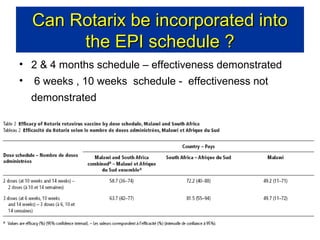
Can Rotarix be incorporated into
the EPI schedule ?
• 2 & 4 months schedule – effectiveness demonstrated
• 6 weeks , 10 weeks schedule - effectiveness not
demonstrated
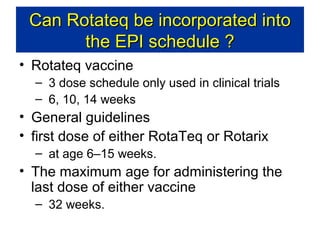
Can Rotateq be incorporated into
the EPI schedule ?
• Rotateq vaccine
– 3 dose schedule only used in clinical trials
– 6, 10, 14 weeks

• General guidelines
• first dose of either RotaTeq or Rotarix
– at age 6–15 weeks.

• The maximum age for administering the
last dose of either vaccine
– 32 weeks.
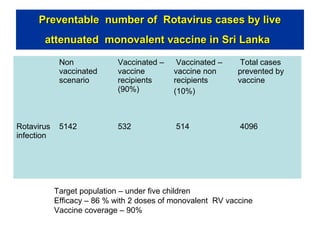
Preventable number of Rotavirus cases by live
attenuated monovalent vaccine in Sri Lanka
Non
vaccinated
scenario

Rotavirus
infection

Vaccinated –
vaccine
recipients
(90%)

Vaccinated –
vaccine non
recipients
(10%)

Total cases
prevented by
vaccine

5142

532

514

4096

Target population – under five children
Efficacy – 86 % with 2 doses of monovalent RV vaccine
Vaccine coverage – 90%
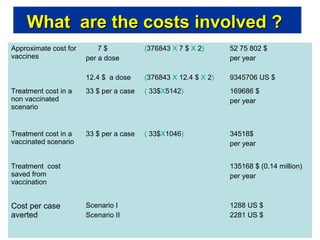
What are the costs involved ?
Approximate cost for
vaccines

7$
per a dose

(376843 X 7 $ X 2)

52 75 802 $
per year

12.4 $ a dose

(376843 X 12.4 $ X 2)

9345706 US $

Treatment cost in a
non vaccinated
scenario

33 $ per a case

( 33$X5142)

169686 $
per year

Treatment cost in a
vaccinated scenario

33 $ per a case

( 33$X1046)

34518$
per year

Treatment cost
saved from
vaccination

Cost per case
averted

135168 $ (0.14 million)
per year

Scenario I
Scenario II

1288 US $
2281 US $
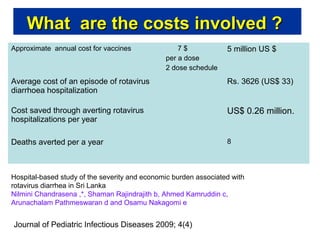
What are the costs involved ?
Approximate annual cost for vaccines

7$
per a dose
2 dose schedule

5 million US $

Average cost of an episode of rotavirus
diarrhoea hospitalization

Rs. 3626 (US$ 33)

Cost saved through averting rotavirus
hospitalizations per year

US$ 0.26 million.

Deaths averted per a year

8

Hospital-based study of the severity and economic burden associated with
rotavirus diarrhea in Sri Lanka
Nilmini Chandrasena ,*, Shaman Rajindrajith b, Ahmed Kamruddin c,
Arunachalam Pathmeswaran d and Osamu Nakagomi e

Journal of Pediatric Infectious Diseases 2009; 4(4)
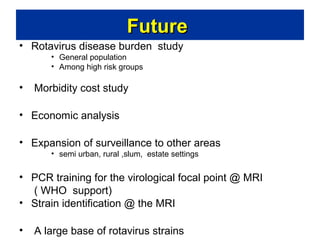
Future
• Rotavirus disease burden study
• General population
• Among high risk groups

•

Morbidity cost study

• Economic analysis
• Expansion of surveillance to other areas
• semi urban, rural ,slum, estate settings

• PCR training for the virological focal point @ MRI
( WHO support)
• Strain identification @ the MRI
•

A large base of rotavirus strains
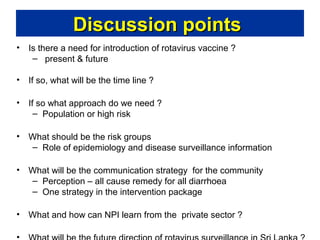
Discussion points
• Is there a need for introduction of rotavirus vaccine ?
– present & future
• If so, what will be the time line ?
• If so what approach do we need ?
– Population or high risk
• What should be the risk groups
– Role of epidemiology and disease surveillance information
• What will be the communication strategy for the community
– Perception – all cause remedy for all diarrhoea
– One strategy in the intervention package
• What and how can NPI learn from the private sector ?
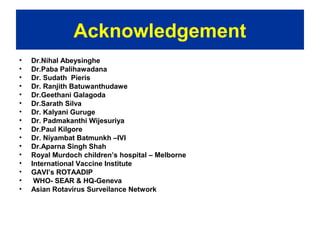
Acknowledgement
•
•
•
•
•
•
•
•
•
•
•
•
•
•
•
•

Dr.Nihal Abeysinghe
Dr.Paba Palihawadana
Dr. Sudath Pieris
Dr. Ranjith Batuwanthudawe
Dr.Geethani Galagoda
Dr.Sarath Silva
Dr. Kalyani Guruge
Dr. Padmakanthi Wijesuriya
Dr.Paul Kilgore
Dr. Niyambat Batmunkh –IVI
Dr.Aparna Singh Shah
Royal Murdoch children’s hospital – Melborne
International Vaccine Institute
GAVI’s ROTAADIP
WHO- SEAR & HQ-Geneva
Asian Rotavirus Surveilance Network

Immunization summit rota 2010

  • 1.
    Immunization Summit -2010 Rotavirusvaccines Is a road map needed for introduction to the EPI in Sri Lanka ? Dr. Pushpa Ranjan Wijesinghe, MD Consultant Epidemiologist
  • 2.
    Consensus statement Immunization summit-2007 •Current rotavirus vaccine is less effective against the serotype G9 which is the second commonest reported serotype after G3 which is the commonest • Hence, introduction of rotavirus vaccine to Sri Lanka should be considered at a later date. • Rotavirus surveillance activities should be extended and strengthened further.
  • 3.
    What is knownabout rotavirus in SL ? Authors No of Rotavirus + patients No of Diarrhea patients % Rotavirus + patients Mendis L et al (1980) 98 326 30.1% Chandrasena et al (2006) - NCTH 126 606 20.8% EPID Unit / IVI study phase I (2005-2007) 428 1806 23.9% EPID Unit / IVI study phase II ( July 2008- June 2009) 182 624 29.1% 88 343 25.7% 103 360 28.6% EPID Unit / WHO ( July 2008- Dec 2009) EPID Unit / WHO (Jan – March 2010)
  • 4.
    What are thecirculating strains ? • What was detected in the phase I • Detection of antigens by enzyme-immunoassay (EIA) • WHO Reference lab was set up in Chennai – 2010 • Strain identification – from this month
  • 5.
    What are thecirculating strains ? Type G1 G2 G3 G4 G9 mixed NT Total P4 0 4 0 0 0 0 1 5 P6 0 0 0 0 0 0 1 1 P8 6 0 17 0 14 4 13 54 P9 0 0 0 0 0 0 0 0 mixed 0 0 0 0 0 0 0 0 NT 3 3 13 0 14 0 0 33 Total 9 7 30 0 28 4 15 93 SOURCE : Epidemiology Unit
  • 6.
    Epidemiology of rotavirusdiarrhea Source Rate of gastroenteritis 1119.4/100000 population (under estimate ?) AHB 2007 Expected number of diarrhoeal diseases among under five 19477 Based on AHB 2007 Mean incidence rate of Rotavirus diarrhoea 26.4% (95% CI = 22.8%-30.0%) Based on all studies Expected number of rotavirus cases per year 5142 (4440- 5843) Based on all studies Estimate of Rota specific deaths for Sri Lanka 1500 per year Case Fatality Ratio = 29%/? (Over estimate ?) CDC
  • 7.
    Efficacy/Effectiveness of monovalentRV(Rotarix) Efficacy of preventing severe diarrhoea South Africa & Malavi combined 61.2% ( 95% CI-44-73%) Efficacy of preventing severe diarrhoea South Africa 76.9% (95% CI-56-88%) Efficacy of preventing severe diarrhoea Malawi 49.5 % (95% CI-19-68%) Efficacy of preventing severe diarrhoea China, Hong Kong, Taiwan & Singapore 96.1% Effectiveness of preventing severe diarrhea El Salvador 74% ( 95%CI- 51%-89%) Effectiveness of preventing very severe diarrhoea El Salvador 88% (95% CI- 47%-97%)
  • 8.
    Efficacy/Effectiveness of PentavalentRV(Rotateq) Efficacy of preventing severe diarrhoea Africa 64.2% (95% CI -40%-79%) Efficacy of preventing severe diarrhoea Asia 51 (95% CI -13%-73%) Effectiveness of preventing severe diarrhoea US 85%-95% Effectiveness of preventing Hospitalization needing IV fluids Nicaragua 46%(95%CI-18%-64% ( children under 2 years) Effectiveness of preventing severe diarrhea Nicaragua 58% ( 95 % CI = 30%-74%) Effectiveness of preventing very severe diarrhoea Nicaragua 77% ( 95% CI- 39%-92%) Source – WHO
  • 9.
  • 10.
    Are these vaccinessafe ? • Recommendations of GACVS – Vaccines are safe – Risk of intussusception ruled out with confidence – No data to support increased risk of intussusception when administered outside the age range • 6–15 weeks for the first dose • 32 weeks for the second dose – No interference with OPV and other EPI vaccines – OPV inhibit the response of the first dose of Rota vaccines – No change in clinical status of • HIV infected children • Children born to HIV infected mothers.
  • 11.
    Update on rotavirusvaccines • FDA recommendations – USA • Addition of Severe Combined Immunodeficiency as a Contraindication • DNA from porcine circovirus type 1(PCV1) in the vaccine (Monovalent RV) • Fragments of DNA from PCV1 and from a related porcine circovirus type 2 (PCV2) (pentavalent RV) • Resumption of using both vaccines • strong safety records-trials/post marketing surveillance • Benefits > theoretical risks • Follow-ups by the FDA
  • 12.
    Can Rotarix beincorporated into the EPI schedule ? • 2 & 4 months schedule – effectiveness demonstrated • 6 weeks , 10 weeks schedule - effectiveness not demonstrated
  • 13.
    Can Rotateq beincorporated into the EPI schedule ? • Rotateq vaccine – 3 dose schedule only used in clinical trials – 6, 10, 14 weeks • General guidelines • first dose of either RotaTeq or Rotarix – at age 6–15 weeks. • The maximum age for administering the last dose of either vaccine – 32 weeks.
  • 14.
    Preventable number ofRotavirus cases by live attenuated monovalent vaccine in Sri Lanka Non vaccinated scenario Rotavirus infection Vaccinated – vaccine recipients (90%) Vaccinated – vaccine non recipients (10%) Total cases prevented by vaccine 5142 532 514 4096 Target population – under five children Efficacy – 86 % with 2 doses of monovalent RV vaccine Vaccine coverage – 90%
  • 15.
    What are thecosts involved ? Approximate cost for vaccines 7$ per a dose (376843 X 7 $ X 2) 52 75 802 $ per year 12.4 $ a dose (376843 X 12.4 $ X 2) 9345706 US $ Treatment cost in a non vaccinated scenario 33 $ per a case ( 33$X5142) 169686 $ per year Treatment cost in a vaccinated scenario 33 $ per a case ( 33$X1046) 34518$ per year Treatment cost saved from vaccination Cost per case averted 135168 $ (0.14 million) per year Scenario I Scenario II 1288 US $ 2281 US $
  • 16.
    What are thecosts involved ? Approximate annual cost for vaccines 7$ per a dose 2 dose schedule 5 million US $ Average cost of an episode of rotavirus diarrhoea hospitalization Rs. 3626 (US$ 33) Cost saved through averting rotavirus hospitalizations per year US$ 0.26 million. Deaths averted per a year 8 Hospital-based study of the severity and economic burden associated with rotavirus diarrhea in Sri Lanka Nilmini Chandrasena ,*, Shaman Rajindrajith b, Ahmed Kamruddin c, Arunachalam Pathmeswaran d and Osamu Nakagomi e Journal of Pediatric Infectious Diseases 2009; 4(4)
  • 17.
    Future • Rotavirus diseaseburden study • General population • Among high risk groups • Morbidity cost study • Economic analysis • Expansion of surveillance to other areas • semi urban, rural ,slum, estate settings • PCR training for the virological focal point @ MRI ( WHO support) • Strain identification @ the MRI • A large base of rotavirus strains
  • 18.
    Discussion points • Isthere a need for introduction of rotavirus vaccine ? – present & future • If so, what will be the time line ? • If so what approach do we need ? – Population or high risk • What should be the risk groups – Role of epidemiology and disease surveillance information • What will be the communication strategy for the community – Perception – all cause remedy for all diarrhoea – One strategy in the intervention package • What and how can NPI learn from the private sector ?
  • 19.
    Acknowledgement • • • • • • • • • • • • • • • • Dr.Nihal Abeysinghe Dr.Paba Palihawadana Dr.Sudath Pieris Dr. Ranjith Batuwanthudawe Dr.Geethani Galagoda Dr.Sarath Silva Dr. Kalyani Guruge Dr. Padmakanthi Wijesuriya Dr.Paul Kilgore Dr. Niyambat Batmunkh –IVI Dr.Aparna Singh Shah Royal Murdoch children’s hospital – Melborne International Vaccine Institute GAVI’s ROTAADIP WHO- SEAR & HQ-Geneva Asian Rotavirus Surveilance Network