Immunity and Its
Classification
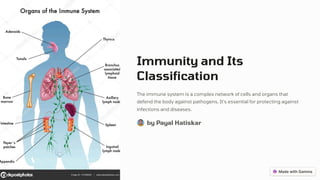
Theimmune system is a complex network of cells and organs that
defend the body against pathogens. It's essential for protecting against
infections and diseases.
by Payal Hatiskar
2.
Introduction to theImmune System
Defense System
The immune system acts as the body's first line of defense
against invaders like bacteria, viruses, and parasites.
Cellular Components
White blood cells, including lymphocytes, macrophages,
and neutrophils, are key players in the immune response.
3.
Types of Immunity:Innate
and Adaptive
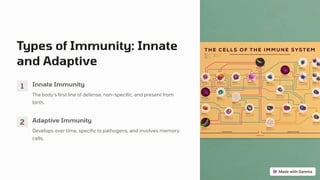
1 Innate Immunity
The body's first line of defense, non-specific, and present from
birth.
2 Adaptive Immunity
Develops over time, specific to pathogens, and involves memory
cells.
4.
Innate Immunity: Barriers
andCellular Responses
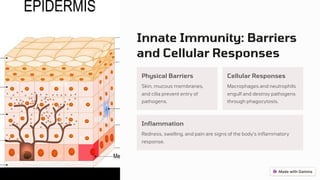
Physical Barriers
Skin, mucous membranes,
and cilia prevent entry of
pathogens.
Cellular Responses
Macrophages and neutrophils
engulf and destroy pathogens
through phagocytosis.
Inflammation
Redness, swelling, and pain are signs of the body's inflammatory
response.
5.
Adaptive Immunity:
Humoral andCell-Mediated
Responses
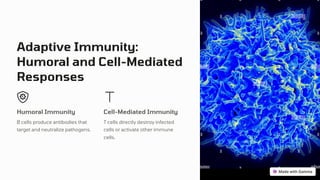
Humoral Immunity
B cells produce antibodies that
target and neutralize pathogens.
Cell-Mediated Immunity
T cells directly destroy infected
cells or activate other immune
cells.
6.
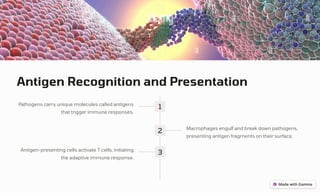
Antigen Recognition andPresentation
1
Pathogens carry unique molecules called antigens
that trigger immune responses.
2 Macrophages engulf and break down pathogens,
presenting antigen fragments on their surface.
3
Antigen-presenting cells activate T cells, initiating
the adaptive immune response.
7.
T Cell Activationand
Differentiation
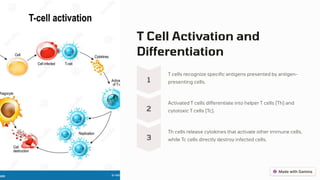
1
T cells recognize specific antigens presented by antigen-
presenting cells.
2
Activated T cells differentiate into helper T cells (Th) and
cytotoxic T cells (Tc).
3
Th cells release cytokines that activate other immune cells,
while Tc cells directly destroy infected cells.
8.
B Cell Activationand
Antibody Production
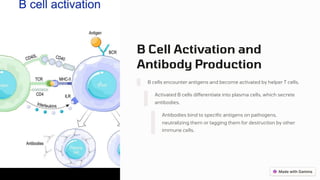
B cells encounter antigens and become activated by helper T cells.
Activated B cells differentiate into plasma cells, which secrete
antibodies.
Antibodies bind to specific antigens on pathogens,
neutralizing them or tagging them for destruction by other
immune cells.
9.
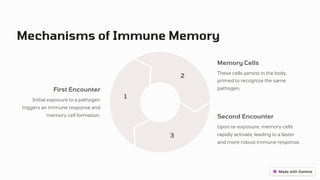
Mechanisms of ImmuneMemory
1
2
3
First Encounter
Initial exposure to a pathogen
triggers an immune response and
memory cell formation.
Memory Cells
These cells persist in the body,
primed to recognize the same
pathogen.
Second Encounter
Upon re-exposure, memory cells
rapidly activate, leading to a faster
and more robust immune response.
10.
Conclusion: Importance ofUnderstanding
Immunity
Understanding the immune system is crucial for developing vaccines, treatments for autoimmune diseases, and strategies
for preventing and managing infections.