Immunity Lesson objectives To describe how the immune system works. To evaluate how vaccination can help prevent some bacterial and viral diseases.
WHAT VACCINATIONS HAVE YOU HAD? AQA Science © Nelson Thornes Ltd 2006 
What vaccinations have you had? Diphtheria  Tetanus Whooping cough (pertussis)  Polio Hib: vaccination against the bacteria Haemophilus influenzae type B, which can cause meningitis,  Measles  Mumps  Rubella (German measles)  Meningitis C  Pneumococcal: vaccination against the bacteria Streptococcus pneumoniae (known as pneumococcus), which can cause meningitis. AQA Science © Nelson Thornes Ltd 2006 
Immune system Every cell has unique proteins on its surface called  antigens . As we have covered your white blood cells recognise antigens on pathogens as different. Your white blood cells make antibodies to attack and kill the pathogens. AQA Science © Nelson Thornes Ltd 2006 
The diseases that children are commonly vaccinated against were once childhood killers.
Immune system White blood cells are able to remember the right antibody needed to tackle a particular pathogen. Immunity happens because next time you meet the pathogen the white blood cells quickly produce the correct antibody. AQA Science © Nelson Thornes Ltd 2006 
Immune system You become ill the first time you meet a new pathogen. This is because it takes time to find the right antibody.  With future infections your body destroys all the invaders before you can become ill. AQA Science © Nelson Thornes Ltd 2006 
Vaccination. Some pathogens are dangerous because they can kill you before your body makes the right antibodies. These days we can protect ourselves against such diseases by  immunisation  ( vaccination ) AQA Science © Nelson Thornes Ltd 2006 
This is how vaccines protect you against dangerous infectious diseases Small amounts of dead or inactive pathogen are put into your body, often by injection. .
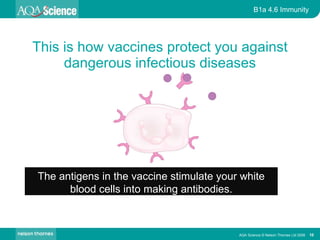
This is how vaccines protect you against dangerous infectious diseases The antigens in the vaccine stimulate your white blood cells into making antibodies.
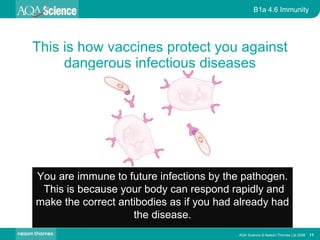
This is how vaccines protect you against dangerous infectious diseases You are immune to future infections by the pathogen.  This is because your body can respond rapidly and make the correct antibodies as if you had already had the disease.
This is how vaccines protect you against dangerous infectious diseases
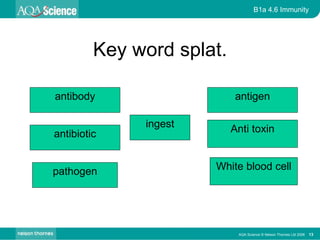
Key word splat. AQA Science © Nelson Thornes Ltd 2006   antibody antigen antibiotic Anti toxin pathogen White blood cell ingest

Immunity

  • 1.
    Immunity Lesson objectivesTo describe how the immune system works. To evaluate how vaccination can help prevent some bacterial and viral diseases.
  • 2.
    WHAT VACCINATIONS HAVEYOU HAD? AQA Science © Nelson Thornes Ltd 2006 
  • 3.
    What vaccinations haveyou had? Diphtheria Tetanus Whooping cough (pertussis) Polio Hib: vaccination against the bacteria Haemophilus influenzae type B, which can cause meningitis, Measles Mumps Rubella (German measles) Meningitis C Pneumococcal: vaccination against the bacteria Streptococcus pneumoniae (known as pneumococcus), which can cause meningitis. AQA Science © Nelson Thornes Ltd 2006 
  • 4.
    Immune system Everycell has unique proteins on its surface called antigens . As we have covered your white blood cells recognise antigens on pathogens as different. Your white blood cells make antibodies to attack and kill the pathogens. AQA Science © Nelson Thornes Ltd 2006 
  • 5.
    The diseases thatchildren are commonly vaccinated against were once childhood killers.
  • 6.
    Immune system Whiteblood cells are able to remember the right antibody needed to tackle a particular pathogen. Immunity happens because next time you meet the pathogen the white blood cells quickly produce the correct antibody. AQA Science © Nelson Thornes Ltd 2006 
  • 7.
    Immune system Youbecome ill the first time you meet a new pathogen. This is because it takes time to find the right antibody. With future infections your body destroys all the invaders before you can become ill. AQA Science © Nelson Thornes Ltd 2006 
  • 8.
    Vaccination. Some pathogensare dangerous because they can kill you before your body makes the right antibodies. These days we can protect ourselves against such diseases by immunisation ( vaccination ) AQA Science © Nelson Thornes Ltd 2006 
  • 9.
    This is howvaccines protect you against dangerous infectious diseases Small amounts of dead or inactive pathogen are put into your body, often by injection. .
  • 10.
    This is howvaccines protect you against dangerous infectious diseases The antigens in the vaccine stimulate your white blood cells into making antibodies.
  • 11.
    This is howvaccines protect you against dangerous infectious diseases You are immune to future infections by the pathogen. This is because your body can respond rapidly and make the correct antibodies as if you had already had the disease.
  • 12.
    This is howvaccines protect you against dangerous infectious diseases
  • 13.
    Key word splat.AQA Science © Nelson Thornes Ltd 2006  antibody antigen antibiotic Anti toxin pathogen White blood cell ingest