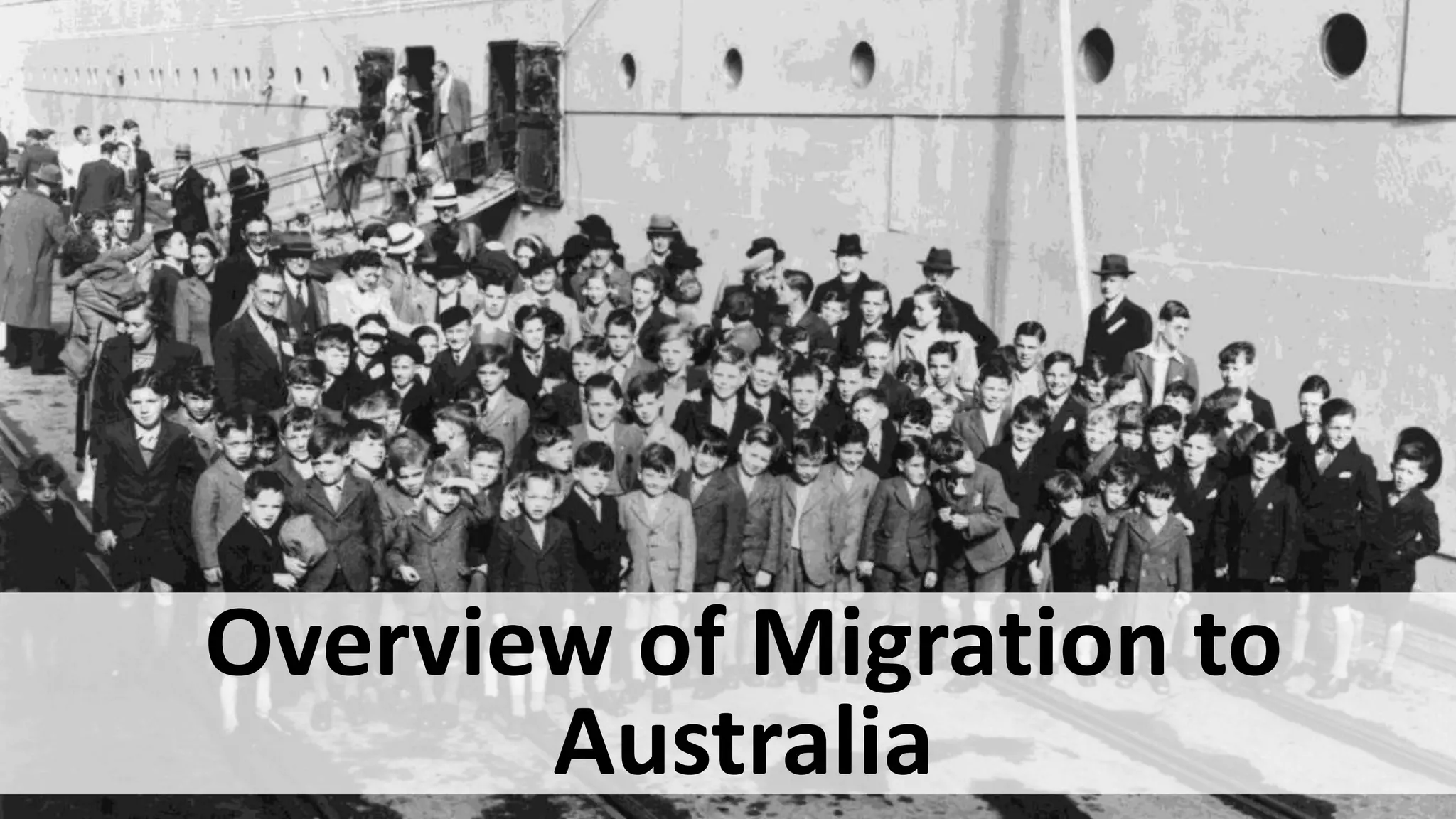
Overview of Migration to 
Australia
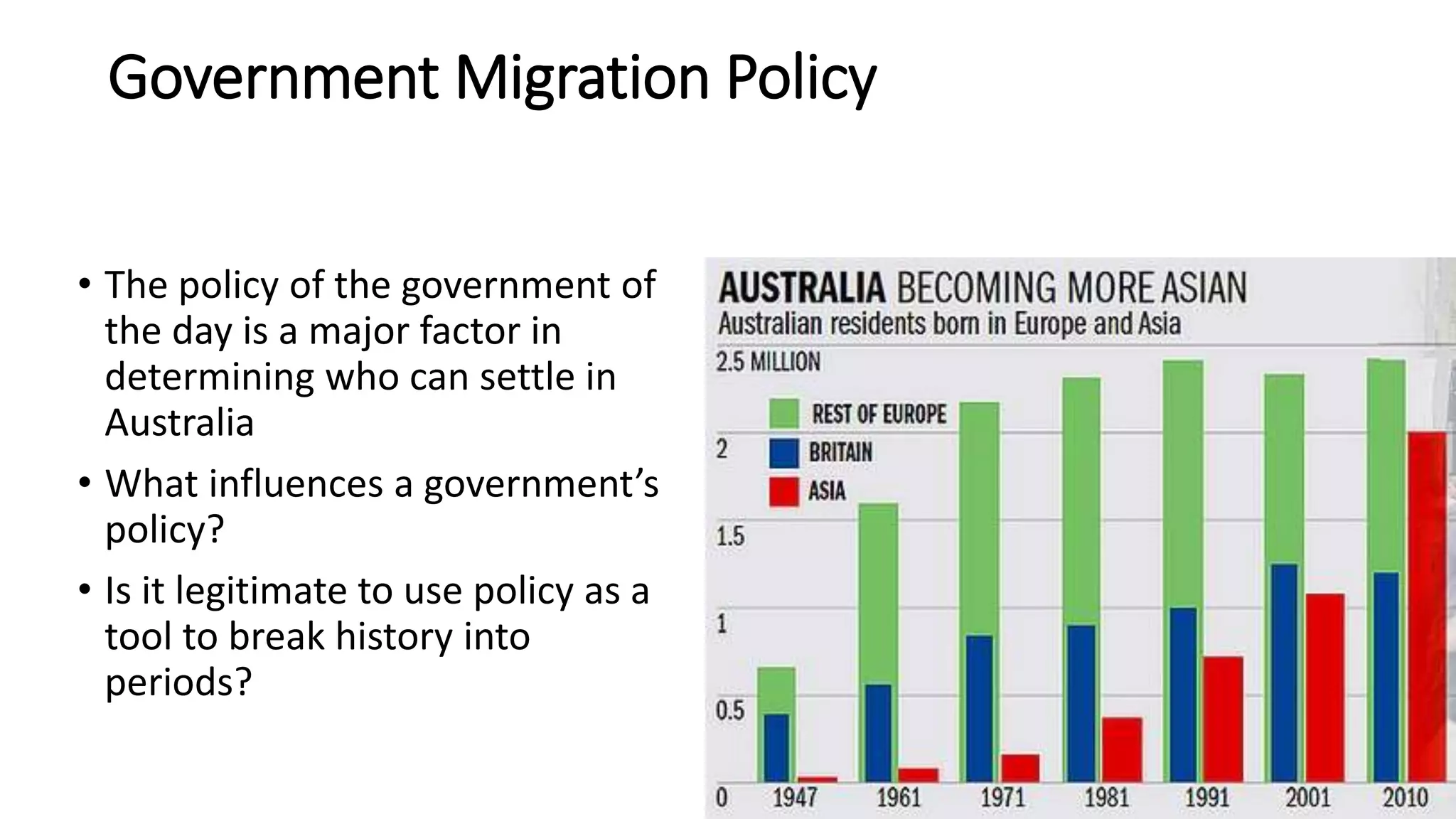
Government Migration Policy 
• The policy of the government of 
the day is a major factor in 
determining who can settle in 
Australia 
• What influences a government’s 
policy? 
• Is it legitimate to use policy as a 
tool to break history into 
periods?
5 Key Phases of Australian Migration Policy 
1. White Australia Policy (1880-1973) 
2. Assimilation Policy (1946-1960s) 
3. Integration Policy (1960s-early 1970s) 
4. Multiculturalism Policy (late 1980s-present) 
5. Reactions to Multiculturalism (late 1990s-present)
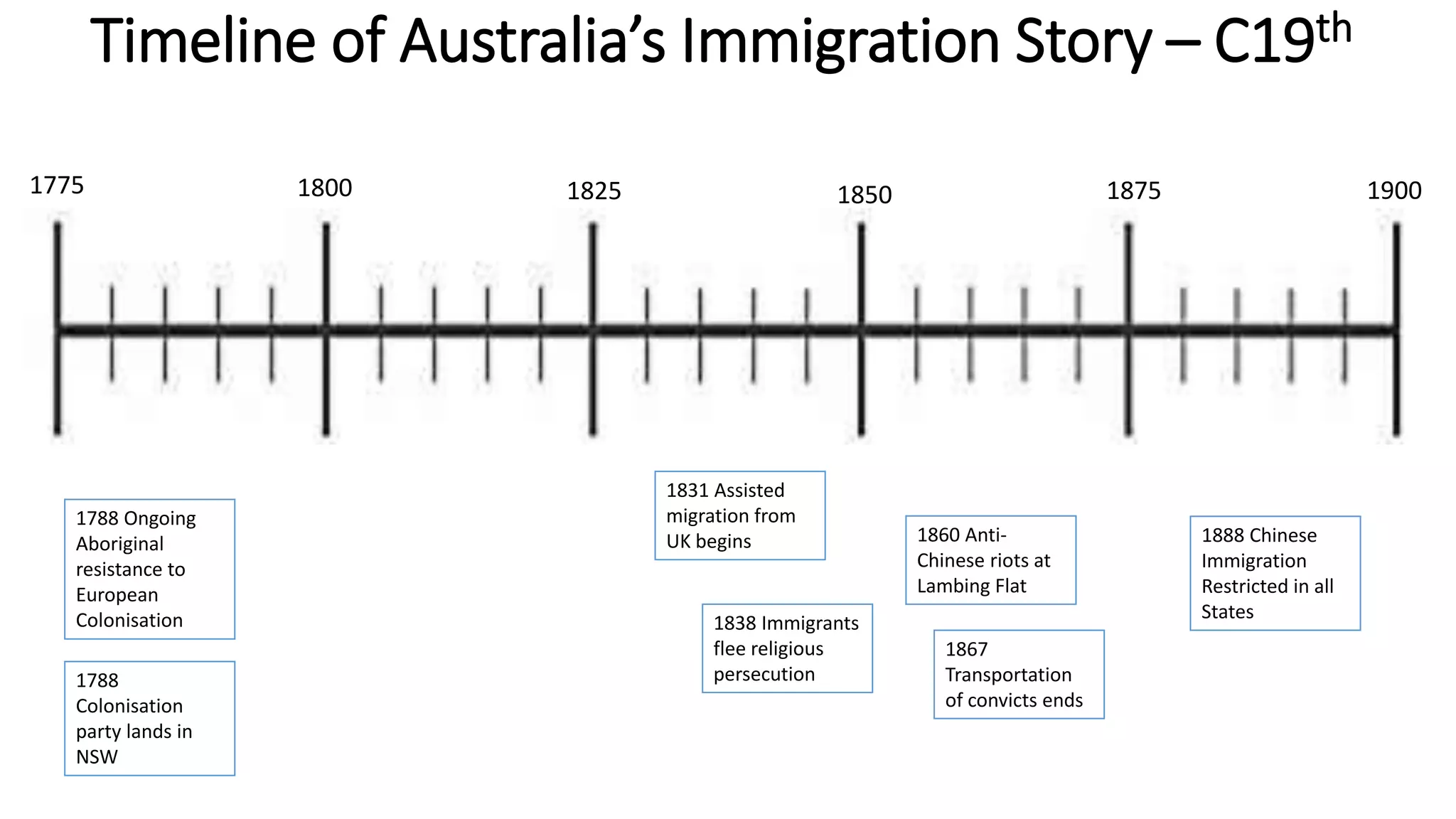
Timeline of Australia’s Immigration Story – C19th 
1800 1825 1850 1875 1900 
1831 Assisted 
migration from 
UK begins 1888 Chinese 
1838 Immigrants 
flee religious 
persecution 
Immigration 
Restricted in all 
States 
1860 Anti- 
Chinese riots at 
Lambing Flat 
1775 
1788 Ongoing 
Aboriginal 
resistance to 
European 
Colonisation 
1788 
Colonisation 
party lands in 
NSW 
1867 
Transportation 
of convicts ends
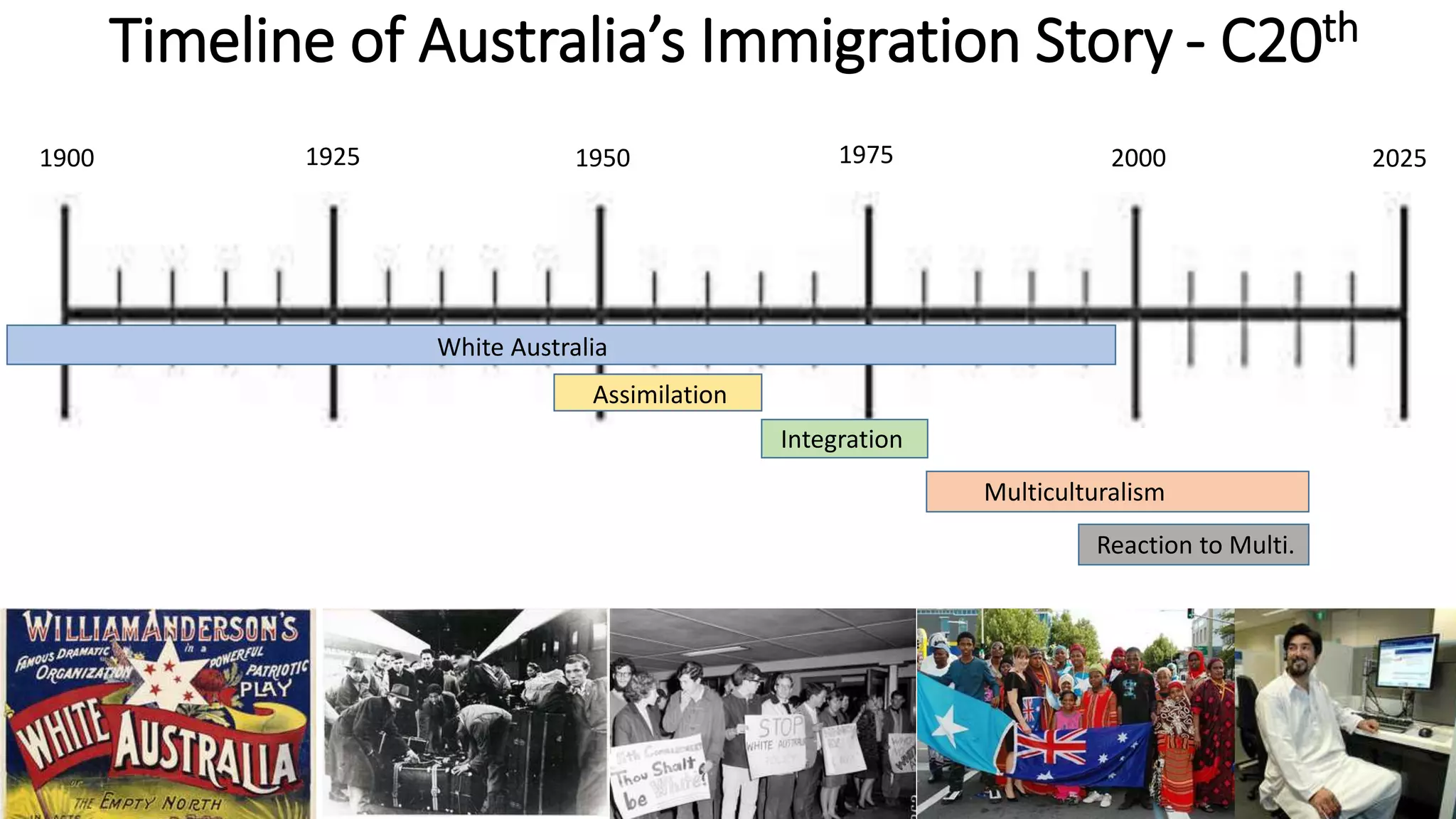
Timeline of Australia’s Immigration Story - C20th 
1900 1925 1950 1975 2000 2025 
White Australia 
Assimilation 
Integration 
Multiculturalism 
Reaction to Multi.
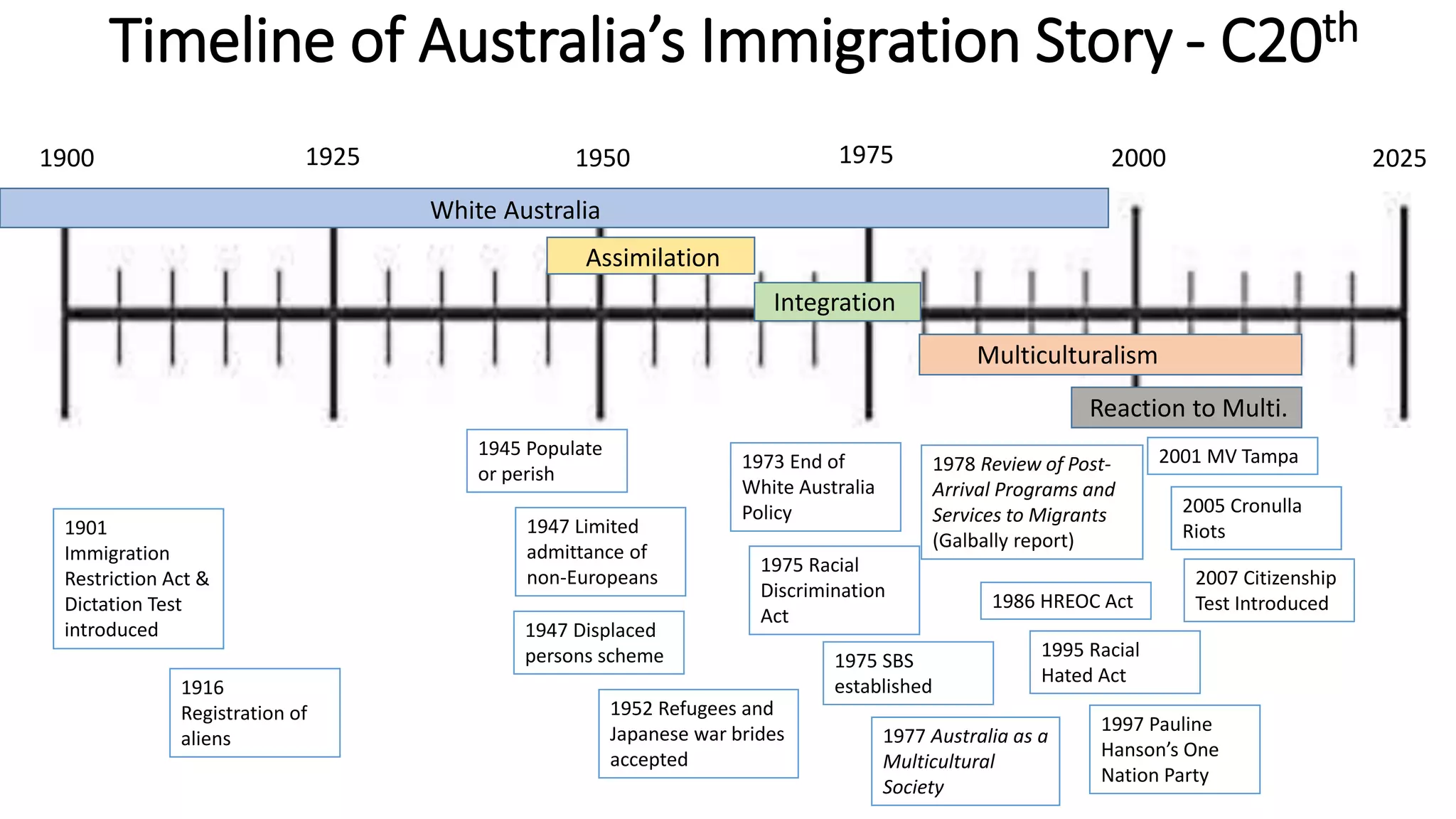
Timeline of Australia’s Immigration Story - C20th 
1900 1925 1950 1975 2000 2025 
White Australia 
Assimilation 
1945 Populate 
or perish 
Integration 
Multiculturalism 
Reaction to Multi. 
1901 
Immigration 
Restriction Act & 
Dictation Test 
introduced 
1947 Limited 
admittance of 
non-Europeans 
1947 Displaced 
persons scheme 
1952 Refugees and 
Japanese war brides 
accepted 
1916 
Registration of 
aliens 
1973 End of 
White Australia 
Policy 
1975 Racial 
Discrimination 
Act 
1986 HREOC Act 
1995 Racial 
Hated Act 
1977 Australia as a 
Multicultural 
Society 
2001 MV Tampa 
2005 Cronulla 
Riots 
2007 Citizenship 
Test Introduced 
1997 Pauline 
Hanson’s One 
Nation Party 
1975 SBS 
established 
1978 Review of Post- 
Arrival Programs and 
Services to Migrants 
(Galbally report)
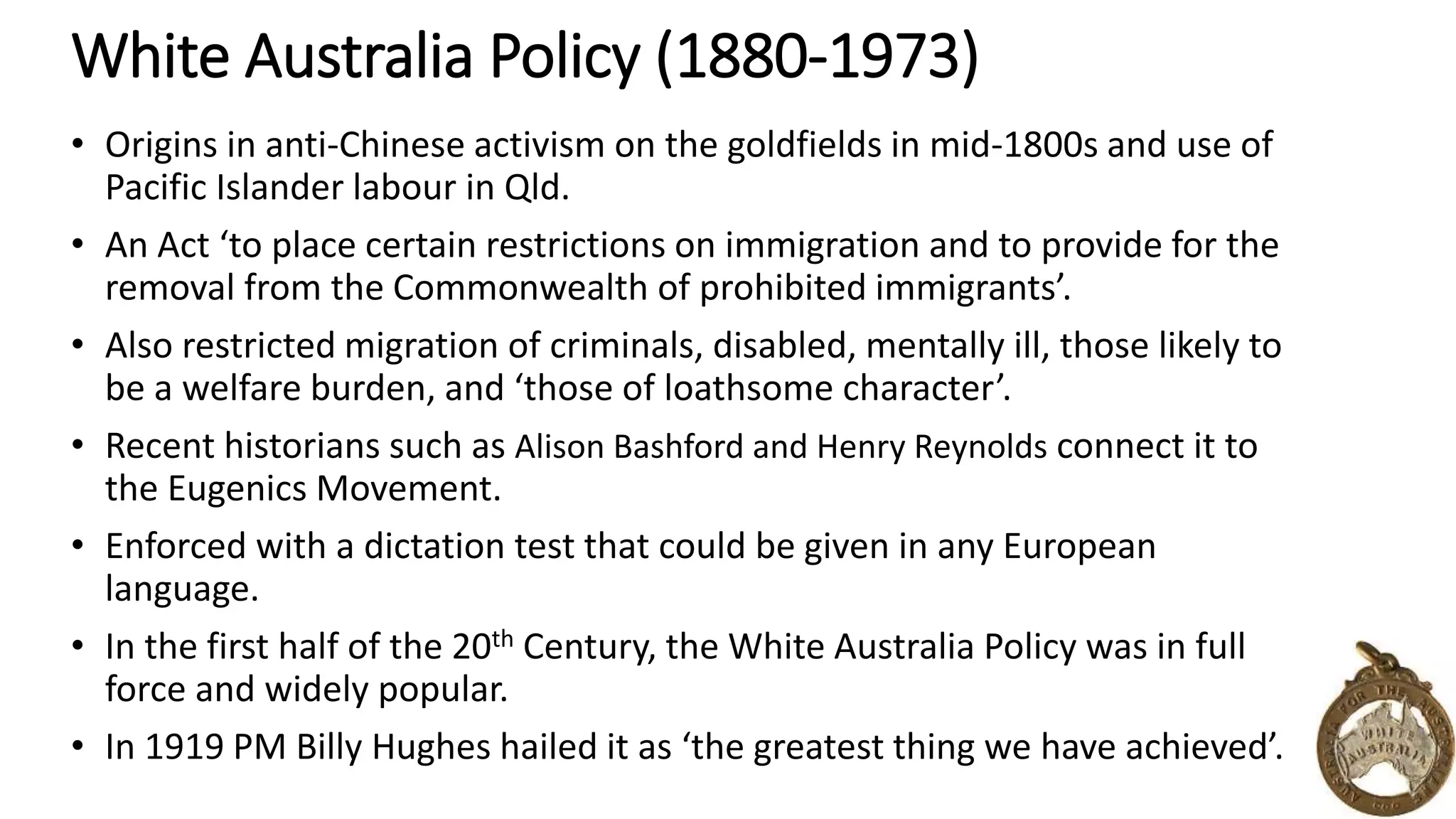
White Australia Policy (1880-1973) 
• Origins in anti-Chinese activism on the goldfields in mid-1800s and use of 
Pacific Islander labour in Qld. 
• An Act ‘to place certain restrictions on immigration and to provide for the 
removal from the Commonwealth of prohibited immigrants’. 
• Also restricted migration of criminals, disabled, mentally ill, those likely to 
be a welfare burden, and ‘those of loathsome character’. 
• Recent historians such as Alison Bashford and Henry Reynolds connect it to 
the Eugenics Movement. 
• Enforced with a dictation test that could be given in any European 
language. 
• In the first half of the 20th Century, the White Australia Policy was in full 
force and widely popular. 
• In 1919 PM Billy Hughes hailed it as ‘the greatest thing we have achieved’.
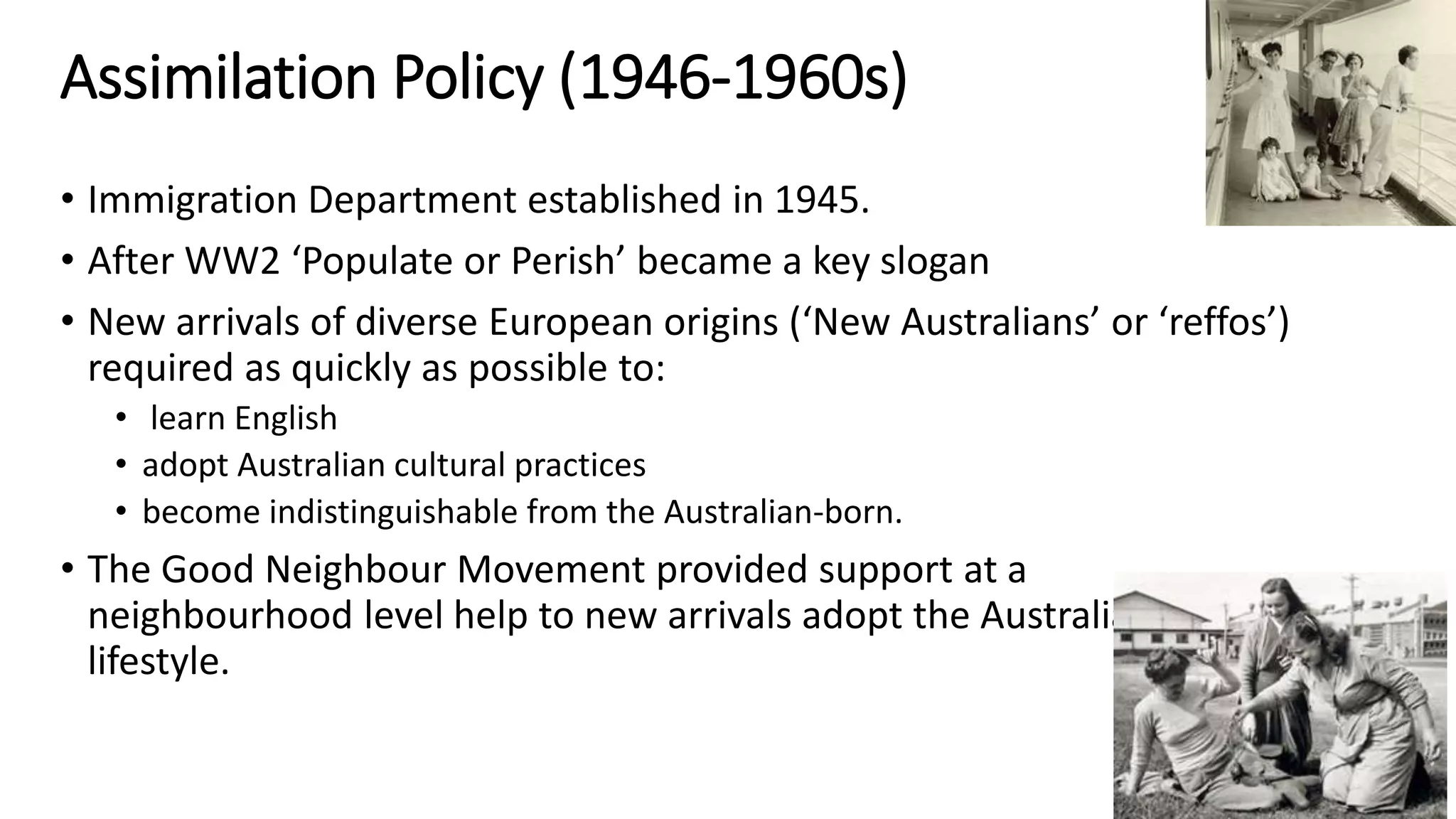
Assimilation Policy (1946-1960s) 
• Immigration Department established in 1945. 
• After WW2 ‘Populate or Perish’ became a key slogan 
• New arrivals of diverse European origins (‘New Australians’ or ‘reffos’) 
required as quickly as possible to: 
• learn English 
• adopt Australian cultural practices 
• become indistinguishable from the Australian-born. 
• The Good Neighbour Movement provided support at a 
neighbourhood level help to new arrivals adopt the Australian 
lifestyle.
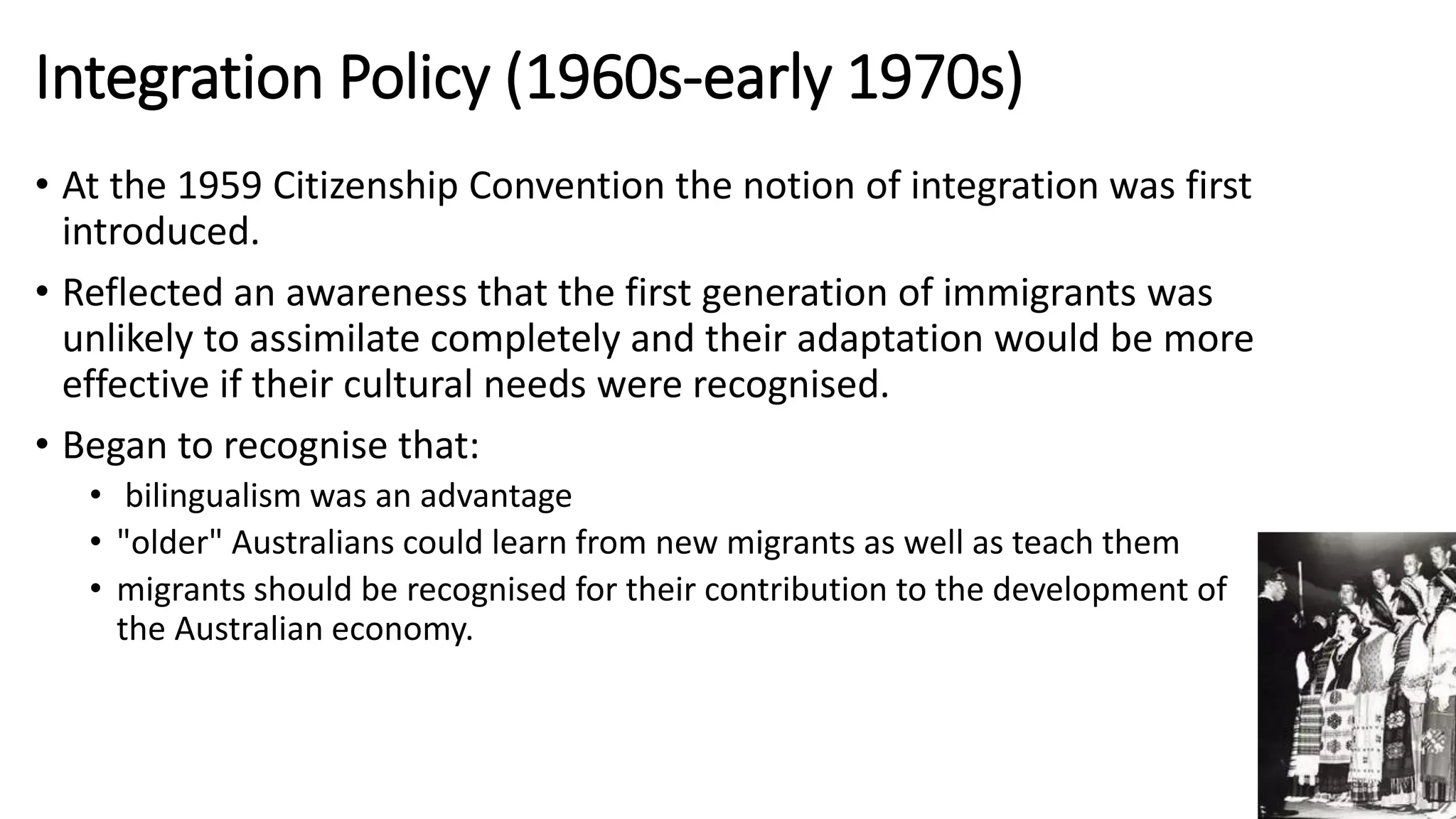
Integration Policy (1960s-early 1970s) 
• At the 1959 Citizenship Convention the notion of integration was first 
introduced. 
• Reflected an awareness that the first generation of immigrants was 
unlikely to assimilate completely and their adaptation would be more 
effective if their cultural needs were recognised. 
• Began to recognise that: 
• bilingualism was an advantage 
• "older" Australians could learn from new migrants as well as teach them 
• migrants should be recognised for their contribution to the development of 
the Australian economy.
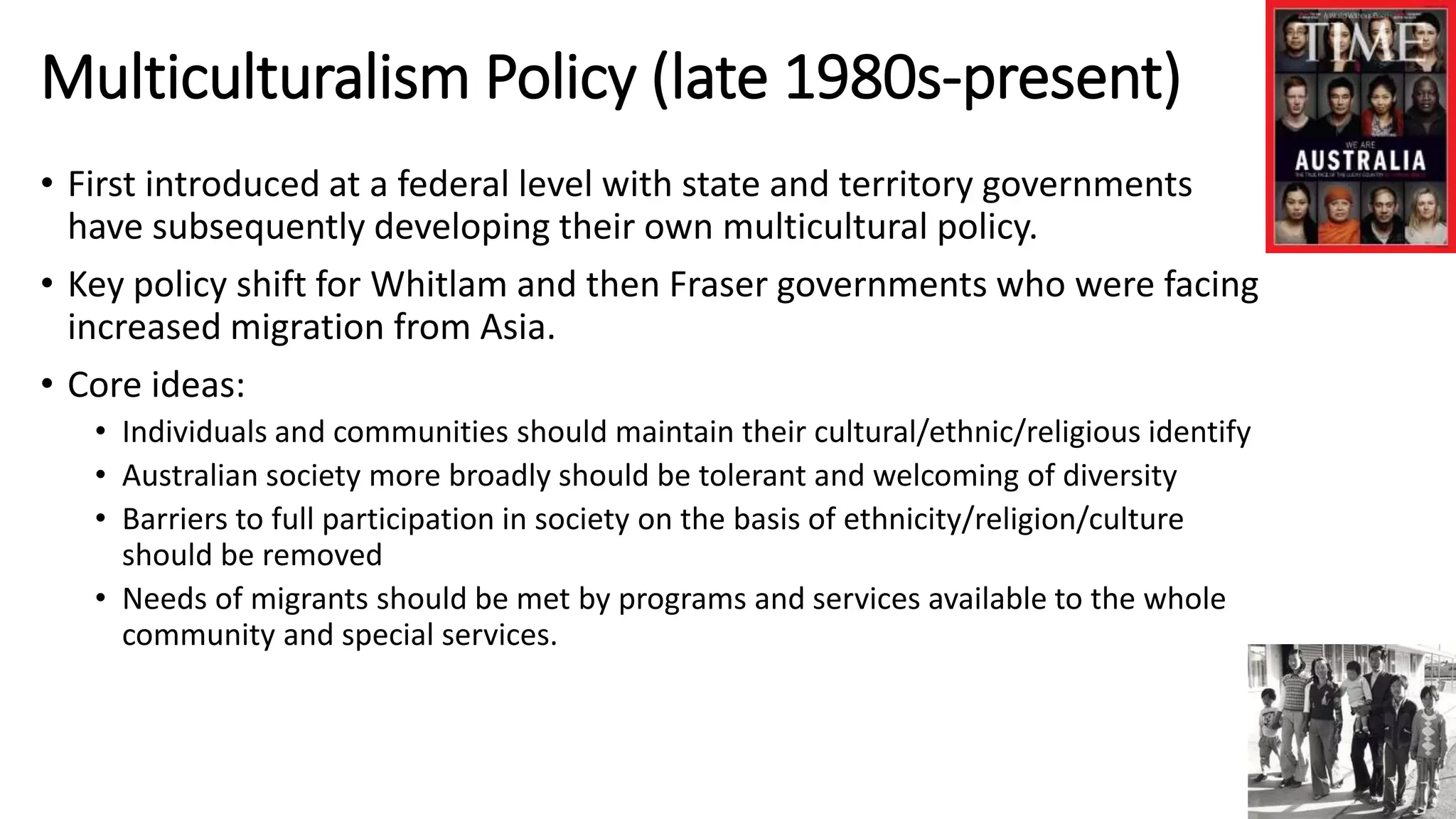
Multiculturalism Policy (late 1980s-present) 
• First introduced at a federal level with state and territory governments 
have subsequently developing their own multicultural policy. 
• Key policy shift for Whitlam and then Fraser governments who were facing 
increased migration from Asia. 
• Core ideas: 
• Individuals and communities should maintain their cultural/ethnic/religious identify 
• Australian society more broadly should be tolerant and welcoming of diversity 
• Barriers to full participation in society on the basis of ethnicity/religion/culture 
should be removed 
• Needs of migrants should be met by programs and services available to the whole 
community and special services.
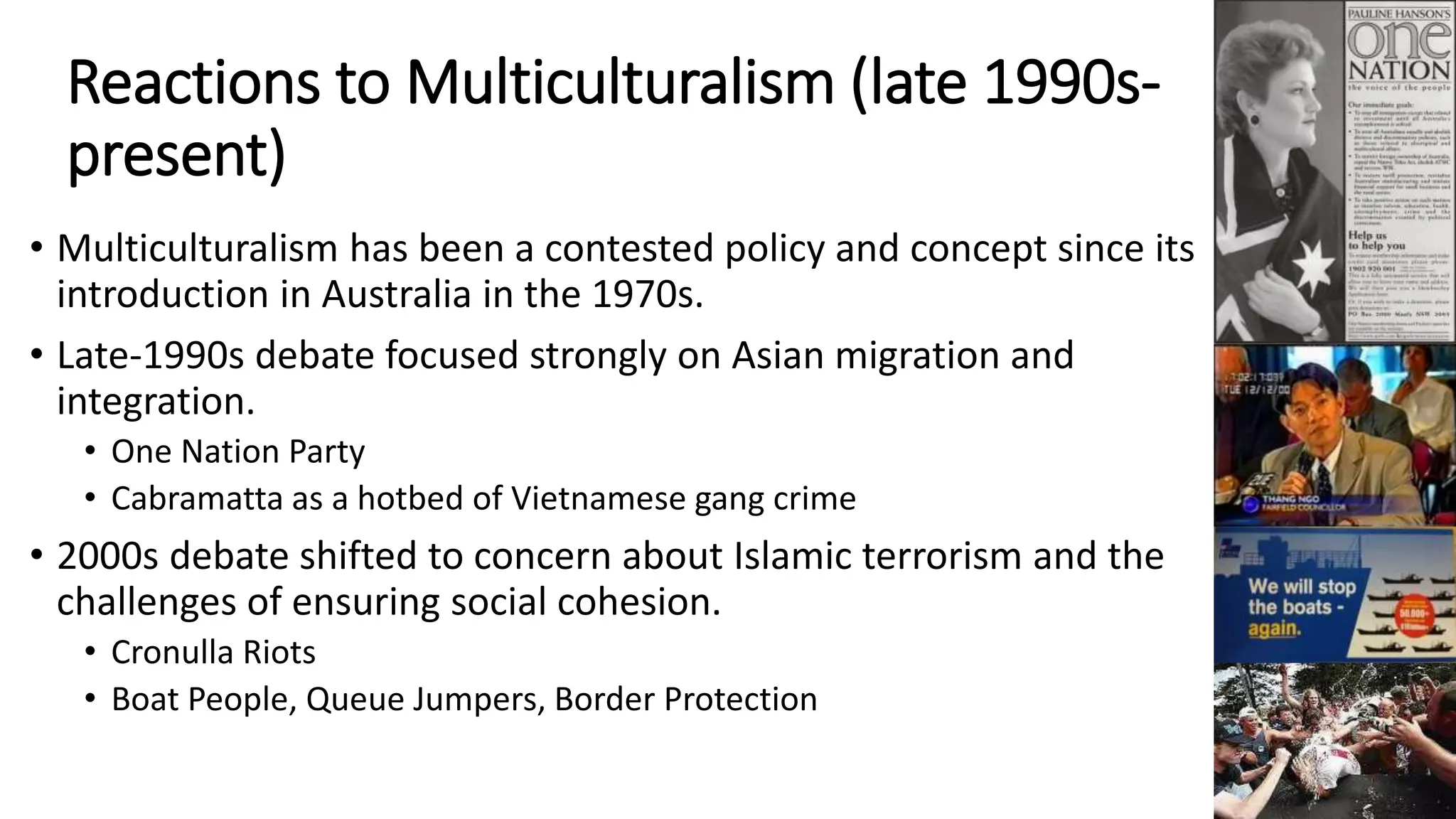
Reactions to Multiculturalism (late 1990s-present) 
• Multiculturalism has been a contested policy and concept since its 
introduction in Australia in the 1970s. 
• Late-1990s debate focused strongly on Asian migration and 
integration. 
• One Nation Party 
• Cabramatta as a hotbed of Vietnamese gang crime 
• 2000s debate shifted to concern about Islamic terrorism and the 
challenges of ensuring social cohesion. 
• Cronulla Riots 
• Boat People, Queue Jumpers, Border Protection

Immigration overview

  • 1.
  • 2.
    Government Migration Policy • The policy of the government of the day is a major factor in determining who can settle in Australia • What influences a government’s policy? • Is it legitimate to use policy as a tool to break history into periods?
  • 3.
    5 Key Phasesof Australian Migration Policy 1. White Australia Policy (1880-1973) 2. Assimilation Policy (1946-1960s) 3. Integration Policy (1960s-early 1970s) 4. Multiculturalism Policy (late 1980s-present) 5. Reactions to Multiculturalism (late 1990s-present)
  • 4.
    Timeline of Australia’sImmigration Story – C19th 1800 1825 1850 1875 1900 1831 Assisted migration from UK begins 1888 Chinese 1838 Immigrants flee religious persecution Immigration Restricted in all States 1860 Anti- Chinese riots at Lambing Flat 1775 1788 Ongoing Aboriginal resistance to European Colonisation 1788 Colonisation party lands in NSW 1867 Transportation of convicts ends
  • 5.
    Timeline of Australia’sImmigration Story - C20th 1900 1925 1950 1975 2000 2025 White Australia Assimilation Integration Multiculturalism Reaction to Multi.
  • 6.
    Timeline of Australia’sImmigration Story - C20th 1900 1925 1950 1975 2000 2025 White Australia Assimilation 1945 Populate or perish Integration Multiculturalism Reaction to Multi. 1901 Immigration Restriction Act & Dictation Test introduced 1947 Limited admittance of non-Europeans 1947 Displaced persons scheme 1952 Refugees and Japanese war brides accepted 1916 Registration of aliens 1973 End of White Australia Policy 1975 Racial Discrimination Act 1986 HREOC Act 1995 Racial Hated Act 1977 Australia as a Multicultural Society 2001 MV Tampa 2005 Cronulla Riots 2007 Citizenship Test Introduced 1997 Pauline Hanson’s One Nation Party 1975 SBS established 1978 Review of Post- Arrival Programs and Services to Migrants (Galbally report)
  • 7.
    White Australia Policy(1880-1973) • Origins in anti-Chinese activism on the goldfields in mid-1800s and use of Pacific Islander labour in Qld. • An Act ‘to place certain restrictions on immigration and to provide for the removal from the Commonwealth of prohibited immigrants’. • Also restricted migration of criminals, disabled, mentally ill, those likely to be a welfare burden, and ‘those of loathsome character’. • Recent historians such as Alison Bashford and Henry Reynolds connect it to the Eugenics Movement. • Enforced with a dictation test that could be given in any European language. • In the first half of the 20th Century, the White Australia Policy was in full force and widely popular. • In 1919 PM Billy Hughes hailed it as ‘the greatest thing we have achieved’.
  • 8.
    Assimilation Policy (1946-1960s) • Immigration Department established in 1945. • After WW2 ‘Populate or Perish’ became a key slogan • New arrivals of diverse European origins (‘New Australians’ or ‘reffos’) required as quickly as possible to: • learn English • adopt Australian cultural practices • become indistinguishable from the Australian-born. • The Good Neighbour Movement provided support at a neighbourhood level help to new arrivals adopt the Australian lifestyle.
  • 9.
    Integration Policy (1960s-early1970s) • At the 1959 Citizenship Convention the notion of integration was first introduced. • Reflected an awareness that the first generation of immigrants was unlikely to assimilate completely and their adaptation would be more effective if their cultural needs were recognised. • Began to recognise that: • bilingualism was an advantage • "older" Australians could learn from new migrants as well as teach them • migrants should be recognised for their contribution to the development of the Australian economy.
  • 10.
    Multiculturalism Policy (late1980s-present) • First introduced at a federal level with state and territory governments have subsequently developing their own multicultural policy. • Key policy shift for Whitlam and then Fraser governments who were facing increased migration from Asia. • Core ideas: • Individuals and communities should maintain their cultural/ethnic/religious identify • Australian society more broadly should be tolerant and welcoming of diversity • Barriers to full participation in society on the basis of ethnicity/religion/culture should be removed • Needs of migrants should be met by programs and services available to the whole community and special services.
  • 11.
    Reactions to Multiculturalism(late 1990s-present) • Multiculturalism has been a contested policy and concept since its introduction in Australia in the 1970s. • Late-1990s debate focused strongly on Asian migration and integration. • One Nation Party • Cabramatta as a hotbed of Vietnamese gang crime • 2000s debate shifted to concern about Islamic terrorism and the challenges of ensuring social cohesion. • Cronulla Riots • Boat People, Queue Jumpers, Border Protection