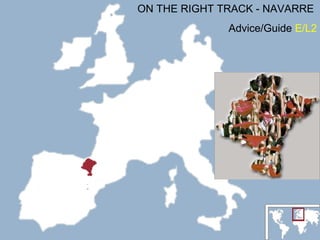
ON THE RIGHT TRACK - NAVARRE  Advice/ Guide  E/L2
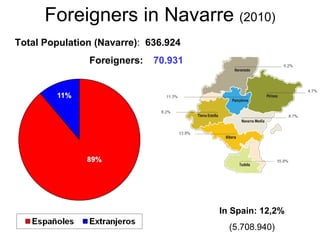
Foreigners in Navarre  (2010) In Spain: 12,2% (5.708.940) Total Population (Navarre) :  636.924   Foreigners:   70.931
Morocco:  9.572 Ecuador: 9.394 Romania: 6.585 Bulgaria: 6.485 Portugal: 5.892 Colombia: 4.356 Foreigners by Nationality Otras
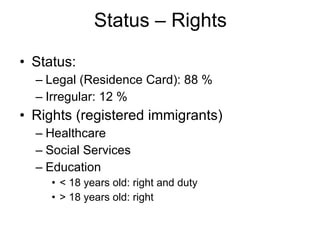
Status – Rights Status: Legal (Residence Card): 88 % Irregular: 12 % Rights (registered immigrants) Healthcare Social Services Education < 18 years old: right and duty > 18 years old: right
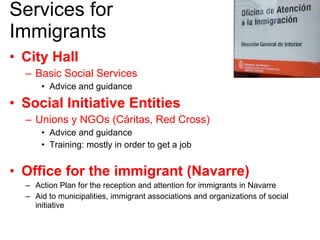
Services for Immigrants City Hall Basic Social Services Advice and guidance Social Initiative Entities Unions y NGOs (Cáritas, Red Cross) Advice and guidance Training: mostly in order to get a job Office for the immigrant (Navarre) Action Plan for the reception and attention for immigrants in Navarre Aid to municipalities, immigrant associations and organizations of social initiative
Adult Education Make effective the right to education for immigrants over 18 years old to facilitate integration Specific courses: Language Briefing of lifestyle in Navarre Highway Code Programmes leading to degrees Compulsory Post-compulsory
Adult Education – E/L2 Adult Education Centers Pamplona Tudela Adult Education Classrooms Noroeste Tierra Estella Ribera Media Pirineo Territorial distribution of foreign population in Navarre (2009)
PAMPLONA CPEBPA José Mª Iribarren  Regional/Zone Public Centre . The activities take place in: Downtown Classrooms in Pamplona’s neighbourhoods (5) Classrooms in the Penitentiary Centre in Pamplona Classrooms in the region’s towns (8) September 2010 enrolment:  1.576 Teaching staff:  21 teachers (f) + 11 teachers (m)
Alternatives / Choices Basic Education:  191 Literacy. Disabled Adults. People at social exclusion risk. Spanish (E/L2):  641 Personal training:  744 Languages (French and English) Computers Literary gathering On-line courses (Mentor)
Participants Spaniards/Foreigners Basic Education: 191 Spaniards:  128 Foreigners:  63 Spanish (E/L2):  641 Personal Training: 744 Spaniards:  678 Foreigners:  66 806 -  770
Foreigners - Courses Basic Education:  63 Spanish (E/L2):  641 Personal training:  66 +  Highway Code courses:  50
Participants - Gender Foreigners Spaniards
Foreigners - nationality Morocco:  125 Bulgaria:  98 Senegal:  78 Nigeria:  54 Romania:  40 Brazil:  31 China:  30 Poland:  29 Ghana:  28 Ecuador:  26 66 nationalities
Contacts: Social Services– District Units Municipal Councillors in Education Associations for Immigrants Red Cross, Cáritas and other NGOs Schools Posters, leaflets Web site Dissemination
 
Courses E/L2 - Levels Teaching staff: 14 Levels Courses Participants Weekly Schedule A0 15 198 7-8 hours A1 11 206 6 hours A2 4 107 6 hours B1 4 85 4 hours B2 2 45 3 hours
Welcome - Guidance A0 - A1- A2 - B1 - B2 Interview ( Oral level) A0 WRITTEN TEST A1-A2-B1-B2 First weeks (Observation) (Tutoring + level test AVE) Basic Training ILLITERATE Basic Training
Welcome: When – Who  Regular periods: September - February Prior to the start of the course Morning and afternoon Most of the teaching staff Throughout the course Hours of opening: welcome (morning and afternoon) E/L2 teaching staff Registration and level test: Place available    registration There is no place    waiting list
Registration Registration Free (7€ for materials) Photo Legal status is not required Attendance Student will be removed if they do not attend for 3 weeks without justifying the absence Special guidance: basic income, support … Available places filled from the waiting list Personal phone call
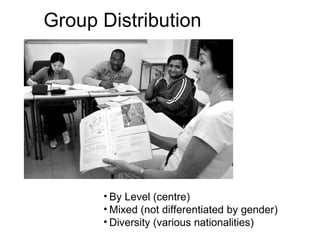
Group Distribution By Level (centre) Mixed (not differentiated by gender) Diversity (various nationalities)
Heterogeneous groups:  age, nationality, gender
Curricular Plan Cervantes Institute Curricular Plan:  Reference levels for Spanish as recommended by the Council of Europe.
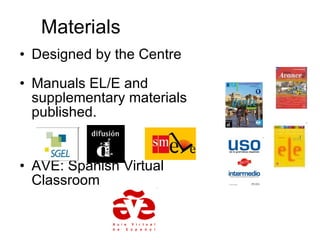
Materials Designed by the Centre Manuals EL/E and supplementary materials published. AVE: Spanish Virtual Classroom
Spanish Virtual Classroom (AVE)
Spanish Virtual Classroom (A2.1)
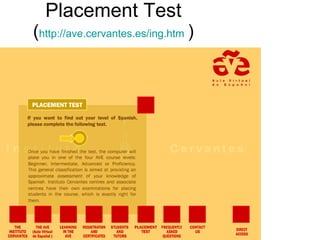
Placement Test ( http://ave.cervantes.es/ing.htm   )
Certificates Centre Attendance Hours Level Cervantes Institute (DELE) Official certificate Levels: A1 - A2 - B1 (Basic) - B2 (Intermediate) - C1 - C2 (Advanced). Authorized centres: universities. Three examination sessions: May, August, November. Fees: 75 – 135 € (depending on level).
Surveys 307 surveys.  A0 :  74 A1 :  108  A2 :  65 B :  60 To assess : Information and dissemination Welcome and guidance Courses
Participants People in A1, A2, B levels attend the centre on arrival to the country (> 70% the first year). People with little training / education take longer in attending the centre: 34 % of A0 have been 6 years or more in Spain. 23 % of the people return to the centre after withdrawing from class.
How do they know about the courses? -Friends, family, relatives  -City Hall -Posters, leaflets -Associations for  immigrants -Other
The most valued Teaching staff: kindness, preparation,  Centre: organization, cleanliness, proximity, media, library, computers, internet. Variety of schedules. Excursions and cultural activities. Very cheap.
To improve More hours To offer more courses for professional training More time on computers More library hours More cultural activities
Welcome Orientation The most valued Relation with the teaching staff Group, colleagues Materials Complementary Activities To improve First contact Information about the Centre activities Information about the course Number of hours
SWOT INTERNAL FACTORS WEAKNESSES Continuous incorporation of new students. Lack of tutorial attention before entering the group Teachers’ disparity on the interpretation of the welcome criteria Group instability due to the student changes Irregular attendance and high level of drop outs Not enough amount of teaching hours for the lowest levels The Centre doesn’t have a Coaching Department Group diversity to be monitored by each teacher. Difficulties when coordinating STRENGTHS Teachers’ positive and open attitude towards the diversity of nationalities and cultures Teachers’ experience on adult education Flexible offer, adapted to the student needs and interests. Variety of levels and timetables. The Centre has appropriate facilities and technological resources. Good atmosphere at school. New teachers are supported by the rest of staff and management. Library with book loan and Internet service for students. Teaching staff satisfaction for the work done and the degree of achievement of the foreseen objectives.
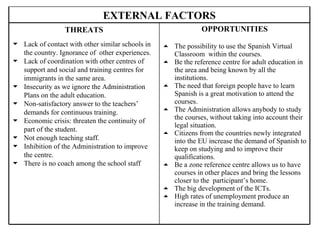
EXTERNAL FACTORS THREATS Lack of contact with other similar schools in the country. Ignorance of  other experiences. Lack of coordination with other centres of support and social and training centres for immigrants in the same area. Insecurity as we ignore the Administration Plans on the adult education. Non-satisfactory answer to the teachers’ demands for continuous training. Economic crisis: threaten the continuity of part of the student. Not enough teaching staff. Inhibition of the Administration to improve the centre. There is no coach among the school staff OPPORTUNITIES The possibility to use the Spanish Virtual Classroom  within the courses. Be the reference centre for adult education in the area and being known by all the institutions. The need that foreign people have to learn Spanish is a great motivation to attend the courses. The Administration allows anybody to study the courses, without taking into account their legal situation. Citizens from the countries newly integrated into the EU increase the demand of Spanish to keep on studying and to improve their qualifications.  Be a zone reference centre allows us to have courses in other places and bring the lessons closer to the  participant’s home. The big development of the ICTs. High rates of unemployment produce an increase in the training demand .

Malmo presentation english2

  • 1.
    ON THE RIGHTTRACK - NAVARRE Advice/ Guide E/L2
  • 2.
    Foreigners in Navarre (2010) In Spain: 12,2% (5.708.940) Total Population (Navarre) : 636.924 Foreigners: 70.931
  • 3.
    Morocco: 9.572Ecuador: 9.394 Romania: 6.585 Bulgaria: 6.485 Portugal: 5.892 Colombia: 4.356 Foreigners by Nationality Otras
  • 4.
    Status – RightsStatus: Legal (Residence Card): 88 % Irregular: 12 % Rights (registered immigrants) Healthcare Social Services Education < 18 years old: right and duty > 18 years old: right
  • 5.
    Services for ImmigrantsCity Hall Basic Social Services Advice and guidance Social Initiative Entities Unions y NGOs (Cáritas, Red Cross) Advice and guidance Training: mostly in order to get a job Office for the immigrant (Navarre) Action Plan for the reception and attention for immigrants in Navarre Aid to municipalities, immigrant associations and organizations of social initiative
  • 6.
    Adult Education Makeeffective the right to education for immigrants over 18 years old to facilitate integration Specific courses: Language Briefing of lifestyle in Navarre Highway Code Programmes leading to degrees Compulsory Post-compulsory
  • 7.
    Adult Education –E/L2 Adult Education Centers Pamplona Tudela Adult Education Classrooms Noroeste Tierra Estella Ribera Media Pirineo Territorial distribution of foreign population in Navarre (2009)
  • 8.
    PAMPLONA CPEBPA JoséMª Iribarren Regional/Zone Public Centre . The activities take place in: Downtown Classrooms in Pamplona’s neighbourhoods (5) Classrooms in the Penitentiary Centre in Pamplona Classrooms in the region’s towns (8) September 2010 enrolment: 1.576 Teaching staff: 21 teachers (f) + 11 teachers (m)
  • 9.
    Alternatives / ChoicesBasic Education: 191 Literacy. Disabled Adults. People at social exclusion risk. Spanish (E/L2): 641 Personal training: 744 Languages (French and English) Computers Literary gathering On-line courses (Mentor)
  • 10.
    Participants Spaniards/Foreigners BasicEducation: 191 Spaniards: 128 Foreigners: 63 Spanish (E/L2): 641 Personal Training: 744 Spaniards: 678 Foreigners: 66 806 - 770
  • 11.
    Foreigners - CoursesBasic Education: 63 Spanish (E/L2): 641 Personal training: 66 + Highway Code courses: 50
  • 12.
    Participants - GenderForeigners Spaniards
  • 13.
    Foreigners - nationalityMorocco: 125 Bulgaria: 98 Senegal: 78 Nigeria: 54 Romania: 40 Brazil: 31 China: 30 Poland: 29 Ghana: 28 Ecuador: 26 66 nationalities
  • 14.
    Contacts: Social Services–District Units Municipal Councillors in Education Associations for Immigrants Red Cross, Cáritas and other NGOs Schools Posters, leaflets Web site Dissemination
  • 15.
  • 16.
    Courses E/L2 -Levels Teaching staff: 14 Levels Courses Participants Weekly Schedule A0 15 198 7-8 hours A1 11 206 6 hours A2 4 107 6 hours B1 4 85 4 hours B2 2 45 3 hours
  • 17.
    Welcome - GuidanceA0 - A1- A2 - B1 - B2 Interview ( Oral level) A0 WRITTEN TEST A1-A2-B1-B2 First weeks (Observation) (Tutoring + level test AVE) Basic Training ILLITERATE Basic Training
  • 18.
    Welcome: When –Who Regular periods: September - February Prior to the start of the course Morning and afternoon Most of the teaching staff Throughout the course Hours of opening: welcome (morning and afternoon) E/L2 teaching staff Registration and level test: Place available  registration There is no place  waiting list
  • 19.
    Registration Registration Free(7€ for materials) Photo Legal status is not required Attendance Student will be removed if they do not attend for 3 weeks without justifying the absence Special guidance: basic income, support … Available places filled from the waiting list Personal phone call
  • 20.
    Group Distribution ByLevel (centre) Mixed (not differentiated by gender) Diversity (various nationalities)
  • 21.
    Heterogeneous groups: age, nationality, gender
  • 22.
    Curricular Plan CervantesInstitute Curricular Plan: Reference levels for Spanish as recommended by the Council of Europe.
  • 23.
    Materials Designed bythe Centre Manuals EL/E and supplementary materials published. AVE: Spanish Virtual Classroom
  • 24.
  • 25.
  • 26.
    Placement Test (http://ave.cervantes.es/ing.htm )
  • 27.
    Certificates Centre AttendanceHours Level Cervantes Institute (DELE) Official certificate Levels: A1 - A2 - B1 (Basic) - B2 (Intermediate) - C1 - C2 (Advanced). Authorized centres: universities. Three examination sessions: May, August, November. Fees: 75 – 135 € (depending on level).
  • 28.
    Surveys 307 surveys. A0 : 74 A1 : 108 A2 : 65 B : 60 To assess : Information and dissemination Welcome and guidance Courses
  • 29.
    Participants People inA1, A2, B levels attend the centre on arrival to the country (> 70% the first year). People with little training / education take longer in attending the centre: 34 % of A0 have been 6 years or more in Spain. 23 % of the people return to the centre after withdrawing from class.
  • 30.
    How do theyknow about the courses? -Friends, family, relatives -City Hall -Posters, leaflets -Associations for immigrants -Other
  • 31.
    The most valuedTeaching staff: kindness, preparation, Centre: organization, cleanliness, proximity, media, library, computers, internet. Variety of schedules. Excursions and cultural activities. Very cheap.
  • 32.
    To improve Morehours To offer more courses for professional training More time on computers More library hours More cultural activities
  • 33.
    Welcome Orientation Themost valued Relation with the teaching staff Group, colleagues Materials Complementary Activities To improve First contact Information about the Centre activities Information about the course Number of hours
  • 34.
    SWOT INTERNAL FACTORSWEAKNESSES Continuous incorporation of new students. Lack of tutorial attention before entering the group Teachers’ disparity on the interpretation of the welcome criteria Group instability due to the student changes Irregular attendance and high level of drop outs Not enough amount of teaching hours for the lowest levels The Centre doesn’t have a Coaching Department Group diversity to be monitored by each teacher. Difficulties when coordinating STRENGTHS Teachers’ positive and open attitude towards the diversity of nationalities and cultures Teachers’ experience on adult education Flexible offer, adapted to the student needs and interests. Variety of levels and timetables. The Centre has appropriate facilities and technological resources. Good atmosphere at school. New teachers are supported by the rest of staff and management. Library with book loan and Internet service for students. Teaching staff satisfaction for the work done and the degree of achievement of the foreseen objectives.
  • 35.
    EXTERNAL FACTORS THREATSLack of contact with other similar schools in the country. Ignorance of other experiences. Lack of coordination with other centres of support and social and training centres for immigrants in the same area. Insecurity as we ignore the Administration Plans on the adult education. Non-satisfactory answer to the teachers’ demands for continuous training. Economic crisis: threaten the continuity of part of the student. Not enough teaching staff. Inhibition of the Administration to improve the centre. There is no coach among the school staff OPPORTUNITIES The possibility to use the Spanish Virtual Classroom within the courses. Be the reference centre for adult education in the area and being known by all the institutions. The need that foreign people have to learn Spanish is a great motivation to attend the courses. The Administration allows anybody to study the courses, without taking into account their legal situation. Citizens from the countries newly integrated into the EU increase the demand of Spanish to keep on studying and to improve their qualifications. Be a zone reference centre allows us to have courses in other places and bring the lessons closer to the participant’s home. The big development of the ICTs. High rates of unemployment produce an increase in the training demand .