The University of Sydney Page 1
Cultural
Intermediation,
Algorithmic Culture
and Public Service
Media:
Social media, co-
creation and influence
Presented by
Dr Jonathon Hutchinson
Department of Media and Communication
jonathon.hutchinson@sydney.edu.au
The University of Sydney Page 2
Today…
– Think through how we (audiences/users) consume
media – and the impact of algorithms
– How are algorithms impacting on culture?
– What is public service media (PSM)?
– How should PSM be engaging in algorithmic culture?
– Explore one program that demonstrates PSM algorithmic
culture, #7DaysLater
The University of Sydney Page 3
The University of Sydney Page 4
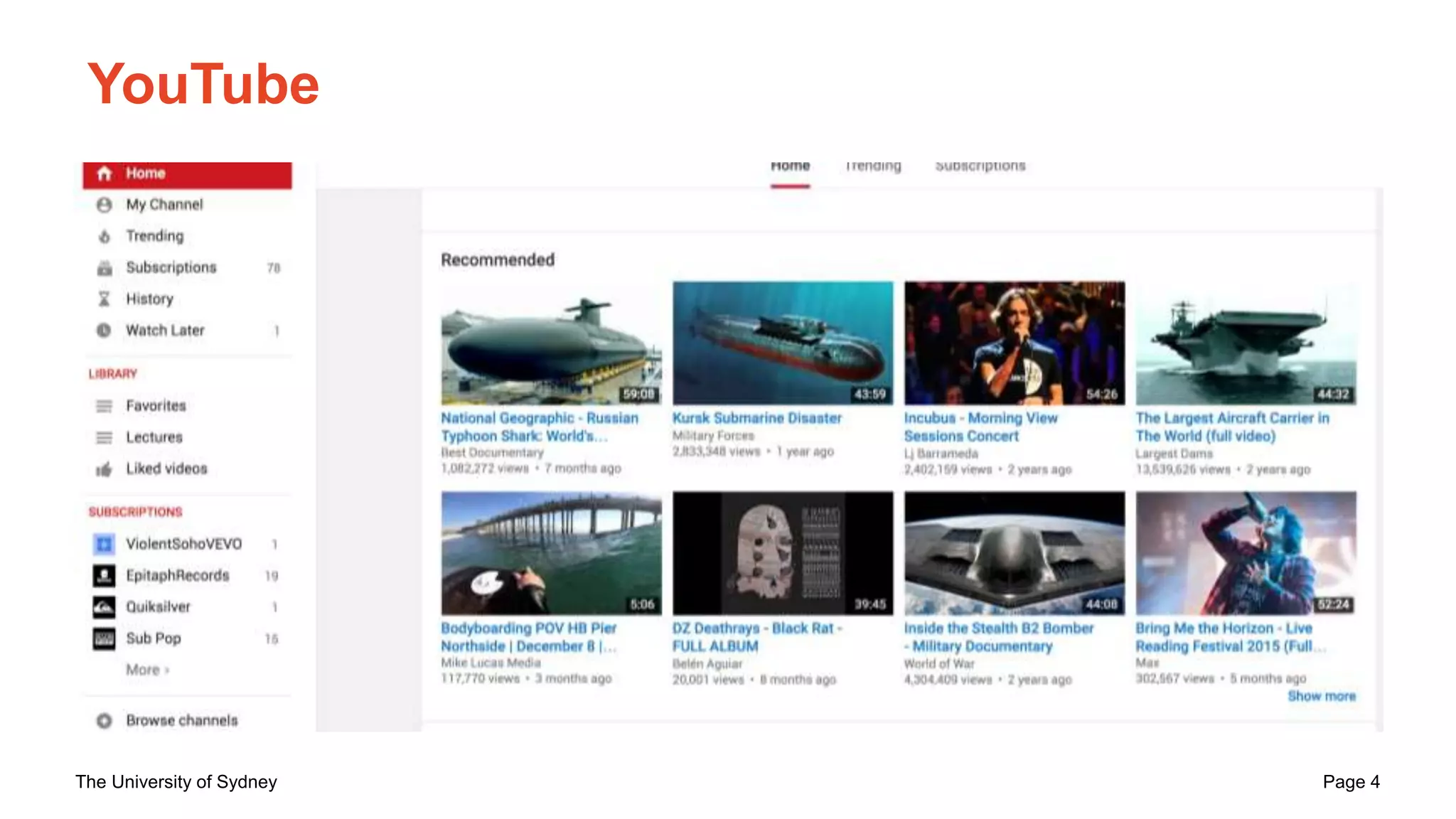
YouTube
The University of Sydney Page 5
Interactive time…
https://play.kahoot.it/#/k/1a401610-0050-
4e85-96c7-9e87bf1c077c
The University of Sydney Page 6
How are algorithms shaping our culture?
– Think of this through a media studies lens
– Raymond Williams notes culture is specific to each
society, where “the making of a society is the finding of
common meanings and directions” (1989)
– How does technology impact on that definition?
– Newspapers during the late 90s limiting the ‘publicness’
due to technological advances in printing and distribution
– Algorithms in contemporary space – also limiting the
publicness?
The University of Sydney Page 7
Public Service Media (PSM)
The University of Sydney Page 8
Public Service Media (PSM)
– “has been tasked to serve the societal and cultural
needs of each member nation and to promote
democracy and participation within the national
geographical boundaries” (Głowacki, 2015, p. 26)
– Built on PSB, which “was to inform, educate and
entertain with total independence from political power
and commercial pressure” (Tremblay, 2016, p. 194)
– The thematic shift from PSB and towards PSM is taken
as “common parlance as services are extended across
‘new’ media platforms and experiments undertaken into
new interactive content forms” (Debrett, 2015, p. 557).
The University of Sydney Page 9
PSM under pressure
– Barnett (2015) remind us that PSM is increasingly under
attack because of conservative governments,
introspective and disorganised left political parties,
hostile media environments, and substantially reduced
funding arrangements
– Tremblay (2016) also observes the mounting pressure
by governments on PSM in its “systematic reduction” in
the field of media and communication, which he notes as
a “gradual and calculated suffocation of public service
media” (p. 192).
– PSM value tests
The University of Sydney Page 10
The Checkout…
http://www.abc.net.au/tv/thecheckout/clips
/
The University of Sydney Page 11
PSM from the research perspective
– Supported through arguments that note it should provide
new multiplatform services beyond television and radio
(Steemers, 2016)
– It is a tool for online citizenship and civic engagement
(Debrett, 2015)
– A locale for ‘distinctive’ media system innovation
(Cunningham, 2015)
The University of Sydney Page 12
PSM: tokenistic participation?
– Głowacki and Jackson (2014) highlight that websites are
often ‘bolt-on’ extras for marketing purposes
– Jakubowicz (2014): “seems to remain in most cases [as]
marginal forms, either designed to obtain input … that
professional journalists use in producing their
programmes, under their exclusive control, or web pages
… serving as a display case for UGC” (p. 229)
– No one is looking at algorithmic cultures, particularly
through social media
The University of Sydney Page 13
Participation is dead?
– While it has gone out of style, participation is crucial for
cultural production
– Monitoring user behaviour is certainly how media is
distributed, if not produced – e.g. Buzzfeed and Vice
Magazine
– But what about public issues and the impact of social
media?
– “Social media play a prominent role in mediating issues
of public concern, not only providing the stage on which
public debates play out, but also shaping their topics and
dynamics” (Burgess & Matamoros-Fernández, 2016)
The University of Sydney Page 14
What’s an algorithm?
https://www.youtube.com/watch?v=6hfOv
s8pY1k
The University of Sydney Page 15
Who cares about algorithms?
– Netflix: bad programming
– YouTube: bad videos
– PSM: Incorrect public issues
– “offloading of cultural work onto computers, databases
and other types of digital technologies has prompted a
reshuffling of some of the words most closely associated
with culture, giving rise to new senses of the term that
may be experientially available but have yet to be well
named, documented or recorded” (Striphas, 2015: 395)
The University of Sydney Page 16
Cultural Intermediaries
– Taste agents (Bourdieu,1984)
– Market agents (Negus, 2002)
– Institutional taste and cultural agents (Hutchinson, 2016)
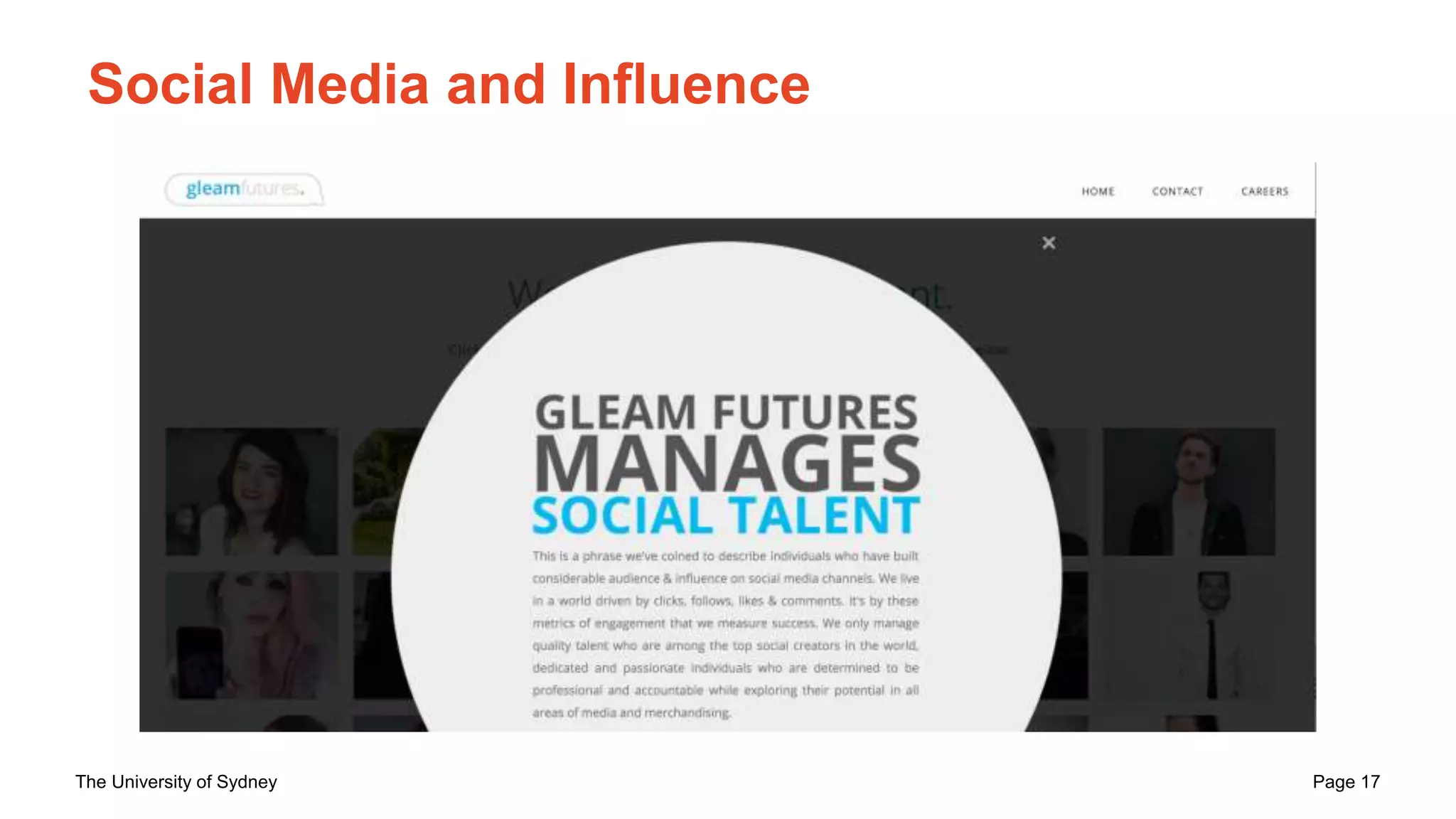
– Multi Channel Networks who facilitate social media
cultural intermediaries
– Essena O’Neill, Fun For Louis, MoreZoella
The University of Sydney Page 17
Social Media and Influence
The University of Sydney Page 18
Cultural intermediaries and PSM
– Can be termed microinfluencers (Abidin, 2015)
– Essential for distributing content
– Generate crucial public issues through social media
– Feed issues back into PSM
– Think of Triple J Hack, for example
The University of Sydney Page 19
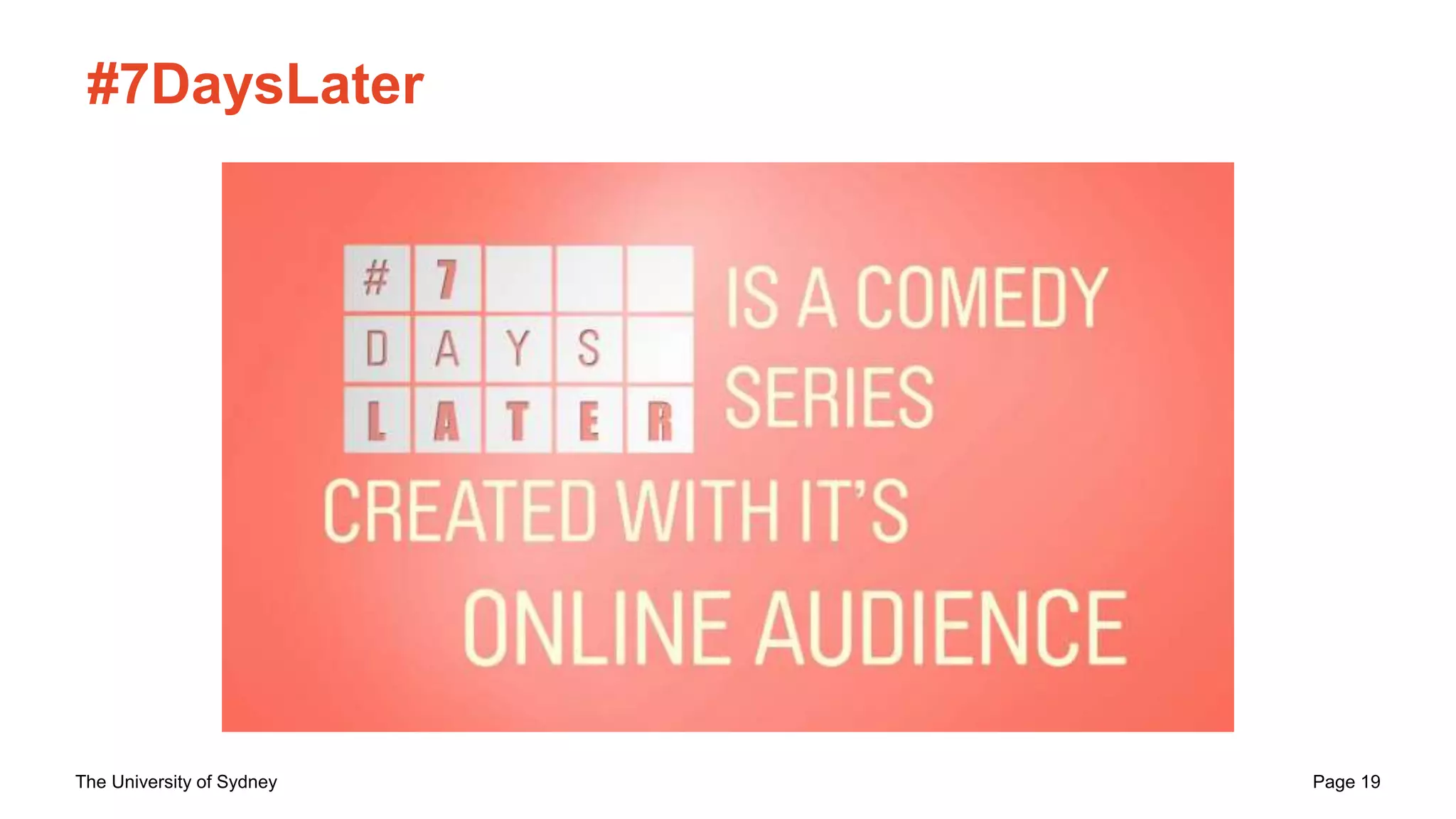
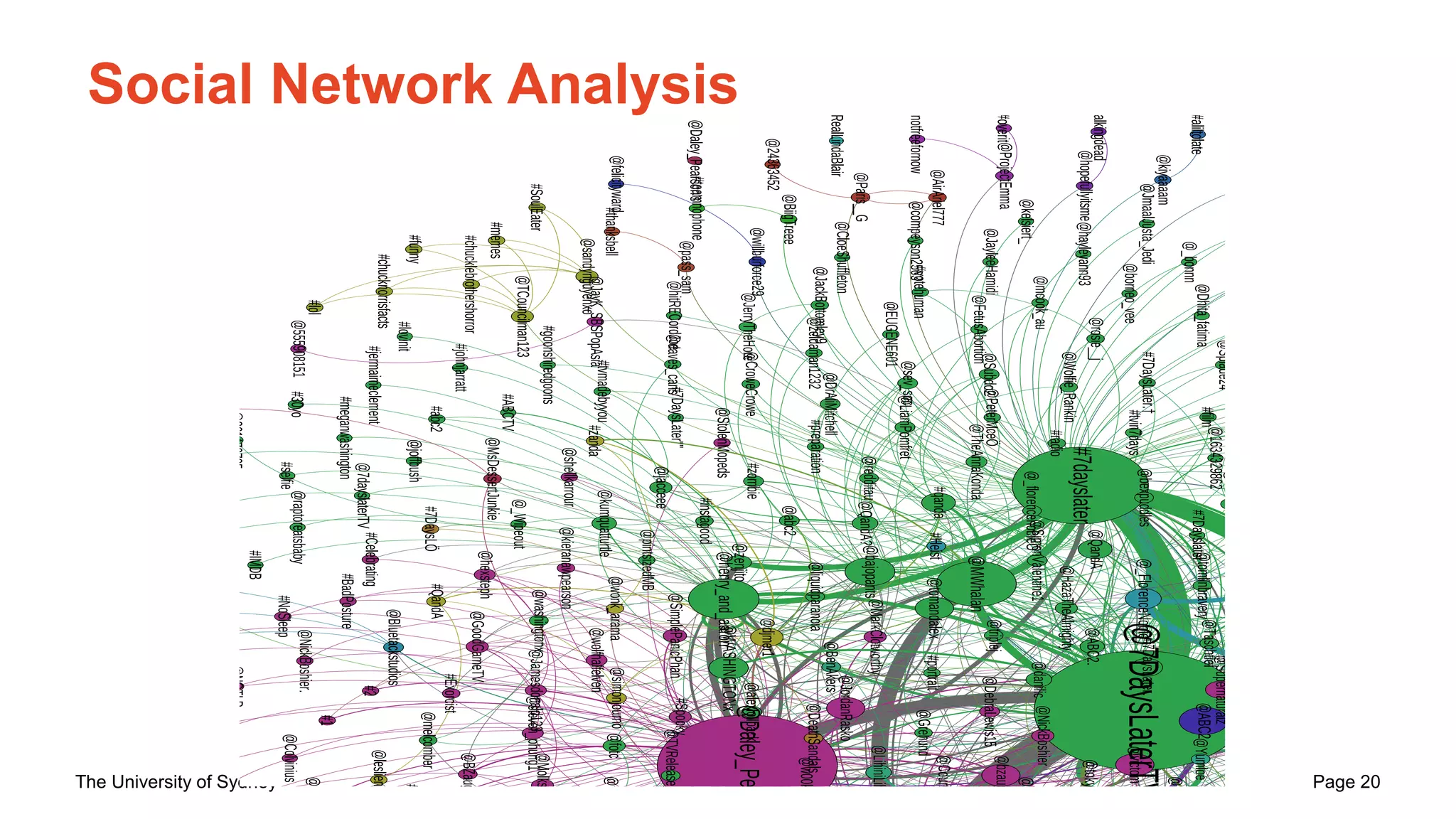
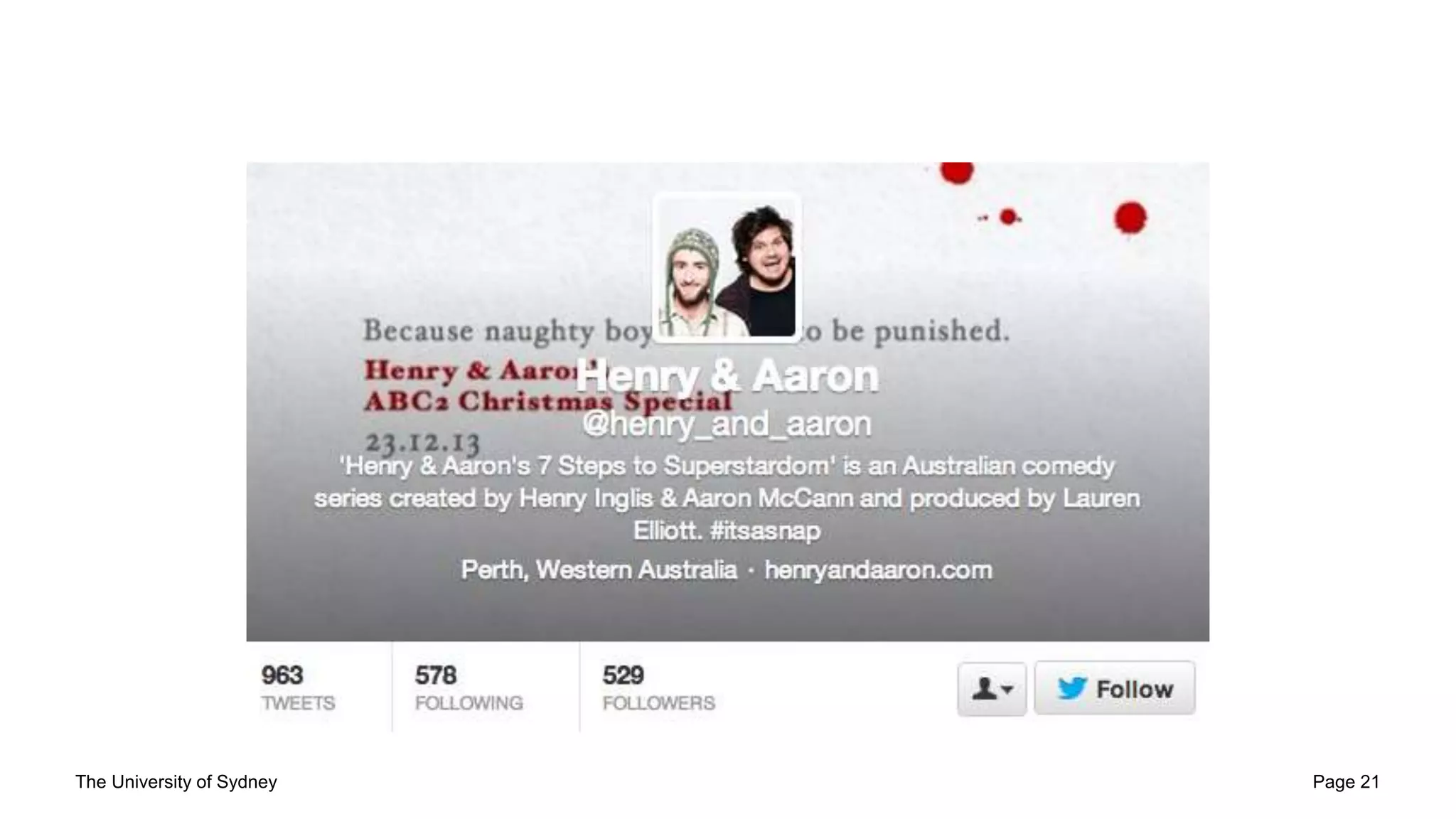
#7DaysLater
The University of Sydney Page 20
Social Network Analysis
The University of Sydney Page 21
The University of Sydney Page 22
So what?
– Algorithms are here to stay for content production
– They need to be closely monitored to ensure information
is correct
– This is crucial for PSM, and other media orgs too
– Cultural intermediaries are the key agents here
– These are the future media work roles
The University of Sydney Page 23
Dr Jonathon
Hutchinson
@dhutchman
jonathon.hutchinson@sydney.edu.au

Cultural Intermediation, Algorithmic Culture and Public Service Media: Social media, co-creation and influence

  • 1.
    The University ofSydney Page 1 Cultural Intermediation, Algorithmic Culture and Public Service Media: Social media, co- creation and influence Presented by Dr Jonathon Hutchinson Department of Media and Communication jonathon.hutchinson@sydney.edu.au
  • 2.
    The University ofSydney Page 2 Today… – Think through how we (audiences/users) consume media – and the impact of algorithms – How are algorithms impacting on culture? – What is public service media (PSM)? – How should PSM be engaging in algorithmic culture? – Explore one program that demonstrates PSM algorithmic culture, #7DaysLater
  • 3.
    The University ofSydney Page 3
  • 4.
    The University ofSydney Page 4 YouTube
  • 5.
    The University ofSydney Page 5 Interactive time… https://play.kahoot.it/#/k/1a401610-0050- 4e85-96c7-9e87bf1c077c
  • 6.
    The University ofSydney Page 6 How are algorithms shaping our culture? – Think of this through a media studies lens – Raymond Williams notes culture is specific to each society, where “the making of a society is the finding of common meanings and directions” (1989) – How does technology impact on that definition? – Newspapers during the late 90s limiting the ‘publicness’ due to technological advances in printing and distribution – Algorithms in contemporary space – also limiting the publicness?
  • 7.
    The University ofSydney Page 7 Public Service Media (PSM)
  • 8.
    The University ofSydney Page 8 Public Service Media (PSM) – “has been tasked to serve the societal and cultural needs of each member nation and to promote democracy and participation within the national geographical boundaries” (Głowacki, 2015, p. 26) – Built on PSB, which “was to inform, educate and entertain with total independence from political power and commercial pressure” (Tremblay, 2016, p. 194) – The thematic shift from PSB and towards PSM is taken as “common parlance as services are extended across ‘new’ media platforms and experiments undertaken into new interactive content forms” (Debrett, 2015, p. 557).
  • 9.
    The University ofSydney Page 9 PSM under pressure – Barnett (2015) remind us that PSM is increasingly under attack because of conservative governments, introspective and disorganised left political parties, hostile media environments, and substantially reduced funding arrangements – Tremblay (2016) also observes the mounting pressure by governments on PSM in its “systematic reduction” in the field of media and communication, which he notes as a “gradual and calculated suffocation of public service media” (p. 192). – PSM value tests
  • 10.
    The University ofSydney Page 10 The Checkout… http://www.abc.net.au/tv/thecheckout/clips /
  • 11.
    The University ofSydney Page 11 PSM from the research perspective – Supported through arguments that note it should provide new multiplatform services beyond television and radio (Steemers, 2016) – It is a tool for online citizenship and civic engagement (Debrett, 2015) – A locale for ‘distinctive’ media system innovation (Cunningham, 2015)
  • 12.
    The University ofSydney Page 12 PSM: tokenistic participation? – Głowacki and Jackson (2014) highlight that websites are often ‘bolt-on’ extras for marketing purposes – Jakubowicz (2014): “seems to remain in most cases [as] marginal forms, either designed to obtain input … that professional journalists use in producing their programmes, under their exclusive control, or web pages … serving as a display case for UGC” (p. 229) – No one is looking at algorithmic cultures, particularly through social media
  • 13.
    The University ofSydney Page 13 Participation is dead? – While it has gone out of style, participation is crucial for cultural production – Monitoring user behaviour is certainly how media is distributed, if not produced – e.g. Buzzfeed and Vice Magazine – But what about public issues and the impact of social media? – “Social media play a prominent role in mediating issues of public concern, not only providing the stage on which public debates play out, but also shaping their topics and dynamics” (Burgess & Matamoros-Fernández, 2016)
  • 14.
    The University ofSydney Page 14 What’s an algorithm? https://www.youtube.com/watch?v=6hfOv s8pY1k
  • 15.
    The University ofSydney Page 15 Who cares about algorithms? – Netflix: bad programming – YouTube: bad videos – PSM: Incorrect public issues – “offloading of cultural work onto computers, databases and other types of digital technologies has prompted a reshuffling of some of the words most closely associated with culture, giving rise to new senses of the term that may be experientially available but have yet to be well named, documented or recorded” (Striphas, 2015: 395)
  • 16.
    The University ofSydney Page 16 Cultural Intermediaries – Taste agents (Bourdieu,1984) – Market agents (Negus, 2002) – Institutional taste and cultural agents (Hutchinson, 2016) – Multi Channel Networks who facilitate social media cultural intermediaries – Essena O’Neill, Fun For Louis, MoreZoella
  • 17.
    The University ofSydney Page 17 Social Media and Influence
  • 18.
    The University ofSydney Page 18 Cultural intermediaries and PSM – Can be termed microinfluencers (Abidin, 2015) – Essential for distributing content – Generate crucial public issues through social media – Feed issues back into PSM – Think of Triple J Hack, for example
  • 19.
    The University ofSydney Page 19 #7DaysLater
  • 20.
    The University ofSydney Page 20 Social Network Analysis
  • 21.
    The University ofSydney Page 21
  • 22.
    The University ofSydney Page 22 So what? – Algorithms are here to stay for content production – They need to be closely monitored to ensure information is correct – This is crucial for PSM, and other media orgs too – Cultural intermediaries are the key agents here – These are the future media work roles
  • 23.
    The University ofSydney Page 23 Dr Jonathon Hutchinson @dhutchman jonathon.hutchinson@sydney.edu.au