Political journalism: a crisis of civic
communications?
MC404 Political Communications
Dr. Carolina Matos
Overview
• Journalism and democracy: the debate continued
• The crisis of civic communications
• PSB and the public sphere: historical and theoretical
perspectives
• Re-evaluating the role of the public media and political
journalism in the digital age
• Political journalism: an overview of the argument
• Partisan character of the British and the Brazilian press
• Online political journalism and the future role for
journalists
• Videos: The power of political satire and Journalism in
Crisis: Nick Davies of The Guardian
The crisis of civic communications: what
is it?
 Gurevitch and Blumler (1995) highlighted crisis in civic
communications in democracies worldwide:
1) Decline of the watchdog role
2) Political arguments reduced to slogans
3) Suspicion of manipulation and growth of cynicism
4) Public interest in civic communications has been
short-changed
Two main reasons: societal and media-related
Some Labels: an age of press politics” (Kalb, 1992);
“mediated politics” (Bennett, 1995); ‘political media
complex’ (Swanson, 1992)
The media and politics
 “…..the role of the media and its relationship to
politics has changed, moving from the role of
reporting on and about politics….to that of being
an active participant in, shaping influence
upon…an integral part of the political process.
This kind of intervention is especially visible
during election campaigns, since the political
functions of the media – and especially of TV-
assume greater visibility and significance….these
developments have resulted in the increased
dependency of both politicians and voters on the
media and the messages they provide…” (Blumler
and Gurevitch, 1995, 3)
Journalism and democracy: the debate
continued
 McNair (2000,2) refers to Blumler and Gurevitch (1995),
who have identified the crisis as having its roots in the
 1)“…decline in the quality of political journalism, driven by
what is described as the process of commercialization,
tabloidization, Americanization and “dumbing down”….;
 2) change for the worse in the relationship between
politicians and journalists, with a shift in the power
balance between them amid the rise of PR experts and
growth of powerful political media
Scenario: Decline of “serious journalism” in advanced
Western societies versus the rise of liberal journalism
cultures in emerging democracies (i.e. Brazil)
New style of journalism is known by some as “post-modern
journalism”
Political journalism in
decline?
• Lament of decline of “serious
journalism” runs throughout the
political spectrum -
“one is just as likely to encounter a
lament for the decline of political
journalism in the pages of the right-
wing Spectator magazine as in the
left-of-centre New Statesmen, and in
The Guardian as much as in The
Daily Telegraph”. (McNair, 2000,2)
* McNair attempts to offer a
“realistic” perspective, avoiding
condemning the impact of
entertainment on politics as a major
cause of crisis
Key debates of the thesis (McNair, 2000)
 1) Dumbing down and the rise of infotainment – thesis
influenced by Habermas (1989) and the debate on the decline
of the PSB amid expansion of media commercialisation and
mass democratization. Political journalism is said to
overwhelmed by tabloidization;
 2) Political information overload – an opposite criticism is that
there is too much “serious politics” in the media. Massive
coverage “bores” audiences, who prefer to consume politics in
soft news formats
 3) Elitism - Political journalism has become too elitist, too
focused on the horse race and not enough on policy substance
 4) Excessive interpretation and commentary at the expense of
straight reporting – Decline of conventional journalism formats
 5) Too much balance (crisis of objectivity regime?) – Others
argue that political journalism is not opinionated enough (i.e.
criticism of BBC’s reporting in the 1997 election)
Journalism and the degeneration of the
public sphere
 Criticism is that the political media have become
more commercialized….and the negative impact of
new technologies …is that news is faster than ever
but not necessarily more informative (8) (i.e.
interview Nick Davies)
 Graber states that “news product has deteriorated
when judged as a resource for public opinion
formation” (quoted in Blumler and Gurevitch, 1995,
66)
 McNair (2000) argues that these arguments are
pessimistic, implying that the more political news we
get, the less informed we are
My argument – some of these theses need updating
in the light of the challenge of the supremacy of the
economic/consumerism market model and the
revival of politics as a new sphere of influence
Jean Baudrillard’s alternative perspective
* Baudrillard (1983) in In The Shadow of the
Silent Majorities argues that the public sphere
is an elitist construct which reflects
bourgeoisie values
* Mass cynicism about politics is thus a
rational response of people that feel no real
involvement in the political process (in
McNair, 2000, 10-11)
“Baudrillard raises the couch potato to the
status of political radical, and cultural
snobbery to that of noble, if passive
resistance to bourgeois efforts at
incorporation of the masses” (in McNair,
2000, 11)
Baudrillard on the masses’ apathy
“They are given meaning; they want spectacle…..Messages
are given to them, but … they idolize the play of signs and
stereotypes, they idolize any content so long as it resolves
itself into a spectacle…”(in McNair, 2000, 11)
“Bombarded with stimuli, messages and testes, the masses
are simply an opaque, blind stratum…..it can no longer be a
question of expression or representation…This is the
meaning of their silence. But this silence is paradoxical….it
is a silence which refuses to be spoken for in its name…..far
from being a form of alienation, it is an absolute weapon”
(Baudrillard, 1983, 21-22)
PSB and the public sphere: some
historical and theoretical perspectives
 PSB under pressure since the 80’s amid the expansion
of the commercialization of TV and rise of new
technologies (cable, satellite and digital)
 According to Collins (1999; 160), the number of
commercial channels in Europe was 58 in 1992,
jumping to 250 in the late 90’s
 As Norris (2000, 33) notes, Blumler identifies certain
general values underlying PSB in Western Europe,
including program quality, the maintenance of regional,
linguistic and political diversity, the protection of
cultural identities….
 Arguments that question BBC’s necessity –
“….media abundance (Keane, 1995); the burden of the
license fee tax on citizens; the claims that the BBC
discourages innovation, and that in its efforts to retain
the attention of fragmented audiences, it is “dumbing
down” and becoming more indistinguishable from
commercial broadcasters…” (Matos, 2008)
US versus European broadcasting: the
expansion of commercial television
 Hallin and Mancini (2004, 40) associate the changes in
the ideological approach to PSB as a result of
secularization – “Many influences here are driven at the
deepest level by the growth of a secularized market
society. This is the core of what is generally referred to
as modernization….”
 UK versus US - Differences - PSB emphases news
and public affairs, features and documentaries;
commercial broadcasting entertainment (Munghan and
Gunther; 2000, 10)
 BBC in the UK - Arguments around the licence fee and
wider state control of broadcasting were grounded on
assumptions of “spectrum scarcity”…;
 TV in the 70-‘s was a highly state-regulated activity; it
was seen as a natural monopoly that needed to be
state regulated (Goodwin in Stokes, Jane and Reading,
Anne, 1999, 130 - 141).
The role of UK PSB in public life (Scannell, 1989;
Keane, 1995) in Matos (2008)
 Criticising academics (i.e. Curran, Scannell) and their
understanding of PSB grounded in the Habermasian notion of
the public sphere, Keane (1995; 57) has argued that the
public service media in old European democracies has slipped
into an identity crisis
 Implication is that the concerns with the public interest are not
fully grounded in our current “post-modern” context of
multiple social movements…., global events transmitted via
24hours news channels to global audiences and the diversity
of elite decision-making public readers of international
newspapers (Matos, 2008).
 Keane’s argument can perhaps strike a wider cord with critics
from more advanced democracies which are currently
experiencing a situation of media-saturation, but even here
such statements…..are problematic (Matos, 2008)
Re-evaluating PSB and the public sphere
in the digital age
 “According to Keane, the development in the
21st century of a “multiplicity of networked
spaces of communication” which are not tied to
the nation-state, and the fact that the language
of the “public interest” and “public good” was
used in the 17th and 18th centuries as a weapon
to pressure for the “liberty of the press” and a
struggle against monarchs who acted in favour
of their selfish private interests, indicate that the
notion of the public sphere is outdated….”
(Matos, 2008)
 Ofcom’s recognition of PSB - “In its 2008
annual report on the role of PSB in the UK, the
fact that an individual’s viewing of content can
have benefits for society as a whole, resulting in
his engagement in the democratic process as a
more active and educated citizen, is pointed out
as a key purpose of PSB” (Matos, 2008)
PSB tradition versus citizens’ wider knowledge
of politics (Semetko and Scammell, 2005)
 BBC is pointed out by researchers as
being able to deliver more elections
news, produce longer stories of greater
substance and give more attention to
minority parties
 Studies (i.e. Curran, 2007; Scammell and
Semetko, 2005) have shown how certain
countries with a strong PSB tradition, like
Britain with its dual system and the
Scandinavian nations, where the state
subsides minority media outlets, citizens
have more knowledge of politics and
international affairs than countries where
the commercial media system
predominates (in Matos, 2008)
Latin American broadcasting has adopted
US model
 Commercial broadcasting has expanded in the light of
(authoritarian) State intervention
 Straubhaar (2001, 134) has highlighted the importance of the
role that the then strong state in the 70’s assumed in shaping
national TV systems in countries like Mexico and Brazil
 I.e. Development of Brazilian television by military planners in
the 60’s onwards contributed for the formation of what
Straubhaar (2001; 138) has defined as the “nationalizing
vocation”, and the creation of a consumer culture and wider
engagement of Brazilians in the market economy (Matos,
2008).
The crisis of political journalism: an outline of
the argument (Gaber and Barnett, 2001)
 Authors shift the debate from the crisis in political
communications to the crisis in political journalism
 State that they do not endorse conspiracy theories and
that they do not place all the blame on journalists
 Identify four pressures:
 1) growing power of government sources;
 2) the impact of media ownership, although
acknowledge that critical journalism can occur in spite
of ownership pressures;
 3) impact on journalism of the growth of media outlets
and of the increased competition on political reporting;
 4) changing nature of the journalism profession –
employment conditions
Video: The Power of Political Satire
Old press barons versus Media Moguls
 “The old style Press Lord (like Northcliffe
or Beaverbrook) successfully accumulated
newspapers and then less successfully
tries to promote specific political policies
through newspaper companies…..To the
mogul it is profits, growth and financial
performance…come first, but political
influence is an arousing extra, not least
because it may be turned to commercial
advantage”. (Tunstall, in Gaber, Ivor and
Barnett, Steven, 2001, 6)
 I.e. Berlusconi in Italy, Rupert Murdoch in
the UK and the Marinho’s in Brazil
Newspapers and public opinion
 Public opinion and political journalism – does (political)
news matter?
 As Gaber and Barnett (2001, 11) note, behind this
debate there is an implicit assumption that “good”
political reporting must be beneficial for democracy and
that “bad” political reporting must not
 Gaber and Barnett (2001) stress 3 contributions that
“good” political journalism can make to democracy –
the first is the press acting as tribunes of the people;
the second is information provision, that accurate,
comprehensive knowledge about contemporary political
issues will allow citizens to formulate their informed
responses and third, the contribution to the process of
opinion formation is to allow citizens a neutral forum in
which to share their views (12)
Journalists and public opinion
 It is not only journalists who have to
deal with “public opinion”, but
politicians, and professional marketing
campaigns use opinion polls to test the
mood of voters on particular issues as
well as to built and improve their image
for future campaigns.
 Gaber (2001, 18) points out how it is
complicated for newspapers to insist
that they reflect “public opinion” on a
particular issue (i.e. The Sun’s title
“Tell us The Truth Tony”, October
1998)
Political journalists and the public sphere
 “One could argue that the role of the political
journalist....is less central to the public sphere element
of the democratic process, for the process of political
reporting (gathering, interpreting and accumulating
information) is a one-electoral rather than a discursive
process, and usually they are judged in regards to the
accuracy and honesty of their reporting, and not
judged on whether they are prompting debate in the
nation’s interest….” (Gaber, Ivor and Barnett, Steven,
2001, 24)
 However, many political journalists and commentators
do play key roles in stimulating and mediating debate,
and can contribute to the advancement of democratic
processes (Matos, 2008)
Role of journalists and the public
 There are different perspectives in regards to
the role of journalists in democracies
 “From one perspective journalists are frequently
presented as trapped between one quest for
audiences and the weight of public opinion on
the other hand and the powerful influence of
professionalised political sources on the other
(Schelsinger, 1990); from another view point,
much research output portrays journalists as
the villains of modern political communications
(Fallows, 1996), ….as being responsible for an
approach…which threatens democratic ideals
and weakens the public’s interest in politics
(Entman, 1989)(in Kuhn, Raymond and Neveu,
Erik, 2002, 2).
The civic (or public) journalism debate
 Jay Rosen (1991) in Making Journalism More Public argues
for a more mobilizing role for journalism, that it should be
more supportive of public discussion and less objective
 US public journalism school has attacked the objectivity
regime, arguing for wider role for journalism in the public
sphere
 Davis Merritt (1995) in Public Journalism and Public Life,
states that it is not enough to simply “tell the news”
 “Worried about the retreat of Americans into private life
and their disinterest in public affairs, Merritt (1995) views
objectivity as stimulating journalists’ detachment from
reality.” (Matos, 2008, 203)
Critiques to civic and other forms of
public journalism
 In the US case, it was encouraged by owners and can be
seen as a “marketing” strategy of newspapers
 Is defined as news that citizens need in order to better
participate in democratic processes - how is this different
from classic liberal media theory ideals?
 Tends to empower journalists more than it does the public
and confuses “community” with “public life”
 Tendency to shift away from balance and towards forms of
militant journalism, advocacy or partisanship at worst
 Problems with partisan media – in the UK with some
of the tabloids (“Is This the Most Dangerous Man in
Britain” (The Sun, 24th June, 1998 and “It Was the Sun
Wot Won It” in 1992 following John Mayor’s victory;
Professionalism and partisanship in the Brazilian
media
 Partisanship in the Brazilian press – a negative
impediment for the advancement of the
democratization process
 Professionalization of media industries – Globo
Organisations, Folha and the Abril Group
 The development of liberal journalism cultures in
newsrooms
 The rise of commercialization and professionalism
 News as a commodity – the struggle between
citizenship and consumerism rationales in the
newsroom
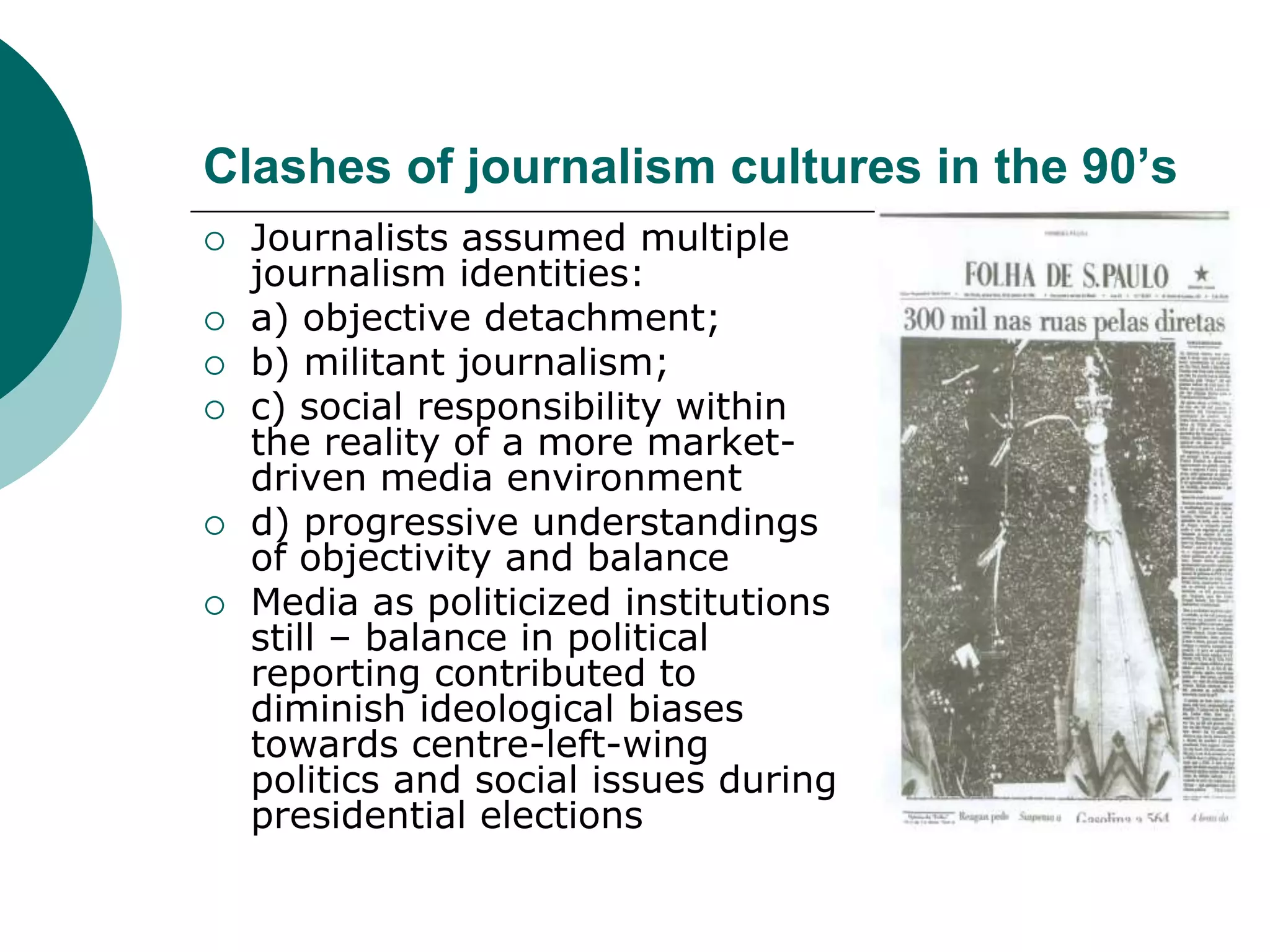
Clashes of journalism cultures in the 90’s
 Journalists assumed multiple
journalism identities:
 a) objective detachment;
 b) militant journalism;
 c) social responsibility within
the reality of a more market-
driven media environment
 d) progressive understandings
of objectivity and balance
 Media as politicized institutions
still – balance in political
reporting contributed to
diminish ideological biases
towards centre-left-wing
politics and social issues during
presidential elections
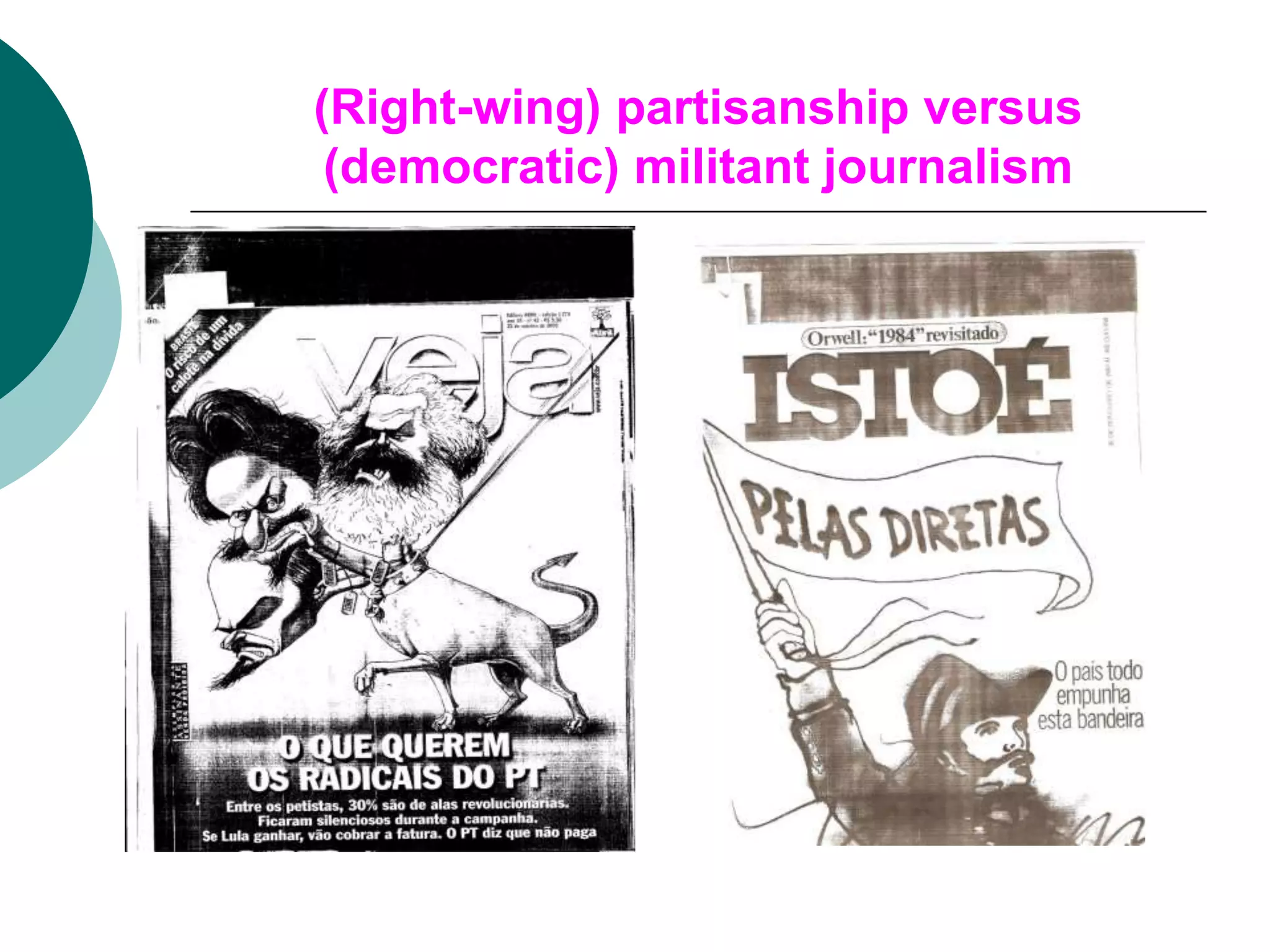
(Right-wing) partisanship versus
(democratic) militant journalism
Future for journalism in the digital age
 Challenges for both old (i.e. newspapers) and new media
(i.e. Internet)
 Newspapers have had to adapt to new technologies and
not attempt to compete with them - The Guardian
(26/11/07) published information on the use of news sites
in the UK stating that it remained the UK’s leading
newspaper online. It showed that 18.4 million people used
Guardian Unlimited in October; The Telegraph had 11.1
million users while The Times, with 12.4 million, was
overtaken by The Mail, with 13.5 million
 PSB - BBC is also a strong competitor - Launched in 1997,
BBC Online has over 2 million pages of content with 41% of
licence fee payers accessing it in early 2003. (Kuhn, 2007).
Online news and the future for “quality”
political journalism
 According to David Hesmondhalgh (2007, 261), the
Internet is full of material that is arcane, bizarre, witty,
but also mundane and banal. The radical potential of the
Internet however has been largely....contained by its
partial incorporation into a larger, profit-orientated set of
cultural industries.
 Internet is less a space for “serious political journalism”
and investigative reporting immersed in the objective
regime tradition, and more a space for the consumption of
fast, hard news
 Blogs and alternative websites – potential for the
development of multiple public spheres and spaces for
debate
The future role for journalists
 What is the impact of these new technologies on the
journalism profession? – (Gaber and Barnett, 2001; Bardoel,
1996; Matos, 2008)
 Conventional reporting versus citizen journalism - Are
journalists becoming redundant?
 Critics have argued that media companies of the future will
require fewer staff, especially in a moment of decline of
circulations, decrease of advertising alongside the need to
pursue further investments in new technologies in order to
continue to be competitive.
 “Journalism will not, as in the era of the mass media, control
public debate, but it will take the lead in directing and defining
it” (Bardoel, 1996; 387 in Matos, 2008).
 Video: Journalism in Crisis: Nick Davies of The Guardian
Conclusions and questions
 Is the capacity of the journalist to make a difference
becoming a distant dream?
 The crisis of civic communications and the crisis of
political reporting – should avoid placing all the blame
on the “entertaining” media, or on politicians or
citizens
 Issue is more complex – structural problems, societal,
rise of new technologies and changes in political
systems
 PSB and the PS – still vital for democratic processes
 Public, civic and partisan forms of journalism have their
limits
 What role is assigned then for political journalism – and
for journalists – in the digital age?
MC404 Revision lecture time and rooms
Lecture: 10-12 U8 ST2
Seminars:
1 – 12-1pm – U103
2 – 2-3pm – NAB 119
3 - 3-4pm – NAB 117
4 – 4-5 pm – NAB 119

Political_Journalism.ppt

  • 1.
    Political journalism: acrisis of civic communications? MC404 Political Communications Dr. Carolina Matos
  • 3.
    Overview • Journalism anddemocracy: the debate continued • The crisis of civic communications • PSB and the public sphere: historical and theoretical perspectives • Re-evaluating the role of the public media and political journalism in the digital age • Political journalism: an overview of the argument • Partisan character of the British and the Brazilian press • Online political journalism and the future role for journalists • Videos: The power of political satire and Journalism in Crisis: Nick Davies of The Guardian
  • 4.
    The crisis ofcivic communications: what is it?  Gurevitch and Blumler (1995) highlighted crisis in civic communications in democracies worldwide: 1) Decline of the watchdog role 2) Political arguments reduced to slogans 3) Suspicion of manipulation and growth of cynicism 4) Public interest in civic communications has been short-changed Two main reasons: societal and media-related Some Labels: an age of press politics” (Kalb, 1992); “mediated politics” (Bennett, 1995); ‘political media complex’ (Swanson, 1992)
  • 5.
    The media andpolitics  “…..the role of the media and its relationship to politics has changed, moving from the role of reporting on and about politics….to that of being an active participant in, shaping influence upon…an integral part of the political process. This kind of intervention is especially visible during election campaigns, since the political functions of the media – and especially of TV- assume greater visibility and significance….these developments have resulted in the increased dependency of both politicians and voters on the media and the messages they provide…” (Blumler and Gurevitch, 1995, 3)
  • 6.
    Journalism and democracy:the debate continued  McNair (2000,2) refers to Blumler and Gurevitch (1995), who have identified the crisis as having its roots in the  1)“…decline in the quality of political journalism, driven by what is described as the process of commercialization, tabloidization, Americanization and “dumbing down”….;  2) change for the worse in the relationship between politicians and journalists, with a shift in the power balance between them amid the rise of PR experts and growth of powerful political media Scenario: Decline of “serious journalism” in advanced Western societies versus the rise of liberal journalism cultures in emerging democracies (i.e. Brazil) New style of journalism is known by some as “post-modern journalism”
  • 7.
    Political journalism in decline? •Lament of decline of “serious journalism” runs throughout the political spectrum - “one is just as likely to encounter a lament for the decline of political journalism in the pages of the right- wing Spectator magazine as in the left-of-centre New Statesmen, and in The Guardian as much as in The Daily Telegraph”. (McNair, 2000,2) * McNair attempts to offer a “realistic” perspective, avoiding condemning the impact of entertainment on politics as a major cause of crisis
  • 8.
    Key debates ofthe thesis (McNair, 2000)  1) Dumbing down and the rise of infotainment – thesis influenced by Habermas (1989) and the debate on the decline of the PSB amid expansion of media commercialisation and mass democratization. Political journalism is said to overwhelmed by tabloidization;  2) Political information overload – an opposite criticism is that there is too much “serious politics” in the media. Massive coverage “bores” audiences, who prefer to consume politics in soft news formats  3) Elitism - Political journalism has become too elitist, too focused on the horse race and not enough on policy substance  4) Excessive interpretation and commentary at the expense of straight reporting – Decline of conventional journalism formats  5) Too much balance (crisis of objectivity regime?) – Others argue that political journalism is not opinionated enough (i.e. criticism of BBC’s reporting in the 1997 election)
  • 9.
    Journalism and thedegeneration of the public sphere  Criticism is that the political media have become more commercialized….and the negative impact of new technologies …is that news is faster than ever but not necessarily more informative (8) (i.e. interview Nick Davies)  Graber states that “news product has deteriorated when judged as a resource for public opinion formation” (quoted in Blumler and Gurevitch, 1995, 66)  McNair (2000) argues that these arguments are pessimistic, implying that the more political news we get, the less informed we are My argument – some of these theses need updating in the light of the challenge of the supremacy of the economic/consumerism market model and the revival of politics as a new sphere of influence
  • 10.
    Jean Baudrillard’s alternativeperspective * Baudrillard (1983) in In The Shadow of the Silent Majorities argues that the public sphere is an elitist construct which reflects bourgeoisie values * Mass cynicism about politics is thus a rational response of people that feel no real involvement in the political process (in McNair, 2000, 10-11) “Baudrillard raises the couch potato to the status of political radical, and cultural snobbery to that of noble, if passive resistance to bourgeois efforts at incorporation of the masses” (in McNair, 2000, 11)
  • 11.
    Baudrillard on themasses’ apathy “They are given meaning; they want spectacle…..Messages are given to them, but … they idolize the play of signs and stereotypes, they idolize any content so long as it resolves itself into a spectacle…”(in McNair, 2000, 11) “Bombarded with stimuli, messages and testes, the masses are simply an opaque, blind stratum…..it can no longer be a question of expression or representation…This is the meaning of their silence. But this silence is paradoxical….it is a silence which refuses to be spoken for in its name…..far from being a form of alienation, it is an absolute weapon” (Baudrillard, 1983, 21-22)
  • 12.
    PSB and thepublic sphere: some historical and theoretical perspectives  PSB under pressure since the 80’s amid the expansion of the commercialization of TV and rise of new technologies (cable, satellite and digital)  According to Collins (1999; 160), the number of commercial channels in Europe was 58 in 1992, jumping to 250 in the late 90’s  As Norris (2000, 33) notes, Blumler identifies certain general values underlying PSB in Western Europe, including program quality, the maintenance of regional, linguistic and political diversity, the protection of cultural identities….  Arguments that question BBC’s necessity – “….media abundance (Keane, 1995); the burden of the license fee tax on citizens; the claims that the BBC discourages innovation, and that in its efforts to retain the attention of fragmented audiences, it is “dumbing down” and becoming more indistinguishable from commercial broadcasters…” (Matos, 2008)
  • 13.
    US versus Europeanbroadcasting: the expansion of commercial television  Hallin and Mancini (2004, 40) associate the changes in the ideological approach to PSB as a result of secularization – “Many influences here are driven at the deepest level by the growth of a secularized market society. This is the core of what is generally referred to as modernization….”  UK versus US - Differences - PSB emphases news and public affairs, features and documentaries; commercial broadcasting entertainment (Munghan and Gunther; 2000, 10)  BBC in the UK - Arguments around the licence fee and wider state control of broadcasting were grounded on assumptions of “spectrum scarcity”…;  TV in the 70-‘s was a highly state-regulated activity; it was seen as a natural monopoly that needed to be state regulated (Goodwin in Stokes, Jane and Reading, Anne, 1999, 130 - 141).
  • 14.
    The role ofUK PSB in public life (Scannell, 1989; Keane, 1995) in Matos (2008)  Criticising academics (i.e. Curran, Scannell) and their understanding of PSB grounded in the Habermasian notion of the public sphere, Keane (1995; 57) has argued that the public service media in old European democracies has slipped into an identity crisis  Implication is that the concerns with the public interest are not fully grounded in our current “post-modern” context of multiple social movements…., global events transmitted via 24hours news channels to global audiences and the diversity of elite decision-making public readers of international newspapers (Matos, 2008).  Keane’s argument can perhaps strike a wider cord with critics from more advanced democracies which are currently experiencing a situation of media-saturation, but even here such statements…..are problematic (Matos, 2008)
  • 15.
    Re-evaluating PSB andthe public sphere in the digital age  “According to Keane, the development in the 21st century of a “multiplicity of networked spaces of communication” which are not tied to the nation-state, and the fact that the language of the “public interest” and “public good” was used in the 17th and 18th centuries as a weapon to pressure for the “liberty of the press” and a struggle against monarchs who acted in favour of their selfish private interests, indicate that the notion of the public sphere is outdated….” (Matos, 2008)  Ofcom’s recognition of PSB - “In its 2008 annual report on the role of PSB in the UK, the fact that an individual’s viewing of content can have benefits for society as a whole, resulting in his engagement in the democratic process as a more active and educated citizen, is pointed out as a key purpose of PSB” (Matos, 2008)
  • 16.
    PSB tradition versuscitizens’ wider knowledge of politics (Semetko and Scammell, 2005)  BBC is pointed out by researchers as being able to deliver more elections news, produce longer stories of greater substance and give more attention to minority parties  Studies (i.e. Curran, 2007; Scammell and Semetko, 2005) have shown how certain countries with a strong PSB tradition, like Britain with its dual system and the Scandinavian nations, where the state subsides minority media outlets, citizens have more knowledge of politics and international affairs than countries where the commercial media system predominates (in Matos, 2008)
  • 17.
    Latin American broadcastinghas adopted US model  Commercial broadcasting has expanded in the light of (authoritarian) State intervention  Straubhaar (2001, 134) has highlighted the importance of the role that the then strong state in the 70’s assumed in shaping national TV systems in countries like Mexico and Brazil  I.e. Development of Brazilian television by military planners in the 60’s onwards contributed for the formation of what Straubhaar (2001; 138) has defined as the “nationalizing vocation”, and the creation of a consumer culture and wider engagement of Brazilians in the market economy (Matos, 2008).
  • 18.
    The crisis ofpolitical journalism: an outline of the argument (Gaber and Barnett, 2001)  Authors shift the debate from the crisis in political communications to the crisis in political journalism  State that they do not endorse conspiracy theories and that they do not place all the blame on journalists  Identify four pressures:  1) growing power of government sources;  2) the impact of media ownership, although acknowledge that critical journalism can occur in spite of ownership pressures;  3) impact on journalism of the growth of media outlets and of the increased competition on political reporting;  4) changing nature of the journalism profession – employment conditions Video: The Power of Political Satire
  • 19.
    Old press baronsversus Media Moguls  “The old style Press Lord (like Northcliffe or Beaverbrook) successfully accumulated newspapers and then less successfully tries to promote specific political policies through newspaper companies…..To the mogul it is profits, growth and financial performance…come first, but political influence is an arousing extra, not least because it may be turned to commercial advantage”. (Tunstall, in Gaber, Ivor and Barnett, Steven, 2001, 6)  I.e. Berlusconi in Italy, Rupert Murdoch in the UK and the Marinho’s in Brazil
  • 20.
    Newspapers and publicopinion  Public opinion and political journalism – does (political) news matter?  As Gaber and Barnett (2001, 11) note, behind this debate there is an implicit assumption that “good” political reporting must be beneficial for democracy and that “bad” political reporting must not  Gaber and Barnett (2001) stress 3 contributions that “good” political journalism can make to democracy – the first is the press acting as tribunes of the people; the second is information provision, that accurate, comprehensive knowledge about contemporary political issues will allow citizens to formulate their informed responses and third, the contribution to the process of opinion formation is to allow citizens a neutral forum in which to share their views (12)
  • 21.
    Journalists and publicopinion  It is not only journalists who have to deal with “public opinion”, but politicians, and professional marketing campaigns use opinion polls to test the mood of voters on particular issues as well as to built and improve their image for future campaigns.  Gaber (2001, 18) points out how it is complicated for newspapers to insist that they reflect “public opinion” on a particular issue (i.e. The Sun’s title “Tell us The Truth Tony”, October 1998)
  • 22.
    Political journalists andthe public sphere  “One could argue that the role of the political journalist....is less central to the public sphere element of the democratic process, for the process of political reporting (gathering, interpreting and accumulating information) is a one-electoral rather than a discursive process, and usually they are judged in regards to the accuracy and honesty of their reporting, and not judged on whether they are prompting debate in the nation’s interest….” (Gaber, Ivor and Barnett, Steven, 2001, 24)  However, many political journalists and commentators do play key roles in stimulating and mediating debate, and can contribute to the advancement of democratic processes (Matos, 2008)
  • 23.
    Role of journalistsand the public  There are different perspectives in regards to the role of journalists in democracies  “From one perspective journalists are frequently presented as trapped between one quest for audiences and the weight of public opinion on the other hand and the powerful influence of professionalised political sources on the other (Schelsinger, 1990); from another view point, much research output portrays journalists as the villains of modern political communications (Fallows, 1996), ….as being responsible for an approach…which threatens democratic ideals and weakens the public’s interest in politics (Entman, 1989)(in Kuhn, Raymond and Neveu, Erik, 2002, 2).
  • 24.
    The civic (orpublic) journalism debate  Jay Rosen (1991) in Making Journalism More Public argues for a more mobilizing role for journalism, that it should be more supportive of public discussion and less objective  US public journalism school has attacked the objectivity regime, arguing for wider role for journalism in the public sphere  Davis Merritt (1995) in Public Journalism and Public Life, states that it is not enough to simply “tell the news”  “Worried about the retreat of Americans into private life and their disinterest in public affairs, Merritt (1995) views objectivity as stimulating journalists’ detachment from reality.” (Matos, 2008, 203)
  • 25.
    Critiques to civicand other forms of public journalism  In the US case, it was encouraged by owners and can be seen as a “marketing” strategy of newspapers  Is defined as news that citizens need in order to better participate in democratic processes - how is this different from classic liberal media theory ideals?  Tends to empower journalists more than it does the public and confuses “community” with “public life”  Tendency to shift away from balance and towards forms of militant journalism, advocacy or partisanship at worst  Problems with partisan media – in the UK with some of the tabloids (“Is This the Most Dangerous Man in Britain” (The Sun, 24th June, 1998 and “It Was the Sun Wot Won It” in 1992 following John Mayor’s victory;
  • 26.
    Professionalism and partisanshipin the Brazilian media  Partisanship in the Brazilian press – a negative impediment for the advancement of the democratization process  Professionalization of media industries – Globo Organisations, Folha and the Abril Group  The development of liberal journalism cultures in newsrooms  The rise of commercialization and professionalism  News as a commodity – the struggle between citizenship and consumerism rationales in the newsroom
  • 27.
    Clashes of journalismcultures in the 90’s  Journalists assumed multiple journalism identities:  a) objective detachment;  b) militant journalism;  c) social responsibility within the reality of a more market- driven media environment  d) progressive understandings of objectivity and balance  Media as politicized institutions still – balance in political reporting contributed to diminish ideological biases towards centre-left-wing politics and social issues during presidential elections
  • 28.
  • 29.
    Future for journalismin the digital age  Challenges for both old (i.e. newspapers) and new media (i.e. Internet)  Newspapers have had to adapt to new technologies and not attempt to compete with them - The Guardian (26/11/07) published information on the use of news sites in the UK stating that it remained the UK’s leading newspaper online. It showed that 18.4 million people used Guardian Unlimited in October; The Telegraph had 11.1 million users while The Times, with 12.4 million, was overtaken by The Mail, with 13.5 million  PSB - BBC is also a strong competitor - Launched in 1997, BBC Online has over 2 million pages of content with 41% of licence fee payers accessing it in early 2003. (Kuhn, 2007).
  • 30.
    Online news andthe future for “quality” political journalism  According to David Hesmondhalgh (2007, 261), the Internet is full of material that is arcane, bizarre, witty, but also mundane and banal. The radical potential of the Internet however has been largely....contained by its partial incorporation into a larger, profit-orientated set of cultural industries.  Internet is less a space for “serious political journalism” and investigative reporting immersed in the objective regime tradition, and more a space for the consumption of fast, hard news  Blogs and alternative websites – potential for the development of multiple public spheres and spaces for debate
  • 31.
    The future rolefor journalists  What is the impact of these new technologies on the journalism profession? – (Gaber and Barnett, 2001; Bardoel, 1996; Matos, 2008)  Conventional reporting versus citizen journalism - Are journalists becoming redundant?  Critics have argued that media companies of the future will require fewer staff, especially in a moment of decline of circulations, decrease of advertising alongside the need to pursue further investments in new technologies in order to continue to be competitive.  “Journalism will not, as in the era of the mass media, control public debate, but it will take the lead in directing and defining it” (Bardoel, 1996; 387 in Matos, 2008).  Video: Journalism in Crisis: Nick Davies of The Guardian
  • 32.
    Conclusions and questions Is the capacity of the journalist to make a difference becoming a distant dream?  The crisis of civic communications and the crisis of political reporting – should avoid placing all the blame on the “entertaining” media, or on politicians or citizens  Issue is more complex – structural problems, societal, rise of new technologies and changes in political systems  PSB and the PS – still vital for democratic processes  Public, civic and partisan forms of journalism have their limits  What role is assigned then for political journalism – and for journalists – in the digital age?
  • 33.
    MC404 Revision lecturetime and rooms Lecture: 10-12 U8 ST2 Seminars: 1 – 12-1pm – U103 2 – 2-3pm – NAB 119 3 - 3-4pm – NAB 117 4 – 4-5 pm – NAB 119