Tech Talk
Waveform and Drop Optimization
September 7-8, 2016
Renaissance Schaumburg Convention Center Hotel,
Schaumburg (Chicago), Illinois USA
• Ink and characteristics
• Printhead architectures and commonality
• Single drop optimization
• Measurement Equipment and Drop Visualization
• Multi Drop and Gray Scale
• Velocity Optimization
• Frequency Response
What are we talking about?
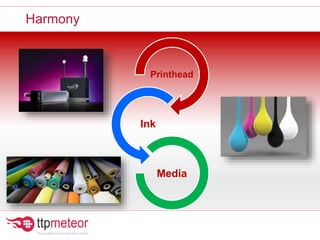
Printhead
Ink
Media
Harmony
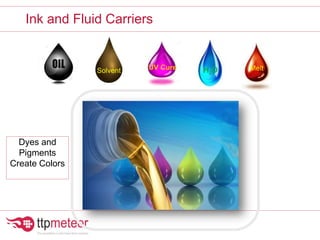
Ink and Fluid Carriers
Solvent UV Cure H2O Melt
Dyes and
Pigments
Create Colors
Ink Physical Properties
Static – easier to
measure
Viscosity
Surface Tension
Contact angle
Temperature
Density – specific gravity
Filtration Time
Conductivity
Particle Size
Dynamic – difficult to measure
Viscosity vs. shear rate
Dynamic Surface Tension
Elasticity
Thermal hysteresis (viscosity)
Dynamic
Characteristics are
unique to printhead
PRINTHEAD ARCHITECTURES
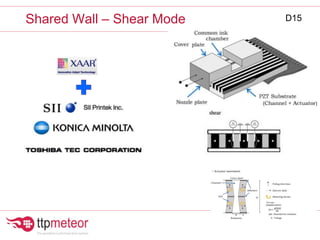
Shared Wall – Shear Mode D15
Push Mode d33
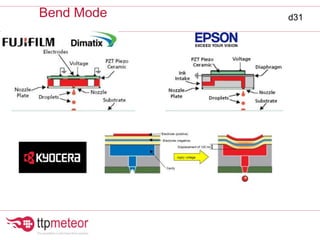
Bend Mode d31
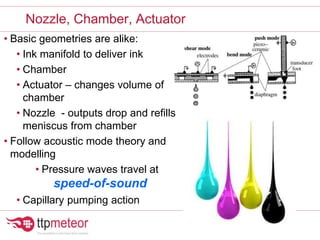
Nozzle, Chamber, Actuator
• Basic geometries are alike:
• Ink manifold to deliver ink
• Chamber
• Actuator – changes volume of
chamber
• Nozzle - outputs drop and refills
meniscus from chamber
• Follow acoustic mode theory and
modelling
• Pressure waves travel at
speed-of-sound
• Capillary pumping action
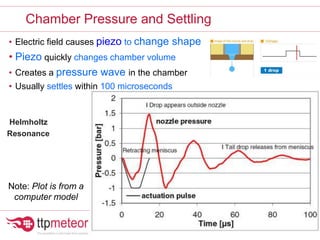
Chamber Pressure and Settling
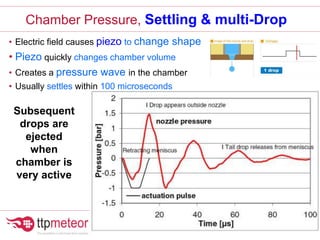
• Electric field causes piezo to change shape
• Piezo quickly changes chamber volume
• Creates a pressure wave in the chamber
• Usually settles within 100 microseconds
Note: Plot is from a
computer model
Helmholtz
Resonance
OPTIMIZE WAVEFORM
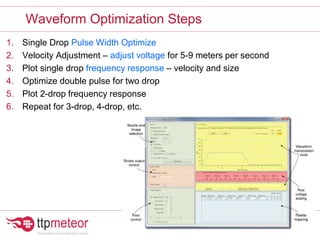
1. Single Drop Pulse Width Optimize
2. Velocity Adjustment – adjust voltage for 5-9 meters per second
3. Plot single drop frequency response – velocity and size
4. Optimize double pulse for two drop
5. Plot 2-drop frequency response
6. Repeat for 3-drop, 4-drop, etc.
Waveform Optimization Steps
Action!
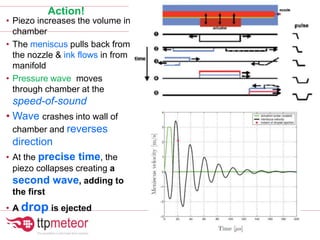
• Piezo increases the volume in
chamber
• The meniscus pulls back from
the nozzle & ink flows in from
manifold
• Pressure wave moves
through chamber at the
speed-of-sound
• Wave crashes into wall of
chamber and reverses
direction
• At the precise time, the
piezo collapses creating a
second wave, adding to
the first
• A drop is ejected
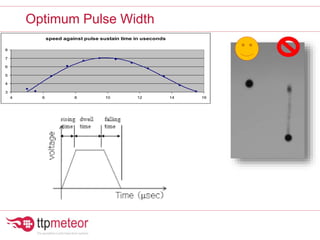
Optimum Pulse Width
speed against pulse sustain time in useconds
3
4
5
6
7
8
4 6 8 10 12 14 16
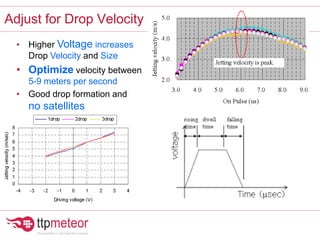
Adjust for Drop Velocity
• Higher Voltage increases
Drop Velocity and Size
• Optimize velocity between
5-9 meters per second
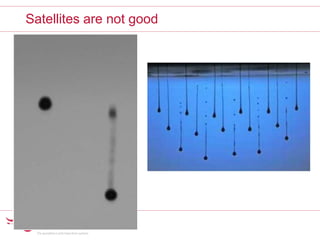
• Good drop formation and
no satellites
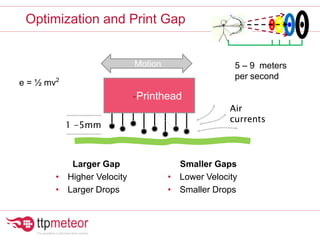
Optimization and Print Gap
-Printhead
1 -5mm
Motion
Air
currents
Larger Gap
• Higher Velocity
• Larger Drops
e = ½ mv2
Smaller Gaps
• Lower Velocity
• Smaller Drops
5 – 9 meters
per second
Uniform Drop
DROP VISUALIZATION
EQUIPMENT
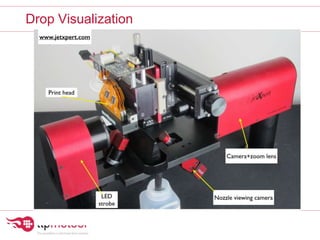
Drop Visualization System
Meteor Drop
Optimization Software
Meteor Waveform
Editor
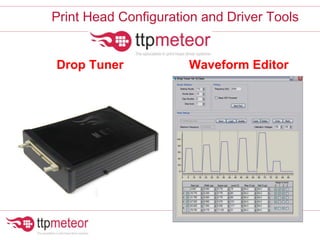
Drop Tuner Waveform Editor
Print Head Configuration and Driver Tools
Drop Visualization
Drop Measurements
Satellites are not good
DROP SIZE(S)
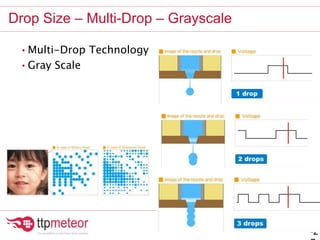
Drop Size – Multi-Drop – Grayscale
-2
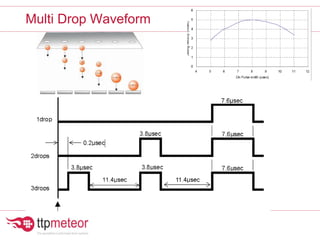
• Multi-Drop Technology
• Gray Scale
Chamber Pressure, Settling & multi-Drop
• Electric field causes piezo to change shape
• Piezo quickly changes chamber volume
• Creates a pressure wave in the chamber
• Usually settles within 100 microseconds
Subsequent
drops are
ejected
when
chamber is
very active
Multi Drop Waveform
PLOTTING DROP
CHARACTERISTICS
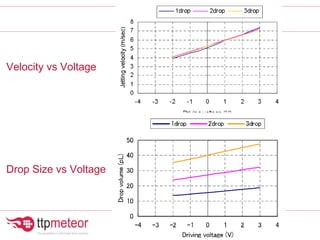
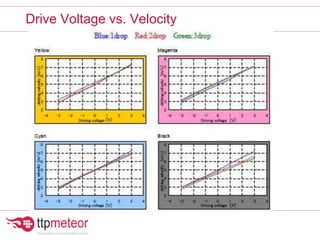
Velocity vs Voltage
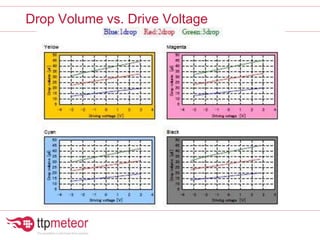
Drop Size vs Voltage
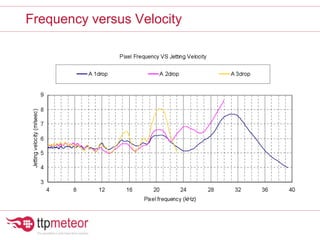
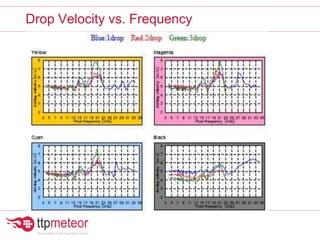
Frequency versus Velocity
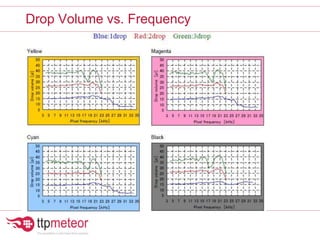
Frequency versus Drop Size
NOW DO IT ALL FOR EACH
COLOR IN YOUR SYSTEM
Drive Voltage vs. Velocity
Drop Volume vs. Drive Voltage
Drop Velocity vs. Frequency
Drop Volume vs. Frequency
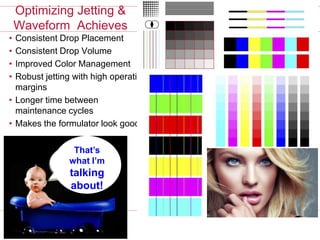
• Consistent Drop Placement
• Consistent Drop Volume
• Improved Color Management
• Robust jetting with high operating
margins
• Longer time between
maintenance cycles
• Makes the formulator look good
Optimizing Jetting &
Waveform Achieves
That’s
what I’m
talking
about!
Guttenberg Press
~1439
“Hey, Johannes,
You know…this is all going
to be digital some day”
- Guttenberg Assistant
Thank You
TTP Meteor Ltd.
Melbourn, Herts. SG8 6EE. UK
Mike Raymond
Technical Sales – Business Development
ttpmeteor, Philadelphia Office, USA
+1 302 514 7775
Mike.Raymond@ttpmeteor.com
-
Sources
• http://www.nt.ntnu.no/users/skoge/prost/proceedings/ifac11-
proceedings/data/html/papers/1129.pdf
• http://seeen.spidergraphics.com/cnf5/doc/Ink%20formulation%20t
utorial.pdf
• Manipulating drop performance in piezo electric inkjet
• Herman Wijshoff, Océ-Technologies B.V., Venlo, the Netherlands
• http://www.slideshare.net/MikeRaymond/edit_my_uploads
Manipulating drop performance in piezo electric inkjet
Herman Wijshoff, Océ-Technologies B.V., Venlo, the Netherlands

IMI Waveform and Drop Optimization - Raymond 20160908 v1.0

Editor's Notes

  • #3 An ink needs to be tuned for the target printhead The best operating points need to be chosen, not the fastest You may have a really good ink but you need to thoroughly characterize the ink using a drop watcher
  • #4 Ink is central Ink must perform both on the media and in the printhead The characteristics required for media conflict with the characteristics required for jetting quality and reliability Dry quickly on media but not dry in head Flow in printhead but not penetrate media Adhere to media ewith good fastenss but do not harden on printhead
  • #5 Many differing types of inks All are either dye based or pigment based All act different in the printhead
  • #6 Printhead specificiaons are based on a specific fluid used for manufacturing test. It is just a target. The characteristics of your ink can be quite different. Tuning is required for optimum jetting; empirical methods are employed
  • #8 Ink Chamber is is made form the piezo
  • #11 All inkjet architecture are common, each has Nozzlw Ink chamber Acturator – change volume of chamber Restriictor – so ink doesn't flow back to manifold Dneser ink has faster speed of sound
  • #12 The piezo changes shape when a voltage is applied This changes the volume of the chamber and creates a pressure wave in the fluid Follows a natural settling before returning to rest Curves are generated by modeling. Actual measurements in the chanber are not practical.
  • #14 Adjust for optimum single pulse waveform Adjust velocity – below 5 is too slow for good control – above 9 usually create drop breakup Plot frequency response for drop velocity and drop size
  • #15 You have to feel the energy and emotion Pretend I’m the set director and you’re the actor
  • #16 Change the pulse width and measure drop velocity Perform at a low frequency to avoid settling effects You should see a nice drio formation
  • #17 Adjust voltage for DV between 5-9 m/s
  • #21 Hardware and software Drive electronics, camera , strobe Drop Optimization software to adust drop rates and patterns Waveform editor Image anaysis
  • #22 And now a word form our sponsor Seriouslt, Meteor has htes units in oeration globally Uses the same drive electronics and software as in the printer
  • #28 Contrary to popular belief printheads really only have a single drop size. This is called the native drop. Larger drop sizes are created by quickly jetting more drops Complete drop forms before hitting substrate
  • #29 The piezo changes shape when a voltage is applied This changes the volume of the chamber and creates a pressure wave in the fluid Follows a natural settling before returning to rest Curves are generated by modeling. Actual measurements in the chanber are not practical.
  • #30 The settling waveform affects the subsequest drops
  • #40 Now the ink is characteriszed System operating parameters are set for best quality and performance And the output is perfected – Yah, that’s what I’
  • #41 ALMOST 500 YEARS FOR THE DIGITAL TRANSFORMATION Just getting started