







Introduction to 3.0
By: Osmar “Oz” Olivo
Product Manager
MongoDB Inc.
Agenda
• Pluggable Storage Engines
• WiredTiger Integration
• Concurrency
• Compression
• Enhanced Querying & Tools
• Administration Enhancements
• Replication Enhancements
Pluggable Storage Engines
• Vision
– One data model, one API, one set of operational
concerns
» Under the hood, many options for every use
case under the sun
Storage Engine Layer
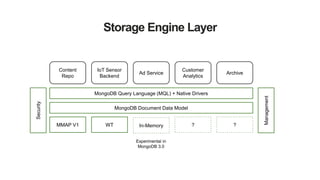
Content
Repo
IoT Sensor
Backend
Ad Service
Customer
Analytics
Archive
MongoDB Query Language (MQL) + Native Drivers
MongoDB Document Data Model
MMAP V1 WT In-Memory ? ?
Supported in MongoDB 3.0 Future Possible Storage Engines
Management
Security
Experimental in
MongoDB 3.0
WiredTiger Integration
Why WT?
They’re Grrrreat!
Why WT?
• WT product and team acquired by MongoDB
– Authors former members of Berkeley DB team
– Standalone engine in use in production today
• WT addresses weaknesses of MMAPv1
– Compression
– Highly concurrent and enables full hardware utilization
– More tunable
Concurrency
MMAPv1 Concurrency Improvements
• Collection Level Concurrency
– One lock per collection
– Write operations to a collection block all other
operations on that collection
– Read operations to a collection block writes to that
collection
• Allow other read operations to occur concurrently
Concurrency in WiredTiger
• Document Level Concurrency
– Uses various algorithms to minimize contention
between threads
– One thread yields on contention to same document
• Writes no longer block all other writes
• CPU utilization directly correlates with performance
Compression
Compression (WT only)
• Compression is on in WT by default
• 3.0 supports two compression algorithms
– snappy (default)
• Good compression benefits with little
CPU/performance impact
– zlib
• Extremely good compression at a cost of additional
CPU/degraded performance
Enhanced Querying & Tools
Indexing & Querying
• Explain() 2.0
– explain() revamped
• Now allows for improved query inspection
• Geospatial Big Polygon support
– Improved handling of polygons with an area greater
than a single hemisphere
• $dateToString operator in aggregation
– Allows user to specify string format for which to
convert a date into
Tools Improvements
• MongoDB Server Tools Rewritten in GO
– Removed all server dependencies
– Allows for much faster iteration
• Parallelized data loading tools
– dump/restore & import/export
– highly improved loading and export times
Administration Enhancements
Administration
• Role Based Auditing
– Auditing rules can be set to filter on specific roles
– Useful for auditing certain kinds of accesses or users
• Logging Improvements
– New component system
– Able to filter by severity levels
Replication
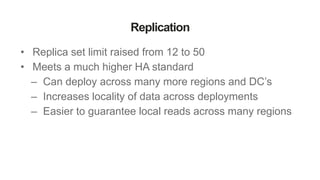
Replication
• Replica set limit raised from 12 to 50
• Meets a much higher HA standard
– Can deploy across many more regions and DC’s
– Increases locality of data across deployments
– Easier to guarantee local reads across many regions
Questions?

Webinar: Introduction to MongoDB 3.0

  • 2.
    Introduction to 3.0 By:Osmar “Oz” Olivo Product Manager MongoDB Inc.
  • 3.
    Agenda • Pluggable StorageEngines • WiredTiger Integration • Concurrency • Compression • Enhanced Querying & Tools • Administration Enhancements • Replication Enhancements
  • 4.
  • 5.
    • Vision – Onedata model, one API, one set of operational concerns » Under the hood, many options for every use case under the sun Storage Engine Layer
  • 6.
    Storage Engine Layer Content Repo IoTSensor Backend Ad Service Customer Analytics Archive MongoDB Query Language (MQL) + Native Drivers MongoDB Document Data Model MMAP V1 WT In-Memory ? ? Supported in MongoDB 3.0 Future Possible Storage Engines Management Security Experimental in MongoDB 3.0
  • 7.
  • 8.
  • 9.
    Why WT? • WTproduct and team acquired by MongoDB – Authors former members of Berkeley DB team – Standalone engine in use in production today • WT addresses weaknesses of MMAPv1 – Compression – Highly concurrent and enables full hardware utilization – More tunable
  • 10.
  • 11.
    MMAPv1 Concurrency Improvements •Collection Level Concurrency – One lock per collection – Write operations to a collection block all other operations on that collection – Read operations to a collection block writes to that collection • Allow other read operations to occur concurrently
  • 12.
    Concurrency in WiredTiger •Document Level Concurrency – Uses various algorithms to minimize contention between threads – One thread yields on contention to same document • Writes no longer block all other writes • CPU utilization directly correlates with performance
  • 13.
  • 14.
    Compression (WT only) •Compression is on in WT by default • 3.0 supports two compression algorithms – snappy (default) • Good compression benefits with little CPU/performance impact – zlib • Extremely good compression at a cost of additional CPU/degraded performance
  • 15.
  • 16.
    Indexing & Querying •Explain() 2.0 – explain() revamped • Now allows for improved query inspection • Geospatial Big Polygon support – Improved handling of polygons with an area greater than a single hemisphere • $dateToString operator in aggregation – Allows user to specify string format for which to convert a date into
  • 17.
    Tools Improvements • MongoDBServer Tools Rewritten in GO – Removed all server dependencies – Allows for much faster iteration • Parallelized data loading tools – dump/restore & import/export – highly improved loading and export times
  • 18.
  • 19.
    Administration • Role BasedAuditing – Auditing rules can be set to filter on specific roles – Useful for auditing certain kinds of accesses or users • Logging Improvements – New component system – Able to filter by severity levels
  • 20.
  • 21.
    Replication • Replica setlimit raised from 12 to 50 • Meets a much higher HA standard – Can deploy across many more regions and DC’s – Increases locality of data across deployments – Easier to guarantee local reads across many regions
  • 23.

Editor's Notes

  • #7 Storage engine layer covers on disk data format, memory representation of the data, and how it is accessed (concurrency)
  • #10 Now have the option to scale both vertically as well as horizontally