INTRODUCTION
•It all began when a small group of Canadian
experimental filmmakers came together to produce a
multi-screen installation at EXPO ‘67 in Montreal.
•The installation was part of competition to create the
first truly large-screen film experience.
•Over the next three years, IMAX technology was born,
and its epic camera, projector system and sound
system.
What is IMAX?
How is IMAX achieved?
Introduction
IMAX Camera
IMAX Film Format
IMAX Projectors
IMAX 3D
IMAX Theatre
Fact
Conclusion
IMAX Sound
What Is IMAX?
IMAX stands for IMAGE MAXIMUM.
IMAX is motion picture format with the capacity
for greater size and clearer resolution than
standard movie systems.
IMAX movies have incredible clarity, even on
huge screens that are the hallmark of IMAX
theaters worldwide.
How is the IMAX effect achieved?
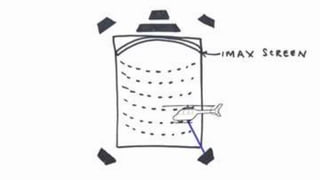
IMAX has a large film format.
A unique projection system that
is specifically designed for IMAX.
The theater itself which is specially
designed.
IMAX Developed its first 2D 65mm film camera in
1976.To this day, it remains the highest- resolution
camera in the world.
When captured with the IMAX Camera, the image
projected in approximately 10x more resolution than
conventional 35mm films.
Delivering up to 40% more clarity and color than the
conventional theatres.
-- Analog Age (2D) --
Huge and heavy.
Few scenes were tough to shoot.
High cost and Maintenance.
Digital Age (2D)
Less weight and portable.
Convenient to shoot.
Digital Output.
High cost and less maintenance.
No compromise in clarity.
Digital Age (3D)
Very less weight.
High portability.
Unique dual lens.
Low cost and maintenance.
IMAX Film Format
IMAX Projectors
Laser aligned projections.
Dual projection system.
Automatic image calibration.
Water cooled xenon projection
system.
IMAX Sound
Laser aligned surround sound
system.
Immersive uncompressed bass.
20-2000Khz sound freq. can be
achieved.
Frame to frame immersive audio.
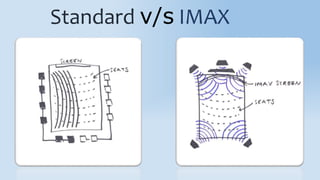
Standard v/s IMAX
IMAX 3D
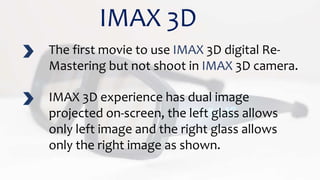
The first movie to use IMAX 3D digital Re-
Mastering but not shoot in IMAX 3D camera.
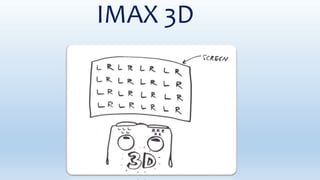
IMAX 3D experience has dual image
projected on-screen, the left glass allows
only left image and the right glass allows
only the right image as shown.
IMAX 3D
IMAX 3D
IMAX Theatre
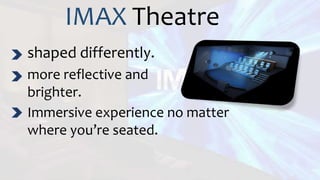
shaped differently.
Immersive experience no matter
where you’re seated.
more reflective and
brighter.
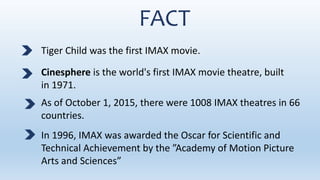
FACT
As of October 1, 2015, there were 1008 IMAX theatres in 66
countries.
In 1996, IMAX was awarded the Oscar for Scientific and
Technical Achievement by the ”Academy of Motion Picture
Arts and Sciences”
Cinesphere is the world's first IMAX movie theatre, built
in 1971.
Tiger Child was the first IMAX movie.
Conclusion
IMAX is an not just a entertainment
experience, it is unmatched visual breath-
taking and audio immersive experience into
the movie…
IMAX

IMAX

  • 2.
    INTRODUCTION •It all beganwhen a small group of Canadian experimental filmmakers came together to produce a multi-screen installation at EXPO ‘67 in Montreal. •The installation was part of competition to create the first truly large-screen film experience. •Over the next three years, IMAX technology was born, and its epic camera, projector system and sound system.
  • 3.
    What is IMAX? Howis IMAX achieved? Introduction IMAX Camera IMAX Film Format IMAX Projectors
  • 4.
  • 5.
    What Is IMAX? IMAXstands for IMAGE MAXIMUM. IMAX is motion picture format with the capacity for greater size and clearer resolution than standard movie systems. IMAX movies have incredible clarity, even on huge screens that are the hallmark of IMAX theaters worldwide.
  • 6.
    How is theIMAX effect achieved? IMAX has a large film format. A unique projection system that is specifically designed for IMAX. The theater itself which is specially designed.
  • 7.
    IMAX Developed itsfirst 2D 65mm film camera in 1976.To this day, it remains the highest- resolution camera in the world. When captured with the IMAX Camera, the image projected in approximately 10x more resolution than conventional 35mm films. Delivering up to 40% more clarity and color than the conventional theatres.
  • 8.
    -- Analog Age(2D) -- Huge and heavy. Few scenes were tough to shoot. High cost and Maintenance.
  • 9.
    Digital Age (2D) Lessweight and portable. Convenient to shoot. Digital Output. High cost and less maintenance. No compromise in clarity.
  • 10.
    Digital Age (3D) Veryless weight. High portability. Unique dual lens. Low cost and maintenance.
  • 11.
  • 12.
    IMAX Projectors Laser alignedprojections. Dual projection system. Automatic image calibration. Water cooled xenon projection system.
  • 13.
    IMAX Sound Laser alignedsurround sound system. Immersive uncompressed bass. 20-2000Khz sound freq. can be achieved. Frame to frame immersive audio.
  • 14.
  • 17.
    IMAX 3D The firstmovie to use IMAX 3D digital Re- Mastering but not shoot in IMAX 3D camera. IMAX 3D experience has dual image projected on-screen, the left glass allows only left image and the right glass allows only the right image as shown.
  • 18.
  • 19.
  • 22.
    IMAX Theatre shaped differently. Immersiveexperience no matter where you’re seated. more reflective and brighter.
  • 25.
    FACT As of October1, 2015, there were 1008 IMAX theatres in 66 countries. In 1996, IMAX was awarded the Oscar for Scientific and Technical Achievement by the ”Academy of Motion Picture Arts and Sciences” Cinesphere is the world's first IMAX movie theatre, built in 1971. Tiger Child was the first IMAX movie.
  • 26.
    Conclusion IMAX is annot just a entertainment experience, it is unmatched visual breath- taking and audio immersive experience into the movie…