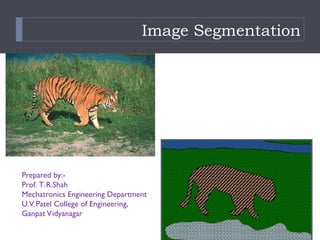
Image Segmentation
Prepared by:-
Prof. T.R.Shah
Mechatronics Engineering Department
U.V.Patel College of Engineering,
Ganpat Vidyanagar
Topic’s to be covered
 Introduction to Image analysis and segmentation
 Detection of Discontinuity
 Point, line, edge and combined detection..
 Edge linking and boundary detection
 Local processing, hough transform, graph-theoretic technique..
 Thresholding
 Global thresholding, Optimal thresholding, threshold
selection..
 Region oriented segmentation
 Region growing, Region splitting and merging..
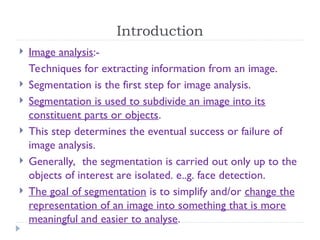
Introduction
 Image analysis:-
Techniques for extracting information from an image.
 Segmentation is the first step for image analysis.
 Segmentation is used to subdivide an image into its
constituent parts or objects.
 This step determines the eventual success or failure of
image analysis.
 Generally, the segmentation is carried out only up to the
objects of interest are isolated. e..g. face detection.
 The goal of segmentation is to simplify and/or change the
representation of an image into something that is more
meaningful and easier to analyse.
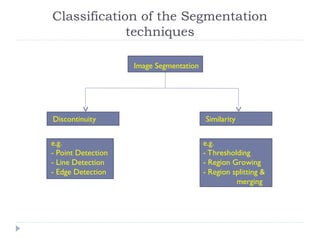
Classification of the Segmentation
techniques
Image Segmentation
Discontinuity Similarity
e.g.
- Point Detection
- Line Detection
- Edge Detection
e.g.
- Thresholding
- Region Growing
- Region splitting &
merging
Point Detection
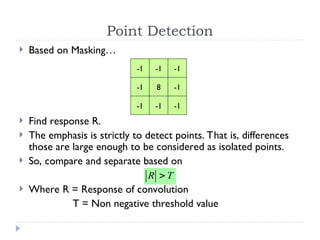
 Based on Masking…
 Find response R.
 The emphasis is strictly to detect points. That is, differences
those are large enough to be considered as isolated points.
 So, compare and separate based on
 Where R = Response of convolution
T = Non negative threshold value
-1
-1
8 -1
-1
-1 -1
-1 -1
R T

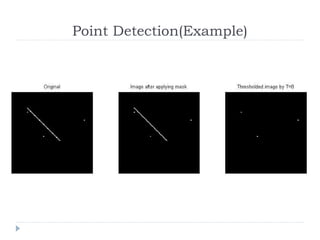
Point Detection(Example)
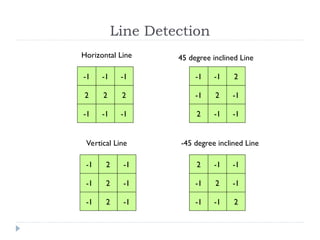
Line Detection
-1
2
2 -1
2
-1 -1
-1 -1
-1
-1
2 -1
-1
-1 2
2 -1
-1
-1
2 -1
-1
2 -1
-1 2
2
-1
2 2
-1
-1 -1
-1 -1
Horizontal Line 45 degree inclined Line
Vertical Line -45 degree inclined Line
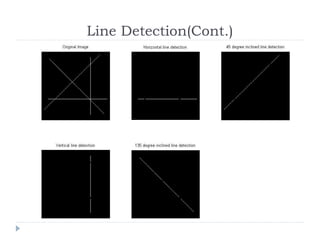
Line Detection(Cont.)
Edge Detection
Robert’s Mask Prewitt Operator
Sobel Operator Laplacian
-1 0
0 1
-1
0
0
1
-1 -1 -1
0 0 0
1 1 1
-1 0 1
-1 0 1
-1 0 1
-1 -2 -1
0 0 0
1 2 1
-1 0 1
-2 0 2
-1 0 1
-1 -1 -1
-1 8 -1
-1 -1 -1
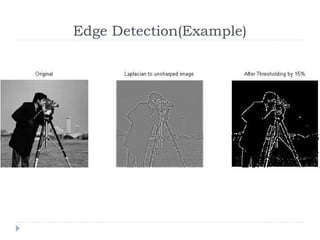
Edge Detection(Example)
Combined Detection
 Multimask formulation makes possible development of a
method to determine whether a pixel is most likely to be
an isolated point or part of a line or an edge.
Combined Detection-
Frei and Chen Filter
1 1
0 0 0
-1 -1
1 0 -1
0
1 0 -1
0 1 0
-1 0 -1
0 1 0
-1 0 1
0 0 0
1 0 -1
1 -2 1
-2 4 -2
1 -2 1
0 -1
1 0 -1
1 0
-1 0
-1 0 1
0 1
2
2

2
2 2
2

2

2

-2 1 -2
1 4 1
-2 1 -2
1 1 1
1 1 1
1 1 1
Edge Linking and Boundary Detection
 Intensity discontinuity can be utilized to find boundary.
 The lagging part of boundary detection using intensity
discontinuity is that the boundary may not be completely
defined because of
 Noise
 Breaks in boundary due to non-uniform illumination
 So, after edge detection, edge linking process is carried
out to assemble edge pixels into meaningful boundary
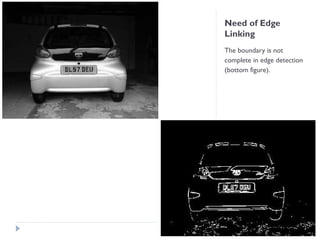
Need of Edge
Linking
The boundary is not
complete in edge detection
(bottom figure).
1) Edge Linking – Local Processing
 Analyze every pixel in small neighborhood that has
undergone edge detection.
 For same characteristics (point is on same edge or not),
two principal properties used are
 Strength of response of the gradient operator
 The direction of gradient.
( , ) ( ', ')
f x y f x y T
   
( , ) ( ', ')
x y x y A
 
 

image-segmentation techniques for object detection

  • 1.
    Image Segmentation Prepared by:- Prof.T.R.Shah Mechatronics Engineering Department U.V.Patel College of Engineering, Ganpat Vidyanagar
  • 2.
    Topic’s to becovered  Introduction to Image analysis and segmentation  Detection of Discontinuity  Point, line, edge and combined detection..  Edge linking and boundary detection  Local processing, hough transform, graph-theoretic technique..  Thresholding  Global thresholding, Optimal thresholding, threshold selection..  Region oriented segmentation  Region growing, Region splitting and merging..
  • 3.
    Introduction  Image analysis:- Techniquesfor extracting information from an image.  Segmentation is the first step for image analysis.  Segmentation is used to subdivide an image into its constituent parts or objects.  This step determines the eventual success or failure of image analysis.  Generally, the segmentation is carried out only up to the objects of interest are isolated. e..g. face detection.  The goal of segmentation is to simplify and/or change the representation of an image into something that is more meaningful and easier to analyse.
  • 4.
    Classification of theSegmentation techniques Image Segmentation Discontinuity Similarity e.g. - Point Detection - Line Detection - Edge Detection e.g. - Thresholding - Region Growing - Region splitting & merging
  • 5.
    Point Detection  Basedon Masking…  Find response R.  The emphasis is strictly to detect points. That is, differences those are large enough to be considered as isolated points.  So, compare and separate based on  Where R = Response of convolution T = Non negative threshold value -1 -1 8 -1 -1 -1 -1 -1 -1 R T 
  • 6.
  • 7.
    Line Detection -1 2 2 -1 2 -1-1 -1 -1 -1 -1 2 -1 -1 -1 2 2 -1 -1 -1 2 -1 -1 2 -1 -1 2 2 -1 2 2 -1 -1 -1 -1 -1 Horizontal Line 45 degree inclined Line Vertical Line -45 degree inclined Line
  • 8.
  • 9.
    Edge Detection Robert’s MaskPrewitt Operator Sobel Operator Laplacian -1 0 0 1 -1 0 0 1 -1 -1 -1 0 0 0 1 1 1 -1 0 1 -1 0 1 -1 0 1 -1 -2 -1 0 0 0 1 2 1 -1 0 1 -2 0 2 -1 0 1 -1 -1 -1 -1 8 -1 -1 -1 -1
  • 10.
  • 11.
  • 12.
    Combined Detection  Multimaskformulation makes possible development of a method to determine whether a pixel is most likely to be an isolated point or part of a line or an edge.
  • 13.
    Combined Detection- Frei andChen Filter 1 1 0 0 0 -1 -1 1 0 -1 0 1 0 -1 0 1 0 -1 0 -1 0 1 0 -1 0 1 0 0 0 1 0 -1 1 -2 1 -2 4 -2 1 -2 1 0 -1 1 0 -1 1 0 -1 0 -1 0 1 0 1 2 2  2 2 2 2  2  2  -2 1 -2 1 4 1 -2 1 -2 1 1 1 1 1 1 1 1 1
  • 14.
    Edge Linking andBoundary Detection  Intensity discontinuity can be utilized to find boundary.  The lagging part of boundary detection using intensity discontinuity is that the boundary may not be completely defined because of  Noise  Breaks in boundary due to non-uniform illumination  So, after edge detection, edge linking process is carried out to assemble edge pixels into meaningful boundary
  • 15.
    Need of Edge Linking Theboundary is not complete in edge detection (bottom figure).
  • 16.
    1) Edge Linking– Local Processing  Analyze every pixel in small neighborhood that has undergone edge detection.  For same characteristics (point is on same edge or not), two principal properties used are  Strength of response of the gradient operator  The direction of gradient. ( , ) ( ', ') f x y f x y T     ( , ) ( ', ') x y x y A    

Editor's Notes

  • #12 Consider vector representation, where zi = gray level values wi = general coefficient mask